
How Thick Should Patio Concrete Be? Complete Guide for San Antonio Homeowners
When planning a concrete patio installation, one of the most critical decisions you’ll make is determining the proper thickness. Get it wrong, and you’re looking at premature cracking, structural failure, and costly repairs. Get it right, and you’ll enjoy a durable outdoor space that withstands San Antonio’s climate for decades.
The standard answer is 4 inches for most residential patios, but that’s just the starting point. Your specific needs from the weight your patio must support to your soil conditions will ultimately determine whether you need a thinner 3.5-inch slab or a reinforced 8-inch foundation.
This comprehensive guide breaks down everything you need to know about concrete patio thickness, helping you make an informed decision that balances structural integrity with budget considerations.
Industry Standard: The 4-Inch Benchmark
According to Angi’s concrete installation guidelines, most concrete patio professionals recommend a standard thickness of 4 inches, which complies with typical building codes across the United States. This measurement has become the industry baseline for good reason it represents the sweet spot between structural integrity and cost-effectiveness for standard residential use.
A 4-inch thick concrete patio provides adequate support for typical outdoor activities including entertaining, outdoor furniture, grilling stations, and moderate foot traffic. This thickness mirrors the standard recommendation for residential driveways, which are designed to support vehicles weighing several thousand pounds.
The widespread adoption of the 4-inch standard means most contractors will automatically quote this thickness unless you specify different requirements. However, this doesn’t mean 4 inches is universally appropriate for every situation.
Why 4 Inches Works For Most Homeowners
The 4-inch standard achieves several objectives simultaneously. First, it provides sufficient depth to distribute weight loads across the slab, preventing concentrated pressure points that cause cracking. Second, it offers enough mass to resist temperature-related expansion and contraction, which is particularly important in San Antonio’s hot climate. Third, it maintains an economical balance thick enough to ensure longevity without excessive material costs.
When properly installed with appropriate base preparation and reinforcement, a 4-inch concrete patio can last 25 to 50 years with minimal maintenance. This longevity makes it one of the most cost-effective outdoor flooring options available.
Factors That Determine Concrete Thickness
While 4 inches serves as a baseline, several critical factors should influence your final thickness decision. Ignoring these variables can lead to premature failure, regardless of how carefully the concrete is mixed or poured.
Weight Load And Intended Use
The anticipated weight your patio will support is the primary determinant of required thickness. A patio designed solely for foot traffic and lightweight furniture has drastically different structural requirements than one supporting a hot tub, outdoor kitchen, or vehicle access.
Consider not just the static weight of permanent fixtures but also dynamic loads from gatherings, maintenance equipment, and seasonal items. Professional contractors calculate total load-bearing needs by estimating the combined weight of all items that will regularly occupy the space.
Climate And Weather Patterns
San Antonio’s climate presents specific challenges for concrete installations. Summer temperatures regularly exceed 95°F, causing significant thermal expansion, while occasional winter freezes create contraction cycles. This constant expansion and contraction stresses concrete slabs over time.
Regions experiencing frequent freeze-thaw cycles may require thicker slabs or enhanced reinforcement to prevent surface spalling and internal cracking. Proper drainage design becomes equally important, as water penetration followed by freezing can cause catastrophic slab failure.
Patio Size And Configuration
Larger patios distribute weight differently than smaller installations. A 200-square-foot patio generates different stress patterns than a 500-square-foot space, even with identical per-square-foot loads. The geometry of your patio whether it’s a simple rectangle, curved design, or irregular shape also affects structural requirements.
Extended spans without support may require additional thickness or more frequent control joints to manage cracking. Professional installers consider these factors during the design phase, adjusting thickness recommendations accordingly.
Thickness Requirements By Patio Use
Different patio applications demand specific thickness standards. Understanding these requirements helps you specify the right concrete depth for your particular needs.
Light Residential Use (3.5-4 Inches)
For patios limited to foot traffic, lightweight outdoor furniture, and small grills, the minimum acceptable thickness is 3.5 inches. However, many contractors recommend the 4-inch standard even for light use, as the marginal cost increase provides significantly better long-term durability.
Light-use patios work well with standard 3,000 PSI concrete and basic wire mesh reinforcement. These installations represent the most economical option while still providing adequate performance for typical residential applications.
Standard Entertaining Spaces (4-5 Inches)
Most homeowners fall into this category patios designed for regular gatherings, outdoor dining sets, fire pits, and moderate entertaining. A 4-inch thickness with proper reinforcement handles these demands comfortably.
For patios hosting frequent large gatherings or heavier outdoor furniture sets, upgrading to 5 inches provides additional peace of mind without significantly impacting costs. This extra inch of thickness can extend the patio’s service life by years, particularly in challenging soil conditions.
Heavy-Duty Applications (6-8 Inches)
Patios supporting substantial weight require substantial thickness. Professional concrete contractors recommend 6 to 8 inches for installations featuring:
- Hot tubs: A filled 6-person hot tub can weigh 3,000 to 4,000 pounds, creating concentrated pressure points
- Outdoor kitchens: Built-in appliances, stone countertops, and masonry structures add considerable weight
- Heavy pergolas or pavilions: Permanent structures anchored to the slab transfer significant loads
- Vehicle access: If the patio doubles as vehicle parking or equipment access, driveway-thickness standards apply
These applications typically require upgraded concrete mixes (4,000 PSI or higher) and enhanced reinforcement with rebar rather than simple wire mesh.
Specialized Applications (8+ Inches)
Some situations demand commercial-grade specifications. If your patio will support extremely heavy equipment, serve as an RV pad, or function as a commercial space, consult a structural engineer. These applications may require 8 to 12 inches of concrete with extensive rebar grids and engineered foundation systems.
Understanding Concrete PSI Ratings
Thickness and concrete strength work together to determine overall patio performance. The PSI (pounds per square inch) rating measures concrete’s compressive strength essentially, how much pressure it can withstand before failing.
Standard PSI Ratings For Patios
Residential concrete applications typically use these PSI ranges:
2,500-3,000 PSI: The minimum acceptable strength for light-duty patios. This economical option works for sidewalks and areas with minimal load requirements. However, most contractors recommend against using the bare minimum for patios you intend to use regularly.
3,000-3,500 PSI: The industry standard for residential patios. This range provides reliable performance for typical outdoor living spaces, handling furniture, foot traffic, and moderate weather exposure without excessive cost.
4,000 PSI: Recommended for patios with enhanced durability requirements. This strength level resists cracking better in freeze-thaw climates and handles heavier loads. Many San Antonio contractors specify 4,000 PSI for premium installations.
4,500-5,000+ PSI: Reserved for heavy-duty applications where equipment or structures mount directly to the slab. This commercial-grade concrete costs more but provides maximum longevity.
The PSI-Thickness Relationship
Higher PSI concrete can potentially allow for thinner slabs in some applications, but local building codes typically set minimum thickness requirements regardless of concrete strength. A 3-inch slab of 4,000 PSI concrete might technically support the same load as a 4-inch slab of 3,000 PSI concrete, but the thinner slab remains more vulnerable to cracking from temperature changes and substrate movement.
Professional installers balance PSI and thickness to achieve optimal performance. For most residential patios, 4 inches of 3,000-3,500 PSI concrete provides the best value proposition.
The Role Of Soil Conditions
Even the thickest, strongest concrete slab will fail if poured over inadequate substrate. Soil conditions significantly impact required concrete thickness and installation specifications.
Soil Types And Their Challenges
Clay Soils: Expansive clay soils, common in parts of Texas, absorb water and swell, then shrink during dry periods. This constant movement can crack even properly designed slabs. Clay soils may require thicker concrete (5-6 inches), extensive base preparation, or specialized engineering.
Sandy Soils: While sandy soils drain well, they can shift and settle unevenly if not properly compacted. Loose sand provides inadequate support, leading to slab settling and cracking. These conditions demand thorough compaction and possibly thicker base layers.
Rocky or Well-Compacted Soils: Stable, well-draining soils provide ideal conditions for concrete patios. Standard 4-inch thickness with proper base preparation typically performs excellently on these substrates.
Poorly Draining Soils: Areas where water pools or drains slowly create ongoing problems for concrete installations. Standing water can undermine the base over time, and freeze-thaw damage accelerates in saturated conditions.
Soil Testing And Mitigation
Before finalizing thickness specifications, consider having a geotechnical evaluation performed, especially for large or expensive patio projects. Professional soil testing identifies potential problems early, allowing contractors to adjust installation methods accordingly.
Common soil remediation techniques include:
- Removing and replacing problematic soil with compacted crushed stone
- Installing proper drainage systems to channel water away from the patio
- Using thicker base layers (6-8 inches instead of 4) to bridge unstable areas
- Increasing concrete thickness to provide additional mass and stability
- Incorporating engineered reinforcement systems for extreme conditions
Reinforcement And Base Preparation
Concrete thickness alone doesn’t guarantee patio longevity. Proper reinforcement and base preparation are equally critical for long-term performance.
Base Layer Requirements
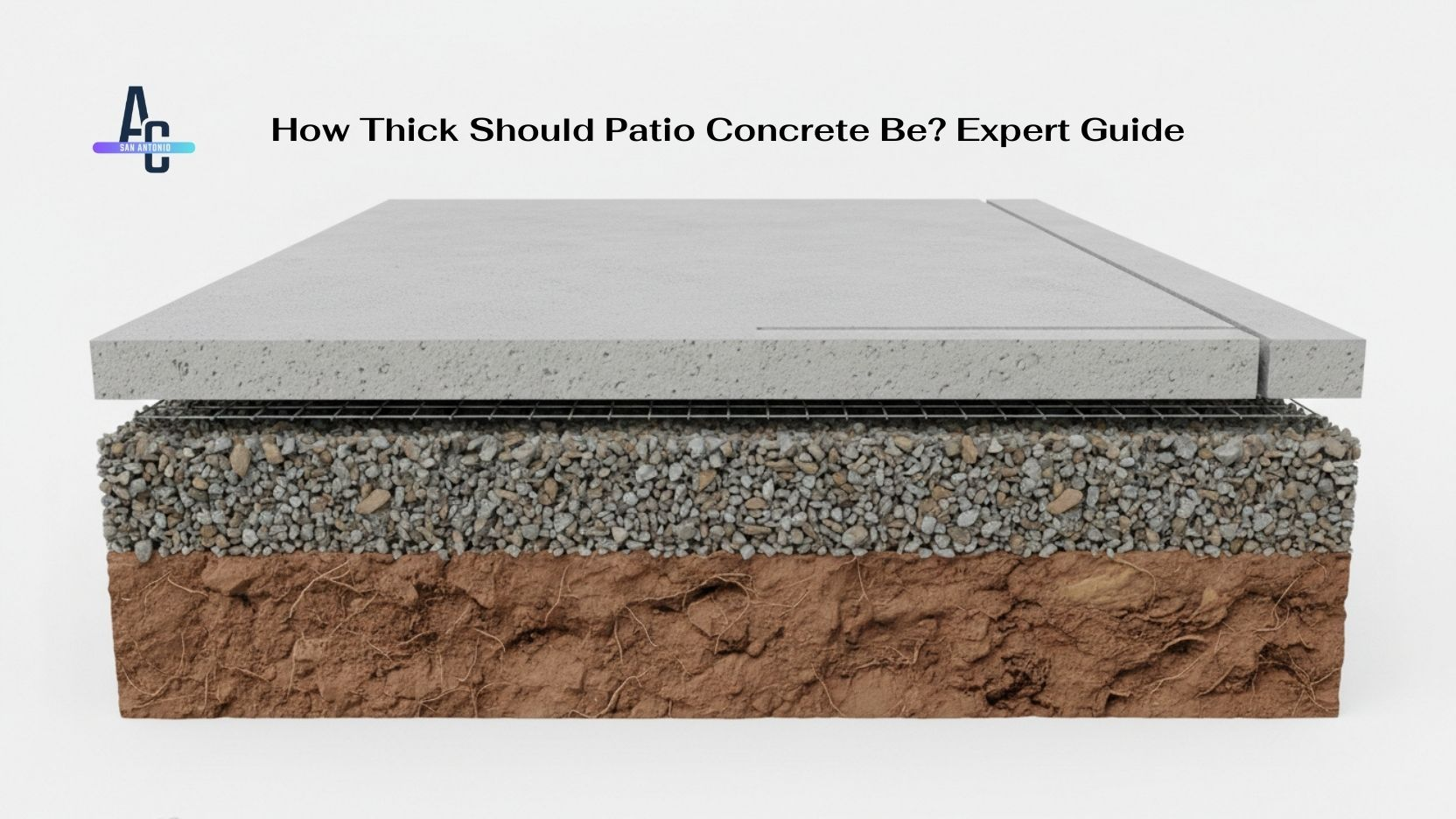
Industry best practice calls for excavating 8 to 12 inches below finished grade for a standard 4-inch concrete patio. This excavation accommodates both the concrete thickness and a compacted gravel base.
The typical base layer consists of 4 to 6 inches of crushed stone or gravel. This base serves multiple functions:
- Load distribution: Spreads weight loads across a larger area, preventing localized sinking
- Drainage: Allows water to drain away from the concrete, preventing undermining
- Frost protection: Provides insulation against ground frost in areas with winter freezing
- Stable substrate: Creates a uniform, solid foundation that resists movement
Proper compaction is absolutely critical. Many DIY installations fail because homeowners underestimate the importance of thorough base compaction. Professionals use plate compactors or jumping jacks to achieve 95% compaction or better.
Reinforcement Options
Concrete excels at handling compressive forces but is relatively weak in tension. Reinforcement addresses this weakness, significantly extending patio life.
Wire Mesh (WWR): Welded wire reinforcement, typically 6-inch grid pattern, provides basic crack control for standard patios. This economical option prevents small cracks from expanding into major problems. Proper placement is crucial; the mesh should sit in the middle third of the slab depth, not resting on the base.
Rebar Grids: For heavy-duty applications, rebar provides superior reinforcement. Common specifications use #4 (1/2-inch) rebar spaced 12 to 18 inches on center, running in both directions. Rebar grids significantly increase the slab’s ability to span soft spots and resist heavy loads.
Fiber Reinforcement: Synthetic fibers mixed directly into the concrete help control surface cracking and improve impact resistance. While useful, fiber reinforcement doesn’t replace steel reinforcement for load-bearing applications, it supplements it.
Post-Tensioning: Rarely used for residential patios but worth mentioning, post-tensioning uses steel cables tensioned after concrete cures. This technique allows for thinner slabs in challenging conditions but requires specialized expertise.
Control Joints
Properly placed control joints (saw cuts or tooled grooves) direct where cracks occur, keeping them neat and controlled rather than random. Joints should be cut to approximately one-quarter of the slab depth and spaced according to the thickness typically no more than 10 feet apart in any direction for 4-inch slabs.
Cost Implications Of Different Thicknesses
Understanding cost structures helps you make informed decisions about patio thickness without overspending or compromising quality.
Material Cost Breakdown
Concrete costs vary by region and current market conditions, but typical pricing ranges from $4 to $8 per square foot for standard installations, and $5 to $12 per square foot for decorative finishes. Thickness directly impacts material costs since you’re purchasing concrete by volume.
For a 200-square-foot patio:
- 4 inches thick: Requires approximately 2.5 cubic yards of concrete
- 6 inches thick: Requires approximately 3.7 cubic yards of concrete
- 8 inches thick: Requires approximately 4.9 cubic yards of concrete
At $150 per cubic yard (typical ready-mix pricing), moving from 4 to 6 inches adds roughly $180 in material costs for this 200-square-foot example. For larger patios, this differential scales proportionally.
Labor And Installation Costs
Thicker slabs require more labor for several reasons:
- Additional excavation depth
- More formwork materials and setup time
- Increased finishing time (more concrete to screed and trowel)
- Heavier-duty reinforcement installation
- Extended curing and monitoring period
Labor typically accounts for 30-50% of total project costs. A complex installation with thicker concrete and enhanced reinforcement can push labor premiums higher.
Long-Term Value Considerations
While thicker concrete costs more upfront, the investment often pays dividends through extended service life and reduced maintenance. A properly designed 6-inch patio in challenging conditions may last 40+ years with minimal maintenance, while an underbuilt 3.5-inch slab might require significant repairs within 10 years.
When evaluating costs, consider:
- Replacement costs if premature failure occurs
- Opportunity costs of renovation disruption
- Property value impact quality hardscaping increases home values
- Maintenance and sealing costs over the patio’s lifetime
Common Mistakes To Avoid
Learning from others’ errors can save thousands of dollars and years of frustration. These mistakes plague DIY and even some professional installations.
Cutting Corners On Thickness
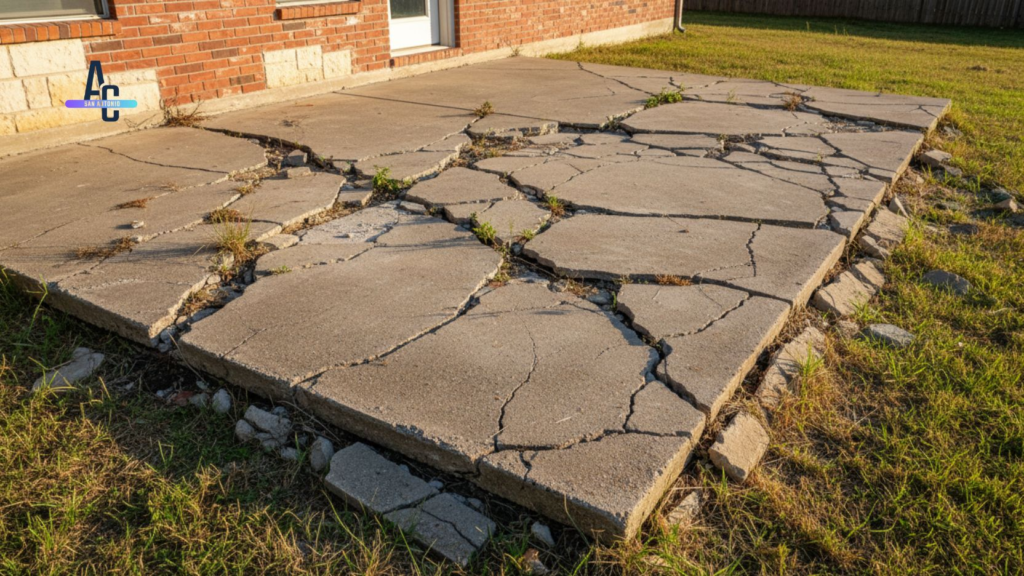
The single most common error is reducing concrete thickness to save money. That “savings” of $200-400 on material costs can lead to $3,000-8,000 in replacement expenses when the undersized slab fails prematurely.
San Antonio homeowners should be particularly cautious about minimum-thickness installations given the region’s climate challenges. The thermal stress from summer heat combined with occasional winter freezes demands robust construction.
Inadequate Base Preparation
Pouring beautiful 4-inch concrete over poorly prepared ground guarantees problems. Skipping proper excavation, using insufficient base material, or failing to compact thoroughly creates a foundation doomed to fail.
Base preparation represents roughly 30% of installation time but prevents 70% of potential problems. This isn’t the place to cut corners.
Improper Reinforcement Placement
Wire mesh lying on the ground does nothing; reinforcement must be positioned correctly within the slab to function. Professionals use chairs or dobies to support mesh at the proper height during pouring.
Similarly, rebar must maintain adequate concrete cover (typically 2-3 inches from all surfaces) to prevent corrosion while still providing structural benefit.
Ignoring Drainage
Water is concrete’s enemy. Ponding water accelerates weathering, freeze-thaw damage, and can undermine base materials. Every patio installation should slope at minimum 1/4 inch per foot away from structures, and more aggressive drainage may be necessary in poor-draining soils.
Skipping Control Joints
Some homeowners think eliminating control joints will prevent cracks. The opposite is true concrete will crack as it cures and experiences temperature changes. Control joints direct those cracks to specific locations, keeping them straight and manageable rather than randomly wandering across the slab.
Building Codes And Permits
Concrete patios aren’t just design decisions, they’re permanent structures subject to local regulations.
San Antonio Building Requirements
Most municipalities, including San Antonio, require permits for substantial concrete slabs. Requirements typically include:
- Minimum 4-inch thickness for residential patios
- Specific PSI ratings (often 3,000 PSI minimum)
- Proper reinforcement specifications
- Adequate base preparation
- Appropriate setbacks from property lines
- Drainage considerations
Building codes exist to ensure safety and longevity. Following them protects your investment and prevents complications during future property transactions.
Permit Process
Obtaining proper permits involves submitting site plans showing:
- Patio dimensions and location
- Proposed thickness and concrete specifications
- Reinforcement details
- Drainage provisions
- Any attached structures (pergolas, roofs, etc.)
Inspection typically occurs before concrete pour (to verify formwork, reinforcement, and base preparation) and after installation. While permits add cost and time, they provide valuable third-party verification that work meets minimum standards.
Consequences Of Unpermitted Work
Skipping permits might seem appealing but creates serious risks:
- Fines and penalties if discovered
- Required removal and reconstruction to meet codes
- Complications selling the property
- Homeowner’s insurance complications if structural issues arise
- Liability if improper construction causes injuries
Professional VS DIY Installation
For homeowners comfortable with heavy labor, DIY concrete patio installation is possible. However, the difference between professional and amateur results can be dramatic.
When DIY Makes Sense
Consider DIY for:
- Small patios (under 150 square feet)
- Simple rectangular designs
- Locations with good soil conditions
- Non-critical applications (not supporting structures)
- Projects where you have appropriate tools and assistance
Even for DIY projects, many homeowners benefit from hiring professionals for critical steps like base preparation or final finishing while handling simpler tasks themselves.
Professional Advantages
Experienced concrete contractors bring several advantages:
Expertise: Professionals assess soil conditions, calculate proper thickness, and specify appropriate reinforcement based on your specific situation rather than generic guidelines.
Equipment: Commercial-grade tools, plate compactors, concrete screeds, power trowels produce superior results and dramatically reduce labor time.
Material Knowledge: Pros understand concrete chemistry, mix design, and proper curing techniques. They know when to adjust water content, how to work with additives, and how to achieve the finish you want.
Efficiency: What might take a homeowner several weekends of hard work, professionals complete in days with better results.
Warranty and Accountability: Reputable contractors stand behind their work. If problems arise from improper installation, you have recourse.
Cost Comparison
DIY concrete patio costs typically range $3-5 per square foot for materials and equipment rental. Professional installation runs $8-15 per square foot for standard concrete, $12-25 per square foot for decorative finishes.
For a 300-square-foot patio, DIY might cost $900-1,500 versus $2,400-4,500 professionally installed. The professional premium buys expertise, efficiency, and accountability often worthwhile for major outdoor investments.
Choosing The Right Thickness For Your Patio
After reviewing all these factors, how do you determine the right concrete thickness for your specific situation?
Decision Matrix
Use this framework to guide your thickness decision:
3.5-4 inches: Choose if you have excellent soil conditions, light use requirements, and budget constraints. Requires proper base prep and reinforcement.
4-5 inches: The sweet spot for most San Antonio residential patios. Handles standard entertaining, moderate furniture, and provides good long-term durability.
6 inches: Necessary for outdoor kitchens, fire features, heavy furniture, or poor soil conditions. The added cost provides substantial peace of mind for demanding applications.
6-8 inches: Required for hot tubs, vehicle access, or when attaching permanent structures. Don’t compromise on thickness for these applications.
Professional Assessment
For projects over $5,000 or those involving challenging conditions, professional evaluation is worthwhile. Experienced contractors can:
- Assess your specific soil conditions
- Calculate accurate load requirements
- Recommend appropriate thickness and reinforcement
- Provide detailed cost comparisons for different approaches
- Ensure code compliance
Maximizing Your Patio Investment
Proper thickness is just one element of successful patio installation. These additional considerations help ensure long-term satisfaction:
Proper Curing
Concrete develops strength through hydration, requiring moisture and appropriate temperatures. Rushing the curing process especially in San Antonio’s hot, dry climate compromises final strength regardless of thickness.
Professional contractors implement curing protocols including:
- Keeping concrete moist for 7+ days
- Using curing compounds or covering with plastic sheeting
- Avoiding traffic until adequate strength develops
- Monitoring weather conditions and adjusting accordingly
Sealing And Maintenance
Even properly installed concrete benefits from periodic sealing. Quality sealers protect against:
- Moisture penetration
- Freeze-thaw damage
- Staining and discoloration
- Surface deterioration
- Cracking from minor temperature movement
Resealing every 2-3 years extends patio life and maintains appearance. This modest investment protects your larger installation investment.
Addressing Issues Promptly
Small cracks and minor settling are normal in concrete installations. Addressing these issues promptly prevents escalation:
- Fill small cracks before they expand
- Monitor for changes indicating substrate movement
- Maintain proper drainage to prevent undermining
- Clean regularly to identify problems early
Conclusion
How thick should patio concrete be? For most San Antonio homeowners, 4 inches of properly reinforced, 3,000-3,500 PSI concrete provides optimal performance and value. This industry standard thickness handles typical residential use, withstands local climate conditions, and balances cost against longevity.
However, your specific situation may warrant adjustments. Heavy-duty applications demand 6-8 inches, while exceptional soil conditions might allow slightly thinner installations. The key is understanding all relevant factors intended for use, soil conditions, climate, budget, and building codes then making an informed decision.
Don’t view concrete thickness as an area to cut costs. The marginal savings from reducing thickness by an inch or two pale compared to replacement costs if the patio fails prematurely. Invest in proper thickness, base preparation, and reinforcement, and you’ll enjoy decades of trouble-free outdoor living.
Ready To Build Your Perfect Concrete Patio?
At Affordable Concrete San Antonio, we bring over 14 years of expertise to every patio installation. We assess your specific needs, soil conditions, and usage requirements to recommend optimal thickness and specifications for your project.
Our comprehensive concrete patio services include:
- Standard concrete patios with proper thickness for your needs
- Stamped and decorative concrete combining beauty with structural integrity
- Custom hardscaping elements including fire pits and seating walls
- Professional patio paving with meticulous attention to base preparation
- Concrete resurfacing to restore existing patios
We work with San Antonio homeowners to create outdoor spaces that last, using proper installation techniques, appropriate thickness specifications, and quality materials. Every project receives the careful planning and expert execution that ensures decades of enjoyment.
Call us today at 713-504-2341 for your free concrete patio estimate. Let’s discuss your vision and develop a patio installation plan with the right thickness, reinforcement, and finish to meet your needs and exceed your expectations.
Transform your backyard with a concrete patio built to last properly designed, expertly installed, and backed by our commitment to quality craftsmanship.