
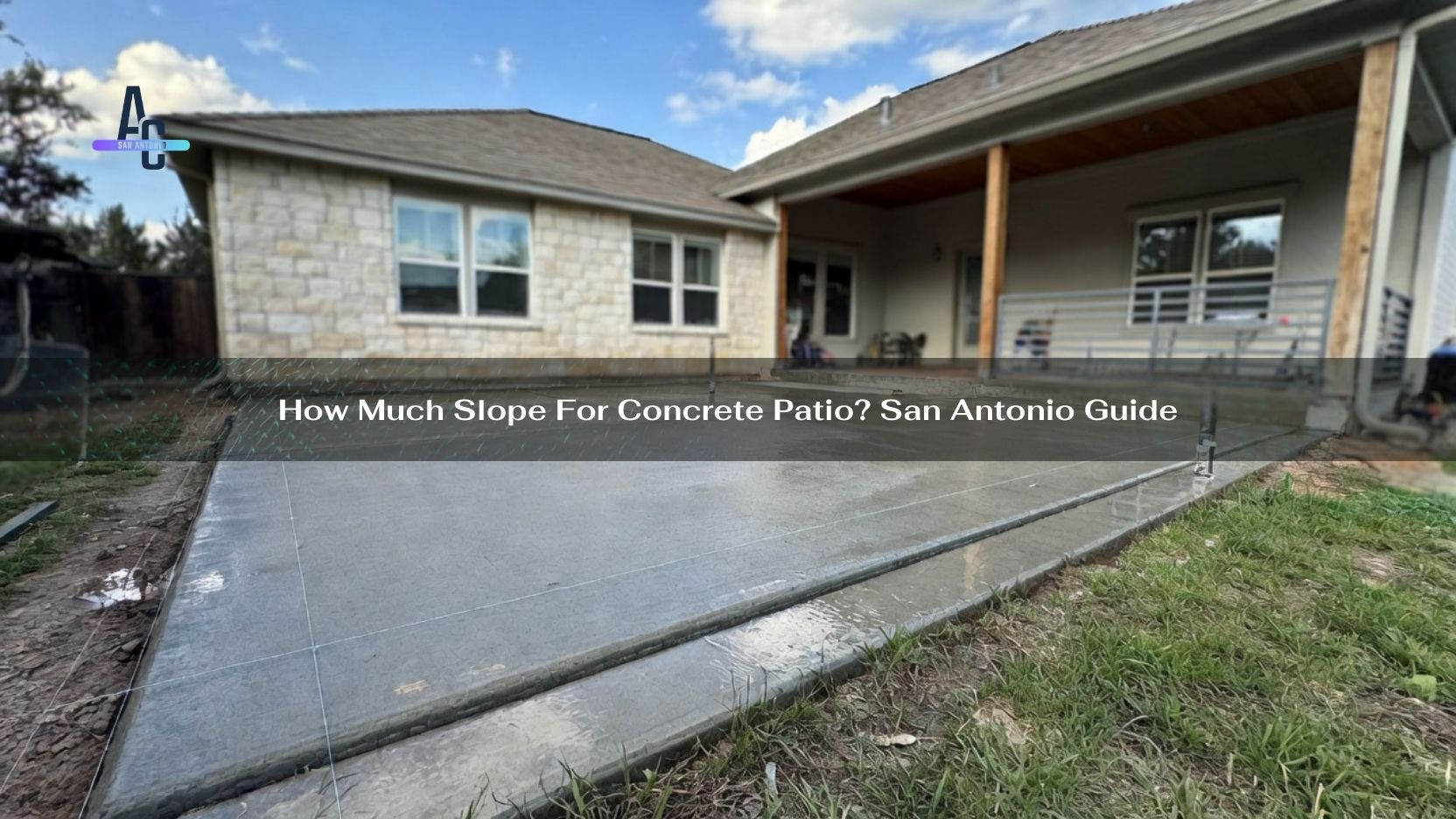
Wondering how much slope for concrete patio drainage is enough? This San Antonio guide gives the standard pitch, a drop chart by patio length, why our clay soil makes slope matter, how to check your own patio, and how a flat or ponding patio gets fixed.
- How much slope for a concrete patio do you need?
- How much should my patio drop by length?
- Why does the slope of a concrete patio matter more in San Antonio?
- Is 1/8 inch per foot enough, and can a patio be too sloped?
- How is concrete patio slope different from driveway or pool deck slope?
- How do I check the slope on my concrete patio?
- How do you fix a flat or ponding concrete patio?
- How do pros set concrete patio pitch on a new pour?
- Should I DIY or hire a pro for patio slope problems?
- Where do we work?
- What else are homeowners asking?
Plan about 1/4 inch of slope per foot, roughly a 2% grade, falling away from the house, so a 12-foot patio drops about 3 inches. San Antonio’s expansive clay soil makes that full pitch matter. Call a pro if water ponds for hours after rain or runs back toward your foundation.
How much slope for a concrete patio do you need?
A concrete patio should slope about 1/4 inch per foot, roughly a 2% grade, away from the house. That is enough fall to move rain off the slab without making the patio feel tilted.
Most crews work in a range of 1/8 to 1/4 inch per foot, and we treat 1/4 inch as the standard for San Antonio patios. The International Residential Code (Section R401.3) also says hard surfaces within 10 feet of the foundation should slope at least 2% away from the building, which works out to about 1/4 inch per foot.
- Direction: Always away from the house, toward the yard, a swale, or a drain.
- Standard pitch: About 1/4 inch per foot (about 2%).
- Feels level: At that pitch, tables and chairs sit normally and the patio still reads as flat to the eye.
How much should my patio drop by length?
Multiply the patio’s depth from the house, in feet, by 1/4 inch to get the total drop. A 12-foot patio should fall about 3 inches from the house wall to the outer edge.
| Patio depth from the house | Drop at 1/4" per ft (standard) | Drop at 1/8" per ft (low end) |
|---|---|---|
| 8 feet | About 2 inches | About 1 inch |
| 10 feet | About 2 1/2 inches | About 1 1/4 inches |
| 12 feet | About 3 inches | About 1 1/2 inches |
| 14 feet | About 3 1/2 inches | About 1 3/4 inches |
| 16 feet | About 4 inches | About 2 inches |
| 20 feet | About 5 inches | About 2 1/2 inches |
Formula: patio depth (ft) × 0.25 inch = total drop. Measure from the house wall straight out to the edge the water should run off.
The numbers to plan around
Why does the slope of a concrete patio matter more in San Antonio?
San Antonio’s expansive clay soil swells when it gets wet and shrinks when it dries, so water that sits on or beside a patio keeps the ground under it moving. The right slope of a concrete patio sends that water away before it soaks the soil near your foundation.
- Clay movement: Repeated wetting and drying under the slab leads to uneven settling, cracks, and lifted edges.
- Heavy storms: Short, hard rains dump a lot of water at once, and a flat patio cannot shed it fast enough.
- Foundation risk: A patio that pitches toward the house puts water right where your slab foundation and door thresholds are most exposed.
- Surface wear: Standing water leaves stains, algae, and soft spots in the finish over time.
That is why we stick to the full 1/4 inch per foot on San Antonio patios instead of the bare minimum.
Is 1/8 inch per foot enough, and can a patio be too sloped?
One-eighth inch per foot moves some water, but it sits below the 2% the code calls for next to the foundation and leaves little margin once clay soil starts to move. On the other end, more than about 1/2 inch per foot makes a patio feel tilted.
| Pitch per foot | What happens | Our take |
|---|---|---|
| Less than 1/8" | Puddles after rain, stains, mosquitoes | Too flat; plan a fix |
| About 1/8" | Drains slowly; small dips hold water | Low end; risky next to the house |
| About 1/4" | Sheds water and still feels level | Standard for San Antonio patios |
| Over 1/2" | Tables wobble, water rushes and erodes edges | Too steep for a seating area |
A patio should never be perfectly level, and it should never look like a ramp. Outdoor kitchens and dining areas are where an over-sloped slab bothers people most.
How is concrete patio slope different from driveway or pool deck slope?
The numbers are similar, but the direction and the traffic change. A patio drains away from the house into the yard, while a driveway usually drains toward the street and a pool deck drains away from the pool edge or into deck drains.
- Patio: About 1/4 inch per foot away from the house is our standard.
- Driveway: Our driveway guide calls for 1/8 to 1/4 inch per foot toward the street, with at least 1/8 inch written into the contract.
- Pool deck: Our pool deck drainage guide treats 1/8 inch per foot as a minimum and 1/4 inch per foot as the working standard for busy decks.
If your patio runs into a driveway or pool deck, the slopes have to meet without trapping water at the joint. That transition is a common place for ponding.
How do I check the slope on my concrete patio?
Set a 4-foot level on the patio pointing away from the house, lift the low end until the bubble centers, and measure the gap. About a 1-inch gap under a 4-foot level means about 1/4 inch per foot.
- Level test: Check several spots, not just one. A 1/2-inch gap under a 4-foot level is about 1/8 inch per foot.
- String line test: Stake a string at the house and at the outer edge, level it with a line level, and measure down to the concrete at both ends. The difference is your total drop.
- Hose test: Run water near the house and watch where it goes. Water that sits, spreads sideways, or runs toward the wall points to a slope problem.
- After-rain check: Note any spot that still holds water a few hours after a storm.
- Water ponds for hours after rain or runs toward the house
- The slab has sunk next to the foundation or door
- Cracks are wider than 1/4 inch or one side is higher than the other
- The patio pitches toward a wall with no drain to catch the water
Not sure what your patio needs? Call (713) 504-2341 for a free site visit and a written plan.
How do you fix a flat or ponding concrete patio?
The fix depends on why the water sits: a settled section, a small low spot, a slab poured flat, or water arriving from somewhere else. A site visit sorts out which one you have before anyone grinds or breaks concrete.
| Fix | When it fits | Limits |
|---|---|---|
| Lift a settled section | One panel has sunk toward the house | Needs a sound slab; base problems may return |
| Grind small high spots | A ridge or lip traps a shallow puddle | Only removes a small amount of concrete |
| Add an edge or channel drain | The patio cannot be re-pitched, or the yard is flat | Water still needs a place to go |
| Overlay with corrected slope | The slab is sound and only slightly flat | Thin layer; cannot fix a slab that is still moving |
| Remove and repour | The slab pitches toward the house or is badly cracked | Most work, but resets the slope from the base up |
Surrounding grade matters too. If the lawn at the edge of the patio is higher than the concrete, water has nowhere to go no matter how well the slab is pitched. Our patio repair team checks drainage and base conditions first, then repairs or repours so the patio drains away from the house. For a bigger decision, see should I repair or replace my concrete patio.
How do pros set concrete patio pitch on a new pour?
A sloping concrete patio is planned before the pour: the crew sets the high point at the house, marks the low edge, and builds the base and forms to that grade. Concrete patio pitch cannot be added after the slab cures without grinding, an overlay, or a repour.
- Set the high point: The finished surface at the house sits below door thresholds and weep lines.
- Grade and compact the base: The base follows the planned fall so the slab is an even thickness.
- Pitch the forms: String lines set the drop, about 1/4 inch per foot, from the house to the outer edge.
- Plan the runoff: Water should leave the patio onto grade that keeps falling, into a swale, or into a drain.
- Check before finishing: The crew checks slope again before the final finish and control joints.
Planning a new slab? Our patio installation service sets drainage during layout, not after.
Should I DIY or hire a pro for patio slope problems?
Checking slope, clearing drains, and fixing the soil grade at the edge are fair DIY jobs. Changing the slope of the concrete itself is professional work.
- Reasonable DIY: Level and hose tests, cleaning out edge drains, extending downspouts away from the patio, and lowering soil or mulch that sits above the slab edge.
- Hire out: Slab lifting, grinding, overlays, drain installation through concrete, and any tear-out and repour.
A patio that already slopes toward the house is the one case not to wait on, because every storm sends water toward the foundation. See our concrete patio service page, call (713) 504-2341, or request a free quote.
Is your patio holding water or draining toward the house?
Free site visit, a slope and drainage check, and every price in writing before work starts. Licensed and insured crew.
Where do we work?
Affordable Concrete San Antonio works across San Antonio and nearby areas from our shop at 1247 W Thompson Pl, San Antonio, TX 78226.
We check, repair, and pour patios in San Antonio and these nearby areas: Helotes, Leon Valley, Shavano Park, Terrell Hills, Alamo Heights, Converse, Universal City, Schertz, Boerne, Cibolo, Fair Oaks Ranch, Bulverde, Spring Branch, New Braunfels, Pleasanton, Floresville, Castroville, Lytle, and Von Ormy. Not sure about your address? Call (713) 504-2341.
What else are homeowners asking?
These are the short answers people want before they book a quote.
How much slope for a concrete patio is standard?
Plan about 1/4 inch per foot, roughly a 2% grade, away from the house. The International Residential Code calls for at least 2% on hard surfaces within 10 feet of the foundation.
How much should a 12-foot concrete patio drop?
At 1/4 inch per foot, a 12-foot patio should drop about 3 inches from the house to the outer edge. A 20-foot patio drops about 5 inches.
Is 1/8 inch per foot enough slope for a concrete patio?
It moves some water, but it is below the 2% the code calls for next to the foundation and leaves little margin on San Antonio clay. We plan patios at about 1/4 inch per foot.
Can a concrete patio have too much slope?
Yes. Past about 1/2 inch per foot, tables and chairs wobble and the patio feels tilted. Most patios still look and feel level at 1/4 inch per foot.
Can you fix a concrete patio that holds water?
Often yes. Depending on the slab, options include lifting a settled section, grinding small high spots, adding an edge drain, or removing and repouring the low area. A site visit decides which one fits.
Is concrete patio pitch the same as slope?
Yes. Pitch, slope, and fall all describe how much the patio drops as it runs away from the house. Contractors write it as inches per foot or as a percent.
Sources used in this article:
- International Code Council, International Residential Code 2021, Section R401.3 Drainage (impervious surfaces within 10 feet of the foundation sloped not less than 2 percent), checked October 14, 2026, up.codes
- Affordable Concrete San Antonio, concrete patio service page, affordableconcretesanantonio.com/concrete-patio-san-antonio/
- Affordable Concrete San Antonio, patio repairs, affordableconcretesanantonio.com/concrete-patio-san-antonio/patio-repairs/
- Affordable Concrete San Antonio, concrete driveway guide for San Antonio homeowners, affordableconcretesanantonio.com/concrete-blogs/concrete-driveway-guide-for-san-antonio-homeowners/
- Affordable Concrete San Antonio, why drainage matters for commercial pool decks, affordableconcretesanantonio.com/concrete-blogs/why-drainage-matters-for-commercial-pool-decks-in-sa/
This article is general information for San Antonio homeowners. Codes and City rules can change, and your local building official is the final authority. It is not a quote and does not replace a site visit.
What should I read next?
Start with our concrete patio page, or keep reading if you are deciding between a repair and a new slab.