
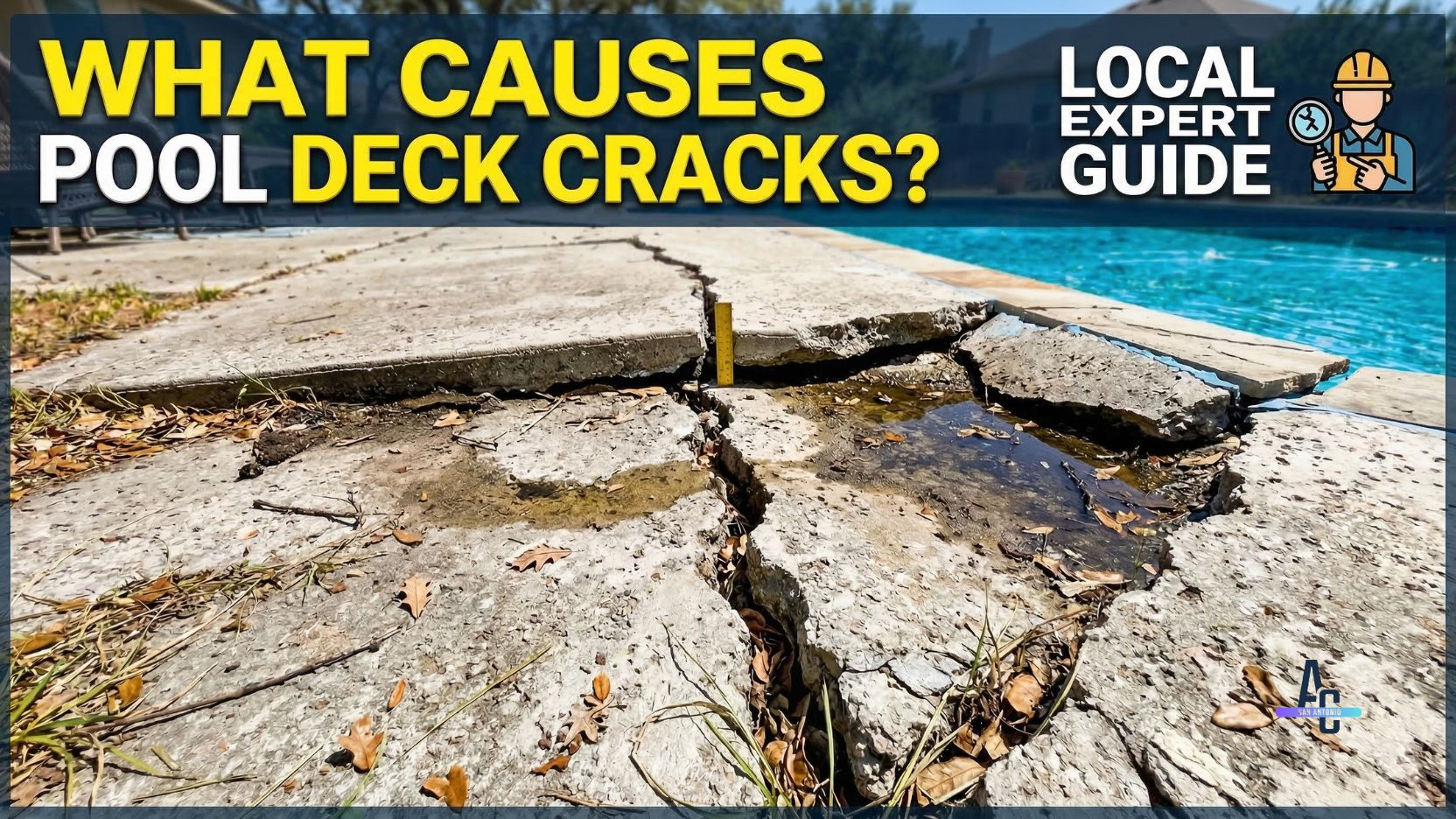
At Affordable Concrete San Antonio, our team draws on more than a decade of hands-on work with outdoor concrete in South Texas, where pool decks face heat, rain, moisture, and shifting soil. The short answer is this: pool deck cracks are usually caused by soil movement, concrete shrinkage during curing, temperature changes, poor drainage, weak base preparation, or missing control joints.
For homeowners in San Antonio and Houston, the biggest local risk is often a combination of expansive clay soil and weather stress. Small cracks may be cosmetic, but wider or uneven cracks can point to a deeper problem.
What Are The Most Common Causes Of Pool Deck Cracks?
Most pool deck cracks start from movement, stress, or water. Here are the main causes homeowners should know.
| Cause | Why it happens | Common sign |
| Soil movement | Expansive soil swells when wet and shrinks when dry | Cracks that widen over time or areas that settle |
| Concrete shrinkage | Concrete naturally loses moisture as it cures | Fine hairline cracks soon after installation |
| Temperature changes | Heat expands concrete; cooler temps contract it | Random surface cracking or joint stress |
| Poor base preparation | Loose or uneven subgrade allows slab movement | Uneven sections, sinking corners, longer cracks |
| Missing control joints | Concrete needs planned weak points to crack in a controlled way | Cracks form across the slab instead of at joints |
| Poor drainage | Water gets under or around the slab and weakens support | Erosion, settlement, and recurring cracks |
| Heavy loads or impact | Furniture, equipment, or accidental impact adds stress | Localized cracks or chipped edges |
Key takeaway: Pool deck cracks rarely result from a single issue. In many cases, several factors work together.
Are Hairline Cracks In A Pool Deck Normal?
Yes, some hairline cracks can be normal. Concrete is strong in compression, but it can still develop very small cracks as it cures and dries.
Hairline cracks are often:
- Thin
- Stable
- Not causing height changes
- Mostly cosmetic
A crack becomes more serious when it is:
- Growing wider
- Causing one side of the slab to sit higher
- Holding water
- Near the pool edge or coping
- Creating a trip hazard
If the crack changes shape, widens, or repeats after repair, the issue may be below the surface.
Does San Antonio Or Houston Weather Make Pool Deck Cracks Worse?
Yes. South Texas conditions can make cracking worse over time. San Antonio and Houston both experience long, hot seasons, heavy rainfall, and soil that shifts with changes in moisture.
In this region, pool decks are often affected by:
- High heat and UV exposure
- Dry spells followed by sudden rain
- Water runoff around the pool
- Clay-rich soil expansion and shrinkage
- Occasional winter cold snaps
When the ground below the concrete expands and contracts, the slab can lose even support. That is one reason homeowners in San Antonio and Houston often see cracks near corners, joints, or low spots.
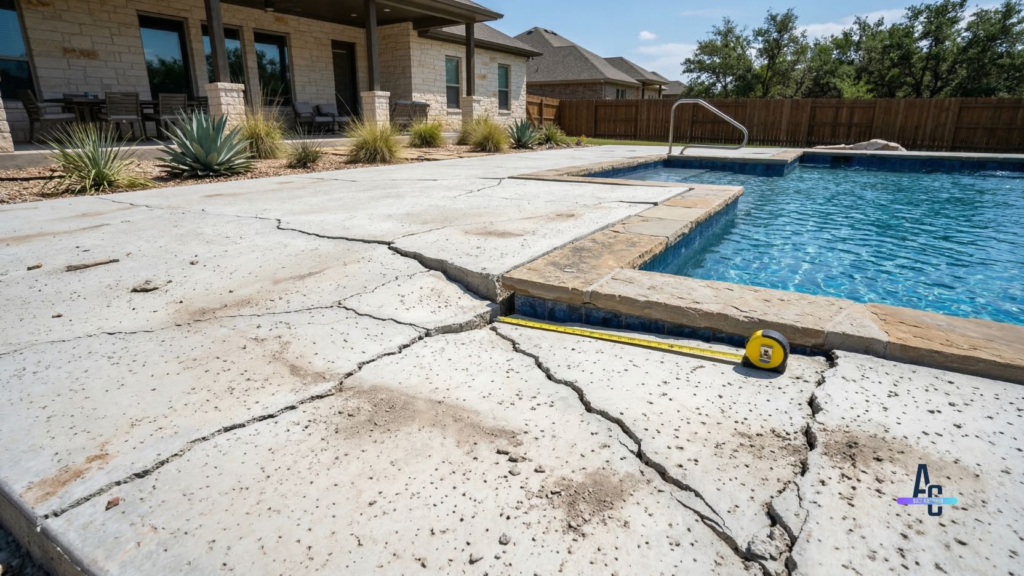
Can Poor Installation Cause Cracks In A Pool Deck?
Absolutely. Installation quality has a major effect on crack resistance. Even a good concrete mix can fail early if the slab is not built correctly.
Common installation issues include:
- Inadequate grading or compaction
- Base material that is too thin or uneven
- Too much water added to the mix
- Poor reinforcement planning
- Incorrect joint spacing
- Improper curing after the pour
A pool deck needs more than a smooth finish. It needs a stable base, the right thickness, proper joint placement, and good drainage planning. Without those steps, the slab is more likely to crack early.
How Do Drainage And Pool Water Contribute To Cracks?
Water is one of the biggest hidden causes of pool deck damage. When water repeatedly gets under the slab, it can wash out support, soften the soil, or create movement.
This can happen from:
- Splash out of the pool
- Poor deck slope
- Clogged drains
- Downspouts discharging near the deck
- Leaks around plumbing or pool features
Water problems often appear as settlement cracks, hollow spots, or low areas that remain wet.
How Can Homeowners Help Prevent Pool Deck Cracks?
You cannot stop all cracking, but you can reduce the risk. A few practical steps go a long way.
Best Prevention Steps
- Keep deck drainage working properly
- Repair small cracks early before water gets in
- Make sure nearby sprinklers are not soaking the slab edge
- Seal the surface when appropriate for the finish
- Watch for soil erosion near deck edges
- Avoid heavy point loads on thin deck sections
- Have movement or uneven cracking checked before resurfacing
Key takeaway: Early maintenance is usually cheaper than major structural repair.
Should You Repair Or Replace A Cracked Pool Deck?
It depends on the type and severity of the crack. Not every cracked pool deck needs full replacement.
Repair may be enough when:
- Cracks are small and stable
- The slab is still level
- Drainage is working
- Surface damage is mostly cosmetic
Replacement may be the better option when:
- The slab is heaving or sinking
- Cracks keep coming back
- Drainage is poor
- The deck has widespread damage
- Safety is a concern
For many homeowners, a professional inspection is the fastest way to tell whether crack repair, resurfacing, or replacement makes the most sense.
FAQs
How Wide Is Too Wide For A Pool Deck Crack?
A very small hairline crack may be cosmetic. If a crack is wide enough to catch a toe, collect water, or show vertical movement, it should be inspected.
Does Resurfacing Fix Pool Deck Cracks Permanently?
Not always. Resurfacing improves the surface, but it does not solve soil movement or drainage problems underneath the slab.
Can I Seal A Pool Deck Crack Myself?
You can seal minor surface cracks, but DIY repair will not fix settlement, base failure, or recurring movement. Those problems need a proper diagnosis first.