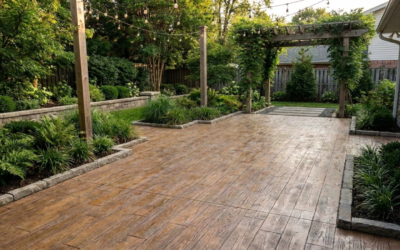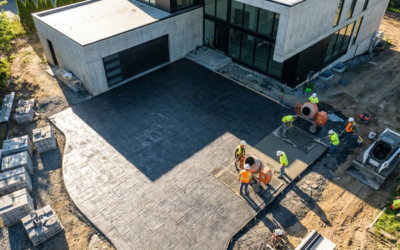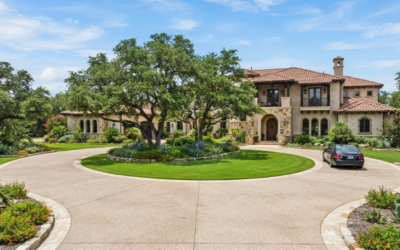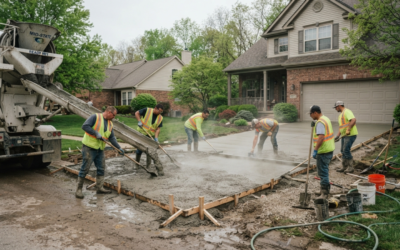
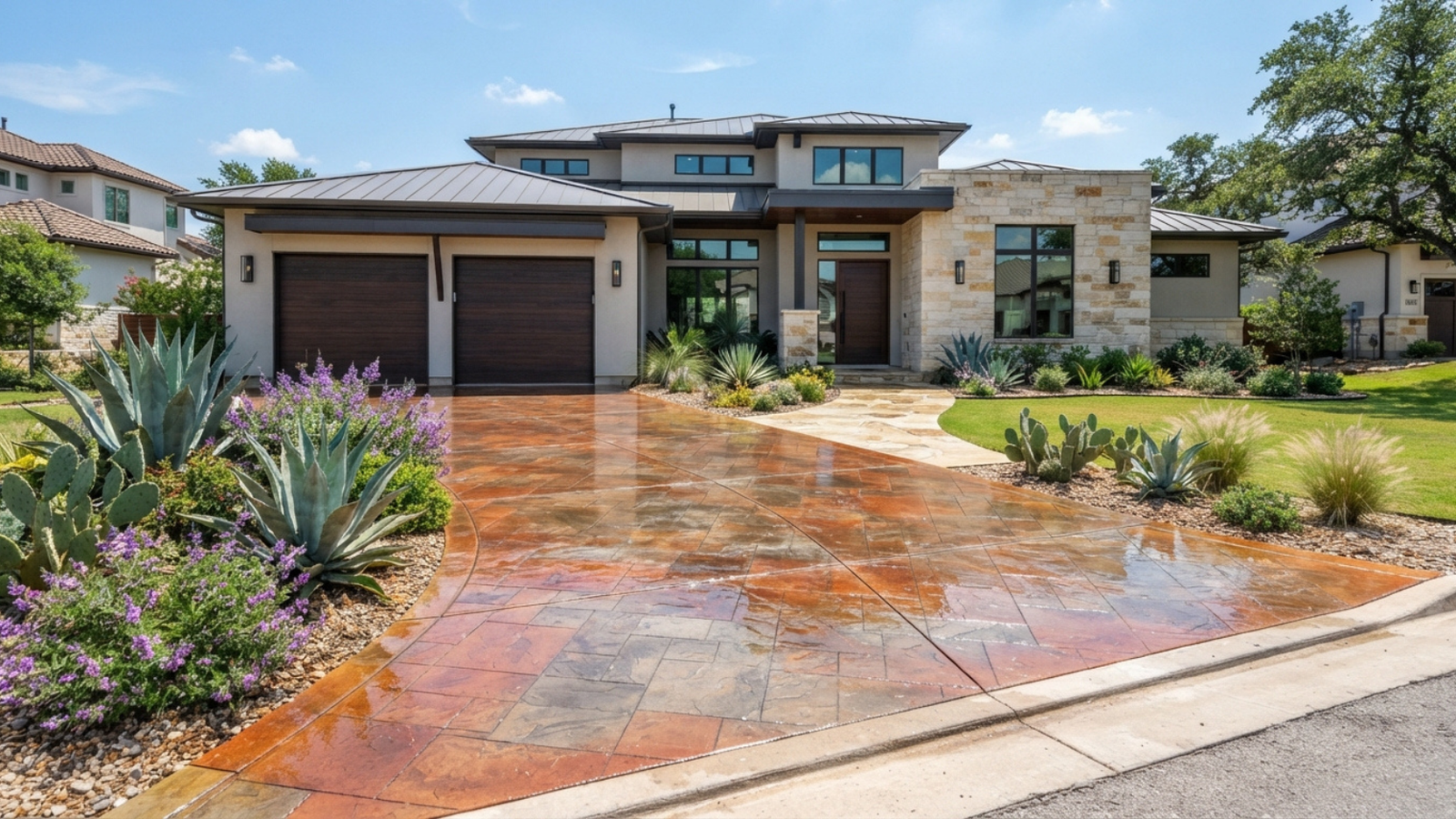
A stamped concrete driveway is the most durable decorative paving surface available in San Antonio and one of the best long-term investments a Bexar County homeowner can make. This complete guide covers patterns, colors, costs, structural requirements, and how to choose a contractor who will get it right the first time.
Most driveways in San Antonio are plain gray slabs. That is not because plain gray is the right choice it is because most homeowners do not realize how close in cost a stamped concrete driveway actually is to the plain version, especially when you factor in a 30-plus-year lifespan and the curb appeal impact on resale value. A standard broom-finish driveway runs $7 to $12 per square foot installed. A stamped concrete driveway with integral color and a natural stone pattern runs $14 to $20. The gap is real, but it is not nearly as wide as most people assume before they get a quote.
What makes stamped concrete the right choice for San Antonio driveways specifically is not just appearance it is the structural advantage over alternatives. Brick pavers and natural flagstone move with Bexar County's notoriously expansive Blackland Prairie clay soil, creating uneven surfaces, gaps, and tripping hazards within a few years. A properly poured concrete slab with rebar reinforcement and correctly spaced expansion joints handles that soil movement as a single unified surface. Stamped concrete gives you the look of natural stone with the performance of a monolithic slab.
San Antonio homeowners regularly choose their stamp pattern and color first, then sign a contract without verifying the structural spec underneath. The pattern determines how the driveway looks on day one. The slab thickness, base preparation, rebar reinforcement, and expansion joint spacing determine how it looks at year 10 and year 20. A stamped surface over an inadequate base will crack regardless of how beautiful the pattern is. Always confirm the structural spec in writing before approving any decorative decisions.
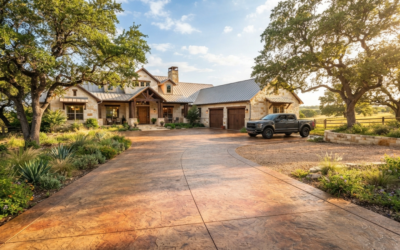
The pattern you choose determines the entire visual character of your stamped driveway. San Antonio's architectural landscape a blend of Spanish Colonial, Texas Hill Country, Mediterranean, and contemporary ranch styles pairs naturally with stone-mimicking patterns. The most popular options we install in Bexar County in 2026 all fall into the natural stone category, for good reason: they complement virtually every home style in the region and do not date the way trend-specific decorative patterns can.
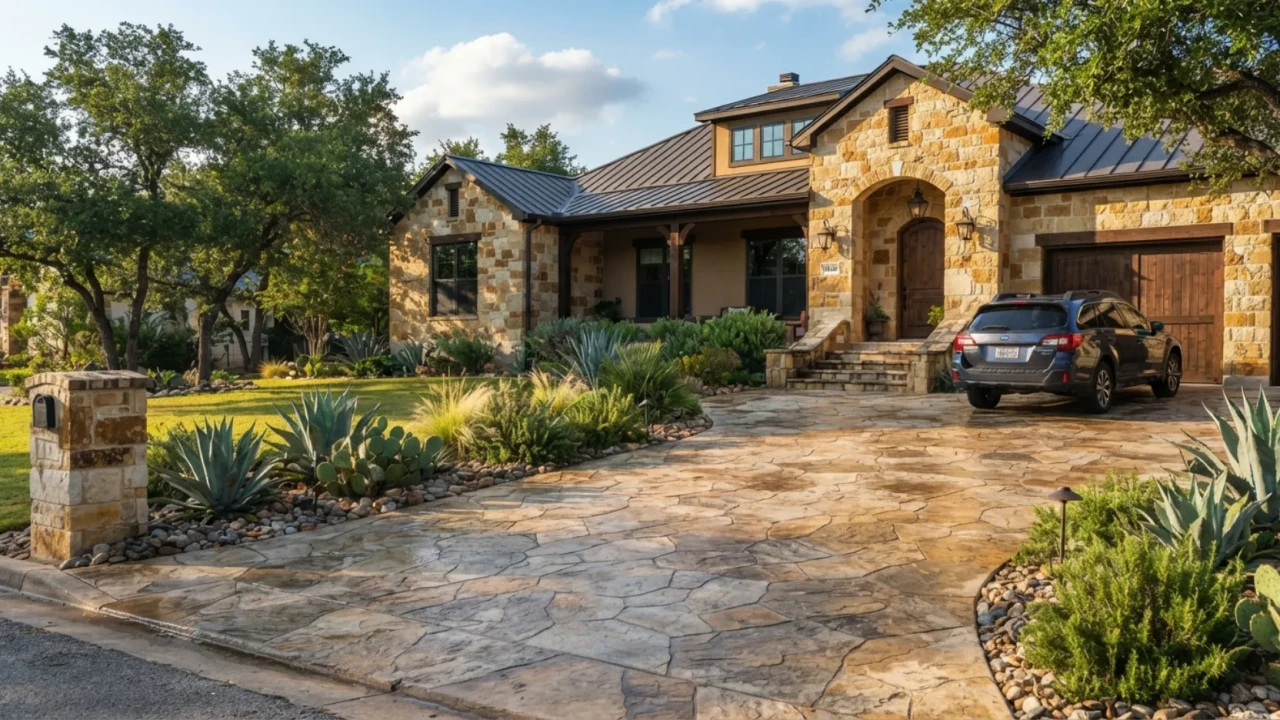
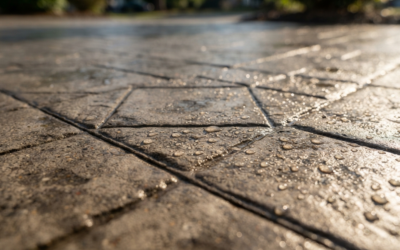
Random flagstone is consistently the top-requested pattern in San Antonio. The irregular, organic layout of varied stone shapes produces a natural appearance that is difficult to distinguish from actual laid stone at a glance. It pairs well with limestone exteriors, stucco finishes, and clay-tile roofing all common across Bexar County neighborhoods from Alamo Heights to Helotes.
How to narrow your pattern choice in 15 minutes: Pull three photos of San Antonio homes with a similar architectural style to yours from Google Street View or a neighborhood real estate listing site. Look at the driveway materials in those photos. The patterns that appear most frequently in your home's style category are the ones that will look most intentional and least out-of-place on your property. If your home is stucco with clay tile roofing, flagstone and cobblestone will almost always feel right. If it is a contemporary flat-roof design in Alamo Ranch or the newer Stone Oak sections, Ashlar slate or a clean running bond pattern will integrate better.
- Pattern chosen based on home architectural style, not just appearance on its own
- Pattern and color confirmed in writing before work begins changes are impossible after the pour
- Contractor has a sample stamp tool on hand request to see an impression in a sandbox or sample board before approving
- Joint lines reviewed: deeper, more defined grout lines look more natural; shallow lines can look artificial under certain lighting
Color is the single most visible decision in a stamped concrete driveway project, and also the most commonly misunderstood. There are three methods for adding color to stamped concrete integral color, release agent, and surface staining and they serve fundamentally different purposes. Understanding the difference before you sign a contract prevents the most common disappointment we see in San Antonio homeowners who expected one result and got another.
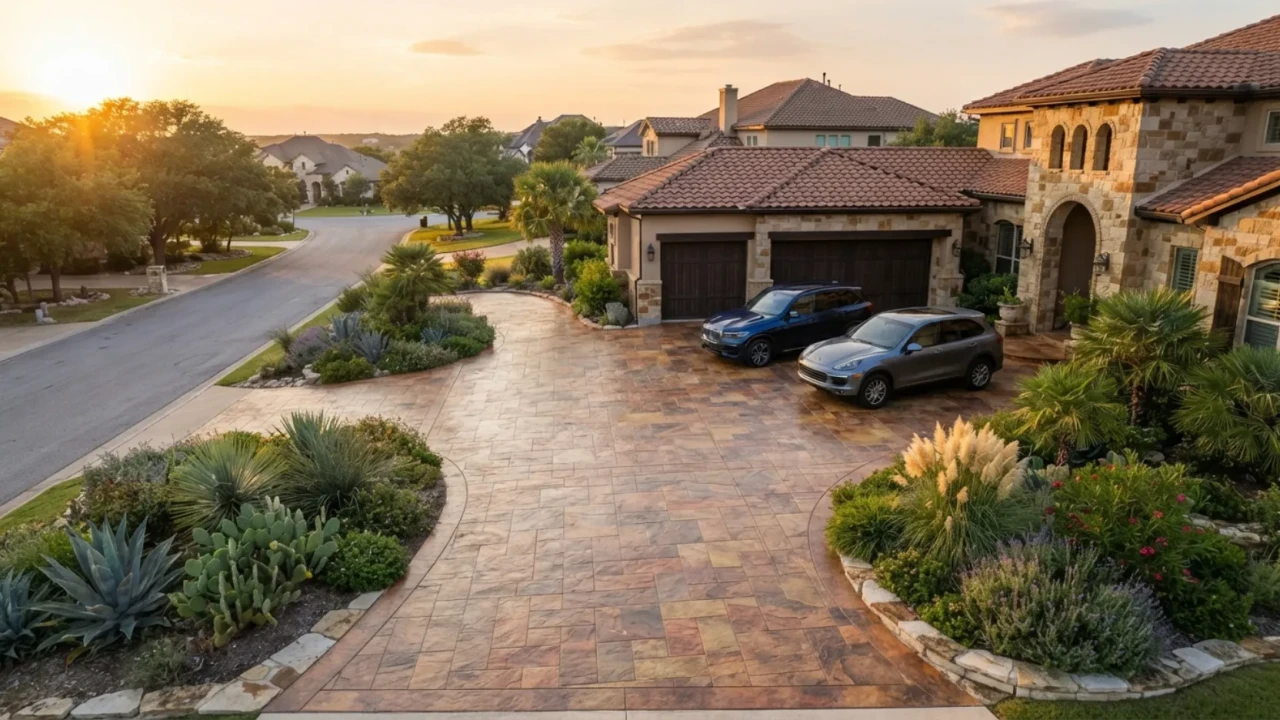
Integral color is pigment blended directly into the concrete mix before it is poured. The color runs through the full depth of the slab. When chips or minor abrasion occur from vehicle traffic, no gray concrete base is exposed the color holds. Integral color is the baseline for any quality stamped driveway in San Antonio and the method we recommend for any application subject to vehicle use.
Release agent is a powder or liquid applied to the stamp tool surface before pressing into the fresh concrete. It prevents the tool from sticking and, importantly, deposits a secondary color into the stamped joints creating the two-tone depth that makes stamped concrete look like real stone rather than a flat colored slab.
The most popular color combination for San Antonio stamped driveways in 2026 is a warm buff or sandstone integral base with a charcoal or dark brown release agent contrast. This combination mimics the appearance of natural Texas limestone a material already deeply embedded in the region's architectural identity and complements the stucco, limestone block, and clay-tile materials common on Bexar County homes.
- Integral color confirmed in the contract not surface stain applied after cure
- Release agent color specified and approved in writing alongside the base integral color
- Color chart or physical chip sample reviewed in direct sunlight, not just indoors or on screen
- Sealing schedule confirmed: sealed surface will appear slightly darker and more saturated than unsealed view a sealed sample before approving the color
No structural requirement matters more in San Antonio than slab thickness, and no mistake is more common than under-specifying it. Bexar County's predominant soil type is Blackland Prairie Vertisol clay one of the most expansive soil categories in the United States. This soil swells significantly when wet and contracts sharply when dry, creating vertical ground movement that stresses any surface sitting on top of it. A stamped concrete driveway at 4 inches on a clay subgrade will crack. At 5 inches with rebar reinforcement and a proper compacted base, it has the structural resilience to manage that movement across decades.

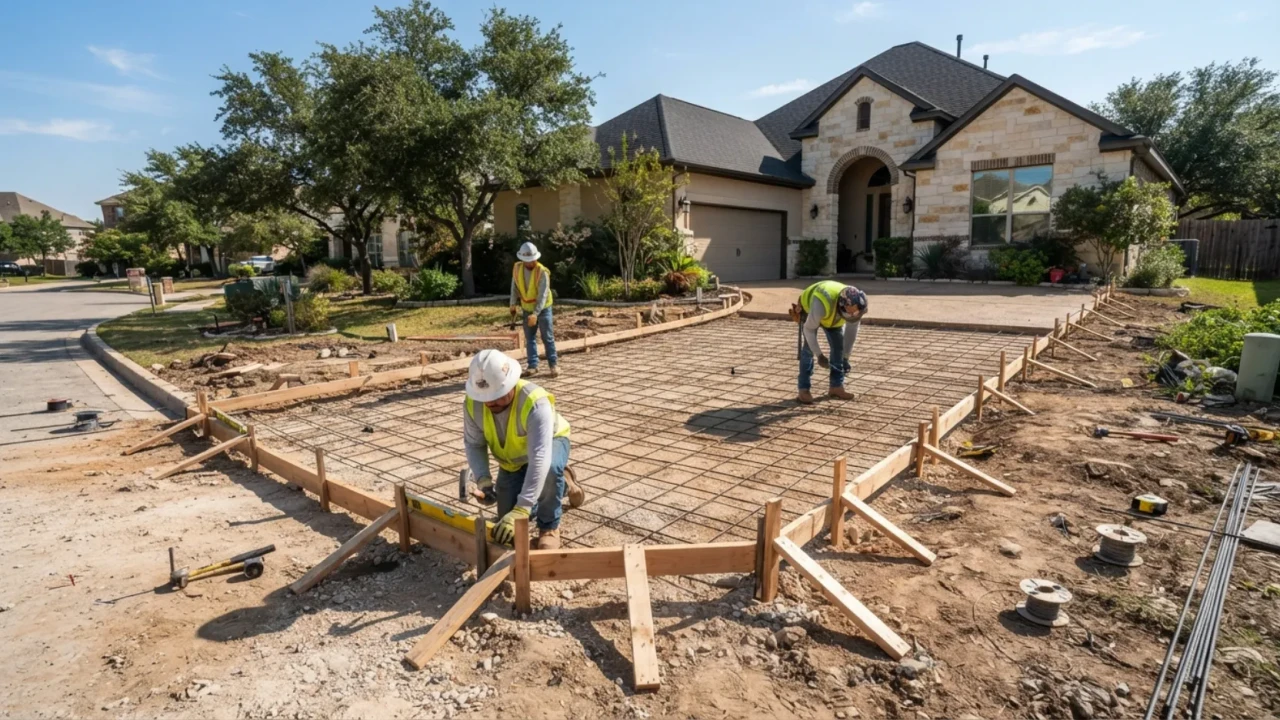
The full structural spec for a stamped driveway in San Antonio is non-negotiable on the following points: 5-inch minimum slab thickness (6 inches if the driveway will accommodate trucks, RVs, or heavy service vehicles); rebar reinforcement using #3 or #4 bar on an 18-inch grid rather than wire mesh, which has inadequate tensile strength for clay soil conditions; a 4- to 6-inch compacted crushed limestone base that is properly graded and moisture-conditioned before the forms are set; and control joints placed every 8 to 10 feet to direct any cracking to predetermined locations rather than allowing it to propagate randomly through the stamped field.
- Slab thickness specified in writing: 5" minimum for residential passenger vehicles
- Reinforcement type confirmed: rebar (#3 or #4 at 18" centers), not wire mesh
- Base preparation included in the scope: excavation, compacted crushed limestone, moisture conditioning
- Control joint layout included in the quote: spacing and placement on the project plan
- Concrete mix design confirmed: minimum 4,000 PSI mix for vehicle-use driveways in Texas climate
Stamped concrete installation is more time-sensitive than a standard broom-finish pour. Once the concrete reaches the right plastic consistency for stamping roughly two to four hours after the pour in San Antonio's summer heat, longer in cooler months the crew has a narrow working window. The stamps must be placed, pressed, and lifted cleanly before the slab reaches initial set. An experienced stamping crew works in coordinated sections from one end of the driveway to the other, maintaining consistent pressure and alignment throughout. A crew without adequate stamped concrete experience shows it here: misaligned patterns, inconsistent depth, and visible seam lines between stamp sections are all signs of insufficient skill.
In San Antonio's summer heat, curing management is the most critical post-stamp task. If the surface loses moisture too quickly before the chemical curing reaction completes, the top layer of the slab will be weaker than the interior a condition that shows up as surface dusting, scaling, or early color fade. A quality contractor will wet-cure the stamped surface for a minimum of three days or apply a liquid curing compound immediately after the stamping work is complete.
The best time of year for stamped concrete in San Antonio: October through April. Not because summer pours are impossible experienced crews do them every day but because the narrow stamping window (when concrete is plastic enough to stamp but not yet set) is much more forgiving in cooler temperatures. A summer driveway pour in August with surface temperatures near 100 degrees can reduce the stamping window to under two hours. This is manageable for an experienced crew that starts early, uses retarder in the mix design, and has enough stampers on site to cover the full pour area quickly. But it adds risk. If your project timeline is flexible, scheduling between October and March gets you better working conditions and often slightly better pricing due to lower demand.
Stamped concrete is a low-maintenance surface, but not a no-maintenance one. The sealer is the most important ongoing commitment: it protects the color system from UV degradation, prevents water infiltration that can weaken the surface in freeze-thaw cycles, and maintains the wet-look sheen that makes stamped concrete distinctive. In San Antonio's climate intense UV, occasional freeze events like Winter Storm Uri, and high summer temperatures an unsealed stamped surface will begin to show color fade and surface degradation within two to three years.

The first sealer application should happen 28 to 30 days after the pour, once the concrete has reached full cure. Sealing before full cure traps moisture in the slab and can cause surface bubbling or whitening under the sealer film. A high-solids acrylic sealer is the standard product for exterior stamped concrete in San Antonio it delivers UV protection, color enhancement, and water resistance in a single application. Solvent-based acrylics provide a higher gloss and deeper color enhancement; water-based formulas offer lower VOC output and easier cleanup.
Oil and grease stains from vehicle drips are the most common maintenance issue on stamped driveways. On an unsealed surface, oil penetrates rapidly and can be nearly impossible to remove fully. On a sealed surface, oil sits on top of the sealer film and can be removed with a commercial degreaser and pressure washing. This is one of the most practical arguments for keeping a sealed surface maintained: the sealer is protecting the concrete from the most damaging contaminant driveways face every day.
- First sealer application at 28 to 30 days after pour calendar this before the project starts
- Resealing every two years for south- or west-facing driveways; every three years for other exposures
- Annual low-PSI pressure wash to remove dirt, algae, and organic debris
- Oil and grease stains treated immediately with commercial degreaser do not allow to penetrate
- Expansion joints inspected annually and refilled with backer rod and polyurethane sealant if cracked or missing
Stamped concrete is a skilled trade. The pour, timing, stamp placement, release agent application, and curing management all require experienced hands. A crew that primarily pours plain slabs and occasionally attempts stamped work will not produce the same result as a team that stamps regularly. The quality difference between an experienced stamped concrete crew and an inexperienced one is visible to anyone who knows what to look for and unfortunately, it is only visible after the pour is complete and the concrete has set.
| What to check | What a qualified contractor provides | Red flag response |
|---|---|---|
| Stamped concrete portfolio | Photos of completed local stamped driveways, patios, and pool decks not stock images | Generic photos from manufacturer websites; cannot provide local project references |
| Structural spec in writing | Slab thickness, reinforcement type, base depth, and control joint spacing all listed in the quote | Quote says only "stamped concrete driveway" with a total price and no spec detail |
| Color and pattern documentation | Specific integral color product name, release agent color, and pattern name confirmed before pour | Verbal color approval only; no written confirmation of color system choices |
| Liability insurance | Certificate of insurance provided on request, $1M minimum general liability | "We are covered" with no documentation; policy below $1M coverage |
| Curing plan | Wet curing schedule or liquid curing compound application confirmed in the contract | No mention of curing; contractor pours and leaves without any post-pour moisture management |
| Sealing schedule | First sealer application included or scheduled at 28 to 30 days post-pour | Sealing treated as entirely separate and optional; not discussed at quote stage |
| Payment terms | Deposit of 30 to 50 percent at contract signing; balance due on project completion | Full payment demanded before work begins |
Before committing to stamped concrete, it helps to see how it compares to the alternatives on the metrics that matter most for Bexar County homeowners: upfront cost, lifespan, maintenance commitment, and performance on clay soil.
| Material | Installed cost (SA 2026) | Lifespan | Clay soil performance | Maintenance |
|---|---|---|---|---|
| Stamped concrete | $14–20/sqft | 30+ years | Excellent monolithic slab with rebar handles movement | Reseal every 2 to 3 years |
| Plain broom-finish concrete | $7–12/sqft | 30+ years | Excellent same structural spec as stamped | Reseal every 3 to 5 years |
| Brick pavers | $18–28/sqft | 20 to 25 years | Poor individual units shift and heave on clay soil | Annual re-leveling; joint sand replacement |
| Natural flagstone | $22–35/sqft | 15 to 20 years | Poor gaps develop as clay soil moves beneath | Annual re-leveling; grout or joint repair |
| Asphalt | $4–7/sqft | 10 to 15 years | Moderate flexible but softens in Texas summer heat | Crack fill every 2 to 3 years; resurface at 10 years |
| Gravel | $1–4/sqft | Indefinite with maintenance | Moderate does not crack but migrates and ruts | Annual top-dressing and regrading |
- Pattern chosen and documented in writing: name, stamp tool brand, and joint depth confirmed
- Integral color product name and code confirmed not just a verbal color description
- Release agent color confirmed and physically sampled alongside the integral base color in direct sunlight
- Sample board or reference photo of the combined pattern and color system reviewed and approved in writing
- Slab thickness confirmed in writing: 5" minimum for passenger vehicles on Bexar County clay soil
- Reinforcement type confirmed: #3 or #4 rebar at 18" centers wire mesh is not adequate for driveways on clay
- Base preparation scope included: excavation, compacted crushed limestone base at 4" to 6" depth
- Concrete mix design confirmed: minimum 4,000 PSI for driveway applications in Texas climate
- Control joint layout included: spacing every 8 to 10 feet, placement documented on a project plan
- Completed local stamped concrete portfolio reviewed photos of actual San Antonio projects, not stock images
- Certificate of insurance received and verified: $1M minimum general liability
- Curing plan confirmed: wet curing for 3 to 5 days or liquid curing compound applied immediately after stamping
- Payment terms confirmed: deposit at signing, balance at completion never full payment before work begins
- Sealing included or scheduled: first application at 28 to 30 days post-pour
- City of San Antonio Right-of-Way permit confirmed if curb cut is modified or widened
- Texas 811 utility locate called at least 3 business days before any excavation begins
- HOA approval documented if decorative driveway finishes are subject to restrictions
- Edwards Aquifer recharge zone setback confirmed if the property is in a regulated area
Get a free stamped concrete driveway quote in San Antonio
Tell us about your project, your preferred pattern, and your budget. We will visit your property, assess the site, and provide a detailed written quote at no cost.