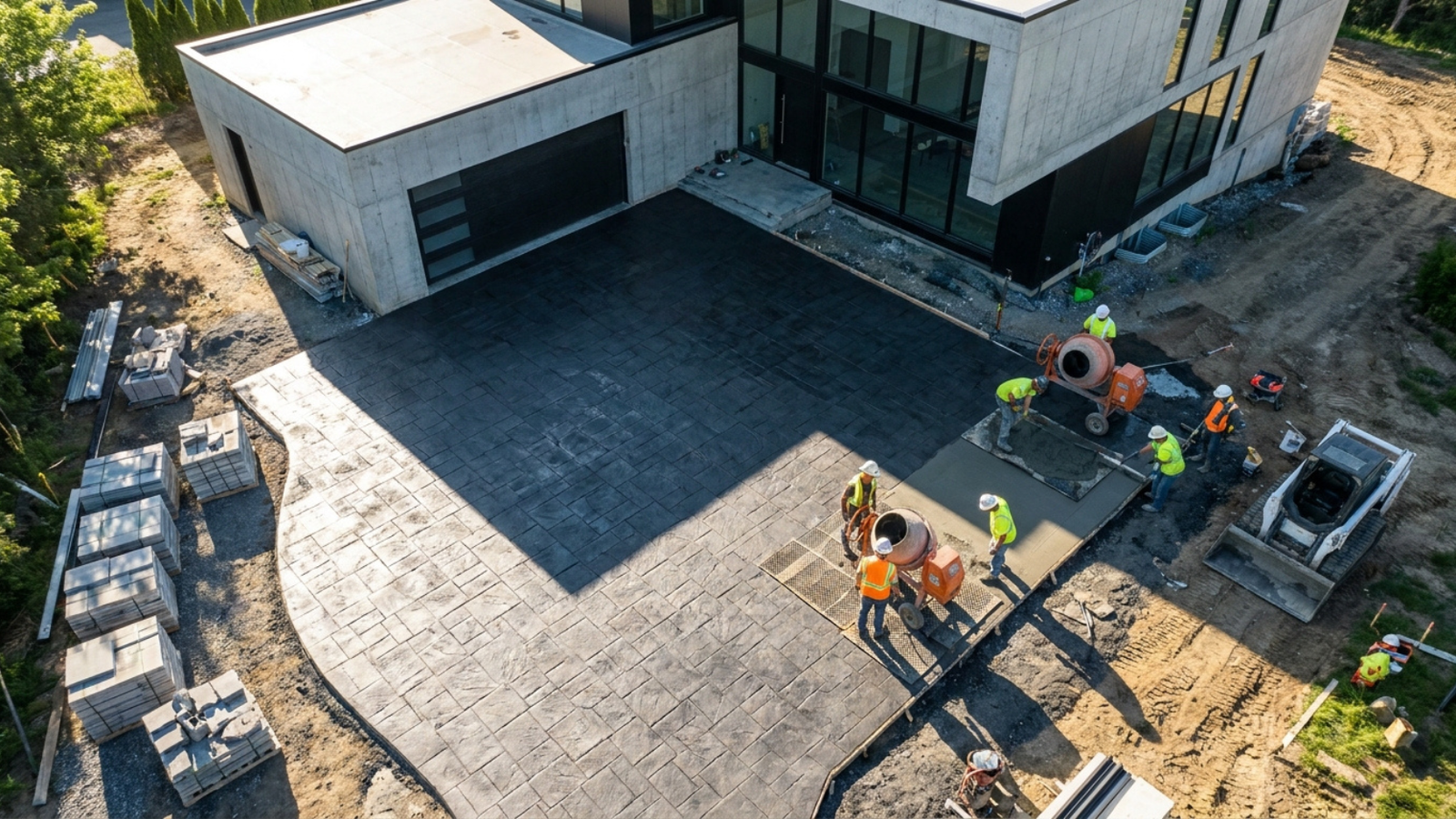
The right contractor makes or breaks your stamped driveway. Hire the wrong crew and you end up with a surface that fades, cracks, or blisters within three years. This guide covers every step: what to look for, what questions to ask, what to verify in writing, and which red flags to walk away from.
Stamped concrete driveways are one of the most technical jobs in residential concrete. Unlike a plain broom-finish slab where small imperfections blend in, a stamped driveway puts every decision on display: color consistency, pattern alignment, release agent application, sealer sheen level, and joint placement all have to be executed within a tight window before the concrete sets. There is no fixing it after the fact.
That means hiring the right contractor is not a secondary decision it is the primary one. A mediocre crew with premium materials will still produce a driveway that looks uneven, fades unevenly, or develops surface cracks within a few seasons. An experienced stamped concrete crew with standard materials will deliver a surface that holds up for decades in San Antonio's heat and clay-soil conditions.
This guide walks you through every step of the hiring process: what credentials to verify, what your written quote must include, what to ask during a site visit, and which answers should send you to the next contractor on your list.
Stamped concrete skill is not evenly distributed among concrete contractors. Most general concrete crews can pour a driveway. Far fewer have the pattern stamping experience, color mixing knowledge, and release-agent timing judgment required to produce a stamped driveway that looks right and holds up in South Texas conditions. Always ask specifically about stamped driveways not just concrete driveways when requesting references and reviewing portfolios.
Texas does not require a statewide contractor license for concrete work, but that does not mean there is nothing to check. Insurance is the non-negotiable document. A concrete contractor without current general liability insurance puts the financial risk of any accident, property damage, or injury squarely on you as the homeowner.
Request the contractor's certificate of insurance before scheduling any site visit or quote. The certificate should name your address as an additional insured location and list the policy period. A policy that expired six months ago provides zero coverage.
| Document to request | What to verify | Red flag |
|---|---|---|
| Certificate of insurance | Policy is current, $1M+ general liability, names your project address | Verbal assurance only; expired or unverifiable policy |
| Workers compensation proof | Active policy covering all on-site crew members | "We're all owner-operators" a common workaround to avoid workers comp coverage |
| Business registration | Verifiable Texas business entity with a local address | No physical address, only a mobile number, no online presence |
| TBPE or local permits | Confirm whether your driveway requires a City of San Antonio ROW (right-of-way) permit for curb cut or street access | Contractor says "you don't need permits" without checking your specific address |
- Certificate of insurance received and verified current policy dates, $1M+ general liability
- Workers compensation coverage confirmed for all crew members
- Physical San Antonio or Bexar County business address verified
- Google Business or BBB listing checked for review history and complaint patterns
- ROW permit requirement confirmed for your specific property and driveway configuration
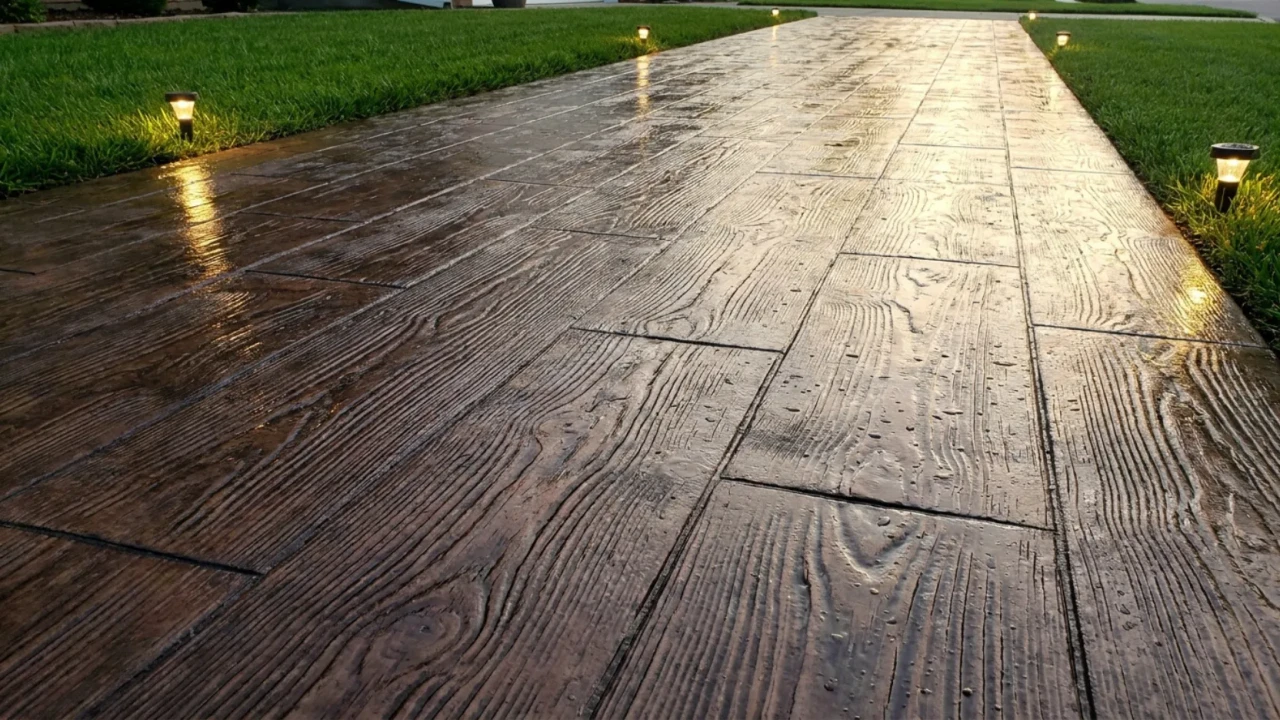
Any concrete contractor can show you photos of clean broom-finish slabs. What you need to see are stamped concrete driveways specifically with visible pattern consistency, color gradation, expansion joint placement, and edge detailing. Ask for photos taken at least two years after installation, not just fresh-pour photos, which always look better than the finished aged surface.
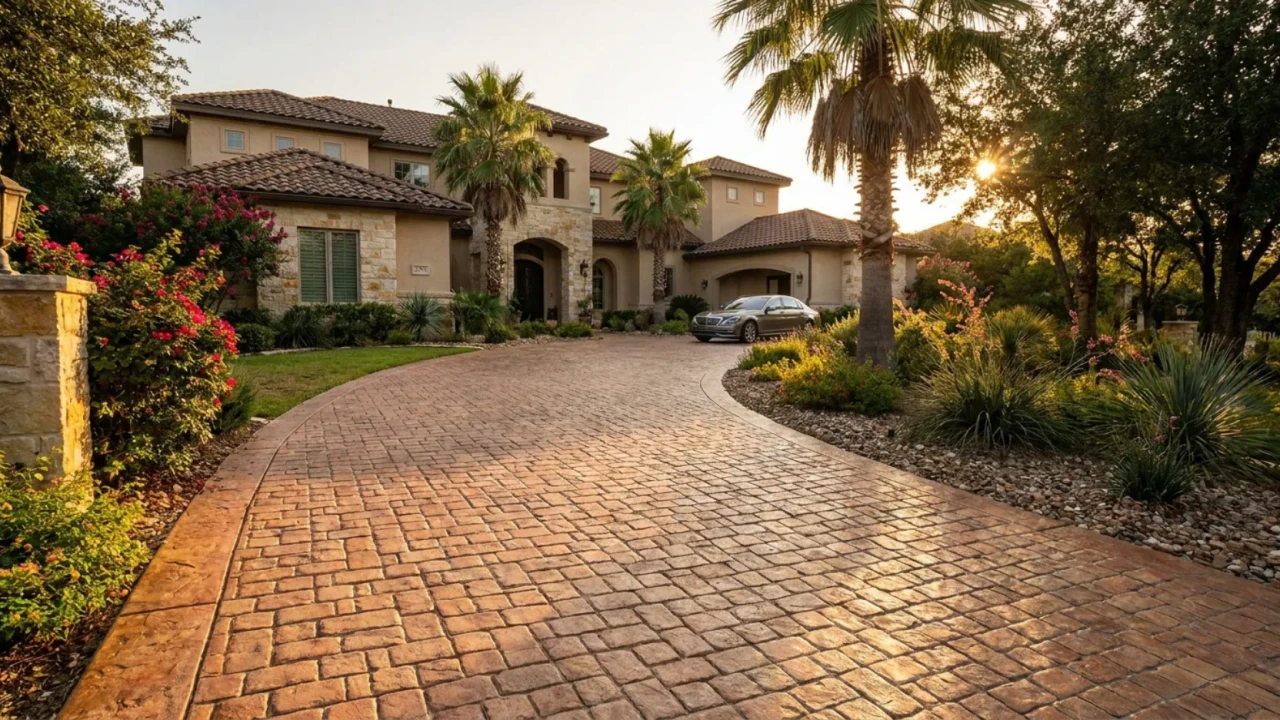
San Antonio's specific conditions matter here. Ask whether the contractor has done stamped driveway work on Bexar County's expansive Vertisol clay soils the same soil type that makes up most residential neighborhoods from Converse to Castroville. A contractor with only Hill Country limestone-soil experience may be underestimating the base preparation requirements your property needs.
Ask for at least three references from completed stamped concrete driveway jobs in San Antonio or the surrounding communities. Call them. Ask specifically whether the color is still consistent, whether there are any surface cracks, and whether the contractor returned promptly to address any early issues.
Visit a completed job in person if possible: Photos can be filtered, cropped, or taken right after the sealer was applied when everything looks glossy and perfect. Ask a contractor for one or two past clients whose homes you can drive by to see the finished driveway in real conditions. Most homeowners who are satisfied with their work are happy to show it off. If a contractor cannot or will not provide a single address to drive by, treat that as a significant warning sign.
- Stamped concrete driveway photos reviewed not just patio or sidewalk work
- Photos include aged examples (1 to 2 years post-installation), not just fresh pours
- Three references from San Antonio stamped driveway jobs contacted by phone
- References asked specifically about color consistency, cracking, and contractor responsiveness
- Drive-by visit to at least one completed stamped driveway in San Antonio confirmed
A quote that says "stamped concrete driveway 600 sq ft $11,400" tells you almost nothing about what you are actually buying. The difference between a 20-year driveway and a 5-year driveway is almost entirely in the preparation details that most low-ball quotes leave out. Every specification below should appear in writing before you sign.
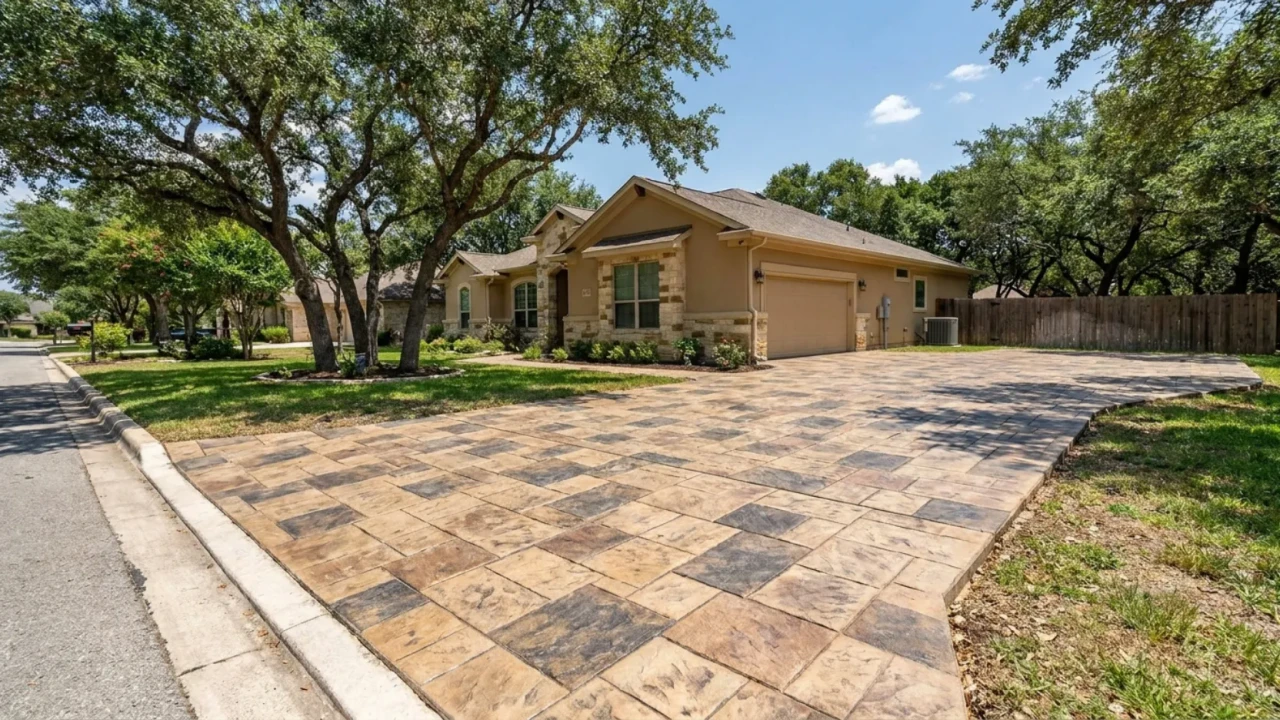
Pay close attention to base preparation depth. San Antonio's Blackland Prairie Vertisol clay is one of the most expansive soil types in the United States. Clay that is not properly excavated and replaced with a compacted crushed limestone base will shrink and swell with the seasons, cracking even a well-poured slab from below. This is the most common cause of early stamped driveway failure in Bexar County.
- Base preparation depth specified: 4 to 6 inches compacted crushed limestone
- Slab thickness specified: 5 inches minimum for a residential vehicle driveway
- Reinforcement specified: rebar grid with bar size and spacing, not wire mesh
- Control and expansion joint spacing specified: 8 to 10 feet
- Stamping pattern specified by name and stamp product number
- Base color and release color specified by manufacturer product code
- Sealer type, sheen level, and number of coats specified
- Texas 811 utility locate requirement acknowledged in the scope of work
The site visit is your interview of the contractor, not just their chance to measure the driveway. How a contractor answers these questions specifically and confidently, or vaguely and defensively tells you more than their quote or their marketing materials ever will.
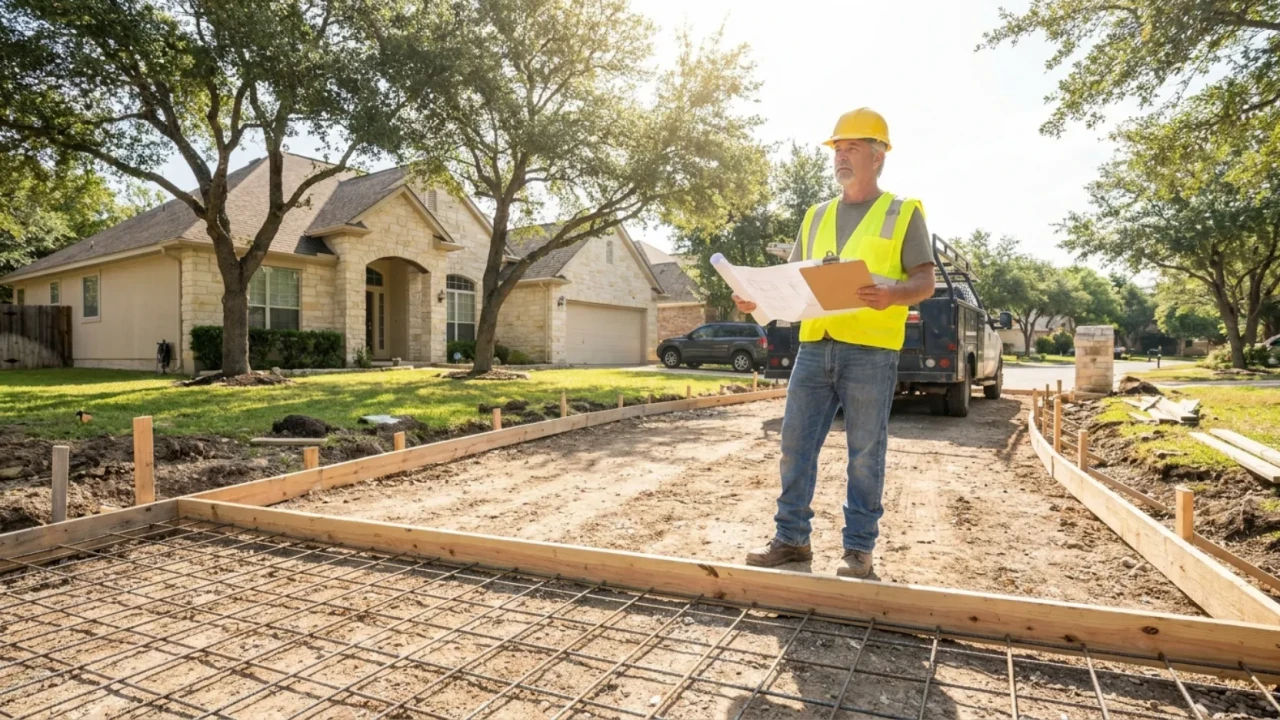
A contractor who knows San Antonio's Bexar County conditions will immediately notice things like nearby trees (root intrusion risk), soil color indicating clay content, existing drainage patterns, and whether the current driveway shows signs of base failure that need to be addressed before the new pour.
If a contractor walks your driveway in five minutes and produces a quote without asking about your drainage patterns, nearby trees, or existing soil conditions, they are quoting a generic job not your specific project.
| Question to ask | Strong answer | Concerning answer |
|---|---|---|
| How will you handle the clay soil under my existing driveway? | Excavate to a specified depth, proof-roll for soft spots, replace with compacted crushed limestone base | "We'll pour right over it" or "the existing base should be fine" |
| How do you schedule around San Antonio heat for the stamping window? | Early morning pours, retarder admixtures to extend working time, two or more experienced stampers on the crew | No specific plan; "we'll pour in the afternoon and stamp when it's ready" |
| How do you integrate control joints with the stamped pattern? | Joint locations are planned on paper before the pour, placed to follow pattern seams wherever possible | "We cut joints after it cures" with no mention of pattern alignment |
| What happens to the pattern at the border and edges? | A specific border detail usually a running bond brick edge or a smooth broom-finish border is discussed and agreed upon before work begins | "We'll figure it out on pour day" or no mention of edge detailing |
| Who actually does the stamping the owner or a subcontracted crew? | The stamping crew is the contractor's own experienced team; can name the lead stamper's years of experience | Work is subcontracted to a crew the contractor does not regularly work with |
| What is your curing process in summer heat? | Wet-cure with burlap or curing blankets for 3 to 5 days, or liquid curing compound applied immediately after finishing | "We spray water on it the first day and it's fine" |
After Winter Storm Uri and the 2021 freeze, San Antonio homeowners should ask any contractor about freeze-thaw resilience: Stamped concrete that was sealed with a non-breathable sealer, or poured too thin, was disproportionately damaged during freeze events because water trapped in the slab expanded and delaminated the surface. Ask your contractor what sealer they use and whether it allows vapor transmission. In normal San Antonio winters this is rarely an issue but a contractor who cannot answer the question at all is demonstrating a gap in their technical knowledge.
- Clay soil management plan confirmed: excavation depth, replacement material, compaction method
- Summer heat stamping plan confirmed: early pour time, retarder admixture, crew size
- Control joint and pattern alignment plan confirmed in writing
- Border and edge detail agreed upon before pour day
- Stamping crew identity confirmed contractor's own team, not a rotating subcontractor
- Curing process specified: wet cure or approved liquid curing compound, minimum 3 days
- Texas 811 call confirmed: utility locate required 48 hours before any excavation
In San Antonio's active residential construction market, there is no shortage of contractors willing to take stamped driveway jobs they are not qualified to complete correctly. The following warning signs appear consistently in cases where homeowners end up with a failed stamped driveway and no effective recourse.
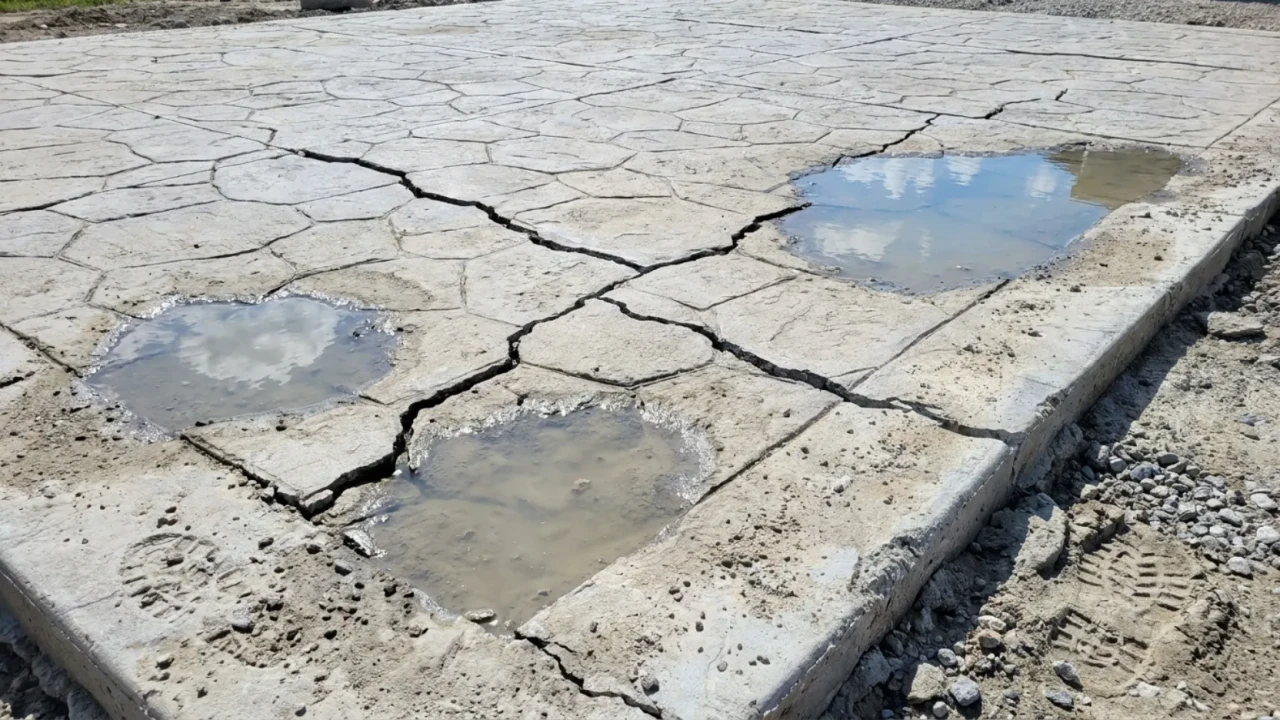
The storm-chaser approach is the most common. After heavy rainfall in Bexar County, crews will solicit driveway work door-to-door claiming they have leftover concrete from a nearby job and can give you a significant discount. At $3 to $5 per square foot for "stamped" concrete, these jobs are physically impossible to do correctly there is no profit margin left for proper base preparation, quality pigment systems, or sealing. You will receive a thin, unsealed slab with surface coloring that fades within one season.
- Contractor was not solicited door-to-door or via an unsolicited text or flyer
- Written quote received before any money changes hands
- Payment terms confirmed: partial deposit upfront, balance due at project completion
- Certificate of insurance in hand not a verbal assurance
- Color system confirmed as integral pigment in the concrete mix, not surface-applied color hardener only
- Price compared against multiple quotes significant outlier pricing investigated before accepting
A signed, detailed contract is your only enforceable protection if something goes wrong with a stamped driveway. Verbal agreements and text-message exchanges are not contracts. Do not start a project of this scale a stamped driveway typically runs $8,000 to $20,000 or more for an average San Antonio home without a signed document that specifies what was agreed.
- Signed written contract in hand before any deposit is paid
- Contract references the full written quote specifications by attachment
- Payment schedule confirmed: deposit at signing, balance at inspected completion
- Warranty terms stated in writing: coverage period, what is included, what is excluded
- Change order process defined in the contract
- Contractor's physical address, license or registration number, and insurance carrier listed in the contract
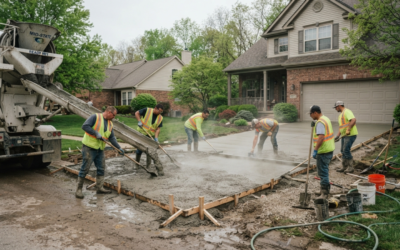
Most homeowners make the mistake of staying out of the way completely on pour day. You do not need to micromanage the crew and you should not but knowing the correct installation sequence lets you recognize when something is clearly going wrong before it sets permanently in the concrete.
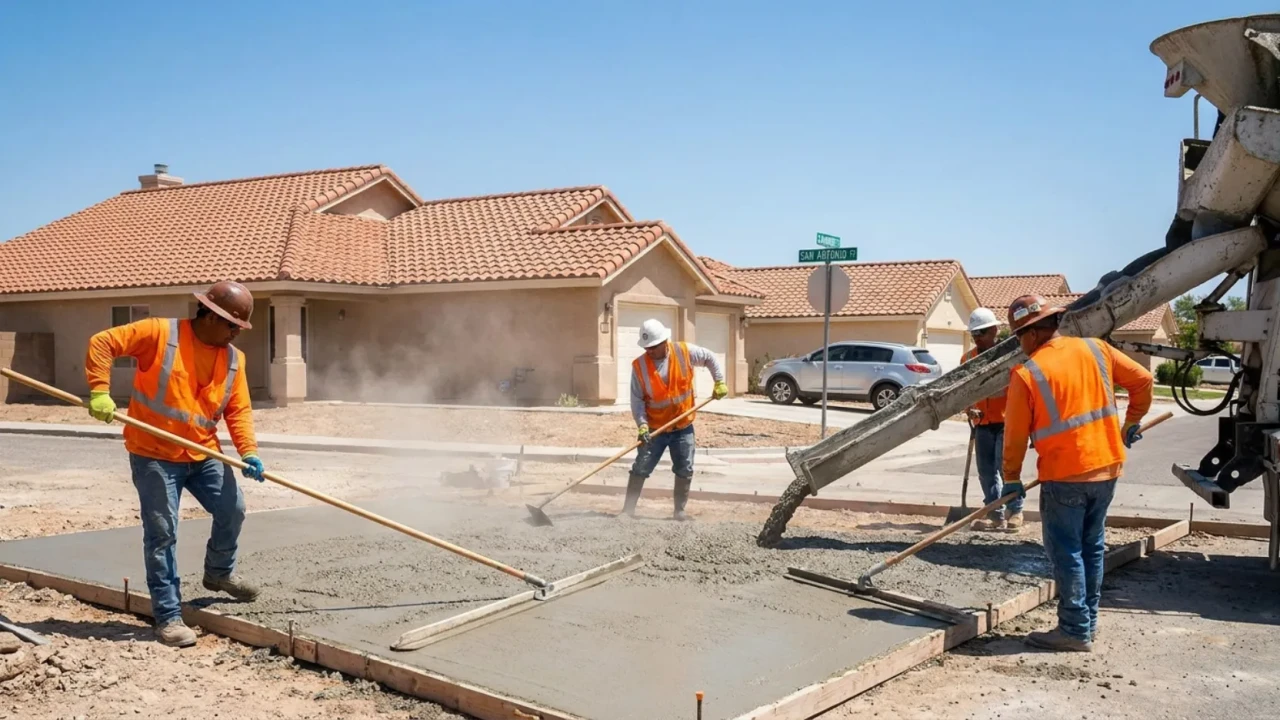
The day before the pour, forms should be set and the base should be fully compacted. If the crew shows up the morning of the pour and is still grading the base when the concrete truck arrives, that is a sign the prep timeline is being compressed which is where base quality problems begin.
In San Antonio's summer heat, the stamping window closes fast. An experienced crew will start early in the morning to buy time before the afternoon heat peak accelerates the set. If your contractor plans a noon concrete delivery for a full driveway stamping job in July, that is a significant concern the back section of the driveway may be setting before the front section is stamped, producing visible inconsistencies in impression depth.
The 28-day inspection: Walk the entire driveway with the contractor at the 28-day mark once the concrete has fully cured. This is when hairline shrinkage cracks, if any, will be visible, and when the sealer should be scheduled for application. Document the surface condition with photos on that day. Any structural issues pattern misalignment, unsealed areas, significant cracking beyond hairline should be raised at this walkthrough, not months later.
- Texas 811 utility locate completed and flags visible before any excavation
- Forms set and base compacted the day before not the morning of the pour
- Rebar in place and elevated off the base (chairs or standoffs visible) before pour
- Concrete truck delivery confirmed for early morning in warm months
- Stamping begins with border detail before main field pattern
- Curing compound or wet cure begins immediately after finishing
- Site cleaned up, debris and waste concrete removed, by end of day
- 28-day walkthrough scheduled with contractor at time of project completion
Understanding what a legitimate stamped driveway costs in San Antonio in 2026 helps you identify quotes that are missing scope not just contractor generosity. The ranges below reflect proper base preparation, reinforcement, stamping, and sealing as described in this guide. Quotes significantly below these ranges are almost always missing something.
| Typical driveway size | Standard stamped estimate | Premium stamped estimate |
|---|---|---|
| 400 sq ft (single car, shorter run) | $7,200 to $8,800 | $8,800 to $11,200 |
| 600 sq ft (standard two-car) | $10,800 to $13,200 | $13,200 to $16,800 |
| 800 sq ft (wider two-car with apron) | $14,400 to $17,600 | $17,600 to $22,400 |
| 1,000 sq ft (large driveway with turnaround) | $18,000 to $22,000 | $22,000 to $28,000 |
- Certificate of insurance received: current policy, $1M+ general liability, workers compensation confirmed
- Physical San Antonio or Bexar County business address verified
- Google Business or BBB listing reviewed for review history and complaint patterns
- ROW permit requirement checked for your specific driveway configuration and street connection
- Stamped concrete driveway photos reviewed specifically driveways, not just patios
- Aged photos (1 to 2 years post-installation) reviewed, not just fresh-pour shots
- Three references from San Antonio stamped driveway projects called and verified
- At least one completed stamped driveway from this contractor viewed in person or verified by drive-by
- Base depth specified: 4 to 6 inches compacted crushed limestone
- Slab thickness specified: 5 inches minimum for vehicle driveway
- Rebar grid specified by bar size (#3 or #4) and spacing (18-inch centers)
- Control and expansion joint spacing specified: 8 to 10 feet
- Stamping pattern specified by name and manufacturer product number
- Base color and release agent color specified by product code
- Sealer type, sheen level, and number of coats specified
- Texas 811 utility locate included in scope
- Signed written contract in hand before any deposit paid
- Contract references quote specifications by attachment
- Payment schedule confirmed: 30 to 50 percent deposit, balance at inspected completion
- Warranty terms stated in writing with coverage period and exclusions
- Change order process defined for any scope modifications
- Texas 811 locate confirmed 48 hours before excavation
- Base prep and forms scheduled for the day before the pour not the morning of
- Early morning pour start confirmed for summer projects
- Curing process specified and agreed upon: wet cure or approved liquid compound, minimum 3 days
- 28-day inspection walkthrough scheduled with contractor
- First sealer application scheduled at 28 to 30 days after pour
Get a free stamped driveway quote in San Antonio
Tell us about your driveway project size, pattern ideas, and timeline. We will visit your property, assess the existing conditions, and give you a detailed written quote at no cost or obligation.