
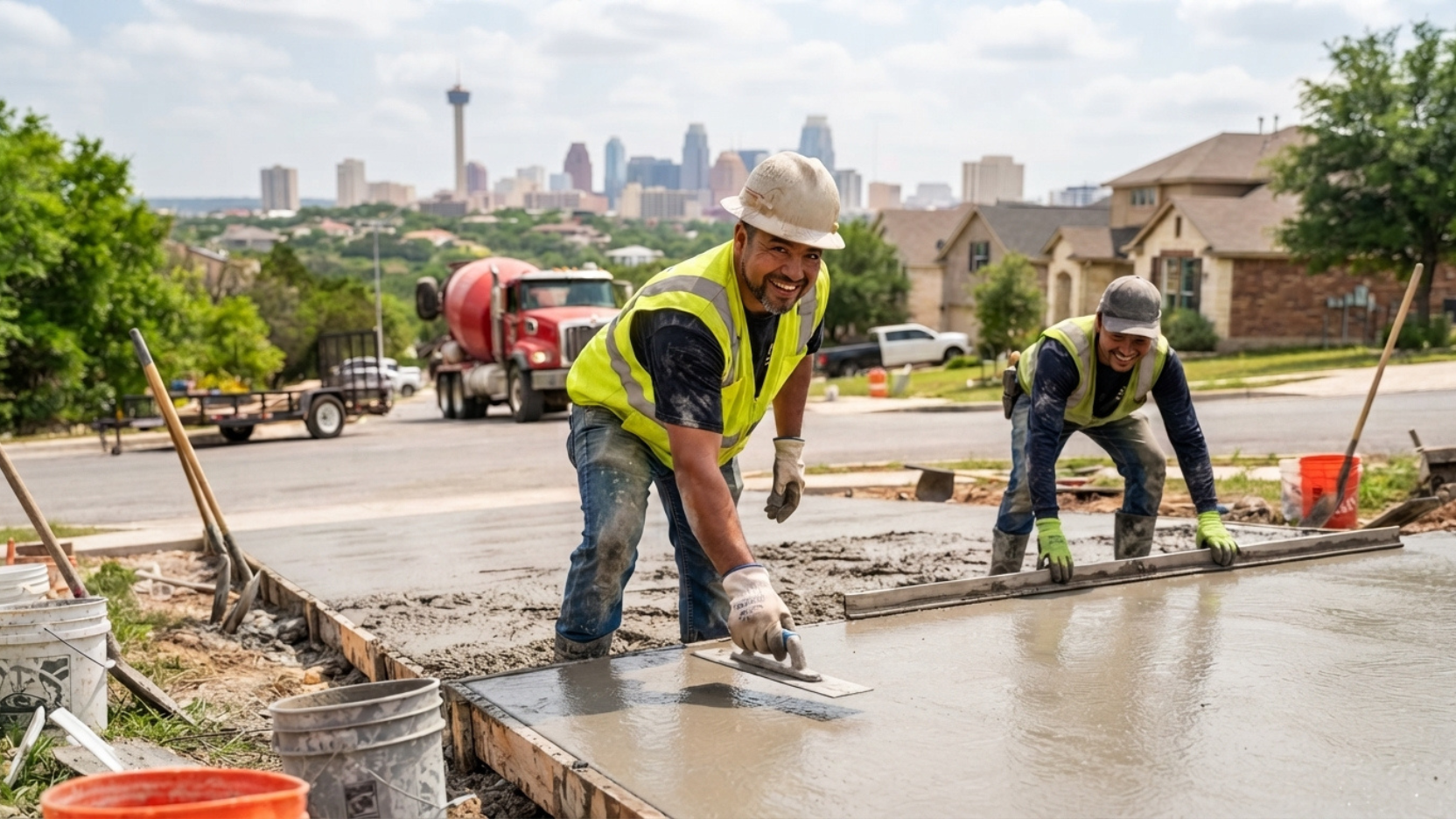
Finding a concrete contractor who is genuinely affordable is not the same as finding the cheapest bid. This guide shows San Antonio homeowners how to get quality concrete work done at a fair price in 2026 without cutting corners that cost more to fix later.
The word “affordable” gets used loosely in the San Antonio concrete market. Some contractors use it to mean genuinely competitive pricing built on efficiency and volume. Others use it to describe bids that leave out base preparation, use undersized slabs, or skip reinforcement entirely problems that will cost far more to repair than the money saved upfront.
This guide is for homeowners who want a real value: a well-installed concrete driveway, patio, or sidewalk at a price that reflects the actual San Antonio market in 2026, not an inflated premium or a dangerous low-ball. The difference between these two outcomes is almost entirely about how you hire.
In Bexar County, concrete work on a budget does not mean skimping on the structural components slab thickness, base preparation, and reinforcement. Those are the items that determine whether your concrete lasts 30 years or cracks within 5. What it does mean is hiring a contractor who prices fairly because of efficiency and local market knowledge, scheduling during the slower fall and winter months for better rates, right-sizing your project, and knowing which upgrades are genuinely worth paying for versus which ones are upsells. This guide covers all of it.
Market Rate
The single most effective thing a homeowner can do before hiring a concrete contractor is spend 30 minutes understanding what concrete work actually costs in San Antonio in 2026. Homeowners who go in without this knowledge are more likely to accept inflated quotes, get upsold on unnecessary upgrades, or more dangerously accept a low-ball bid without recognizing what was left out of the scope.
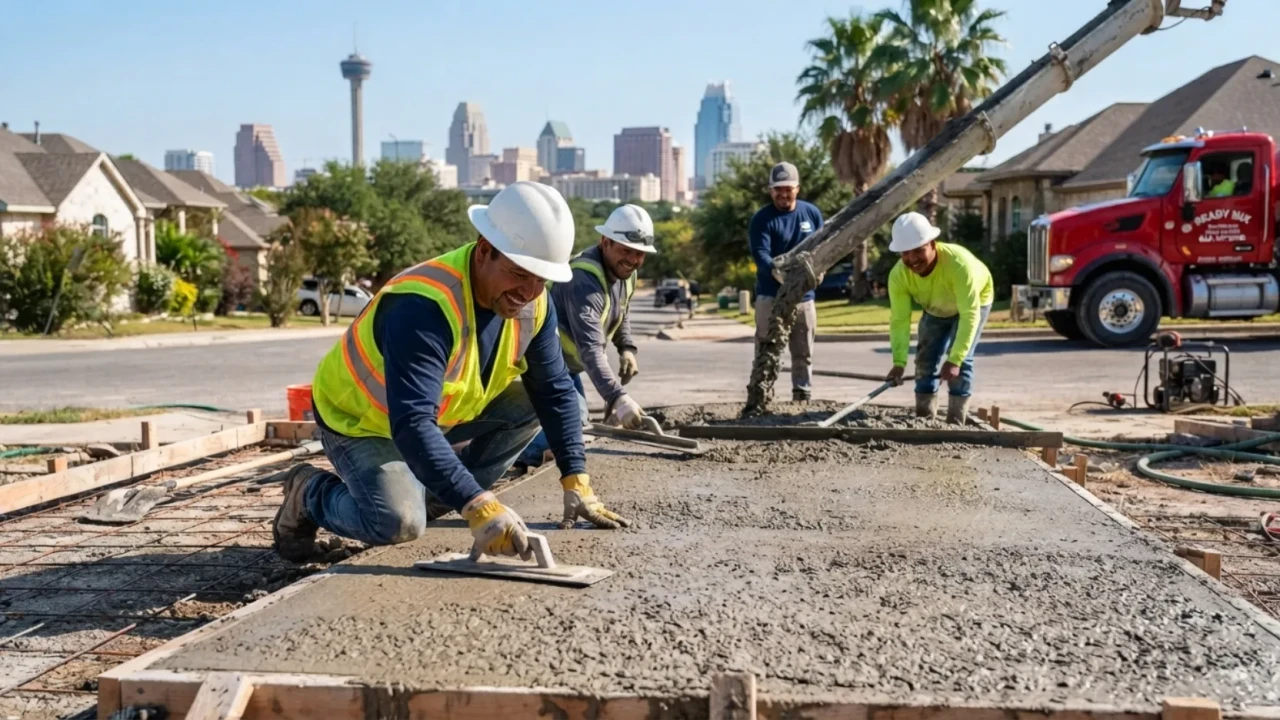
San Antonio concrete pricing in 2026 is consistently higher than what national cost calculators report. That gap exists because of three local factors: Blackland Prairie Vertisol clay soils require thicker slabs and deeper base preparation than most U.S. markets; Edwards Aquifer hard water requires careful concrete mix management; and 2026 labor and material costs in San Antonio reflect a construction market under significant demand pressure from the region’s continued population growth.
- Confirm what type of project you need and look up the San Antonio market rate for that specific scope before requesting quotes
- Treat any quote below $6 per sq ft for a standard residential driveway as a warning sign that requires close scrutiny
- Collect at least three written quotes to establish your own comparison baseline for your specific project
- Remember that demolition of an existing driveway adds $1.50 to $3.00 per sq ft on top of installation costs
Quote Comparison
The most common mistake San Antonio homeowners make when trying to save money on concrete work is choosing the lowest bid without confirming that all three quotes are for equivalent work. A bid of $5,800 versus $7,400 for the same driveway looks like a $1,600 saving until you discover that the lower bid excluded base preparation, used a 4-inch slab instead of 5 inches, and skipped rebar in favor of wire mesh. On Bexar County clay soil, that “saving” typically results in a cracked driveway within 4 to 6 years and a full replacement bill of $6,000 or more.
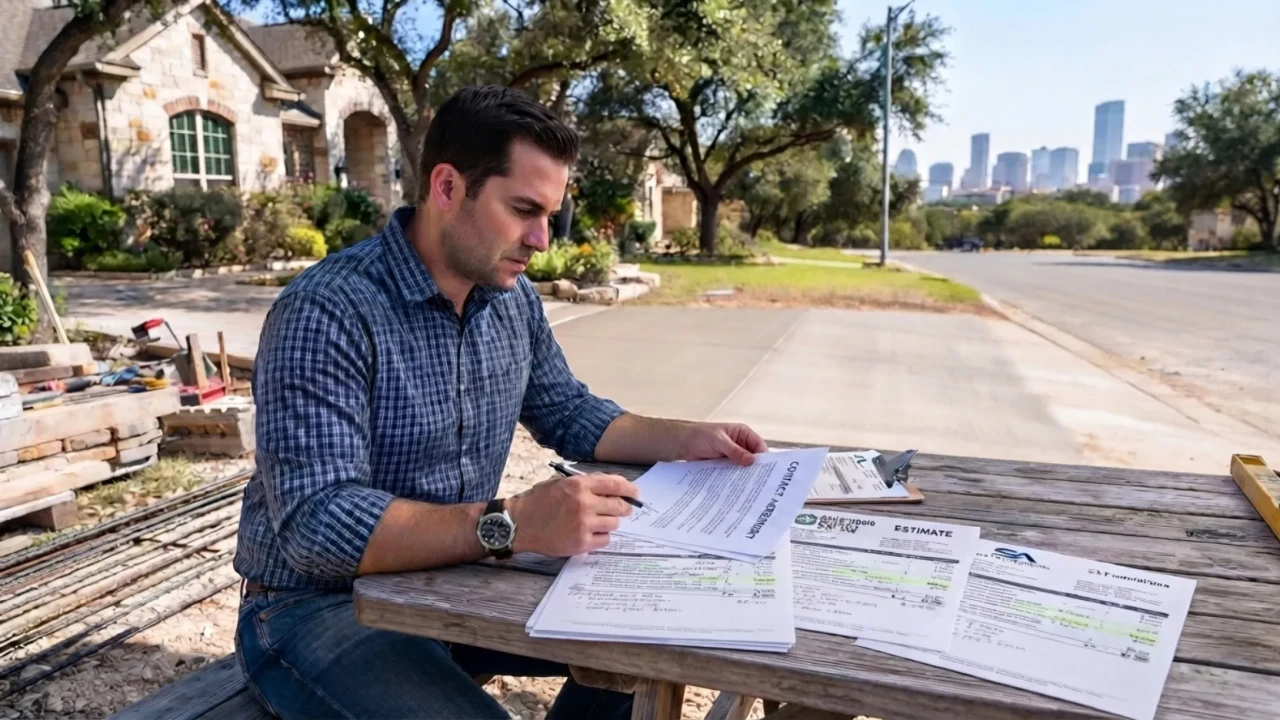
To compare quotes accurately, every bid needs to specify the same items in writing. When a contractor refuses to itemize or provides a single lump-sum number with no scope detail, that is itself a signal about how they operate. Reputable contractors in San Antonio are happy to break out line items because they are confident in what they are delivering.
| Quote line item | What to require in writing | Why it matters in San Antonio |
|---|---|---|
| Square footage | Exact area in sq ft being priced | Prevents scope creep or underbidding a smaller area than what is needed |
| Slab thickness | 5 inches minimum for driveways on clay soil | 4-inch slabs are the national minimum but undersized for Bexar County’s Vertisol clay movement |
| Reinforcement | Rebar grid (#3 or #4 at 18-inch centers) | Wire mesh alone is insufficient for driveways on expansive clay soils; rebar is the correct spec |
| Base preparation | 4 to 6 inches of compacted crushed limestone | San Antonio clay soils require a proper compacted base to prevent settlement and cracking |
| Expansion joints | Every 8 to 10 feet for driveways | Joints control where concrete cracks without them, cracks appear randomly across the slab |
| Demolition | Itemized separately if removing existing concrete | Demo and haul-away adds $1.50 to $3.00 per sq ft confirm whether it is included or extra |
Send the same written scope to all three contractors. Write out exactly what you need square footage, project type, finish preference, whether demo is required and send the identical description to each contractor. When every bid is priced against the same specifications, comparison becomes straightforward. You can see whether price differences reflect contractor efficiency, overhead levels, or actual differences in what is being proposed. This approach also protects you: when scope is in writing from the outset, there are no misunderstandings about what was agreed to before work begins.
- Send the same written project description to all three contractors so bids are comparable
- Confirm slab thickness is 5 inches in each quote reject any quote specifying only 4 inches without a technical explanation
- Confirm reinforcement type: rebar grid for driveways, not wire mesh alone
- Confirm base preparation is included and specifies compacted crushed limestone at 4 to 6 inches depth
- Identify whether demolition and haul-away is included or a separate line item in each bid
- Do not make a final decision on price alone evaluate scope, reputation, and insurance alongside the number
Contractor Vetting
Hiring an uninsured or unlicensed concrete contractor to save money is one of the most financially dangerous decisions a San Antonio homeowner can make. If a worker is injured on your property and the contractor carries no liability insurance, the claim can come back to your homeowner’s policy or to you personally. If the work fails and the contractor has dissolved or moved on, you have no recourse. The short-term price saving disappears instantly.
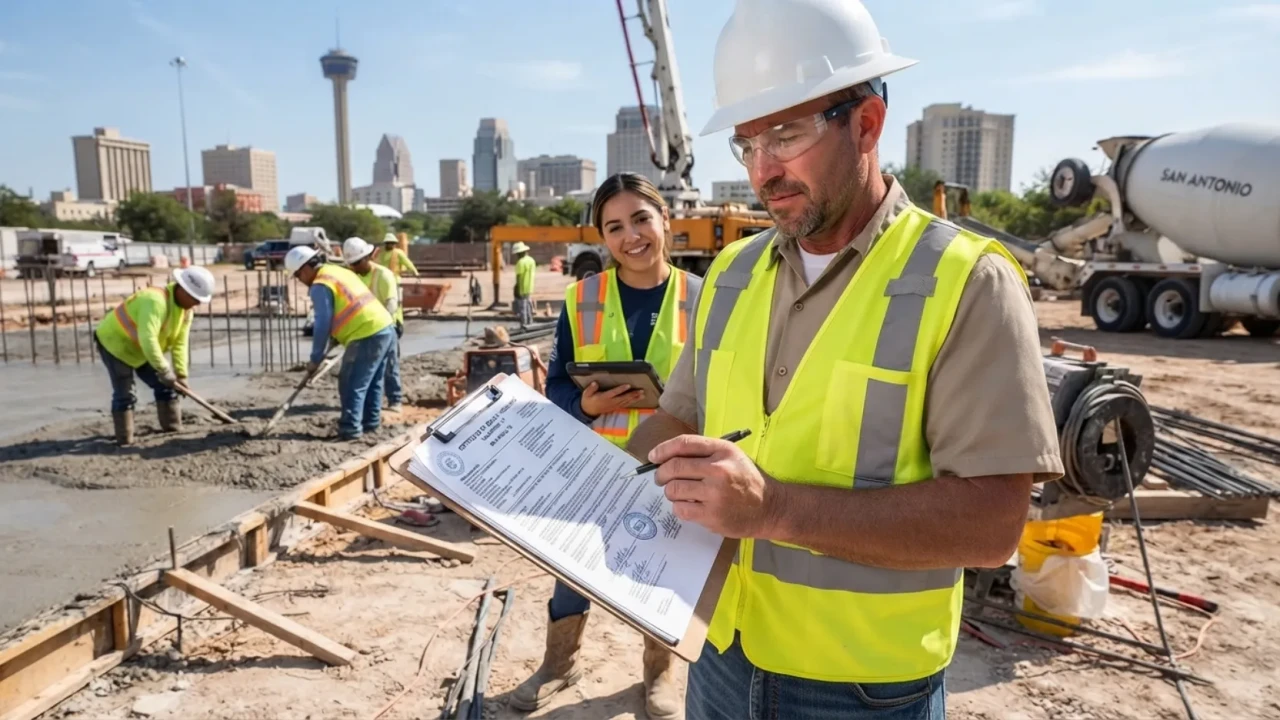
In San Antonio, concrete contractors are not required to hold a state contractor’s license the way plumbers or electricians are but the legitimate ones do carry general liability insurance at a minimum. Any reputable contractor will provide a certificate of insurance on request within 24 hours. If a contractor hesitates, makes excuses, or provides only a verbal assurance, that is a definitive sign to move on.
When checking references, ask specifically about projects similar in size and type to yours, and ask whether the contractor completed work on schedule, communicated clearly about any changes, and honored the original written quote. A contractor with a strong local reputation in San Antonio is one of the most reliable indicators of a good outcome often more predictive than price.
- Certificate of insurance received and reviewed $1 million or more general liability minimum
- Policy verified with the insurer directly a quick phone call confirms the certificate is current
- Local San Antonio or Bexar County business address confirmed not just a mobile number
- At least two recent local references contacted and confirmed the quality of completed work
- Online reviews checked across multiple platforms (Google, BBB, Yelp) look for patterns rather than single reviews
Seasonal Savings
Concrete contractor demand in San Antonio follows a predictable seasonal rhythm. Spring (March through May) is peak season contractors are booked 4 to 6 weeks out, pricing reflects that demand, and your leverage as a buyer is lowest. Fall (September through November) and winter (December through February) are consistently slower, and a reputable contractor who would not normally negotiate on price during peak season is often willing to work with homeowners who can offer a quick project start on a slower week.
| Season | Contractor demand | Pricing expectation | Concrete curing notes |
|---|---|---|---|
| Spring (Mar to May) | Peak 4 to 6 week backlog | Full market rate no negotiating leverage | Ideal temperatures for curing, high demand |
| Summer (Jun to Aug) | High 2 to 4 week backlog | Full market rate | Early morning pours required; curing compound essential in Texas heat |
| Fall (Sep to Nov) | Moderate 1 to 2 week backlog | 5 to 10 percent below peak | Best overall season excellent curing temps, lower demand |
| Winter (Dec to Feb) | Low often same-week scheduling | 10 to 15 percent below peak | San Antonio winters rarely disrupt pours; freeze events are brief and manageable |
The fall scheduling strategy in practice: Call contractors in early October and ask for a November or December start. Tell them you have a project ready to go and are looking for the best available pricing for a flexible schedule. Contractors who are approaching the slower winter months will often offer their best pricing to lock in work for that period. On a $6,000 to $8,000 project, a 10 to 15 percent reduction is $600 to $1,200 in real savings with no compromise on quality, spec, or crew. The concrete outcome in November is identical to April. You are only changing when you schedule, not what you get.
- If your project is not urgent, target a fall or winter start date for the best pricing in San Antonio
- Call contractors in September or October when they are still wrapping up summer work and starting to plan winter schedules
- Explicitly mention schedule flexibility when requesting quotes it signals you are a low-friction customer and may prompt better pricing
- Confirm the contractor’s curing management plan for summer pours if you cannot wait early morning starts and curing compounds are the standard
Smart Scoping
Budget-friendly concrete work is not just about hiring the right contractor at the right time of year. It is also about making smart decisions on scope. There are structural items that should never be cut regardless of budget, and there are finish and aesthetic options that are genuine optional upgrades. Knowing the difference is how you get a great concrete project at a fair price rather than a compromised one at a cheap price.
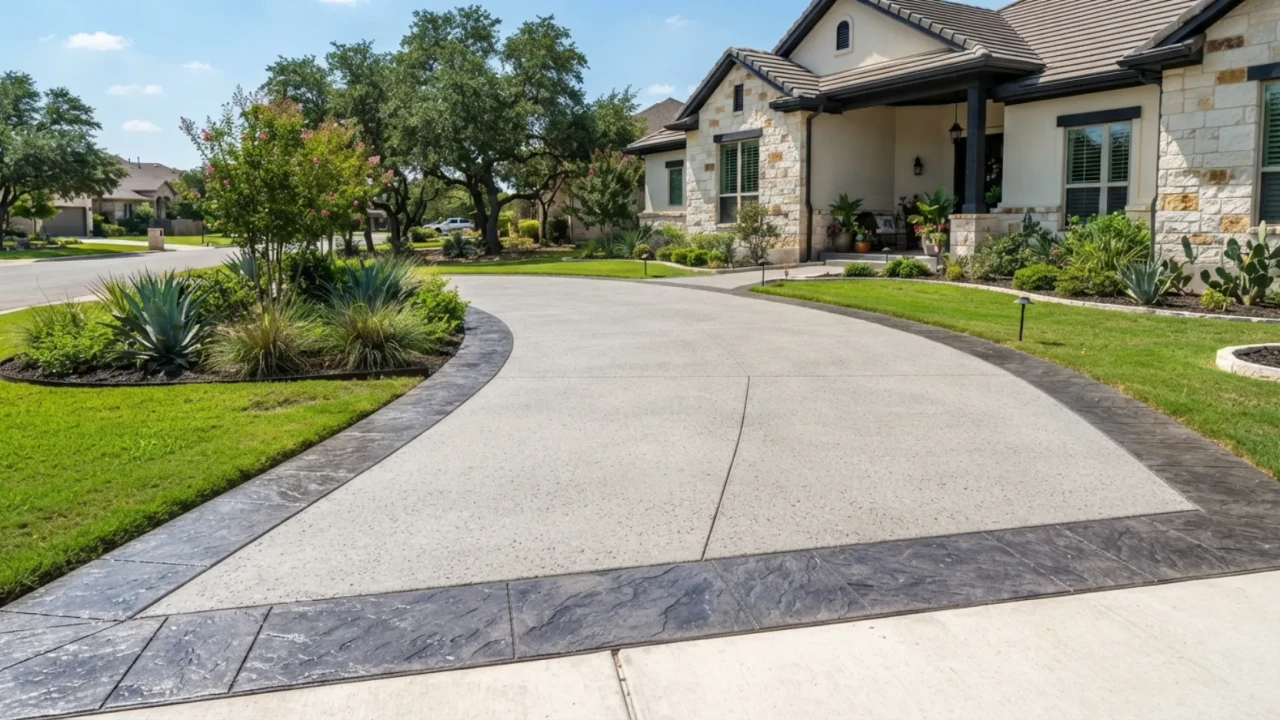
Items that should never be cut from a San Antonio concrete project: Slab thickness (5 inches for driveways on clay soil), rebar reinforcement, compacted crushed limestone base, and expansion joints are the structural foundation of any quality concrete installation in Bexar County. Cutting any one of these to reduce cost is a decision you will pay for usually within 5 years on San Antonio’s notoriously expansive Vertisol clay soils.
Items that are genuine optional upgrades: Stamped patterns, color work, exposed aggregate finish, decorative borders, and specialty sealers add visual appeal and some functional benefits, but they are not structural requirements. If budget is tight, a well-executed broom-finish driveway or patio built to proper spec will outperform a stamped surface that was installed on a compromised structural foundation.
- Confirm all structural items are included: 5-inch slab, rebar, limestone base, expansion joints these are not areas to cut
- Evaluate whether decorative finishes are a priority for your specific project or a nice-to-have that can wait
- Include first-application sealing in the project scope the cost-to-benefit ratio is strong
- Ask what the total cost reduction would be to go from a stamped finish to a broom finish on the same structural spec this is the clearest way to understand the premium you are considering
Red Flags
The San Antonio market like most active construction markets includes contractors who bid cheap because they are efficient and experienced, and contractors who bid cheap because they are cutting corners that will not be visible until the concrete starts to crack. Learning to tell these apart before signing a contract is the most valuable skill a homeowner can develop.
| Warning sign | What it likely means | What to do |
|---|---|---|
| Quote below $6 per sq ft for a residential driveway | Base preparation, slab thickness, or reinforcement has been left out of the scope | Ask for a full itemized breakdown before responding or rejecting |
| No certificate of insurance provided on request | Contractor is uninsured all liability risk falls on the homeowner | Do not proceed; move to the next contractor regardless of price |
| Door-to-door solicitation offering a low price due to “leftover material” | Storm-chaser crew with no local accountability or warranty | Decline politely and request a quote in writing through normal channels if interested |
| Demand for full payment before work begins | A deposit of 30 to 50 percent is standard; full upfront payment is not | Decline and ask for standard payment terms; a legitimate contractor will not insist on full prepayment |
| Verbal-only quote with no written scope | Scope disputes after the pour are common and difficult to resolve without written documentation | Request a written quote that specifies slab thickness, base prep, reinforcement, finish, and square footage |
| No local references or only out-of-area portfolio photos | Contractor may not have an established Bexar County track record | Request two recent local references and follow up with a phone call before hiring |
- Any bid below $6 per sq ft has been scrutinized line by line for what was excluded from scope
- Insurance certificate has been physically received and verified not just verbally confirmed
- Full upfront payment has not been agreed to standard terms are 30 to 50 percent deposit, balance on completion
- Written quote has been received before any verbal agreement or handshake deal
- Contractor has not proposed pouring over existing failed concrete without a clear and documented technical justification
- Project type and scope measured and documented: square footage, finish preference, whether demo is required
- San Antonio market rate confirmed for your specific project type and finish
- Three contractors identified with local Bexar County track records
- Identical written project description prepared to send to all three contractors
- Each quote specifies exact square footage, slab thickness (5 inches), reinforcement type, base prep material and depth, and finish
- Demolition and haul-away is either included or priced separately not omitted entirely
- Expansion joint spacing is stated: every 8 to 10 feet for driveways on San Antonio clay
- All three quotes are compared on equivalent spec not just the final number
- Certificate of insurance received from the selected contractor and verified with the insurer
- Local San Antonio or Bexar County business address confirmed
- At least two recent local references contacted and provided positive feedback
- Payment terms confirmed: deposit of 30 to 50 percent upfront, balance on completion
- Project scheduled for fall or winter if not time-sensitive, to take advantage of 10 to 15 percent seasonal pricing reduction
- Structural non-negotiables confirmed in the quote: 5-inch slab, rebar, limestone base, expansion joints
- Decorative finish decision made with a clear understanding of what it adds versus what a broom-finish saves
- First sealing application included in project scope or scheduled for 28 to 30 days after the pour
What is a fair price for a concrete contractor in San Antonio in 2026?
How do I find a reputable affordable concrete contractor in San Antonio?
Is it safe to hire a concrete contractor who approaches me door-to-door in San Antonio?
Can I negotiate the price of concrete work in San Antonio?
Why does San Antonio concrete work cost more than what I see on national websites?
Get a free concrete quote in San Antonio
Tell us about your project driveway, patio, sidewalk, or pool deck. We will visit your property, assess the site, and give you a detailed written quote at no obligation.