
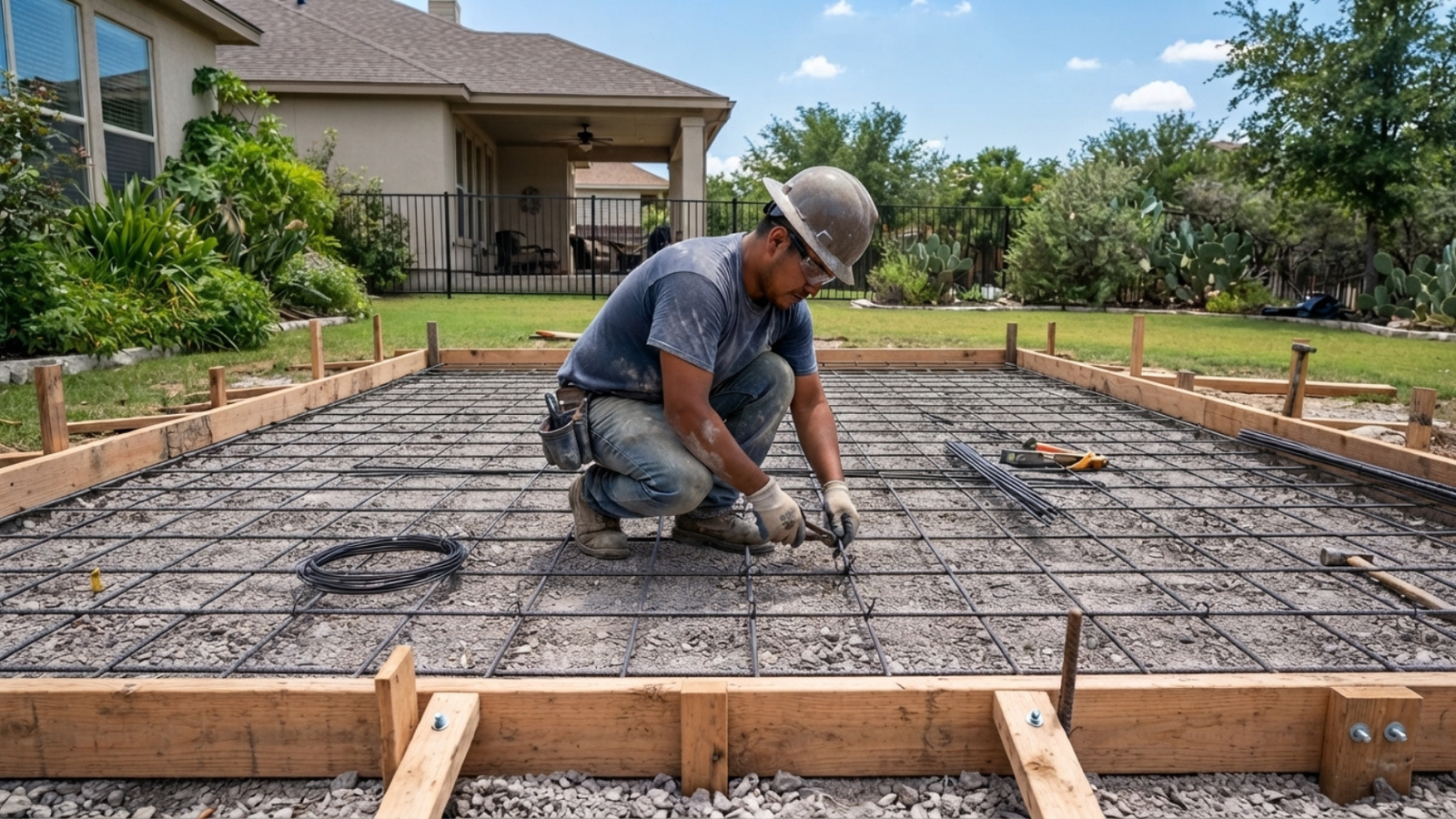
Hiring a concrete contractor in San Antonio should not feel like a gamble. This complete guide walks you through every stage from the first phone call to the final sealed surface so you know exactly what a qualified residential concrete contractor looks like, what they should deliver, and which red flags to walk away from before signing anything.
Most San Antonio homeowners hire a concrete contractor once every 10 to 20 years when a driveway needs replacing, a patio gets added, or a sidewalk heaves. Without regular experience evaluating these bids and watching crews work, it is genuinely difficult to know whether a contractor is doing the job right or cutting corners that will show up as cracks three years from now.
This guide gives you the framework that experienced property owners and commercial project managers use when vetting concrete contractors. It covers every stage: how to evaluate quotes, what specifications a professional contractor should provide without being asked, what actually happens on installation day, and what you should expect and demand after the work is done. Everything here is calibrated to San Antonio’s specific soil conditions, climate, and 2026 pricing.
The difference between a residential concrete driveway that lasts 30 years and one that starts cracking in year four is almost never the price you paid. It is almost always the base preparation, reinforcement placement, and concrete mix specification three things a budget contractor will skip to win a low bid, and three things that are impossible to fix after the slab is poured. This guide teaches you how to spot these differences before any work begins, while there is still time to change contractors or demand a better spec.
Contractor Vetting
Vetting a contractor before the quote saves you from investing time evaluating a bid from someone who should never have been contacted in the first place. There are four things every San Antonio homeowner should confirm before scheduling a site visit: insurance documentation, verifiable local presence, references from completed Bexar County projects, and a willingness to provide written specifications rather than verbal estimates.
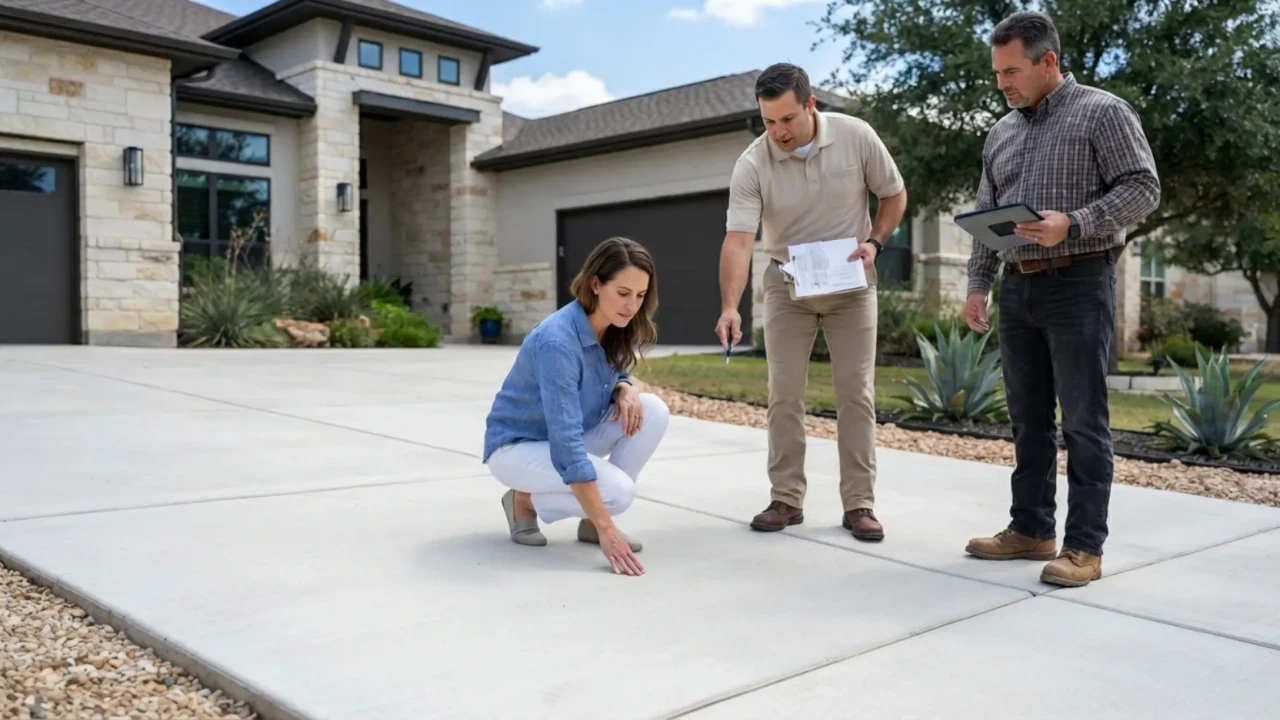
Insurance verification is not optional and should take less than five minutes. Ask any contractor you are considering to email you a certificate of insurance before the site visit. A legitimate contractor will provide this without hesitation. You are looking for general liability coverage of at least $1 million, plus workers compensation coverage if they employ crews rather than working solo. If a contractor tells you they are covered but cannot produce a certificate, do not schedule the visit.
Local presence matters in San Antonio for a reason that goes beyond accountability. Bexar County’s Blackland Prairie Vertisol clay soil behaves differently from soils in most other Texas cities. A contractor who primarily works in Houston or Austin may not have the local experience needed to properly account for San Antonio’s unique base preparation requirements, drainage slopes, or the control joint spacing that the clay movement demands.
- Certificate of insurance requested and received before scheduling site visit $1M general liability minimum
- Workers compensation coverage confirmed if contractor employs a crew
- Local San Antonio or Bexar County business address verified not a PO box
- References from completed projects in the last 12 months requested
- Business reviews checked across at least two platforms (Google, BBB, Yelp) for pattern of recent feedback
- Contractor confirmed to be familiar with San Antonio soil conditions and local permit requirements
Quote Review
A quote that says “concrete driveway $4,500” tells you almost nothing. The cost of a residential concrete driveway in San Antonio varies by a factor of two or three depending on slab thickness, base depth, reinforcement type, and finish. A quote with no specifications is an invitation for a contractor to build whatever is cheapest after you have already agreed to a price. Every residential concrete quote should contain specific written answers to the following questions before you sign.
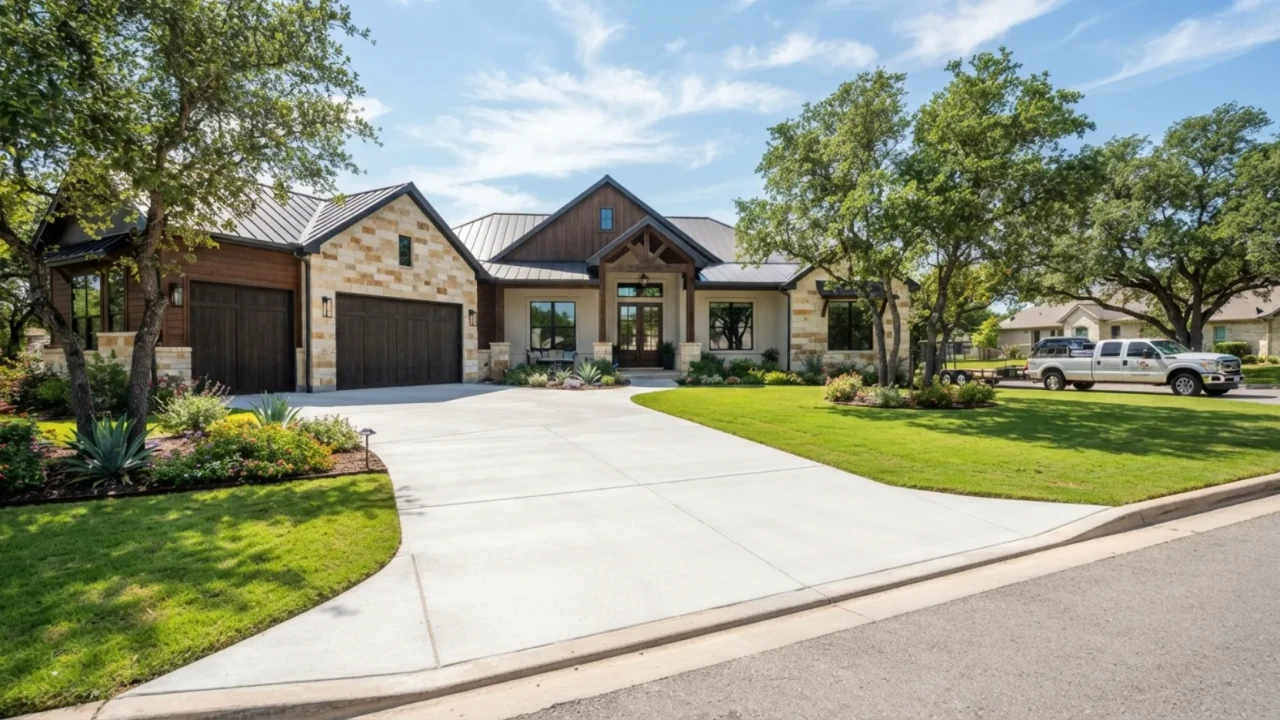
The five specification items that belong in every residential concrete quote are: slab thickness in inches, base preparation depth and material, reinforcement type and placement method, concrete mix PSI, and finish type with sealing schedule. If any of these items is missing from a written quote, ask the contractor to add it. A contractor who resists putting specifications in writing is telling you something important about how they work.
| Quote item | What a strong quote says | What a weak quote says |
|---|---|---|
| Slab thickness | “4-inch slab minimum; 5-inch recommended for Bexar County soil conditions” | “Standard thickness” or no mention at all |
| Base preparation | “Excavate and compact 4 to 6 inches of crushed limestone base before pour” | “Prep work included” with no depth or material specified |
| Reinforcement | “#3 rebar at 18-inch centers on plastic chairs at mid-slab depth” | “Reinforced concrete” with no type, size, or spacing |
| Concrete mix | “3,000 PSI minimum from local San Antonio ready-mix supplier” | No mention of PSI or concrete grade |
| Control joints | “Control joints cut or formed every 8 to 10 feet to control cracking” | No mention of joint spacing |
| Sealing | “First sealer applied at 28 days after pour; type and product specified” | “Sealed” with no timeline or product type |
| Payment terms | “30% deposit at contract signing, 70% upon completion and homeowner inspection” | Full payment required before work begins |
| Timeline | “Pour scheduled for [date]; no foot traffic for 48 hours; vehicle traffic after 7 days” | “We’ll start soon” with no committed date |
The single best question to ask when comparing two quotes that are far apart in price: “Can you tell me exactly what is different between your spec and the higher quote I received?” A good contractor will walk you through the differences directly and honestly. A contractor who deflects, talks about experience over specifications, or says “our mix is just as good” without being able to explain why the price is lower is signaling that the difference lies in the spec and the spec difference will show up in your driveway within a few years.
- Slab thickness written as a specific inch measurement “standard” is not acceptable
- Base preparation depth and material specified: 4 to 6 inches compacted crushed limestone for Bexar County
- Reinforcement type, bar size, and spacing confirmed in writing
- Concrete PSI minimum stated: 3,000 PSI minimum for residential driveways in San Antonio
- Control joint spacing included in scope of work
- Finish type and sealing schedule confirmed in quote
- Payment terms written: partial deposit before work, balance on completion
- Pour date and traffic restriction timeline included
Site Prep
For a residential concrete project, site preparation is the most important phase of the entire job and the phase most homeowners never see because it happens before the concrete truck arrives. Poor base preparation on San Antonio’s expansive Blackland Prairie Vertisol clay is the primary cause of premature concrete cracking, slab heaving, and surface failure in Bexar County. The concrete itself is often fine. The ground beneath it is what causes the problem.
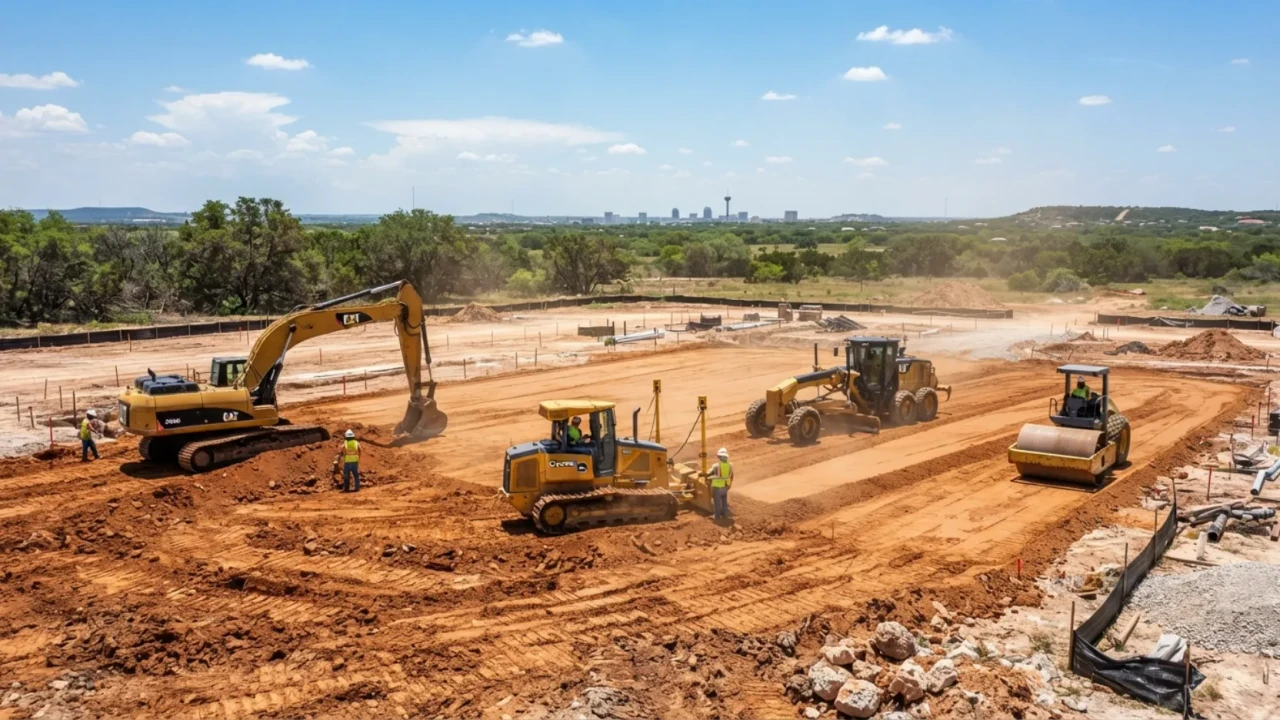
Proper site preparation for a residential concrete driveway in San Antonio begins with excavation to the correct depth typically 8 to 10 inches below final surface grade to accommodate both the slab thickness and the base layer beneath it. The native clay is then compacted with mechanical equipment, not hand tamping. Over that compacted clay goes 4 to 6 inches of crushed limestone base material, which is itself mechanically compacted in lifts before forms are set.
This process typically takes most of a day before the pour date. If a crew arrives, sets forms, and pours concrete on the same day, they almost certainly skipped meaningful base preparation. On stable sandy or loam soils, this might be acceptable. On Bexar County Vertisol clay, it is a guarantee that the slab will crack within a few years as the clay swells and shrinks beneath an inadequately prepared base.
The drainage slope requirement is often overlooked by residential contractors who do not do foundation or civil work. Every concrete surface adjacent to a home must slope away from the structure at a minimum of 1/8 inch per foot to direct water away from the foundation. In San Antonio’s Flash Flood Alley environment, where a single storm event can dump 3 to 4 inches of rain in two hours, a flat or improperly sloped driveway or patio creates conditions that accelerate foundation problems and basement or crawl space moisture issues.
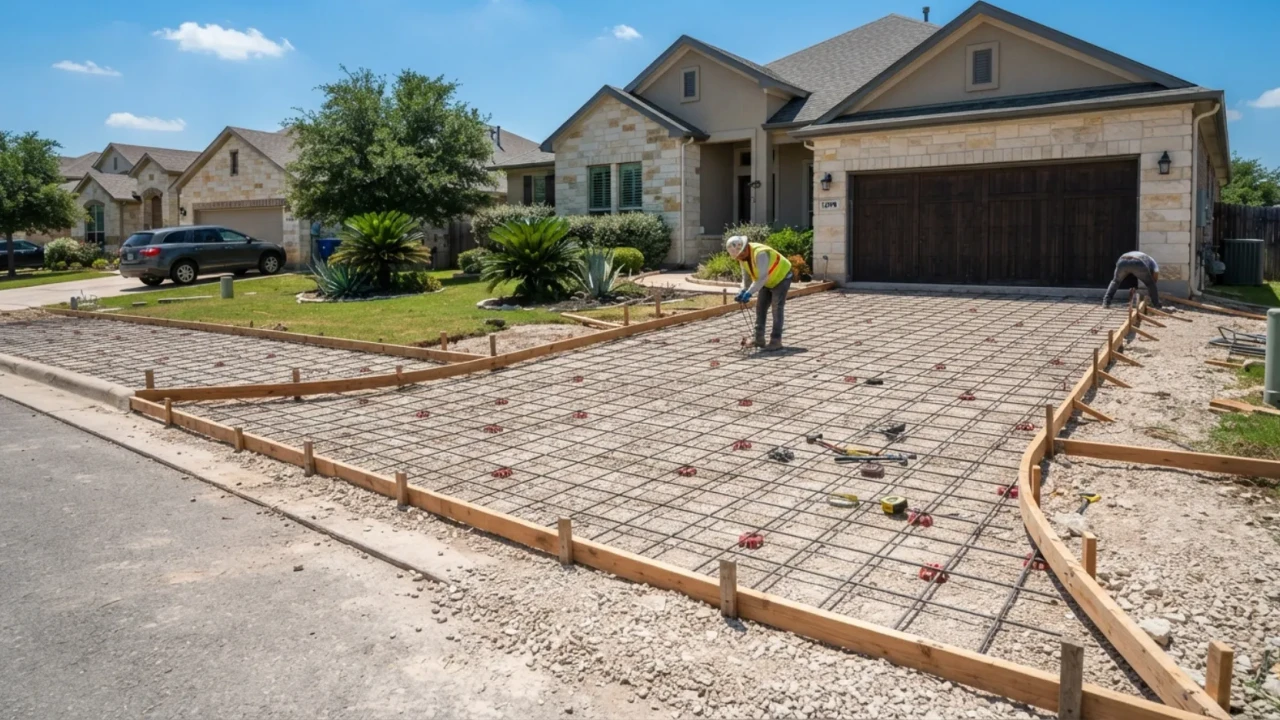
Reinforcement placement is the other critical site prep item. Rebar or welded wire mesh placed flat on the ground even on a properly prepared base provides almost no structural benefit. Steel reinforcement must be elevated to the center-third of the slab to resist the tensile forces created when the ground moves beneath the concrete. On a 4-inch slab, that means the reinforcement should be suspended at 1.5 to 2 inches from the bottom using plastic chairs or concrete donut supports.
Ask your contractor specifically how they plan to achieve correct reinforcement elevation. “We kick it up during the pour” is not an acceptable answer this method consistently results in reinforcement that settles to the bottom of the slab before the concrete stiffens, providing minimal benefit in exactly the locations where it is most needed.
- Excavation depth confirmed before forms are set: 8 to 10 inches below finished grade for a 4 to 5-inch slab with proper base
- Base material type and depth confirmed: 4 to 6 inches compacted crushed limestone for Bexar County clay conditions
- Mechanical compaction of both native clay and base material confirmed hand tamping is not adequate for residential driveways
- Forms set at correct drainage slope: 1/8 inch per foot minimum away from any structure
- Reinforcement elevation method confirmed: plastic chairs or concrete supports, not kicked up during pour
- Base prep day and pour day confirmed as separate calendar days for any project over 200 square feet
Pour Day
Pour day is the fastest-moving phase of any residential concrete project. Once the ready-mix truck arrives, the crew has a limited working window typically 90 minutes to 2 hours in San Antonio summer conditions, and up to 3 to 4 hours on cooler days to place, screed, float, and finish the entire slab. Knowing what the correct sequence looks like helps you identify problems while there is still time to address them.
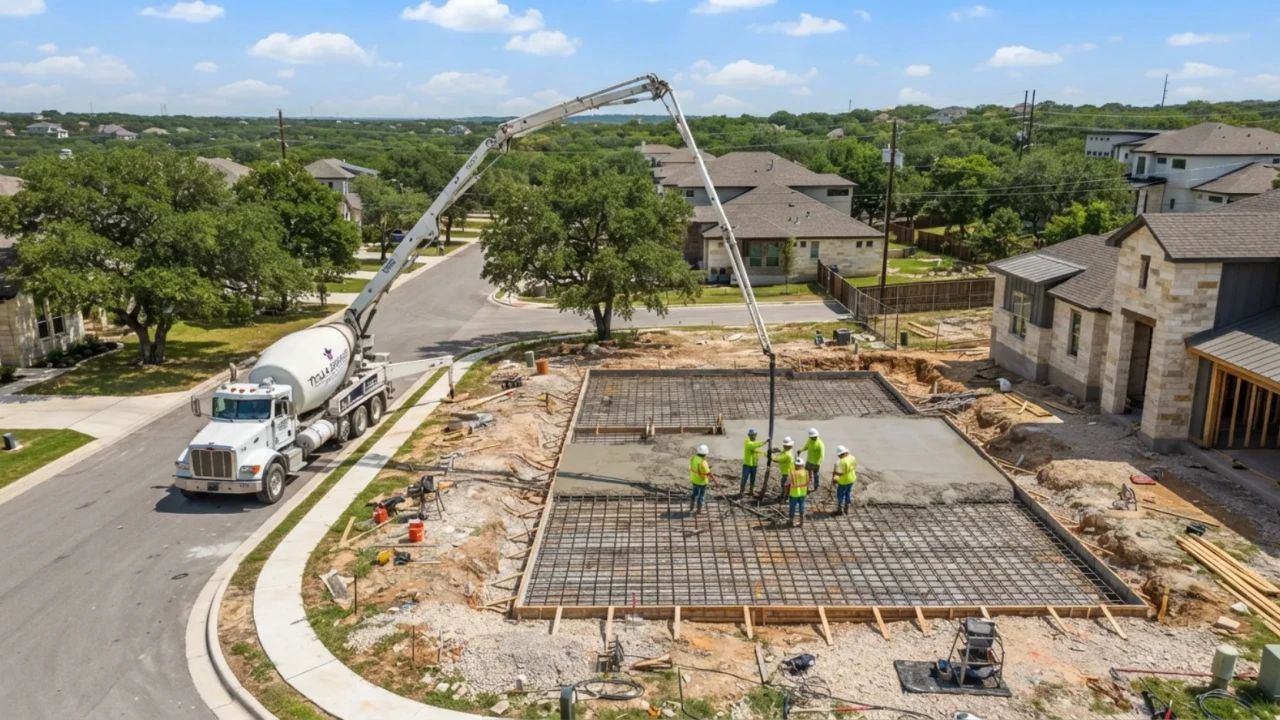
Start time matters in San Antonio. Summer concrete pours should begin no later than 7 AM. A crew that arrives at 10 AM in July or August is starting during the hottest part of the day, which accelerates set time and reduces their working window for finishing particularly for any stamped or decorative work. Early morning starts are standard practice for experienced San Antonio concrete contractors. If your contractor schedules a summer pour for late morning, that is worth raising before the truck rolls.
Water additions at the truck are a red flag. Ready-mix concrete arrives at a specific water-to-cement ratio calibrated for the ordered PSI strength. Adding water at the job site to make the mix more workable reduces that strength potentially significantly. A small addition might drop a 3,000 PSI mix to 2,500 PSI. If you see a contractor adding significant amounts of water to the mix at your job site, ask them to stop and explain why it is necessary.
| Pour day sequence | What you should see | Warning sign |
|---|---|---|
| Truck arrival and placement | Concrete placed directly into forms; crew spreads and screeds level immediately | Excessive water added to truck drum before or during discharge |
| Screeding | Straight board pulled across forms to level and consolidate concrete at correct grade | Skipping screed and using only rakes to roughly level uneven surface results |
| Bull floating | Large float worked across surface to embed aggregate and close surface voids | Moving to finishing too quickly before bleedwater evaporates |
| Finishing | Broom, stamp, or trowel applied at correct time based on surface moisture | Finishing while bleedwater is still visible weakens surface layer |
| Control joints | Cut or formed at planned spacing (every 8 to 10 feet) within first 12 to 24 hours | Joints not cut until days later, or skipped entirely |
| Curing | Wet curing, curing blanket, or liquid curing compound applied immediately after finishing | Crew leaves without any curing treatment in summer heat |
Curing concrete in San Antonio’s summer heat requires active management. Concrete cures through a chemical reaction called hydration not simply by drying. If a freshly poured slab dries too quickly in 95 to 100-degree summer temperatures, the hydration reaction stops before full strength is reached, producing a weaker and more porous surface than the specified mix would normally deliver. A responsible contractor will wet-cure the slab for 3 to 5 days after the pour, apply a plastic sheeting cover, or use a liquid curing compound sprayed on the surface immediately after finishing. Ask specifically what curing method will be used on your project before pour day.
- Pour start time confirmed: no later than 7 AM for summer pours in San Antonio
- No significant water additions observed at the truck during discharge
- Screed and bull float used to properly level and consolidate slab before finishing
- Finishing not begun while bleedwater is still visible on the surface
- Control joints cut or formed at specified spacing on the same day as the pour
- Curing method confirmed and applied immediately after finishing: wet cure, blanket, or liquid compound
- No foot traffic on new slab for 48 hours; no vehicle traffic for 7 days
Post-Pour
Most San Antonio homeowners think concrete is “done” when the crew leaves the job site. In reality, the 28 days following the pour are a critical performance window. The chemical curing process continues for the entire first month, progressively increasing the slab’s strength. Foot traffic is typically safe after 48 hours. Vehicle use should wait 7 days. But full structural strength and the correct time to apply the first sealant does not arrive until 28 days after the pour.
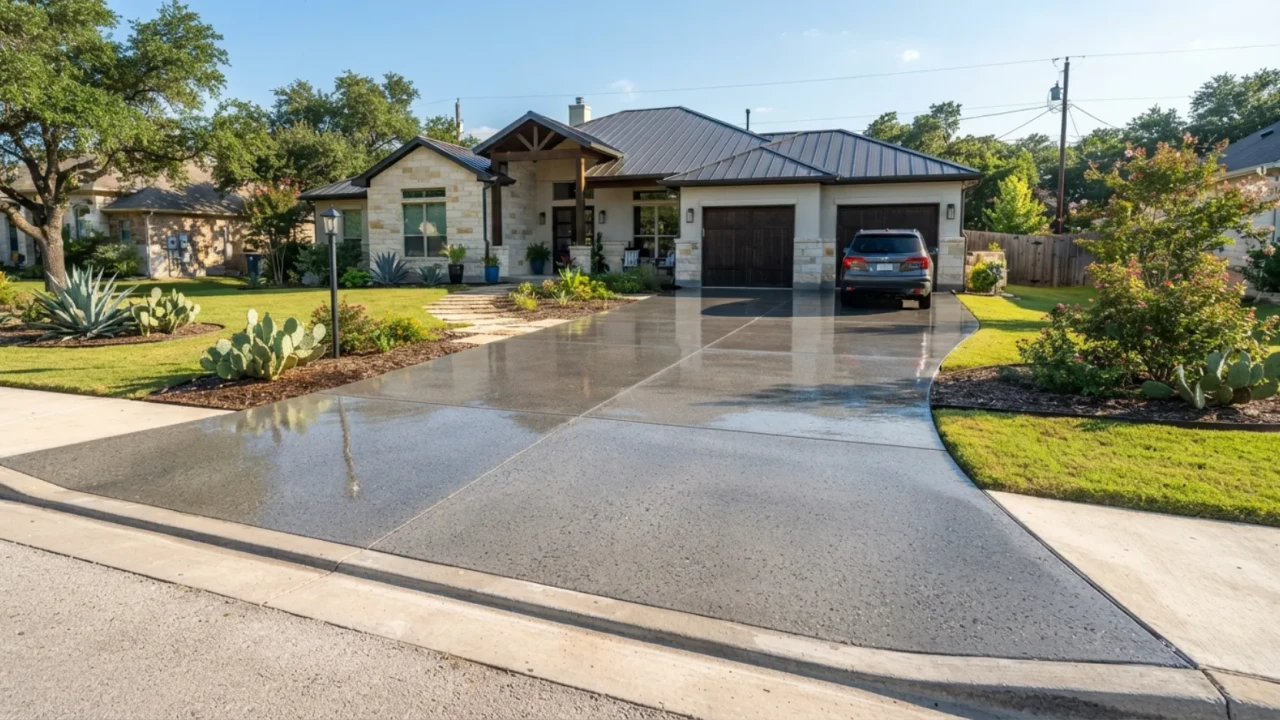
Sealing at 28 to 30 days is the most important maintenance step a San Antonio homeowner can take. Concrete is porous without a sealer, it absorbs water from Flash Flood Alley storms, Edwards Aquifer hard water mineral deposits, oil drips from vehicles, and the alkaline compounds that leach from Bexar County clay soil when wet. Texas UV intensity also degrades unsealed concrete surfaces faster than in Northern states.
For a standard broom finish residential driveway, a quality penetrating silane-siloxane sealer applied at 28 days provides 3 to 5 years of protection before reapplication is needed. For stamped or stained decorative concrete, an acrylic topcoat sealer provides UV protection and color enhancement but requires reapplication every 2 to 3 years. Ask your contractor what type of sealer is included in the project scope and request the product name so you can verify it is appropriate for the finish type.
- 48-hour no-traffic period observed after pour; foot traffic only after that until 7-day mark
- No vehicle use until 7 full days after pour; heavy vehicles wait for 28-day full cure
- Contractor return visit for sealing scheduled at 28 to 30 days post-pour
- Sealer product type and name documented for future reapplication reference
- Resealing calendar set: every 2 to 3 years for decorative, every 3 to 5 years for standard broom
- Water bead test performed annually to assess sealer condition
- Any cracks wider than 1/4 inch or with vertical displacement assessed by a contractor, not just filled
Red Flags
San Antonio’s residential concrete market is large and competitive, which means it attracts both skilled, established contractors and opportunistic operations that produce substandard work and disappear before problems become apparent. The following patterns appear consistently in Bexar County homeowner complaints and are worth knowing before you start collecting quotes.
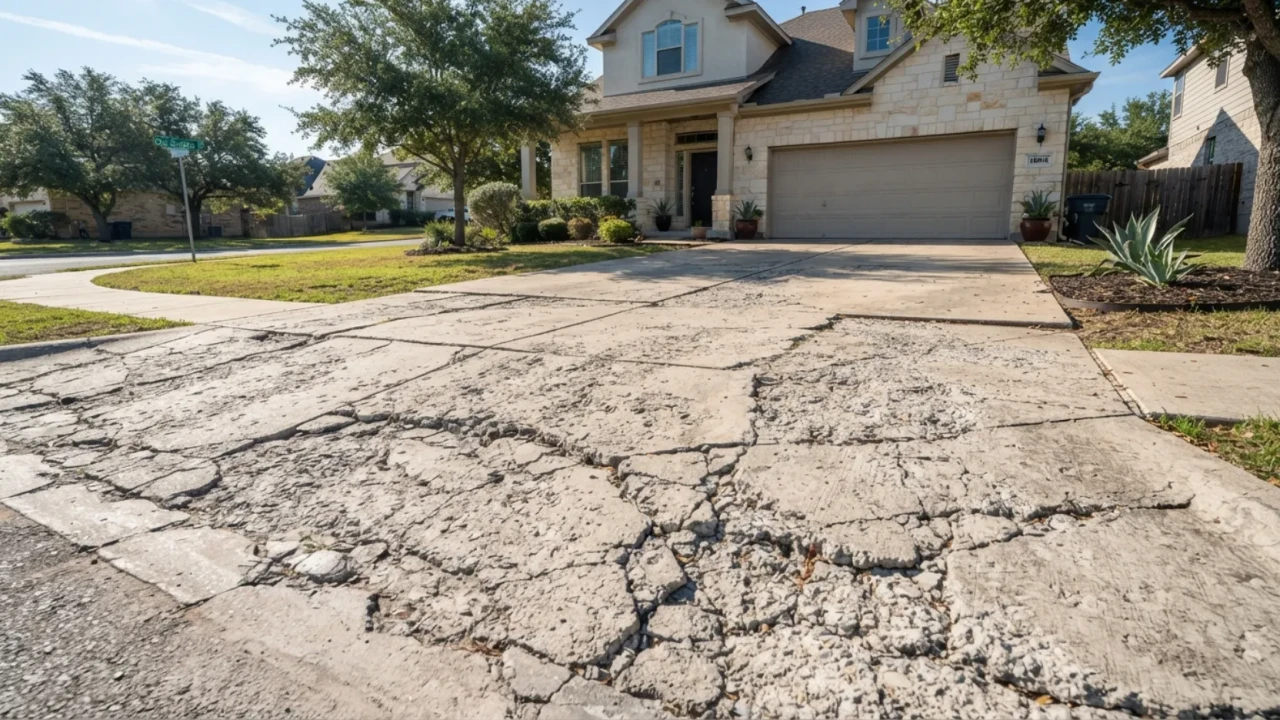
The leftover-material pitch is the most common residential concrete scam in San Antonio. A crew often out-of-state or operating without local business registration knocks on your door and offers to pour a driveway for $2 to $4 per square foot because they “have leftover concrete from another job nearby.” Leftover mixed concrete cannot be stored and must be used quickly, which means this pitch creates artificial urgency. There is no time for base preparation, no reinforcement, no quality mix and no contractor to contact when cracks appear six months later. Never hire a crew that approaches you unsolicited, regardless of how appealing the price sounds.
Verbal-only agreements protect no one but the contractor. Any legitimate concrete project in San Antonio should have a written contract that specifies scope of work, materials, thickness, timeline, and payment terms. A contractor who says the job is simple enough not to need a contract is a contractor who plans to define “simple” on their own terms after the work is done.
- No unsolicited door-to-door contractors accepted regardless of price offered
- All work scoped and agreed to in a written, signed contract before any deposit is paid
- No full upfront payment deposit only, balance on completion
- Low bids explained line-by-line: which spec items differ and why
- Base prep work confirmed on a separate day or with documented timeline before pour
- Recent local references (within 90 days) available and contactable
- Portfolio images verified as actual San Antonio projects, not stock photography
Use this table when evaluating contractors for any residential concrete project in San Antonio. The specifications listed reflect the correct baseline for Bexar County soil and climate conditions in 2026 not a premium upgrade, but the honest minimum for work that will last.
| Project type | Minimum slab thickness | Recommended reinforcement | Cost range (2026) | Sealing schedule |
|---|---|---|---|---|
| Standard driveway (2-car) | 4″ to 5″ | #3 rebar at 18″ centers | $7 to $12/sqft | First seal at 28 days; reseal every 3 to 5 years |
| Large or circular driveway | 5″ | #3 or #4 rebar at 18″ centers | $7 to $11/sqft | First seal at 28 days; reseal every 3 to 5 years |
| Stamped decorative driveway or patio | 4″ | #3 rebar at 18″ centers | $14 to $22/sqft | First seal at 28 days; reseal every 2 to 3 years |
| Broom finish patio | 3.5″ to 4″ | Wire mesh or #3 rebar | $6 to $10/sqft | First seal at 28 days; reseal every 3 to 5 years |
| Pool deck | 4″ | #3 rebar at 18″ centers | $10 to $20/sqft | First seal at 28 days; reseal every 2 to 3 years |
| Sidewalk or walkway | 4″ | Wire mesh minimum; rebar preferred | $6 to $10/sqft | First seal at 28 days; reseal every 3 to 5 years |
| Heavy residential (RV, truck parking) | 5″ to 6″ | #4 rebar at 18″ centers | $9 to $14/sqft | First seal at 28 days; reseal every 3 to 5 years |
- Certificate of insurance requested and received from every contractor being considered
- Workers compensation coverage confirmed if contractor employs a crew
- Local San Antonio or Bexar County address and verifiable business presence confirmed
- References from projects completed in the last 12 months requested from each contractor
- Minimum of three written quotes collected before making any decision
- Slab thickness written as a specific inch measurement in the quote document
- Base preparation depth and material specified: 4 to 6 inches compacted crushed limestone
- Reinforcement type, bar size, and spacing written into the quote
- Concrete PSI minimum stated: 3,000 PSI minimum for San Antonio residential work
- Control joint spacing included in the project scope
- Finish type and sealing schedule confirmed in the quote document
- Payment terms written: deposit before work, balance on satisfactory completion
- Base prep scheduled as a separate day from the pour for projects over 200 square feet
- Drainage slope confirmed: 1/8 inch per foot minimum away from any structure
- Reinforcement elevation method confirmed: plastic chairs or concrete supports
- Pour start time confirmed: before 7 AM for any summer pour in San Antonio
- Curing method confirmed and applied immediately after finishing
- 48-hour no-traffic and 7-day no-vehicle periods respected after pour
- Contractor return visit for first sealing scheduled at 28 to 30 days post-pour
- Sealer product type documented for future reapplication
- Resealing calendar set for 2 to 3 years (decorative) or 3 to 5 years (standard)
- Any crack wider than 1/4 inch or with vertical displacement assessed by a contractor
Do concrete contractors in San Antonio need to be licensed?
How long does a residential concrete driveway take to complete in San Antonio?
Is the cheapest concrete quote in San Antonio usually a bad idea?
What should I do if my new concrete driveway is already cracking?
What time of year is best for pouring a residential concrete driveway in San Antonio?
How do I know if my contractor skipped base preparation after the fact?
Get a free quote from a residential concrete contractor in San Antonio
We visit your property, assess site conditions, and provide a detailed written quote with every specification listed at no cost and no obligation.