Concrete Staining San Antonio: Complete Homeowner Guide

Concrete Staining San Antonio | Complete Homeowner Guide

Concrete Staining San Antonio: Complete Homeowner Guide | Affordable Concrete San Antonio
Complete Homeowner Guide San Antonio, TX

Concrete staining transforms plain gray slabs into rich, permanent surfaces that look like high-end stone or tile at a fraction of the price. This guide covers every decision San Antonio homeowners need to make: stain types, costs, prep requirements, contractor vetting, and what to expect from start to finish.

Concrete staining San Antonio Acid stain vs. water-based stain Cost guide · Durability ratings Patios · Driveways · Interior Floors Updated 2026
A
Affordable Concrete San Antonio Editorial Team
With over 10 years of residential and commercial concrete experience in San Antonio and the surrounding areas, our team has completed thousands of staining, patios, driveways, and decorative concrete projects across Bexar County. Every guide we publish reflects real on-the-ground expertise not generic contractor advice.
· affordableconcretesanantonio.com · Licensed & Insured · $2M Liability Coverage
$2–5/sqft
Typical cost range for acid or water-based concrete staining in San Antonio
20+yrs
Lifespan of properly stained and sealed concrete with routine maintenance
48hrs
Average time from stain application to foot traffic on a cured San Antonio slab
2–3yrs
Recommended resealing interval to protect stained concrete in South Texas heat

Concrete staining is one of the highest-return upgrades a San Antonio homeowner can make. A plain gray driveway apron, a dull backyard patio, or a garage floor that looks like a storage unit can be transformed in two to three days without tearing out and replacing the slab. The result is a permanent, rich color that actually bonds with the concrete rather than sitting on top like paint.

But there is a lot of bad information out there about how concrete staining works, what it costs, and how long it lasts. This guide cuts through the noise with straight numbers and honest trade-offs based on projects we complete every week across Bexar County.

The single most important thing to understand about concrete staining: it reacts with what is already there

Unlike paint or epoxy coatings, concrete stain does not sit on the surface. Acid-based stains react chemically with the minerals in the concrete itself, and water-based stains penetrate the pores and bond permanently. This means the final color depends on the existing concrete mix, its age, any prior sealers, and surface conditions. Two slabs treated with the same stain color will rarely look identical. That variability is part of what makes stained concrete beautiful and it is something every homeowner needs to understand before choosing this finish.
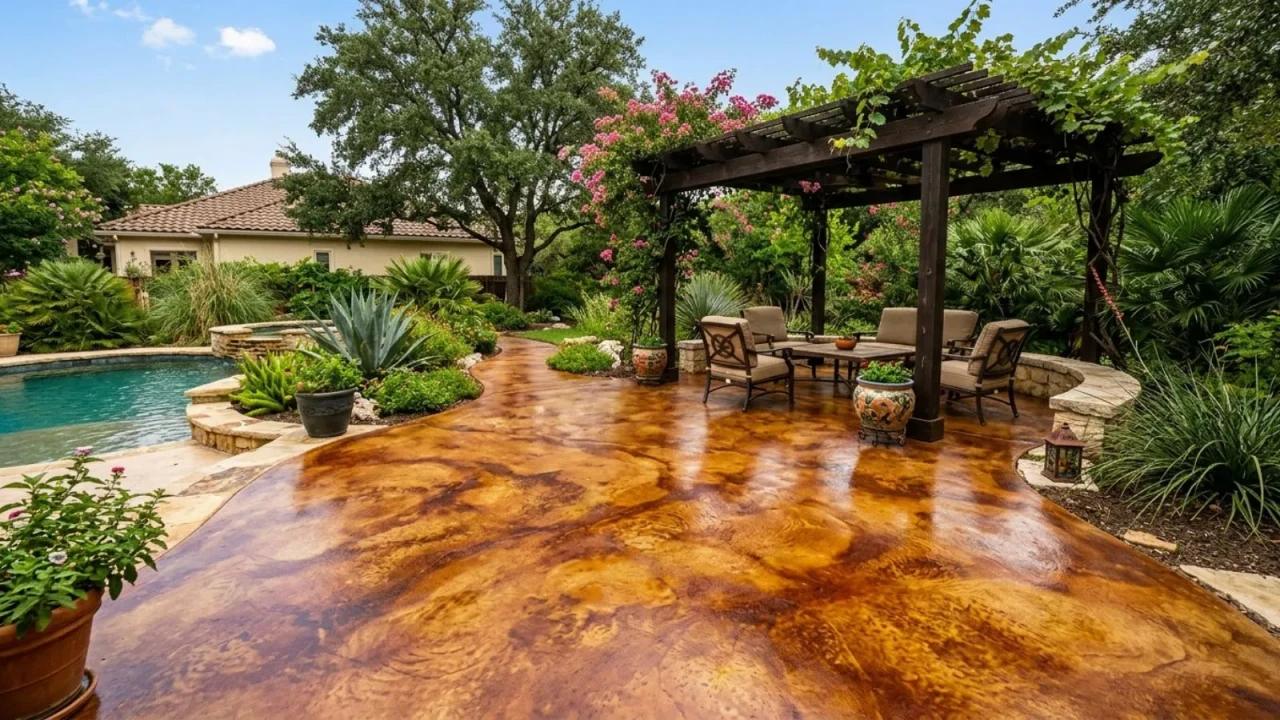
Acid stained concrete patio in San Antonio backyard showing rich amber and terracotta tones
Acid-stained concrete patio in San Antonio the mottled amber and terracotta tones are created by a chemical reaction with the minerals already in the slab, not by applying a pigmented paint.
● ● ●
Five decisions that determine your project's success
Everything San Antonio homeowners need to know about concrete staining
01
Acid stain vs. water-based stain: choosing the right product
The two categories behave differently, look different, and suit different applications
Stain Type

Most homeowners arrive at this decision after seeing a photo they love online without knowing which type of stain produced it. The difference matters more than most contractors admit upfront. Acid stains and water-based stains are fundamentally different products with different results, different prep requirements, and different long-term performance in San Antonio's climate.

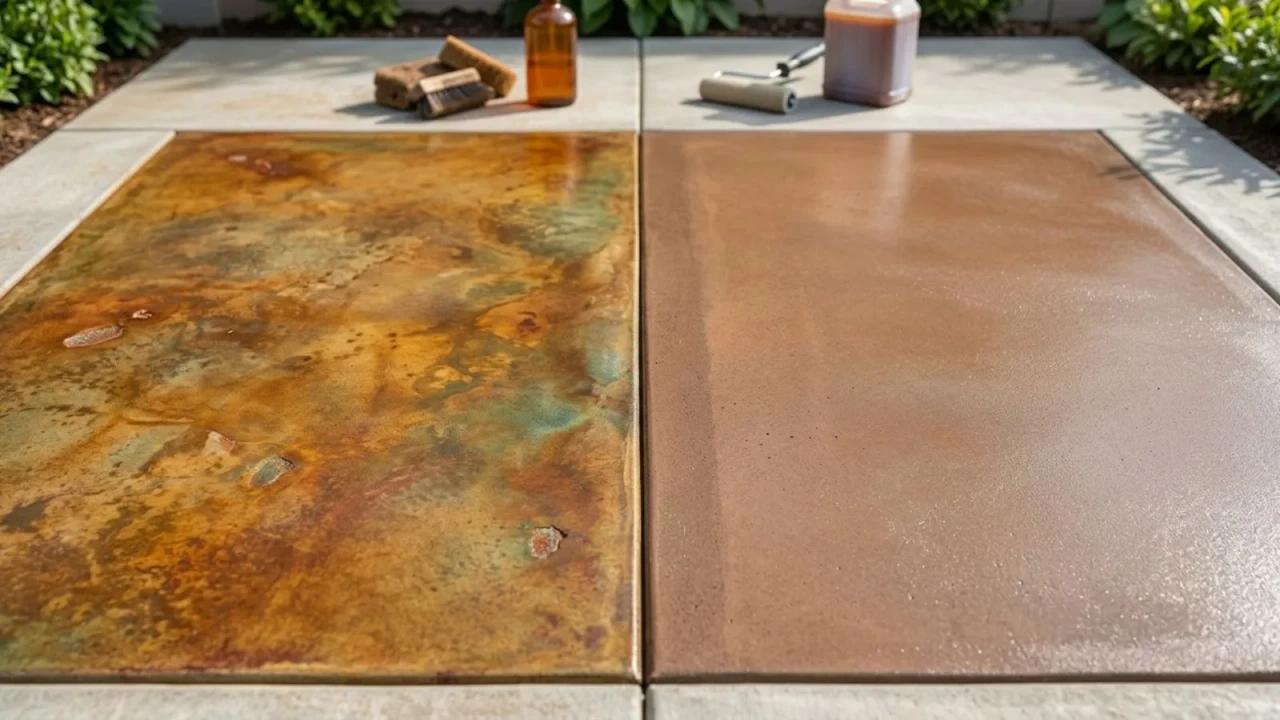
Comparison of acid stain versus water-based concrete stain results on similar slabs

Acid stain uses a diluted hydrochloric acid solution mixed with metallic salts to chemically react with the calcium hydroxide in concrete. The reaction produces permanent earth tones: ambers, terracottas, tans, blues, and greens. No two applications look the same. The color is mottled, variegated, and organic. It cannot be painted over or reversed.

Water-based stain uses acrylic or reactive pigments that penetrate the concrete surface. It produces more consistent, predictable color, and comes in a wider range of hues including grays, charcoals, blacks, and even bright tones. It is the correct choice when a specific, uniform color is the goal.

Acid stain: Permanent · Mottled earth tones · Highly variable Water-based: Consistent color · Wider range · More predictable Both types: Require sealing within 24 hrs of application Acid stain: Cannot be reversed once applied to the slab
Acid Stain
Chemical reaction with the slab creates permanent, mottled earth tones. No two applications are identical. Best for patios, driveways, and interior floors where a natural, variegated look is the goal. Produces the richest, most authentic appearance of any stain type.
Requires neutralization and rinsing after application. Residue must be fully removed before sealing. Cannot be lightened or reversed.
Water-Based Stain
Penetrating acrylic or reactive pigment in a wide range of colors. More predictable and consistent than acid stain. The right choice for homeowners who want a specific color or a more uniform appearance across the slab.
Easier application process. Works well over previously stained slabs when color correction is needed. Some water-based products also work on vertical surfaces.
Reactive Metallic Stain
A category of water-based stain using metallic pigments to create dramatic, lustrous effects. Popular for interior garage floors and decorative interior slabs. Produces a pearlescent, high-end look that photographs exceptionally well.
Higher cost per square foot than standard water-based stain. Requires the same prep and sealing protocol. Typically used indoors or in covered areas where UV exposure is limited.
Acetone Dye
Ultra-fine dye particles suspended in acetone penetrate concrete deeply and produce very vibrant, saturated colors. Common on polished interior concrete floors. Fades faster outdoors without UV-resistant topcoats. Not a common choice for San Antonio exterior applications.
Best suited for interior polished concrete. Requires solvent-resistant sealer. Not recommended for outdoor use in South Texas without UV-stabilized topcoat protection.
🌡️ San Antonio climate note: South Texas UV intensity is among the highest in the continental United States. Water-based stains with UV-stabilized pigments outperform standard formulas significantly for outdoor applications here. Always specify a UV-resistant sealer over any stain applied to an exposed patio or driveway in Bexar County.
Stain type selection checklist
  • Application location confirmed: interior vs. exterior determines UV resistance requirements
  • Color goal assessed: mottled/organic look requires acid stain; uniform/specific color requires water-based
  • Existing slab evaluated: prior sealers, paint, or coatings must be fully removed before any stain application
  • Age of slab confirmed: concrete must be cured a minimum of 28 days before staining
  • UV-resistant sealer specified for all outdoor applications in San Antonio
02
Surface preparation: the step that determines whether staining works at all
Concrete stain cannot penetrate a sealed, painted, or contaminated surface
Prep Guide

The most common reason concrete staining fails in San Antonio is skipped or inadequate surface preparation. Concrete stain needs open pores to penetrate. If the slab has a prior sealer, curing compound, oil stains, paint, or even years of accumulated grime, the stain will not absorb evenly and will peel with the sealer when the top coat eventually fails.
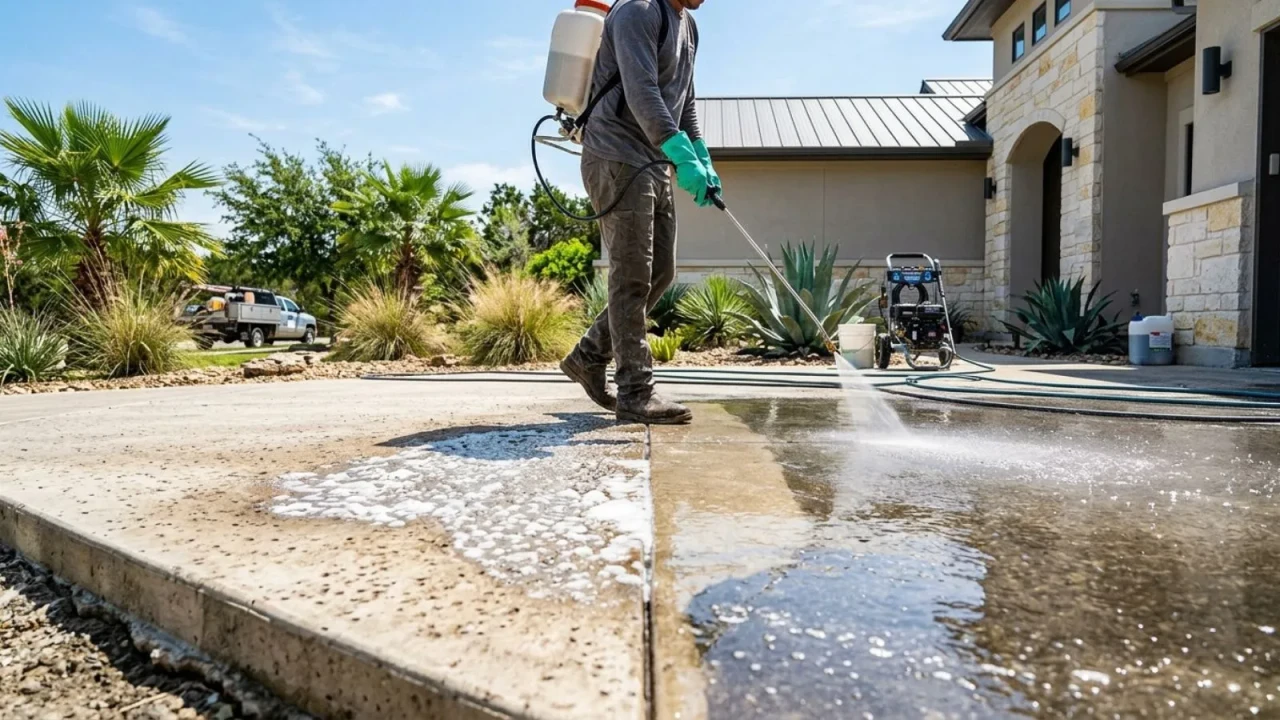
Concrete surface being acid-etched and cleaned prior to staining in San Antonio
Proper surface preparation before concrete staining includes acid etching, degreasing, and thorough rinsing. Skipping this step is the leading cause of peeling and uneven color.

For existing slabs, preparation almost always involves mechanical grinding or chemical etching to open the concrete surface, followed by degreasing to remove oil and organic contamination. On new slabs, a curing compound applied during construction must be fully removed or the stain will not penetrate. This preparation work is unglamorous but it is the most important part of the entire project.

Acid etching: Diluted muriatic acid opens concrete pores for stain absorption Grinding: Diamond grinder removes sealers, paint, and surface contamination Degreasing: Alkaline cleaner neutralizes oil, grease, and tire marks Shot blasting: Commercial-grade surface prep for large areas or heavily contaminated slabs
Pro tip

The water-drop test tells you whether your slab is ready to stain: Splash a small amount of water on the concrete surface. If it beads up, the surface has a sealer or coating that must be removed before staining. If the water absorbs within a few seconds and darkens the concrete, the surface is open and ready. This test takes 10 seconds and immediately tells you whether your contractor's prep work was sufficient before any stain is applied.

Slab condition Required prep method Estimated prep cost (San Antonio)
New slab, no curing compound Light acid etch and rinse only Included in staining quote
New slab with curing compound Mechanical grinding or chemical stripper to remove compound, then etch $0.50–1.00/sqft additional
Existing slab, previously sealed Sealer stripper, mechanical grind, acid etch, degrease, rinse $1.00–1.50/sqft additional
Existing slab with oil staining Alkaline degreaser treatment (may require multiple passes), etch, rinse $0.75–1.25/sqft additional
Painted slab Full paint removal via grinder or chemical stripper before any stain work begins $1.50–2.50/sqft additional
⚠️ Red flag: any concrete staining contractor in San Antonio who does not ask about the slab's history, prior sealers, or existing coatings before quoting is skipping the prep assessment. Surface prep is not optional and it is not included for free in a low-ball quote. Get the prep scope itemized in writing before any work begins.
Surface preparation checklist
  • Water-drop test passed: water absorbs within seconds, no beading or rolling off
  • Prior sealers, curing compounds, and paint confirmed as removed before stain application
  • Oil stains and tire marks treated with alkaline degreaser and rinsed
  • Cracks and spalling repaired with compatible concrete filler before staining
  • Surface fully dry after etching and rinsing: minimum 24 hours before stain application
03
Concrete staining cost in San Antonio: real numbers for 2026
What you actually pay per square foot and what drives the price up or down
Cost Guide

Concrete staining is priced per square foot, and the range in San Antonio is wide enough to be confusing. A basic single-color water-based stain on a prepared slab costs $2–3 per square foot. A full acid-stain project with multi-color layering, decorative sawcut patterns, and a high-performance sealer can run $8–12 per square foot. Here is what drives the difference.

$2–4/sqft
basic
Single-color water-based stain on a prepared slab: One color, basic prep on a clean surface with no prior sealer or coating. Standard roll-on or spray application. Basic penetrating sealer topcoat included. The entry-level staining package.
$4–7/sqft
standard
Acid stain with standard prep and UV-resistant sealer: Single-color acid stain with professional prep including etch and degrease. High-performance solvent-based or water-based polyurethane sealer for South Texas outdoor conditions. The most common residential project.
$7–10/sqft
premium
Multi-color layered stain with decorative sawcut pattern: Two or three stain colors applied in sequence with masking between colors. Decorative sawcut or scored pattern adds visual dimension. Professional-grade epoxy or polyurethane sealer. Most popular for high-visibility patios and entryways.
$10–14/sqft
full service
Full-service decorative project with heavy prep, complex pattern, and premium sealer: Existing sealed or painted slab requiring grinding, multi-step staining with layered colors and custom pattern, scored border, and two-coat commercial-grade polyurethane finish. The flagship decorative concrete project for Bexar County homeowners.
Budget tip

The 400 sqft rule for San Antonio patios: The average San Antonio residential patio runs 300–500 square feet. At the standard acid-stain rate of $4–7/sqft, a 400 sqft patio runs $1,600–2,800 professionally completed. That is less than half the cost of a new stamped concrete pour and achieves a very similar visual result on an existing slab in good condition. If your current concrete is structurally sound with no major cracking or displacement, staining is almost always the smarter investment.

Cost verification checklist
  • Quote specifies price per square foot AND total square footage verify against your own measurement
  • Prep work itemized separately: surface grinding, etching, degreasing noted with cost
  • Sealer type and grade specified: "penetrating sealer" is not the same as a UV-resistant polyurethane topcoat
  • Number of stain coats and colors specified: single-coat vs. layered multi-color affects both cost and result
  • Any decorative sawcut or scoring work quoted separately before you approve
04
The concrete staining process: what happens on project day
Step-by-step from surface prep through sealing and cure
Process Guide

Most concrete staining projects in San Antonio run two to three days from start to foot traffic. Knowing the correct sequence helps you verify the work is being done right and avoid surprises about when you can use the space again.
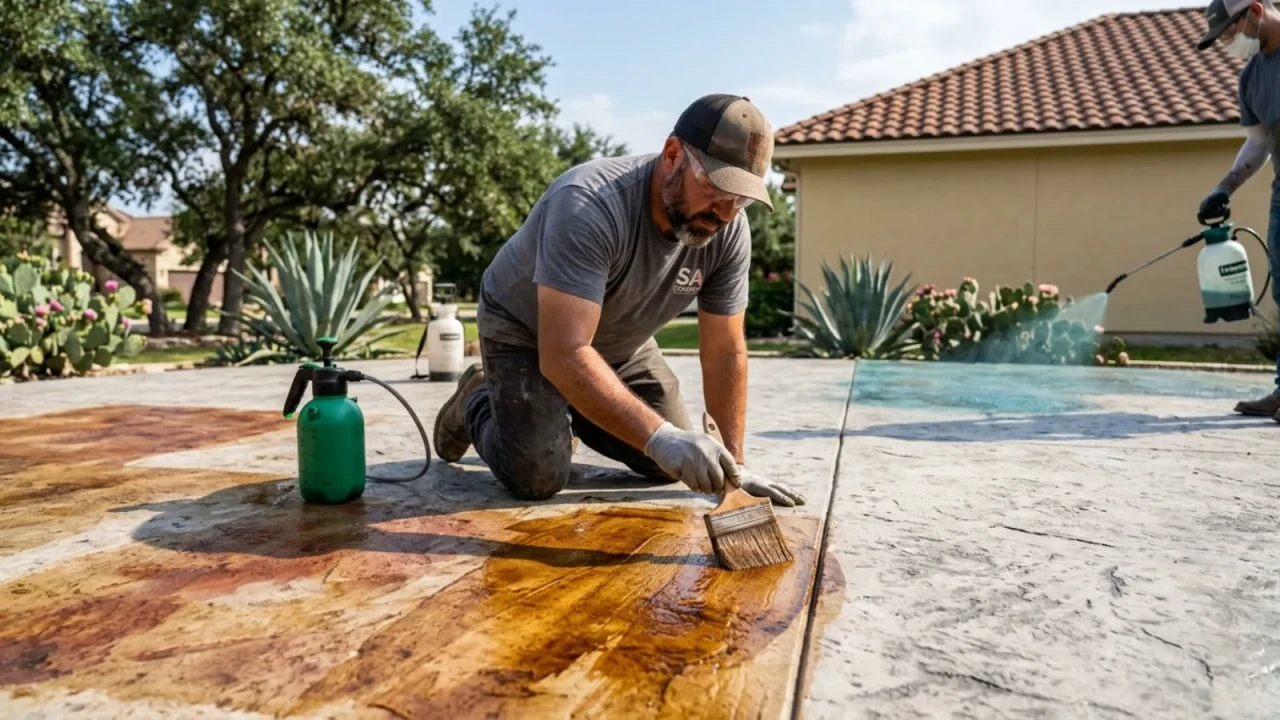
Contractor applying acid stain to concrete patio in San Antonio with brush and spray application
Acid stain application in progress on a San Antonio patio. The stain is applied with brushes or low-pressure sprayers and left to react for two to eight hours depending on the color depth desired.
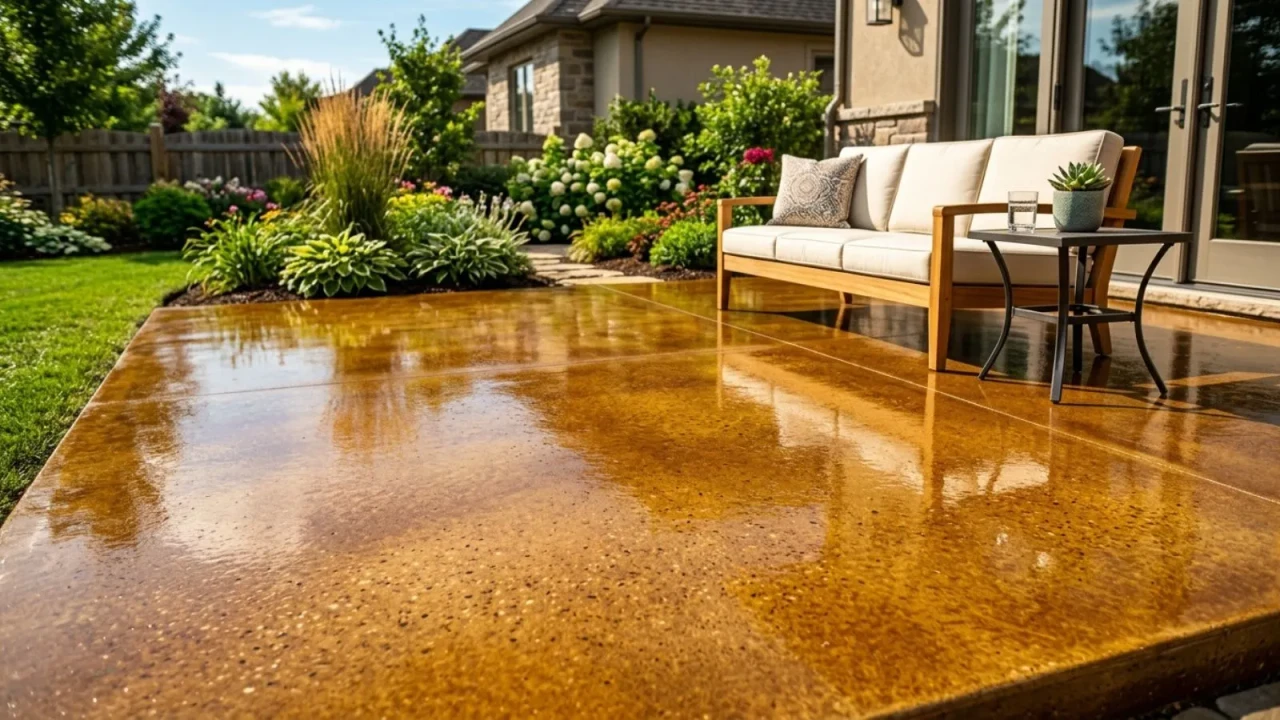
Freshly sealed stained concrete patio showing rich amber tones with wet-look polyurethane finish

A proper staining project never happens in a single visit. The slab must be fully prepped and completely dry before stain goes down. After application, acid stain needs two to eight hours to react before neutralization. Water-based stain dries faster but still requires a full cure before sealing.

Day 1: Surface prep grinding, etching, degreasing, rinsing Day 1 or 2: Stain application and reaction time (acid stain: 4–8 hrs) Day 2: Neutralization, rinse, residue removal, surface dry time Day 2 or 3: Sealer application first coat, dry, second coat if specified Day 3 or 4: Light foot traffic approved; full cure 72 hours

In San Antonio's summer heat, sealer application timing is critical. Solvent-based polyurethane sealers applied in direct sun or above 90 degrees can bubble or cloud. Most experienced local contractors schedule sealer application for early morning or in shaded conditions. If your contractor is spraying sealer on a hot concrete surface in direct July sun, that is a problem worth flagging before the coat goes down and locks in the issue.

🌤️ Best time to stain concrete in San Antonio: October through April. Moderate temperatures allow longer working times for acid stain application and eliminate heat-related sealer issues. Summer staining is done successfully every week by experienced local crews, but it requires early start times, careful sealer scheduling, and more precise timing. If your project is flexible, fall is ideal.
Project day checklist
  • Surface fully prepped and completely dry before any stain is applied
  • Masking and edging complete: adjacent surfaces, walls, and landscaping protected from stain overspray
  • Acid stain neutralized with baking soda solution and rinsed completely before sealing
  • All residue and neutralization byproduct removed and surface fully dry before sealer goes down
  • Sealer applied in appropriate temperature range: not above 90 degrees or in direct peak-afternoon sun
  • Two sealer coats confirmed if specified in the quote: single-coat and two-coat results differ significantly
05
Sealing, maintenance, and long-term care in the San Antonio climate
Stained concrete lasts decades with the right sealer and a simple maintenance schedule
Maintenance

Concrete stain is permanent. The color bonds with the slab and does not fade the way paint does. But the sealer protecting that color is not permanent. In San Antonio, where UV intensity is high, summer temperatures routinely exceed 100 degrees, and the occasional freeze-thaw event occurs in winter, an unsealed or under-sealed stained surface will begin to show wear within a few years.
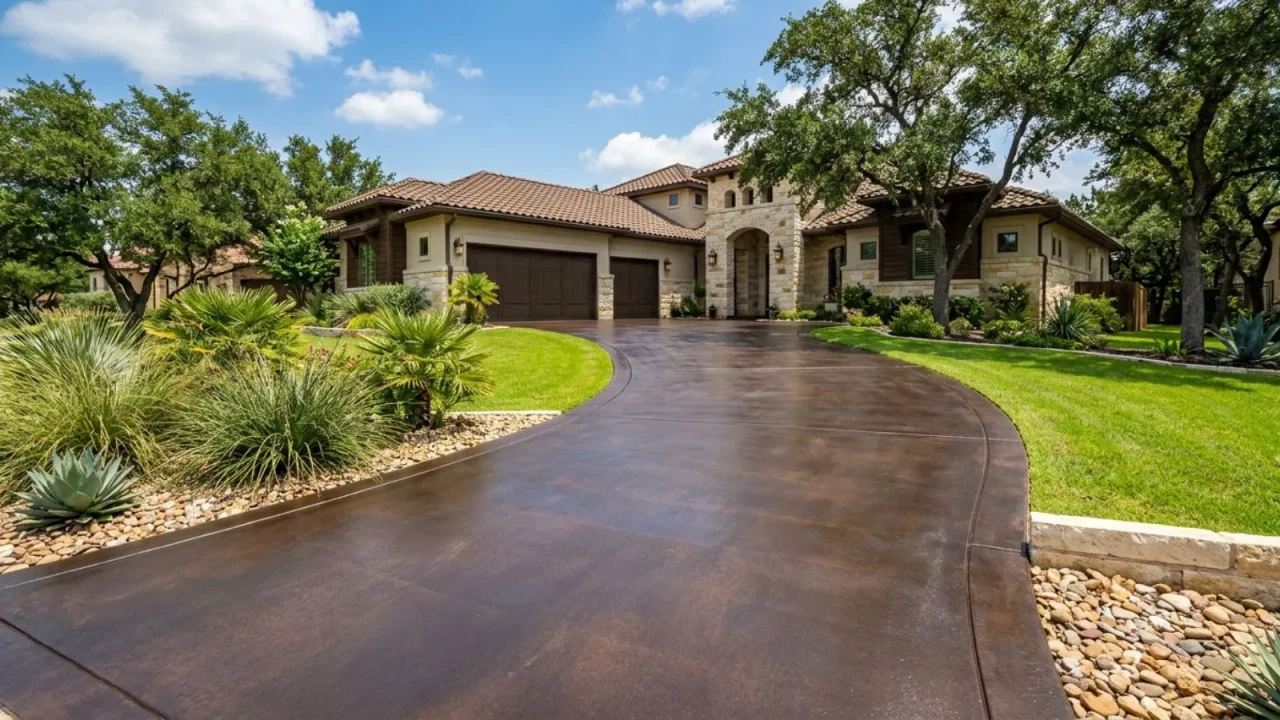
Well-maintained stained concrete driveway in San Antonio Bexar County showing even color and sealed finish after five years
A stained concrete driveway in Bexar County after five years with proper resealing every two to three years. The color remains rich and the surface shows no significant wear under South Texas conditions.
Initial seal: Applied 24 hours after stain neutralization on same project Resealing: Every 2–3 years for outdoor applications in San Antonio Indoor/covered: Every 3–5 years with normal foot traffic Cleaning: Neutral pH cleaner only avoid acidic or bleach-based products

The sealer choice at the time of installation matters as much as the resealing schedule. A low-cost acrylic sealer will need reapplication every one to two years in Bexar County conditions. A commercial-grade solvent-based polyurethane or epoxy topcoat lasts two to four years between applications and holds up significantly better to tire traffic on driveways and foot traffic on patios.

Sealer type Best application Resealing interval (San Antonio) Approximate cost
Acrylic water-based sealer Interior floors, low-traffic covered patios 1–2 years outdoors $0.30–0.60/sqft DIY
Solvent-based acrylic sealer Outdoor patios and driveways, moderate traffic 2–3 years $0.50–0.90/sqft DIY
Polyurethane (water-based) Outdoor and indoor applications requiring durability 2–4 years $0.80–1.50/sqft professional
Polyurethane (solvent-based) High-traffic driveways, pool decks, commercial 3–5 years $1.00–2.00/sqft professional
Epoxy topcoat Interior garage floors and commercial applications 5–10 years indoors $1.50–3.00/sqft professional
Maintenance tip

How to tell when your stained concrete needs resealing: Pour a small amount of water on the surface. If it beads up and rolls off, the sealer is still intact. If the water absorbs immediately and darkens the concrete, the sealer has worn through and it is time to reseal. Do this test annually on outdoor applications in San Antonio. Catching the sealer just before it fails is much easier than waiting until the surface looks worn or the color begins to dull.

Ongoing maintenance schedule
  • Annual water-drop test to assess sealer condition before visible wear appears
  • Resealing every 2–3 years for outdoor applications; 3–5 years for covered or interior surfaces
  • Clean spills immediately: cooking oils, tire marks, and fertilizer chemicals stain unsealed or worn sealer
  • Use only pH-neutral cleaners: acidic cleaners and bleach degrade concrete sealers and can affect stain color
  • Avoid metal shovels or de-icing salts on stained concrete: both damage the sealer surface
● ● ●
At-a-glance comparison for San Antonio homeowners
Acid stain vs. water-based stain vs. other decorative concrete options

Use this table to quickly compare concrete staining against other decorative concrete finishes available in San Antonio so you can make the right decision for your specific project.

Option Best for Cost range (installed) Color consistency Maintenance level
Acid stain Patios, driveways, interior floors $4–7/sqft Variable / organic Reseal every 2–3 yrs
Water-based stain Any application needing a specific color $2–5/sqft Consistent / predictable Reseal every 2–3 yrs
Stamped concrete New patio or pool deck pour $14–22/sqft Consistent with integral color Reseal every 2–3 yrs
Epoxy floor coating Interior garage floors only $3–7/sqft Very consistent Low chip-resistant topcoat
Exposed aggregate Pool decks, patios (new pour required) $8–14/sqft Depends on aggregate spec Low minimal sealing needed
Broom finish (plain) Driveways, sidewalks, utility surfaces $6–10/sqft Gray only Very low
● ● ●
Complete concrete staining project checklist
Review every item before approving a contractor quote or signing a contract
Before the project starts
  • Stain type confirmed: acid stain for organic/mottled look, water-based for consistent/specific color
  • Slab age verified: concrete must be fully cured a minimum of 28 days before staining
  • Surface condition evaluated: prior sealers, curing compounds, paint, and coatings identified
  • Water-drop test performed: water absorbs within seconds with no beading
  • Color sample or reference photo approved in writing before work begins
Surface preparation
  • All prior sealers, coatings, and curing compounds fully removed
  • Oil stains and grease treated with alkaline degreaser and rinsed
  • Cracks and spalling repaired with compatible concrete filler before staining
  • Surface acid-etched and completely dry before stain application
Application and sealing
  • Stain applied per manufacturer instructions: proper dwell time for acid stain (4–8 hours)
  • Acid stain fully neutralized with baking soda solution and thoroughly rinsed
  • Sealer type specified: UV-resistant polyurethane or solvent-based acrylic for outdoor use in San Antonio
  • Sealer applied in appropriate temperature conditions: not in direct sun above 90 degrees
  • Two sealer coats applied if specified in the quote
Post-project care
  • No foot traffic for minimum 24 hours after final sealer coat
  • No vehicle traffic for minimum 72 hours after sealing
  • Annual water-drop test scheduled to monitor sealer condition
  • Resealing scheduled every 2–3 years for outdoor San Antonio applications
● ● ●
Common questions answered
FAQs
Q
How much does concrete staining cost in San Antonio?
For a standard acid-stain project on an existing patio or driveway in San Antonio, expect to pay $4–7 per square foot professionally installed. That includes surface prep, single-color acid stain application, neutralization, and a solvent-based acrylic sealer. A 400 sqft patio runs $1,600–2,800 at that rate. Multi-color or decorative sawcut projects run $7–10/sqft. Water-based single-color staining on a clean surface starts lower, around $2–4/sqft. The biggest variable is surface prep: a previously sealed or painted slab adds $1–2.50/sqft to the cost before any stain goes down. Always get the prep work itemized separately in your quote.
Q
Can you stain old concrete that is already sealed or painted?
Yes, but the sealer or paint must be fully removed first. Concrete stain cannot penetrate a coated surface. Depending on the existing coating, removal involves mechanical grinding, chemical strippers, or both. This prep work adds cost and one to two days to the project timeline. Once the surface is clean and open (confirmed with the water-drop test), the staining process proceeds normally. The final result on an old cleaned slab is often indistinguishable from a freshly poured one. Old concrete actually tends to accept acid stain more richly than very new slabs because the mineral content has had more time to develop.
Q
How long does concrete staining last in San Antonio?
The stain color itself is permanent. Acid stain and reactive water-based stains chemically bond with the concrete and do not fade the way paint does. What requires maintenance is the sealer protecting that color. In San Antonio, where UV intensity is high and summer temperatures routinely exceed 100 degrees, outdoor sealers need to be reapplied every two to three years. Interior or covered applications last three to five years between resealing. With proper sealing and basic maintenance, stained concrete looks excellent for 20 or more years. The homeowners who report stained concrete fading or peeling almost always let the sealer wear through without reapplication.
Q
What colors are available with concrete staining in San Antonio?
Acid stain is limited to earth tones: ambers, tans, terracottas, soft blues, and greens produced by the chemical reaction with the minerals in concrete. The exact shade depends on the existing slab, so a color chip from the stain manufacturer is an approximation, not a guarantee. Water-based stains come in a much wider range including grays, charcoals, warm and cool whites, blacks, and even bright accent colors. For multi-color or decorative projects, water-based and acid stain are sometimes layered together. If you have a specific color in mind, water-based stain is the more predictable choice. If you want the organic, stone-like look that shows up in most design photos, acid stain is what produced that result.
Q
Is stained concrete slippery when wet?
Stained concrete with a high-gloss sealer can be slippery when wet, particularly around pools and in areas that see rain exposure. For outdoor applications in San Antonio, we always recommend a sealer that includes an anti-slip aggregate additive, or a matte-finish sealer that provides traction without requiring the additive. Pool decks specifically should use a matte or satin sealer with anti-slip treatment. Standard interior floors with a high-gloss finish are not typically a traction concern in dry conditions. If your project is a pool deck, driveway apron, or any surface that gets wet regularly, ask your contractor specifically about the slip resistance of the sealer they are applying before the job starts.
Q
Can concrete staining be done as a DIY project?
Water-based concrete stain is available at home improvement stores and is a manageable DIY project for a homeowner who is comfortable with surface prep work. Acid staining is a different story. The chemicals are hazardous, the neutralization step is critical, and errors in application are irreversible. On a 400 sqft patio, a patchy or uneven acid-stain job cannot be touched up after the fact without starting over from the grinding stage. For acid staining, professional application is strongly recommended. For water-based staining, a careful DIY homeowner can achieve good results but must invest in proper surface prep. The biggest DIY mistake is skipping the etching step or applying stain over an incompletely clean surface.
More from Affordable Concrete San Antonio
Explore more concrete staining resources from Affordable Concrete San Antonio, including guides on staining methods, stain types, and project costs. Learn how concrete staining can enhance your property, or visit our Concrete Staining San Antonio service page for professional solutions.

Get a free concrete staining quote in San Antonio

Tell us about your patio, driveway, or floor. We will assess the slab, recommend the right stain type for your goals, and give you a detailed written quote at no cost.

Brandon Wyatt

Author: Home Improvement & Roofing Specialist

Brandon Wyatt is a home improvement specialist with extensive experience in residential roofing, storm damage restoration, and exterior home maintenance in San Antonio, Texas.