
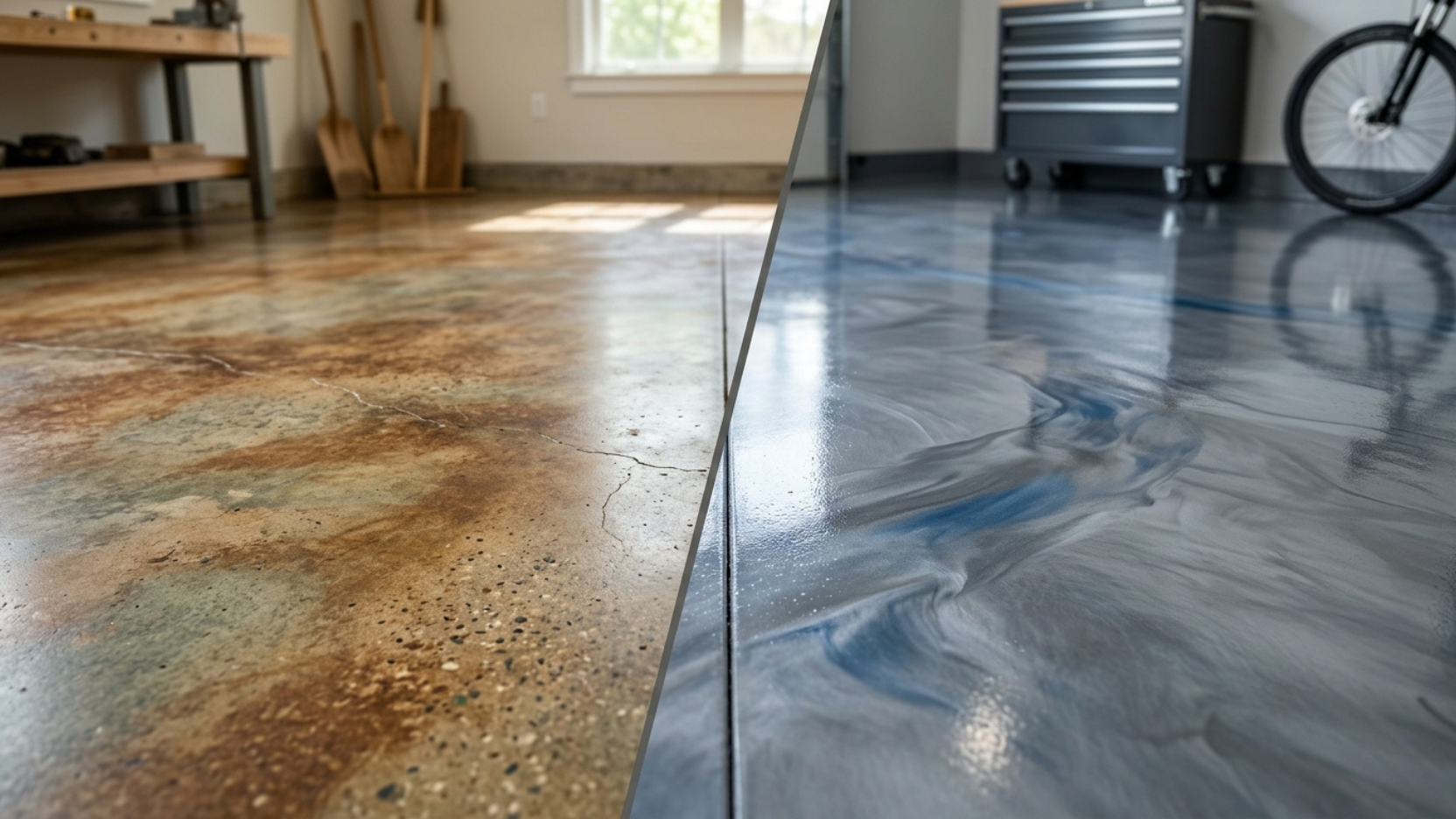
Two popular decorative floor finishes, one important decision. This guide breaks down the real differences between concrete staining and epoxy coatings so San Antonio homeowners and business owners can choose the right option for their space, budget, and long-term goals.
When San Antonio homeowners want to upgrade a plain concrete floor, two options come up in almost every conversation: concrete staining and epoxy floor coatings. Both transform a dull gray slab into something dramatically better looking. Both are significantly less expensive than tearing out concrete and installing tile or hardwood. And both have real advantages that make them the right call in specific situations.
The problem is that they are not interchangeable. Concrete staining and epoxy coatings work through completely different mechanisms, hold up differently under San Antonio’s climate conditions, require different prep and maintenance, and suit different applications. Choosing the wrong one for your garage, patio, or interior floor is a mistake you will be looking at for years. This guide lays out every key difference so you can make the right call before a contractor shows up.
Ask yourself: do you want a finish that becomes part of the concrete permanently, or a protective coating that sits on top of it? Concrete stain penetrates and chemically bonds with the slab it cannot peel because it is not a surface layer. Epoxy is a coating that adheres to the surface, providing excellent protection and a uniform finish but remaining vulnerable to delamination if the prep work is inadequate or moisture is present. That single mechanical difference explains most of the pros and cons you will find throughout this guide.
Mechanism
Understanding how these two finishes actually work will make every other comparison in this guide easier to follow. They operate on fundamentally different principles, which is why they behave so differently in real-world conditions.

Concrete stain works by penetrating the surface of the concrete and reacting chemically with the material itself. Acid-based stains react with the lime compounds in the concrete to produce permanent, translucent color. Water-based stains penetrate and deposit pigment particles in the concrete’s pores. In both cases, the color becomes part of the slab. You cannot peel it off any more than you can peel the color out of natural stone.
Epoxy floor coatings are two-part polymer systems (resin plus hardener) that are mixed and applied on top of the concrete surface. Once cured, epoxy forms a thick, hard plastic-like layer that bonds mechanically to the concrete below. It is a coating, not a penetrant and that distinction is the source of both its strengths and its vulnerabilities.
Aesthetics
Most homeowners start the stain-vs.-epoxy conversation because of how a floor looks and this is the area where the two options differ most sharply. Neither is objectively better. They produce entirely different aesthetics, and which one fits your space depends on the look you are trying to achieve.

Concrete stain produces a one-of-a-kind, organic appearance. Because the stain reacts with the concrete’s natural mineral composition, no two stained floors look exactly alike. Color variation, marbling, and mottling are features, not flaws they give stained concrete floors the kind of character you cannot get from a uniform coating. Acid stain colors range from warm earthy tones (terra cotta, walnut, amber) to deeper shades of blue-green and black. Water-based stains expand the palette to nearly any color imaginable while producing a more consistent, less marbled result.
Epoxy coatings offer a consistently uniform finish in a huge range of colors and effects. Full broadcast flake systems (popular in garages) layer colored chips over the base coat for a terrazzo-like appearance. Solid color epoxy delivers a clean, commercial look. Metallic epoxy systems create dramatic, swirling pearlescent effects. The result is polished and precise the right choice when a uniform, high-performance aesthetic is the goal.
Matching finish to space: Stained concrete tends to work best in living areas, patios, and commercial spaces where a natural, high-end aesthetic is the goal. The organic variation reads as intentional and sophisticated. Epoxy coatings tend to work best in garages, workshops, utility areas, and commercial facilities where a clean, durable, easy-to-clean surface is the priority. Using flake epoxy in a garage and acid stain in a kitchen or patio is a very common combination for whole-home projects in San Antonio.
Cost Guide
Cost is one of the most common decision factors, and the gap between these two options is narrower than most people expect. Both are significantly more affordable than replacing concrete with tile, stone, or hardwood. The real cost differences come from prep requirements and the long-term maintenance picture rather than just the installation quote.

Prep work is where cost surprises come from. Both options require clean, sound concrete before application, but epoxy has stricter requirements. The slab must be mechanically ground or shot-blasted (not just acid etched) to achieve the surface profile epoxy needs to bond properly. Moisture vapor testing is required. Any cracks, spalling, or contamination must be addressed first. These prep steps add $0.50 $1.50/sqft to the base quote but are non-negotiable for a job that lasts.
Concrete staining is more forgiving of minor imperfections in the existing slab in fact, existing texture and variation tend to enhance the final appearance. The prep for staining primarily involves thorough cleaning, degreasing, and repair of any major cracks or spalling.
Factor in recoating when comparing quotes: Acid-stained concrete, once properly sealed, typically needs resealing every three to five years a $0.50 $1.00/sqft maintenance cost. Epoxy coatings typically need to be fully recoated every five to ten years depending on traffic levels and UV exposure. A garage epoxy recoat runs $1.50 $3.00/sqft. Over a 20-year period, a properly maintained stained floor often has a lower total cost of ownership than epoxy even if the initial installation cost is similar.
- Get itemized quotes: base prep, any crack repair, application coats, and sealer/topcoat listed separately
- Confirm whether moisture vapor testing is included in the epoxy quote it should be
- Ask how many coats of sealer or topcoat are included minimum two coats for any quality installation
- Factor in resealing or recoating cycles over 10 20 years when comparing total cost
- Verify the contractor uses 100% solids or high-solids epoxy, not a thin water-based epoxy that looks similar but fails much sooner
Durability
San Antonio’s climate puts specific demands on concrete floor finishes. Intense UV radiation, summer temperatures that regularly exceed 100 degrees, occasional freeze events in winter, and high humidity levels create a performance environment that not all products handle equally well. Knowing how each finish responds to these conditions is essential before committing to one.
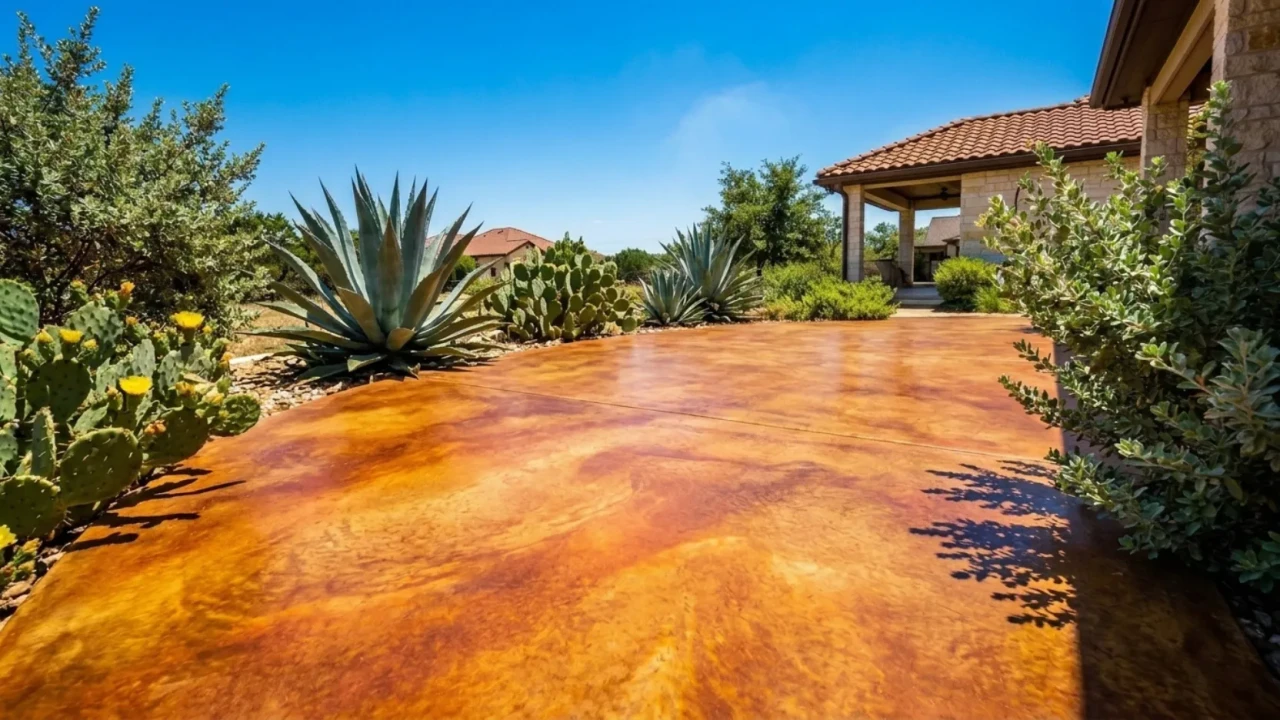
UV resistance: Standard epoxy yellows and fades with prolonged UV exposure a significant problem for garage floors with natural light and an even bigger problem for exterior applications. Quality epoxy systems use a polyurea or polyaspartic topcoat specifically for UV stability, which largely solves this issue indoors but limits epoxy’s use outdoors. Concrete stain, being part of the concrete itself, does not yellow or peel. Color may gradually fade on exterior surfaces over many years but maintains integrity throughout.
Chemical resistance: This is where epoxy has a clear advantage. Properly applied epoxy is highly resistant to motor oil, transmission fluid, gasoline, battery acid, and most household chemicals. For a garage floor, this matters significantly. Acid-stained concrete sealed with a penetrating sealer provides reasonable chemical resistance but will stain if oil or chemicals sit on the surface for extended periods without cleanup.
| Performance factor | Concrete stain | Epoxy coating | Winner for San Antonio |
|---|---|---|---|
| UV and fade resistance | Excellent stain is part of the concrete | Moderate requires UV-stable topcoat | Concrete stain |
| Chemical and oil resistance | Moderate depends on sealer quality | Excellent high-solids epoxy resists most chemicals | Epoxy coating |
| Moisture vapor tolerance | Excellent penetrant is not affected by vapor | Poor without mitigation moisture causes delamination | Concrete stain |
| Impact and abrasion resistance | Moderate sealer can scratch; concrete itself is hard | Excellent thick coating resists heavy impact | Epoxy coating |
| Outdoor patio suitability | Excellent widely used on patios and pool decks | Limited UV and moisture issues outdoors | Concrete stain |
| Garage floor suitability | Fair can work but limited chemical protection | Excellent purpose-built for this application | Epoxy coating |
| Long-term maintenance | Low reseal every 3 5 years | Moderate recoat every 5 10 years | Concrete stain |
Decision Guide
With the key differences laid out, the decision usually becomes straightforward once you match your application and priorities to the right option. Here is how we advise San Antonio clients on this question depending on their specific situation.

Choose concrete stain when: Your project is outdoors (patio, pool deck, driveway); you want a natural, organic aesthetic with color variation and character; you are finishing an interior living space where the look matters as much as durability; your slab has some age and variation that will enhance rather than detract from the appearance; or you want the lowest long-term maintenance commitment.
Choose epoxy when: The application is a garage floor or workshop where chemical resistance, heavy impact durability, and easy cleanup from oils and fluids are priorities; you want a very specific, uniform color or a decorative flake or metallic effect; the space is a commercial facility with high foot or vehicle traffic; or you need the highest possible surface hardness and impact resistance.
| Application | Best choice | Reason |
|---|---|---|
| Backyard patio | Concrete stain | UV stability, outdoor moisture tolerance, natural aesthetic |
| Pool deck | Concrete stain | Handles constant moisture and sun without peeling |
| Garage floor | Epoxy coating | Chemical resistance, impact durability, easy degreasing |
| Interior living space | Concrete stain | Organic look, no VOC concerns after cure, permanent finish |
| Basement floor | Concrete stain (with moisture test) | Below-grade moisture makes epoxy delamination risk higher |
| Commercial warehouse | Epoxy coating | Heavy forklift traffic, spill resistance, seamless cleanable surface |
| Retail or restaurant floor | Either depends on aesthetic goals | Stain for upscale look; epoxy for high-traffic utility areas |
| Driveway | Concrete stain | UV exposure and outdoor moisture make epoxy a poor long-term fit |
You do not have to choose just one across your whole property: Many San Antonio homeowners use concrete stain on their patios, interior floors, and driveways while using epoxy in the garage. The two finishes are compatible with each other and serve entirely different purposes in those spaces. Getting quotes for both applications at the same time often allows for schedule and mobilization savings since the same contractor can handle both.
- Confirm whether the application is indoor or outdoor epoxy is not recommended for exterior use in San Antonio
- Identify your primary priority: aesthetic character (stain) or maximum chemical and impact protection (epoxy)
- Have the existing slab assessed for moisture vapor emission before committing to epoxy
- Ask to see local examples of both finishes in similar applications before making a final decision
- Get written specs for the number of coats, product brands, and topcoat type included in each quote
- Confirm that prep work (grinding or shot-blasting for epoxy; degreasing and crack repair for stain) is included in the quoted price
Use this table as your quick reference when comparing quotes or finalizing your decision. Every key factor from aesthetics to cost to long-term maintenance is summarized in one place.
| Factor | Concrete stain | Epoxy coating |
|---|---|---|
| How it works | Penetrates and reacts with the concrete permanent | Surface coating that bonds on top of the slab |
| Installed cost (San Antonio) | $2 $6/sqft | $3 $12/sqft depending on system |
| Appearance | Organic, varied, translucent, one-of-a-kind | Uniform, high-gloss, customizable color and effect |
| UV resistance | Excellent for outdoor use | Requires UV-stable topcoat; yellows without it |
| Chemical resistance | Moderate sealer-dependent | Excellent purpose-built for chemical exposure |
| Moisture vulnerability | Not affected by moisture vapor | Can delaminate if moisture vapor is not managed |
| Peeling or delamination risk | None no surface layer to lift | Yes if prep or moisture testing is inadequate |
| Best applications | Patios, pool decks, interiors, driveways | Garages, workshops, commercial facilities |
| Outdoor suitability | Excellent | Limited not recommended outdoors in San Antonio |
| Maintenance schedule | Reseal every 3 5 years | Recoat every 5 10 years |
| Lifespan with proper care | 20+ years | 5 15 years before recoating |
| Can it be applied over old concrete? | Yes surface must be clean and porous | Yes surface must be ground and moisture tested |
- Confirmed whether the surface is interior or exterior critical for determining if epoxy is appropriate
- Identified the primary use of the space: decorative living area, garage, commercial facility, or outdoor entertaining
- Assessed existing slab condition: major cracks, spalling, or staining that needs to be addressed first
- Determined whether chemical resistance or aesthetic character is the higher priority
- Moisture vapor emission test completed on the existing slab before any work begins
- Mechanical surface preparation (grinding or shot-blasting) confirmed acid etching alone is not sufficient
- UV-stable polyurea or polyaspartic topcoat included if the space has any natural light exposure
- Product specs confirmed: 100% solids or high-solids epoxy, not water-based thin-film products
- Number of coats specified in writing: primer coat, color coat, and topcoat minimum
- Stain type selected: acid-based for organic depth and variation, water-based for more predictable color control
- Existing slab thoroughly degreased oil contamination prevents stain penetration
- Color test patch completed before full application, especially for acid stain
- Sealer type confirmed: penetrating sealer for exterior use, film-forming sealer acceptable for interior applications
- Two coats of sealer included in the quote with resealing schedule provided
- Certificate of insurance received and verified $1M+ general liability minimum
- Local San Antonio references available for the specific finish type you are choosing
- Written quote itemizes prep, application, coats, and materials separately
- Payment terms confirmed: deposit upfront, balance on completion not full payment before work begins
Can I stain my concrete instead of putting down epoxy in my garage?
Why does epoxy peel and how can I prevent it?
Which lasts longer concrete stain or epoxy?
Can I apply epoxy over an already stained concrete floor?
How much does it cost to stain a concrete patio vs. apply epoxy to a garage in San Antonio?
Get a free concrete quote in San Antonio
Whether you are leaning toward concrete staining or epoxy, we will assess your slab, walk you through the right options for your space, and give you a detailed written quote at no cost.