
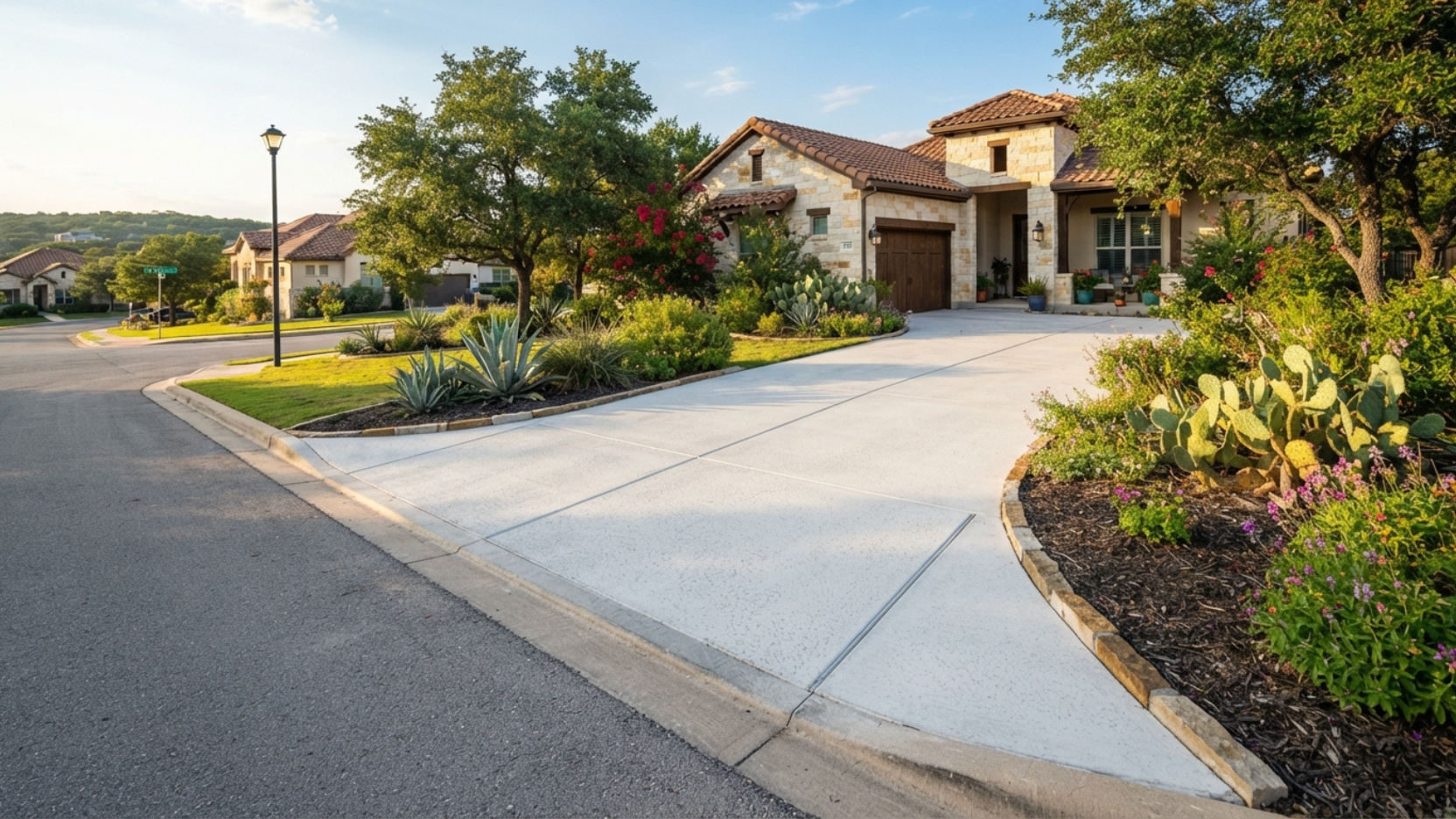
Everything you need to know before pouring, replacing, or repairing a concrete driveway in San Antonio from slab thickness and reinforcement to 2026 pricing and contractor vetting. This guide covers the complete picture so you get a driveway that lasts 30 years, not five.
A concrete driveway is one of the highest-impact investments a San Antonio homeowner can make. It improves curb appeal, increases property value, eliminates the dust and rutting that plague gravel driveways, and when properly built lasts longer than almost any other paved surface. The catch is that “properly built” has specific requirements that many lower-priced contractors skip.
In Bexar County, the two biggest enemies of a concrete driveway are expansive Vertisol clay soils and the intense heat cycle that creates dramatic shrink-swell movement in the ground beneath your slab. A driveway poured over inadequate base preparation, without proper reinforcement, or without enough expansion joints will crack in a fraction of the time it should last. This guide covers every decision so you understand exactly what you’re buying and what questions to ask before any money changes hands.
Base preparation determines 80% of how long your driveway lasts. The most common reason a concrete driveway cracks prematurely in San Antonio is not the concrete mix or the thickness it is inadequate base compaction under an expansive clay soil that shrinks and swells with every wet and dry cycle. A minimum 4-inch compacted crushed limestone base is the standard here, and skipping or shortchanging that layer is the difference between a driveway that looks great at 25 years and one that is cracked and heaving at year six.
Planning
Before a single form is set, a concrete driveway project requires planning around three things: the right dimensions for your vehicles and property, proper drainage slope so water moves away from the garage and foundation, and an understanding of whether your project needs a City of San Antonio Right-of-Way permit (required any time the driveway connects to a public street or curb cut).
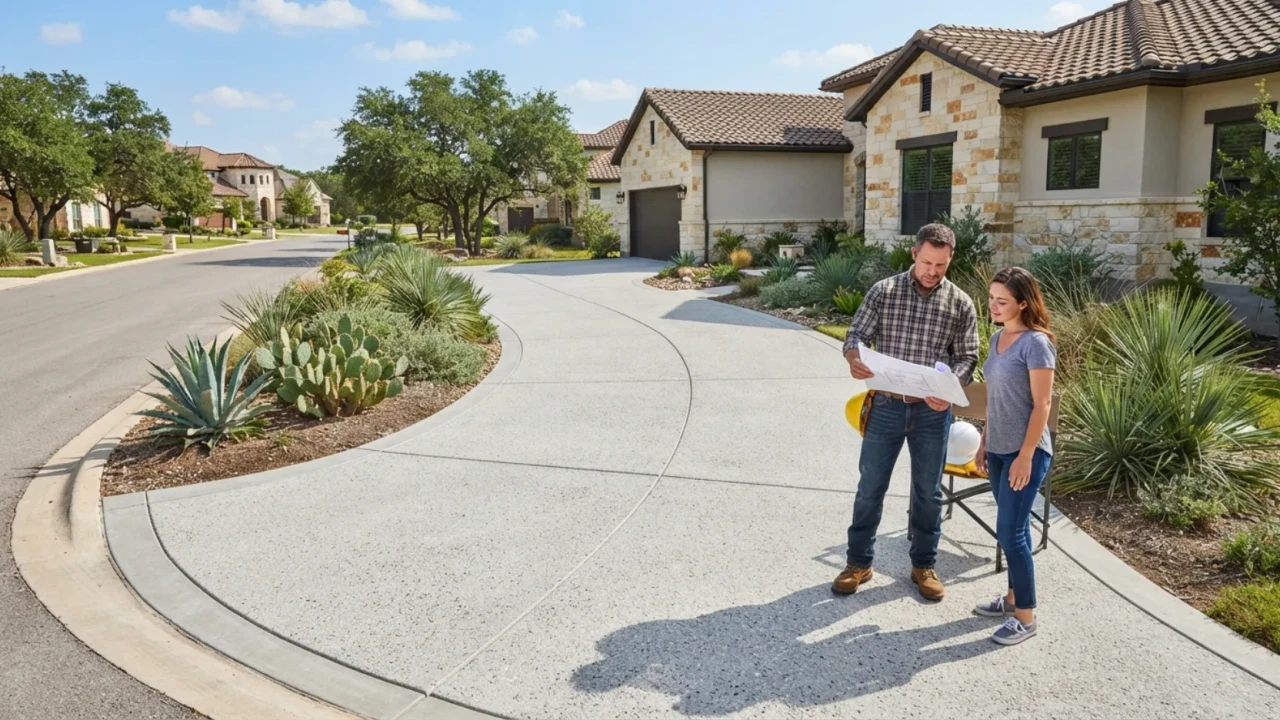
Standard driveway widths in San Antonio: Single-car driveways run 10 to 12 feet wide at minimum, though 12 feet is far more practical. Two-car driveways should be 20 to 24 feet wide. If your household regularly uses trucks or SUVs, size up 24 feet gives comfortable door clearance on both sides without driving over the edge.
Drainage is non-negotiable. San Antonio gets intense rainfall events storms that dump 2 to 3 inches in a few hours are common during spring and fall. A flat driveway or one that slopes toward the garage will send water directly into your garage or under your foundation. A minimum slope of 1/8 inch per foot toward the street should be specified in writing before the pour. If your lot has drainage complications, discuss French drains or channel drains with your contractor before the project starts.
- Driveway width confirmed: 12 ft minimum single-car, 20-24 ft for two-car
- Drainage slope specified: 1/8 to 1/4 inch per foot away from garage and foundation
- Right-of-Way permit confirmed if curb cut or public street connection is modified
- Utility locates requested before any excavation (Texas 811 call 811 or request online)
- Tree roots and landscaping assessed concrete should not be poured over surface roots
Structural Spec
San Antonio’s Blackland Prairie Vertisol clay soils are among the most active in the United States. These soils absorb water, swell, and then contract as they dry a cycle that repeats dozens of times per year. Without a proper base layer separating your concrete from direct soil contact, this movement will telegraph straight into your slab, creating cracks within a few years regardless of how good the concrete mix was.

The structural spec for a residential concrete driveway in San Antonio has three components: the base layer, the slab thickness, and the reinforcement type. All three are interdependent you cannot shortchange one and make up for it in another.
Why rebar over wire mesh for driveways? Wire mesh (welded wire fabric) is fine for patios, sidewalks, and light-duty slabs. For a driveway that will take daily vehicle loads on San Antonio’s expansive clay soils, rebar is the correct choice. Rebar holds cracked sections together if movement does occur wire mesh does not provide the same structural continuity. Specify #3 or #4 rebar at 18-inch centers in both directions, elevated to the middle third of the slab depth using rebar chairs, not resting on the ground.
Edwards Aquifer recharge zone note: Portions of northwest San Antonio and the Hill Country fringe sit in the Edwards Aquifer recharge and contributing zones. If your property is in this area, there may be additional requirements around concrete permeability or drainage that affect your project. The San Antonio Water System (SAWS) and City of San Antonio both publish recharge zone maps. A locally experienced contractor will flag this issue before the project starts it is another reason to hire a contractor with a genuine San Antonio track record rather than one who travels in from out of the area.
| Component | Minimum standard | Recommended for San Antonio clay soils |
|---|---|---|
| Base material | 4 in. crushed limestone, compacted | 4-6 in. compacted caliche or crushed limestone with proof roll |
| Slab thickness (residential) | 4 in. | 5 in. the extra inch adds significant load resistance |
| Slab thickness (heavy vehicles) | 5 in. | 6 in. for RVs, trailers, or commercial-duty use |
| Reinforcement | 6×6 WWF (wire mesh) | #3 rebar at 18 in. centers, elevated to mid-slab |
| Control joints | Every 10 ft | Every 8 ft in both directions more joints, less random cracking |
| Concrete mix | 3,000 psi | 3,500-4,000 psi for driveways higher strength, lower water-cement ratio |
- Base material type and compacted depth specified in the written quote
- Slab thickness specified in inches not just “standard residential”
- Reinforcement type specified: rebar size, spacing, and elevation method
- Concrete mix strength specified: minimum 3,500 psi for driveways in San Antonio
- Control joint spacing specified: every 8-10 feet in both directions
- Rebar chairs or supports included to elevate mesh/rebar to correct height
Cost Guide
The 2026 market price for a standard broom-finish concrete driveway in San Antonio runs $7 to $12 per square foot installed. That range reflects real variation in base preparation depth, concrete mix quality, reinforcement spec, and project size not contractor markup differences. A legitimate quote at the low end of that range is cutting something; a quote significantly below $7 per square foot is almost certainly omitting base preparation or using a lower-grade mix.
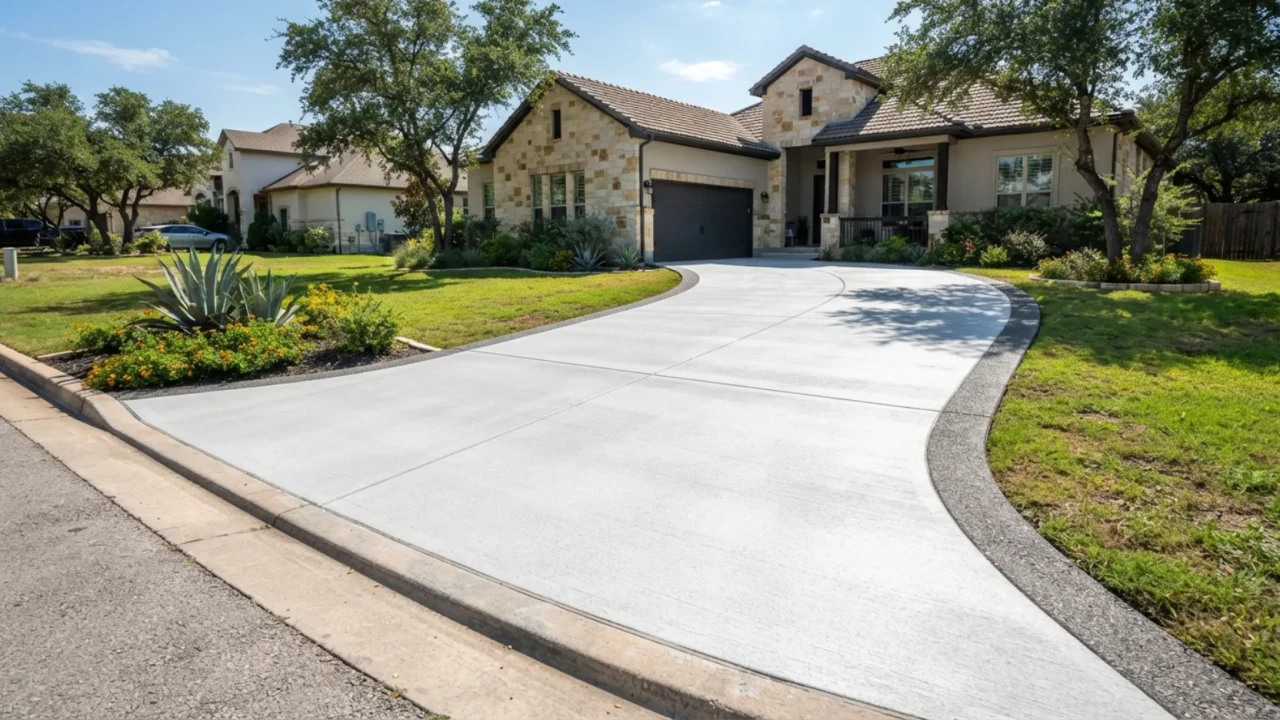
Sample project costs for common San Antonio driveway sizes:
What should a line-item quote include? Any contractor who cannot break out base preparation, concrete material, labor, reinforcement, finishing, and cleanup as separate line items is not operating with full transparency. You do not need a five-page estimate but the quote should specify: base material and depth, slab thickness and square footage, reinforcement type, concrete mix design, finish type, number of control joints, and payment terms.
- Written quote received with itemized line items not just a lump sum
- Base preparation material and compacted depth explicitly stated
- Slab thickness and square footage clearly defined
- Reinforcement type and spacing specified
- Concrete mix design specified (psi rating)
- Old driveway removal and disposal included if applicable confirm who handles it
- Payment terms confirmed: deposit (30-50%) upfront, balance on completion and inspection
Contractor Vetting
A concrete driveway’s quality is almost entirely determined by the crew’s experience with San Antonio soil conditions and their willingness to do the prep work correctly. A skilled, properly equipped crew with a 3,500 psi mix on a 4-inch compacted base will outperform an inexperienced crew using premium materials every time. Vetting the contractor is at least as important as specifying the materials.

The five things to verify before hiring any concrete contractor in San Antonio:
| What to verify | Good contractor response | Red flag response |
|---|---|---|
| Liability insurance | Certificate of insurance provided immediately on request minimum $1M general liability | “We are covered” with no documentation; policy below $1M; expired certificate |
| Local soil knowledge | Specific mention of Vertisol clay, base compaction requirements, and expansion joint spacing for Bexar County | Generic answers that could apply anywhere in Texas no local specificity |
| Quote detail | Written quote itemizing base prep, reinforcement, mix design, square footage, finish, and cleanup | Verbal quote only; written quote is a single lump sum with no spec detail |
| References | Two or three recent San Antonio driveway projects with homeowner contact info available | Cannot provide local references; offers only Google reviews as proof of work |
| Equipment on site | Plate compactor or jumping jack for base compaction; rebar chairs for reinforcement elevation | Hand tamping the base; rebar resting on the ground without elevation support |
| Payment terms | 30-50% deposit upfront, balance on completion after homeowner inspection | Full payment required before work begins; no written contract |
Ask specifically about their curing plan. Concrete curing in San Antonio’s summer heat is different from curing in Houston or Dallas. With air temperatures regularly reaching 100-105 degrees from June through September, freshly poured concrete can lose moisture faster than the hydration reaction requires weakening the final slab before it reaches full strength. A contractor who answers “we wet-cure for 3 to 5 days after the pour” or “we apply a curing compound immediately after finishing” understands the local climate. A contractor who says “we just let it dry” does not.
- Certificate of insurance received and reviewed do not accept verbal confirmation
- Business has a verifiable San Antonio address and has been operating locally for at least 3 years
- At least two local references from completed driveway projects in Bexar County
- Written quote received with full spec detail before any deposit is paid
- Contractor confirmed knowledge of Bexar County soil conditions without prompting
- Curing plan stated: wet curing for 3-5 days OR liquid curing compound applied post-finish
Maintenance
Concrete driveways are low maintenance not zero maintenance. In San Antonio, two factors make regular sealing more important than in most other U.S. cities: intense UV radiation from an average of 220 sunny days per year, and Edwards Aquifer hard water with high mineral content that leaves deposits and accelerates surface degradation on unsealed concrete. A driveway sealed on schedule will look significantly better and last significantly longer than an identical driveway left unsealed.
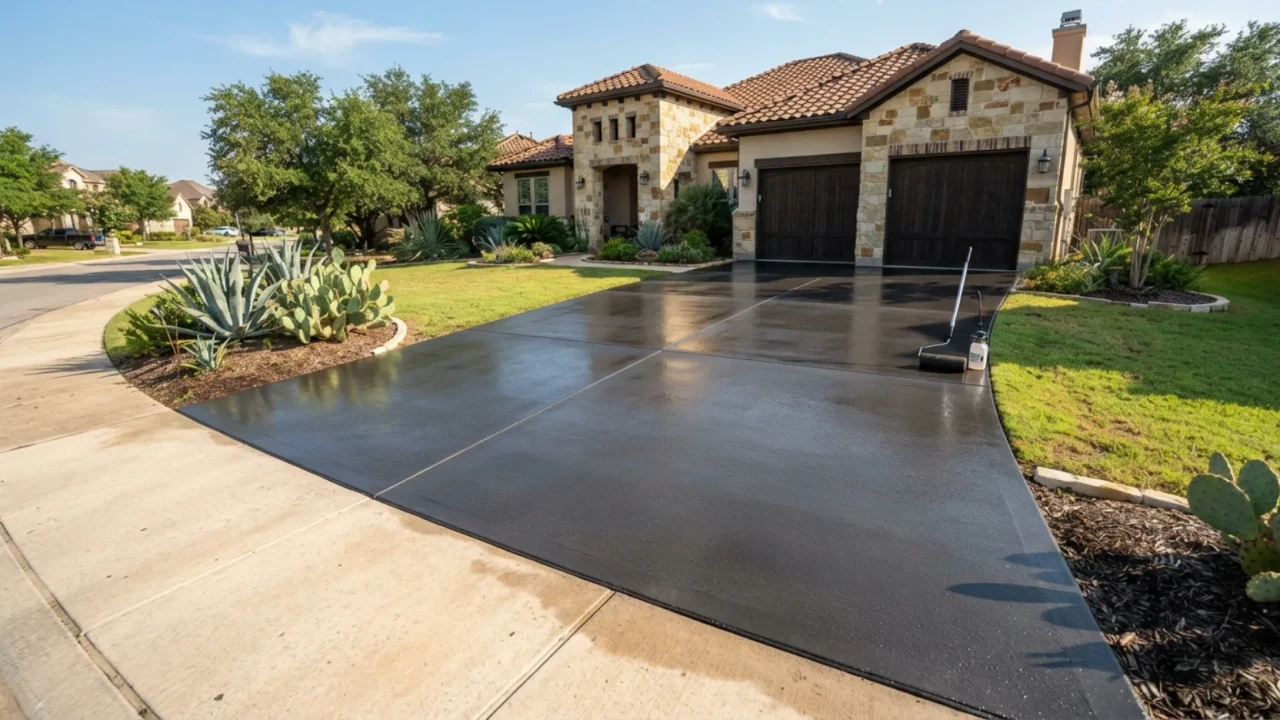
Sealing schedule for San Antonio driveways:
Crack repair: Hairline cracks under 1/4 inch wide that appear in the first year are normal shrinkage cracks a byproduct of concrete losing moisture as it cures. Fill these with a polyurethane or epoxy crack filler in the first season before they widen. Wider cracks, cracks that run through a control joint, or cracks with vertical displacement (one side higher than the other) indicate base movement and require a contractor assessment. In Bexar County, the most common causes of structural cracking are tree roots under the slab and clay soil heave from inadequate base preparation.
Stain and oil removal: San Antonio’s hard water leaves mineral deposits (calcium and magnesium) on unsealed concrete that etch the surface over time. Oil stains from vehicles penetrate unsealed concrete within hours. Clean oil spills immediately with a commercial degreaser do not let them sit. Annual pressure washing removes algae, mildew, and dirt accumulation that retains moisture and accelerates concrete degradation.
- First sealer application at 28-30 days after pour do not seal before full cure
- Reseal every 3-5 years for standard broom finish; every 2-3 years for decorative or stamped
- Annual pressure washing to remove algae, mold, hard water deposits, and organic staining
- Oil and grease spills cleaned immediately with commercial degreaser do not allow penetration
- Hairline cracks filled in year one before they widen polyurethane crack filler preferred
- Structural cracks (wider than 1/4 in. or with vertical displacement) assessed by a contractor
Use this table to match your household’s specific needs to the correct driveway specification. Every row reflects real-world conditions in Bexar County and current 2026 market pricing.
| Driveway use case | Recommended slab thickness | Reinforcement | 2026 cost range |
|---|---|---|---|
| Standard residential (sedan, crossover) | 4-5 in. | #3 rebar at 18 in. centers | $7-9/sqft |
| Heavy vehicles (trucks, SUVs, trailers) | 5-6 in. | #4 rebar at 18 in. centers | $9-12/sqft |
| RV pad or boat trailer storage | 6 in. | #4 rebar at 12 in. centers | $11-15/sqft |
| Stamped decorative driveway | 4-5 in. | #3 rebar at 18 in. centers | $14-20/sqft |
| Driveway apron (street to garage) | 5 in. | #3 rebar at 18 in. centers | $8-11/sqft |
| Circular driveway (full loop) | 4-5 in. | #3 rebar at 18 in. centers | $7-10/sqft (higher due to curves) |
| Commercial or multi-unit property | 6 in. | #4 rebar at 12 in. centers | $6-10/sqft (volume pricing) |
- Driveway width confirmed for your household’s vehicles: 12 ft min single-car, 20-24 ft two-car
- Drainage slope specified in the quote: 1/8 to 1/4 in. per foot toward the street
- Texas 811 utility locate requested before any excavation begins
- Right-of-Way permit confirmed if curb cut or street connection is involved
- Tree root proximity assessed no concrete over surface roots without root barrier
- Base material type and compacted depth in the written quote: 4-6 in. crushed limestone
- Slab thickness specified in inches: 4-5 in. residential, 5-6 in. heavy vehicles
- Reinforcement type specified: rebar size, spacing, and elevation method (not resting on ground)
- Concrete mix strength specified: minimum 3,500 psi for residential driveways
- Control joint spacing specified: every 8-10 feet in both directions
- Certificate of insurance reviewed: $1M+ general liability, worker’s comp for crew with employees
- Written itemized quote received before any deposit is paid
- At least two local Bexar County references from completed driveway projects verified
- Curing plan confirmed: wet curing 3-5 days or curing compound applied post-finish
- Payment terms: 30-50% deposit, remainder on completion and inspection only
- No vehicle traffic for 7 days; foot traffic restricted for 48 hours
- First sealer application at 28-30 days after pour
- Resealing scheduled: every 3-5 years broom finish, every 2-3 years decorative
- Annual pressure washing on the maintenance calendar
- Hairline cracks monitored and filled within year one if they appear
How much does a concrete driveway cost in San Antonio in 2026?
How long does a concrete driveway last in San Antonio?
Should I repair or replace my cracked concrete driveway?
How long does it take to pour a concrete driveway in San Antonio?
Is concrete or asphalt better for a driveway in San Antonio?
Do I need a permit for a new concrete driveway in San Antonio?
Get a free concrete driveway quote in San Antonio
Tell us your driveway size, vehicle type, and timeline. We will visit your property, assess the existing surface and soil conditions, and deliver a detailed written quote at no cost or obligation.