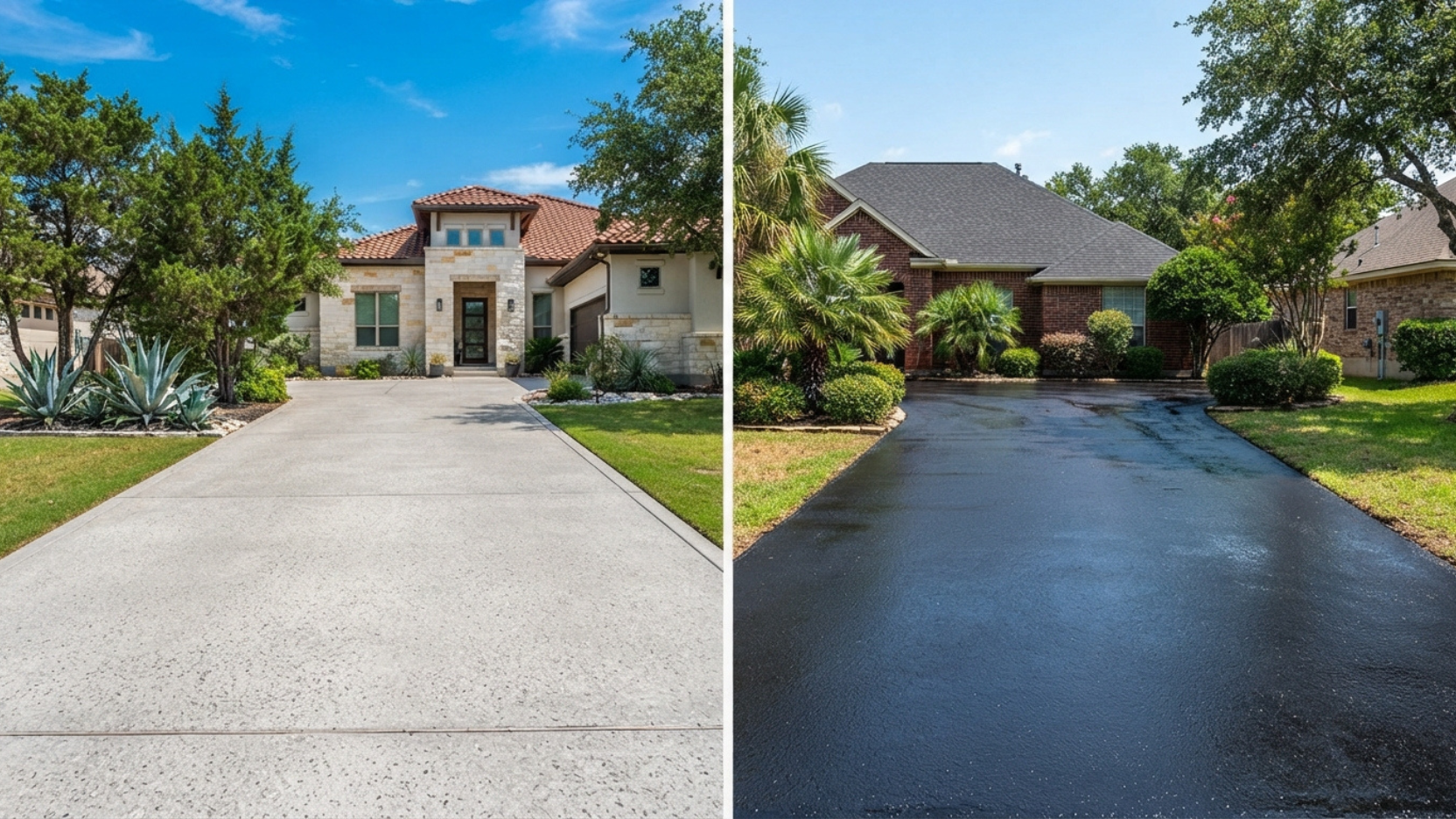
Concrete vs Asphalt Driveways Which Is Better

Concrete VS Asphalt Driveways: Which Is Better?

Concrete vs Asphalt Driveways: Which Is Better? | Affordable Concrete San Antonio
Concrete Driveway Guide San Antonio, TX

Both materials can make a solid driveway. But in San Antonio's climate, one of them handles the heat, the clay soils, and the long ownership timeline significantly better than the other. This guide breaks down every category cost, lifespan, maintenance, appearance, and resale impact so you can make the right call for your property.

Concrete vs asphalt driveway San Antonio Which driveway material is better in Texas Cost · Lifespan · Climate Performance Side-by-side comparison · 2026 Updated 2026
A
Affordable Concrete San Antonio Editorial Team
With over 10 years of residential and commercial concrete experience in San Antonio and the surrounding areas, our team has completed thousands of driveways, patios, pool decks, and commercial slabs across Bexar County. Every guide we publish reflects real on-the-ground expertise not generic contractor advice.
· affordableconcretesanantonio.com · Licensed & Insured · $2M Liability Coverage
Part of our complete driveway guide
Concrete Driveway Guide for San Antonio Homeowners
30–50yrs
Concrete driveway lifespan in San Antonio with proper installation and sealing
15–25yrs
Asphalt driveway lifespan in the Texas climate before significant resurfacing is needed
20–40%
Typical upfront cost premium for concrete over asphalt on a residential driveway
120°F+
Surface temperature asphalt reaches on a San Antonio summer afternoon enough to soften the material

The concrete versus asphalt question comes up on almost every San Antonio driveway project. Both materials are widely used, both have legitimate strengths, and the right answer depends on your priorities, your budget, and how long you plan to own the property. What makes this comparison different in San Antonio than in, say, Minnesota, is the climate. Heat performance changes the equation significantly in Texas, and most of the comparison guides written for national audiences do not reflect what actually happens to an asphalt driveway during a San Antonio summer.

This guide covers the comparison across six categories: upfront cost, total cost of ownership, lifespan, climate performance, maintenance requirements, and appearance. At the end, you will find a scenario-by-scenario verdict that tells you which material wins for each type of homeowner situation.

The one factor that tips the balance in San Antonio specifically: heat performance

In cooler northern climates, asphalt and concrete trade off more evenly. Asphalt's lower upfront cost and easier crack repair make it competitive where summers are mild. San Antonio summers are not mild. Asphalt softens when surface temperatures exceed 120 degrees Fahrenheit, and on a south-facing driveway in direct July sun, that threshold is routinely crossed by early afternoon. The softening causes rutting under tire load, tracking (material sticking to shoes and tires), and accelerated surface oxidation that shortens the effective service life. Concrete does not have this problem. In the Texas climate, that single factor deserves significant weight in your decision.

● ● ●
Six categories, head-to-head
Concrete vs. asphalt compared on every dimension that matters
01
Upfront installation cost
Asphalt wins on day one but the margin is smaller than most homeowners expect
Cost

Asphalt has the lower upfront installation cost in most markets, and San Antonio is no exception. The material is cheaper per square foot, installation is faster, and the base preparation requirements are slightly less demanding than concrete in some applications. That lower day-one number is the primary reason many homeowners default to asphalt without exploring the full picture.
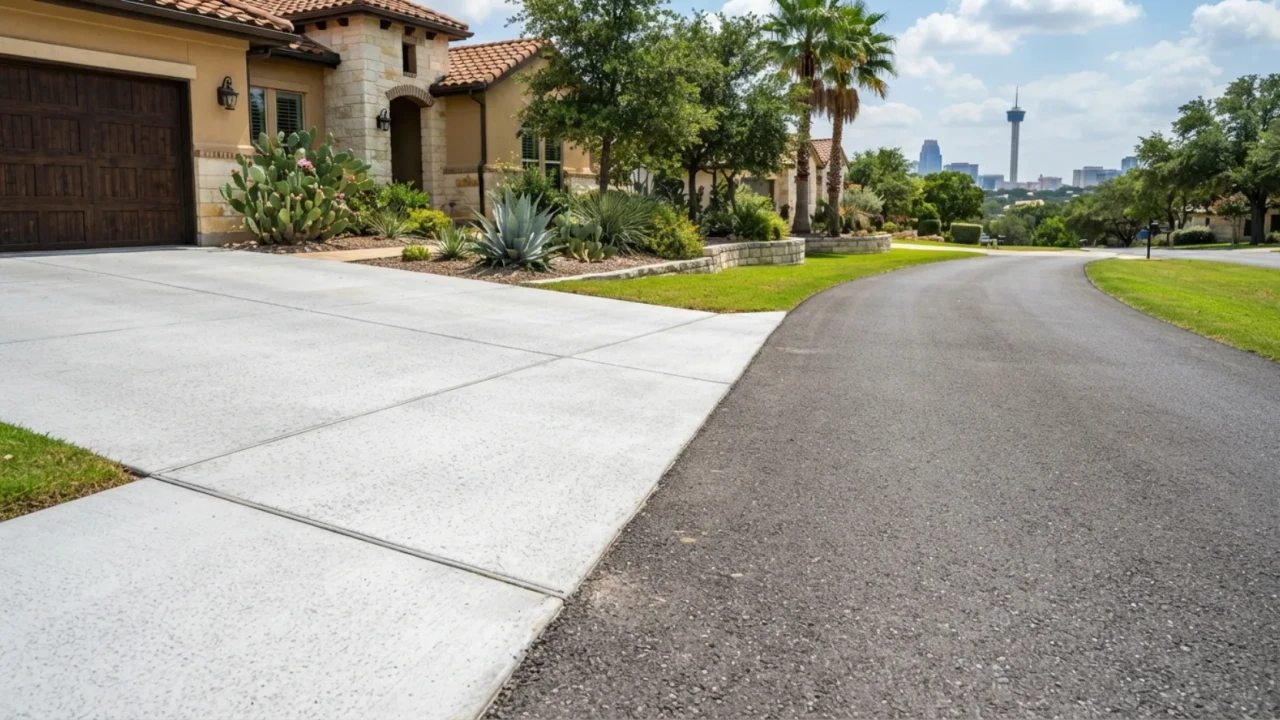
Concrete driveway installation cost comparison versus asphalt in San Antonio Texas

For a standard two-car residential driveway in San Antonio (roughly 600 square feet), current 2026 pricing runs approximately $4 to $7 per square foot for asphalt installed and $7 to $12 per square foot for concrete installed. On that 600-square-foot example, the difference comes out to roughly $1,800 to $3,000 more for concrete upfront. That gap is real, but it needs to be weighed against the maintenance and replacement cost difference over 20 to 30 years.

Asphalt installed: $4–$7 per sq ft in San Antonio Concrete installed: $7–$12 per sq ft in San Antonio 600 sq ft driveway: Concrete costs roughly $1,800–$3,000 more upfront Price driver: Concrete requires longer cure window and more labor
$4–$7/sqft
Asphalt
Asphalt driveway, installed: Lower material cost and faster pour-and-roll installation drive the lower price. Typically drivable within 24 to 48 hours. Standard residential spec uses 2 to 3 inches of compacted asphalt over a crushed stone base.
$7–$12/sqft
Concrete
Standard concrete driveway, installed: Higher material cost, more labor-intensive finishing, and a 7-day wait before vehicle traffic account for the premium. Includes compacted limestone base, rebar, pour, finishing, and initial cure. Broom finish at the lower end; brushed or decorative edge work at the higher end.
$12–$22/sqft
Decorative
Stamped or stained concrete driveway: Decorative concrete finishes have no asphalt equivalent. Stamped patterns, integral color, and exposed aggregate finishes put concrete in a category of its own for curb appeal. Asphalt cannot be stamped or permanently colored in comparable ways.
Category verdict
Asphalt wins on upfront cost
Asphalt is cheaper to install in San Antonio by 20 to 40 percent on a standard residential driveway. If day-one budget is the primary constraint, asphalt wins this category. However, the gap narrows significantly when you factor in the resealing and resurfacing costs asphalt accumulates over its shorter lifespan.
Cost comparison quick facts
  • Asphalt installation: $4 to $7 per sq ft in San Antonio (2026 pricing)
  • Concrete installation: $7 to $12 per sq ft for standard broom finish
  • Decorative concrete (stamped, stained): $12 to $22 per sq ft no asphalt equivalent exists
  • On a 600 sq ft driveway, concrete costs roughly $1,800 to $3,000 more upfront than asphalt
  • Both materials require similar base preparation costs savings on asphalt come from material, not prep
02
Lifespan and long-term durability
Concrete lasts twice as long in the Texas climate and the gap is wider than national averages suggest
Lifespan

Lifespan is where the concrete versus asphalt comparison shifts most decisively in favor of concrete, particularly in San Antonio. National averages often cite asphalt at 20 to 30 years and concrete at 30 to 50 years. In the Texas climate, those ranges compress toward the lower end for asphalt and hold more firmly toward the middle and upper end for concrete, assuming proper installation and maintenance in both cases.
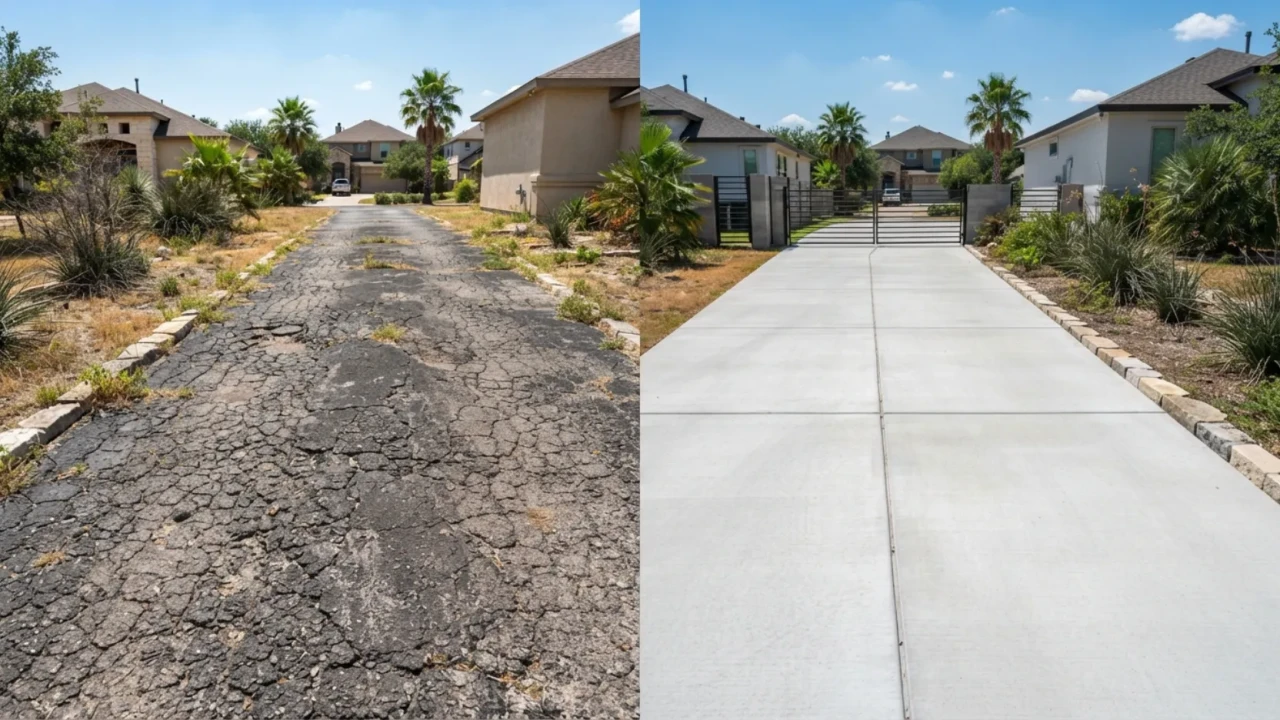
Asphalt driveway cracking and deteriorating in San Antonio Texas heat compared to concrete longevity

The primary lifespan threat to asphalt in San Antonio is UV oxidation combined with heat softening. Asphalt binder degrades under intense UV exposure and loses flexibility over time, which causes cracking and surface raveling. In northern states, freeze-thaw cycles are the primary degradation mechanism. In San Antonio, it is heat and UV a year-round stressor rather than a seasonal one. Concrete, by contrast, is not meaningfully affected by UV exposure and handles heat expansion through its control joint system.

Concrete lifespan (San Antonio): 30–50 years Asphalt lifespan (San Antonio): 15–20 years realistic Primary asphalt threat: UV oxidation and heat softening Primary concrete threat: Clay soil movement and tree root intrusion
Lifespan factor Concrete in San Antonio Asphalt in San Antonio
Expected lifespan, well maintained 35 to 50 years 15 to 20 years
Expected lifespan, minimal maintenance 20 to 30 years 10 to 15 years
Heat performance (100°F+ days) Dimensionally stable; no softening Surface softens; rutting possible under tire load
UV resistance High; color fades slightly but structure is unaffected Low; binder oxidizes and surface becomes brittle within 5 to 7 years
Clay soil performance Good with proper expansion joints and base prep Flexible nature can accommodate some movement; but thinner cross-section is more vulnerable
Full replacement cycle Once in 40 to 50 years for most homeowners Possibly twice in the same timeframe
Category verdict
Concrete wins on lifespan by a wide margin in Texas
Concrete lasts roughly twice as long as asphalt in San Antonio conditions. A homeowner who installs concrete today and maintains it properly should not face replacement for 35 to 50 years. An asphalt driveway installed today will likely need significant resurfacing or full replacement in 15 to 20 years. Over a 40-year ownership period, that is the difference between replacing a driveway once versus twice.
Lifespan comparison quick facts
  • Concrete driveway: 35 to 50 years realistic lifespan in San Antonio with proper installation
  • Asphalt driveway: 15 to 20 years realistic lifespan in San Antonio heat conditions
  • Asphalt begins oxidizing visibly within 5 to 7 years in Texas UV exposure without regular sealing
  • Concrete's lifespan is determined primarily by installation quality; asphalt's by ongoing maintenance intensity
  • A 40-year homeowner will likely replace an asphalt driveway twice; a concrete driveway once or not at all
03
Climate performance in San Antonio
Heat, UV, clay soils, and freeze events how each material handles the full San Antonio climate
Climate

San Antonio sits in USDA Hardiness Zone 9, with summers regularly exceeding 100 degrees Fahrenheit and surface temperatures on paved areas routinely hitting 140 to 150 degrees in direct afternoon sun. Winters are generally mild but do include occasional freeze events. The clay soils prevalent across Bexar County add a third stressor: ground movement from alternating wet and dry seasons. Each material handles this combination differently.

Concrete driveway in San Antonio Texas performing well in summer heat versus asphalt softening

Concrete's biggest climate advantage in San Antonio is its behavior in extreme heat. Concrete is rigid and dimensionally stable at temperatures far above what asphalt can handle. The control joint system in a properly installed concrete driveway accommodates thermal expansion without surface distortion. Asphalt, by contrast, relies on the petroleum-based binder for its structural cohesion, and that binder softens as temperatures rise. A car parked in the same spot daily on a softened asphalt surface will leave visible ruts within a single summer season.

Asphalt softening point: 115–125°F surface temperature SA summer surface temp: 140–155°F on dark asphalt in direct sun Concrete behavior at heat: Stable; expands marginally, absorbed by joints Light color advantage: Concrete reflects more heat than dark asphalt
SA climate note

The heat island effect favors concrete in San Antonio: Asphalt's dark color absorbs significantly more solar radiation than concrete's lighter surface. In San Antonio's urban and suburban settings, this contributes to the heat island effect around your home raising ambient temperatures around the driveway area during summer months. Concrete's higher solar reflectance (albedo) means it absorbs less heat and keeps the surrounding area measurably cooler. If your driveway runs along the side of the house or adjacent to an outdoor living area, concrete's lower surface temperature is a meaningful comfort advantage from June through September.

Concrete in San Antonio Heat
Dimensionally stable at all temperatures encountered in the Texas climate. Surface temperature runs 20 to 30 degrees cooler than comparable asphalt in direct sunlight. Expansion joints manage thermal movement without surface distortion. Color fades slightly over years but structural performance is unaffected by UV.
Climate verdict: Concrete is the better performer for San Antonio heat and UV conditions.
Asphalt in San Antonio Heat
Dark surface absorbs maximum solar radiation, raising surface temperatures to 140 to 155 degrees on summer afternoons. Binder softens above 115 to 125 degrees, creating potential for rutting under parked vehicles. UV oxidation of the binder begins visibly within 5 to 7 years, turning the surface gray and brittle.
Climate verdict: Asphalt faces more stress in the Texas climate than in cooler regions where it competes more evenly with concrete.
Concrete in San Antonio Freeze Events
San Antonio experiences occasional freeze events but not the prolonged freeze-thaw cycling that damages concrete in northern states. Properly sealed concrete handles the rare San Antonio freeze without significant damage. Surface spalling from freeze-thaw is uncommon here compared to Chicago or Denver.
Concrete's freeze performance in San Antonio is not a concern with basic sealing maintenance.
Clay Soil Performance: Both Materials
Bexar County's expansive clay soils are the biggest ground-movement challenge for both driveway types. Concrete handles this through expansion joints and a rigid slab that bridges minor voids. Asphalt's flexibility can absorb minor movement, but its thinner cross-section is more vulnerable to base loss under extended drought cycles.
Both materials require a proper compacted base over San Antonio clay. Neither performs well on an inadequately prepared subgrade.
Category verdict
Concrete wins on climate performance in San Antonio
The San Antonio climate is specifically hard on asphalt and relatively neutral toward concrete. Heat softening, UV oxidation, and the city's dark-surface heat island effect all disadvantage asphalt in this market. Concrete's rigid structure, lighter color, and UV resistance make it a better long-term fit for the Texas climate than it is in most of the national comparison guides written for general audiences.
Climate performance quick facts
  • Asphalt surface temperatures in San Antonio summers: 140 to 155 degrees Fahrenheit in direct sun
  • Asphalt softening threshold: approximately 115 to 125 degrees surface temperature
  • Concrete surface in the same conditions: 20 to 30 degrees cooler due to lighter color and higher reflectance
  • Asphalt UV oxidation begins visibly within 5 to 7 years of installation in Texas sun without resealing
  • Concrete freeze-thaw damage is not a significant concern in San Antonio's mild winter climate
04
Maintenance requirements over the full lifespan
Asphalt requires more frequent attention and the cumulative cost is significant
Maintenance

Asphalt is often described as "easier to repair" than concrete, which is accurate in a narrow sense: filling a crack in asphalt takes less skill and less time than patching concrete. But that statement misses the bigger picture. Asphalt requires significantly more frequent maintenance interventions over its lifespan than concrete, and the cumulative cost of those interventions matters when comparing total ownership expense.
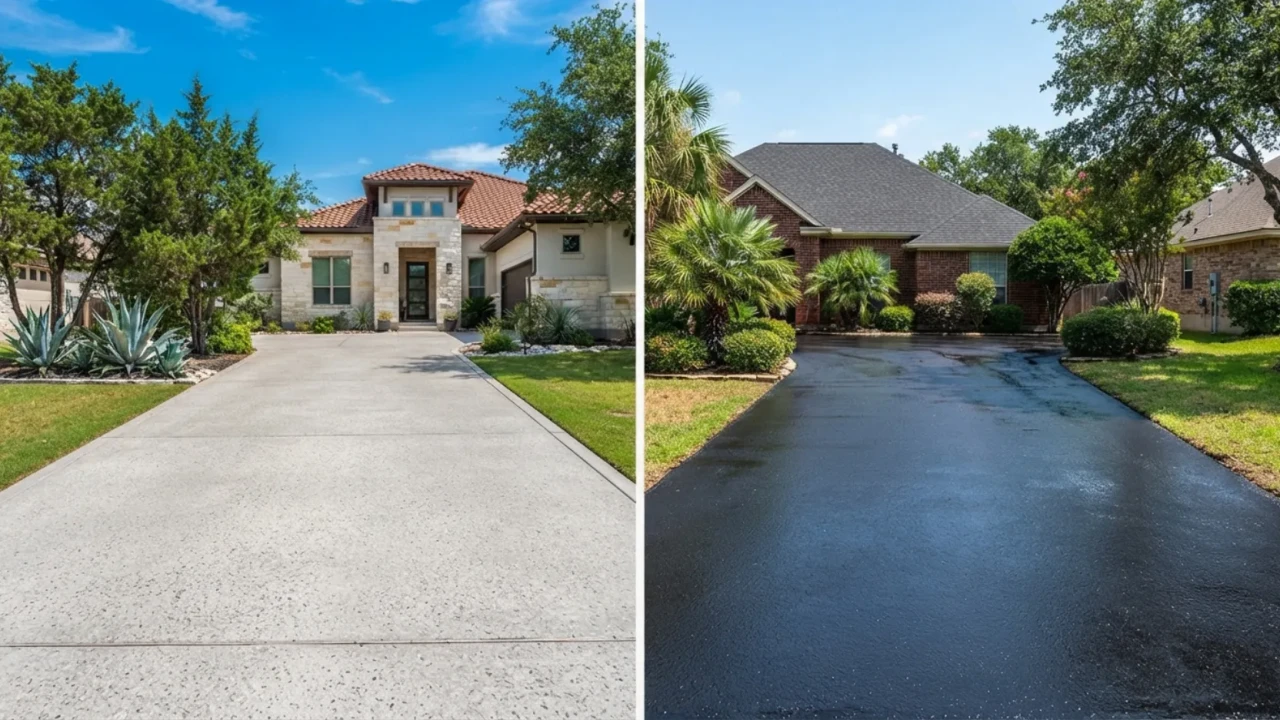
Concrete driveway maintenance sealing in San Antonio versus asphalt resealing requirements

Asphalt driveways require sealcoating every 1 to 3 years. In San Antonio's UV-intense environment, skipping sealcoating accelerates oxidation dramatically, and most professionals here recommend annual or biennial applications. Concrete requires sealing every 2 to 3 years for decorative surfaces, and every 3 to 5 years for a standard broom-finish driveway. That difference in maintenance frequency compounds significantly over a 20 to 30-year period when you account for material cost and labor.

Asphalt sealcoating: Every 1–2 years in San Antonio Concrete sealing: Every 2–3 years (decorative) or 3–5 years (broom) Asphalt crack fill: Easier and cheaper per repair event Asphalt resurfacing: Typically needed at year 10–15
$0.15–0.25/sqft
Asphalt sealcoat
Asphalt sealcoating, professional application: Applied every 1 to 2 years in San Antonio. A 600-square-foot driveway runs $90 to $150 per application. Over 20 years at an average of 18 months between coats, total sealcoating cost reaches $1,200 to $2,000 before any crack filling or resurfacing.
$0.12–0.20/sqft
Concrete sealing
Concrete sealing, professional application: Applied every 2 to 3 years for standard residential driveways in San Antonio. A 600-square-foot driveway runs $75 to $120 per application. Over 20 years at an average of 2.5 years between coats, total sealing cost is approximately $600 to $960.
$1,200–3,500
Asphalt resurface
Asphalt resurfacing at year 10 to 15: A standard 600-square-foot driveway will typically need an overlay or full resurfacing before the end of its service life. This cost is largely absent from concrete ownership unless isolated crack repair is needed.
$300–800
Concrete repair
Concrete crack repair (if needed): Isolated crack filling on a concrete driveway is less frequent than asphalt maintenance events. Structural crack repair may be needed once in a 30-year period on a well-installed concrete driveway on stable soil.
💡 The total cost math: On a 600-square-foot driveway over 30 years, asphalt maintenance (sealcoating plus one resurfacing) typically costs $2,500 to $5,500 in today's dollars. Concrete maintenance (sealing only) runs $900 to $1,500 over the same period. That difference, added to the replacement cost advantage of concrete's longer lifespan, often makes concrete the less expensive option over 20 to 30 years even though it costs more on day one.
Maintenance tip

One area where asphalt genuinely wins on maintenance: early crack repair. Filling a crack in asphalt takes a tube of cold-patch filler and 15 minutes of work. The result blends nearly invisibly with the surrounding material. Concrete crack repair is more visible and more involved matching the original surface texture is difficult, and filled cracks will always be slightly more noticeable than in asphalt. If surface appearance after minor repair is a priority and your driveway is prone to settling cracks from clay soil movement, that is a legitimate point in asphalt's favor worth considering.

Category verdict
Concrete wins on total maintenance cost asphalt wins on repair ease
Concrete requires less frequent maintenance and lower cumulative maintenance spending over its lifespan. Asphalt is easier and cheaper to repair on a per-event basis. For homeowners who want low total maintenance effort and cost, concrete is the better choice. For homeowners who expect frequent minor repairs and prioritize each repair being invisible, asphalt has a real advantage in that narrow respect.
Maintenance comparison quick facts
  • Asphalt sealcoating interval in San Antonio: every 1 to 2 years due to UV intensity
  • Concrete sealing interval: every 2 to 3 years (decorative) or 3 to 5 years (standard broom finish)
  • Asphalt resurfacing typically needed at year 10 to 15 concrete equivalent not usually required
  • Asphalt crack repair is easier, cheaper, and more invisible per repair event
  • Total 30-year maintenance cost: asphalt roughly 2 to 4 times higher than concrete
05
Appearance, curb appeal, and resale value
Concrete offers far more design flexibility and delivers measurable return at resale
Appearance

Asphalt comes in one look: dark gray to black, uniform, and utilitarian. That appearance is clean when new, becomes progressively gray and weathered within a few years without consistent sealcoating, and has no meaningful variation available. Concrete, by contrast, offers a wide range of finish options that range from clean and simple to genuinely decorative.

This category matters beyond personal preference. Real estate agents and appraisers in San Antonio consistently cite driveway material and condition as a visible curb appeal factor, and a stamped or well-maintained concrete driveway contributes positively to home value in ways that asphalt does not. Concrete also ages more gracefully in appearance: a sealed concrete driveway at 20 years looks noticeably better than an asphalt driveway at the same age in a Texas climate.

Broom Finish Concrete
The standard residential concrete finish. Clean, light gray surface with subtle linear texture. Much lighter in color than asphalt visually cooler in appearance and actual temperature. Brightens the front elevation of a home compared to asphalt's dark surface. Stays presentable with biennial cleaning and sealing.
The baseline concrete option that already outperforms asphalt on appearance over time.
Stamped Concrete
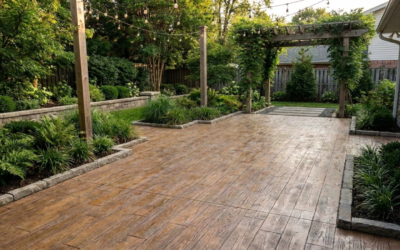
Pressed patterns that replicate brick, flagstone, slate, or wood plank. Full color integration from integral pigment. No asphalt equivalent at any price point. The most popular premium driveway upgrade in San Antonio for homeowners focused on curb appeal and resale value. Adds measurable visual impact from the street.
Requires sealing every 2 to 3 years to maintain color vibrancy. Highest visual return on investment of any driveway material.
Exposed Aggregate Concrete
Washed surface reveals the stone and pebble aggregate within the mix. Natural texture and color from the aggregate itself. Distinctive appearance that does not date. Popular in upscale San Antonio neighborhoods as a durable decorative option that blends with limestone landscaping common in the area.
Appearance depends on aggregate selection specify before the pour. Color is permanent and UV-stable.
Asphalt (New Installation)
Clean dark surface when freshly installed and sealed. No pattern, color, or finish variation available. Ages to gray within 3 to 5 years without consistent sealcoating. The uniform dark surface can look dated or institutional in neighborhoods where concrete and decorative paving are common.
Appearance peaks at installation and declines with age. Sealcoating restores color temporarily but cannot duplicate concrete's design range.
Category verdict
Concrete wins on appearance and resale impact
Concrete offers a range of finish options that asphalt cannot match at any price point. A plain broom-finish concrete driveway already ages more gracefully than asphalt in the Texas climate. A stamped or decorative concrete driveway is a genuine curb appeal upgrade with documented resale impact in the San Antonio market. Asphalt has no design variation and no equivalent contribution to home value.
Appearance comparison quick facts
  • Asphalt finish options: one dark gray to black, no pattern or color variation available
  • Concrete finish options: broom, stamped, exposed aggregate, stained, brushed wide range at varying price points
  • Asphalt ages visibly to gray within 3 to 5 years in Texas UV without consistent sealcoating
  • Concrete color fades slowly and uniformly over decades a sealed slab at 15 years looks significantly better than comparable asphalt
  • Stamped and decorative concrete contributes positively to home resale value; asphalt does not carry equivalent appraisal impact
06
Scenario-by-scenario verdict: which material is right for your situation
The right answer depends on your timeline, budget structure, and priorities
Final Verdict

Most comparisons end with a generic "it depends" conclusion that is not helpful when you need to actually make a decision. The scenarios below give you a specific recommendation based on the most common homeowner situations in San Antonio. Read the one that matches your situation most closely.

Your situation Recommended material Why
Long-term homeowner (10+ years), normal budget Concrete Lower total cost of ownership over 20 to 30 years; lifespan advantage is decisive when you plan to stay
Tight upfront budget, planning to sell in 5 to 7 years Asphalt Lower day-one cost matters more than long-term savings; a well-maintained asphalt driveway presents fine at resale within that window
Focused on curb appeal or home value Concrete (decorative) Stamped or exposed aggregate concrete is the only driveway material with documented curb appeal and appraisal impact; asphalt has no equivalent
Heavy vehicle use (trucks, RVs, trailers) Concrete (5–6" slab with rebar) Asphalt is particularly vulnerable to rutting under heavy repeated load in San Antonio heat; a properly specified concrete slab handles heavy vehicle weight without surface deformation
Rental property or investment property Concrete Lower maintenance intervention frequency reduces landlord burden; concrete's durability over a longer period means fewer tenant-cycle replacements
Replacing a failed asphalt driveway Concrete If the asphalt driveway has reached end-of-life and full replacement is required, upgrading to concrete resets the lifespan clock to 35 to 50 years and eliminates the frequent resealing cycle going forward
Cold climate (not applicable in San Antonio) Either asphalt competitive In northern states with heavy freeze-thaw cycling, asphalt's flexibility competes more evenly with concrete's rigidity; the San Antonio climate removes this advantage entirely
🏆 Bottom line for San Antonio homeowners: If you are replacing an existing driveway or installing a new one and you plan to own your home for more than 7 to 10 years, concrete is the better investment in this market. The combination of superior heat performance, longer lifespan, lower long-term maintenance cost, and broader design options makes concrete the correct choice for the majority of San Antonio residential driveway projects.
Decision summary
  • Choose concrete if: long-term ownership, heavy vehicle use, curb appeal priority, or rental property
  • Choose asphalt if: tight upfront budget and planning to sell within 5 to 7 years
  • San Antonio's heat climate tips the balance toward concrete more strongly than national comparisons suggest
  • Total cost of ownership over 30 years typically favors concrete despite the higher upfront price
  • Decorative concrete options (stamped, exposed aggregate) have no asphalt equivalent at any price point
● ● ●
Complete side-by-side comparison
Concrete vs. asphalt: every category at a glance

Use this table as a quick reference for the full comparison. Each row represents a decision factor with a clear winner for San Antonio conditions.

Category Concrete Asphalt Winner (San Antonio)
Upfront install cost $7–$12 per sq ft $4–$7 per sq ft Asphalt
Expected lifespan 35–50 years 15–20 years Concrete
Heat performance (100°F+) Stable; no softening Softens; risk of rutting Concrete
UV resistance High; minimal degradation Low; oxidizes within 5–7 years Concrete
Sealing frequency Every 2–5 years Every 1–2 years in SA Concrete
Crack repair ease More involved; visible repair Simple; blends well Asphalt
Design / finish options Broom, stamped, aggregate, stained One option only Concrete
Surface temperature in summer Cooler; reflects more solar radiation Hotter; absorbs maximum solar load Concrete
Resale / curb appeal impact Positive; measurable for decorative finishes Neutral to minimal Concrete
Total 30-year ownership cost Lower (longer lifespan, less maintenance) Higher (more maintenance, shorter life) Concrete
Time before vehicle traffic allowed 7 days (full cure) 24–48 hours Asphalt
Environmental footprint Lower; concrete is recyclable Petroleum-based; energy-intensive to produce Concrete
● ● ●
Your concrete driveway decision checklist
Run through these before finalizing your driveway material choice and contractor selection
Evaluating your situation
  • Ownership timeline confirmed: staying 10 or more years strongly favors concrete on total cost
  • Upfront budget evaluated: concrete costs 20 to 40 percent more on day one for the same square footage
  • Vehicle use assessed: heavy trucks, RVs, or trailers on the driveway make concrete the clearly correct choice in San Antonio heat
  • Curb appeal priority noted: if resale value or home appearance matters, decorative concrete has no asphalt equivalent
  • Rental or investment property: concrete's lower maintenance frequency reduces management burden across ownership cycles
If choosing concrete
  • Slab thickness specified: 4 to 5 inches for standard residential; 5 to 6 inches for heavy vehicle use
  • Base preparation confirmed: minimum 4 inches compacted crushed limestone for San Antonio clay soils
  • Reinforcement type included: rebar (#3 or #4 at 18-inch centers) for driveways; do not accept wire mesh only
  • Finish type selected: broom (functional), stamped or aggregate (decorative), or stained (decorative, existing slab)
  • Sealing schedule planned: every 2 to 3 years for standard driveways in San Antonio UV conditions
If choosing asphalt
  • Sealcoating schedule committed: every 1 to 2 years in San Antonio to prevent UV oxidation
  • Resurfacing budget accounted for at year 10 to 15 of ownership
  • Heat-related expectations set: surface will be significantly hotter than concrete in summer; parking tire marks possible in extreme heat
  • Contractor confirmed: base preparation requirements for asphalt are similar to concrete; do not accept a pour over native clay with no base
Contractor selection (both materials)
  • Certificate of insurance received: $1 million or more general liability minimum
  • Written quote specifies base depth, material thickness, and scope of work in detail
  • Local San Antonio references from comparable projects available on request
  • Payment terms confirmed: deposit upfront, balance on satisfactory completion not full payment before work begins
● ● ●
Common questions answered
FAQs
Q
Is concrete or asphalt better for driveways in San Antonio specifically?
Concrete is the better choice for most San Antonio homeowners, and the climate makes the case more clearly here than in most other U.S. cities. The combination of extreme summer heat, intense UV exposure, and the expansive clay soils common across Bexar County all favor concrete's rigidity and stability over asphalt's petroleum-based flexibility. Asphalt softens at surface temperatures above 115 to 125 degrees Fahrenheit, and San Antonio's summer sun pushes dark asphalt surfaces well above that threshold by early afternoon. The heat that causes the most driveway problems in northern states (freeze-thaw cycles) is largely absent here, which removes the one climate scenario where asphalt's flexibility gives it a structural advantage. For long-term ownership, concrete's lifespan of 35 to 50 years versus asphalt's 15 to 20 years in the Texas climate makes it the stronger investment for the majority of homeowners.
Q
Does concrete cost more than asphalt to install in San Antonio?
Yes, concrete costs more upfront. In San Antonio's 2026 market, standard concrete installation runs $7 to $12 per square foot while asphalt runs $4 to $7 per square foot installed. On a standard two-car driveway of roughly 600 square feet, that translates to a concrete premium of approximately $1,800 to $3,000 on the initial installation. However, when you extend the comparison over 20 to 30 years of ownership, concrete typically has a lower total cost of ownership. Asphalt requires sealcoating every 1 to 2 years in San Antonio's UV-intense climate, a resurfacing at roughly the 10 to 15-year mark, and eventually a full replacement in 15 to 20 years. A properly installed concrete driveway avoids most of those costs and does not need replacement for 35 to 50 years. For homeowners planning to own for 10 or more years, the total cost math often favors concrete despite the higher day-one number.
Q
Can you put concrete over an existing asphalt driveway in San Antonio?
It is technically possible but generally not recommended by experienced concrete contractors in San Antonio. Pouring concrete directly over existing asphalt skips the base preparation step that is critical for driveway longevity on San Antonio's clay soils. The existing asphalt may have voids, settled areas, or delamination underneath that will telegraph through the new concrete surface as cracking. Additionally, the total driveway height increases, which can create grade problems at the garage threshold and where the driveway meets the street or sidewalk. The standard professional recommendation is to demo the existing asphalt, verify and correct the base as needed, and pour fresh concrete on a properly prepared surface. The demolition cost is real but it is far less than the cost of a failed concrete pour over a compromised asphalt base.
Q
Does a concrete driveway add value to a home in San Antonio?
Yes, particularly decorative concrete. A stamped or well-maintained concrete driveway consistently ranks among the visible curb appeal factors that real estate professionals and appraisers note in San Antonio's residential market. A plain broom-finish concrete driveway contributes neutrally to positively it suggests quality construction and low maintenance requirements, which buyers register. A stamped concrete driveway with integral color can function as a genuine design feature that differentiates the home from comparable listings. Asphalt, by contrast, carries a neutral to slightly negative perception in San Antonio neighborhoods where concrete and decorative paving are common. It is associated with lower construction quality and higher ongoing maintenance expectations by prospective buyers. If resale impact is a factor in your decision, concrete is the clearly stronger choice.
Q
How long does an asphalt driveway last in San Antonio compared to other cities?
Shorter. The national average lifespan figure commonly cited for asphalt driveways is 20 to 30 years, but that figure reflects a broad national average that includes northern states where asphalt performs better due to milder summers. In San Antonio, a realistic lifespan for a well-maintained asphalt driveway is 15 to 20 years. The primary reasons are the UV oxidation rate in Texas sunshine, which degrades the petroleum binder faster than in less sunny regions, and the heat softening cycle that occurs on south-facing driveways through June, July, and August. A homeowner who sealcoats every year and addresses cracks promptly will get closer to the 20-year mark. A homeowner who skips sealcoating for several years may be looking at significant deterioration in 10 to 12 years. Concrete's lifespan in San Antonio, by contrast, holds closer to the 35 to 50-year range because its performance is not meaningfully affected by the same UV and heat factors.
More from Affordable Concrete San Antonio
Explore more driveway resources from Affordable Concrete San Antonio, including guides on installation, costs, and the lifespan of concrete driveways. Visit our Concrete Driveway San Antonio service page for expert driveway installation and replacement services.

Get a free concrete driveway quote in San Antonio

Ready to install a new concrete driveway or replace an existing one? Our team will assess your site and give you a detailed written quote at no cost.