
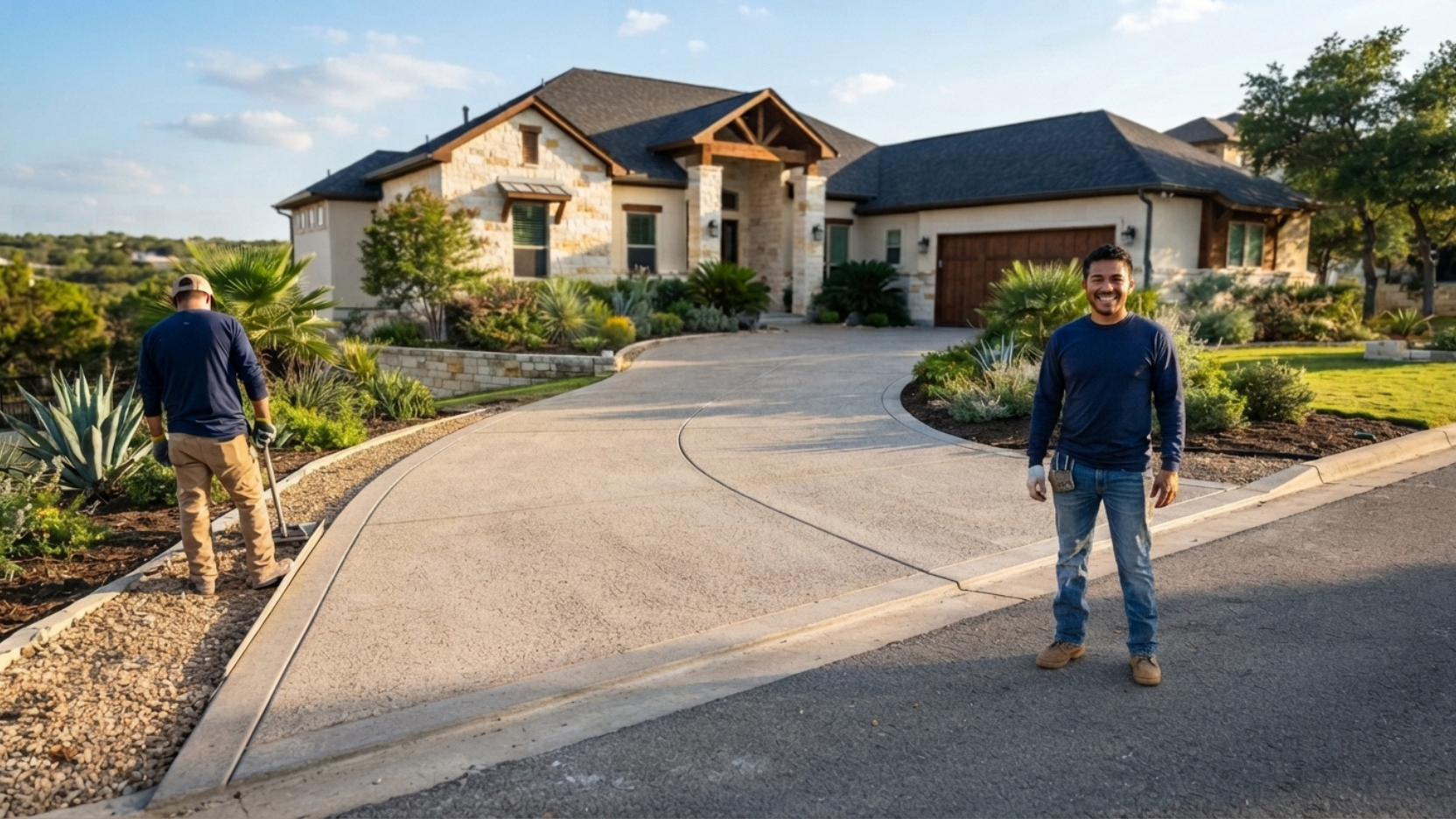
A driveway takes more daily abuse than any other concrete surface on your property, vehicle weight, heat, expansive clay soil, and years of use. Choosing the right contractor, the right spec, and the right finish up front is what separates a driveway that lasts three decades from one that cracks within three years.
A concrete driveway is a bigger commitment than almost any other surface on a residential property. It carries the daily weight of vehicles, sits exposed to full Texas sun, and rests on top of Bexar County’s expansive clay soil, which shrinks and swells more than almost any other soil type. Get the spec wrong, thin slab, missing rebar, skipped base compaction, and the cracking shows up within a few years, not a few decades.
This guide covers what actually determines whether a San Antonio driveway lasts: the structural spec, the finish options that hold up to vehicle traffic, realistic cost ranges, how to evaluate a contractor’s quote, and what to expect from the pour through the first year of curing and sealing.
Homeowners often focus on finish choices first, broom versus stamped, when the decisions that actually determine longevity happen underneath the surface. A driveway needs a thicker slab than a patio, a proper rebar grid rather than light wire mesh, and a well-compacted base to handle both vehicle weight and San Antonio’s clay soil movement. Get those structural decisions right with your contractor before finish selection even comes up.
Structural Spec
A driveway carries far more load than a patio or walkway, and it needs a spec built for that. Vehicle weight, especially trucks, trailers, or multiple cars, combined with San Antonio’s clay-heavy soil movement, means a driveway poured to patio specifications will crack early, no matter how good the finish looks on day one.
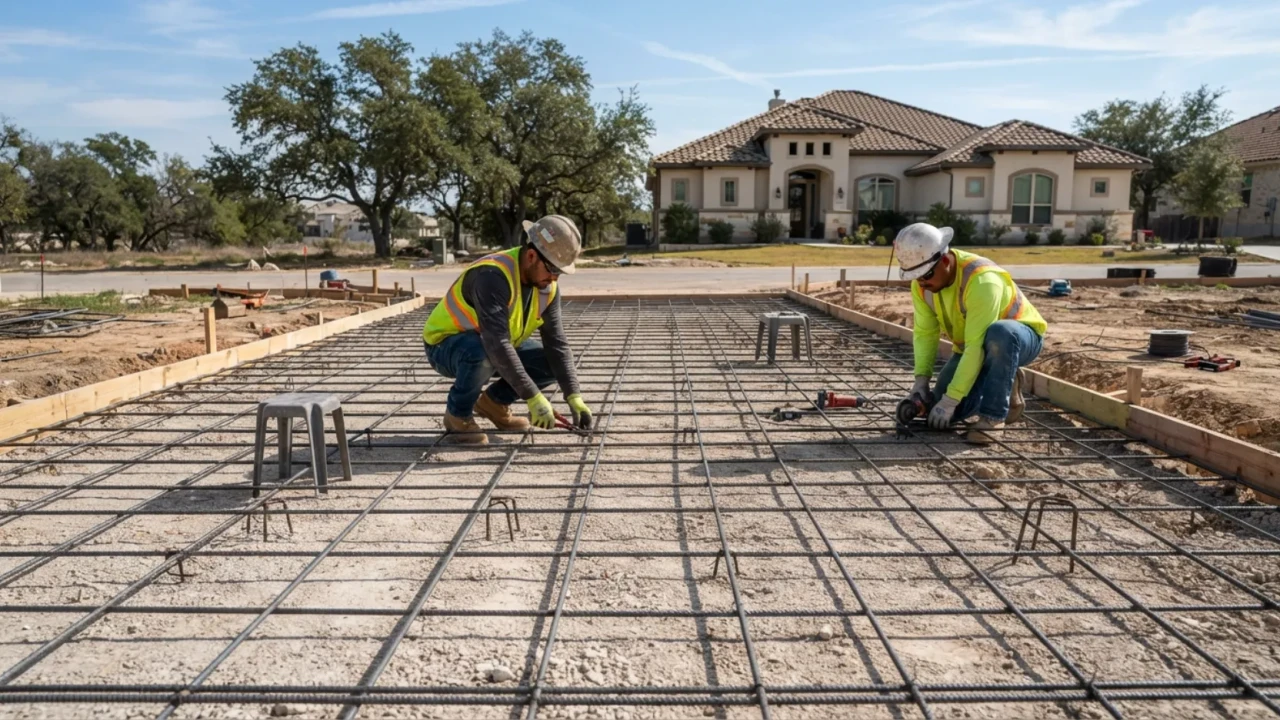
Slab thickness: 4 to 5 inches for standard residential vehicles, 5 to 6 inches for driveways expecting trucks, RVs, or heavy trailers. Thicker is not overkill in San Antonio’s soil conditions, it is the margin that prevents cracking.
Reinforcement: A rebar grid, typically #3 or #4 bar at 18-inch centers, is strongly recommended over wire mesh for driveways. Wire mesh tends to sag to the bottom of the pour during placement and provides far less real reinforcement than a properly supported rebar grid.
- Slab thickness specified in the quote: 4 to 5 inches minimum, 5 to 6 inches for heavy vehicles
- Reinforcement confirmed as a rebar grid, not wire mesh, for a standard driveway
- Base preparation depth included: 4 to 6 inches of compacted crushed limestone
- Expansion joint spacing noted: every 8 to 10 feet along the driveway’s length
- Drainage slope confirmed: 1/8″ per foot away from the garage or house
Finish Options
Unlike a patio, a driveway needs a finish that holds up to daily vehicle traffic, tire wear, and repeated exposure without becoming slick or wearing down unevenly. Here are the finish options that work well for San Antonio driveways.
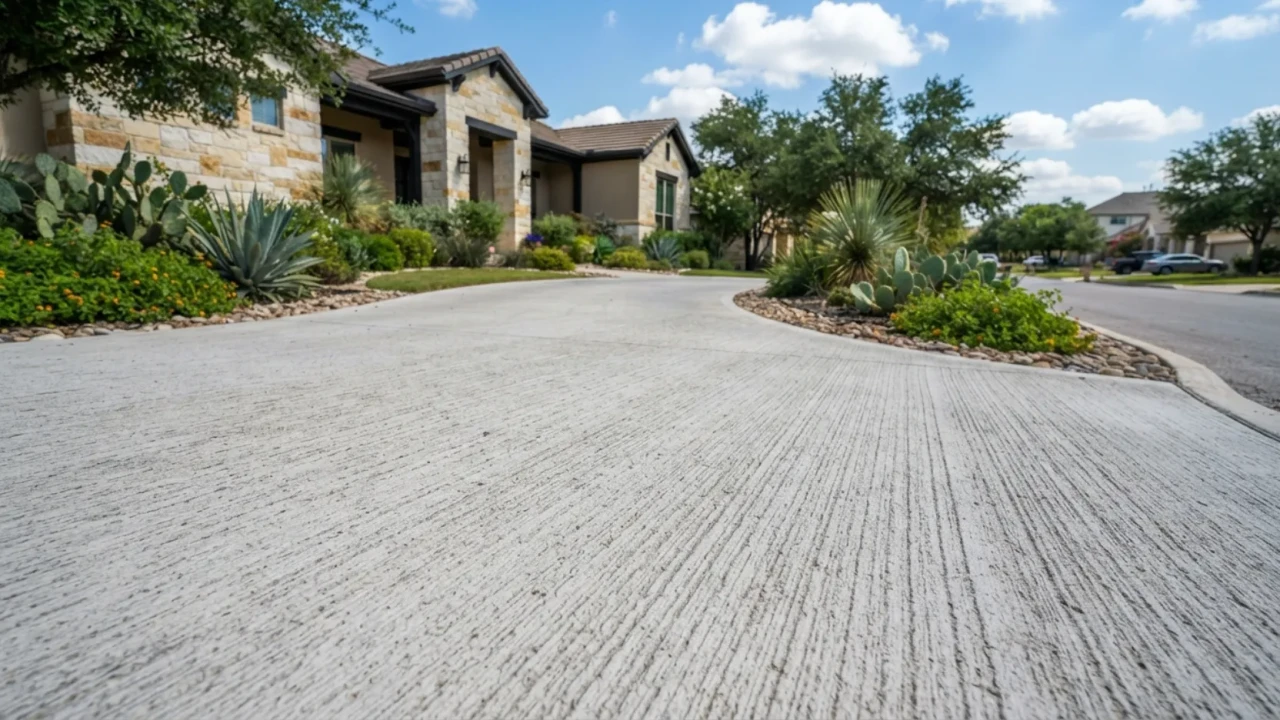
Broom finish: The standard for residential driveways. A stiff brush dragged across the fresh pour creates a slip-resistant texture that performs well wet or dry, holds up to tire wear, and requires almost no ongoing maintenance beyond periodic sealing.
Exposed aggregate: The surface paste is washed away to reveal the stone within the mix, creating a naturally textured, slip-resistant surface with a more upscale appearance than plain broom finish.
Combining finishes on one driveway: A popular approach in San Antonio is a broom-finished main driveway surface paired with a stamped or exposed aggregate apron near the street or garage entry. This balances cost and durability for the high-wear zones while adding curb appeal where it is most visible.
- Finish matched to actual use: broom or exposed aggregate for daily vehicle traffic
- Stamped or decorative accents reserved for low-traffic areas like the apron or border, if used
- Color and pattern confirmed in writing before the pour if stamped or stained work is included
- Sealing schedule confirmed for any decorative finish, typically every 2 to 3 years
Cost Breakdown
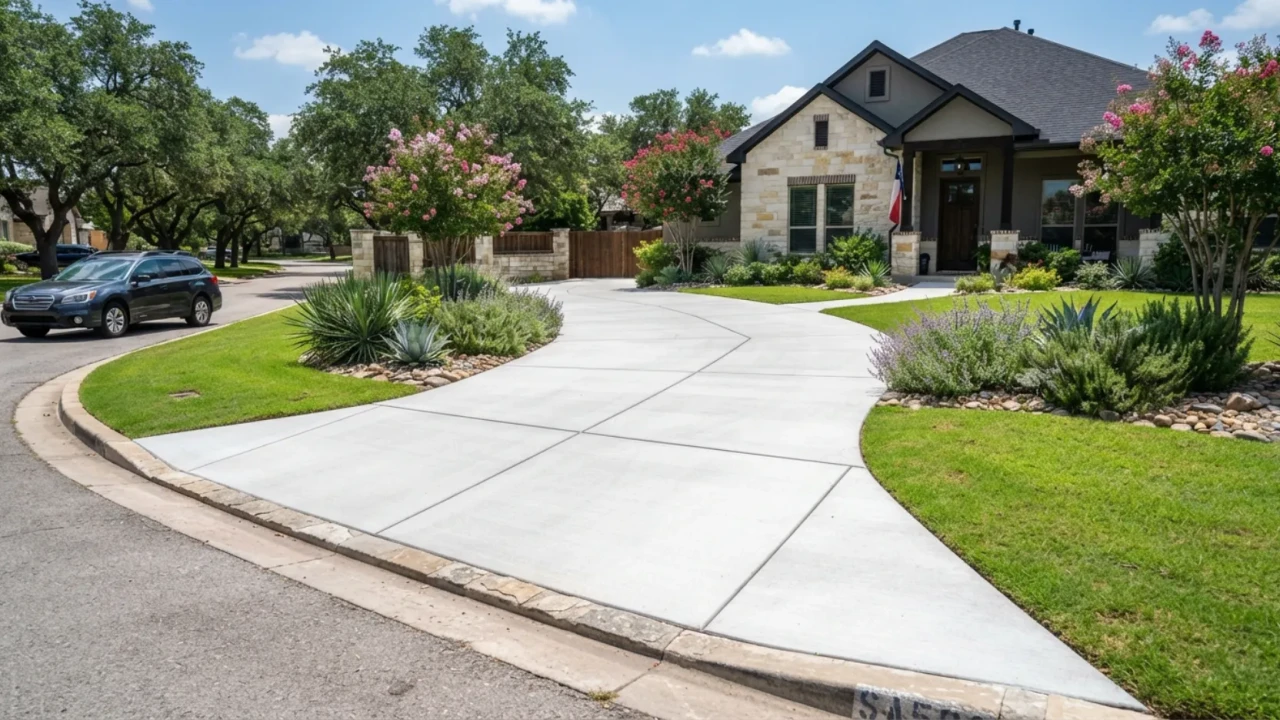
Driveway pricing depends on square footage, finish, thickness, and how much site preparation is needed, including demolition of an existing driveway, grading, and drainage work. Below are typical per-square-foot ranges for San Antonio, along with what drives the cost at each tier.
For a typical two-car driveway around 600 square feet, a standard broom finish runs roughly $4,200 to $5,400 for the pour itself, before any demolition of an existing surface. Always get an itemized quote so you know exactly what is included, and confirm whether demolition, grading, and disposal are part of the price or billed separately.
Contractor Vetting
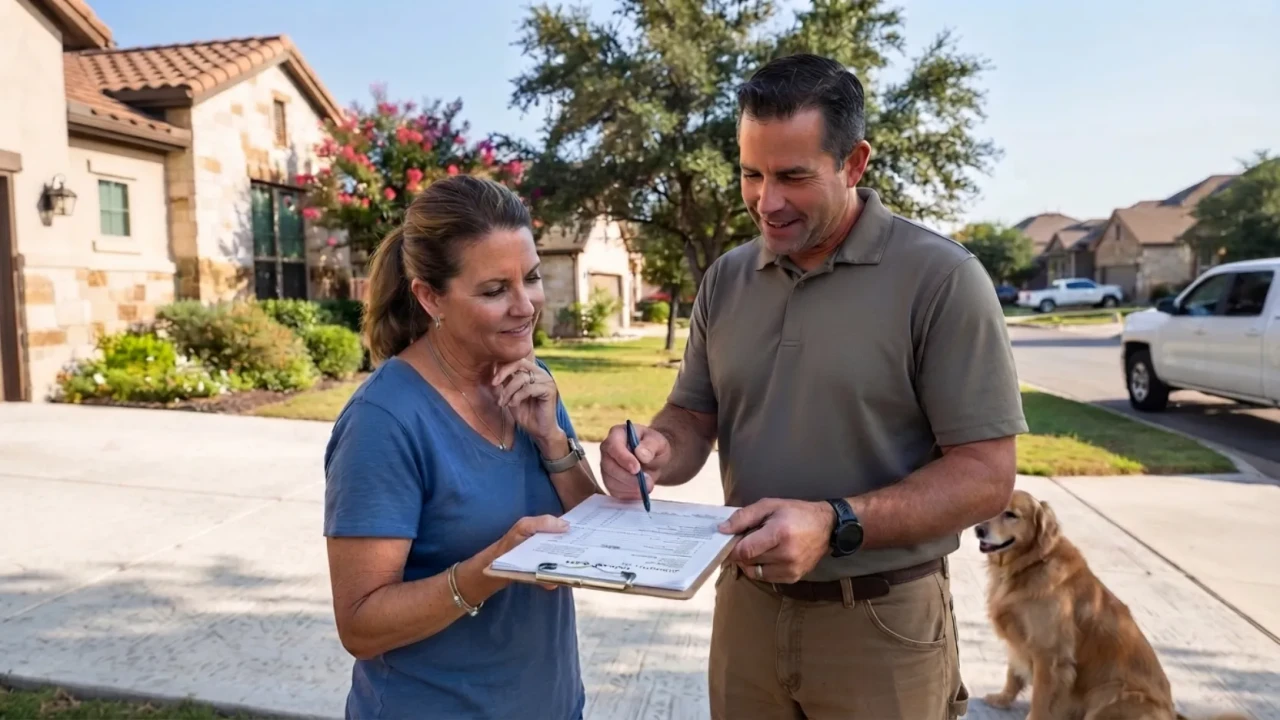
Because a driveway is one of the largest concrete investments most homeowners make, and one of the hardest surfaces to redo without significant cost, the contractor’s experience and willingness to do the prep work correctly matters more here than on almost any other project.
| What to check | What a good contractor provides | Red flag response |
|---|---|---|
| Liability insurance | Certificate of insurance on request, $1M+ general liability minimum | “We’re covered” with no documentation, or a policy below $1M |
| Written quote details | Slab thickness, reinforcement type, base depth, finish, and joint spacing all specified in writing | Quote just says “driveway” with a lump-sum price |
| Base preparation | Excavation and compacted crushed limestone base included in the scope | Pouring directly over existing dirt or skipping compaction |
| Reinforcement type | Rebar grid specified for driveway loads, not wire mesh alone | Wire mesh only, or vague language about “reinforcement included” |
| Local experience | Specific knowledge of Bexar County clay soils and expansion joint requirements | Generic answers that don’t reference local soil or climate conditions |
| Payment terms | Deposit of 30 to 50 percent upfront, remainder on completion and inspection | Full payment demanded before work begins |
Process & Maintenance
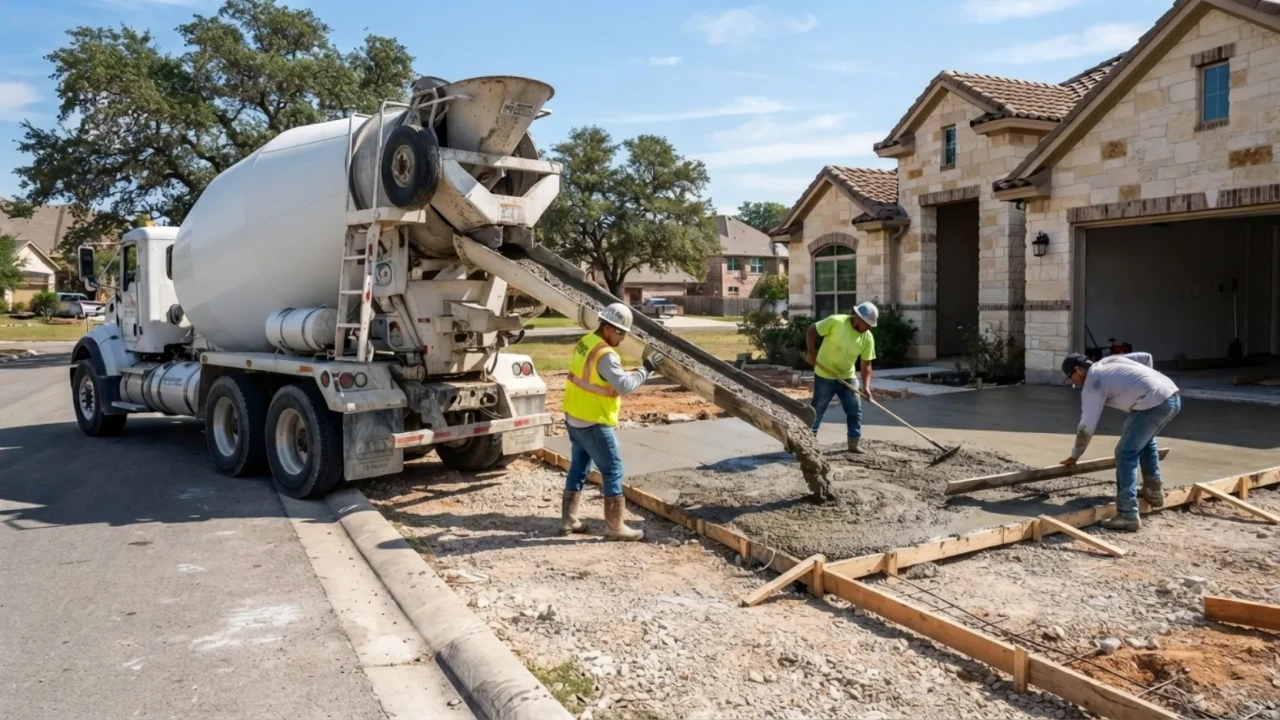
A driveway pour follows the same core sequence as any concrete project, forms and reinforcement set, concrete poured and finished, then cured, but the stakes are higher because a driveway carries vehicle weight almost immediately after it opens for use.
Vehicle traffic too early is the single most common cause of early driveway damage. A minimum of 7 days before any vehicle use is standard, even though the surface may look and feel solid after just a day or two. Full structural strength is not reached until 28 days, which is why heavy trucks, trailers, or RVs should wait even longer if possible.
Sealing schedule: First sealing at 28 to 30 days after the pour, once fully cured. Reseal broom finish driveways every 3 to 5 years, and stamped or aggregate finishes every 2 to 3 years. Degrease oil and transmission fluid stains immediately, since they penetrate unsealed concrete within hours and become very difficult to remove afterward.
- Forms set correctly and level, checked before the concrete truck arrives
- Rebar grid elevated off the base at mid-slab height, not resting on the ground
- No vehicle traffic for a minimum of 7 days; no foot traffic for the first 48 hours
- First sealing scheduled at 28 to 30 days after the pour
- Resealing reminder set: every 3 to 5 years for broom finish, every 2 to 3 years for stamped or aggregate
Use this table as your reference point for any driveway project. Your contractor’s site visit should confirm the final spec for your specific soil and vehicle needs.
| Driveway type | Recommended finish | Min. slab thickness | Cost range (San Antonio) |
|---|---|---|---|
| Standard residential | Broom finish with control joints | 4–5″ | $7–9/sqft |
| Heavy vehicle / truck use | Broom finish, denser rebar grid | 5–6″ | $8–10/sqft |
| Exposed aggregate | Washed aggregate finish | 4–5″ | $9–12/sqft |
| Stamped driveway or apron | Stamped pattern with integral color | 4–5″ | $14–20/sqft |
| Replacement (existing driveway) | Matches new driveway spec above | Varies | +$1,500–3,000 demolition |
- Slab thickness confirmed in writing: 4 to 5 inches minimum, 5 to 6 inches for heavy vehicles
- Base type and depth specified: compacted crushed limestone, minimum 4 to 6 inches
- Reinforcement confirmed as a rebar grid, not wire mesh, for standard driveway loads
- Expansion joint spacing confirmed: every 8 to 10 feet
- Finish type selected and appropriate for vehicle traffic: broom or exposed aggregate for full driveway use
- Decorative finishes reserved for low-traffic accents unless the homeowner accepts the added upkeep
- Color and pattern confirmed in writing for any stamped or stained sections
- Certificate of insurance received and verified, $1M+ general liability
- Quote itemizes base prep, reinforcement, demolition (if applicable), pour, and finishing separately
- Payment terms confirmed: deposit upfront, balance on completion, not full payment before work
- Local references from completed San Antonio driveway projects available
- No vehicle traffic for a minimum of 7 days; no foot traffic for the first 48 hours
- Curing process agreed: wet curing or liquid compound applied after finishing
- First sealing scheduled at 28 to 30 days after the pour
- Resealing reminder set based on finish type chosen
How much does a concrete driveway cost in San Antonio?
How long before I can drive on a new concrete driveway?
Should I use rebar or wire mesh for my driveway?
Why is my driveway cracking after only a few years?
Is it worth replacing an old driveway instead of patching it?
Get a free driveway quote in San Antonio
Tell us about your project, new driveway, replacement, or repair, and we’ll visit your property, assess the soil and site conditions, and give you a detailed written quote at no cost.