
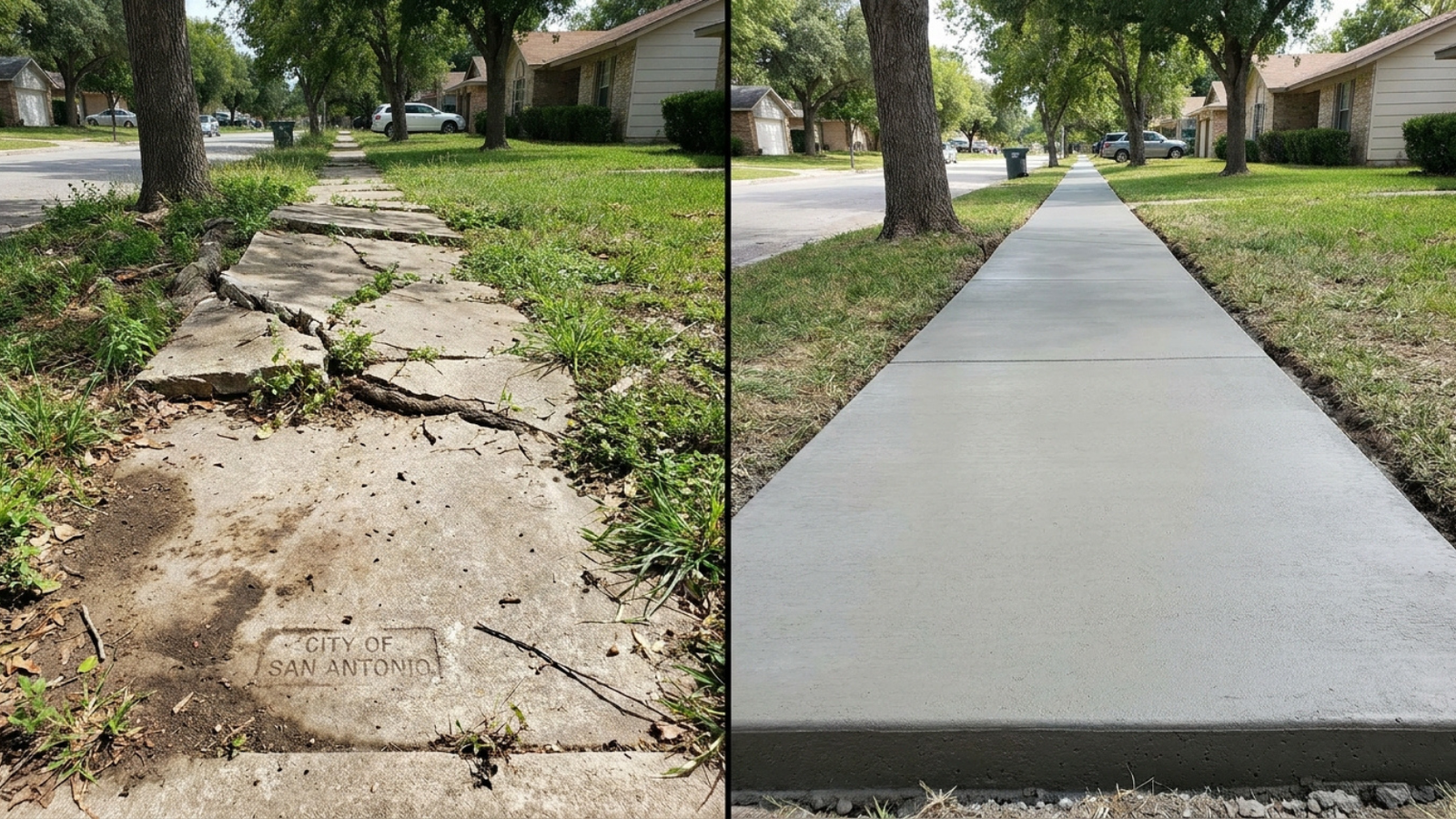
Cracked, sunken, or uneven sidewalks are more than an eyesore in San Antonio. They create trip hazards, invite city citations, and get worse with every rain cycle. This guide covers how to assess the damage, when to repair versus replace, what repairs cost, and how to choose a contractor who will do it right.
San Antonio’s expansive clay soils move constantly. They swell after heavy rain and shrink during the summer dry season, and that cycle repeats every year. Concrete sidewalks take the brunt of it. A panel that is perfectly level this spring can shift, crack, or heave by fall, and once one edge rises above the other by half an inch, you have a legal trip hazard and a potential liability issue on your hands.
The good news is that most sidewalk damage in San Antonio is repairable, and even full panel replacements are among the more straightforward concrete jobs a homeowner can hire out. Knowing the difference between cosmetic damage and structural failure, what repairs actually cost, and what to watch for in a contractor quote is all it takes to handle this the right way.
Patching a crack without fixing the soil movement underneath it is like painting over a water stain without fixing the leak. In San Antonio’s clay-heavy soils, sidewalk damage is almost always driven by subsurface movement, tree root intrusion, or drainage issues. Any repair that does not address the root cause will fail within a few years. This guide will help you identify what is actually causing the problem before you spend money fixing the surface.
Damage Assessment
Not all sidewalk damage is equal, and treating every crack the same way leads to either overspending on unnecessary replacement or underspending on a patch that fails in two years. Before you call a contractor, do a quick walk-through of your sidewalk using these categories.
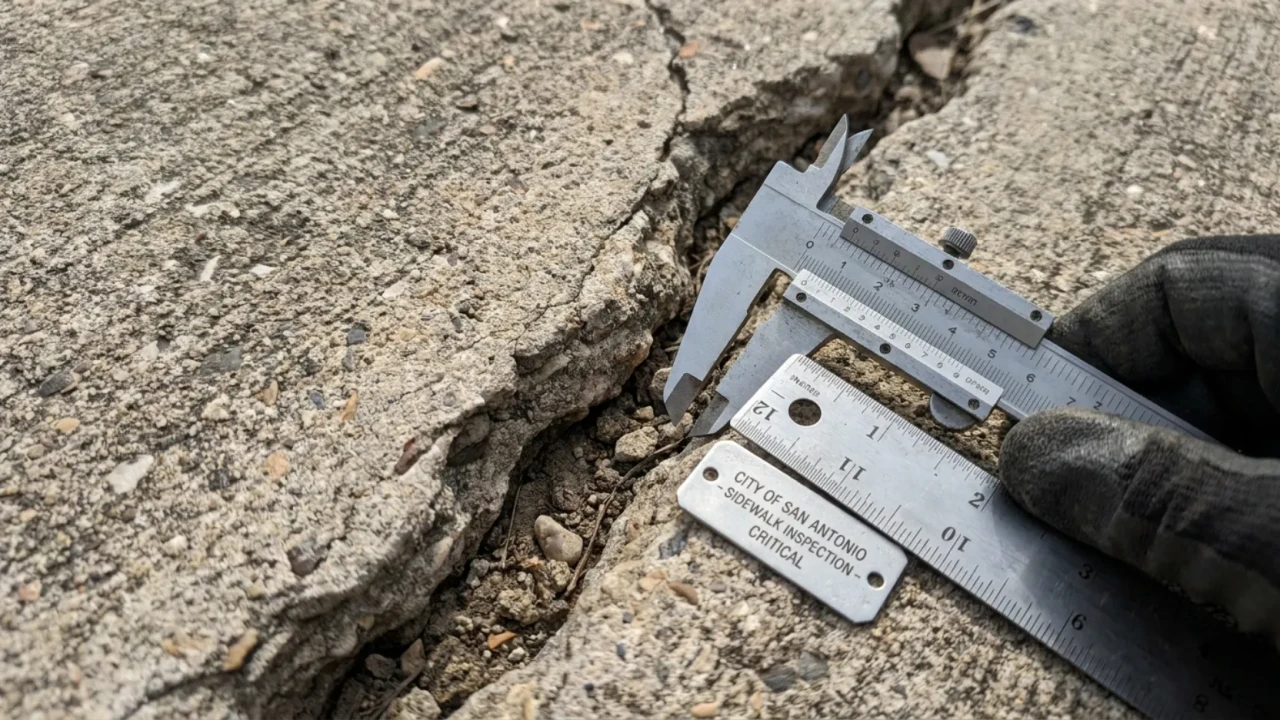
Hairline cracks (under 1/8″ wide, no vertical displacement): These are almost always shrinkage cracks from the original pour or normal concrete aging. They are cosmetic in nature. Filling them with a polyurethane or epoxy crack filler stops water infiltration and prevents them from widening. This is a DIY-friendly repair in most cases.
Wide cracks (1/4″ or wider) or cracks with vertical displacement: If one side of a crack sits higher or lower than the other, you have a structural problem. The underlying soil has shifted. Filling the surface crack without addressing the subsurface movement means the crack returns within a season or two.
Trip hazard threshold: In Texas, a vertical displacement of 1/2 inch or more between adjacent sidewalk panels is legally considered a trip hazard. The City of San Antonio can issue a notice of violation requiring the property owner to repair the hazard within a set timeframe. If you have panels with that level of displacement, this is not a “get around to it” repair.
- Walk the full sidewalk and measure any vertical displacement between panels
- Note crack width: under 1/8″ is cosmetic, 1/4″+ warrants professional evaluation
- Check for panel sinking (settled below grade) versus heaving (pushed up above grade)
- Identify any nearby trees whose roots may be causing or contributing to the damage
- Check drainage: does water pool on or near any panels after rain? Standing water accelerates soil movement under slabs
Repair vs. Replace
The repair-versus-replace decision is the most important one in any sidewalk project, and it is also where homeowners most often get pushed in the wrong direction by contractors who either want to sell a full replacement when repair would work or who patch everything when replacement is actually needed.
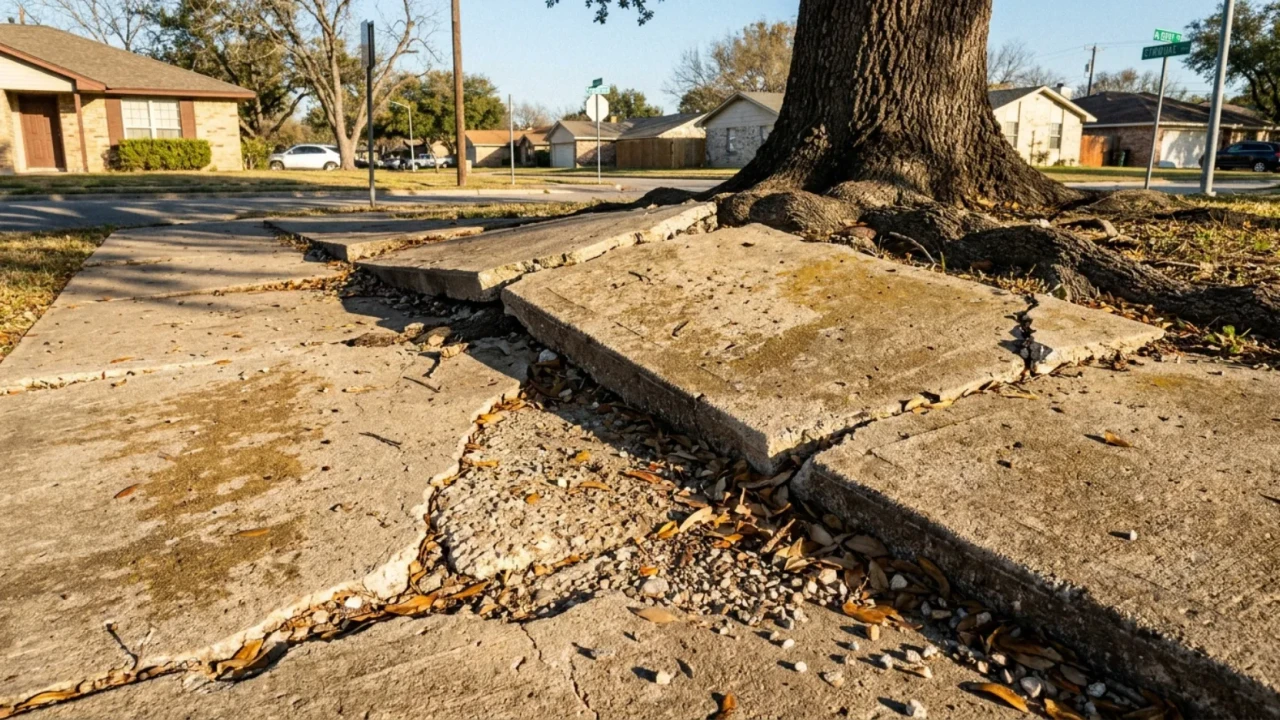
The general framework: repair (patching, mudjacking, or crack filling) works when the panel is structurally sound and the underlying cause of damage has been addressed or is not progressive. Replacement is the right call when the panel is severely cracked across multiple directions, has significant vertical displacement, is so deteriorated that patching would cover more than 30 to 40 percent of the surface, or when the underlying soil issue cannot be corrected without removing the panel.
| Damage type | Recommended approach | Lifespan of repair |
|---|---|---|
| Hairline shrinkage cracks, no displacement | Crack filler (polyurethane or epoxy) | 5 to 10 years with proper filler |
| Panel sunken 1 to 2 inches, no cracking | Mudjacking or polyurethane foam lifting | 5 to 10 years if soil is stable |
| Wide cracks with minor displacement (under 1/2″) | Professional patching or grinding high edge | 3 to 7 years depending on soil movement |
| Panel heaved by tree roots | Full panel replacement plus root management | Long-term if root issue is addressed |
| Multiple cracks crossing in multiple directions | Full panel replacement | 30+ years with correct base prep |
| Spalling across more than 40% of surface | Full panel replacement | 30+ years with correct base prep |
| Vertical displacement of 1/2″ or more (trip hazard) | Grinding high edge (temporary) or replacement | Grinding: 1 to 3 years. Replacement: 30+ years |
Mudjacking in San Antonio: when it makes sense and when it does not. Mudjacking (pumping a slurry mix under a sunken slab to raise it) works well in San Antonio when the underlying soil is stable and the panel has settled uniformly without cracking. It costs roughly $3 to $6 per square foot compared to $5 to $9 for full replacement. However, if the panel is cracked, if soil erosion was the cause, or if the panel is adjacent to active tree roots, mudjacking is a short-term solution. Polyurethane foam lifting is a newer alternative that weighs less and sets faster, but costs 20 to 30 percent more than traditional mudjacking.
- Panel with only hairline cracks and no displacement: crack filler is sufficient
- Panel sunken but intact: get a mudjacking or foam lifting quote before committing to replacement
- Panel cracked in multiple directions: replacement is the only long-term solution
- Tree root identified as cause: any repair must include a root management plan to last
- Displacement of 1/2″ or more: this is a code violation in San Antonio and must be addressed promptly
Cost Guide
Sidewalk repair pricing in San Antonio varies significantly depending on whether you are patching, lifting, or fully replacing panels, and how many panels are involved. Contractors price small jobs at a higher per-square-foot rate because mobilization, setup, and cleanup costs are fixed regardless of job size. A single panel replacement often carries a minimum charge of $400 to $600 even if the panel is only 25 square feet.
The most important thing to understand about sidewalk replacement pricing is that the per-square-foot cost drops as the scope increases. Replacing two panels costs more per square foot than replacing eight. If you have multiple damaged panels, doing them all at once is almost always less expensive per panel than calling a contractor back for each one separately.
- Get at least two to three quotes before committing to replacement versus lifting
- Ask whether demolition and haul-away are included in the replacement quote
- Ask whether base preparation (grading and compaction) is included
- Bundle multiple panels into a single job to reduce per-panel cost
- Confirm there are no additional charges for concrete truck minimums (some companies charge a short-load fee for small pours)
Replacement Process
A properly replaced sidewalk panel in San Antonio should last 25 to 30 years. A poorly done one can crack, settle, or heave again within two to three years. The difference comes down almost entirely to base preparation and slab thickness. Both of these are invisible once the concrete is poured, which is why dishonest contractors cut corners on them.
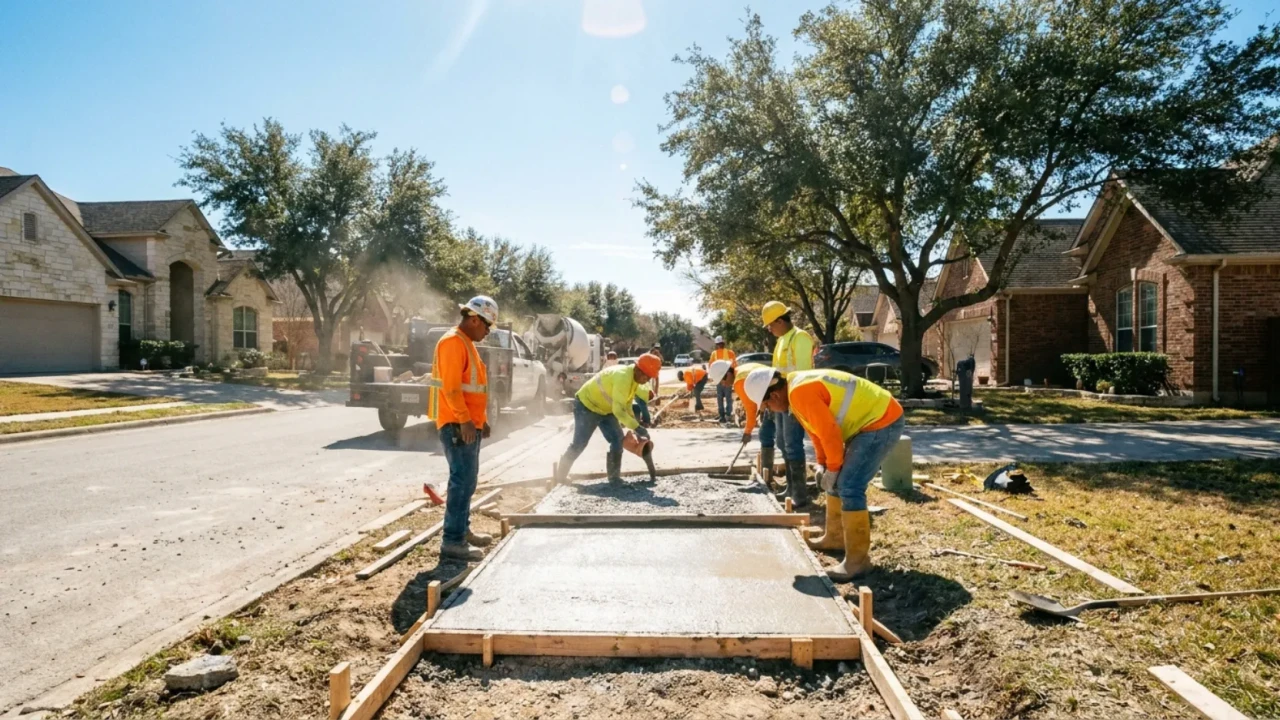
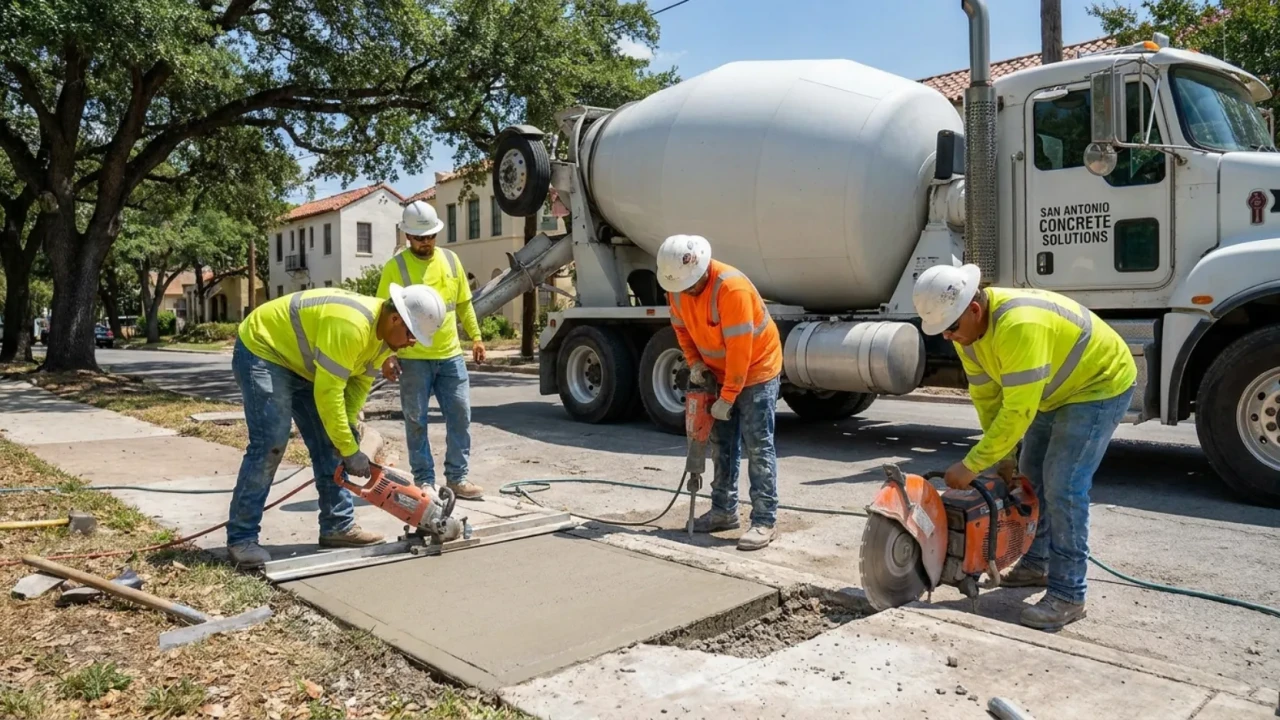
The correct process for a sidewalk panel replacement in San Antonio: the old panel is saw-cut at the expansion joint lines and broken out with a jackhammer. The subgrade is inspected for root intrusion or soil voids, graded to the correct slope, and compacted. A 4-inch compacted crushed limestone base is placed. Forms are set to maintain the correct grade and cross-slope. A 4-inch concrete slab (minimum) is poured, screeded, floated, and finished with a broom texture for slip resistance. Expansion joints are placed at the borders with adjacent panels.
ADA and city slope requirements: Residential sidewalks in San Antonio must meet ADA accessibility requirements if they connect to public right-of-way. The maximum cross-slope is 2 percent (about 1/4 inch per foot), and any curb ramps at intersections must meet specific slope and texture requirements. If your replacement is near an intersection or driveway apron, confirm with your contractor that the work will meet current City of San Antonio standards.
Best time to schedule sidewalk repairs in San Antonio: October through April is ideal. Summer pours are common and manageable for experienced crews, but the July to September heat means faster initial set times, which compresses the finishing window. If you schedule a summer repair, ask your contractor about their curing protocol. A curing compound applied immediately after finishing, or wet curing with burlap kept damp for three days, is the minimum standard in San Antonio’s heat. A contractor who pours, finishes, and walks away without any curing process in July is skipping a critical step.
- Old panel removed by saw-cutting at expansion joints, not broken randomly across adjacent panels
- Subgrade inspected and any roots, voids, or drainage issues addressed before pouring
- 4-inch compacted crushed limestone base placed and verified before forms are set
- Slab poured at 4 inches minimum thickness; confirm this is in the written scope
- Broom finish applied for slip resistance
- Expansion joints placed at borders with existing panels
- Curing compound or wet curing process applied immediately after finishing
- No foot traffic for 48 hours; no vehicle crossing for 7 days
Contractor Vetting
Sidewalk repair attracts door-to-door solicitors more than almost any other concrete service, particularly after heavy rain events when visible damage is widespread across neighborhoods. A crew knocking on your door offering to patch cracks for cash is almost never the right choice. Here is what to look for and what to walk away from.
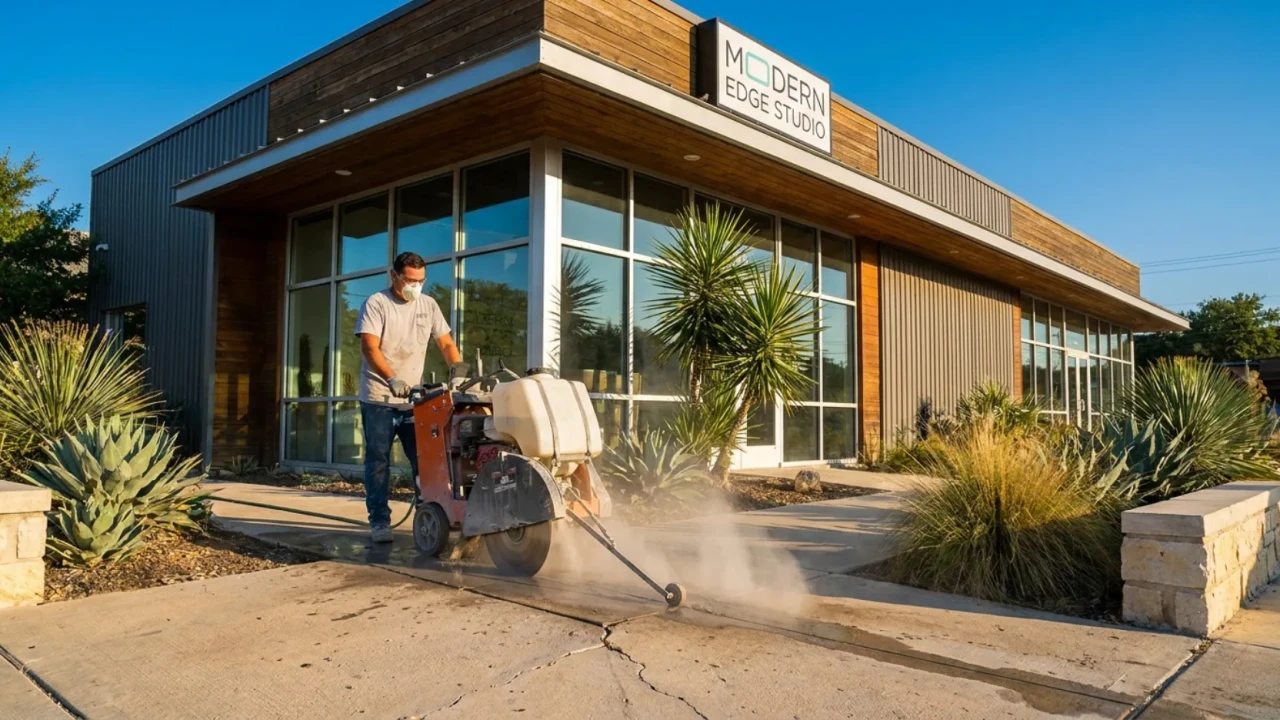
A legitimate concrete contractor in San Antonio will have a verifiable business address, carry liability insurance of at least $1 million, and provide a written quote that specifies the scope of work in detail. The quote should call out which panels are being replaced, what the slab thickness will be, whether base prep is included, and what the payment terms are. Verbal commitments on sidewalk work are not sufficient.
| What to check | What a good contractor provides | Red flag response |
|---|---|---|
| Liability insurance | Certificate of insurance on request, $1M+ general liability | “We have insurance” with no documentation available |
| Written quote detail | Panels specified by location, slab thickness, base prep, finish, and cleanup all itemized | Quote says only “sidewalk repair” with a lump sum |
| Demolition included | Old panel removal and haul-away explicitly included | Base price only covers the pour; demo is an add-on |
| Base preparation | Subgrade inspection, grading, and compacted limestone base in scope | Pouring directly over existing subgrade without inspection |
| Payment terms | Deposit of 30 to 50 percent upfront, remainder on completion | Full payment demanded before any work begins |
| Local references | Recent San Antonio job photos and references available on request | Only stock photos, no verifiable local work |
- Verified business address in San Antonio (not just a phone number or website)
- Certificate of insurance received and confirmed: $1M+ general liability minimum
- Written quote identifies each panel to be repaired or replaced by location
- Slab thickness, base prep, demolition, and curing all included in the written scope
- Payment terms: deposit upfront, balance on completion after your inspection
- Right-of-way permit responsibility confirmed in writing if work is in the city right-of-way
Use this table to quickly identify the right approach for the damage you are seeing, along with a realistic cost range for each repair type in the San Antonio market.
| What you are seeing | Likely cause | Recommended repair | Estimated cost (San Antonio) |
|---|---|---|---|
| Hairline cracks, flat panels | Normal shrinkage curing | Crack filler sealant | $1 to $3 per sqft or DIY |
| Panel sunken 1 to 2 inches, no cracking | Soil settlement under slab | Mudjacking or foam lifting | $3 to $6 per sqft |
| One edge higher than other by 1/4 to 1/2 inch | Differential soil movement | Concrete grinding (temporary) or replacement | $150 to $300 for grinding |
| Displacement over 1/2 inch (trip hazard citation) | Root intrusion or soil failure | Full panel replacement with root management | $5 to $9 per sqft |
| Panel cracked in multiple directions | Base failure or heavy loading | Full panel replacement with base prep | $5 to $9 per sqft |
| Surface spalling or flaking | Poor original mix or freeze event | Resurfacing or full replacement | $3 to $5 resurfacing; $5 to $9 replacement |
| Front entry, decorative area | Normal wear or damage | Replacement with stamped or exposed aggregate finish | $8 to $14 per sqft |
- Walk the full sidewalk and document each damaged panel with photos
- Measure vertical displacement between panels: 1/2 inch or more is a code violation in San Antonio
- Identify nearby trees that may have roots under the affected panels
- Check whether any damaged panels are in the city right-of-way or on private property
- Get a minimum of two to three written quotes before committing
- Confirm each quote includes demolition, base prep, pour, and cleanup as a single scope
- Ask each contractor whether mudjacking is a viable alternative to replacement for sunken intact panels
- Bundle all damaged panels into a single job to reduce per-panel cost
- Certificate of insurance received for every contractor you consider: $1M+ general liability
- Written quote specifies panel locations, slab thickness (4″ minimum), base prep, and finish
- Payment terms confirmed: 30 to 50 percent deposit, balance on completion
- Right-of-way permit responsibility confirmed in writing if any work is in the city right-of-way
- No foot traffic for 48 hours after pour; confirm this restriction with your contractor
- Curing process confirmed: compound applied or wet curing scheduled for at least three days
- Root management plan in place if tree roots were a contributing cause
- Monitor new panels through the first full wet season for any sign of settlement or movement
Is the city of San Antonio responsible for sidewalk repairs, or is it the homeowner?
How long does it take for a replaced sidewalk panel to cure in San Antonio?
Can I patch a cracked sidewalk panel instead of replacing it?
Do I need a permit to replace a sidewalk panel in San Antonio?
What is the best way to prevent sidewalk damage in San Antonio?
Get a free sidewalk repair quote in San Antonio
Tell us which panels need attention and we will come out, assess the damage, and give you a detailed written quote at no cost. No pressure, no door-to-door sales tactics.