
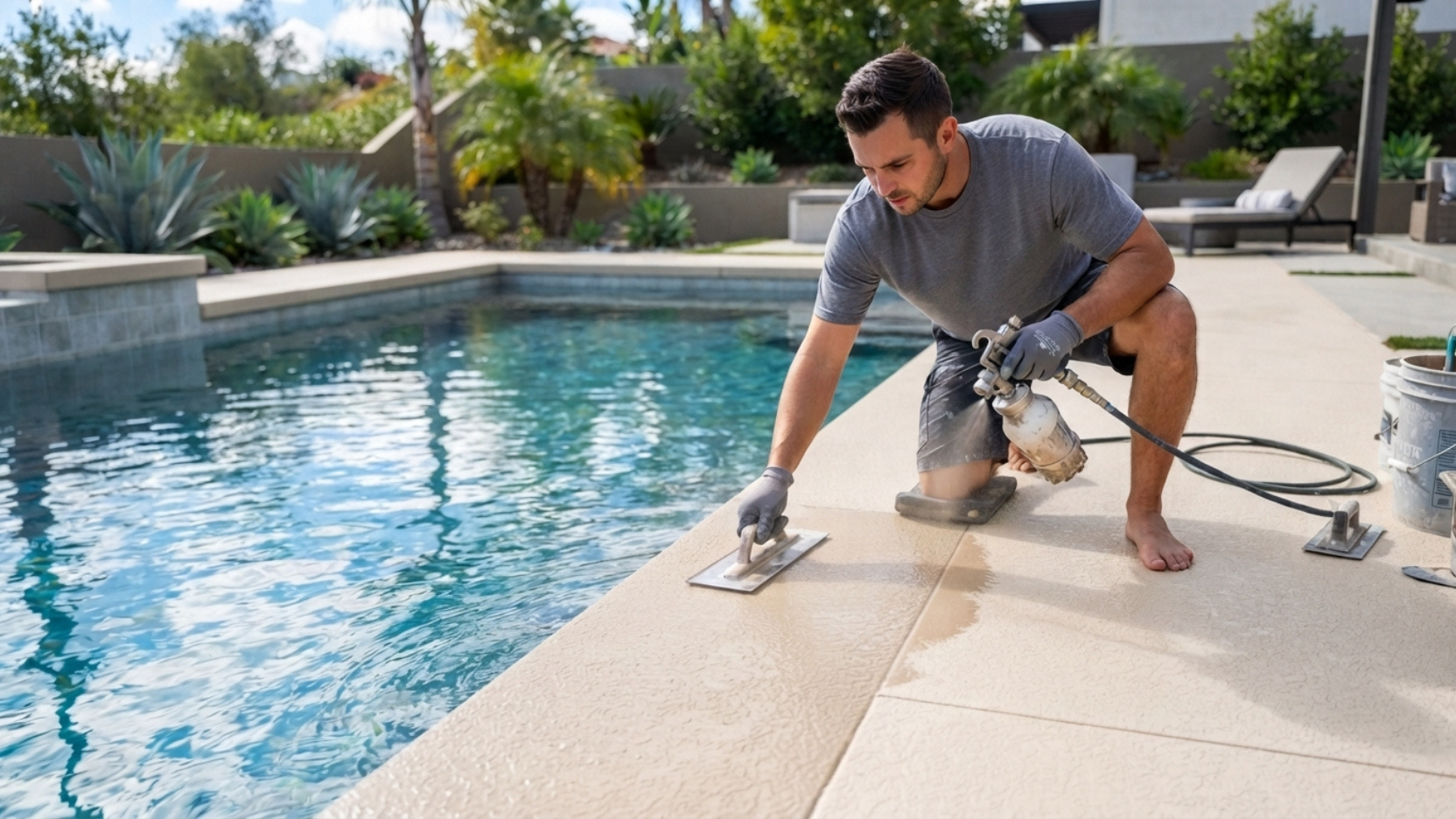
San Antonio pool decks face a relentless combination of Blackland Prairie clay movement, intense Texas UV radiation, chlorine and hard water exposure, and summer heat that reaches the concrete surface before it ever touches the water. This guide covers every repair scenario from hairline cracks to full resurfacing with accurate 2026 pricing and local contractor guidance for Bexar County homeowners.
A cracked, spalled, or uneven pool deck is more than an eyesore. In San Antonio, a deteriorating pool deck is a slip hazard, a liability concern, and if left unaddressed a source of accelerating structural damage as water infiltrates the cracks, saturates the Vertisol clay below, and drives further movement through the slab. The good news is that the vast majority of pool deck damage in San Antonio is repairable without full demolition and replacement.
The key is correctly identifying the type of damage and matching it to the right repair approach. Treating a structural crack with a cosmetic overlay product will not hold. Replacing a slab that only needs resurfacing costs homeowners three to four times what the right repair would have. This guide walks through every damage type, every repair method, and the accurate 2026 cost figures for Bexar County so you can make an informed decision before calling a contractor.
The most expensive mistake San Antonio homeowners make is patching visible cracks without addressing what caused them. In Bexar County’s expansive Vertisol clay, soil movement beneath a pool deck is ongoing it does not stop when you fill a crack. If the cause of cracking is active soil movement, a surface patch will crack again within one to two seasons. A qualified contractor will assess whether the movement is active or stable before recommending any repair approach. Any contractor who quotes a resurfacing job on a structurally compromised deck without that assessment is setting you up for repeat repairs at your expense.
Before any repair can be planned or quoted accurately, the damage type must be correctly identified. In San Antonio, the following six categories cover the overwhelming majority of residential pool deck problems. Each has a different cause, a different repair path, and a very different cost outcome.
Crack Repair

Crack repair is the most common pool deck service call in San Antonio, and the most frequently done incorrectly. The failure mode is almost always the same: rigid cement patching compound applied to a crack in expansive clay soil. The clay moves, the rigid patch breaks, and the homeowner is back to square one in one season.
The correct filler for pool deck cracks in Bexar County is a flexible polyurethane or self-leveling urethane sealant a material that can flex with the slight movement that Vertisol clay produces year-round without cracking. For cracks wider than 1/4 inch, the crack should be routed (widened with a grinder to a uniform V or U profile) before filling to ensure proper adhesion depth and a clean seal.
- Measure crack width and check for vertical displacement before choosing repair method
- Clean crack with wire brush and compressed air no loose material left inside
- Route cracks wider than 1/4 inch before filling for proper adhesion depth
- Install foam backer rod on deep cracks to control filler depth and prevent three-point bonding
- Use polyurethane or urethane self-leveling sealant never rigid cement patching compound
- Monitor repaired cracks for 60 days reopening indicates active soil movement requiring further assessment
Slab Lifting

Sunken or uneven pool deck sections are one of the most common structural problems in Bexar County, and one of the most frequently over-solved. Many homeowners are quoted full slab replacement for a settled section that would respond perfectly well to mudjacking or polyurethane foam lifting at roughly one third to one half the replacement cost.
Mudjacking involves drilling small holes through the settled slab and pumping a slurry of cement, soil, and water beneath it to lift the slab back to grade. Polyurethane foam lifting works on the same principle but uses an expanding two-part foam that is lighter, cures faster (approximately 15 minutes vs. 24 to 48 hours for mudjacking), and provides some additional void-filling stability in eroded soil areas.
| Method | Best for | Cost range (San Antonio 2026) | Cure time | Limitations |
|---|---|---|---|---|
| Mudjacking (slabjacking) | Settled sections 1 to 3 inches below grade; stable soil conditions | $3 to $6 per sq ft of settled area | 24 to 48 hours before foot traffic | Heavier than foam; not suitable for severely deteriorated slabs |
| Polyurethane foam lifting | Voids from erosion; faster turnaround needed; sections near pool water | $5 to $10 per sq ft of settled area | 15 to 30 minutes before foot traffic | Higher material cost; not appropriate for slabs with major structural cracking |
| Full slab replacement | Slabs with severe structural cracking, heaving, or deterioration beyond repair | $10 to $18 per sq ft installed | 28 days full cure; 7 days before light foot traffic | Highest cost; necessary when base failure is extensive |
How to tell if your settled pool deck section is a mudjacking candidate: Knock on the settled slab with your knuckles or a rubber mallet. A hollow sound indicates a void beneath the slab the soil has eroded or pulled away and there is nothing supporting the concrete. This is exactly the condition mudjacking addresses. A dense, solid sound means the slab has settled because the soil below has compacted or shifted, which may require a different stabilization approach. A qualified slab lifting contractor will probe the area before giving you a firm recommendation.
Mudjacking and foam lifting are not appropriate for every settled slab. If the concrete itself is severely cracked, spalled across most of its surface, or thinner than 3 inches, lifting it may cause further breakage. In those cases, replacement of the affected section is the right answer. A good contractor will tell you honestly which situation you are in rather than sell you a lifting job that will fail within a season.
- Measure the settlement depth: sections 1 to 3 inches below grade are typically good mudjacking candidates
- Tap the settled section with a mallet to check for hollow void sound indicating erosion beneath
- Inspect the settled slab for structural cracks or severe spalling compromised slabs may not survive lifting
- Confirm the soil cause: pool backwash erosion, irrigation runoff, and clay shrinkage are common San Antonio drivers
- Address the water source causing the erosion before lifting otherwise the settlement will recur
- Get the repair area repaired and crack-filled after lifting, before resealing
Resurfacing

Pool deck resurfacing is the repair category that delivers the most dramatic visual transformation at the lowest cost relative to replacement. When the existing slab is structurally sound no major cracking, no heaving, no settled sections but the surface is rough, spalled, stained, or simply outdated, a resurfacing overlay restores the deck to like-new appearance for a fraction of replacement cost.
In San Antonio’s heat, not all overlay systems are equal. Products that cure too fast in summer temperatures can trap air bubbles and delaminate within a season. Systems formulated for hot climates with polymer-modified binders and fiber reinforcement hold up significantly better under Texas UV and the thermal cycling between cool nights and 100-plus-degree summer afternoons.
Heat reflectivity matters more on San Antonio pool decks than almost anywhere else in Texas. A standard gray concrete pool deck in direct summer sun can reach surface temperatures of 140 to 160 degrees Fahrenheit hot enough to cause burns on bare feet within seconds. Light-colored Kool Deck spray texture or a pale-toned stampable overlay with a matte finish can reduce surface temperature by 30 to 50 degrees Fahrenheit compared to untreated gray concrete. If you are resurfacing a pool deck in San Antonio, surface temperature management is not an aesthetic decision it is a safety and usability decision. Ask your contractor specifically about heat-reflective product options.
- Existing slab confirmed structurally sound no heaving, no wide structural cracks, no settled sections
- All cracks repaired and stable before resurfacing overlay is applied
- Surface prep scope included in quote: mechanical grinding, acid etching, or scarification
- Bonding primer or bonding agent included in the scope do not accept a quote that omits this
- Overlay system confirmed appropriate for San Antonio climate check manufacturer heat and UV ratings
- Sealing schedule confirmed for post-cure maintenance overlay systems require sealing every 3 to 5 years
Joint Repair

Expansion joints are the planned separation gaps between the pool coping and the deck slab, between deck panels, and around any fixed features like steps or equipment pads. They exist to give the concrete room to expand in summer heat and contract in cooler months without cracking and to give Vertisol clay room to move without transmitting all of that stress directly into the slab.
In San Antonio, expansion joint sealant degrades faster than in most U.S. cities. The combination of intense UV radiation, summer temperatures that push the joint open and winter temperatures that close it, and the ongoing clay movement below creates repeated stress on the sealant material. Most pool deck expansion joint sealants in San Antonio need replacement every 5 to 7 years. When they fail and are not replaced, every rain event drives water directly into the joint cavity, saturates the clay below, and creates exactly the soil expansion and differential movement that pool deck repair calls are made of.
The repair process is straightforward: remove all existing failed sealant with an oscillating tool or utility knife, clean the joint thoroughly, install closed-cell foam backer rod to the proper depth so the sealant bonds only to the two joint walls and not the bottom (a three-point bond causes the sealant to tear under movement rather than flex), apply a polyurethane joint sealant primer if required by the product, and fill with self-leveling sealant in two passes.
- All expansion joints inspected annually fall is the best timing before winter rains begin
- Failed sealant removed completely before refilling do not apply new sealant over old material
- Foam backer rod installed at correct depth top of backer rod should sit 1/4 inch below slab surface
- Sealant bonds to two joint walls only backer rod prevents the problematic three-point bond
- Pool coping bond beam joint inspected and maintained every year without exception
- Allow 24 to 48 hours cure time before pool area foot traffic after sealant application
Safety

A pool deck presents three distinct safety challenges that a standard residential concrete surface does not: constant wet conditions underfoot, barefoot traffic that cannot tolerate high surface temperatures, and the proximity of a body of water that makes a fall particularly serious. All three must be addressed in any pool deck repair or resurfacing plan.
Slip resistance is a function of surface texture. A smooth trowel-finished concrete surface is genuinely dangerous when wet the Coefficient of Friction (COF) drops below safe levels for wet barefoot use. In San Antonio, where pool decks see daily use through a seven-month swim season, surface texture is not optional. Any repair or resurfacing that results in a smooth surface is not appropriate for a pool deck application, regardless of how good it looks dry.
| Surface type | Wet slip resistance | Barefoot comfort | Surface heat (San Antonio summer) | Pool deck appropriate? |
|---|---|---|---|---|
| Smooth trowel finish | Poor dangerously low COF when wet | Comfortable dry, uncomfortable wet | Very high 140 to 160 F surface temp | No slip hazard |
| Broom finish (medium) | Good adequate texture for wet use | Comfortable for most users | High 130 to 150 F surface temp | Acceptable standard minimum |
| Exposed aggregate | Excellent natural texture is inherently non-slip | Can be rough on bare feet depending on aggregate size | High similar to broom finish | Yes best natural option |
| Kool Deck spray texture | Very good textured acrylic surface | Very comfortable soft texture on bare feet | Low 30 to 50 F cooler than bare concrete | Yes best overall San Antonio choice |
| Stampable overlay (matte seal) | Good texture from stamp pattern | Comfortable smooth enough for bare feet | Medium depends on color and sealer sheen | Yes with matte sealer only; avoid high-gloss |
| High-gloss sealed concrete | Poor sealer creates slick surface when wet | Comfortable dry, dangerous wet | High dark colors absorb more heat | No slip hazard when wet |
Trip hazards from uneven joints and settled sections are the leading cause of pool deck injury claims in San Antonio. Any height difference between adjacent deck panels greater than 1/4 inch is considered a trip hazard under standard safety guidelines. Concrete grinding can correct minor height differences at the joint without full slab lifting. For settlements greater than 1/2 inch, mudjacking or polyurethane lifting restores level grade without replacement. Do not accept a resurfacing overlay over an uneven surface as a solution to a trip hazard the surface may look smoother but the height difference remains and the liability exposure does not change.
- Surface texture confirmed appropriate for wet barefoot use: broom, exposed aggregate, Kool Deck, or textured overlay
- No smooth trowel or high-gloss sealed surface anywhere on the pool deck walking area
- All panel-to-panel height differences measured: anything over 1/4 inch requires grinding or lifting
- Settled sections assessed and corrected before any cosmetic resurfacing work
- Surface temperature evaluated for San Antonio summer use light-colored heat-reflective coatings considered
- Pool coping edge: confirm no sharp chipped edges or exposed rebar at pool perimeter
Prevention

The repair bills that San Antonio homeowners face from pool deck damage are almost always the result of deferred maintenance specifically, failing to seal, failing to maintain expansion joints, and allowing water to enter the system in ways that accelerate clay movement. The annual maintenance cost for a well-maintained pool deck is a fraction of the repair cost for a neglected one.
San Antonio pool decks have specific vulnerabilities that homeowners in other climates do not deal with at the same intensity: the UV environment that degrades sealers and overlay coatings faster than elsewhere, the Edwards Aquifer hard water that deposits minerals on any surface it contacts, and the Vertisol clay that responds to every significant rain event with measurable movement. Managing these three factors through consistent annual maintenance prevents the majority of pool deck repair scenarios described in this guide.
- Spring pressure washing to remove winter sediment, algae, and mineral deposits from the full deck surface
- Fall expansion joint inspection and sealant replacement for any failed or missing sections
- Water bead test performed to assess sealer status reseal if water absorbs in under 30 seconds
- Pool backwash discharge confirmed to drain away from deck perimeter not under or adjacent to slab
- Rust stains from metal furniture treated promptly with oxalic acid-based rust remover
- Hard water mineral deposits treated with calcium and lime remover before annual resealing
- Any new crack or joint gap noted and scheduled for repair before next wet season
The most expensive mistake in pool deck maintenance is replacing a deck that could have been repaired, or repairing a deck that has crossed the threshold where repair is no longer cost-effective. Use this table to orient your decision before talking to a contractor.
| Condition | Repair appropriate? | Best approach | Estimated cost range |
|---|---|---|---|
| Hairline cracks, no displacement | Yes straightforward repair | Polyurethane crack filler | $75 to $200 per crack (professional) |
| Surface spalling, structurally sound slab | Yes resurfacing appropriate | Grinding + overlay system | $3 to $14 per sq ft depending on overlay type |
| Sunken section 1 to 3 inches, stable base | Yes lifting appropriate | Mudjacking or foam lifting | $3 to $10 per sq ft of settled area |
| Expansion joint failure | Yes highest ROI repair | Remove, backer rod, polyurethane refill | $150 to $350 full deck joints |
| Widespread structural cracking with heaving | Partial assess first | Stabilization + crack repair or section replacement | $500 to $3,000+ depending on extent |
| Multiple settled sections, severe base failure | Likely no replacement may be better value | Full deck demolition and replacement | $10 to $18 per sq ft installed |
| Aging deck, cosmetic issues only, structurally sound | Yes resurfacing ideal | Stampable overlay or Kool Deck spray texture | $6 to $14 per sq ft |
Pool deck repair in San Antonio has a higher-than-average concentration of low-quality work, primarily because the jobs are visually approachable and homeowners often have difficulty distinguishing between a contractor who knows pool deck substrates and one who does not. The following table covers the specific questions to ask and the red flags to watch for.
| What to ask | Good contractor answer | Red flag response |
|---|---|---|
| How do you handle cracks before resurfacing? | Route all cracks over 1/4 inch, fill with polyurethane filler, allow to cure before overlay | “We fill them with the overlay material” or no specific answer |
| What surface prep does the quote include? | Mechanical grinding or acid etching, pressure washing, bonding agent all itemized | “We clean it good and apply the coating” with no specifics |
| What overlay system do you use? | Named product with manufacturer specs and heat/UV ratings provided | No specific product named, or product not rated for hot climates |
| Do you carry general liability insurance? | Certificate of insurance provided on request $1M minimum coverage | “Yes” with no documentation; policy under $1M; no response |
| Do you assess for soil movement before repair? | Yes they check for active vs. stable cracks and look for settlement indicators before quoting | Goes straight to resurfacing quote without discussing underlying causes |
| What is the warranty on the work? | Written workmanship warranty of at least 1 year on labor; manufacturer warranty on overlay | Verbal warranty only; no written documentation offered |
The single best predictor of pool deck repair quality in San Antonio: how much time the contractor spends on the assessment before quoting. A qualified contractor should spend 20 to 30 minutes walking the deck, tapping for voids, measuring crack widths, checking joint condition, and evaluating drainage before producing a quote. A contractor who shows up, spends 5 minutes looking around, and hands you a price on the spot has not done the assessment needed to quote the right repair scope. You will either get an under-scoped job that fails quickly, or an over-scoped job that replaces work the deck did not need.
- Walk the full deck and catalog all cracks by width and whether displacement is present
- Tap settled sections with rubber mallet to listen for hollow void beneath the slab
- Measure height differences at all panel-to-panel joints flag anything over 1/4 inch as a trip hazard
- Inspect all expansion joints including the pool coping bond beam joint for failed sealant
- Note any staining type: rust, mineral deposits, chemical bleaching, or organic growth
- Photograph all damage before contacting contractors documentation supports accurate scoping
- Certificate of insurance received and verified $1M general liability minimum
- Surface prep scope specified in writing: grinding, etching, bonding agent all included
- Crack treatment method specified: routing, polyurethane filler, cure time before overlay
- Overlay product named with manufacturer specs confirm rated for hot climate application
- Payment terms: deposit maximum 30 to 50 percent upfront; balance on completion and inspection
- Written warranty provided: minimum 1 year workmanship, manufacturer warranty on materials
- First sealing on resurfaced deck: follow manufacturer schedule typically 28 to 30 days post-application
- Annual spring pressure wash: remove mineral deposits, algae, and winter sediment
- Annual fall joint inspection: replace any failed expansion joint sealant before rainy season
- Reseal spray texture and overlay surfaces every 2 to 3 years do not wait until visible degradation
- Pool backwash discharge confirmed to drain away from deck perimeter annually
- Rust stains and mineral deposits treated promptly do not allow them to bond permanently
How much does it cost to repair a concrete pool deck in San Antonio in 2026?
Can my cracked pool deck be resurfaced instead of replaced?
Why does my pool deck keep cracking even after repairs?
What is the best pool deck surface for San Antonio heat?
How long does pool deck resurfacing last in San Antonio?
Do I need a permit to repair or resurface my pool deck in San Antonio?
Get a free pool deck repair assessment in San Antonio
Our Bexar County crew will walk your pool deck, assess every crack, joint, and settled section, and give you a clear written recommendation on the right repair approach with accurate 2026 pricing. No pressure, no upsell to replacement if repair is the right answer.