
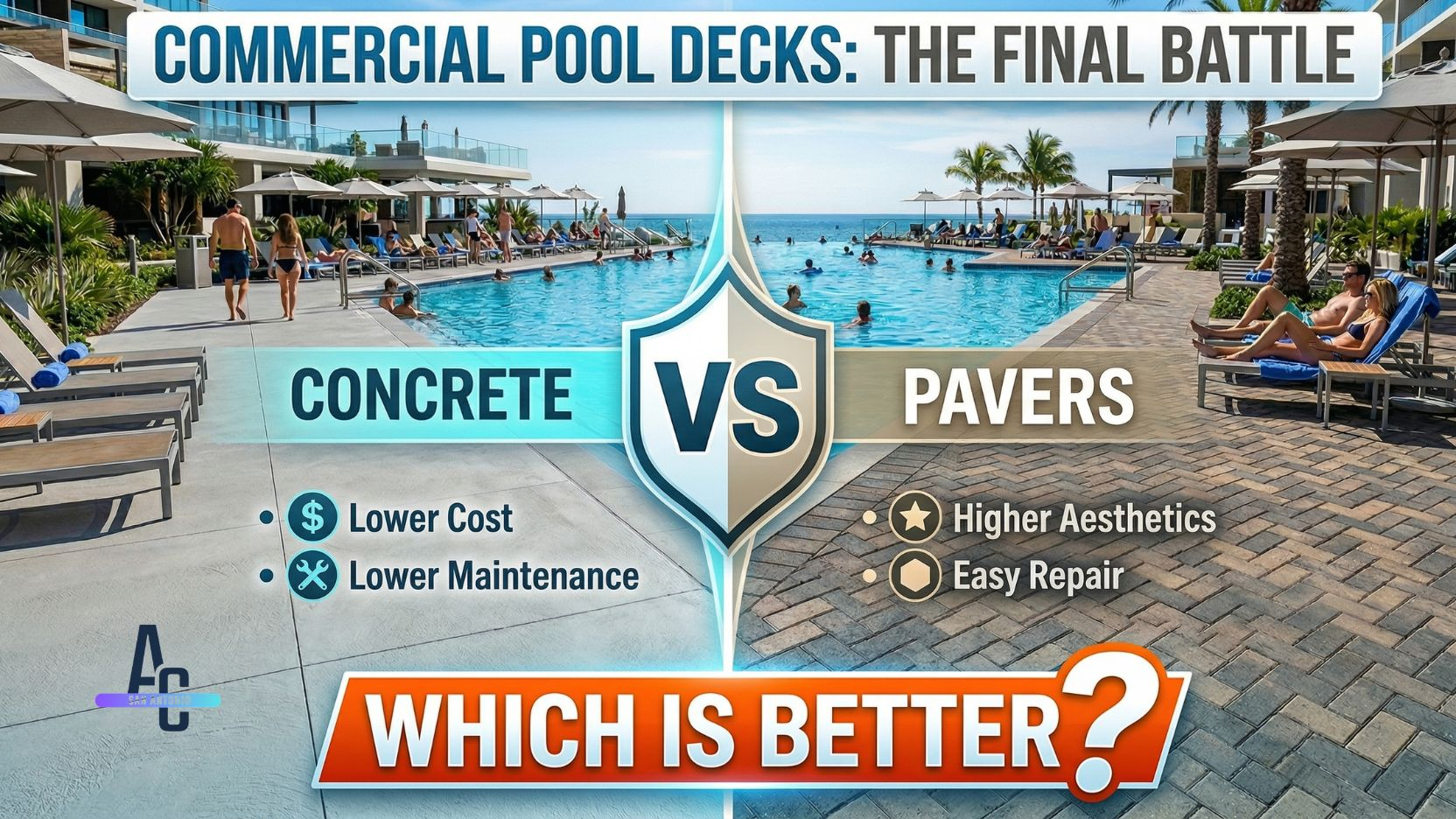
If you’re deciding between concrete vs pavers for commercial pool decks, the better choice usually comes down to budget, maintenance, safety, appearance, and long-term performance. In most commercial settings, concrete is the more cost-effective and lower-maintenance option, while pavers offer easier spot repairs and a premium modular look.
At Affordable Concrete San Antonio, our team works on residential and commercial concrete surfaces in the San Antonio area, where heat, UV exposure, drainage, and slip resistance all affect pool deck performance. For commercial pool decks, the right material is not just about looks. It must handle foot traffic, weather, water exposure, and ongoing upkeep.
Are Concrete Or Pavers Better For Commercial Pool Decks?
Concrete is typically better for commercial pool decks when you want a durable, streamlined, lower-cost surface with fewer joints. Pavers are often better when you prioritize upscale appearance and easier section-by-section repairs.
Here’s the simple breakdown:
| Factor | Concrete | Pavers |
| Upfront cost | Usually lower | Usually higher |
| Maintenance | Lower overall | Moderate |
| Repair method | Patching or resurfacing | Replace individual units |
| Slip resistance | Good with proper finish | Good with textured pavers |
| Appearance | Clean, customizable | Premium, segmented look |
| Weed/joint issues | Minimal joints | More joints to maintain |
| Heavy traffic performance | Strong with proper install | Strong if base is installed well |
Key takeaway: For many hotels, apartment pools, HOA pools, and community spaces, commercial concrete pool decks offer better value over large surface areas.
What Makes Concrete A Strong Choice For Commercial Pool Decks?
Concrete works well for commercial pool decks because it is durable, versatile, and cost-efficient over larger spaces.
For commercial properties, concrete offers several practical advantages:
- Lower installation cost per square foot on large decks
- Custom finish options, including broom finish, textured concrete, stamped concrete, and colored concrete
- Fewer joints, which can mean easier cleaning and a more uniform surface
- Strong drainage planning, especially when properly sloped
- Slip-resistant finishes that improve safety around wet areas
In hot climates like San Antonio and Houston, concrete can also be tailored with coatings, textures, and lighter colors to help improve comfort underfoot.
When Are Pavers A Better Option Around A Commercial Pool?
Pavers are a good option when appearance and repair flexibility matter more than initial cost.
Pavers can make sense for commercial pool decks when a property wants:
- A more upscale or resort-style look
- Easy replacement of damaged sections
- A modular design with visual texture
- Less noticeable cracking compared with poured slabs
That said, pavers have more joints. In commercial settings, those joints may require more cleaning, more maintenance, and occasional re-sanding or weed control depending on the system used.
Which Lasts Longer: Concrete Or Pavers?
Both can last for many years when installed correctly, but they age differently.
Concrete tends to perform well as a continuous slab, especially when reinforced, properly jointed, and sealed as needed. However, it can crack over time due to settlement, expansion, or poor drainage.
Pavers do not crack the same way a slab can, but they can shift, settle unevenly, or develop joint maintenance issues if the base is not installed properly.
The real lifespan depends more on installation quality, drainage, sub-base preparation, and maintenance than the material alone.
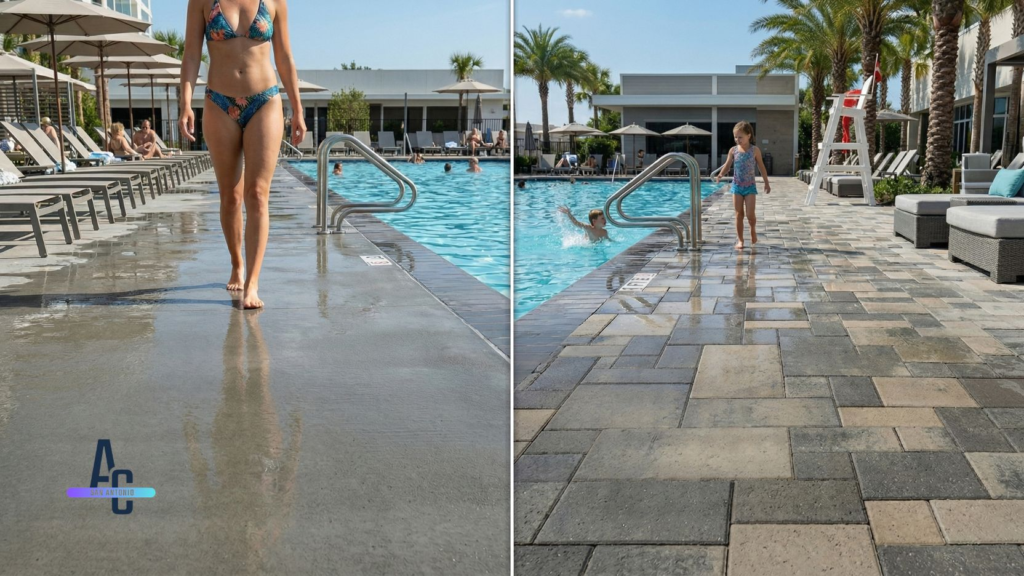
Is Concrete Or Pavers Safer For Wet Commercial Pool Areas?
Both can be safe, but slip resistance depends more on the finish than the material itself.
For commercial pool decks, safety usually comes from:
- Surface texture
- Drainage slope
- Coating or sealer choice
- Ongoing maintenance
Concrete can be finished with:
- Broom texture
- Knockdown texture
- Exposed aggregate
- Slip-resistant sealers
Pavers can also provide traction, especially with textured surfaces. But uneven settling can create trip hazards if maintenance is ignored.
Key takeaway: For wet environments, choose the material and finish based on traction, drainage, and maintenance plan, not appearance alone.
Which Is More Affordable For Commercial Pool Deck Projects?
Concrete is usually more affordable upfront, especially for larger commercial pool decks.
Large commercial decks often favor poured concrete because:
- Installation is more efficient over broad spaces
- Material costs are often lower than pavers
- Labor can be simpler depending on design
- Maintenance tends to be more predictable
Pavers generally cost more due to:
- Higher material costs
- More labor-intensive installation
- More detailed base preparation and placement
If your property needs a large, functional, durable deck with controlled costs, concrete is often the practical choice.
What Matters Most In San Antonio And Houston Pool Deck Construction?
In South Texas, heat, drainage, sun exposure, and heavy use matter as much as material choice.
For commercial pool decks in San Antonio and Houston, focus on:
- Proper grading and drainage
- Expansion joints where needed
- UV-resistant finishes
- Slip-resistant textures
- Surface temperature considerations
- Durable installation for repeated foot traffic
A pool deck that looks good but drains poorly or becomes slick when wet is not a good commercial solution.
How Should Property Owners Choose Between Concrete And Pavers?
Choose concrete if you want lower cost, easier large-area installation, and a clean, durable finish. Choose pavers if you want a higher-end segmented look and easier piece-by-piece repairs.
Concrete is often best for:
- Apartment complexes
- HOA pool areas
- Community pools
- Schools
- Hotels with large deck footprints
Pavers may be best for:
- Boutique properties
- Resort-style pool designs
- Projects prioritizing decorative appearance
FAQs
Is Concrete Cheaper Than Pavers For Commercial Pool Decks?
Yes. Concrete is usually cheaper upfront than pavers, especially on larger commercial pool deck projects.
Do Pavers Last Longer Than Concrete Around Pools?
Not necessarily. Both can last a long time if installed properly. Performance depends heavily on base prep, drainage, and maintenance.
Is Stamped Concrete Good For A Commercial Pool Deck?
Yes, if it is installed with the right texture and sealed correctly. Stamped concrete can work well when slip resistance and maintenance are planned properly.