
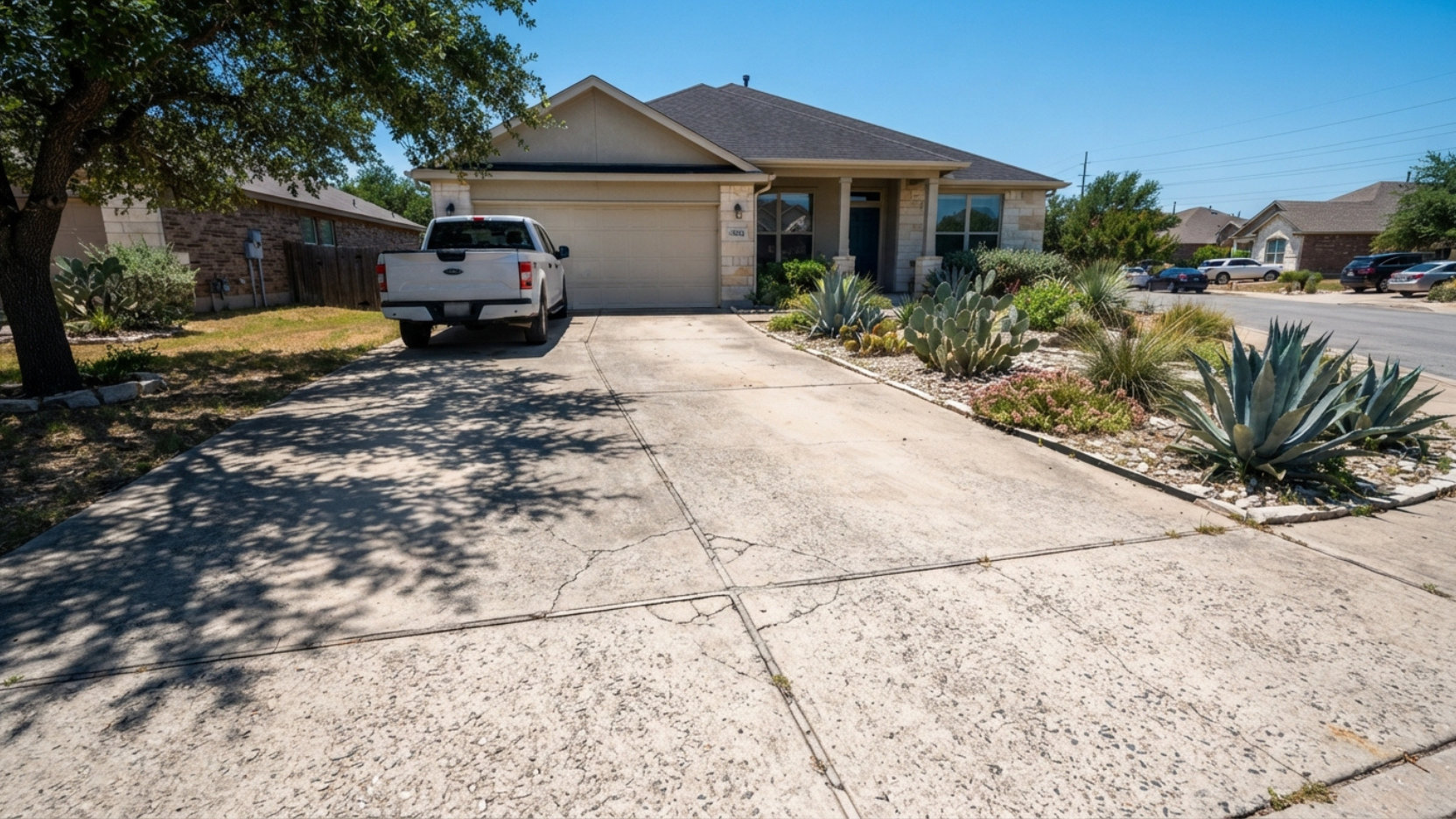
San Antonio’s climate is one of the hardest on residential concrete in the entire country. Triple-digit summer heat, intense UV radiation, heavy spring rains, hard Edwards Aquifer water, and occasional winter freezes all work against your driveway year-round. This guide explains exactly what each weather condition does to concrete and what you can do to protect it.
Most San Antonio homeowners know their concrete driveway will not last forever. What surprises people is how specifically local weather conditions not general wear and tear are responsible for nearly every driveway failure we see across Bexar County. The heat that bleaches your concrete surface. The flash floods that erode the base underneath it. The hard mineral-rich water from the Edwards Aquifer that leaves deposits in your concrete pores. The occasional January freeze that expands any moisture trapped inside the slab.
Understanding exactly how each weather factor damages concrete puts you in control. It tells you when to seal, what to seal with, how to build drainage into a new driveway, and when to call a contractor before a small crack becomes a slab replacement. This guide covers all of it organized by weather type, with practical action steps after each section.
Three conditions combine in San Antonio that do not appear together in most American metros: expansive Blackland Prairie Vertisol clay soil beneath the slab, extremely hard Edwards Aquifer water that deposits minerals in concrete pores, and a climate that cycles between scorching summer heat and occasional sub-freezing winter events within the same year. Any one of these would require careful concrete maintenance. All three together mean that driveways installed and maintained incorrectly degrade faster here than nearly anywhere else in Texas.
Before going deep on each weather factor, this seasonal overview gives you the quick picture. San Antonio does not have four equal seasons it has a dominant summer that stretches roughly from May through October, a mild and unpredictable winter, and short shoulder periods in spring and fall that bring heavy rain and soil movement.
Heat Damage
San Antonio regularly records air temperatures above 100 degrees Fahrenheit from June through August, and concrete surface temperatures run 40 to 60 degrees hotter than the air. A driveway slab on a 104-degree afternoon may be 150 to 165 degrees at the surface. That is not just uncomfortable to walk on barefoot it is a sustained thermal stress event that happens hundreds of times per summer.
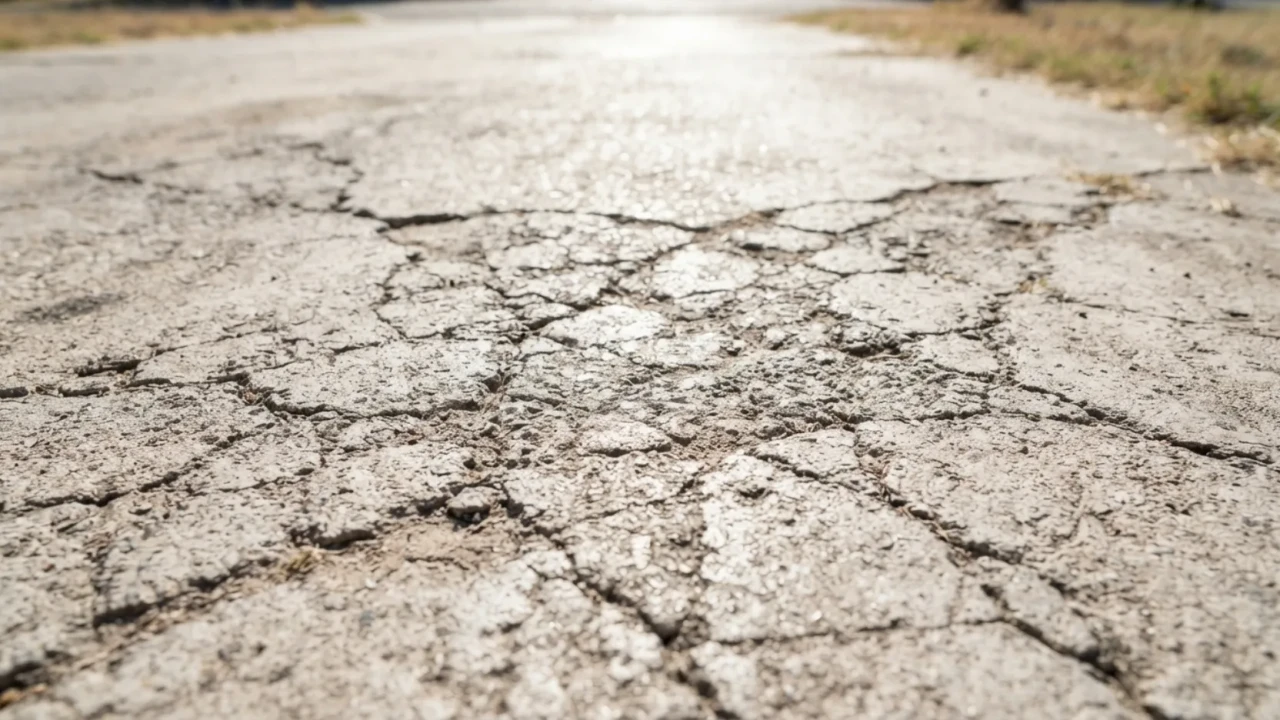
Thermal expansion and contraction cycles: Concrete expands when heated and contracts when it cools. Every day that the temperature rises significantly from morning to afternoon and back is a small expansion-contraction cycle. Over a San Antonio summer with dozens of 100-plus-degree days, those cycles accumulate. Expansion joints are designed to absorb this movement. When joints are too far apart, cracked, or filled with rigid material that does not flex, the thermal stress has nowhere to go except into the concrete itself creating surface cracks that start small and widen over seasons.
Sealer degradation from UV and heat: Concrete sealers protect the surface by filling the pores and creating a barrier against moisture, stains, and freeze events. But most acrylic sealers break down under sustained UV exposure and heat. In San Antonio, an untended sealer applied in cooler climates might last four to five years; locally it typically lasts two to three years before it becomes brittle, chalks, and loses its protective function. An expired sealer is worse than no sealer in some respects it gives the appearance of protection while no longer providing it.
Heat and new concrete curing: When a new driveway is poured in summer, the heat creates a specific risk. Concrete cures through hydration a chemical reaction between cement and water. If the surface dries out before this reaction completes which summer heat dramatically accelerates the result is a surface that looks set but has not reached its design strength. The concrete is weaker, more porous, and more susceptible to all the other weather threats discussed in this guide. Experienced San Antonio contractors schedule summer pours early in the morning, use water reducers in the mix, and apply curing compounds immediately after finishing to slow moisture loss.
Use a penetrating silane-siloxane sealer rather than an acrylic coating for maximum heat and UV durability. Penetrating sealers absorb into the concrete pores rather than forming a film on top. They are not degraded by UV in the same way surface coatings are, and they do not peel or chalk. For a San Antonio driveway that will face 100-plus-degree summers repeatedly, a penetrating sealer applied every three to five years outperforms a film-forming acrylic applied every two to three years and requires less maintenance effort over the life of the slab.
- Expansion joints filled with flexible polyurethane sealant inspect and refill annually before summer
- Sealer applied or reapplied every 2 to 3 years do not let it expire in San Antonio’s UV conditions
- New pour scheduled before 8 AM in summer months not mid-day
- Curing compound or wet curing applied immediately after new concrete is finished
- Surface map cracking inspected for at the 6-month and 12-month marks after any summer pour
UV Damage
San Antonio receives among the highest annual UV intensity readings of any major U.S. city. Unlike northern metros where UV exposure is seasonal, San Antonio’s sun is aggressive year-round including winter months when the lower sun angle still delivers significant radiation to horizontal surfaces like driveways. UV damage to concrete is cumulative and mostly invisible until it crosses a threshold.
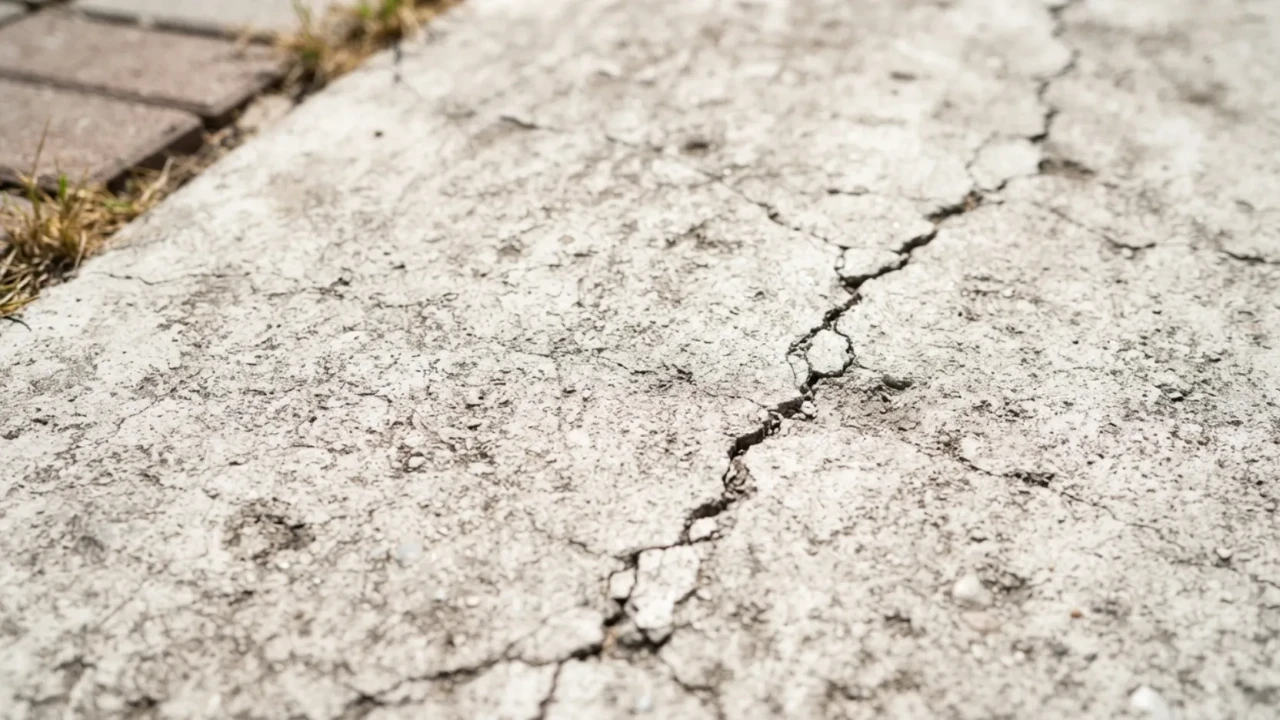
Surface carbonation: UV radiation and carbon dioxide from the atmosphere react with the calcium hydroxide in concrete through a process called carbonation. Over time, this converts the surface layer to calcium carbonate a harder but more brittle compound that is more prone to surface dusting and spalling. You see this as chalky whitening, surface powder, or a dull, flat appearance that did not respond to cleaning. Carbonation progresses slowly inward from the surface over years.
Sealer film breakdown: Film-forming sealers acrylics, epoxies, polyurethanes applied as coatings rely on a continuous membrane to function. UV radiation breaks the polymer chains in this membrane over time, making the sealer brittle and causing it to chalk or peel. In San Antonio, this process runs faster than the manufacturer’s label typically assumes (most labels are written for moderate-UV markets). A sealer that the manufacturer rates for five years may show failure signs at two to three years in San Antonio’s conditions.
Decorative concrete and UV: Stamped and colored concrete driveways are particularly vulnerable to UV fading in San Antonio. Integral colors and surface-applied color hardeners both fade when the protective sealer layer is compromised. Color hardeners that are not protected by a UV-stable sealer will begin showing fading within two to three seasons of San Antonio sun. Homeowners who invest in decorative concrete need to treat the resealing schedule as a firm maintenance commitment rather than an optional upgrade the color investment depends on it.
- UV-stable sealer specified: look for products rated for high-UV southern climates, not generic all-climate formulations
- Stamped and colored concrete resealed every 2 years in San Antonio not the 3 to 5-year cycle appropriate for cooler climates
- Surface checked annually for chalking, dusting, or peeling these are signs the sealer has failed
- Penetrating silane-siloxane sealer considered for plain driveways far better UV resistance than acrylic film coatings
- Color restoration or re-staining addressed before the next pour if integral color has faded past acceptable appearance
Water Damage
San Antonio sits in Flash Flood Alley a band across Central Texas known for producing intense, fast-falling rainfall events. The city averages about 32 inches of rain per year, but that precipitation does not fall gently and evenly. It comes in concentrated bursts: two inches in an hour is not unusual, and five inches in a single event occurs multiple times per decade. For concrete driveways, the damage from rain is rarely to the concrete surface itself. The damage is almost always to the ground underneath it.
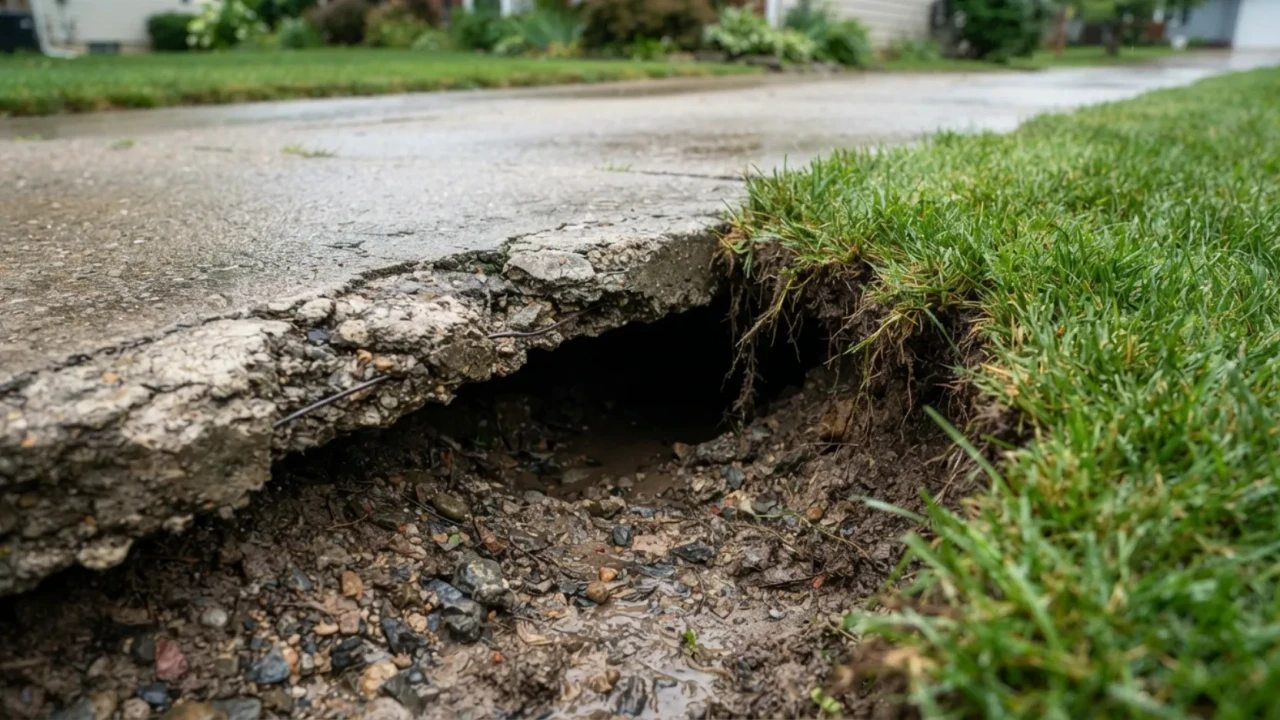
Sub-base erosion: When large volumes of rain fall faster than the soil can absorb it, water travels horizontally across and under hard surfaces. This underflow carries fine soil particles away from the compacted base beneath your driveway a process called sub-base erosion. Over multiple storm events, voids form under the slab. You cannot see them from the surface. What you eventually see is the slab cracking and settling as the unsupported sections give way under vehicle loads. In San Antonio’s clay-heavy soil, this process is particularly damaging because the clay does not drain freely it directs water sideways until it finds an exit path, often under the concrete.
Edge washing: The edges and ends of a concrete driveway are the most vulnerable points for water intrusion. When the soil at the edges is not properly graded away from the slab, rainwater pools and flows under the concrete at the perimeter. Over time the soil beneath the edges is washed away, leaving the edge section of the slab without support. This is why edge cracking and edge breakage are so common on older San Antonio driveways it is not random aging, it is specific to poor drainage at the perimeter.
Edwards Aquifer hard water and mineral deposits: San Antonio’s water supply from the Edwards Aquifer is among the hardest in the United States typically 200 to 400 parts per million of dissolved calcium and magnesium carbonates. When hard water evaporates on a concrete surface or seeps through it during rain events, it leaves behind mineral deposits. These deposits accumulate in the pores of the concrete, gradually reducing the concrete’s porosity and interfering with how sealers bond to the surface. Over years, efflorescence the white powdery mineral residue visible on concrete surfaces appears and indicates that water movement through the slab is carrying minerals to the surface. Efflorescence is not structurally dangerous on its own, but it signals that the sealer is not blocking water movement as it should.
- Driveway drainage slope confirmed: minimum 1/8″ per foot directed away from the structure
- Slab edges graded and compacted to prevent underflow at the perimeter
- French drain or channel drain installed at the low end of the driveway if the lot slopes toward the garage
- Concrete sealer blocking water penetration inspect after each heavy rain for standing water or efflorescence
- Efflorescence treated promptly with acid-based cleaner and surface re-sealed to close water pathways
- Sub-base voids suspected if any section sounds hollow when tapped professional assessment before cracking worsens
Freeze Damage
Most San Antonio homeowners underestimate freeze damage to concrete because the city is not known for harsh winters. But freeze damage to concrete does not require repeated or sustained sub-freezing temperatures. A single event one or two nights below 32 degrees on a moisture-saturated, unsealed slab is enough to cause significant damage. Water expands by approximately nine percent when it freezes. Inside a porous concrete slab, that expansion has nowhere to go except outward, fracturing the concrete from within.
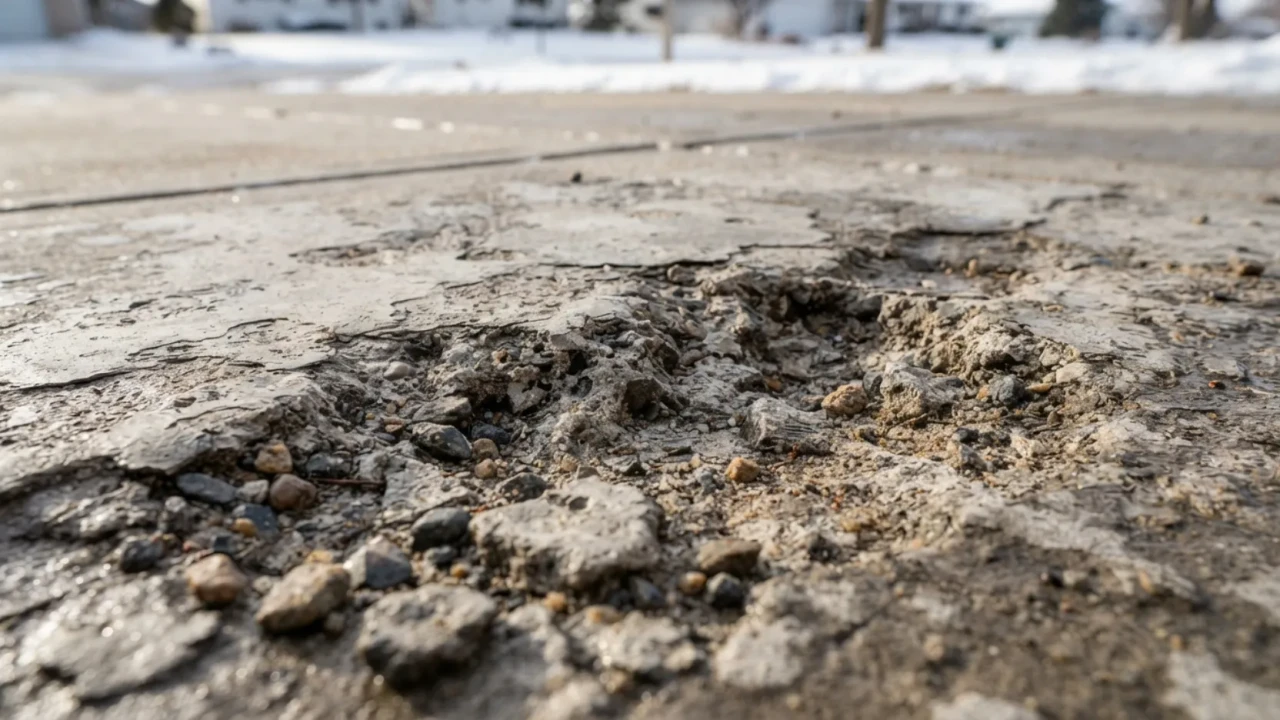
Spalling from freeze-thaw cycles: Spalling is the flaking or peeling of the concrete surface in sheets or chips. In San Antonio, it is most commonly caused by freeze events after moisture has entered the concrete through an expired or absent sealer. The water in the surface pores freezes, expands, and pushes the top layer of concrete off the slab. Spalling looks similar to normal wear and age, but it progresses much faster and tends to appear in irregular patches rather than uniformly across the surface. Once spalling starts, the exposed aggregate underneath is more porous and even more vulnerable to the next freeze event.
Winter Storm Uri and the lessons for San Antonio concrete: The February 2021 winter event that brought unprecedented temperatures to Texas created a generation of damaged concrete driveways across San Antonio. Homeowners and contractors reported widespread spalling, new cracking, and expansion joint failures across the metro area after the freeze. The driveways most affected were those that had not been resealed recently or that had existing hairline cracks that allowed water penetration. The slabs that came through without damage were almost entirely those that had been sealed within the previous two years.
Deicing chemicals and concrete damage: Rock salt and chemical deicers are the second major freeze-related threat. Most deicing chemicals work by lowering the freezing point of water which means they increase the number of freeze-thaw cycles rather than eliminating them. Applied to concrete, they also draw additional moisture into the slab through osmosis and can attack the reinforcement steel if the concrete cover is thin. In San Antonio, where freeze events are occasional rather than constant, the correct approach is sand or kitty litter for traction rather than chemical deicers the traction is what matters, and the abrasive does not damage the concrete.
- Sealer current before winter season: an unsealed slab entering a San Antonio freeze event is at serious risk of spalling
- Existing cracks filled before winter even hairline cracks allow water entry that ice expands into structural fractures
- Sand or kitty litter stocked for traction during freeze events not rock salt or chemical deicers
- Post-freeze inspection: check for new spalling, surface flaking, or crack widening within 2 to 4 weeks of any hard freeze
- Hairline cracks that appeared after a freeze filled promptly they will admit water through next winter season
Soil Movement
This factor is not strictly a weather threat but it is driven entirely by weather. San Antonio’s Blackland Prairie soil is classified as Vertisol, one of the most expansive soil types on earth. When rain saturates this clay, it swells significantly. When summer heat dries it out, it shrinks and cracks. The ground beneath your driveway is rising and falling throughout the year in response to rainfall, and the concrete slab on top of it moves with every cycle.
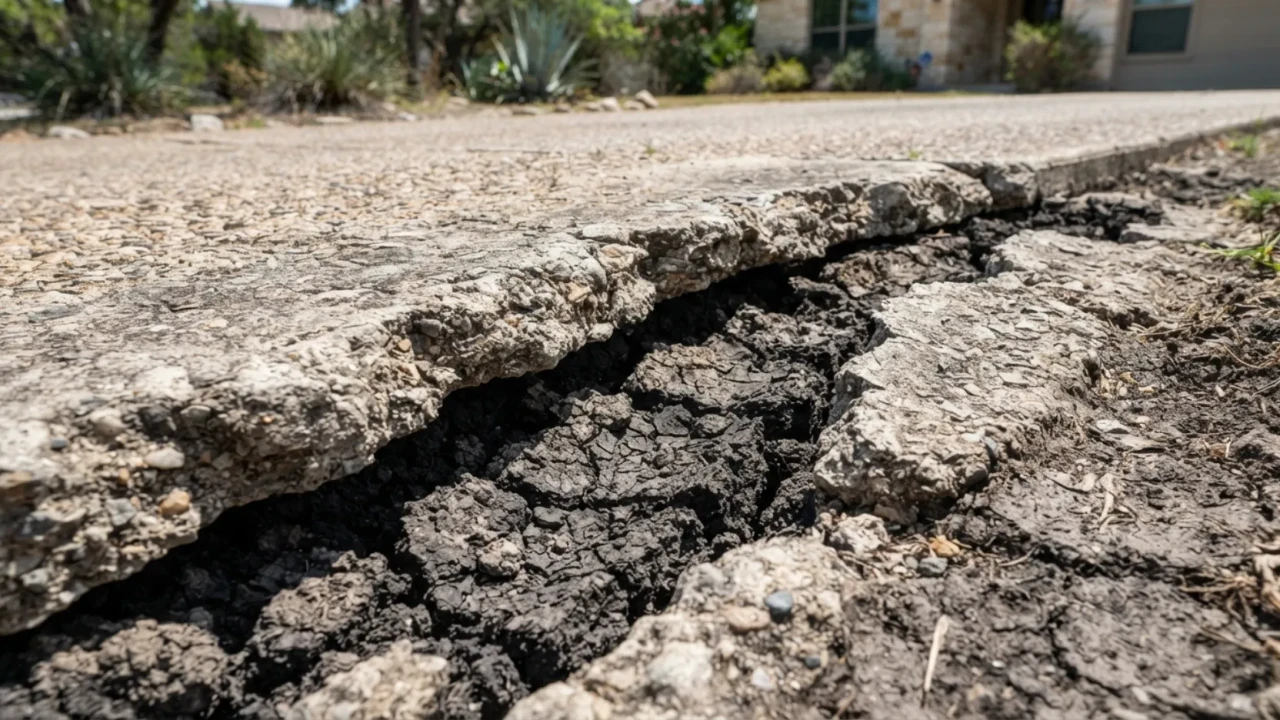
How soil movement translates to concrete damage: A concrete slab is a rigid object sitting on a moving surface. When the clay swells in spring rains, it pushes upward on the slab from below this is heaving, and it can lift sections of the driveway by a quarter inch or more over a season. When the clay dries in summer, it shrinks and pulls away from the bottom of the slab, leaving voids. The slab sections that were heaved up now hang partially unsupported over those voids. When a vehicle drives over an unsupported section, the slab cracks or breaks along the line where support ends.
Why this is worse in San Antonio than most Texas cities: The Blackland Prairie formation runs through Bexar County with particular intensity. The clay content in San Antonio’s Vertisol soils is higher than in most surrounding areas, making ground movement more dramatic per inch of rainfall and more severe during summer drought. San Antonio driveways experience more accumulated soil movement per year than comparable driveways installed in Houston, Austin, or Dallas on different soil types.
Tree roots and clay soil: Trees and large shrubs worsen the clay soil problem significantly. Tree roots draw moisture aggressively from the soil in summer, causing accelerated drying and shrinkage in the zone around the root system. This creates uneven soil movement under the slab one section is heaving from rain saturation while the section near the tree is sinking from root-driven drought. That differential movement is what causes stepped cracks where one side of a crack is higher than the other the most structurally serious type of concrete driveway failure.
- Base prep specified for any new or replacement driveway: 4 to 6″ compacted crushed limestone not granular fill or uncompacted soil
- Rebar grid (#3 or #4 at 18″ centers) specified wire mesh alone is insufficient in San Antonio clay conditions
- Expansion joints placed every 8 feet rather than the generic 10-foot standard used in other regions
- Tree setback confirmed: no trees planted within 10 feet of the slab edge
- Stepped cracks (one side higher than the other) treated as a structural alert professional assessment before overlaying or patching
- Hollow-sounding sections under the slab investigated for sub-base voids before any new concrete is poured
The right maintenance task at the right time of year makes the difference between a driveway that lasts 30 years and one that needs major repair at 10. This calendar is built around San Antonio’s specific climate cycle not a generic national schedule.
| Time of year | Key maintenance task | Why this timing matters in San Antonio |
|---|---|---|
| February March | Post-winter inspection: check for new spalling, surface flaking, and crack changes after freeze season | Freeze-related damage becomes visible as temperatures stabilize. Catch it before spring rains drive moisture through new cracks. |
| March April | Crack filling and edge repair before spring rain season | Spring is peak rain season. Open cracks entering the rain season allow sub-base erosion and moisture penetration during the period of highest rainfall intensity. |
| April May | Expansion joint inspection and refilling with flexible polyurethane sealant | Joints that dried out over winter or were damaged by freeze events need to be restored before summer thermal cycling begins. |
| May or September | Sealer application or reapplication (every 2 to 3 years) | These shoulder months offer temperatures below 90 degrees and low humidity ideal conditions for sealer adhesion and cure. Avoid sealing in peak summer heat or during rain periods. |
| June August | Weed and root monitoring at joints; hose down monthly to slow surface carbonation | Weeds and grass growing through expansion joints are a warning sign their roots expand joints and allow water infiltration. Monthly rinsing reduces surface dust and slows UV-driven surface oxidation. |
| September October | Annual pressure wash; assess sealer condition; fill any new cracks | Best weather window for concrete maintenance. Assess the sealer honestly if it is chalking or beading has decreased, reseal now rather than waiting through another winter unsealed. |
| October November | Pre-winter sealer confirmation; stock sand or kitty litter for freeze events | Entering winter with a current sealer is the single most effective freeze protection. Chemical deicers should not be on the property stock sand instead. |
- Sealer applied within the last 2 to 3 years not expired or chalking
- Expansion joints filled with flexible polyurethane not cracked or missing
- No surface map cracking or widespread hairline craze cracks visible (signs of heat-curing problems)
- UV-stable sealer product selected not a generic all-climate formulation
- Driveway slopes away from the house and garage at a minimum 1/8″ per foot
- No water pooling on the slab surface after rain events
- Slab edges graded to direct runoff away from the perimeter no soil washing under the edges
- No efflorescence (white mineral deposits) visible sign of water moving through unsealed concrete
- No hollow-sounding sections when tapping the surface indicates sub-base voids
- Sealer current before entering winter season minimum requirement before any freeze event
- All cracks filled before November open cracks entering freeze season cause spalling
- Chemical deicers absent from the property sand or kitty litter stocked for traction instead
- Post-freeze inspection scheduled for February March after each winter
- No trees within 10 feet of slab edge root-driven differential settlement avoided
- No stepped cracks present (one side higher than the other) structural alert requiring professional assessment
- If a new driveway: 4 to 6″ compacted crushed limestone base and rebar grid specified in the contractor scope
- Expansion joints at 8-foot intervals on the existing slab not stretched to 10 or 12 feet
What is the best time of year to pour a new concrete driveway in San Antonio?
How often should I seal my concrete driveway in San Antonio?
Will San Antonio’s winters damage my concrete driveway?
Why does my driveway crack in the same place every year?
What is the white powder appearing on my concrete driveway after it rains?
Does shade from trees help protect a concrete driveway from San Antonio heat?
Worried about weather damage to your San Antonio driveway?
We inspect driveways across Bexar County every week. Tell us what you are seeing cracking, spalling, heaving, or general wear and we will give you an honest assessment and a written quote at no cost.