
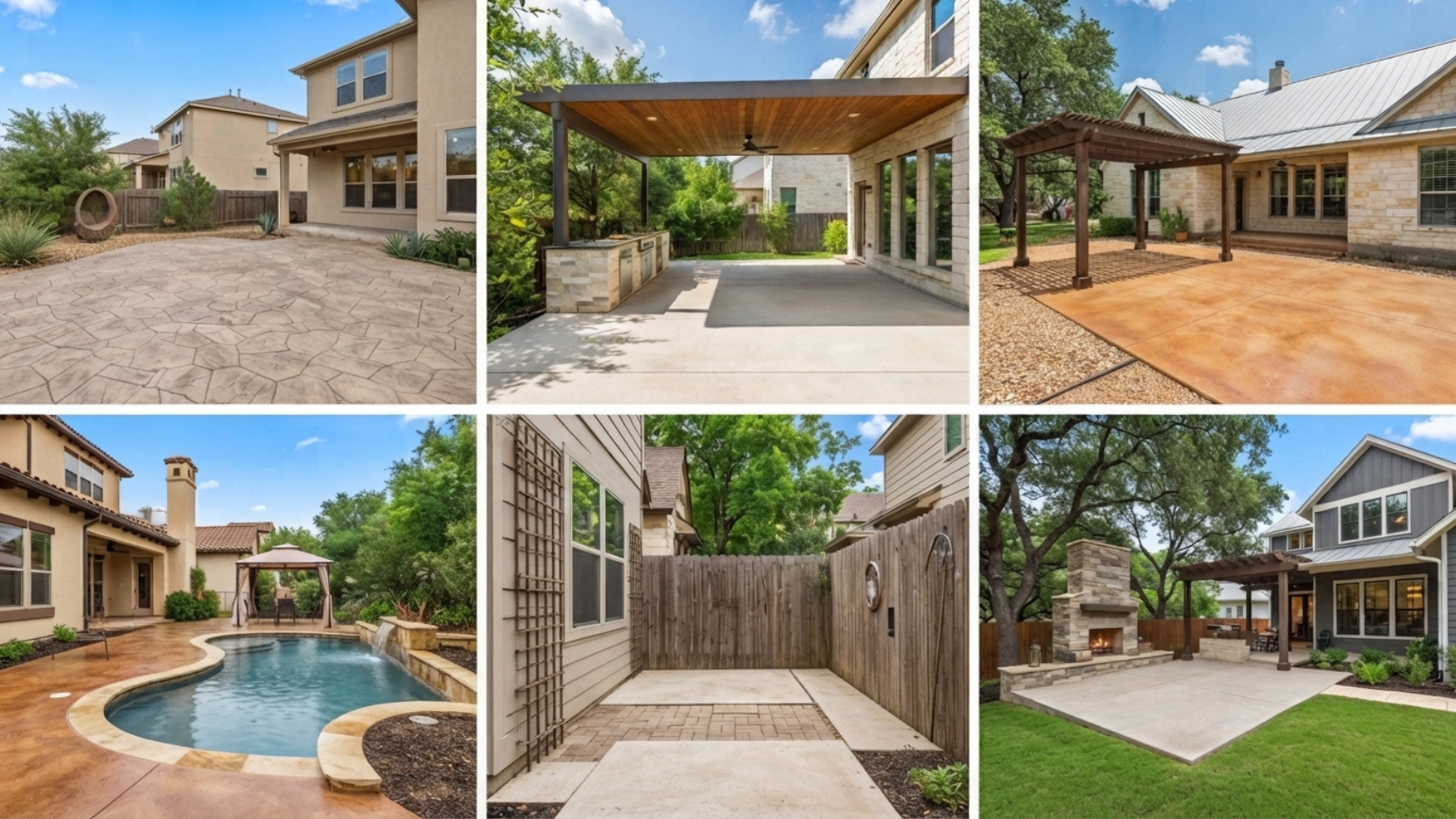
From budget-friendly broom-finish slabs to high-end stamped stone patterns, this guide covers every concrete patio design style that works in San Antonio’s climate with real 2026 cost ranges and the local factors that determine which option is right for your backyard.
Concrete is the most versatile patio material available to San Antonio homeowners and the most underestimated. Mention concrete to most people and they picture a gray utilitarian slab. The reality in 2026 is a material that can convincingly replicate the look of natural flagstone, travertine, brick, or wood plank while delivering a surface that survives Bexar County’s expanding clay soils, 100-degree summers, and intense UV exposure far better than any of the materials it imitates.
Choosing the right design is not just an aesthetic decision. In San Antonio’s climate, certain finishes perform better than others for heat reflectivity, slip resistance, and long-term color stability under direct Texas sun. This guide covers six design approaches, from the most budget-conscious to the most decorative, with the local factors that should shape your decision.
The biggest mistake homeowners make when planning a concrete patio is choosing a finish or color before deciding on structural specs. In San Antonio’s Blackland Prairie clay soils, base preparation depth, slab thickness, and expansion joint placement determine whether a patio lasts five years or thirty regardless of how beautiful the finish is. Get the structural spec right first, then choose the design that fits your budget and home style. A stunning stamped patio on a thin slab with no base prep will crack and heave within two years. A plain broom-finish patio on a proper 4-inch slab over compacted crushed limestone will outlast everything in your yard.
Most Popular 2026
Stamped concrete is the most popular decorative patio choice across Bexar County in 2026, and for good reason. Rubber stamps pressed into freshly poured concrete create patterns that closely replicate flagstone, slate, travertine, cobblestone, and even wood plank while the concrete itself costs significantly less than any of those natural materials and requires far less ongoing maintenance than pavers or natural stone in San Antonio’s expansive clay soils.

The design flexibility of stamped concrete is its primary advantage. Pattern, color, and texture are all independent choices. A common San Antonio combination is an Ashlar slate pattern (large, irregular stone-like sections) with a terracotta or warm sand integral color a palette that complements the Spanish colonial and Hill Country architecture styles common across the city’s established neighborhoods.
The most important technical decision with stamped concrete is color delivery method. Integral color (pigment blended throughout the entire concrete mix) is strongly preferred over surface-only color hardener in San Antonio’s climate. Integral color means the slab retains its color even if the surface chips or wears, which matters more here than in most markets because of the thermal cycling concrete endures between freezing winter nights and 105-degree summer afternoons.
- Pattern and color specified in writing before the pour changes after the concrete sets are impossible
- Integral color chosen over surface color hardener alone for long-term chip resistance
- Release agent color (the secondary contrasting tone applied to the stamps) confirmed in writing
- UV-resistant polyurethane sealer specified not standard acrylic for a San Antonio patio
- Resealing schedule agreed: every 2 years in San Antonio’s climate, not the national standard of 3
Great For Pools
Exposed aggregate concrete is produced by washing the surface paste away before the slab fully cures, revealing the natural stone, gravel, or decorative pebbles embedded in the concrete mix. The result is a textured surface with natural visual depth and inherent slip resistance that no applied finish can replicate. For San Antonio homeowners with pool decks adjacent to their patio, or patios that regularly get wet from sprinkler overspray, exposed aggregate is the most practical decorative choice available.

The appearance of an exposed aggregate patio is determined almost entirely by the aggregate specified before the pour. Pea gravel produces a fine, uniform texture with earthy brown and tan tones that suits most San Antonio backyard styles. River rock aggregate in larger sizes (3/8 to 3/4 inch) creates a bolder, more dramatic surface. Decorative options include quartz aggregate (sparkles in direct Texas sun), turquoise glass aggregate, and locally sourced limestone chip for a Hill Country aesthetic.
One critical advantage for San Antonio: exposed aggregate patios tend to run 8 to 12 degrees cooler underfoot than dark stamped concrete in direct summer sun. In a market where surface temperatures can exceed 150 degrees on a July afternoon, the practical comfort difference is significant for bare-foot outdoor living.
- Aggregate type, size, and color specified in writing before the pour aggregate cannot be changed afterward
- Ask your contractor for a sample board or completed project photos using the same aggregate
- Confirm surface exposure depth: light wash (subtle texture) vs. deep wash (bold texture) discuss with contractor
- Penetrating silane-siloxane sealer specified not a film-forming sealer that obscures the aggregate appearance
- If adjacent to a pool, confirm aggregate size is compatible with bare-foot comfort for the household
Works on Existing Slabs
Concrete staining is the only design approach on this list that can transform an existing patio slab without demolition. If you have a plain gray broom-finish patio that is structurally sound but visually dull, acid staining or water-based staining can deliver a dramatic upgrade at a fraction of full replacement cost. This makes it one of the most cost-effective design decisions available to San Antonio homeowners who want a decorative finish without starting from scratch.

Acid staining uses a chemical reaction between the stain and the minerals in the concrete to create permanent, mottled earth tones terracotta, amber, coffee brown, sage green, and blue-gray are the most common results. Because the color results from a chemical reaction rather than a surface coating, no two slabs stain identically. The variation and depth of color are the defining aesthetic characteristic: acid-stained concrete looks like no other surface material.
Water-based staining delivers more predictable, uniform color than acid staining and is available in a far wider range of hues including blues, greens, and even reds. Water-based stains are applied as a coating rather than a chemical reaction, so they can be layered and blended for custom color effects. Both stain types require a high-quality sealer applied over the finished surface to protect the color from UV fading, which in San Antonio’s climate requires reapplication every two years.
Staining an existing slab requires a clean concrete history. Sealers, curing compounds, adhesives, paint, grease, and oil stains all interfere with color absorption. Before scheduling staining on an existing patio, the concrete must be diamond-ground or shot-blasted to open the surface pores. A reputable staining contractor will assess the slab before quoting the job and be transparent about areas where prior contamination may affect results. Avoid any contractor who quotes staining without first inspecting the existing slab condition.
- Confirm whether the existing slab has been previously sealed sealed concrete cannot be acid-stained without grinding
- Review sample boards or completed project photos in similar lighting conditions to the patio
- Understand that acid stain results vary no contractor can guarantee an exact color match from a sample
- Confirm surface prep method included in the quote: diamond grinding, shot blasting, or acid etching
- Sealer coat included in project scope stain without sealer will fade rapidly under San Antonio UV
Best Value
A plain broom finish is the most durable and lowest-maintenance concrete surface available and in its basic form, it is also the least interesting visually. The upgraded broom finish design approach uses the structural simplicity of a standard slab as a foundation, then adds design interest through color borders, geometric saw-cut patterns, contrasting integral color bands, or embedded stone or brick accents. The result is a patio that looks intentional and well-designed without the full cost premium of a stamped or decorative surface.

The most popular upgraded broom finish in San Antonio is a standard gray broom-finish field with a 12-inch contrasting color border around the perimeter. The border can be an integral color (terracotta, charcoal, or tan are common choices) poured simultaneously with the main slab, using a temporary form board to create a clean division. The result is a two-tone patio that reads as a designed space without the cost or maintenance requirement of a stamped surface.
Saw-cut geometric patterns cut into a finished broom slab after curing are another cost-effective way to add visual interest. Diagonal grid patterns, herringbone lines, or a simple square grid saw-cut to 1/4 inch depth across the slab field create a stone-tile visual effect for a modest additional cost. The cuts also function as additional control joints, which is a structural benefit in San Antonio’s clay soils where expansion and contraction are ongoing.
- Border color and width specified in writing before the pour
- Form board divider placement confirmed to ensure clean straight edge between field and border
- If saw-cut pattern is planned: depth (1/4 inch standard) and pattern confirmed before cutting begins
- Saw cuts filled with matching-color joint sealant to prevent water infiltration and weed growth
- Penetrating sealer applied across the full surface including saw-cut areas after full cure
Classic Choice
A salt finish is created by pressing rock salt crystals into freshly poured concrete, then dissolving them with water after initial set to leave a pitted, textured surface. The result is a subtle, organically patterned finish that is distinct from broom finish but far less uniform than stamped patterns somewhere between the two in visual complexity. Salt finish concrete is a long-standing favorite in San Antonio for covered patio areas, shaded outdoor dining spaces, and any application where a natural, understated texture is preferred over a bold decorative statement.

The pitted surface of a salt finish creates natural slip resistance, making it a sensible choice for areas adjacent to outdoor kitchens, grills, or outdoor bars where spills are frequent. It also drains more effectively than a smooth troweled surface, though it requires slightly more attention during cleaning since debris can collect in the pits.
Salt finish concrete is compatible with integral color and can be combined with a contrasting border in a different finish a popular San Antonio design is a salt-finish main field with a stamped cobblestone or Ashlar border, delivering two distinct textures within the same pour and the same color palette. This hybrid approach delivers a high-design result without the full cost of stamping the entire surface.
Salt finish with landscape lighting is one of the most underused design combinations in San Antonio. The pitted texture of a salt finish interacts with low-angle lighting at dusk and evening to create a shadow pattern across the surface that smooth or broom-finish concrete cannot replicate. If your patio project includes or is adjacent to outdoor lighting, show your lighting designer a salt-finish sample the combined effect is consistently one of the most striking affordable outdoor design results our team produces.
- Confirm rock salt size with contractor coarser salt creates larger pits, finer salt creates subtler texture
- Note that pit depth and pattern will vary salt finish has inherent organic variation, not a uniform appearance
- If combining with a stamped border: confirm pour sequence so both areas remain workable simultaneously
- Sealing fills the pits slightly discuss sealer type with contractor to confirm desired surface appearance after sealing
- Plan for slightly more effort in regular cleaning: a stiff-bristle brush removes debris from pits that a broom misses
No Demo Required
A concrete overlay is a thin (typically 1/4 to 1/2 inch) layer of polymer-modified cement applied over a structurally sound existing slab, then stamped, stenciled, textured, or colored to create a decorative finish. For San Antonio homeowners with an existing patio that is dull, stained, or dated in appearance but structurally intact beneath the surface, an overlay delivers a near-complete design transformation at 30 to 50 percent of full replacement cost.

Overlays are not a repair product they are a design product. The critical requirement is that the existing slab beneath must be structurally sound, free of active cracking, properly drained, and free of delaminating areas. Any existing cracks in the base slab will eventually reflect through an overlay, so active structural issues must be repaired before overlay installation. A reputable contractor will assess the existing slab thoroughly before agreeing to an overlay project.
The design options available with a concrete overlay are nearly as broad as with a new pour. Microtexture overlays can be stamped with the same patterns available for new concrete, stenciled with geometric tile designs, or given a smooth troweled finish for a contemporary look. Decorative saw cuts added after overlay curing extend the design options further. Color is applied via integral pigment, acid stain, or water-based stain layered on top of the cured overlay.
- Existing slab assessed by contractor before any quote is accepted do not proceed without a structural evaluation
- Active cracks repaired and allowed to stabilize before overlay installation
- Surface prep method confirmed: diamond grinding or shot blasting (not just pressure washing)
- Polymer-modified overlay product specified not a standard cement-only topping that will delaminate
- Sealer coat included in project scope and maintenance interval confirmed
Use this table to match your priorities budget, maintenance tolerance, home style, and use case to the right concrete patio design approach.
| Design style | Cost range (installed) | Maintenance level | Best fit for |
|---|---|---|---|
| Stamped concrete | $14 to $22 per sqft | Reseal every 2 years | Homeowners who want a premium decorative look; Spanish, Mediterranean, or Hill Country homes |
| Exposed aggregate | $10 to $16 per sqft | Reseal every 2 to 3 years; annual pressure wash | Pool deck adjacent areas; contemporary or transitional home styles; families with kids |
| Acid or water-based stain | $10 to $16 per sqft (new); $3 to $7 (existing) | Reseal every 2 years | Existing slabs needing a visual upgrade; unique color or custom look requirements |
| Upgraded broom finish | $8 to $14 per sqft | Reseal every 3 to 5 years; lowest ongoing cost | Budget-conscious homeowners; utility-focused patios with design accents |
| Salt finish | $7 to $12 per sqft | Reseal every 2 to 3 years; brush cleaning | Covered patios; outdoor kitchen and dining areas; evening-lit outdoor spaces |
| Decorative overlay | $4 to $10 per sqft | Reseal every 2 years; 8 to 15 year lifespan | Existing patios that are structurally sound but visually dated; renovation budgets |
- Slab thickness confirmed in writing: minimum 4 inches for all residential patios in San Antonio
- Base type and depth specified: 4-inch minimum compacted crushed limestone on Bexar County clay soils
- Reinforcement included: wire mesh for patios under 400 sqft; rebar grid for larger slabs or irregular shapes
- Expansion joint spacing confirmed: every 10 feet maximum for patios; closer in direct sun areas
- Drainage slope specified: 1/8 inch per foot minimum away from the house foundation
- Design style selected from the six options in this guide and confirmed in writing
- Pattern and color confirmed in writing for stamped work no verbal agreements on color or pattern
- Integral color vs. surface color hardener decision made and confirmed (integral preferred in San Antonio)
- Sealer type specified: UV-resistant polyurethane preferred over standard acrylic for San Antonio patios
- Sealing schedule confirmed: 2 years for stamped and decorative surfaces; 3 to 5 years for broom finish
- Certificate of insurance received: $1 million minimum general liability coverage
- Written quote itemizes base prep, slab thickness, reinforcement, finish type, and sealing separately
- Local references from completed San Antonio decorative patio projects available on request
- Payment terms confirmed: 30 to 50 percent deposit; remainder on completion and inspection
- No foot traffic for 48 hours after pour; no furniture for 7 days; full cure at 28 days
- First sealer application scheduled at 28 to 30 days after pour not before full cure
- Curing process confirmed: wet curing or liquid curing compound for minimum 3 days in summer heat
- Resealing reminder noted in calendar for 2 years (decorative) or 3 to 5 years (broom finish)
What is the most popular concrete patio design in San Antonio in 2026?
Does the color of a concrete patio affect how hot it gets in San Antonio summers?
Can I add a design to my existing concrete patio without replacing it?
How much does a stamped concrete patio cost in San Antonio?
How long will a decorative concrete patio last in San Antonio?
Get a free concrete patio design quote in San Antonio
Tell us about your home, your backyard, and the design style that appeals to you. We will visit your property and give you a detailed written quote with no pressure and no cost.