
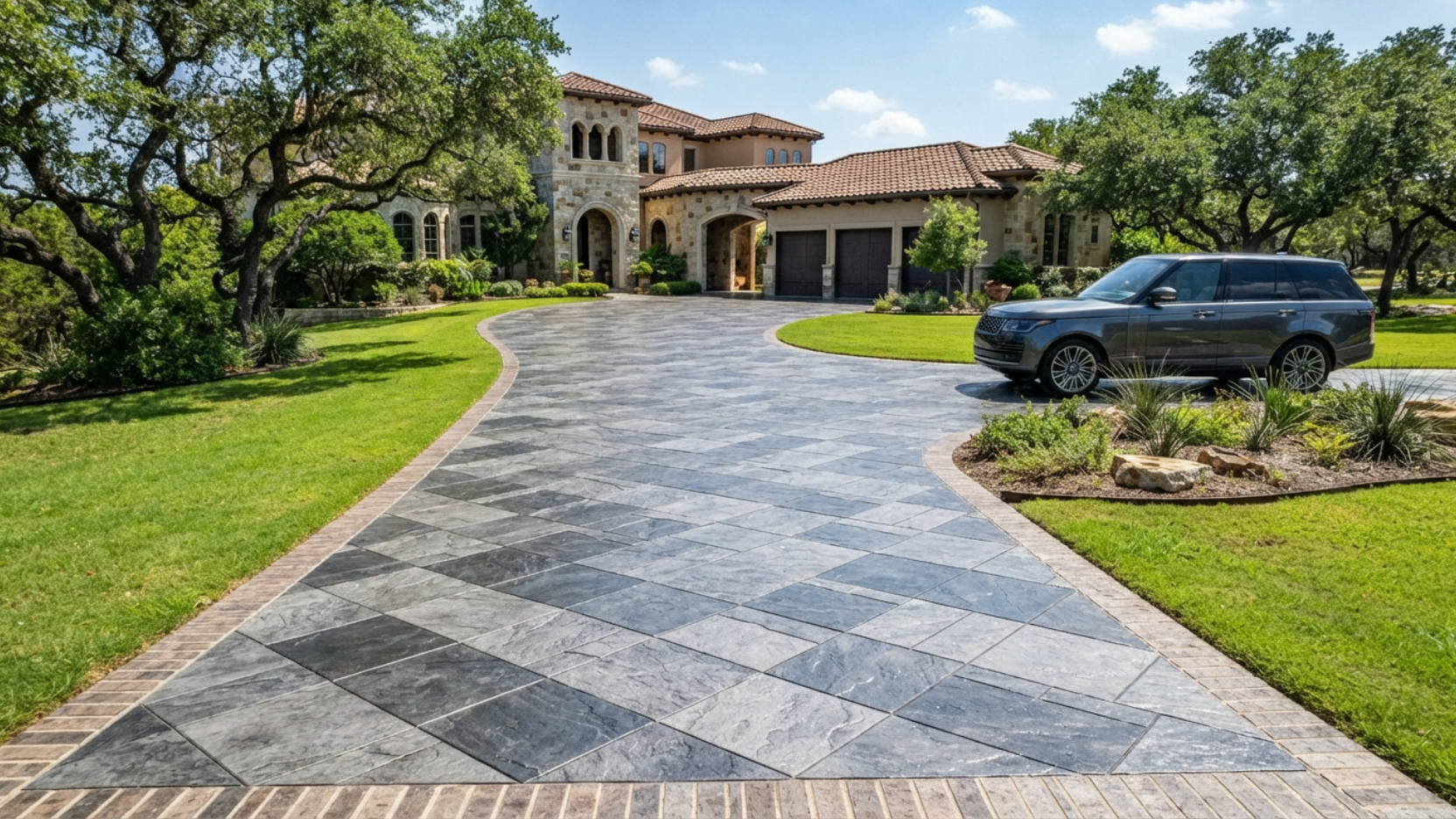
Stamped concrete is the most popular patio upgrade in San Antonio and also one of the most misunderstood. This guide covers every advantage, every real limitation, what it actually costs in Bexar County in 2026, and how San Antonio’s heat and clay soils change the long-term performance picture.
Stamped concrete shows up on more San Antonio patios, pool decks, and driveways than any other decorative finish and for good reason. It delivers the look of natural stone, slate, brick, or wood at a fraction of the material cost, poured monolithically so there are no loose pieces, no shifting pavers, and no joints for weeds to colonize. In a city where outdoor living is a year-round pursuit, a well-designed stamped concrete patio genuinely elevates the backyard experience.
But stamped concrete also comes with real limitations that generic contractor websites tend to minimize. In San Antonio specifically, the Blackland Prairie clay soil, intense Texas UV exposure, and hard Edwards Aquifer water each affect how stamped surfaces age and what maintenance is required to keep them looking the way they did at installation. This guide covers both sides honestly so you can decide whether stamped concrete is the right choice for your project.
Many homeowners evaluate stamped concrete purely as an aesthetic choice. But in San Antonio’s expansive clay soil environment, the structural decisions underneath the stamp determine whether that beautiful finish lasts 5 years or 25. Proper base preparation with compacted crushed limestone, correct slab thickness (minimum 4 inches for patios, 5 inches for driveways), and a rebar grid that handles soil movement are just as important as the pattern and color you choose on top. A contractor who leads with pattern books before discussing base depth is showing you where their priorities are.
Pro
The most compelling argument for stamped concrete is simple: it looks like flagstone, slate, brick, or travertine at roughly one-third to one-half the cost of the real material. Natural flagstone installed in San Antonio typically runs $25 to $45 per square foot. Travertine pavers come in at $20 to $35 per square foot installed. A well-executed stamped concrete patio with integral color and a quality release agent lands at $14 to $22 per square foot and produces a result that is visually comparable to non-specialists.

The color and texture combination available through stamped concrete has expanded significantly. Modern integral pigments provide rich, UV-stable color throughout the full slab depth not just on the surface. Release agents in contrasting earth tones add depth and variation that mimic the natural color irregularity of real stone. The result is a surface that photographs beautifully and holds up to daily scrutiny from normal viewing distances.
Pro
Pavers whether brick, travertine, or concrete are individual pieces sitting on a sand or mortar bed. In San Antonio’s Blackland Prairie Vertisol clay soil, which expands when wet and contracts when dry, that sand bed shifts seasonally. The result over time is uneven paver surfaces, trip hazards at lifted joints, and persistent weed and grass growth through the open joints. Stamped concrete eliminates all three problems at once by being a single connected slab.

The grout lines you see in a stamped concrete surface are molded into the slab they are purely decorative, not structural joints between separate pieces. There is no gap for weeds to push through, no sand bed to shift, and no individual piece to settle independently. In a city where Bermuda grass and weeds are aggressive, and where the clay soil moves enough to unseat paver surfaces within a few years, this monolithic quality is a genuine practical advantage over paver alternatives.
- Blackland Prairie clay soil expands and contracts seasonally paver sand beds are vulnerable to this movement
- Bermuda grass and local weeds exploit open paver joints aggressively in San Antonio’s growing season
- City of San Antonio pool deck codes require smooth, even surfaces with no loose or shifting pieces near water
- Insurance liability for trip hazards from shifted pavers falls on the property owner stamped concrete reduces this exposure
Pro
San Antonio’s residential neighborhoods span a wide architectural range Hill Country limestone homes, Spanish Colonial, Texas Craftsman, modern transitional, and suburban traditional and stamped concrete can be designed to complement each. Pattern selection, integral color choice, and release agent tone are all specified before the pour and can be matched precisely to the home’s existing stone, brick, or tile palette.
The 2026 San Antonio stamped concrete trend: Integral color throughout the full slab depth not just a surface color hardener combined with a release agent in a contrasting tone is the most popular patio upgrade we are completing this year. Integral color means the pigment goes all the way through the slab, so if the surface chips or wears, the color remains consistent. Combined with a warm release agent in a complementary earth tone, the result mimics the depth and variation of real natural stone in a way that surface-only coloring cannot replicate.
Pro
One concern homeowners often raise is whether the stamping process weakens the concrete. It does not. The stamp is pressed into the surface of the slab during the finishing window before the concrete reaches initial set and it creates a textured profile, not a structural modification. The concrete mix, thickness, reinforcement, and base preparation all remain identical to a standard broom-finish slab. A properly poured stamped concrete patio in San Antonio has the same 25 to 30 year structural lifespan as an equivalent plain slab.
The durability caveat is sealing. Stamped concrete that is sealed on schedule every two to three years in San Antonio’s climate maintains its color vibrancy and surface integrity for decades. Stamped concrete that is never sealed will fade, become porous, and lose visual appeal within 8 to 12 years, even though the underlying slab remains structurally sound. Sealing is not optional maintenance for stamped concrete in San Antonio it is the mechanism that preserves the investment.
- First sealing at 28 to 30 days after pour do not seal before full cure is complete
- Resealing every 2 to 3 years due to San Antonio’s high UV intensity and summer heat
- Annual pressure washing to remove organic staining, algae, and mineral deposits
- Reapply sealer immediately if water stops beading on the surface between scheduled sealings
Pro
Outdoor living space is among the most valued features in San Antonio residential real estate, where the year-round usable climate makes a well-finished backyard a genuine lifestyle asset. A stamped concrete patio or pool deck in good condition consistently contributes positive value in home appraisals and buyer perception particularly when it complements the home’s architecture and is in well-maintained condition at time of sale.
The resale argument for stamped concrete over plain broom finish is straightforward: the cost premium over standard concrete ($6 to $12 per square foot additional) typically translates to a buyer’s perception of quality and care that exceeds the actual dollar difference. A home with a well-designed 400 sqft stamped patio reads as meaningfully more finished than the same home with a plain slab, even if the price difference is only $2,400 to $4,800.

Con
Stamped concrete costs significantly more than a standard broom-finish pour. The premium covers the additional labor for stamp placement and timing, the cost of integral color or color hardener, release agent material, and the sealing that must be applied before the project is considered complete. For homeowners on a tight budget, this cost difference is not trivial.
Con
This is the most common disappointment with stamped concrete in San Antonio: a homeowner installs a beautiful, richly colored patio, neglects to reseal it on schedule, and watches the color fade from deep terracotta to washed-out tan over three to five years. San Antonio receives among the highest annual UV doses of any major Texas city, and unsealed concrete sealers which carry the color vibrancy visible at completion break down faster here than in most U.S. markets.

The critical distinction here is between integral color (pigment mixed throughout the concrete) and surface-applied color hardener (a powder broadcast onto the surface during finishing). Integral color fades more slowly because the pigment is distributed through the full 4 inches of the slab the surface can wear slightly without losing color. Color hardener fades faster because the pigment is concentrated at the surface and is more directly exposed to UV. Both require sealing to maintain vibrancy, but integral color is more forgiving of a delayed resealing cycle.
- First sealing at 28 to 30 days after pour using a penetrating or film-forming acrylic sealer rated for exterior use
- Reseal every 2 years for south-facing or fully exposed patios San Antonio’s sun angle is aggressive
- Reseal every 3 years for covered or partially shaded patios where direct UV is reduced
- Water test annually: drip water on the surface. If it absorbs rather than beading, reseal immediately
- Use a UV-stable, solvent-based acrylic sealer rather than water-based products for longer intervals between applications
Con
Concrete cracks. This is true of all concrete surfaces, regardless of finish, and it is especially relevant in San Antonio where the Blackland Prairie clay soil moves seasonally beneath every slab in the city. On a plain broom-finish driveway, a hairline crack is nearly invisible the gray-on-gray contrast is too subtle to register from a normal viewing distance. On a richly colored stamped patio, that same hairline crack is clearly visible as a gray line cutting across a terracotta or charcoal surface.
Proper installation adequate base prep, correct slab thickness, rebar reinforcement, and control joints at correct spacing minimizes cracking significantly. But it does not eliminate it entirely. Shrinkage cracking during cure is a normal part of the concrete hydration process, and in a climate where San Antonio summer heat accelerates moisture loss during the critical curing window, minor surface cracking is common even on well-executed jobs. Homeowners considering stamped concrete should understand this before committing to the finish.
- Specify control joints every 8 to 10 feet in all directions placed along stamp pattern lines where possible
- Confirm rebar grid reinforcement (#3 or #4 at 18″ centers) wire mesh alone is insufficient in San Antonio clay soil
- Require a minimum 4″ slab thickness for patios, 5″ for driveways undersized slabs crack more readily
- Schedule pour for cooler months (October through April) when rapid moisture loss from heat is less likely
- If summer pour is unavoidable, confirm early morning start and liquid curing compound application
Con
If a section of stamped concrete requires repair from a structural crack, a tree root intrusion, or utility work that cuts through the slab matching the repair to the surrounding surface is genuinely difficult. Concrete color changes as it ages and weathers, and new concrete poured next to a 5-year-old slab will not match, even if the identical mix design and color is used. The stamp pattern also requires skill and the correct tools to replicate precisely on a small patch area.
This limitation affects how repair decisions are made on stamped concrete. A minor crack repair on plain broom finish is invisible within a season. The same repair on a stamped surface may remain noticeable for years. Some homeowners choose to reseal the entire slab after a repair to minimize the contrast between patched and original areas an added cost but effective at reducing the visible difference. Planning for potential future repairs is a legitimate consideration when choosing stamped concrete over a more forgiving plain finish.
- For hairline cracks (under 1/4″ wide): fill with a color-matched concrete crack filler and reseal the full surface
- For larger cracks or section replacement: use the same stamp tools and color system bring your original contractor back if possible
- After any repair: reseal the entire slab, not just the repaired area, to unify sheen and color tone
- Ask your contractor to retain your color formula documentation at the time of installation you will need it for future repairs
Con
Sealed stamped concrete has a smooth, glossy surface sheen that can become slippery when wet a meaningful concern for pool decks, patios used during rain events, and any stamped surface where foot traffic occurs in wet conditions. This is not an inherent defect of stamped concrete, but it is a characteristic that requires attention during product selection and installation design.

The solution is straightforward: anti-slip aggregate additives (aluminum oxide or shark grip products) are mixed into the sealer before application. This introduces a fine texture into the sealer film that significantly improves wet traction without meaningfully altering the visual appearance of the surface. For pool decks specifically, this additive is not optional it should be specified in the sealing scope for every stamped pool deck installation in San Antonio.
- For pool decks: anti-slip additive in sealer is mandatory specify it in writing in the project contract
- For patios with steps or grade changes: anti-slip additive recommended on all horizontal surfaces
- Pattern choice matters: cobblestone and heavily textured stamps have more inherent grip than smooth slate or travertine stamps
- Reapply anti-slip additive with every resealing it does not carry over to the new sealer coat
This summary organizes the key factors that push a decision toward or away from stamped concrete. Most projects land clearly in one column the homeowners where the decision is genuinely difficult are typically choosing between stamped concrete and exposed aggregate, which is worth a separate conversation with your contractor.
- Aesthetics and curb appeal are a top priority for the project
- Budget allows for the full cost including sealing every 2 to 3 years
- The patio, pool deck, or driveway is a long-term investment (5+ year horizon)
- You want to eliminate weed growth and shifting piece issues of pavers
- The property is in a neighborhood where a premium outdoor finish is consistent with comps
- You are committed to resealing on schedule or can budget for a contractor to do it
- The project is a pool deck where monolithic surface safety is a priority
- Budget is the primary constraint broom or exposed aggregate delivers more per dollar
- The surface is primarily utilitarian (service area, side yard, back utility pad)
- You are not willing or able to maintain a resealing schedule
- The project has a short time horizon before a planned sale or renovation
- Heavy vehicle traffic is expected stamped color can wear faster in tire path areas
- You need absolute slip resistance in all conditions without an additive commitment
- Future repair visibility is a significant concern for you personally
Use this table to compare stamped concrete against the most common alternative surface choices for San Antonio patios, pool decks, and driveways. Every cost range reflects 2026 San Antonio contractor pricing.
| Surface option | Installed cost (2026 SA) | Lifespan | Maintenance level | Best application |
|---|---|---|---|---|
| Stamped concrete | $14-22/sqft | 25-30 years | Moderate (seal every 2-3 yrs) | Patios, pool decks, decorative driveways |
| Broom-finish concrete | $6-10/sqft | 25-30 years | Low (seal every 3-5 yrs) | Driveways, sidewalks, utilitarian surfaces |
| Exposed aggregate | $10-14/sqft | 25-30 years | Low-moderate (seal every 3-5 yrs) | Pool decks, walkways, patios where slip resistance is the top priority |
| Travertine pavers | $20-35/sqft | 20-25 years (sand bed resets needed sooner in clay soil) | Moderate-high (joint maintenance, re-leveling) | Pool decks, entry areas where individual piece replacement is desired |
| Natural flagstone | $25-45/sqft | 30+ years | Moderate (joint sealing, weed control) | Patios where authentic natural material is the priority regardless of cost |
| Concrete acid stain | $4-8/sqft (on existing slab) | 10-15 years (color only) | Moderate (seal every 1-2 yrs) | Existing concrete upgrade where replacement budget is not available |
Generic stamped concrete guides are written for average U.S. conditions. San Antonio presents a specific combination of factors expansive clay soil, intense UV, hard aquifer water, and summer heat that each affect how stamped surfaces perform and what maintenance timeline is actually required here.
SA-Specific
The Vertisol clay soils of the Blackland Prairie which underlies much of Bexar County are classified as some of the most expansive soils in the United States. They swell significantly when wet and shrink during dry periods, generating enough uplift force to crack concrete slabs and enough lateral movement to create voids beneath them. This soil behavior is the primary reason stamped concrete patios in San Antonio crack more readily than equivalent installations in stable-soil cities.
The mitigation is base preparation: a minimum 4-inch compacted crushed limestone base under all stamped concrete in San Antonio. Limestone does not compact and lose volume the same way native clay does, and it resists moisture penetration that drives the expansion cycle. Contractors who propose pouring a stamped patio on minimal or no base preparation in San Antonio are setting up a project that will crack faster than the industry average taking the beautiful stamp finish with it.
SA-Specific
San Antonio’s summer heat affects stamped concrete during curing in ways that require specific contractor responses. Stamped concrete must be placed and finished within a precise timing window the slab must still be workable when the stamps are pressed, but firm enough to hold the impression cleanly. In summer heat, this window is shorter, meaning the crew needs to work quickly and in coordination. Experienced San Antonio crews manage this by scheduling summer pours in the early morning hours and using water reducers in the mix to extend workability.
Edwards Aquifer water the municipal supply for most of San Antonio has elevated calcium carbonate and mineral content. Over time, irrigation sprinkler overspray and rain events deposit these minerals on the sealed surface as efflorescence (white chalky deposits). On plain broom-finish concrete, this is barely noticeable. On a richly colored stamped surface, white mineral deposits are clearly visible and require more frequent washing. Adjusting sprinkler heads to avoid direct spray on stamped surfaces is a simple preventive measure that extends the maintenance interval significantly.
- Base material specified in writing: minimum 4″ compacted crushed limestone not native clay re-grade
- Slab thickness confirmed: 4″ minimum for patios and pool decks, 5″ for driveways
- Reinforcement type specified: rebar grid (#3 or #4 at 18″ centers) wire mesh is not adequate for SA clay soil
- Control joint spacing confirmed: every 8 to 10 feet in all directions, positioned along stamp pattern lines where possible
- Drainage slope verified: 1/8″ to 1/4″ per foot away from the structure
- Pattern selected from contractor’s physical stamp samples not just photos
- Integral color or color hardener type specified in writing integral color preferred for UV resistance
- Release agent color confirmed and approved against the home’s existing exterior palette
- Color formula documented by contractor for future repair reference request this in writing
- Sample panel or reference project inspected in person before approving final color combination
- Pour scheduled for October through April if timing is flexible summer pours require early morning start
- If summer pour: confirm early morning start time and liquid curing compound are included in scope
- No foot traffic for 48 hours after pour confirmed with all household members
- No vehicle traffic for 7 days after pour
- First sealing scheduled at 28 to 30 days after pour not before
- Anti-slip additive confirmed in sealer for pool decks, steps, and any wet-exposure areas
- Resealing schedule set: every 2 years for exposed patios, every 3 years for covered or shaded surfaces
- Sprinkler heads adjusted to avoid direct overspray on stamped surface reduces hard water mineral deposits
- Color formula documentation stored with home improvement records for future repair and color matching
How much does stamped concrete cost per square foot in San Antonio in 2026?
How long does stamped concrete last in San Antonio’s heat?
Is stamped concrete slippery? Is it safe for a pool deck?
Can stamped concrete be repaired if it cracks?
Is stamped concrete or pavers better for a San Antonio patio?
Get a free stamped concrete quote in San Antonio
Tell us about your project patio, pool deck, driveway, or entryway. We will bring pattern samples to your property, walk you through color options, and give you a detailed written quote at no cost.