
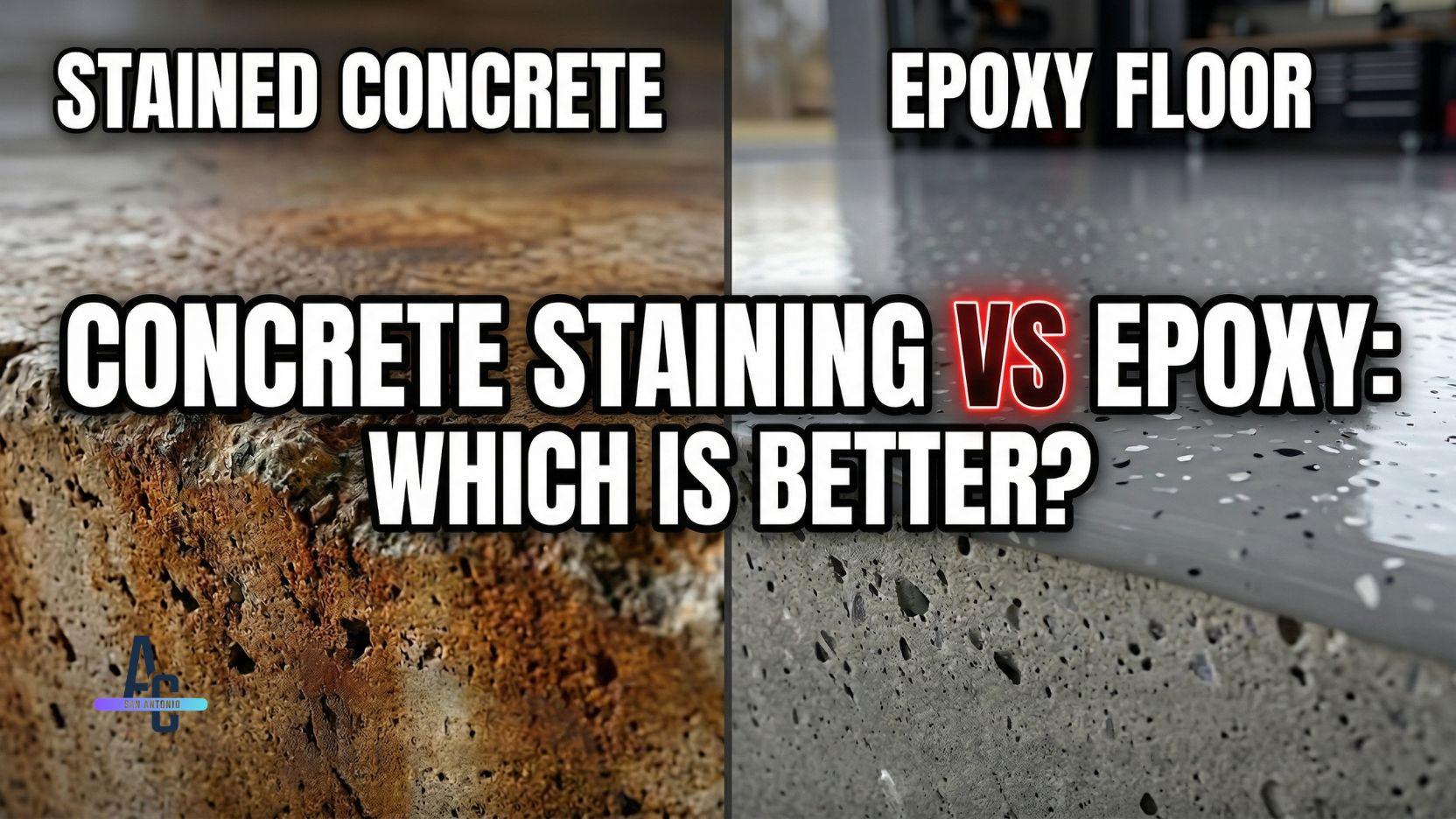
Epoxy vs stained concrete is one of the first questions San Antonio homeowners ask when a garage, patio, or interior slab needs a new look. Both finishes work well, but on different surfaces. This guide compares concrete stain vs epoxy on cost, looks, lifespan, sun and heat, upkeep, and prep, and explains when the two can be used together.
- What is the difference between epoxy and stained concrete?
- Is epoxy or stained concrete better for most San Antonio homes?
- How much does concrete stain vs epoxy cost in San Antonio?
- Which is better for a garage floor: stain vs epoxy?
- Which holds up better outdoors in San Antonio sun and heat?
- Which is better for interior floors and basements?
- Which lasts longer, stained concrete or epoxy?
- Can you use concrete stain and epoxy together?
- What prep does each finish need, and when should I call a pro?
- Where do we work?
- What else are homeowners asking?
Stained concrete is usually better outdoors and in living spaces, and epoxy is usually better on garage and shop floors. Staining typically runs about $2 to $6 per square foot installed in San Antonio. Our strong sun is hard on standard epoxy outside, so call a pro when the slab has cracks, moisture, or an old coating.
What is the difference between epoxy and stained concrete?
Concrete stain soaks into the slab and colors the concrete itself, while epoxy is a resin coating that bonds on top of the slab as a hard layer. That one difference drives almost every other comparison between stained concrete vs epoxy.
| Stained concrete | Epoxy coating | |
|---|---|---|
| How it works | Penetrates or reacts with the concrete | Coating that bonds to the surface |
| Look | Translucent, mottled, stone-like, every slab different | Uniform color, flake, or metallic, gloss or satin |
| Best for | Patios, pool decks, walkways, interior living areas | Garages, workshops, utility rooms, commercial floors |
| Outdoors in direct sun | Good fit | Standard epoxy not recommended |
| Peeling risk | The stain cannot peel; only the sealer wears | Can chip or lift if prep or moisture is wrong |
| Upkeep | Reseal on a schedule | Recoat when worn |
Is epoxy or stained concrete better for most San Antonio homes?
For most San Antonio homes, stained concrete is the better choice for patios, entries, and indoor living spaces, and epoxy is the better choice for a garage or workshop that sees oil, chemicals, and hot tires. Neither is better everywhere, so choose by the space.
- Choose stain if: the slab is outdoors or in a living area, you want a natural or stone-like look, and you would rather reseal than recoat.
- Choose epoxy if: the floor is indoors or covered, you park, work on cars, or store chemicals there, and you want a solid, easy-to-wipe surface.
- Get the slab checked first if: it has wide cracks, damp spots, or an old sealer, paint, or coating. Those change which finish will hold.
How much does concrete stain vs epoxy cost in San Antonio?
Concrete staining typically runs about $2 to $6 per square foot installed in San Antonio, and epoxy runs about $3 to $12 per square foot depending on the system. A standard flake epoxy garage floor sits around $3 to $7 per square foot, so on plain floors the two often overlap.
| Finish | Typical installed cost | Notes |
|---|---|---|
| Water-based stain with sealer | About $2 – $5 / sq. ft. | Widest color range, consistent results |
| Acid stain with sealer | About $3 – $6 / sq. ft. | Variegated, stone-like look |
| Stained garage floor | About $3 – $8 / sq. ft. | Garages often need degreasing and crack repair first |
| Standard flake epoxy | About $3 – $7 / sq. ft. | The most common garage floor system |
| Metallic or decorative epoxy | About $5 – $12 / sq. ft. | Multi-layer systems with custom effects |
| Two-car garage, flake epoxy with polyurea topcoat | About $1,200 – $3,500 | Roughly 400 – 500 sq. ft. |
| Clear epoxy or polyurethane topcoat over stain | About $1 – $2 / sq. ft. | Added protection for high-traffic floors |
Typical estimate ranges as of October 2026, in line with our concrete staining vs epoxy pros and cons, concrete staining cost, and stained garage floors guides. They are not a quote; your price is set in writing after a free site visit.
What most San Antonio homeowners can expect
Which is better for a garage floor: stain vs epoxy?
For a working garage, epoxy is usually the better concrete floor finish because it resists oil, chemicals, and abrasion and wipes clean. For a parking-only garage where looks matter most, a stained and sealed floor is a good, lower-upkeep option.
- Epoxy wins on: oil and fluid spills, tool drops, and easy degreasing. Ask for a polyurea or other topcoat rated for hot tires.
- Stain wins on: a natural look and no peeling layer. The sealer on a stained garage floor typically needs renewing every 2 to 3 years.
- Either way: the garage must be empty for the job, and old oil stains, paint, or sealer have to come off first.
See our stained garage floors guide for colors and prep details.
Which holds up better outdoors in San Antonio sun and heat?
Stained concrete holds up better outdoors in San Antonio. Standard epoxy is not UV-stable, so we do not recommend it on uncovered patios, pool decks, or driveways here.
- Sun: Outdoor stain keeps its color because the color is in the concrete; the sealer on top is what wears and gets renewed.
- Moisture from below: Slabs on grade can push moisture up, and a surface coating that traps it can lift. Stain with a penetrating sealer does not form a thick film that can peel.
- Slip resistance: Ask for a non-slip additive in the sealer on pool decks and walkways, whichever finish you choose.
See our concrete staining page for outdoor stain and sealer work on patios, walkways, entries, and pool decks.
Which is better for interior floors and basements?
Stain is usually the better choice for interior living spaces and below-grade floors. Moisture coming up through a basement or slab-on-grade floor raises the risk of an epoxy coating lifting, so any floor should be moisture-tested before either finish goes on.
Stained interior floors are popular in older San Antonio homes where carpet or tile comes up and reveals a usable slab. Read more in our interior stained concrete floors guide.
Which lasts longer, stained concrete or epoxy?
Properly sealed stained concrete usually lasts longer as a finish, because the stain is permanent and only the sealer needs renewing. Epoxy typically needs a full recoat every 5 to 10 years in a residential garage, and sooner with heavy sun or chemical exposure.
| Stained concrete | Epoxy coating | |
|---|---|---|
| What wears | The sealer, not the color | The coating itself |
| Maintenance cycle | Reseal about every 2 – 3 years outdoors; often 3 – 5 years on protected interior floors | Recoat about every 5 – 10 years |
| With upkeep | Can look good for 15 – 20 years or more | Lasts as long as the bond and topcoat hold |
| Daily care | Sweep and damp mop with a pH-neutral cleaner | Sweep, mop, and clean spills quickly |
Can you use concrete stain and epoxy together?
Yes. A slab can be stained or dyed for color and then sealed with a clear epoxy or polyurethane topcoat, which typically adds about $1 to $2 per square foot. This concrete stain and epoxy combination is mainly used indoors, on garage and commercial floors.
- Why do it: You get the depth of stained color with a tougher, easier-to-clean surface on top.
- Where not to: Uncovered outdoor slabs, where a penetrating sealer is the better top layer for stain.
- Order matters: Stain first, neutralize and dry, then the clear coat. Epoxy cannot be stained after it is applied.
What prep does each finish need, and when should I call a pro?
Stain needs clean, bare, porous concrete, and epoxy needs a ground, dry surface that has passed a moisture test. Most failures of either finish come from skipped prep, not from the product.
- Water drop test: If water soaks into the slab, it will take stain. If it beads, an old sealer is still there and must come off.
- New concrete: Wait at least 28 days of cure before staining a new slab.
- Epoxy prep: The floor is ground, cracks are repaired, and moisture is tested before any coating goes down.
- A crack is wide, growing, or one side sits higher than the other
- The slab has damp spots, white powder, or a musty smell
- An old sealer, paint, or epoxy is peeling or still on the floor
- Oil has soaked deep into a garage slab
San Antonio’s expansive clay swells and shrinks with rain and drought and cracks many local slabs, and moisture coming up through a slab is the other common reason coatings fail. Call (713) 504-2341 for a free look, or see our concrete staining page.
Ready to compare options on your own slab? Request a free quote and we will tell you honestly which finish fits.
Not sure if your slab should be stained or coated?
Free site visit, a quick porosity and moisture check, and a written price before any prep starts. Licensed and insured crew.
Where do we work?
Affordable Concrete San Antonio works across San Antonio and nearby areas from our shop at 1247 W Thompson Pl, San Antonio, TX 78226.
We stain, seal, and refinish concrete in San Antonio and these nearby areas: Helotes, Leon Valley, Shavano Park, Terrell Hills, Alamo Heights, Converse, Universal City, Schertz, Boerne, Cibolo, Fair Oaks Ranch, Bulverde, Spring Branch, New Braunfels, Pleasanton, Floresville, Castroville, Lytle, and Von Ormy. Not sure about your address? Call (713) 504-2341.
What else are homeowners asking?
These are the short answers people want before they book a quote.
Is epoxy or stained concrete better?
Stained concrete is usually better for patios, pool decks, and interior living areas, and epoxy is usually better for garages and workshops that see oil, chemicals, and hot tires. The right choice depends on the space and the slab condition.
How much does concrete stain vs epoxy cost per square foot?
In San Antonio, concrete staining typically runs about $2 to $6 per square foot installed. Epoxy runs about $3 to $12 per square foot, with standard flake garage systems around $3 to $7.
Is stained concrete or epoxy better for a garage floor?
Epoxy is usually better for a working garage because it resists oil, chemicals, and abrasion. A stained and sealed floor is a good choice for a parking-only garage where a natural look matters more.
Can you put epoxy over stained concrete?
Yes. A slab can be stained for color and then sealed with a clear epoxy or polyurethane topcoat, which typically adds about $1 to $2 per square foot. It is mainly used indoors.
Can epoxy be used on an outdoor patio in San Antonio?
Standard epoxy is not UV-stable, so we do not recommend it for uncovered outdoor slabs in San Antonio. Stain with a penetrating sealer is the better choice for patios, walkways, and pool decks.
Which lasts longer, stain or epoxy?
Sealed stained concrete usually lasts longer because the color is permanent and only the sealer is renewed, about every 2 to 3 years outdoors. Epoxy typically needs a full recoat every 5 to 10 years.
Sources used in this article:
- Affordable Concrete San Antonio, concrete staining service page, affordableconcretesanantonio.com/concrete-staining-san-antonio/
- Affordable Concrete San Antonio, concrete staining vs epoxy flooring pros and cons, affordableconcretesanantonio.com/concrete-blogs/concrete-staining-vs-epoxy-flooring-pros-and-cons/
- Affordable Concrete San Antonio, concrete staining cost in San Antonio, affordableconcretesanantonio.com/concrete-blogs/how-much-does-concrete-staining-cost-in-san-antonio/
- Affordable Concrete San Antonio, stained garage floors guide, affordableconcretesanantonio.com/concrete-blogs/stained-garage-floors-benefits-costs-and-design-ideas/
This article is general information for San Antonio homeowners. Prices are typical estimates as of October 2026 and can change. It is not a quote and does not replace a site visit.
What should I read next?
Start with our concrete staining page, or keep reading if you are still comparing finishes and prices.