
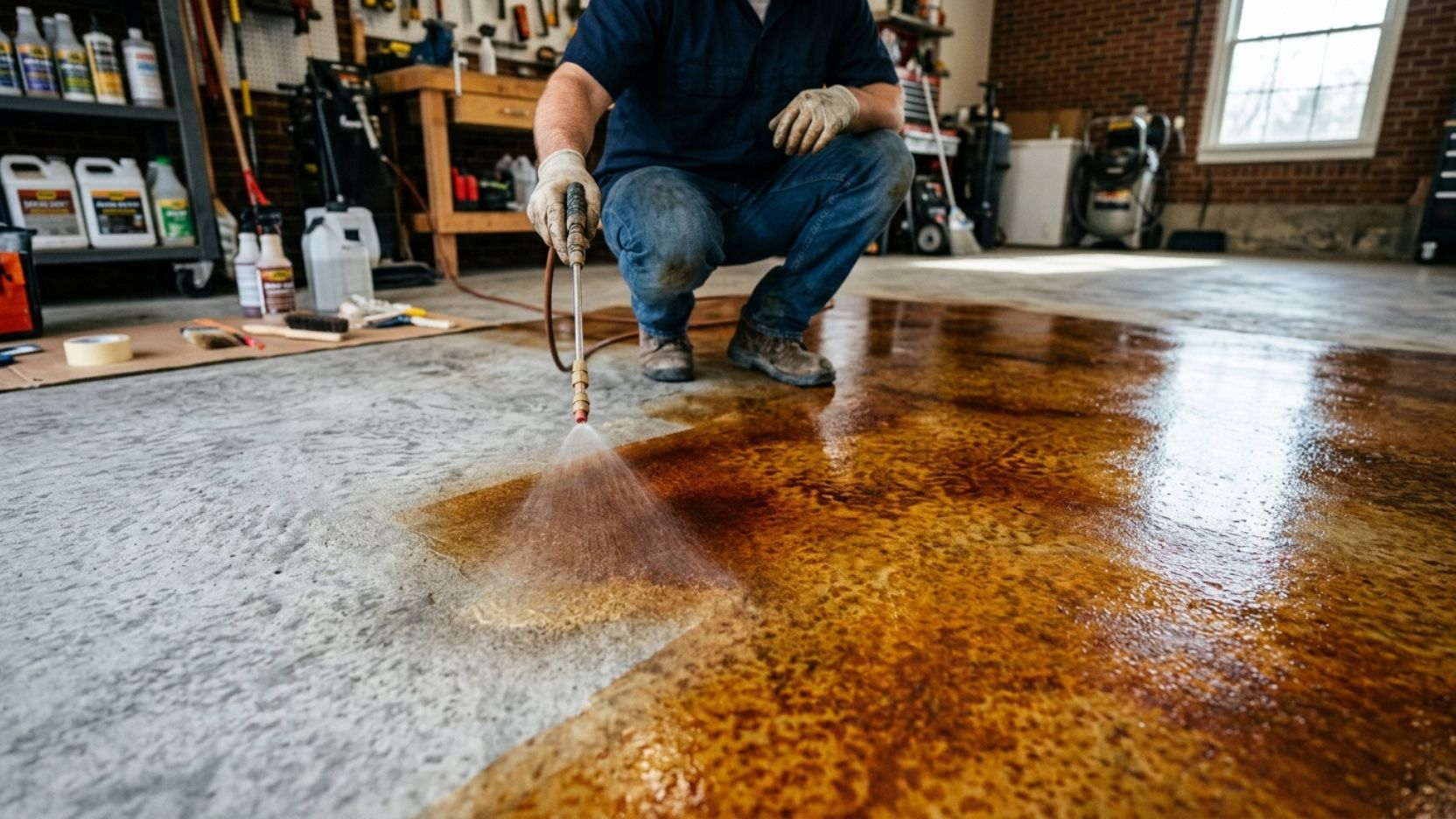
Concrete staining colors a slab from within, soaking into the surface instead of sitting on top like paint. This guide explains exactly what staining is, the two types used in San Antonio, how the chemistry works, and what the process looks like from prep to final seal.
Concrete staining is one of the most misunderstood finishes in the trade. Homeowners often picture it as a coat of colored paint rolled over a slab. It is the opposite. A stain does not form a film on top of the concrete. It sinks into the surface and becomes a permanent part of it, which is exactly why a properly stained floor or patio looks rich and natural and never peels the way painted concrete does.
This guide breaks down what concrete staining actually is, the difference between acid and water-based stains, the chemistry that gives each its color, and the full application process from surface prep to the final sealer. If you are weighing staining for a patio, garage floor, or pool deck, this is the foundation. For costs and a complete project walkthrough, see our complete concrete staining guide for San Antonio.
Paint and epoxy sit on the surface as a film. They can look great on day one, but they chip, peel, and show wear because they are a separate layer bonded to the top. A stain works differently. It penetrates the pores of the concrete and deposits color inside the material itself. There is no film to fail. Once you understand that single distinction, every other detail about staining, from why prep matters so much to why you still need a sealer, starts to make sense.
Definition
Concrete staining is a method of permanently coloring concrete by driving pigment or reactive minerals into the surface of the slab. Unlike paint, which dries into a film on top, a stain is absorbed by the porous concrete and becomes embedded in it. The result is color that lives inside the material rather than on top of it.
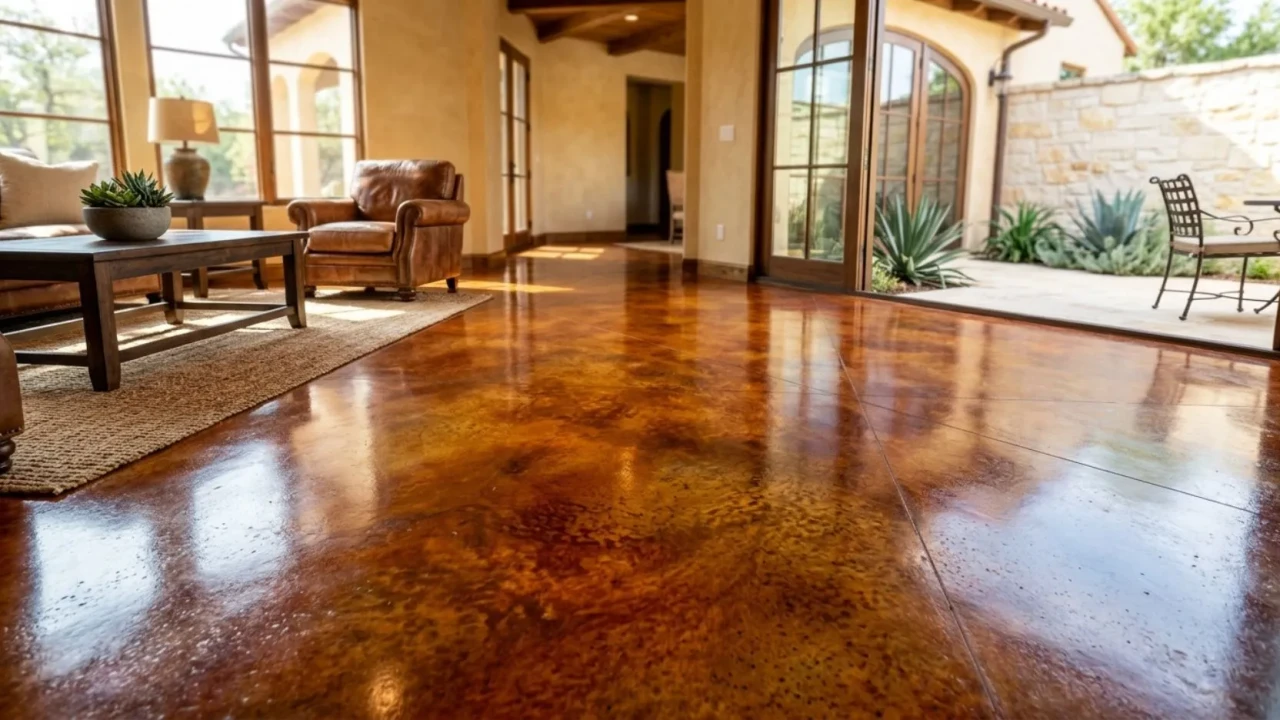
Because the color penetrates, a stained surface keeps the natural texture and variation of the concrete underneath. You can still see the subtle character of the slab, only now it carries a deep, translucent tone. This is why stained concrete reads as a high-end, stone-like finish rather than a flat painted look.
Staining works on both new and existing concrete and is used indoors and outdoors. Common applications in San Antonio include interior living floors, garage floors, patios, walkways, and pool decks.
- It is a penetrating color treatment that bonds into the surface of the slab
- It is not a paint, epoxy, or coating that forms a separate film on top
- It keeps the natural texture and slight variation of the concrete visible
- It works on bare, porous concrete, both new pours and existing slabs
- It is a finish only, so it does not strengthen or repair the concrete itself
Stain Types
Almost every concrete stain falls into one of two families. They produce different looks, use different chemistry, and suit different projects. Knowing which is which is the single most useful thing a homeowner can learn before starting.
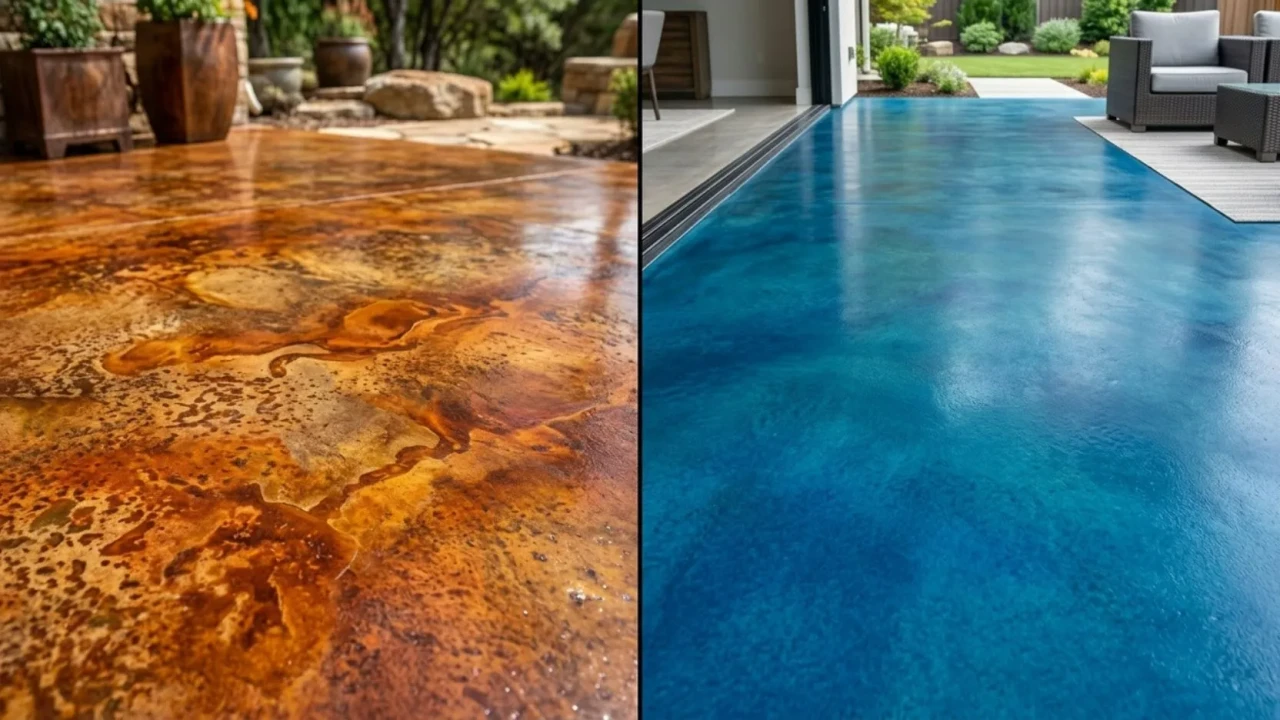
Acid stain (reactive): A blend of water, a mild acid, and metallic salts. It reacts chemically with the concrete to deposit color. Acid stains produce translucent, variegated, marbled earth tones, and no two slabs ever look exactly alike. The palette is limited to browns, tans, terracotta, amber, and soft blue-greens.
Water-based stain (non-reactive): Pigment carried in a water or solvent base. It does not react with the concrete. Instead it fills the pores and deposits color. Water-based stains offer a far wider palette, including blues, reds, blacks, and bright tones, with more consistent and predictable results.
The two are not mutually exclusive. Many decorative floors use an acid stain as a base for natural depth, then layer a water-based stain for accent color. For a full breakdown of which to choose, see our dedicated guide on acid stain versus water-based stain.
- Want a natural, stone-like, marbled look in earth tones: choose acid stain
- Want a specific or bold color, or need to match a target shade: choose water-based
- Need predictable, repeatable color across a large area: water-based is easier
- Want maximum depth and one-of-a-kind character: acid stain delivers it
- Confirm with your installer whether a sample patch will be done before full application
The Science
Understanding why a stain is permanent comes down to what happens at the surface of the slab. The two stain types get there by completely different routes.
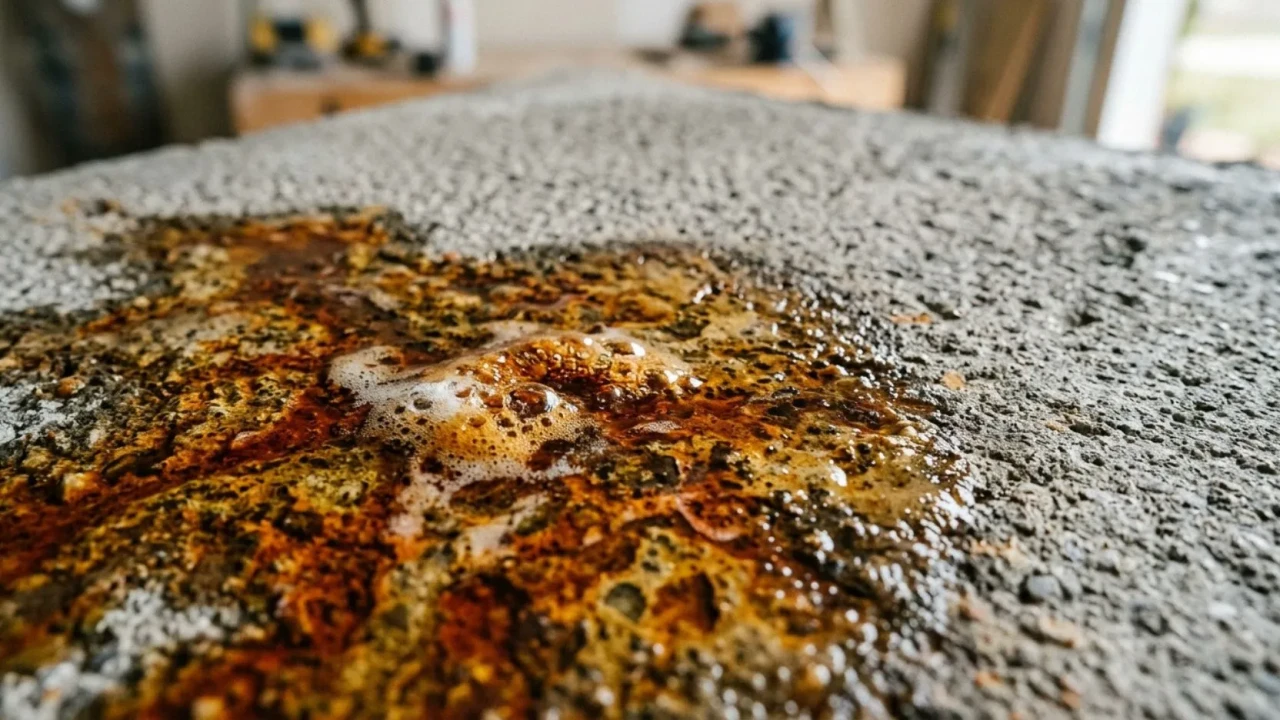
Acid stain reaction: Cured concrete contains free lime, also called calcium hydroxide. When an acid stain is applied, its mild acid opens the surface slightly and its metallic salts react with that lime. This reaction deposits new colored mineral compounds that are chemically locked into the concrete. The color is not sitting in the pores. It has become part of the surface chemistry, which is why it is essentially permanent.
Water-based penetration: A water-based stain skips the reaction entirely. Its fine pigment particles are carried into the open pores of the concrete by the water or solvent base. As the carrier evaporates, the pigment stays lodged in the surface. The color is held mechanically inside the pores rather than chemically bonded, but because it penetrates rather than coats, it still resists peeling.
Both reactions depend on an open, porous surface. If the concrete is sealed, coated, or has a smooth troweled-on layer of fine paste, the stain cannot get in. A reactive acid stain has no lime to reach, and a water-based stain has no open pores to fill. This is the single biggest reason staining jobs fail: the surface was never properly opened up. Thorough cleaning and, when needed, light grinding or etching are not optional steps.
- Acid stains react with lime in the concrete to form permanent colored minerals
- Water-based stains carry pigment into the pores, where it stays as the carrier dries
- Neither sits on top as a film, so neither peels the way paint does
- A porous, bare surface is required for either type to take hold
- Sealers, coatings, and dense troweled surfaces must be removed before staining
The Process
A professional staining job follows the same core sequence whether it is an interior floor or a backyard patio. The reactive acid stain process adds one step the water-based process does not, the neutralizing rinse, but everything else lines up.
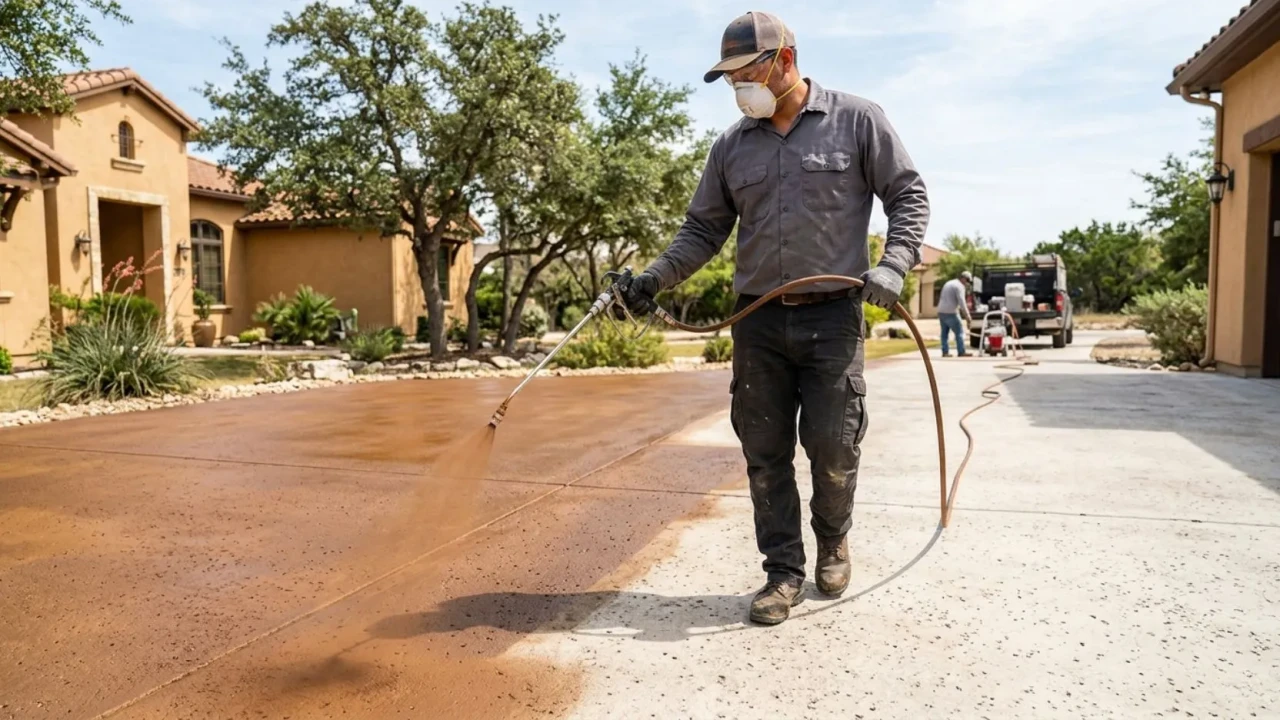
The order below is what a quality installer in San Antonio follows. Each step sets up the next, and skipping prep or sealing is where most do-it-yourself jobs go wrong.
The sealer is what wears, not the color. Because the stain itself is locked into the surface, the color does not fade from foot traffic. What wears over time is the protective sealer on top. Reapplying sealer on schedule, roughly every 2 to 3 years for outdoor surfaces in San Antonio, restores the protection and refreshes the depth of the color without restaining.
- Surface stripped, cleaned, and opened so it is bare and porous
- Test patch completed and color approved before the full application
- Stain applied evenly with the correct tool for the desired look
- Acid stain neutralized and rinsed to stop the reaction and clear residue
- Surface fully dry before sealing, with no trapped moisture
- Sealer applied, plus a floor finish for interior floors that see heavy use
Applications
Staining is versatile, but it has real requirements. The surface has to be sound, bare, and porous, and the project has to suit the local climate. Here is where it shines and what to watch for in San Antonio specifically.
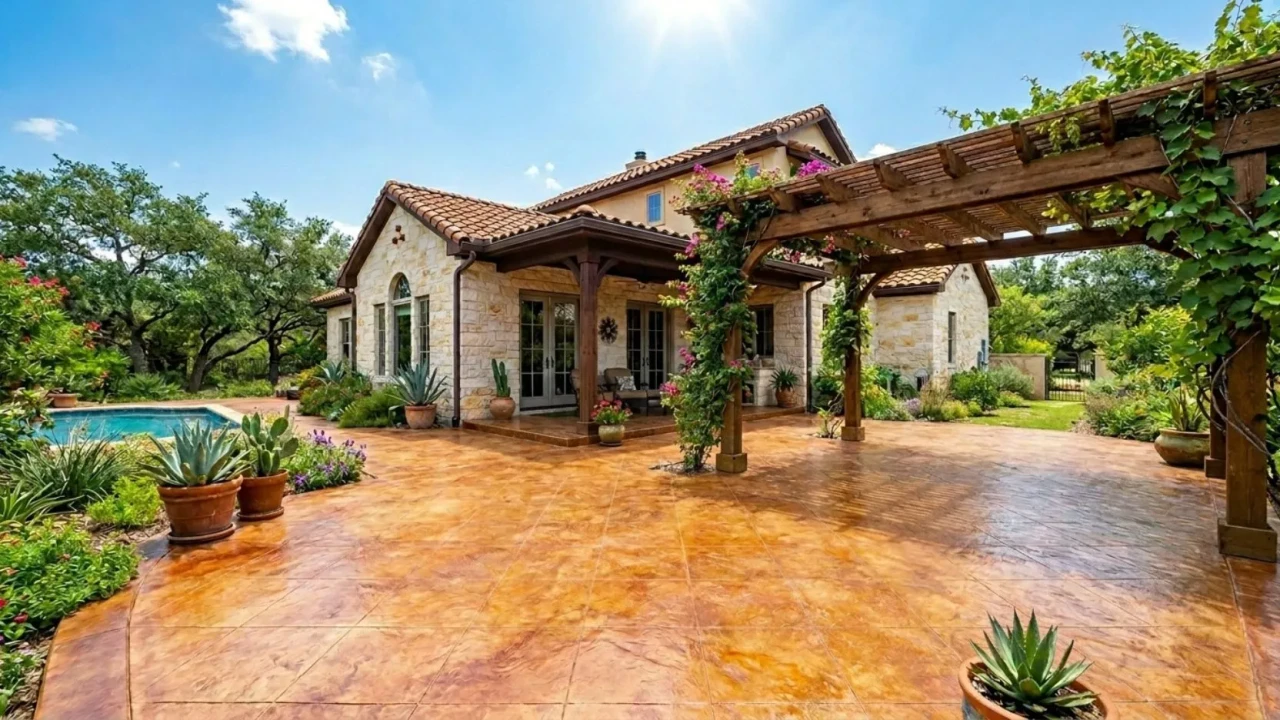
New concrete: Should cure fully, about 28 days, before acid staining so there is enough free lime for a reliable reaction and so trapped moisture does not interfere. Water-based stains can sometimes be applied sooner, but full cure is still the safe standard.
Existing concrete: Stains beautifully as long as it is structurally sound and can be stripped back to a bare, porous surface. Old sealers, paint, glue, and coatings must come off first, which usually means grinding.
- New concrete cured to roughly 28 days before acid staining
- Existing concrete is structurally sound with no active settling or heaving
- Surface can be stripped to bare, porous concrete free of sealers and coatings
- Any cracks or base problems repaired before staining, since stain is cosmetic only
- Exterior projects matched with a UV-stable sealer and slip resistance where needed
This table summarizes the practical differences between the two stain types so you can see at a glance which fits your project. For a deeper comparison, read our full guide on choosing between them.
| Feature | Acid / Reactive Stain | Water-Based / Acrylic Stain |
|---|---|---|
| How it colors | Chemically reacts with lime in the concrete | Pigment penetrates and lodges in the surface pores |
| Color range | Limited earth tones: browns, tans, terracotta, soft greens | Wide range including blues, reds, blacks, and brights |
| Look | Translucent, marbled, no two slabs alike | More uniform and predictable, can be more opaque |
| Predictability | Varies with the slab, hard to guarantee exact color | Consistent, easier to match a target shade |
| Neutralizing step | Required after the reaction | Not required |
| Best suited for | Natural, stone-like floors and patios | Bold colors, logos, consistent commercial color |
Is concrete staining the same as painting concrete?
Can you stain old or existing concrete?
How long does concrete staining last?
Can I get any color I want with concrete staining?
Does concrete staining work outdoors in San Antonio heat and sun?
Get a free concrete staining quote in San Antonio
Thinking about staining a floor, patio, or pool deck? Tell us about your slab and the look you want. We will assess the surface, recommend the right stain and sealer, and give you a detailed written quote at no cost.