
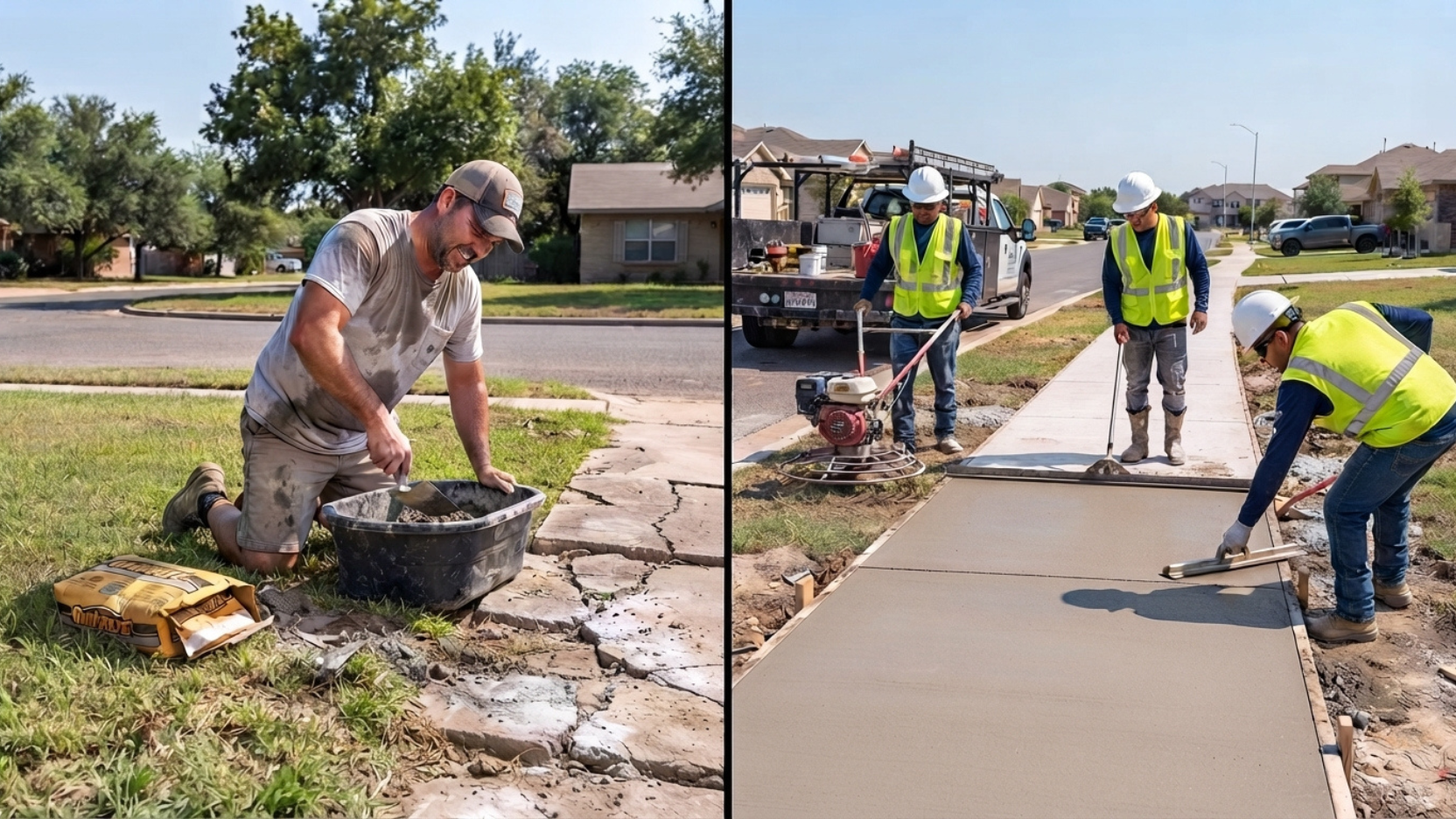
A cracked or uneven sidewalk in San Antonio is more than an eyesore. It is a liability risk, a code compliance issue, and in Bexar County’s expansive clay soils, a problem that worsens with every wet season. This guide tells you exactly when to grab the tools yourself and when to call a professional with real 2026 cost numbers for both paths.
Sidewalk repair in San Antonio is a decision point that catches a lot of homeowners off guard. The crack looks small. The patch kit at the hardware store looks affordable. The YouTube tutorial makes it look like a Saturday project. Then the repaired section fails within a year because the root cause was never addressed and now there are two problems where there used to be one.
This guide is built around one principle: repair decisions should match damage type, not optimism. Some sidewalk damage is genuinely DIY-friendly. Some of it requires professional equipment and licensed contractors regardless of how capable you are with tools. Knowing the difference before you buy the patch kit saves you time, money, and a second repair bill.
Most failed sidewalk patch jobs share the same root problem: the homeowner repaired the visible crack without fixing what caused it. In San Antonio’s Blackland Prairie Vertisol clay soils, the number one sidewalk failure driver is soil movement swelling after rain, shrinking in drought, and the repetitive stress of that seasonal cycle on a slab that was poured without adequate base preparation. If the soil beneath your sidewalk panel is unstable, applying surface filler does nothing but cover the crack for six to eighteen months before the movement opens it again. Diagnosis before repair is not optional.
Diagnosis First
Before any repair decision is made, the damage needs to be categorized correctly. San Antonio sidewalk damage falls into four primary types, and each type has a different repair path. Applying the wrong fix to the wrong problem is the single most common reason sidewalk repairs fail within a year of completion.

Walk the entire affected section in good light and assess each of these four categories before making any repair decision. The most important check is whether any panel section has vertical displacement one side sitting higher than the other. That single indicator changes the repair path from cosmetic to structural every time.
| Damage type | Visual sign | Likely cause in San Antonio | Repair path |
|---|---|---|---|
| Hairline cracks | Fine lines under 1/8″ wide, no displacement | Normal concrete shrinkage during cure, or minor thermal cycling | DIY with polyurethane or epoxy crack filler |
| Medium cracks | Visible gaps 1/8″ to 1/4″, generally flat | Soil movement from seasonal clay expansion, root pressure, or drainage issues | DIY if flat; professional if crack is growing or near joints |
| Wide cracks | Gaps over 1/4″ wide, may show edges | Base failure, ongoing soil movement, or inadequate original reinforcement | Professional assessment before any repair |
| Heaving / lifting | One panel raised above adjacent panel by any amount | Tree root pressure, clay swell, or differential base settlement | Professional only root removal, mudjacking, or replacement |
| Sunken panels | Panel lower than surrounding sections, water pooling | Base material wash-out, soil compaction failure, or void formation | Professional mudjacking or full panel replacement |
| Surface spalling | Flaking, pitting, or scaling of the top layer | UV degradation, deicing salt use (minimal in SA), or poor original mix | DIY resurfacing on structurally sound slab |
- Crack width measured use a coin or ruler, not visual estimate alone
- Both sides of each crack checked for vertical displacement (heaving)
- Panel checked for water pooling or drainage toward the house foundation
- Tree roots within 10 feet of the damaged section identified
- Cracks assessed after a recent rain event, not only during dry conditions
- Full sidewalk section walked from property line to property line before scoping repair
DIY Guide
Hairline and medium cracks on flat, structurally stable sidewalk panels are genuinely within the reach of a careful homeowner with the right products and a half day of time. The emphasis is on structurally stable. If the panel has any heaving, sinking, or soil instability beneath it, DIY surface repair is a temporary cosmetic fix, not a real repair.

For cracks up to 1/4″ on a stable slab, a self-leveling polyurethane caulk or epoxy injection filler is the correct product choice. Vinyl concrete patching compound works for small chips and spalls. Avoid hydraulic cement for surface cracks it expands as it sets and can widen the crack further in San Antonio’s heat if applied too aggressively.
In San Antonio summer heat, timing your DIY pour is as critical as the product choice: Concrete patching products cure through a chemical reaction that requires moisture. In Bexar County’s summer temperatures regularly above 95 degrees by mid-morning the patch surface dries out before the reaction completes. Schedule DIY concrete work for early morning starts (before 9 a.m.) in summer months, mist the existing crack with water before applying filler, and shade the repaired section for at least 24 hours after application. Fall through spring repairs are significantly easier to cure correctly.
- Crack confirmed as stable no vertical displacement, no heaving, no evidence of root pressure
- Crack width measured: under 1/4″ for DIY polyurethane; 1/8″ to 1/4″ for epoxy injection
- Existing crack fully cleaned with wire brush and compressed air or shop vac before any filler is applied
- Crack edges slightly widened (V-shaped) to provide a mechanical key for the filler to grip
- Backer rod inserted for cracks deeper than 1/2″ to prevent filler from falling through
- Weather check: no rain forecast for 24 to 48 hours after application; temperature between 50 and 90 degrees
- Repair shaded and misted for first 24 hours in summer conditions
Professional Only
There is a category of sidewalk damage where DIY repair is not just unlikely to work it actively creates problems. Covering a heaved panel with filler without addressing the root cause does not make the root go away. Patching over a sunken section without mudjacking the void underneath does not restore structural support. And applying a surface overlay on a slab with base failure just means the overlay cracks too, and now you have a failed repair on top of a failing slab.

Professional repair is the correct path in five specific scenarios. Each requires either specialized equipment (mudjacking pumps, slab saws, lifting rigs), licensed concrete work that triggers City of San Antonio permitting requirements, or structural assessments that require professional experience to read correctly. None of these scenarios is safely within DIY territory regardless of skill level.
| Scenario | Why DIY fails here | Professional solution | 2026 cost range (San Antonio) |
|---|---|---|---|
| Heaved panel (tree root) | Surface patch does not remove root; heaving continues and reopens repair | Root removal, panel grinding or replacement, base reset | $400 to $900 per panel depending on access |
| Sunken panel (void or base failure) | Surface filler has no support underneath; cracks immediately under foot traffic | Mudjacking (slab lifting) or panel removal and base reset | $200 to $600 mudjacking; $600 to $1,200 replacement |
| Cracks over 1/4″ with displacement | Indicates structural failure filler provides zero structural capacity | Full panel saw-cut and replacement with proper base | $600 to $1,500 per panel including base work |
| Public right-of-way sidewalk | City of San Antonio permits required; unlicensed work creates liability | Licensed contractor with City ROW permit and inspection | $15 to $25 per square foot installed |
| ADA trip hazard (over 1/2″ vertical) | Property owner liability for trip and fall accidents on defective walkway | Panel grinding, leveling, or replacement to ADA tolerance | $300 to $800 depending on method |
- Any panel with vertical displacement one side higher than the other by any measurable amount
- Any sunken panel with water pooling or visible void space around the edges
- Any crack wider than 1/4″ especially with displacement or ongoing growth
- Any sidewalk adjacent to a public street or in a City of San Antonio right-of-way
- Any trip hazard with a vertical difference over 1/2 inch at a joint or crack
- Any damage within 10 feet of a large tree where root pressure is the likely cause
Cost Guide
The DIY cost advantage is real for the repairs where it applies. For hairline and medium crack filling on a stable slab, a homeowner spending $30 to $80 in materials and a half day of labor gets the same surface result as a professional charging $200 to $400 for the same linear footage. The math strongly favors DIY in that specific scenario.
The math flips entirely once structural issues are involved. A homeowner who spends $60 on a patch kit for a heaved panel, applies it correctly, and watches it reopen six months later has spent $60 to delay the professional repair that was always necessary. When the professional finally comes, nothing has changed except the homeowner’s patience and $60.

The true cost of a professional sidewalk repair in San Antonio in 2026 factors in more than the material and labor. It includes the value of work done correctly the first time, which in concrete terms means a repair that holds for 10 to 20 years rather than a patch that holds for 1 to 3. For structural issues, the cost of delayed professional repair is almost always greater than the cost of prompt professional repair.
When you get professional quotes in San Antonio, ask for panel-by-panel itemization: A lump sum quote for “sidewalk repair” tells you very little about what is actually being done. Ask the contractor to specify each panel: grinding vs. replacement, whether the base is being reset, and whether root removal is included in panels adjacent to trees. The difference between a $600 quote that grinds raised panel edges and a $600 quote that replaces the panel with a proper compacted base is enormous in terms of how long the repair lasts.
- Damage type confirmed before choosing DIY or professional path structural issues remove DIY from consideration
- DIY material cost estimated including tools, prep supplies, and weather protection materials
- Minimum three professional quotes obtained for any professional repair
- Each professional quote reviewed for panel-by-panel scope detail no lump sum accepted
- Base preparation cost confirmed as included in each professional quote
- Warranty or guarantee terms noted for each professional bidder
Permits & Safety
Sidewalk repair in San Antonio involves two distinct categories that have very different regulatory requirements. Private sidewalks entirely within your property backyard paths, side entry walks, interior courtyard walkways are generally not subject to City permitting for standard repair work. Public-adjacent sidewalks, meaning any walk that borders a public street or sits within the City of San Antonio right-of-way, are a different matter entirely.

The City of San Antonio Development Services Department requires a Right-of-Way Construction Permit for any concrete work within the public right-of-way, including sidewalk repair and replacement adjacent to public streets. This permit requires a licensed contractor in most cases DIY work within the ROW is not permitted. Texas 811 utility locate must be called at least 48 hours before any excavation, including for sidewalk base work.
Many San Antonio homeowners are surprised to learn that the City may hold them financially responsible for maintaining the public sidewalk adjacent to their property, even though the homeowner does not own that strip of land. Under certain conditions, San Antonio can send notice requiring homeowners to repair adjacent damaged sidewalk sections at the homeowner’s expense. If you have received such a notice, the repair must be completed by a licensed contractor with a City permit. DIY repair on a noticed violation does not satisfy the City’s requirements and does not limit liability.
ADA compliance is a non-negotiable requirement on all public-adjacent sidewalk repairs in San Antonio. Replacement panels must meet ADA cross-slope tolerances (no more than 2 percent cross slope), running slope requirements, and surface texture standards. Any contractor quoting ROW sidewalk work who does not mention ADA compliance as part of their scope should be questioned about it directly before signing any agreement.
- Sidewalk location confirmed: private property vs. public right-of-way (determines permit need)
- City of San Antonio ROW Construction Permit obtained if any work is in the public right-of-way
- Texas 811 called at least 48 hours before any excavation or base work begins
- Licensed concrete contractor confirmed for all public ROW sidewalk work
- ADA compliance confirmed as part of any public sidewalk replacement scope
- HOA guidelines reviewed if applicable before any visible concrete repair or resurfacing
- City of San Antonio notice documentation preserved if repair is in response to a city deficiency notice
Contractor Vetting
Sidewalk repair is not a high-complexity concrete job, which means it attracts a wide range of contractors from highly experienced crews who do this work daily to storm chasers and general handymen who bid on anything after a heavy rain. The difference matters because a sidewalk repair done without base assessment, proper compaction, or ADA compliance will fail on the same timeline as the original damage.

The most important single document in contractor vetting is the certificate of insurance with at least $1 million in general liability coverage. The second most important is a written quote that itemizes every scope element separately not a lump sum. Any contractor who cannot produce both documents on request within 24 hours of your inquiry is not a contractor worth hiring for work on your property.
| What to check | What a quality contractor provides | Red flag response |
|---|---|---|
| Insurance documentation | Certificate of insurance with $1M+ general liability emailed within 24 hours of request | “We are covered” with no documentation provided; policy under $1M coverage |
| Scope detail in quote | Each damaged panel identified, repair method specified (grinding vs. replacement), base work included | Quote says “sidewalk repair” with a total price and no further detail |
| Base assessment | Contractor probes or inspects the base under damaged panels before quoting replacement | Panel is quoted for replacement without checking what is under it |
| Root cause identification | Tree roots identified and removal or barrier method specified for heaved panels | Heaved panel quoted for replacement with no mention of the root that caused it |
| Payment terms | 30 to 50 percent deposit, balance due on completion and homeowner inspection | Full payment required before work begins |
| Local references | Photos of completed San Antonio sidewalk projects; references from recent local jobs available | Stock photos only; cannot provide Bexar County references |
- Certificate of insurance received and reviewed before signing any agreement
- Written quote itemizes each panel with repair method, materials, and base work scope
- At least three quotes obtained and compared on scope detail, not just total price
- Root cause addressed in any quote involving heaved or sunken panels
- Payment terms confirmed: deposit at start, balance on completion not full payment upfront
- Local San Antonio reference projects requested and reviewed
- City of San Antonio ROW permit confirmed as contractor responsibility for public sidewalk work
Use this table to make the repair decision for any sidewalk damage you encounter in Bexar County. When in doubt between DIY and professional, err toward professional the cost of a professional assessment is almost always less than the cost of a failed DIY repair plus the professional repair you will eventually need anyway.
| Damage type | Displacement present | Location | Correct repair path | 2026 cost estimate |
|---|---|---|---|---|
| Hairline cracks (under 1/8″) | No | Private property | DIY polyurethane sealant | $15 to $35 materials |
| Medium cracks (1/8″ to 1/4″) | No | Private property | DIY epoxy filler or sealant | $40 to $80 materials |
| Surface spalling on stable slab | No | Private property | DIY concrete resurfacer | $50 to $120 materials |
| Medium cracks (1/8″ to 1/4″) | No | Public ROW | Professional City permit required | $200 to $500 per section |
| Wide cracks (over 1/4″) | Any | Either | Professional structural assessment first | $400 to $1,500 per panel |
| Heaved panel tree root | Yes | Either | Professional root removal plus repair | $400 to $900 per panel |
| Sunken panel void or base failure | Yes (panel low) | Either | Professional mudjacking or replacement | $200 to $1,200 per panel |
| Trip hazard over 1/2″ vertical | Yes | Either | Professional liability and ADA issue | $300 to $800 per location |
| Full panel replacement needed | Any | Either | Professional saw-cut and reset | $600 to $1,500 per panel |
- Crack width measured accurately using a ruler, not estimated by eye
- Both panel edges at every crack checked for vertical displacement
- Panel surface checked for water pooling or tilt toward house foundation
- Tree roots within 10 feet of damage identified as potential cause
- Damage assessed after a recent rain event to see full extent of movement
- Damage type matched to the decision table above before any purchase or call is made
- Any vertical displacement confirmed as triggering professional repair path automatically
- Location confirmed: private property or public right-of-way
- Root cause addressed in repair scope, not just the visible surface damage
- Product selected matches damage type: polyurethane for hairline, epoxy for medium cracks, resurfacer for spalling
- Repair scheduled for fall through spring or early morning start in summer
- Existing crack cleaned and prepped before any filler is applied
- Backer rod inserted for cracks deeper than 1/2 inch
- Cured section shaded and misted for first 24 hours post-application in warm weather
- Texas 811 utility locate called at least 48 hours before any excavation
- City of San Antonio ROW permit confirmed for all public sidewalk work
- Certificate of insurance with $1M+ general liability received from each contractor
- Written itemized quote received per panel or section no lump sum accepted
- Root cause addressed in scope for all heaved or sunken panels
- Payment terms confirmed: deposit upfront, balance on completion
- ADA compliance confirmed as part of scope for all public sidewalk replacement work
Can I repair my sidewalk myself in San Antonio?
How much does sidewalk repair cost in San Antonio?
Who is responsible for sidewalk repair in San Antonio?
Why does my sidewalk keep cracking in San Antonio?
Is a raised sidewalk panel a safety hazard?
What is mudjacking and when does San Antonio sidewalk repair need it?
Get a free sidewalk repair quote in San Antonio
Tell us about your sidewalk damage we will visit your property, assess the damage and root cause, and give you a fully itemized written quote at no cost. Licensed, insured, and local to Bexar County.