
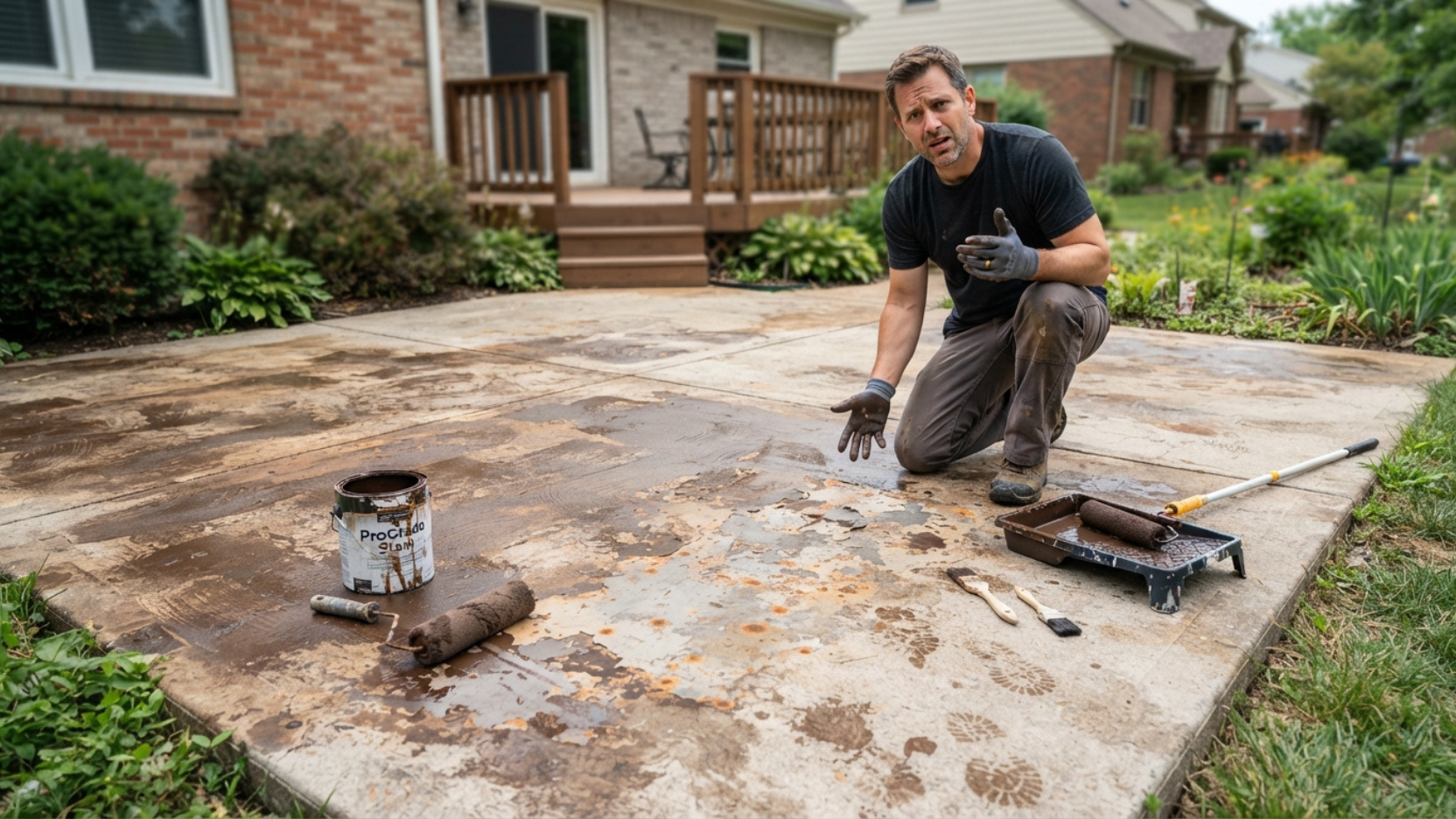
Concrete staining is one of the best investments you can make for a San Antonio patio, driveway, or interior floor but only when it is done right. These are the ten most common mistakes our crews see, and exactly how to avoid each one before work begins.
Concrete staining transforms a plain gray slab into a surface with real character rich earth tones, layered color variations, and a look that holds up to decades of Texas heat when the job is executed correctly. The problem is that staining is one of the most prep-dependent processes in residential concrete work. Skip a step, rush a drying time, or choose the wrong product for your surface, and you end up with blotchy coverage, peeling sealer, or a color that fades in the first summer.
This guide covers the ten mistakes our crews see most often on both DIY jobs and work done by less experienced contractors in San Antonio. Whether you are planning to stain a backyard patio, a covered interior floor, or an existing driveway, knowing these pitfalls in advance is the difference between a result you are proud of and one you have to redo.
The most expensive stain on the market will look blotchy and uneven on a poorly prepped surface. The most affordable acid stain will look stunning on a surface that has been properly cleaned, etched, and dried. In San Antonio’s climate with Blackland Prairie clay soil creating moisture transfer issues and Edwards Aquifer hard water leaving mineral deposits surface preparation is not an optional first step. It is the entire job. Every mistake on this list is either directly a preparation failure or a downstream consequence of rushing through prep.
Surface Prep
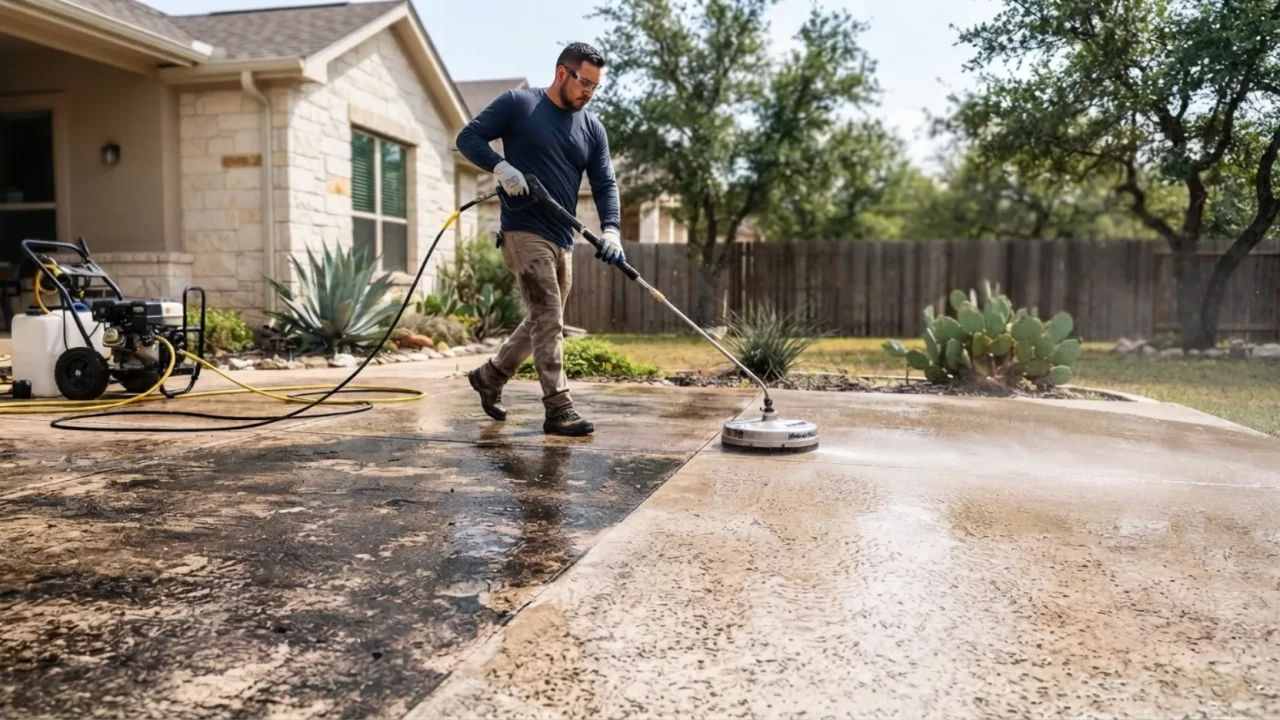
Concrete is porous. Anything sitting in those pores oil, grease, curing compound residue, paint overspray, or even mineral deposits from San Antonio’s hard tap water will block the stain from penetrating evenly. The result is a patchy surface where some areas take the color and others repel it completely.
Proper surface cleaning means degreasing with an alkaline cleaner, rinsing thoroughly, and then acid-etching the surface with a diluted muriatic acid or phosphoric acid solution to open the pores and create a uniform profile for the stain to bond to. In San Antonio, hard water from the Edwards Aquifer leaves calcium and mineral buildup on exterior slabs. These deposits must be addressed during the cleaning phase not after the stain is already applied. Once you see white blotches under a fresh coat of stain, the only fix is to strip and start over.
- Applying stain over an uncleaned or ungraded surface blotchy results are not fixable without stripping
- Skipping acid etching and relying on pressure washing alone pressure washing cleans but does not open pores
- Staining over a surface that still has curing compound from the original pour most curing compounds seal the surface and block stain penetration
Timing
Fresh concrete continues to off-gas moisture and undergo chemical changes for 28 days after the pour. Staining before that cure window closes traps moisture beneath the stain, which causes bubbling, peeling, and color inconsistency that shows up within a few weeks of application. In San Antonio’s summer heat, slabs look and feel dry within 48 hours which fools a lot of homeowners and less experienced crews into thinking the surface is ready.
The 28-day rule is not a suggestion it is a chemistry requirement. The hydration reaction that gives concrete its compressive strength needs that full month to reach completion. A slab stained at 10 days still has active internal moisture movement, and that moisture will push through any stain or sealer you apply on top of it.
If you are working with an existing slab (not a new pour), the curing concern does not apply, but you still need to assess moisture content before staining. A plastic sheet taped to the slab for 24 hours is a simple field test if condensation forms under the sheet, the slab is still releasing enough moisture to affect stain adhesion.
Simple moisture test before staining any slab: Tape a 12-inch square of clear plastic sheeting flat to the concrete surface and leave it for 24 hours. If moisture droplets appear on the underside of the plastic, the slab is not dry enough for staining. Wait another 3 to 5 days and repeat the test before proceeding. This works for both new pours and existing slabs that may have seasonal moisture issues from San Antonio’s clay soil.
- Staining or sealing new concrete before the 28-day cure period is complete
- Relying on surface dryness as the only indicator a slab can look dry and still be off-gassing internally
- Staining after rain events without waiting for the slab to fully dry out wet concrete resists stain penetration
Product Selection
Homeowners and contractors who are new to decorative concrete often treat acid stains and water-based concrete stains as equivalent options. They are not. Acid stains work through a chemical reaction with the calcium hydroxide in concrete which means the color result depends heavily on the specific concrete mix, its age, and its surface condition. Water-based stains are pigment-based and more predictable in color output, but they sit on the surface rather than penetrating it, making them more vulnerable to wear.
In San Antonio’s intense UV environment, the choice of stain type also matters for longevity. Acid stains that have been properly sealed hold their color well under direct Texas sun. Water-based stains that are not UV-stabilized can fade noticeably within a single summer on south-facing or unshaded slabs. Always confirm UV stability with your product supplier before applying any stain to an exterior surface in Bexar County.
- Choosing a stain type based on color charts alone always request a sample application on your specific slab
- Using water-based stains on high-traffic exterior surfaces without confirming UV and abrasion resistance ratings
- Mixing stain brands or product lines incompatible chemistries can cause adhesion failures when sealer is applied
Surface Prep
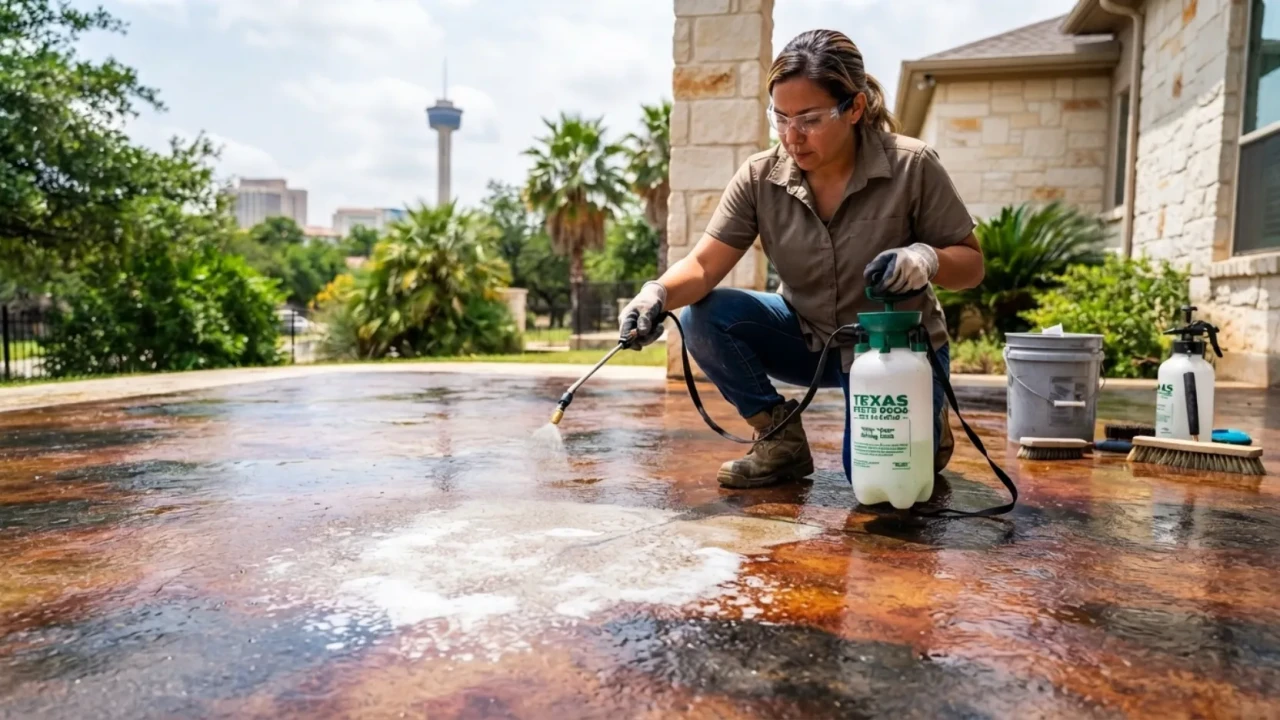
Acid staining creates metallic salts as a byproduct of its reaction with the concrete surface. If those residues are not fully neutralized and removed before sealer is applied, the ongoing chemical activity will continue beneath the sealer film, causing it to bubble, peel, and delaminate within months of application.
Proper neutralization uses a baking soda and water solution (approximately one cup of baking soda per gallon of water) scrubbed across the entire stained surface until the fizzing reaction stops completely. The surface must then be rinsed thoroughly and allowed to dry for a full 24 hours in San Antonio’s summer conditions before sealer touches it. Rushing the rinse or drying step is one of the most common causes of sealer failure on acid-stained patios.
- Sealing immediately after rinsing surface must be completely dry, minimum 24 hours post-neutralization in summer heat
- Skipping the neutralization step and only rinsing with water water alone does not stop the acid reaction
- Using a mop instead of a scrub brush for neutralization scrubbing is required to work the baking soda solution into all pores
Climate Timing
San Antonio concrete slabs can reach surface temperatures of 140 to 160 degrees Fahrenheit on a summer afternoon. Sealer applied to a slab at those temperatures dries too fast solvent-based sealers flash off before they can penetrate, and water-based sealers form a skin on the surface before the lower layers have properly bonded. The result is a cloudy, blotchy, or bubbled finish that has to be stripped and reapplied.

The correct window for sealer application in San Antonio is early morning ideally before 9 a.m. in summer months when the slab surface temperature is below 90 degrees Fahrenheit. Shaded surfaces can be sealed slightly later, but any direct-sun exposure during or immediately after application will compromise adhesion.
The same rule applies to fall and spring weather in San Antonio. While cooler months reduce the temperature concern, sealer should never be applied when rain is forecast within 24 hours or when the overnight temperature drops below 50 degrees. Both conditions affect curing and can leave a tacky or cloudy surface that attracts dirt and requires recoating.
- Sealing between 10 a.m. and 4 p.m. on any summer day in San Antonio slab surface temperatures will be too high
- Applying sealer before a forecasted rain event even light rain within 24 hours of application will cloud the finish
- Using a solvent-based sealer on a hot slab without testing the surface temperature first with an infrared thermometer
Application
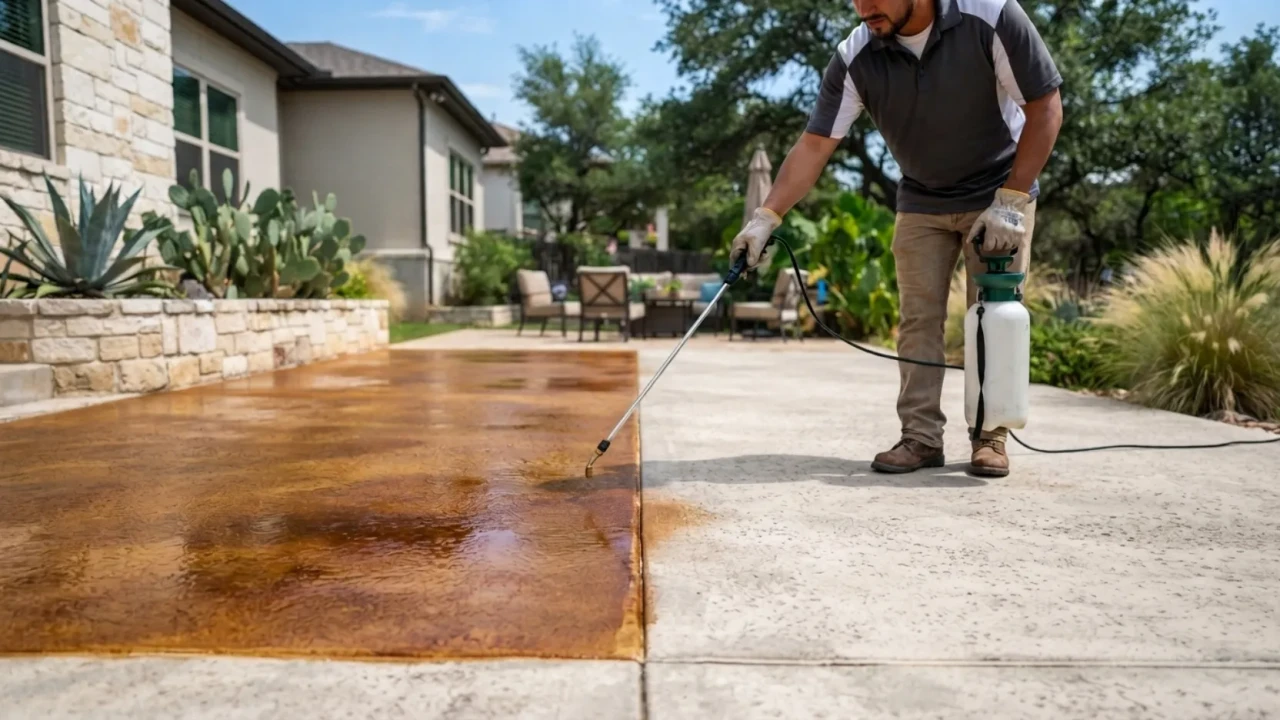
One of the most reliable ways to ruin a staining project is to apply too much product at once. Thick coats of acid stain pool in low spots and create uneven color intensity. Thick coats of sealer trap air and moisture, producing a milky or bubbled finish. The correct approach for both stain and sealer is two or three thin, even coats with full drying time between each pass.
Thin-coat application technique for San Antonio exteriors: Apply acid stain with a pump sprayer at a low-to-medium pressure setting using a circular, overlapping pattern to avoid streaks and lap marks. Move continuously stopping in one spot while the pump is running allows pooling that creates dark patches. For sealer, use a low-nap (3/16 to 1/4 inch) roller designed for smooth surfaces. Work in 4-foot sections, maintaining a wet edge to prevent lap marks. Two coats at the correct rate will outperform one coat at double the thickness every time.
In San Antonio’s heat, solvent-based sealers in particular need to be applied in thin passes because they flash off quickly. If you are using a lambswool applicator or a squeegee for sealer, you are applying too much product. Rollers and sprayers give you the thin, controlled coat that bonds correctly.
- Applying acid stain in heavy, saturating passes use a pump sprayer at low pressure for even distribution
- Applying sealer with a squeegee or lambswool applicator these tools deposit too much product at once
- Skipping the drying window between coats stacking wet coats traps moisture and causes sealer cloudiness
Color Control
Acid stain color is not predictable the way paint color is. The final tone depends on the mineral content and mix design of your specific concrete slab, how old the slab is, whether it has been sealed before, and how aggressively the surface was etched during prep. Two slabs treated with the same stain from the same batch can look noticeably different from each other.
The only reliable way to know what your slab will look like is to apply a test patch. Pick an inconspicuous area a corner of the patio, an area that will be covered by outdoor furniture and run the full process: clean, etch, stain, neutralize, and seal a small section before committing to the entire surface. In San Antonio’s older neighborhoods (Alamo Heights, Terrell Hills, Tobin Hill), existing slabs often have decades of mineral buildup and previous sealers that produce unexpected reactions with acid stains. The test patch is not optional it is your insurance against a full redo.
- Choosing a stain color based solely on manufacturer swatches or online photos without a test patch on your actual slab
- Expecting uniform, paint-like color from acid stain natural variation is inherent to the product
- Skipping the test on an existing slab that has been previously sealed old sealer dramatically changes how stain absorbs
Product Selection
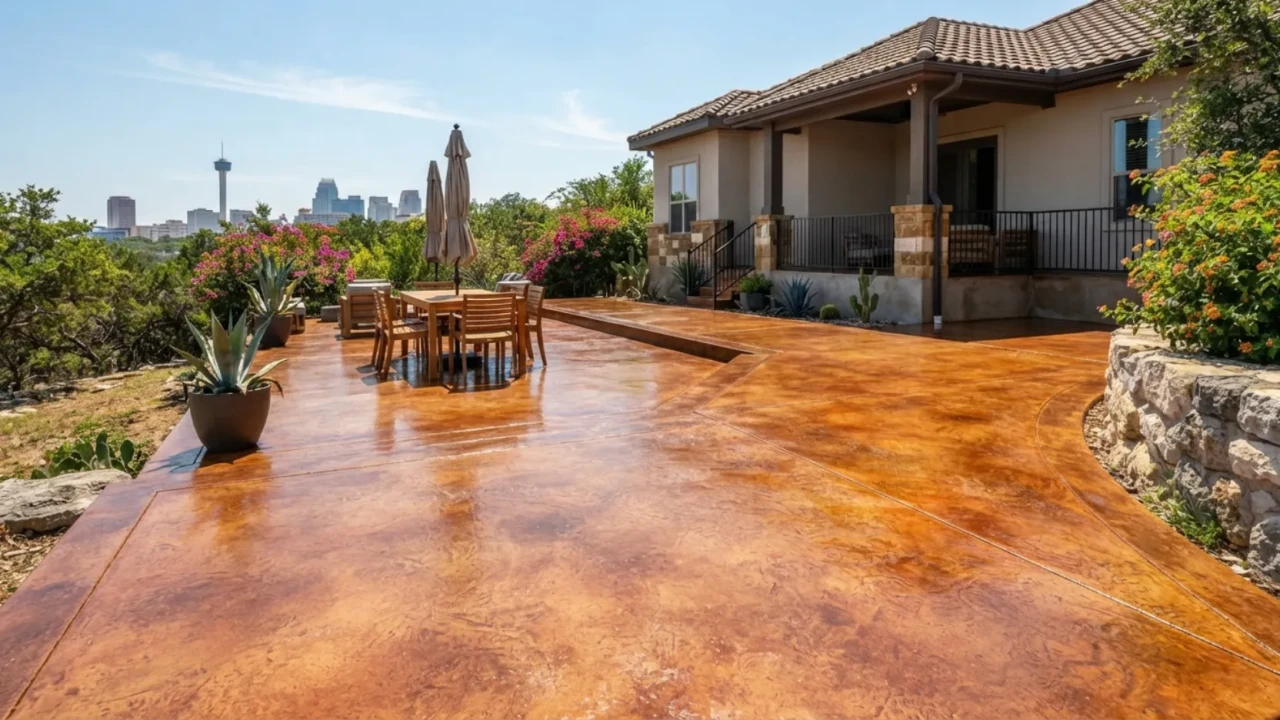
San Antonio receives over 220 days of sunshine per year, and UV radiation breaks down non-UV-stabilized sealers and stains faster than almost any other variable. Interior-grade concrete stains and sealers are formulated for controlled environments garages, warehouse floors, and indoor patios. When applied to an exterior surface in Bexar County, they begin to yellow, fade, or peel within one to two seasons.
Exterior-rated products contain UV inhibitors and are formulated for the thermal cycling that happens on Texas slabs surface temperatures swinging from 50 degrees on a January morning to 150 degrees on an August afternoon. Acrylic sealers designated for exterior use hold up to this range. Always check that both your stain and your sealer carry an exterior-use rating before purchasing. If only one of them is exterior-grade, the weaker product determines how long the job lasts.
- Using any stain or sealer on an exterior San Antonio surface without confirming it carries a UV-stable exterior-use rating
- Reusing leftover interior floor coating on an outdoor patio formulations are different and the exterior performance will be poor
- Choosing a glossy acrylic sealer for a high-sun pool deck high-gloss finishes become slippery when wet and show UV degradation faster than satin finishes
Maintenance
A stained concrete surface is only as durable as the sealer protecting it. The stain itself is embedded in the concrete and is effectively permanent but the sealer coat on top is the sacrificial layer that takes the UV exposure, foot traffic, and water penetration. When that sealer wears down, water and dirt begin to penetrate directly to the stained surface, and color degradation follows quickly.
| Surface type | Resealing interval (San Antonio) | Signs sealer is failing |
|---|---|---|
| Exterior stained patio | Every 2 to 3 years | Water no longer beads on surface; visible dullness or color fading |
| Interior stained floor | Every 3 to 5 years | Scuff marks visible; surface absorbs water instead of shedding it |
| Stained pool deck | Every 1 to 2 years | Sealer whitening (blushing) from constant moisture exposure |
| Stained driveway | Every 2 to 3 years | Oil stains absorbing into surface; tire marks that will not clean off |
| Covered/shaded patio | Every 3 to 4 years | Surface looks flat or chalky; color appears less saturated than when first sealed |
A simple water bead test confirms whether your sealer is still active. Pour a small amount of water on the surface. If it beads up and rolls off, the sealer is intact. If it absorbs immediately, you are past due for resealing. In San Antonio’s high-UV environment, scheduling a resealing check each October after the hardest months of summer UV exposure keeps stained surfaces protected through the next summer season.
- Assuming a staining job is a one-time installation with no further maintenance sealer is a consumable that wears over time
- Waiting until you see visible color fading before resealing by that point, the stain itself has absorbed UV damage
- Applying new sealer over a dirty surface always clean and lightly etch before resealing to ensure adhesion
Contractor Selection
A contractor who pours excellent driveways and builds solid slabs is not automatically qualified to do high-quality decorative staining work. Concrete staining is a craft that involves chemistry knowledge, color judgment, precision application technique, and experience reading how different slabs respond to different products. In San Antonio’s market, there are many contractors who add staining to their service list without the hands-on experience to do it consistently well.
Before hiring any contractor for concrete staining in Bexar County, ask for photos of completed staining projects on surfaces similar to yours. Ask which specific stain products and sealer brands they use, and why. A contractor who cannot answer product selection questions with specificity or who quotes a price without inspecting your slab in person is a risk. The prep process and the product choices change significantly between an interior floor, a covered patio, and a fully exposed driveway. Contractors who treat all three as identical jobs will not deliver consistent results across all three.
Three questions to qualify a concrete staining contractor in San Antonio: First, ask them to describe how they would handle the neutralization step after acid staining any qualified contractor should be able to describe the baking soda rinse process without hesitation. Second, ask what sealer they plan to use and whether it is rated for exterior UV exposure in Texas. Third, ask whether they will apply a test patch before committing to the full surface. A contractor who proposes skipping the test patch on an existing slab is taking a shortcut that is your risk, not theirs.
- Hiring based on general concrete experience alone decorative staining requires a specific, separate skill set
- Accepting a quote from a contractor who will not inspect the slab in person before pricing the job
- Choosing the lowest bid without asking how they handle surface prep, neutralization, and sealer selection
- Slab is at least 28 days old if it is a new pour no staining before full cure is reached
- Surface has been degreased with an alkaline cleaner and rinsed completely
- Acid etching has been applied and neutralized surface has a matte, open texture
- Plastic sheet moisture test completed no condensation under the sheet after 24 hours
- Curing compound residue has been confirmed absent curing compounds block stain penetration
- Stain type confirmed as appropriate for the surface: acid stain for interior and covered surfaces, UV-stable exterior stain for exposed areas
- Sealer confirmed as exterior-rated and UV-stabilized for any outdoor San Antonio surface
- Test patch applied in a low-visibility area and evaluated before full-surface application begins
- All products confirmed as compatible with each other mixing brands without checking compatibility causes adhesion failures
- Application scheduled for early morning slab surface temperature below 90 degrees Fahrenheit
- No rain in the forecast for at least 24 hours after application
- Overnight temperatures confirmed above 50 degrees Fahrenheit for the curing window
- Stain applied in thin, even passes using a pump sprayer no pooling or heavy saturation
- Acid stain residue fully neutralized with baking soda solution and rinsed thoroughly
- Surface allowed to dry minimum 24 hours after neutralization before sealer is applied
- Sealer applied in two thin coats with full drying time between passes
- Resealing schedule confirmed: every 2 to 3 years for exterior surfaces, every 3 to 5 years for interior
Can I stain my existing concrete patio myself, or do I need a contractor?
How do I fix blotchy or uneven concrete stain results?
How long does concrete staining last in San Antonio’s climate?
What is the best concrete stain color for San Antonio homes?
Does concrete staining increase home value in San Antonio?
Get a free concrete staining quote in San Antonio
Tell us about your surface — patio, driveway, pool deck, or interior floor. We will inspect the slab, assess the prep requirements, and give you a detailed written quote at no cost.