Timing your concrete driveway installation in San Antonio is one of the most overlooked decisions homeowners make. The wrong season can mean premature cracking, weak curing, and contractor delays. This guide covers every season, what San Antonio's climate actually does to fresh concrete, and how to schedule your project for the best outcome.
San Antonio is not a typical concrete market. Daytime highs exceed 100°F for weeks at a stretch from June through August. The Blackland Prairie Vertisol clay soil underneath most driveways in Bexar County expands and contracts dramatically with moisture changes. Flash Flood Alley storms can drop two inches of rain in 45 minutes. And Winter Storm Uri reminded everyone that hard freeze events are not impossible here, even if they are rare.
All of these factors directly affect when you should pour a concrete driveway, and what precautions a contractor must take if you are installing outside the optimal window. This guide covers every season so you can make an informed scheduling decision and ask the right questions before signing any contract.
Concrete does not "dry." It cures through a chemical reaction called hydration, where water reacts with cement particles to form the crystalline structure that gives concrete its strength. Heat accelerates this reaction but also drives off the water the reaction needs. Cold slows or halts it entirely. In San Antonio, the risk is almost always too much heat, not too little: this means curing management is the central issue in any summer installation, and fall through spring installations are more forgiving by default.
October through early December represents the single best window to install a concrete driveway in San Antonio. Daytime temperatures typically range from 65°F to 85°F, nighttime lows stay well above freezing, and the brutal summer humidity has broken. These are near-ideal conditions for concrete hydration: the chemical reaction proceeds at a controlled pace, water is not driven off prematurely by extreme heat, and there is no freeze risk to disrupt the fresh slab.

Why fall concrete cures better: In moderate temperatures, concrete retains the moisture needed for full hydration without requiring the aggressive wet-curing protocols demanded by summer heat. A fall pour in San Antonio is more forgiving of minor variations in mix water ratio, finishing time, and curing effort, which means a higher margin of quality even from a competent but less experienced crew.
Fall installations also come with a practical advantage: contractor schedules are more open after the summer rush. In the July and August peak, San Antonio concrete contractors are often booked three to four weeks out. By October, lead times shorten and you are more likely to get the crew and pour date you want without rushing a decision.
Book your fall installation by September: Experienced San Antonio concrete contractors start filling October and November slots before fall arrives. If you want October, call in late August or early September. Waiting until October itself often means pushing into November or December as the calendar fills with homeowners who had the same idea.
- Check the 10-day forecast before scheduling your pour date; avoid days with rain in the 24-hour window before or after the pour
- Confirm overnight lows are above 40°F for the three nights following the pour
- No accelerating admixtures needed in fall temperatures: standard mix is appropriate
- Wet-curing still recommended for 3 days minimum, even in mild temperatures
- Book contractor in August or September to secure your preferred October or November slot
Spring is the second-best window for concrete driveway installation in San Antonio, and for many homeowners it is the most practical choice. March through April offers the same mild temperature range as fall, and the concrete will cure without the heat stress of summer or the freeze risk of winter. May is still acceptable but begins to approach summer-level heat in the final week or two.
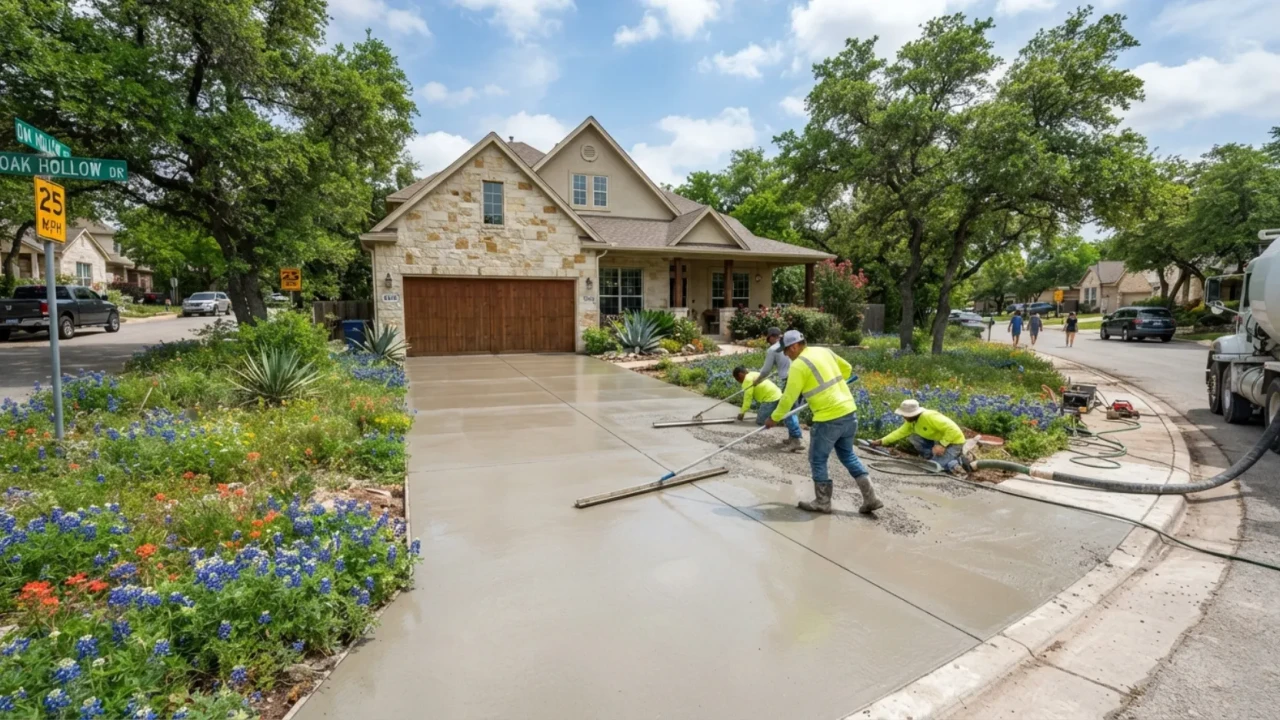
The spring caveat: Flash Flood Alley storms. San Antonio sits at the head of Flash Flood Alley, and spring is the peak of the severe weather season. A thunderstorm that drops two inches of rain on a freshly poured slab before initial set can wash the surface and ruin the finish. Rain that falls after initial set but before full cure can cause surface scaling in the wrong conditions. Experienced contractors watch forecasts obsessively during spring pours and know how to use forming plastic to protect the slab.
Spring is also when contractor demand starts to climb. By March, many homeowners are ready to start outdoor projects after winter, and concrete crews get busy quickly. Booking in late January or February gives you first access to the best spring slots before the rush begins.
- Verify a 48-hour rain-free window around the pour date; check NOAA forecasts, not just a general weather app
- Confirm your contractor has plastic sheeting or curing blankets available to protect the slab from unexpected rain during the first 4–6 hours after finishing
- Book your slot in January or February; March and April fill fast
- If scheduling in May, treat curing requirements the same as a summer pour: early morning start, curing compound, 3–5 day wet cure
- Texas 811 utility locate call required before any excavation; call 811 at least 48 hours in advance
Most national concrete guides treat winter as a no-go season, but that guidance is written for climates with sustained below-freezing temperatures. San Antonio is a different situation. Average January highs reach the mid-50s to low 60s°F, and freezes below 28°F are infrequent in most years. A properly managed winter pour in San Antonio is entirely achievable and can produce excellent results.

What changes in winter: Cold temperatures slow the hydration reaction. A slab poured at 45°F will take longer to reach initial set and will reach its 28-day design strength at a slower pace than a fall pour. This is manageable with two adjustments: using hot water in the mix (standard practice for cold-weather pours) and blanketing the slab overnight to retain heat generated by the hydration reaction itself.
The one scenario that justifies postponing a winter pour is a forecasted hard freeze, specifically temperatures below 28°F sustained for more than four hours within the first 24 hours after the pour. At that temperature, fresh concrete that has not yet reached initial set can freeze, and ice crystal formation inside the paste structure permanently weakens the slab. Winter Storm Uri in February 2021 reminded Bexar County that these events do happen, even if rarely. Any reputable contractor will reschedule if a hard freeze is in the forecast for pour day plus one.
Several homeowners in Bexar County who had driveways poured in late January or early February of 2021 saw surface scaling and spalling after Uri hit. In most cases, the concrete was less than 28 days old, still gaining strength, when the sustained hard freeze occurred. Concrete that has fully cured to 28-day strength can withstand isolated freeze events. Fresh concrete cannot. If you are scheduling a winter pour, build a weather-monitoring clause into your agreement: your contractor should be willing to postpone at no charge if a hard freeze warning is issued within the 5 days following your pour date.
Winter is the best time to negotiate price: Concrete contractors in San Antonio see their slowest demand in January and February. Crews still need to work, and many contractors will offer their most competitive pricing during this window. If your project is flexible on timing, a January quote often saves 8–15% compared to a summer quote for identical scope.
- Confirm no hard freeze forecast (below 28°F) within 48 hours before or 72 hours after the pour
- Verify your contractor will use curing blankets or insulating blankets to cover the slab each night for the first 72 hours
- Confirm contractor uses warm or hot water in the mix: standard cold-weather concrete practice
- Ask about the rescheduling policy for freeze events: no-charge postponement should be the standard
- Avoid pouring on any day when temperatures will not rise above 40°F; hydration slows significantly below that threshold
Summer is not a prohibited season for concrete in San Antonio; experienced local crews pour driveways in June, July, and August every year and produce excellent results. But the margin for error is much narrower than in fall or spring. The combination of 100°F daytime temperatures, intense Texas UV radiation, and low humidity creates the most challenging curing environment a residential slab will ever face.
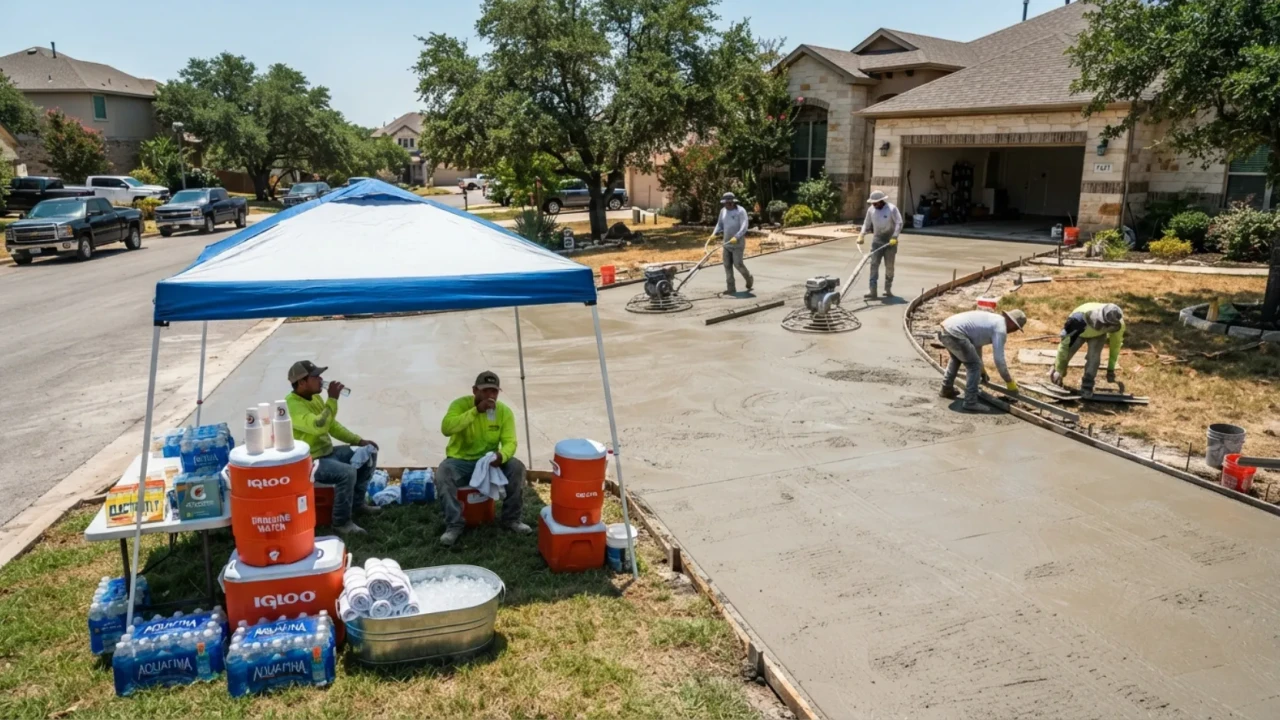
The core problem in summer: At high ambient temperatures, concrete reaches initial set very quickly, sometimes in as little as 45 to 60 minutes after the truck arrives. This compresses the window for screeding, floating, and finishing. If the crew is not experienced with hot-weather pours, they may rush the finish or apply water to the surface to buy more working time; both of these degrade the final product significantly.
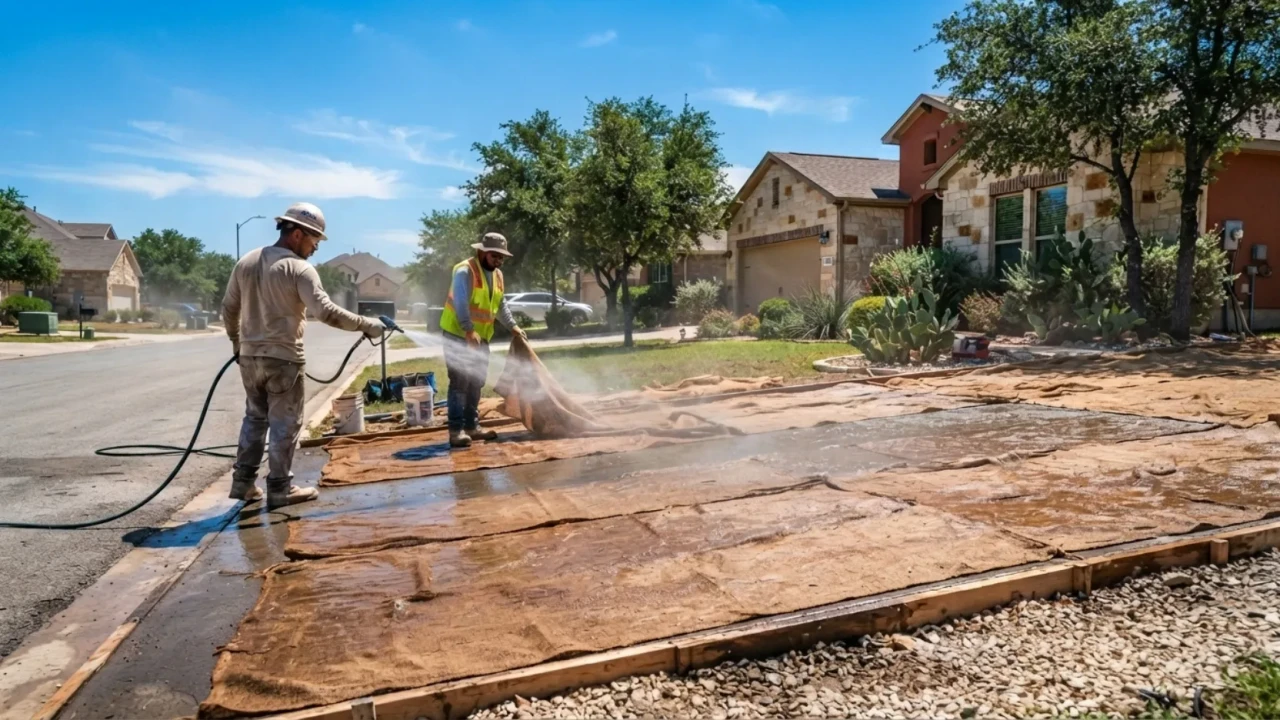
Non-negotiable summer pour protocols: A reputable San Antonio contractor handling a summer driveway installation will take specific steps that a less experienced crew might skip. These protocols are not optional in extreme heat. If a contractor you are considering does not mention them unprompted, that is a red flag worth taking seriously.
Ask directly: What time will the truck arrive? What is the mix temperature at delivery? What is the curing plan for the following five days? Specific, confident answers indicate summer pour experience. Vague answers about "doing it all the time" without specifics indicate the opposite.
- Confirm pour start time: truck must arrive before 8 AM; afternoon summer pours are not acceptable
- Verify contractor requests chilled mix water or ice from the batch plant for concrete delivery below 85°F
- No surface water application by finishers during the finishing window: zero tolerance
- Curing compound applied immediately after final finish, or wet-cure plan for minimum 5 days confirmed
- No foot traffic for 48 hours, no vehicle traffic for 7 days; heat-cured slabs are more sensitive in the first week
- Confirm experienced summer-pour crew: ask specifically how many summer driveways this crew has completed in Bexar County
Season is the biggest variable, but several other factors determine the actual best date for your specific project. Understanding these ensures you are not caught off guard by delays that could have been anticipated and planned around.
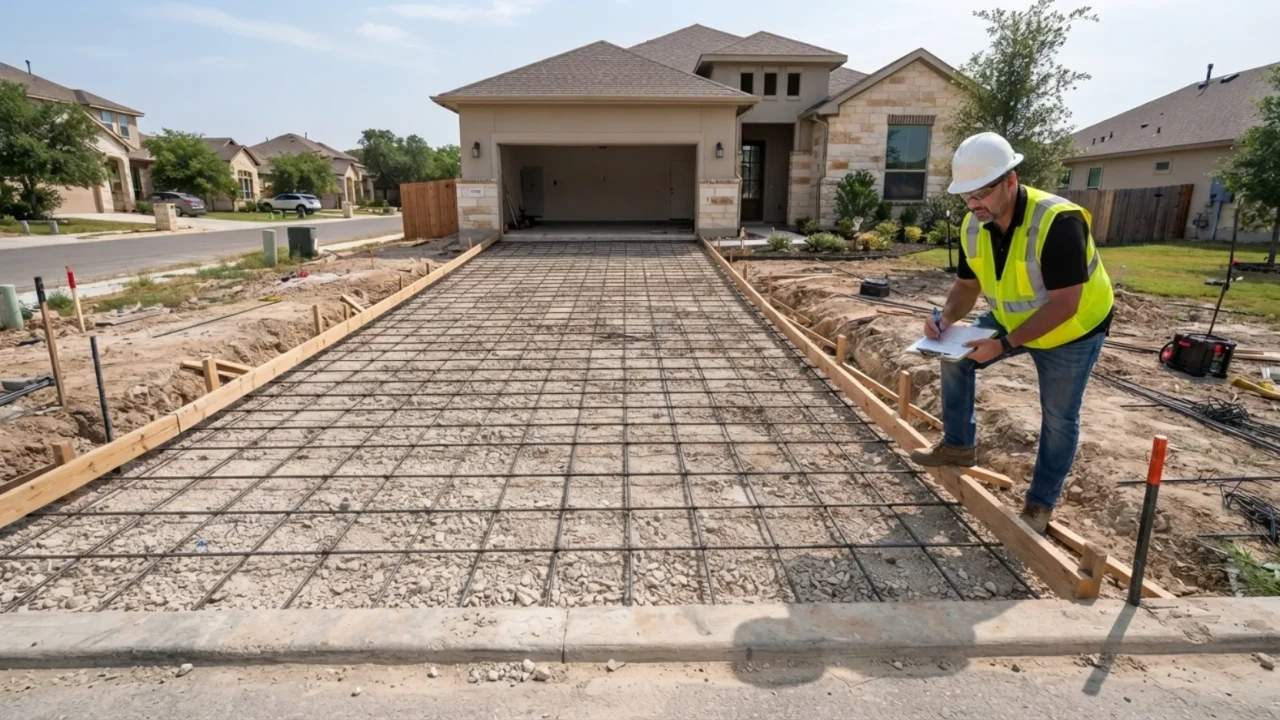
City of San Antonio permitting: Driveway work that involves modifying access to a public street may require a Right-of-Way permit from the City of San Antonio. Standard residential driveways entirely within your property line typically do not. Confirm this with your contractor before setting a pour date; permit processing can add one to three weeks to your timeline if it is required.
Blackland Prairie soil and base preparation: San Antonio's Vertisol clay requires thorough sub-base preparation before any concrete is poured. The clay must be excavated to adequate depth, a compacted crushed limestone base (minimum 4 inches) must be installed, and that base must cure and settle before the forms go up. This process takes a full day of work and ideally a day of settling before the pour. Build this into your schedule: this is not a same-day task.
Edwards Aquifer and drainage: San Antonio's position over the Edwards Aquifer means proper drainage slope is not just a concrete quality issue; it is an environmental one. Any driveway that channels runoff toward a recharge zone may require specific drainage planning. Your contractor should slope the slab a minimum of 1/8 inch per foot away from the structure and direct runoff to an appropriate drainage path. In some Bexar County neighborhoods near natural recharge features, local restrictions apply.
Build in a weather day buffer: When scheduling your pour date, ask your contractor what the rescheduling policy is if weather forces a postponement. A 24-hour cancellation window is standard: concrete trucks are ordered the evening before and cannot be cancelled without cost on the morning of the pour. Knowing this policy in advance prevents disputes if a Flash Flood Alley storm forces a same-day decision.
- Confirm whether a City of San Antonio Right-of-Way permit is needed and allow 1–3 weeks for processing if so
- Call Texas 811 at least 48 hours before any excavation begins; this is legally required
- Base preparation scheduled as a separate day from the pour, not same-day
- 48-hour rain-free window confirmed around your pour date; use NOAA National Weather Service for Bexar County
- Contractor rescheduling and cancellation policy confirmed in writing before signing
- Drainage slope confirmed in the project spec: minimum 1/8 inch per foot away from the structure
Use this table to quickly assess any month for a concrete driveway installation in San Antonio. Ratings reflect typical conditions; always check your specific 10-day forecast and consult your contractor for the final scheduling decision.
| Month | Typical Temp Range | Rating | Key Consideration |
|---|---|---|---|
| January | 40°F to 62°F | Good | Watch for hard freeze events; use blankets overnight; best pricing of the year |
| February | 44°F to 66°F | Good | Peak freeze risk month; monitor forecasts closely; Uri was February 2021 |
| March | 52°F to 73°F | Excellent | Spring storms begin; confirm 48-hour rain-free window around pour |
| April | 60°F to 80°F | Excellent | Near-ideal temperatures; storm risk remains; book slot in February |
| May | 67°F to 88°F | Good | Late May heat spikes; treat the last two weeks like summer; storm risk continues |
| June | 75°F to 95°F | Caution | Summer protocols required: early morning pour, chilled mix, extended curing |
| July | 78°F to 99°F | Caution | Peak demand and heat; experienced crew and strict protocols essential |
| August | 78°F to 100°F | Caution | Hottest month; all summer precautions apply; pour before 7 AM if possible |
| September | 72°F to 93°F | Good | Early September is still summer; late September begins to moderate; watch daily temps |
| October | 60°F to 82°F | Best Month | Ideal conditions: moderate heat, minimal storm risk, lower contractor demand |
| November | 50°F to 71°F | Excellent | Excellent curing temps; blankets recommended overnight for late November pours |
| December | 43°F to 63°F | Good | Early December is fine; mid-December onward requires winter protocols |
- Target pour month identified: October or November for best conditions; March or April as strong alternatives
- 48-hour weather window verified: no rain before or immediately after the pour
- Overnight lows confirmed above 40°F for the three nights following the pour (winter) or below 100°F daytime (summer)
- NOAA National Weather Service 10-day forecast checked, not just a general app
- City of San Antonio permit status confirmed: Right-of-Way permit required or not
- Texas 811 utility locate call scheduled: minimum 48 hours before any excavation
- Base preparation day scheduled separately from pour day: excavation, crushed limestone, compaction
- Drainage slope included in project spec: minimum 1/8 inch per foot away from the house
- Summer: early morning start confirmed, chilled mix water or ice requested, no surface water addition, 5-day cure plan
- Winter: curing blankets confirmed, hot or warm mix water confirmed, hard-freeze rescheduling policy in writing
- Spring: rain contingency plan confirmed, plastic sheeting available, storm rescheduling policy in writing
- Fall: standard mix confirmed, 3-day minimum wet cure plan, no unusual precautions required
- Contractor booked 4–6 weeks in advance for fall and spring; 2–3 weeks acceptable for winter; 3–5 weeks for summer peak
- Rescheduling and cancellation policy confirmed in writing before signing the contract
- Payment terms confirmed: deposit upfront, balance on completion and inspection, not full payment in advance
- Written quote includes pour date, backup date, and weather postponement policy
Ready to schedule your San Antonio concrete driveway?
Tell us your timeline and project details. We will assess your site, recommend the best pour window for your schedule, and provide a detailed written quote at no cost.