
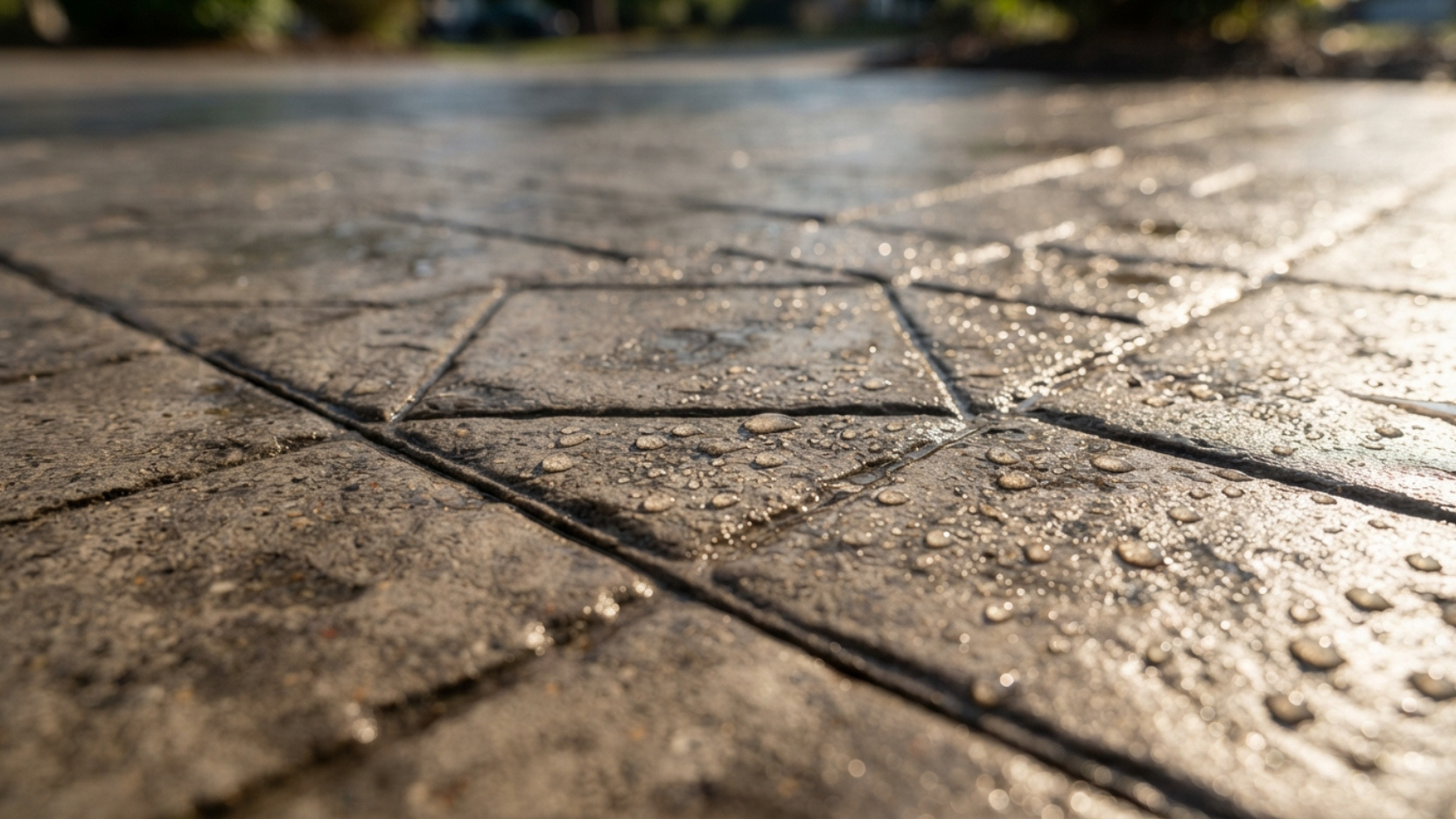
Concrete driveways in San Antonio cost more upfront than asphalt or gravel but over a 30-plus-year lifespan, they almost always win on total cost, curb appeal, and daily usability. This complete guide breaks down every factor so you can make the right call for your home and budget.
Every homeowner in San Antonio eventually faces the driveway question: replace what you have, upgrade the surface, or start from scratch. Concrete is almost always the right answer for a permanent installation but “worth it” depends entirely on whether the project is spec’d and installed correctly for local conditions.
In Bexar County, two factors complicate every driveway decision: the expansive Blackland Prairie Vertisol clay soil that shifts with rain and drought cycles, and the intense Texas UV and heat that accelerates surface degradation on lesser materials. A concrete driveway that is properly designed for these conditions will last 30 to 40 years with minimal maintenance. One that is not regardless of the material will be failing within five to eight years.
This guide covers the real cost of a concrete driveway in San Antonio, how it compares to asphalt and pavers over a full lifespan, what determines whether the investment pays off, and how to ensure the project is done right the first time.
For homeowners staying five years or fewer, the upfront cost difference between concrete and asphalt may not fully pay back through resale value though concrete still commands a stronger appraisal. For homeowners planning 10 or more years in the property, a properly installed concrete driveway is almost always the lower-cost option on a per-year basis when you factor in asphalt’s required resurfacing every 10 to 15 years and its shorter functional lifespan. In San Antonio’s heat, the gap between concrete and asphalt performance is wider than in most U.S. cities.
Cost Breakdown
Concrete driveway pricing in San Antonio varies based on slab thickness, driveway size, finish type, base preparation requirements, and whether demo of an existing surface is needed. The numbers below reflect real 2026 project data from the San Antonio metro area not national averages, which run significantly lower due to lower labor and material costs in other regions.
The single biggest driver of price variation is the demo and haul-off of an existing surface. Removing old asphalt or a cracked concrete slab adds $1.50 to $3.00 per square foot before the new work even begins. For a standard two-car driveway of 600 square feet, that is an additional $900 to $1,800 on top of the installation cost.
Base preparation is the second major cost variable and the one most commonly cut by low-bid contractors. In San Antonio’s clay-heavy soils, skipping proper base work is a false economy that results in cracking within three to five years.
- Slab thickness confirmed: minimum 4″ for residential driveways, 5″ for heavy vehicles
- Base preparation specified as a line item: 4″ compacted crushed limestone minimum
- Reinforcement type listed: rebar (#3 or #4 at 18″ centers) recommended over wire mesh in Bexar County clay soils
- Demo and haul-off quoted separately if removing an existing surface
- Control joint placement included: every 8 to 10 feet to control cracking
- Sealing quoted or scheduled: first seal at 28 days, every 3 to 5 years after
Durability and Lifespan
The upfront cost of concrete is higher than asphalt typically 20 to 40% more per square foot at installation. But asphalt requires resurfacing every 10 to 15 years and has a functional lifespan of 20 to 25 years before full replacement is needed. Concrete, properly installed and sealed in San Antonio, routinely lasts 30 to 40 years. The math almost always favors concrete once you account for the full ownership timeline.
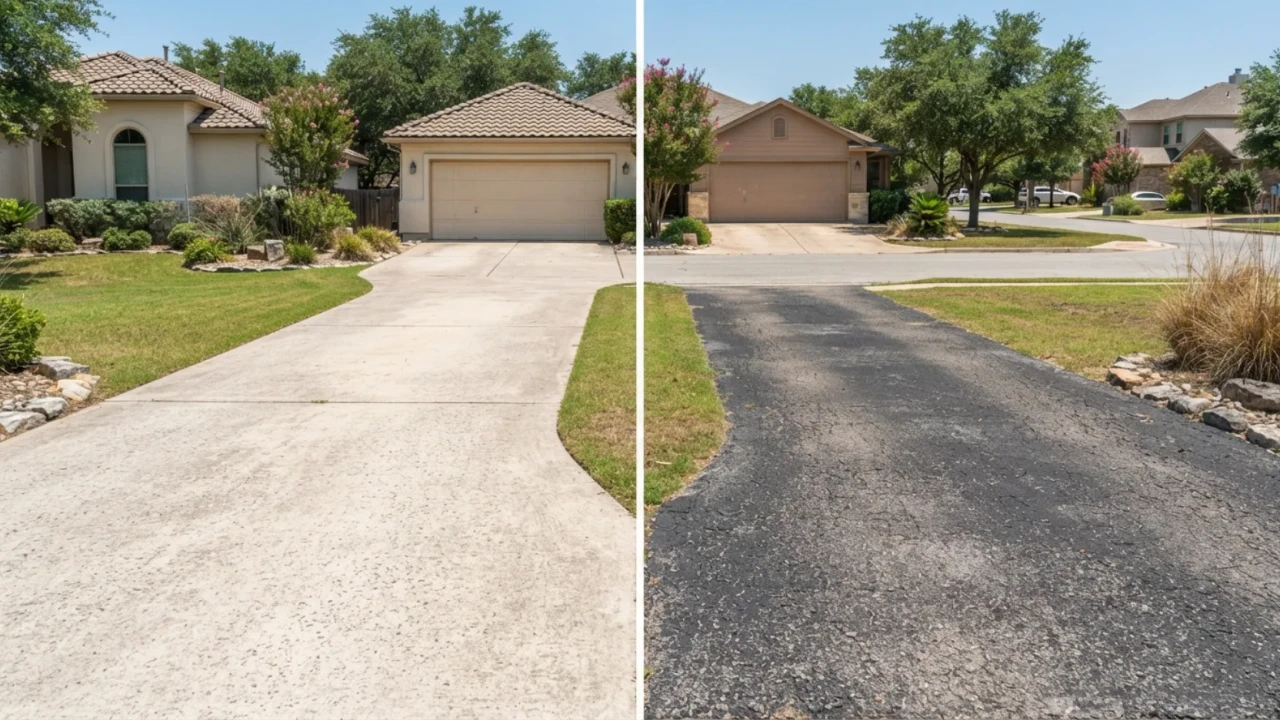
San Antonio’s climate accelerates this gap. Summer surface temperatures on asphalt regularly exceed 150 degrees Fahrenheit, causing softening and rutting under vehicle tires. Concrete maintains its structural integrity at those temperatures. In areas near the Edwards Aquifer where soils drain more freely, asphalt also degrades faster due to the combination of heat and moisture cycling.
Gravel and decomposed granite driveways, common at lower price points, have the shortest lifespan of all options. They require annual top-dressing, create dust and tracking, and wash out during Flash Flood Alley rain events a recurring San Antonio problem that makes gravel a poor long-term choice for most residential properties.
| Material | Install cost (600 sqft) | Lifespan | 30-year total cost | San Antonio performance |
|---|---|---|---|---|
| Concrete (standard) | $4,200-$6,000 | 30-40 years | $5,500-$8,000 (sealing only) | Excellent holds up to heat and clay soil movement when properly spec’d |
| Asphalt | $2,400-$3,600 | 20-25 years | $9,000-$14,000 (includes two resurfacings and full replacement) | Poor in summer heat softens, ruts, and degrades faster than most U.S. cities |
| Concrete pavers | $12,000-$20,000 | 25-35 years | $14,000-$24,000 (includes re-leveling and joint refilling) | Good visual result but higher cost and more maintenance in clay soil areas |
| Gravel or decomposed granite | $600-$1,800 | 3-5 years effective | $6,000-$15,000 (annual top-dressing plus periodic full replacement) | Poor washes out in heavy rain events and requires constant upkeep |
The real comparison is not install cost it is cost per year of useful life. A $5,000 concrete driveway that lasts 35 years costs approximately $143 per year. An asphalt driveway installed for $3,000 that requires $2,000 in resurfacing at year 12 and full replacement at year 22 costs approximately $250 to $300 per year over the same period. The concrete driveway is nearly half the annual cost of the asphalt option in a typical San Antonio scenario. This is before factoring in the higher property value that concrete contributes.
- Concrete outlasts asphalt by 10 to 20 years in San Antonio’s climate when properly installed
- Asphalt softens and ruts in Texas summer heat a more significant problem here than in most U.S. cities
- Gravel washes out during heavy rain events common to San Antonio’s Flash Flood Alley geography
- Concrete pavers deliver the highest visual impact but also the highest initial cost and ongoing maintenance
- Concrete is the best value on a cost-per-year-of-useful-life basis for most San Antonio homeowners
Local Conditions
Generic driveway advice written for national audiences routinely underestimates how much local soil and climate conditions affect concrete performance. In San Antonio, three site-specific factors determine whether a driveway lasts 10 years or 40 years. Understanding them helps you evaluate contractor proposals and catch shortcuts before they become costly repairs.
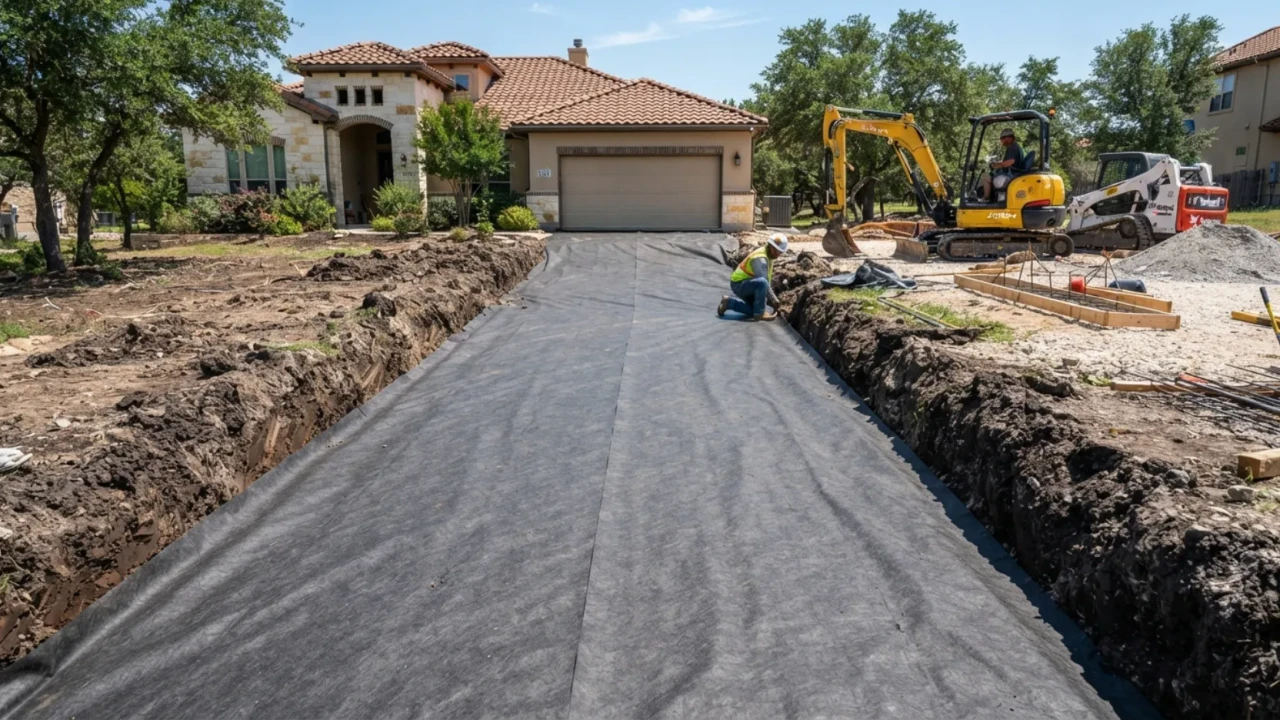
Blackland Prairie Vertisol clay: Bexar County sits on some of the most expansive clay soils in the United States. Vertisol clay swells when wet and shrinks when dry, creating a seasonal movement cycle that places significant stress on any concrete slab placed directly over it. A driveway installed without a proper compacted crushed limestone base will begin cracking within three to five years as the underlying soil shifts beneath it. The base is not an optional upgrade it is the reason the slab stays flat.
Texas UV and heat: Unsealed concrete in direct Texas sun degrades surface hardness and color at a rate that surprises most homeowners from other regions. Annual sealing, or at minimum every three years, is not optional in this climate.
Edwards Aquifer hard water: San Antonio’s water supply from the Edwards Aquifer has high mineral content. During summer curing, when contractors wet-cure a slab in San Antonio, the mineral deposits left by evaporating water can create white scaling on the surface if the first sealer coat is delayed beyond 30 days. This is a cosmetic issue that proper sealing timing eliminates, but it catches uninformed homeowners off guard.
Before any concrete work begins, make sure drainage is addressed. San Antonio averages 31 inches of rainfall per year, and a significant portion falls in intense, short-duration events. A driveway with insufficient slope or no drainage solution at the low end will pond water against the house foundation or push water under the slab. The minimum slope is 1/8 inch per foot away from the structure. In low-lying areas of the property, a channel drain or curb cut should be part of the project scope.
- Base preparation: 4 to 6″ compacted crushed limestone specified in writing do not allow pouring over native clay soil
- Rebar reinforcement: #3 or #4 rebar at 18″ centers (not wire mesh) in clay soil areas of Bexar County
- Control joints: every 8 to 10 feet to manage seasonal slab movement from soil shrink-swell cycles
- Drainage slope: minimum 1/8″ per foot away from the home confirm this is in the project scope
- Sealing timeline: first seal at 28 to 30 days after pour to prevent hard water mineral scaling from the Edwards Aquifer
Resale Value
A concrete driveway is one of the highest-ROI exterior improvements a homeowner can make. Unlike interior renovations, which may not match a buyer’s taste, a clean, well-maintained concrete driveway is universally valued it reduces one buyer concern (driveway condition) and signals that the property has been maintained with quality materials.
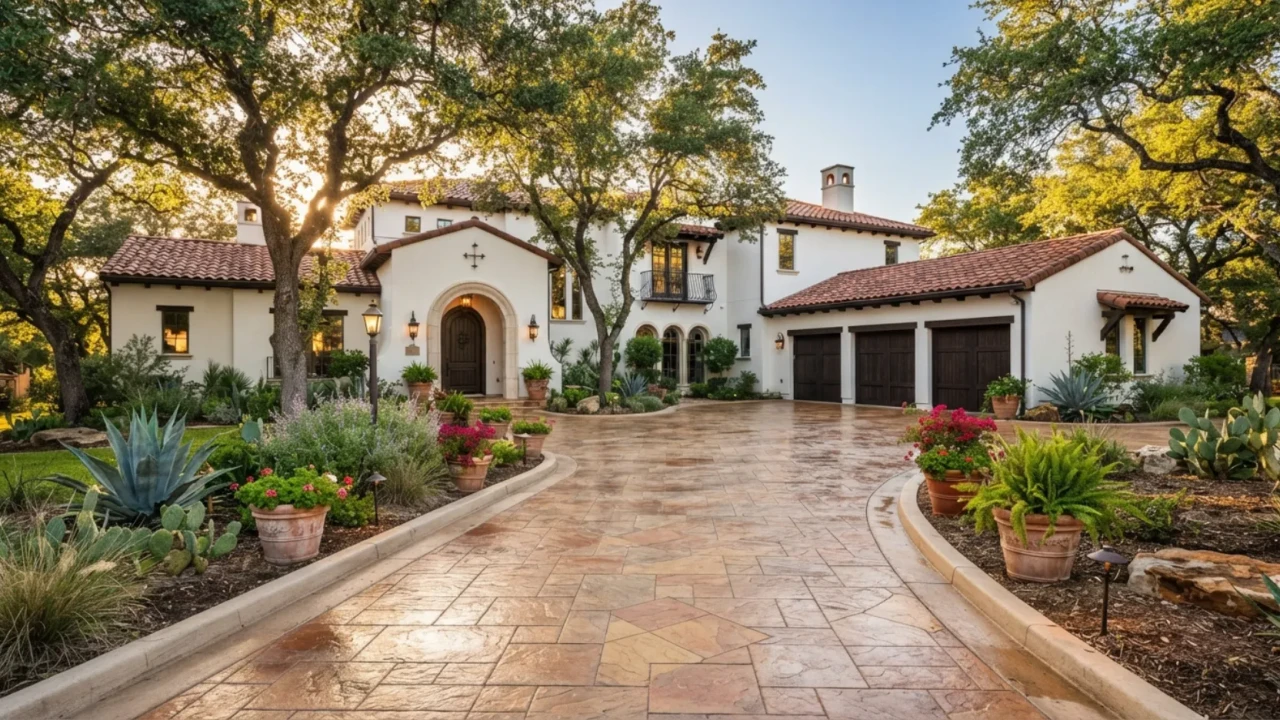
According to real estate professionals in the San Antonio market, a new concrete driveway typically returns 70 to 80 cents on the dollar at resale meaning a $6,000 driveway project adds $4,200 to $4,800 in appraised home value. That return rate is comparable to mid-range kitchen updates and significantly higher than most landscaping improvements, which return 40 to 60 cents on average.
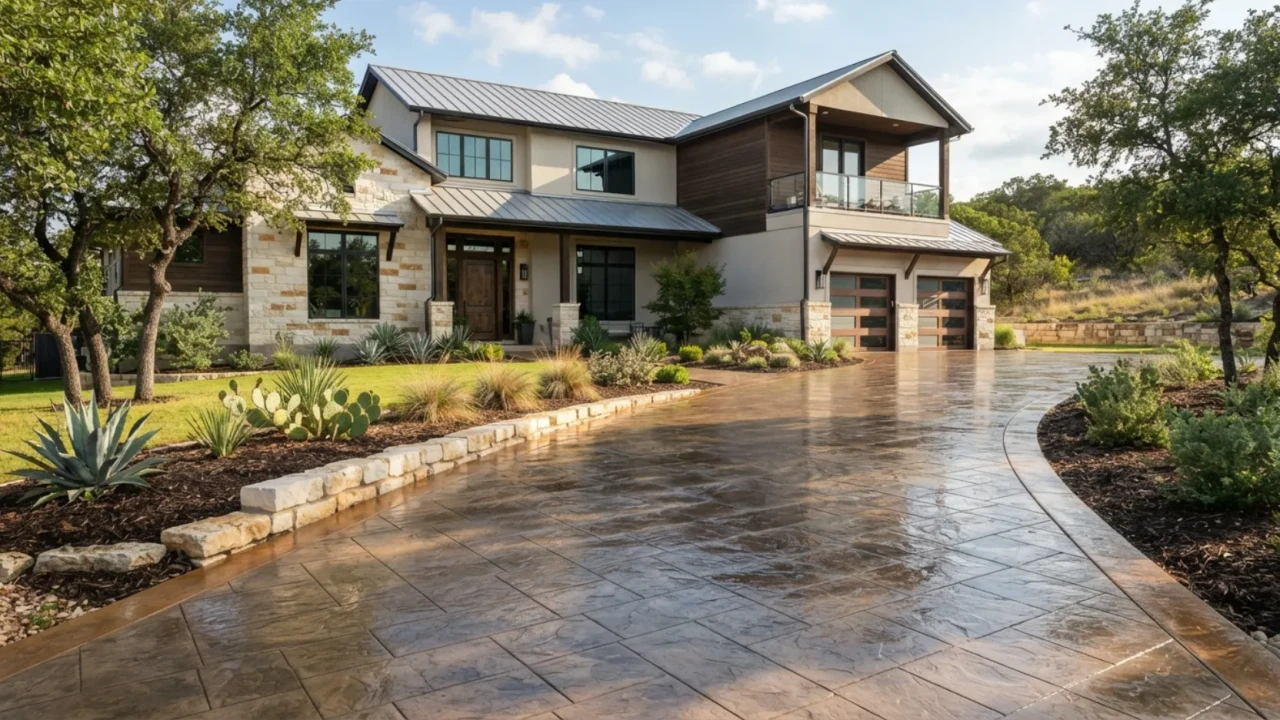
Stamped or decorative concrete driveways can push that return higher in neighborhoods where comparable homes already have standard concrete, because the upgrade differentiates the property. The strongest return comes from replacing a deteriorated asphalt or gravel driveway with fresh concrete the contrast effect on buyer perception is significant.
Beyond resale, there is the daily quality-of-life argument: a smooth, durable, low-maintenance driveway surface reduces vehicle tire wear, eliminates the loose stone and dust tracking common with gravel, and never requires sealing equipment or resurfacing crews on a 10-year cycle the way asphalt does. For homeowners with children, a concrete driveway also provides a stable, clean surface for outdoor activities that asphalt or gravel cannot match.
A freshly poured, well-finished concrete driveway transforms the front elevation of a home in a way that paint and landscaping cannot fully replicate. In San Antonio’s competitive housing market, where homes are frequently listed with professional photography and virtual tours, the driveway is one of the first exterior elements buyers evaluate. A cracked or patched asphalt driveway signals deferred maintenance throughout the property even when nothing else is wrong. A concrete driveway signals investment and care. That perception matters well before any appraisal conversation begins.
- Concrete driveway ROI of 70 to 80% is among the highest returns of any exterior home improvement in San Antonio
- Replacing deteriorated asphalt with concrete delivers the strongest buyer perception impact
- Stamped or colored concrete adds further differentiation in neighborhoods where standard concrete is common
- First impression effect: driveway condition is among the first things buyers evaluate in listing photos and in-person visits
- Maintenance-free surface signals property care to appraisers and buyers alike
Installation Quality
The concrete itself is not what determines longevity in San Antonio the prep work is. Two driveways poured on the same street with the same ready-mix concrete can look identical on day one and perform completely differently by year five if the base preparation, reinforcement, and joint placement differ. Understanding the installation decisions that matter lets you evaluate quotes accurately and avoid the shortcuts that lead to early failure.
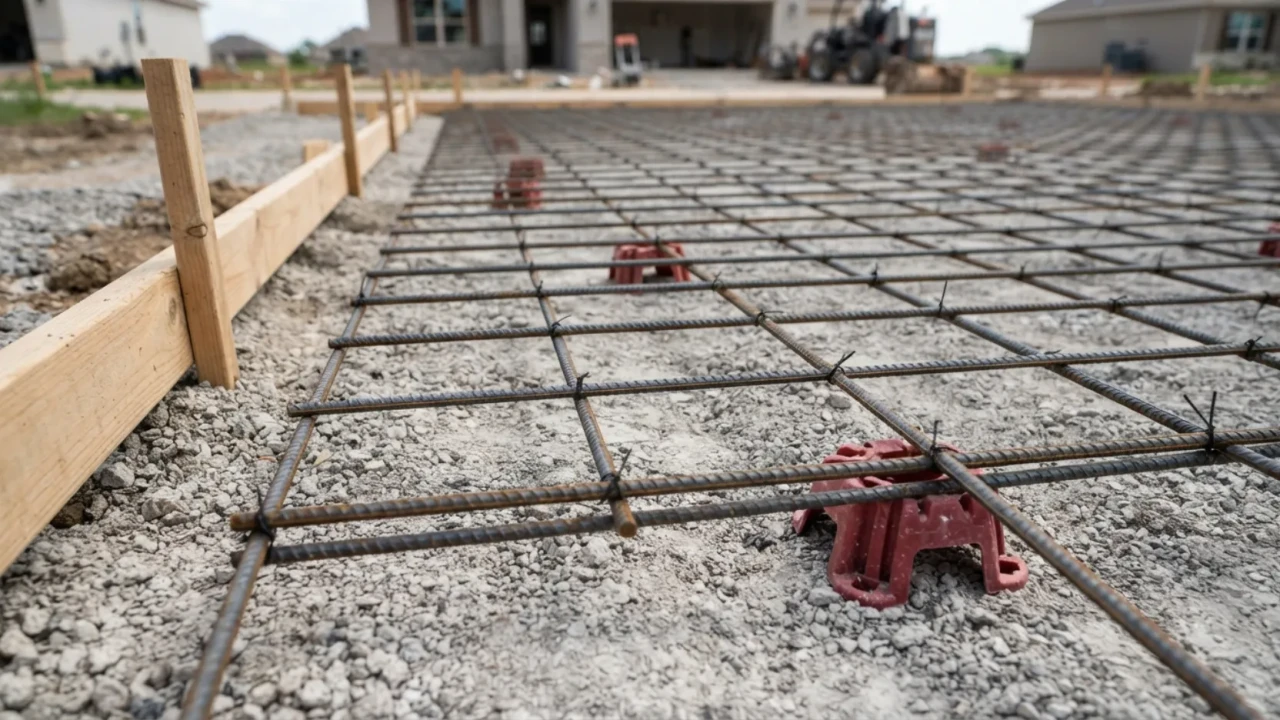
Base preparation: The single most important factor. In San Antonio’s clay soils, a minimum 4-inch layer of compacted crushed limestone is required before any concrete is poured. Some contractors in high-clay areas of Bexar County go to 6 inches. Any contractor who proposes pouring over native soil or who cannot specify the base preparation in writing should be disqualified from consideration.
Slab thickness: Four inches minimum for residential driveways, five inches if the driveway will regularly bear trucks, RVs, or trailers. Underpoured slabs a common cost-cutting measure will crack under load and cannot be repaired economically. Thickness must be confirmed in the written quote.
| Installation factor | Correct specification | What happens when cut |
|---|---|---|
| Base preparation | 4-6″ compacted crushed limestone in Bexar County clay soil areas | Slab heaves and cracks within 3-5 years as clay shrinks and swells seasonally |
| Slab thickness | 4″ minimum residential, 5″ for heavy vehicles | Slab cracks under load; cannot be patched requires full replacement |
| Reinforcement | Rebar #3 or #4 at 18″ centers in clay soil zones; wire mesh for stable soils only | Cracks open and widen without steel to hold the slab together after cracking initiates |
| Control joints | Placed every 8-10 feet; depth of 1/4 of slab thickness | Slab cracks randomly across the surface in unpredictable locations |
| Curing | Wet curing 3-5 days or liquid curing compound applied immediately after finishing | Surface hardness reduced; early surface scaling and dusting within the first year |
| Sealing | First seal at 28-30 days, then every 3-5 years depending on finish | UV degradation, mineral scaling from hard water, and accelerated surface wear |
- Base prep: 4 to 6″ compacted crushed limestone specified in writing, confirmed before pour
- Slab thickness: 4″ residential minimum confirmed; 5″ if heavy vehicles will use the driveway
- Reinforcement: rebar placement method and spacing specified elevated off base, not resting on ground
- Control joints: placement plan at 8 to 10 foot intervals discussed and agreed before work begins
- Curing plan: wet-cure method or liquid curing compound applied immediately after surface finishing
- Sealing: first application scheduled for 28 to 30 days after pour
Contractor Selection
The quality of a concrete driveway project is almost entirely determined by the crew doing the work. The concrete itself is a commodity product the differentiation is in the prep, the reinforcement, and the pour sequence. Choosing a contractor based on the lowest price alone is the single most reliable way to end up with a driveway that fails early.
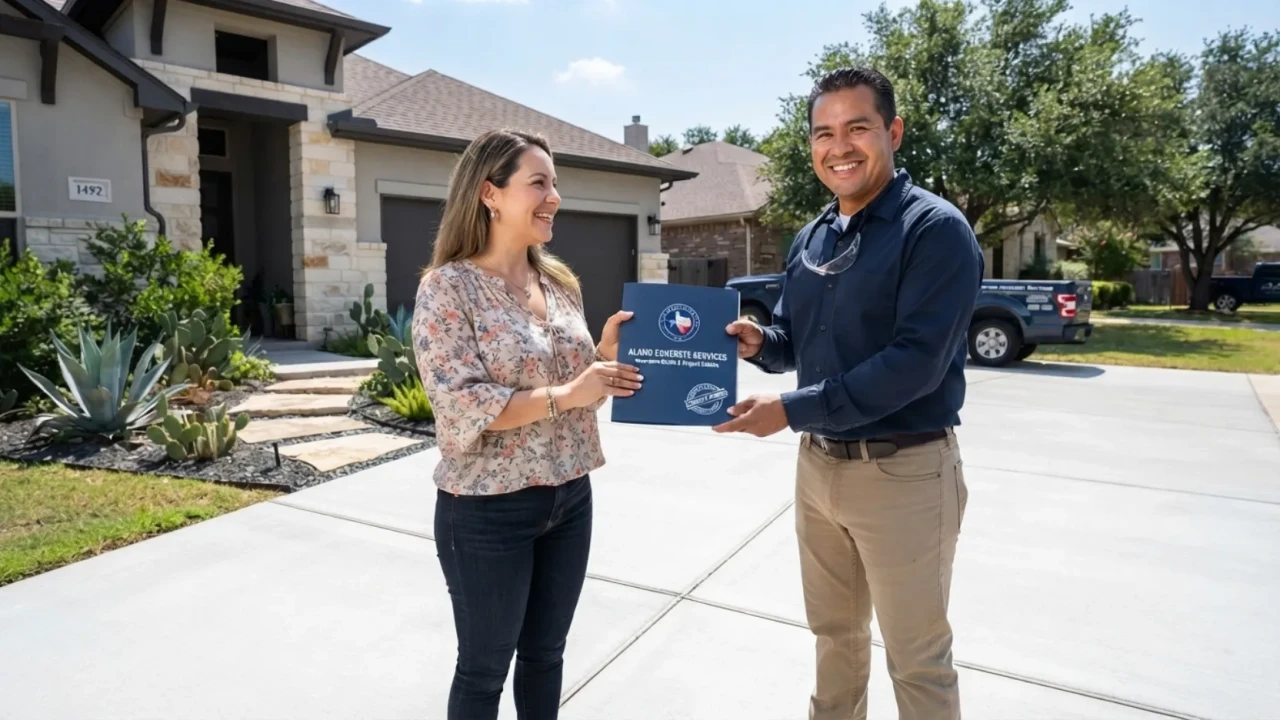
In San Antonio, concrete contractor quality varies widely. Established companies with verifiable local addresses, insurance certificates, and a portfolio of completed Bexar County projects will price higher than unlicensed crews working out of unmarked trucks but the difference in long-term outcome is dramatic. An improperly installed driveway that fails in six years costs more in total than a properly installed one that lasts 35.
| What to check | What a qualified contractor provides | Red flag response |
|---|---|---|
| Liability insurance | Certificate of insurance on request $1M or more general liability minimum | “We’re covered” with no documentation; cannot produce a certificate |
| Written quote detail | Base depth, slab thickness, reinforcement type, finish, and joint spacing all specified in writing | Quote just says “concrete driveway” with a price no spec detail at all |
| Base preparation method | Crushed limestone type and compaction equipment specified; subgrade inspection before pour | Vague answer about “preparing the area” with no specifics about material or depth |
| San Antonio experience | Specific knowledge of Bexar County clay soil behavior and local climate requirements | Generic answers that do not reference local soil conditions or climate |
| Payment terms | 30 to 50% deposit; remainder on completion after homeowner inspection | Full payment demanded before work begins |
| Permit knowledge | Knows which San Antonio projects require a City ROW permit and handles it correctly | Unaware of permit requirements or dismisses the question |
After any major storm or hailstorm in San Antonio, be cautious of door-to-door concrete crews. A common local pattern is that out-of-state crews arrive after storm damage events, offer below-market pricing on driveways, collect a deposit, and perform substandard work or disappear entirely. A legitimate San Antonio concrete company has a verifiable local address, a working phone number, and is available for warranty follow-up after the job is done. If a crew approaches you unsolicited with “leftover concrete,” decline and contact an established local company instead.
- Certificate of insurance requested and received verify the policy is current, not expired
- Written quote includes slab thickness, base prep depth and material, reinforcement type, and finish detail
- Local San Antonio references from recent driveway projects available and contactable
- Payment structure: deposit only upfront, balance on completion after inspection
- Contractor has a verifiable physical address in the San Antonio area not just a cell number
- Permit responsibility clarified: contractor handles City of San Antonio ROW permit if required
- Total project budget includes demo and haul-off if replacing an existing surface ($1.50 to $3.00/sqft additional)
- Three itemized quotes obtained compared on spec detail, not just total price
- Finish type selected and priced: standard broom ($7-$10), decorative ($10-$14), or stamped ($14-$20)
- Sealing cost budgeted: first application at 28 days, then every 3 to 5 years ($200-$500 DIY or $500-$900 professional)
- Slab thickness: 4″ minimum for residential driveways, 5″ for heavy vehicle use
- Base preparation: 4 to 6″ compacted crushed limestone specified in the contract, not assumed
- Reinforcement: rebar grid (#3 or #4 at 18″ centers) confirmed not wire mesh in clay soil areas
- Control joint placement: every 8 to 10 feet, 1/4 of slab depth minimum
- Drainage slope: 1/8″ per foot away from the home confirmed in the project scope
- Certificate of insurance received and verified $1M or more general liability
- Written contract signed before any work begins or deposit paid
- Local San Antonio references confirmed from projects completed in the last two years
- Payment terms agreed: deposit upfront, balance only on satisfactory project completion
- City of San Antonio ROW permit responsibility assigned if driveway connects to a public street
- Curing method agreed: wet curing minimum 3 days or liquid curing compound applied immediately after finishing
- Traffic restriction confirmed: foot traffic after 48 hours, vehicles after 7 days, no exceptions
- First sealing appointment scheduled for 28 to 30 days after pour
- Resealing reminder set: every 3 to 5 years for standard broom, every 2 to 3 years for stamped or colored
How much does a concrete driveway cost in San Antonio in 2026?
Is concrete or asphalt better for a San Antonio driveway?
How long does a concrete driveway last in San Antonio?
Does a new concrete driveway add value to my home?
Do I need a permit for a concrete driveway in San Antonio?
How soon can I drive on a new concrete driveway in San Antonio?
Get a free concrete driveway quote in San Antonio
Tell us about your project we will assess your site, review your soil and drainage conditions, and give you a detailed written quote at no cost. Serving all of San Antonio and Bexar County.