
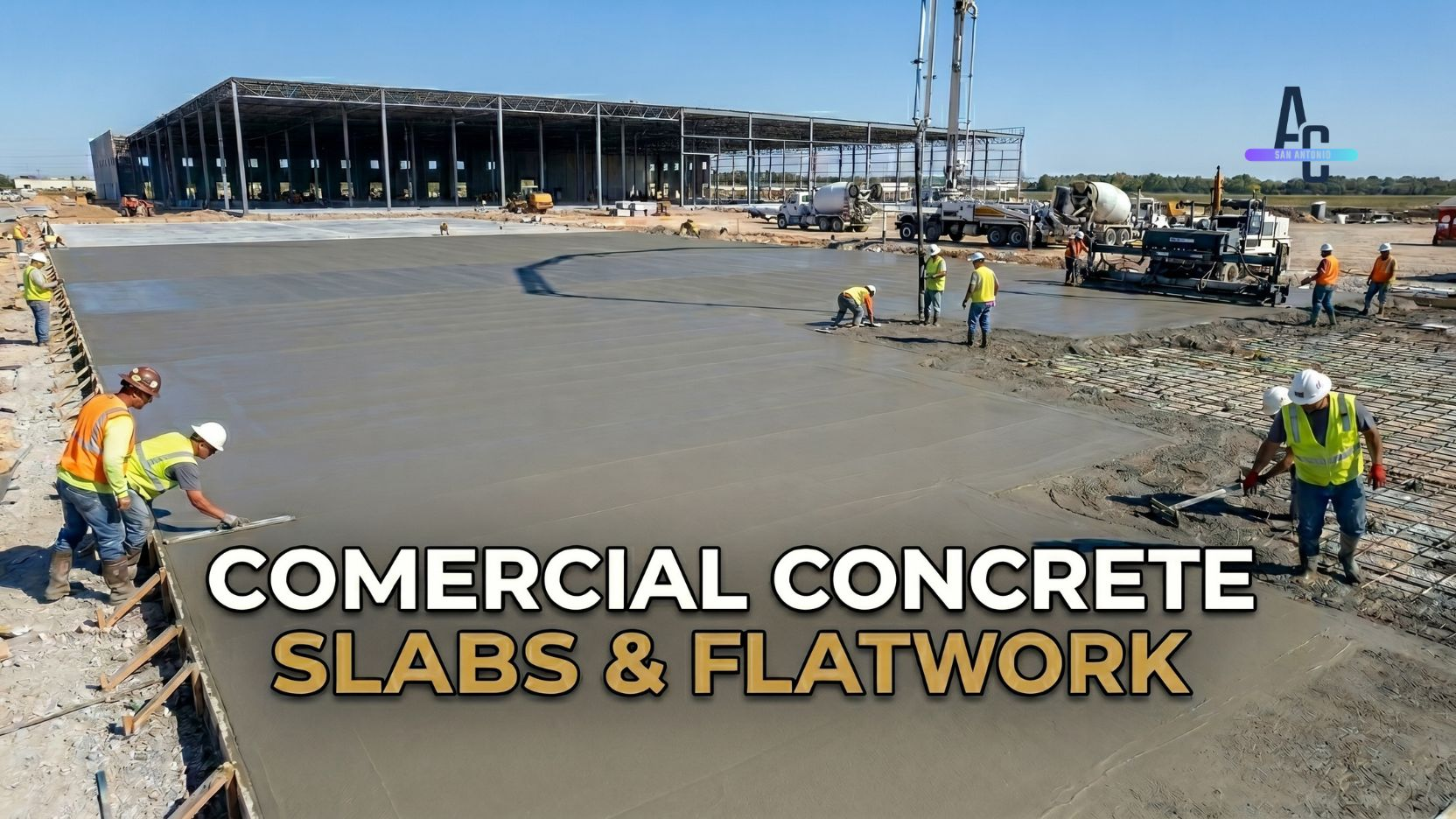
Cast-in-place concrete is poured into forms on your site and cures right where it will be used. Most slabs, foundations, parking areas, sidewalks, and driveways in San Antonio are built this way. This guide shows how to compare cast in place concrete contractors, what the work typically costs per square foot, which specs belong in the bid, and how permits work here.
- What do cast in place concrete contractors do?
- Is cast-in-place concrete better than precast or tilt-up?
- What should I look for in cast in place concrete contractors?
- How much does cast-in-place concrete cost in San Antonio?
- What specs should a cast-in-place concrete bid include?
- How does San Antonio clay soil change cast-in-place work?
- Do I need a permit for cast-in-place concrete in San Antonio?
- How does a cast-in-place concrete project run?
- What should I ask before I sign?
- Where do we work?
- What else are homeowners asking?
Hire cast in place concrete contractors who walk the site, quote thickness, base, steel, mix strength, and curing line by line, and plan permits up front. In San Antonio, commercial flatwork typically runs about $5 to $9 per square foot installed. Our expansive clay makes base prep critical, so get engineered specs for heavy loads.
What do cast in place concrete contractors do?
Cast in place concrete contractors build forms on your site, set the base and steel, place and finish the concrete, and cure it in its final position. It is the way most slabs, foundations, parking areas, and flatwork in San Antonio are built.
- Commercial slabs and flatwork: Warehouse and shop floors, retail pads, restaurant slabs, sidewalks, and equipment pads.
- Parking and drive lanes: Lots, drive-through lanes, dumpster pads, and loading areas.
- Foundations: Slab-on-grade, post-tensioned slabs, and grade beams built to an engineer’s drawings.
- Residential work: Driveways, patios, walkways, and pads are cast in place too.
Our commercial concrete services and commercial concrete slabs pages cover the slab, flatwork, and repair side of this work for San Antonio property owners.
Is cast-in-place concrete better than precast or tilt-up?
Cast-in-place concrete is usually the better fit for slabs, foundations, and flatwork that sit on the ground and follow the shape of the site. Precast pieces are made in a plant and trucked in, and tilt-up wall panels are cast flat on site and lifted into place.
| Method | How it is built | Typical use |
|---|---|---|
| Cast-in-place | Poured into forms in its final position | Slabs, foundations, parking, sidewalks, driveways |
| Precast | Made in a plant, trucked, and set by crane | Repeated units such as panels, barriers, and some stairs |
| Tilt-up | Wall panels cast flat on site, then tilted up | Large warehouse and industrial walls |
Even on precast and tilt-up buildings, the floor slab and site paving are normally cast in place.
What should I look for in cast in place concrete contractors?
Look for a local crew with insurance in writing, recent work of the same type as yours, and a proposal that itemizes base, thickness, reinforcement, mix strength, joints, and curing. A single square-foot price with no spec behind it is a warning sign.
- Matching experience: Ask for recent San Antonio jobs like yours, whether that is a shop floor, a retail pad, or a parking area.
- Insurance: Ask for at least $1 million in general liability on commercial work. Our service pages state $2,000,000 in coverage.
- Itemized proposal: Subgrade, base, forms, steel, concrete, finish, joints, and cleanup on separate lines.
- Heat plan: From May through October, pours should start early in the morning with evaporation retarder and sunshade on hand.
- Testing: On structural work, ask how many test cylinders are cast; our foundations guide calls for at least one set per 50 cubic yards.
Checked against our commercial concrete services page and our commercial flatwork, foundations, and permits guides on October 20, 2026.
How much does cast-in-place concrete cost in San Antonio?
Commercial cast-in-place flatwork in San Antonio typically runs about $5 to $9 per square foot installed, depending on thickness, base, reinforcement, and finish. Heavy engineered slabs and deep foundation systems cost more.
| Work | Typical installed cost | Notes |
|---|---|---|
| Light commercial slab | About $5 – $7 / sq. ft. | 4 – 5 in., wire mesh or light rebar, 4 in. base |
| Standard commercial slab | About $6 – $8 / sq. ft. | 6 in., rebar grid, 6 in. base |
| Heavy industrial slab | About $7 – $9 / sq. ft. | 7 – 8 in., #5 rebar, engineered base |
| Heavy-duty engineered slab | About $8 – $12+ / sq. ft. | Lime stabilization, thick reinforcement |
| Conventional slab-on-grade foundation | About $4 – $7 / sq. ft. | Only on favorable soils |
| Post-tensioned slab foundation | About $5 – $9 / sq. ft. | Common on San Antonio clay |
| Drilled pier and grade beam | About $8 – $14 / sq. ft. | Multi-story or poor surface soils |
| Residential driveway, broom finish | About $7 – $12 / sq. ft. | For comparison |
| 5,000 sq. ft. standard 6 in. slab | About $30,000 – $40,000 | Simple arithmetic from the $6 – $8 range |
Typical estimate ranges as of October 2026, in line with our commercial slabs and flatwork, commercial foundations, and driveway cost guides. Parking lots are priced in our parking lot contractors guide. These are not quotes; your price is set in writing after a free site visit.
What most San Antonio property owners can expect
What specs should a cast-in-place concrete bid include?
A good cast-in-place bid lists slab thickness, base depth and compaction, reinforcement, mix strength, joint layout, finish, and curing. When every bidder quotes the same spec, you can compare prices fairly.
- Base: At least 4 inches for light commercial and 6 inches for warehouses, with compaction testing in the scope.
- Mix: A minimum of 4,000 psi at 28 days for commercial flatwork, written into the contract.
- No water added on site: Water added to the truck without retesting slump weakens the mix, so ask how additions are handled and documented.
- Reinforcement: Bar size and spacing, or mesh, stated in writing; rebar grid is preferred on clay soils.
- Joints and curing: Joint spacing, curing compound right after finishing, and joint sealant after the full 28-day cure.
- Flatness: Floors with forklifts or racking should carry an F-number flatness spec.
How does San Antonio clay soil change cast-in-place work?
San Antonio’s expansive clay swells when wet and shrinks when dry, so base prep and reinforcement matter more here than in stable-soil regions. Heavier and commercial structures usually need a geotechnical report and an engineered design.
- Post-tensioned slabs: A common foundation answer for light commercial and residential buildings on clay.
- Drilled piers: Where surface soils are weak, piers are typically bored 15 to 35 feet down to stable caliche or rock.
- Drainage: Slabs and paving should shed water away from buildings so the soil under them stays more even.
- The slab will carry forklifts, racking, trucks, or heavy equipment
- The work is a foundation, grade beam, or anything holding up a building
- The site has a history of cracking, heaving, or standing water
- The pour ties into a public sidewalk, curb, or drive approach
Call (713) 504-2341 for a free site visit, or see our commercial concrete slabs page.
Do I need a permit for cast-in-place concrete in San Antonio?
Commercial cast-in-place concrete almost always needs a permit from the City of San Antonio Development Services Department. Homeowners pouring a driveway or sidewalk inside their property line usually do not, because those are on the City’s No Permit Required List.
- Commercial slabs and sitework: Expect a building or commercial permit, stamped engineering for structural slabs, and a pre-pour inspection of forms, base, and steel.
- Public right-of-way: Sidewalks, curb cuts, and drive approaches in the right-of-way need a separate permit; the City’s form is the Sidewalk-Curb Permit.
- Residential flatwork: Sidewalks and driveways inside your property line are on the No Permit Required List (checked October 20, 2026), but historic, conservation, and corridor districts can limit design and materials.
- Questions: Call Development Services at 210-207-1111 before you schedule demolition or base work.
Our commercial permits, codes, and ADA guide walks through inspections and accessibility rules in more detail.
How does a cast-in-place concrete project run?
Most cast-in-place jobs follow the same path: site visit, written estimate, permits and plans, base and forms, inspection, pour, cure, and a final walkthrough. A clear schedule keeps tenants, customers, and deliveries moving.
- Call or request online: Share the size, use, and timeline of the project.
- On-site assessment: We check soil, drainage, access, and any existing concrete.
- Free written estimate: Itemized scope and price before any work begins.
- Permits and plans: Engineering and permits are confirmed before demolition or base work.
- Base, forms, and steel: Subgrade prep, compacted base, forms, and reinforcement, then inspection where required.
- Pour and finish: Early-morning pours in hot months, then the specified finish and curing.
- Cure, joints, and walkthrough: Traffic limits through the cure, joint sealing, and a final walkthrough with you.
What should I ask before I sign?
Ask each contractor the same questions in writing so the answers can be compared side by side. The way a crew answers tells you as much as the price.
- What thickness, base depth, reinforcement, and psi are you quoting?
- Who pulls the permit, and who schedules inspections?
- How do you handle pours in summer heat?
- What is the joint layout, and when are joints sealed?
- Can I see your certificate of insurance and recent local jobs like mine?
- What does your workmanship warranty cover?
Ready for numbers on your site? See our commercial concrete services page, our driveway installation page for residential pours, or request a free quote.
Planning a cast-in-place concrete project in San Antonio?
Free site visit, an itemized written estimate, and a straight answer on specs and permits before any work starts. Licensed and insured, $2,000,000 liability coverage.
Where do we work?
Affordable Concrete San Antonio works across San Antonio and nearby areas from our shop at 1247 W Thompson Pl, San Antonio, TX 78226.
We pour and repair commercial and residential concrete in San Antonio and these nearby areas: Helotes, Leon Valley, Shavano Park, Terrell Hills, Alamo Heights, Converse, Universal City, Schertz, Boerne, Cibolo, Fair Oaks Ranch, Bulverde, Spring Branch, New Braunfels, Pleasanton, Floresville, Castroville, Lytle, and Von Ormy. Not sure about your address? Call (713) 504-2341.
What else are homeowners asking?
These are the short answers people want before they book a quote.
What is cast-in-place concrete?
Cast-in-place concrete is poured into forms on the job site and cures in its final position. Most slabs, foundations, parking areas, sidewalks, and driveways are built this way.
How much does cast-in-place concrete cost per square foot in San Antonio?
Commercial cast-in-place flatwork typically runs about $5 to $9 per square foot installed in San Antonio. Heavy engineered slabs can reach $8 to $12 or more, and a broom-finish residential driveway runs about $7 to $12.
Is cast-in-place concrete stronger than precast?
Neither is automatically stronger. Strength comes from the mix design, reinforcement, and curing. Commercial flatwork is commonly specified at a minimum of 4,000 psi at 28 days.
Do I need a permit for cast-in-place concrete in San Antonio?
Commercial cast-in-place work almost always needs a City of San Antonio permit. Residential sidewalks and driveways inside your property line are on the No Permit Required List, and right-of-way work needs a Sidewalk-Curb Permit.
How long before I can use a new concrete slab?
Cars can usually use a new residential driveway after about 7 days. Forklifts and heavy equipment should wait for the full 28-day cure on a commercial slab.
What insurance should a concrete contractor carry?
Ask for a certificate showing at least $1 million in general liability for commercial work. Affordable Concrete San Antonio carries $2,000,000 in liability coverage.
Sources used in this article:
- City of San Antonio, No Permit Required List, checked October 20, 2026, sa.gov
- City of San Antonio, Development Services Department, sa.gov
- City of San Antonio, Sidewalk-Curb Permit Application, docsonline.sanantonio.gov
- Affordable Concrete San Antonio, commercial concrete services page, affordableconcretesanantonio.com/commercial-concrete-services/
- Affordable Concrete San Antonio, commercial concrete slabs and flatwork guide, affordableconcretesanantonio.com/concrete-blogs/commercial-concrete-slabs-flatwork/
- Affordable Concrete San Antonio, commercial foundations and structural concrete guide, affordableconcretesanantonio.com/concrete-blogs/commercial-foundations-structural-concrete/
- Affordable Concrete San Antonio, commercial permits, codes, and ADA guide, affordableconcretesanantonio.com/concrete-blogs/commercial-concrete-permits-codes-ada-in-san-antonio/
This article is general information for San Antonio property owners. Prices are typical estimates as of October 2026 and can change. City rules can change too, and the City of San Antonio is the final authority on permits. It is not a quote and does not replace a site visit or an engineer.
What should I read next?
Start with our commercial services page, or keep reading if you are budgeting or comparing bids.