
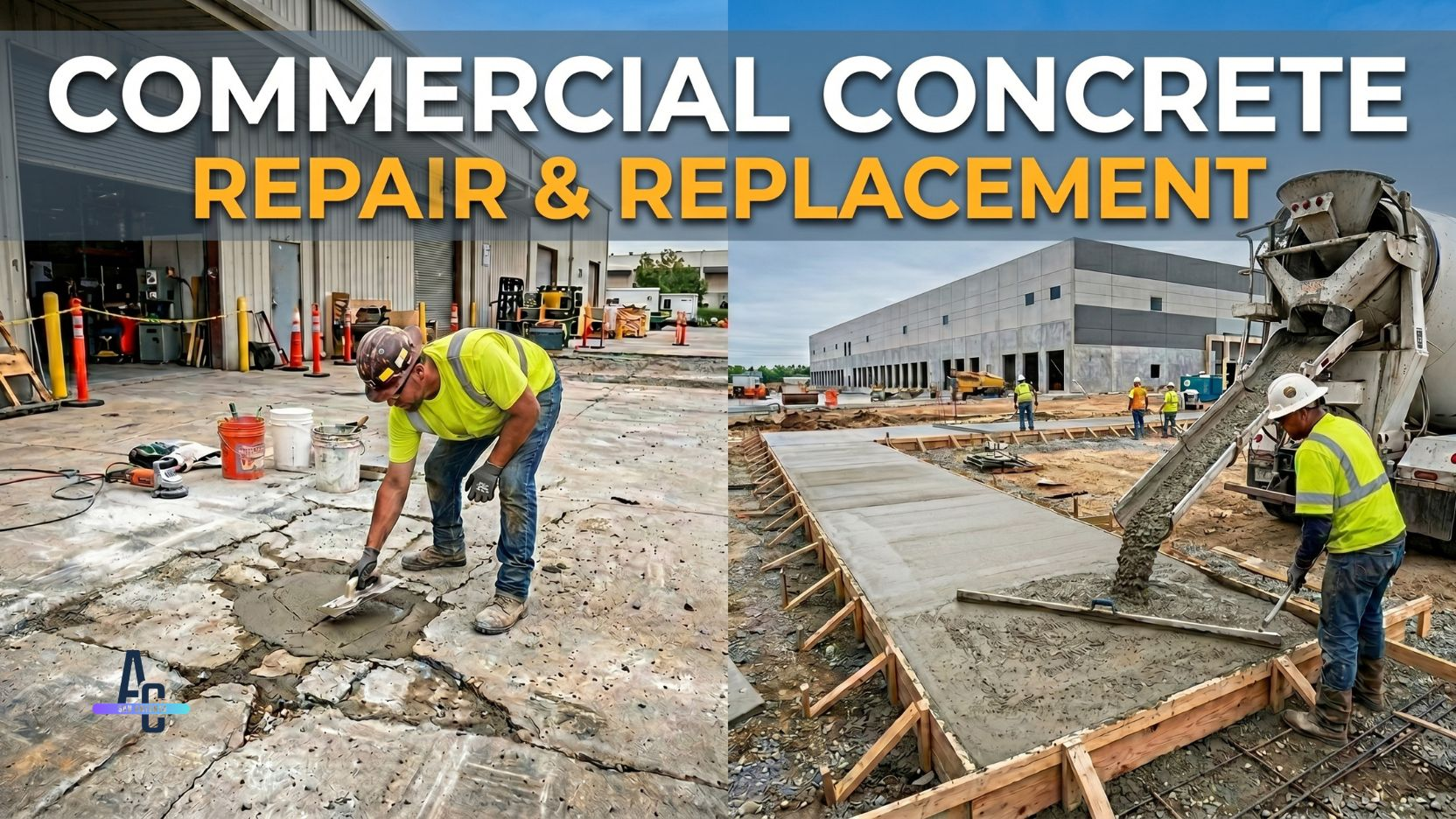
When a commercial slab cracks, sinks, or spalls, the real question is whether to repair it or tear it out. This guide breaks down how to tell the difference, what each option costs in San Antonio, and how to get the work done without shutting your business down.
For a commercial property, failing concrete is more than an eyesore. A cracked parking lot, a sunken sidewalk, or a spalling loading dock creates trip-hazard liability, slows operations, and gets worse every season it is ignored. The good news is that most commercial concrete problems in San Antonio do not require a full tear-out. The trick is knowing which ones do.
This guide walks through the repair-versus-replace decision, the most common failures we see on San Antonio commercial slabs, the repair methods that actually hold up in our clay soils and heat, and what full replacement involves when it is the only sound option. Every section includes the cost ranges and questions you need before approving any scope of work.
Concrete fails for two very different reasons. Either the slab itself is damaged while the ground beneath it is stable, or the subgrade has moved and taken the slab with it. The first is a repair. The second is usually a replacement, because patching a slab sitting on a failed base just buys you a year or two before the same crack returns. In San Antonio, where expansive clay soil swells and shrinks with every wet and dry cycle, base failure is the single most common reason a repair does not last. Diagnose the base first, then choose the fix.
Decision
.webp)
Every commercial concrete decision starts with one question: is the slab worth saving? The answer is rarely about the cracks you can see. It is about the condition of the base beneath the slab, how much of the surface is affected, and how the repair cost compares to the remaining useful life you would get from it.
Repair makes sense when: the base is stable, damage is localized (under roughly 30 to 40% of the slab area), cracks are narrow with no vertical displacement, and the slab still has years of service life left. Targeted repairs typically cost 40 to 60% less than replacement and can often be done overnight or in sections.
Replacement makes sense when: the base has failed, damage is widespread, the slab has heaved or settled unevenly, or repeated past repairs have already failed. Pouring good money into a slab on a bad base is the most common waste we see on commercial sites.
- Base condition assessed: is the subgrade stable, or has it moved?
- Percentage of slab affected estimated: localized damage favors repair, widespread favors replacement
- Vertical displacement measured at cracks and joints: flat cracks repair well, offset cracks signal base movement
- Repair history reviewed: a slab that has been patched repeatedly is usually a replacement candidate
- Repair cost compared against remaining service life, not just the replacement price
Diagnosis
.webp)
Before you can choose a fix, you need to know what you are actually looking at. The same crack can be a cosmetic shrinkage line or the first sign of a failing base. Here are the failures we see most often on San Antonio commercial concrete and what each one tells you.
A displaced commercial sidewalk is a liability, not just a repair item. Under ADA accessibility rules, a vertical change in level over 1/4 inch must be beveled, and anything over 1/2 inch generally requires a ramp rather than an abrupt edge. On a commercial property open to the public, a raised slab edge is both a trip hazard and a documented accessibility violation. If a sidewalk panel has heaved or settled at a joint, treat it as a priority, not a someday item.
- Crack width measured: under 1/4 inch and flat is usually cosmetic; wider or offset is structural
- Vertical displacement checked at every joint and crack along public walkways
- Spalling and scaling noted: surface-only breakdown can often be resurfaced
- Drainage observed: standing water near the damage points to a base or grading problem
- Photos and measurements documented for insurance, ADA, and contractor scoping
Repair Methods

Once you know the slab is worth saving, the repair method depends on the type and depth of the damage. Using the wrong method, such as a surface patch over a structural crack, is why so many commercial repairs fail within a year. These are the methods that hold up in San Antonio.
| Method | Best for | What it does | Notes |
|---|---|---|---|
| Crack injection | Narrow structural or active cracks | Fills and bonds the crack through the full depth of the slab | Epoxy for structural bonding; polyurethane for moving or wet cracks |
| Slab lifting | Settled but intact slabs | Raises the slab back to grade by injecting fill underneath it | Polyurethane foam is fast and light; mudjacking is lower cost |
| Partial-depth patch | Localized spalling and joint spalls | Removes and replaces only the damaged top layer | Needs a clean, square cut and a proper bonding agent |
| Full-depth repair | Through-slab cracks, broken panels | Removes and repours the full panel thickness | Often dowelled to adjacent panels for load transfer |
| Resurfacing / overlay | Worn or scaled but sound slabs | Bonds a new wear surface over the existing concrete | Restores look and texture; only works on a stable base |
| Joint resealing | Open, dried, or weed-filled joints | Cleans and refills control and expansion joints | Cheap, high-value maintenance that keeps water out |
| Diamond grinding | Minor trip-hazard displacement | Grinds a raised edge down to remove the lip | Fast ADA fix for displacement under about 1/2 inch |
A crack that keeps coming back after injection is telling you the base is moving, no matter how good the injection was. A scaled surface that gets resurfaced will scale again if the original cause (poor finishing, deicing salts, or a high water-to-cement ratio) is not addressed. The repair method buys you time only when it is paired with the actual fix for what caused the damage. On a commercial site, that usually means addressing drainage and subgrade first.
- Method matched to damage type and depth, not just appearance
- Structural cracks injected full-depth, not surface-sealed
- Settled slabs evaluated for lifting before tear-out is quoted
- Bonding agent and proper cut specified for any partial-depth patch
- Joint resealing scheduled as routine maintenance, not just after failure
Replacement
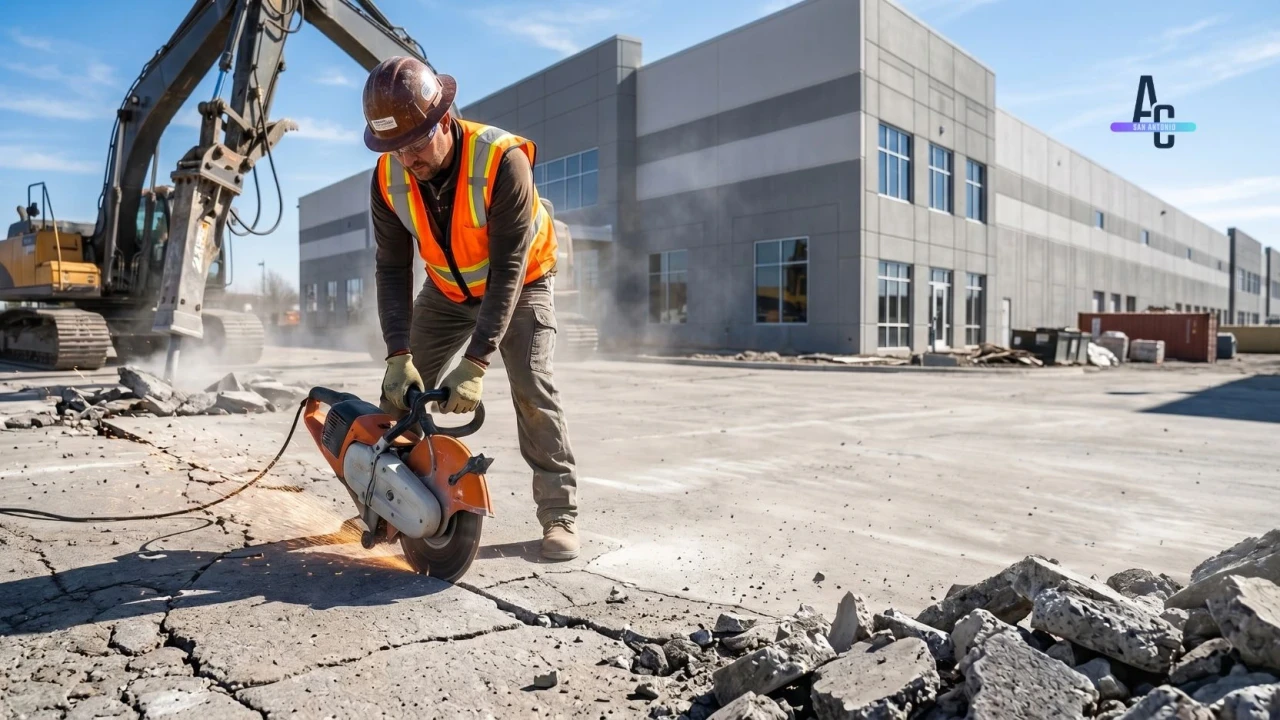
When the base has failed or damage is too widespread to patch, replacement is the only fix that lasts. A commercial repour is more than pouring concrete in the same hole. The base rebuild is what determines whether the new slab outlives the old one, and on a working property, the sequencing matters as much as the spec.
Specification for commercial slabs in San Antonio: 6 inch minimum thickness for parking and drive areas, heavier for truck and dock traffic, over a compacted crushed-limestone base of 6 inches or more. Use a rebar grid (not just wire mesh) for load transfer, with sawn control joints on a tight grid to manage the cracking that clay soil movement will eventually cause.
You usually do not have to close to replace concrete. Most commercial replacements can be phased so that only part of a lot or walkway is closed at a time, and high-early-strength mixes can bring a section back to light traffic in 24 to 48 hours instead of the standard 7 days. Night and weekend pours are common for retail and restaurant sites. Build the phasing plan into the contract up front so operations and the crew are working from the same schedule.
- Cause of failure identified and corrected before repour (drainage, subgrade, load)
- Base rebuild specified: excavation depth and compacted limestone base in writing
- Slab thickness and reinforcement matched to the actual load (parking vs. truck vs. dock)
- Control and expansion joint layout planned, not left to chance
- Phasing and cure schedule agreed so the business keeps operating
- High-early-strength mix considered where fast reopening matters
Contractor & Care

Commercial concrete is unforgiving of shortcuts, and the difference between a slab that lasts 30 years and one that fails in 8 is almost always the crew and the prep, not the concrete itself. Vet the contractor the same way on a repair as on a full replacement.
| What to check | What a good commercial contractor provides | Red flag response |
|---|---|---|
| Liability insurance | Certificate of insurance on request, $1M+ general liability, with commercial references | “We’re covered” with no documentation |
| Scope detail | Written scope: cause of damage, method, base prep, thickness, reinforcement, joints | A flat per-foot price with no diagnosis |
| Diagnosis | Inspects and explains why the concrete failed before quoting a fix | Quotes a patch without checking the base or drainage |
| Phasing plan | A written plan to keep your site operating during the work | No plan for access, traffic, or downtime |
| References | Photos and contacts from commercial jobs in San Antonio | Residential-only portfolio for a commercial slab |
| Warranty | Written workmanship warranty on the repair or pour | Verbal assurances only |
Sealing and joint maintenance are what protect the investment. Reseal joints before they open up and let water reach the base, pressure wash and reseal the surface on schedule, and fix small cracks in the first season before clay movement widens them. A few hundred dollars of annual maintenance routinely adds a decade to a commercial slab in our climate.
- Insurance certificate verified, $1M+ general liability, commercial references checked
- Written scope includes the diagnosed cause, not just the repair price
- Phasing and downtime plan agreed before work starts
- Workmanship warranty provided in writing
- Joint resealing and surface sealing scheduled as ongoing maintenance
- Small cracks filled in the first season before they widen
Use this table to match what you are seeing on your property to the likely cause and the most cost-effective fix. When in doubt between repair and replacement, the deciding factor is almost always the condition of the base.
| Problem | Likely cause | Repair or replace | Typical method & cost |
|---|---|---|---|
| Hairline / shrinkage cracks | Normal curing, minor surface stress | Repair | Crack fill or seal · $2–5/linear ft |
| Wide or displaced cracks | Base movement, overload, clay swelling | Repair or replace | Injection if base sound; replace panel if not · $6–14/sqft |
| Surface spalling / scaling | Poor finishing, salts, freeze events | Repair | Partial-depth patch or overlay · $4–9/sqft |
| Settled / sunken slab | Subgrade washout or compaction loss | Repair | Foam lifting or mudjacking · $5–12/sqft |
| Heaved / raised slab | Clay swelling, tree roots, moisture | Repair or replace | Grind small lips; replace if severe · varies |
| Failed / open joints | Age, dried sealant, water intrusion | Repair | Clean and reseal joints · $3–6/linear ft |
| Trip hazard at sidewalk | Heaving or settlement at a joint | Repair | Diamond grinding or lift · $200–600/location |
| Broken panels / widespread failure | Base failure, end of service life | Replace | Full removal and repour · $10–18/sqft |
- Cause of damage diagnosed in writing: slab problem or base problem
- Crack widths and vertical displacement measured and photographed
- Drainage and standing-water issues noted near the damage
- ADA trip hazards on public walkways flagged as priority items
- Repair-versus-replace decision based on base condition, not just visible cracks
- Method matched to damage type: injection, lifting, patch, overlay, or repour
- For replacement: base rebuild depth, slab thickness, and reinforcement specified
- Control and expansion joint layout included in the scope
- Certificate of insurance verified, $1M+ general liability
- Written scope itemizes diagnosis, prep, materials, and warranty separately
- Commercial references and local project photos reviewed
- Workmanship warranty provided in writing
- Phasing plan agreed so the business keeps operating during the work
- Cure and reopening schedule confirmed (standard vs. high-early-strength mix)
- Night or weekend work scheduled where customer access matters
- Maintenance plan set: joint resealing and surface sealing on a schedule
Should I repair or replace my commercial concrete?
How much does commercial concrete repair cost in San Antonio?
Can you repair commercial concrete without closing my business?
Why does commercial concrete crack and sink in San Antonio?
Is a sunken or raised sidewalk an ADA liability for my business?
Get a free commercial concrete assessment in San Antonio
Tell us what you are dealing with: a cracked lot, a sunken sidewalk, a spalling dock, or a slab at the end of its life. We’ll inspect the site, diagnose the cause, and give you a written repair-or-replace recommendation at no cost.