
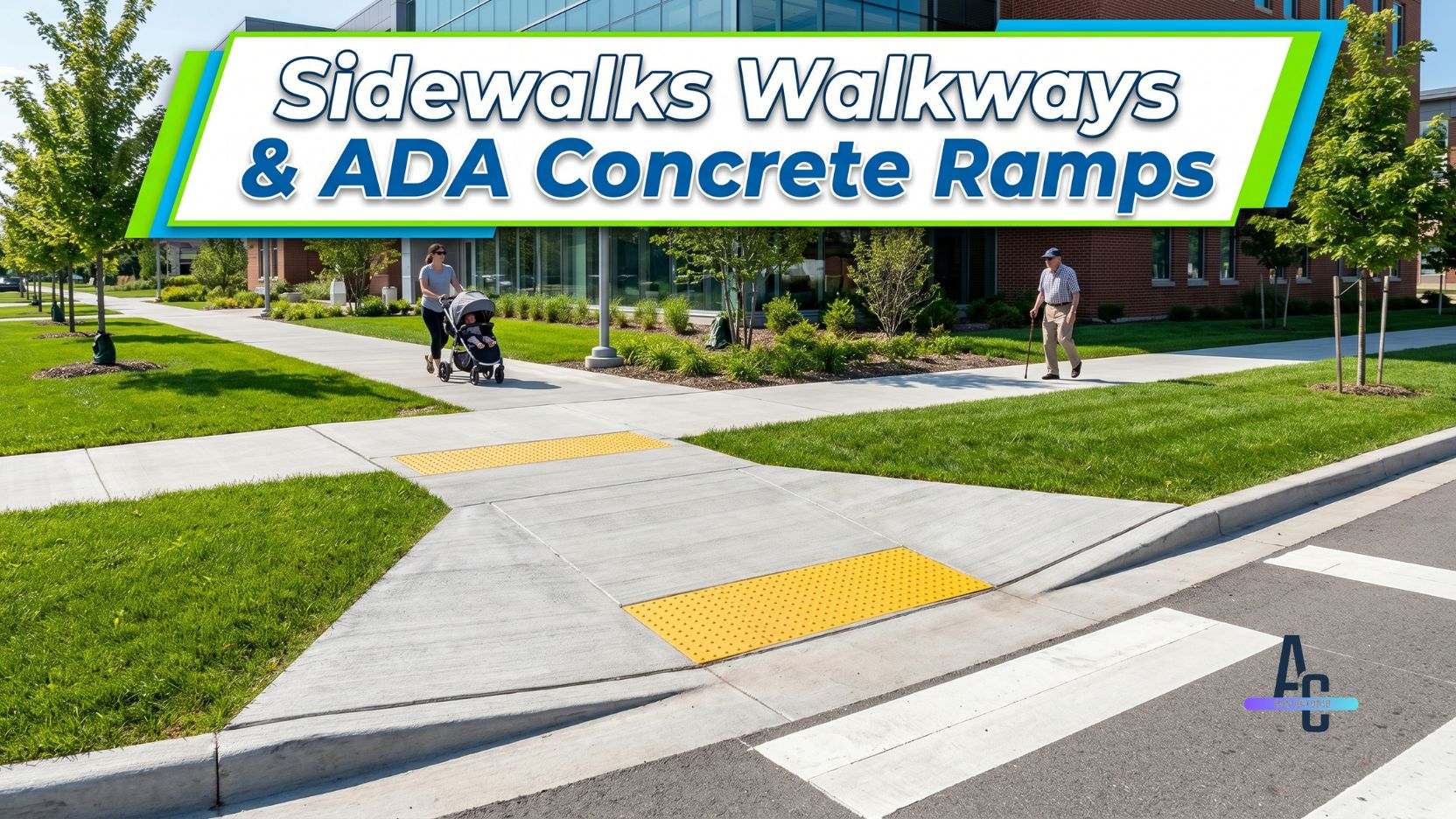
Whether you need a front walkway, a backyard path, or a fully code-compliant ADA curb ramp, this guide covers everything specs, costs, installation, and the compliance rules that matter most for San Antonio property owners in 2026.
A cracked front walkway, a sloped sidewalk that sheds water onto the foundation, or a commercial entrance that fails ADA standards these are problems that cost more to fix later than to do right the first time. Concrete sidewalks, walkways, and ADA ramps are some of the most common projects we complete in San Antonio, and they carry more rules than most homeowners and property managers realize.
This guide covers the full picture: what sets a residential walkway apart from a commercial sidewalk, what ADA compliance actually requires for curb ramps and accessible routes, what a properly specified job looks like, and what you should expect to pay in San Antonio in 2026. If you are planning any pedestrian concrete surface private path, public-facing sidewalk, or disability access ramp the information below applies directly to your project.
The most common and most costly mistake in walkway and ramp projects is skipping the structural specification before the pour. Slope requirements, minimum widths, truncated dome placement, and slab thickness are non-negotiable for ADA-regulated surfaces. A ramp that does not meet the 1:12 slope rule must be torn out entirely there is no patch for a non-compliant grade. The same logic applies to residential walkways: a slab poured without proper drainage slope or base preparation will crack and settle within a few years in San Antonio’s expansive clay soils. Get the spec right first. The pour is the easy part.
Project Types
Not all concrete pedestrian surfaces are the same. A front walkway leading to a residential front door operates under different rules than a sidewalk bordering a public right-of-way, and a commercial accessible route connecting a parking lot to a building entrance is governed by ADA federal standards that carry legal teeth. Knowing which category your project falls into determines the spec, the permits required, and who is responsible for code compliance.
Residential walkways on private property give homeowners the most flexibility. Width, finish, and drainage slope are largely a matter of preference though a minimum 3 feet of clear width is the practical standard and a 4-foot width is strongly recommended for comfort and utility. Public sidewalks along city streets are governed by the City of San Antonio’s Engineering Standards, which set minimum widths (typically 4 feet, and 5 feet or wider in higher-traffic areas) and require a Right-of-Way Encroachment Permit for any work within the public right-of-way. Commercial walkways on private property are subject to ADA requirements if the property serves the public, which includes virtually all retail, restaurant, medical, office, and multi-family developments.
In San Antonio, property owners are generally responsible for maintaining the sidewalk adjacent to their property even though it sits within the public right-of-way. If a public sidewalk in front of your home is damaged, cracked, or heaved, the City of San Antonio may share repair responsibility depending on the cause (city-owned trees are a common culprit). Before starting any sidewalk work adjacent to the street, contact the City of San Antonio Development Services Department and Public Works to confirm permit requirements and to determine whether the city has any cost-sharing programs available for your area.
| Walkway type | Minimum width | Governing standard | Permit typically required? |
|---|---|---|---|
| Residential front walkway | 3 ft recommended (4 ft preferred) | None at state level; local HOA may apply | Usually no |
| Public sidewalk (city right-of-way) | 4 ft minimum; 5+ ft on collector streets | City of San Antonio Engineering Standards | Yes ROW permit required |
| Commercial property walkway | 36 in. (3 ft) ADA minimum clear width | ADA Standards for Accessible Design (2010) | Yes building permit typically required |
| ADA accessible route | 36 in. minimum; 60 in. preferred where turning required | ADA Standards, Section 402 | Yes permits and inspection required |
| Curb ramp at intersection | 5 ft wide minimum landing at top | ADA Standards, Section 406; PROWAG | Yes always |
- Project category identified: residential, public right-of-way, commercial, or ADA-regulated
- Width requirements confirmed for your category before design is finalized
- Permit requirements checked with City of San Antonio Development Services before work begins
- HOA requirements reviewed if applicable some restrict concrete finishes or colors
- Base preparation specified in writing: 4-inch minimum compacted crushed limestone in San Antonio
ADA Standards
ADA compliance is not optional for commercial properties, multi-family housing, or any facility that serves the public. The Americans with Disabilities Act of 1990 and the 2010 ADA Standards for Accessible Design set specific, measurable requirements for ramps, walkways, landings, and curb cuts. A surface that does not meet these standards exposes property owners to ADA complaints, lawsuits, and remediation costs that far exceed the original construction savings. In San Antonio, the City enforces ADA accessibility standards through the building permit and inspection process for commercial projects.
- Ramp slope: Maximum 1:12 ratio (one inch of rise for every 12 inches of horizontal run). Steeper slopes do not qualify as ADA ramps.
- Cross slope: Maximum 1:48 (approximately 2%) across the width of any accessible route or ramp surface.
- Minimum ramp width: 36 inches of clear width between handrails.
- Handrails: Required on both sides of any ramp with a rise greater than 6 inches. Handrails must be 34 to 38 inches above the ramp surface.
- Edge protection: Curbs, walls, or barriers are required along the sides of ramps to prevent wheels from slipping off the edge.
- Landing at top and bottom: A flat landing (maximum 1:48 slope in any direction) at least 60 inches by 60 inches is required at the top and bottom of every ramp run.
- Maximum rise per ramp run: 30 inches. Longer rises must include intermediate landings at least 60 inches long.
- Surface: Stable, firm, and slip-resistant. Broom finish or exposed aggregate meet this requirement. Smooth-troweled or polished surfaces do not.
- Truncated domes (detectable warning surfaces): Required at curb ramps where the accessible route meets the vehicle way. Dome color must contrast with surrounding concrete (typically bright yellow in San Antonio).
- Curb ramp flare slope: Maximum 1:10 slope on the side flares of a perpendicular curb ramp where pedestrians walk.
Curb ramps are the most scrutinized ADA concrete element in San Antonio. There are two acceptable curb ramp types: the perpendicular ramp (which cuts directly through the curb, with the ramp running perpendicular to the curb face) and the parallel ramp (where the ramp runs parallel to the street, lowering the sidewalk into a depressed section). Perpendicular ramps with flared sides are the most common installation in San Antonio for both new construction and retrofit projects. Both types require detectable warning surfaces (truncated domes) at the base where the ramp meets the vehicle travel lane.
The most common ADA ramp failure in San Antonio: incorrect slope verification. A ramp that looks visually correct during construction can easily exceed the 1:12 maximum slope limit when measured with a digital level. The only way to confirm ADA compliance is to measure slope with a calibrated digital inclinometer at multiple points across the ramp width and length during and immediately after the pour. Do not rely on eyeballing the grade request written slope verification from your contractor before the project is accepted.
| ADA element | Code requirement | Most common violation |
|---|---|---|
| Ramp slope | Maximum 1:12 (8.33%) | Slope measured at 1:10 or steeper to save space |
| Cross slope | Maximum 1:48 (2.08%) | Excessive cross slope for drainage causes rolling difficulty |
| Ramp width | 36 in. minimum clear between handrails | Handrail posts reduce clear width below 36 in. |
| Landing at top and bottom | 60 in. x 60 in. minimum, max 1:48 slope | Landing too small or sloped beyond 2% |
| Truncated domes | Required at curb ramp/street interface; contrasting color | Omitted entirely or placed too far from street edge |
| Handrails | Both sides if rise exceeds 6 in.; 34–38 in. height | Handrail on one side only, or incorrect height |
| Surface texture | Stable, firm, slip-resistant | Smooth trowel finish applied for appearance |
- Ramp slope specified at 1:12 maximum in the project drawings before work begins
- Cross slope specified at 1:48 maximum across the full ramp and landing surface
- Landing dimensions confirmed at 60 x 60 inches minimum at top and bottom of every ramp run
- Truncated dome detectable warning surface specified at curb ramp base contrasting color confirmed
- Handrails specified on both sides for any ramp with rise greater than 6 inches
- Slope verification by digital inclinometer required and documented at project completion
- Building permit pulled and inspection scheduled do not skip the inspection process
Finish Options
The finish you choose for a walkway or sidewalk is not purely aesthetic. Safety requirements particularly slip resistance must guide finish selection for any pedestrian surface. ADA-regulated surfaces, pool-adjacent paths, and any walkway exposed to San Antonio’s summer rain events need a surface that provides meaningful traction. Smooth or polished finishes are never appropriate for exterior pedestrian concrete regardless of how they look.
Broom finish is the correct specification for any ADA ramp, public sidewalk, or utility walkway. The textured surface created by dragging a stiff bristle brush across the fresh concrete provides traction in wet conditions without requiring any maintenance. For a residential front entry walkway where appearance matters, a light broom finish with a brushed or swirl pattern adds visual interest at virtually no additional cost. Exposed aggregate is the premium walkway finish it looks exceptional alongside home landscaping and holds up well in San Antonio’s climate without requiring sealing as frequently as stamped concrete.
Stamped concrete can be used on residential walkways and garden paths, but it should not be specified for any surface that will be regulated under ADA standards or used as a public sidewalk. The uneven texture created by stamping molds can create tripping hazards and makes consistent slope measurement difficult. For front entry paths in upscale residential neighborhoods, stamped concrete with an integral color and contrasting release agent is a popular upgrade that significantly improves curb appeal.
The most requested walkway upgrade in San Antonio in 2026: exposed aggregate with a smooth broom-finished border. The border frame keeps the decorative aggregate contained and gives the path a finished, intentional look. The aggregate surface provides excellent slip resistance, the border is easy to maintain, and the combination looks far more polished than a standard broom finish across the whole surface. This design works particularly well for front entry paths, courtyard walkways, and garden paths adjacent to landscaped beds.
- Slip-resistant finish confirmed for any exterior pedestrian surface: broom, exposed aggregate, salt, or brushed not smooth trowel
- ADA ramps specified with broom finish only stamped or polished finishes are not acceptable on ADA surfaces
- Aggregate color and size confirmed in writing before pour if exposed aggregate is chosen
- Stamped pattern and color approved in writing before work begins if used on residential walkway
- Sealing schedule understood: stamped and stained walkways require resealing every 2 to 3 years
Structural Spec
Structural specification is where most walkway projects in San Antonio succeed or fail. The finish is visible, but the base preparation, slab thickness, and drainage slope are what determine whether a walkway lasts five years or thirty. In San Antonio’s expansive clay soils, these decisions matter more than in most U.S. cities.
The drainage slope requirement on a standard walkway (1% to 2% cross slope away from any adjacent structure) and the ADA maximum cross slope (2% on any accessible route) are the same number from opposite perspectives. A walkway that drains properly at 1.5% cross slope also meets ADA cross slope limits. The conflict arises when contractors pour with excessive cross slope for drainage on a surface that is supposed to meet ADA standards always measure and verify both requirements are satisfied simultaneously.
Control joints are critical in San Antonio. The coefficient of thermal expansion in concrete means temperature swings between San Antonio’s summer highs (100 degrees plus) and winter lows (occasional freezes) create significant stress in long, unjointed slabs. Tooled or saw-cut joints every 5 to 6 feet on a standard 4-foot-wide walkway create intentional weak points where the slab can crack cleanly, rather than randomly across the surface. These joints do not indicate a failure they are a required part of a correctly designed concrete walkway.
- Surface must be stable and firm no soft spots, no settled sections, no loose aggregate
- Vertical surface discontinuities (lips, edges, offsets) must not exceed 1/4 inch at any joint
- Horizontal openings (grates, drainage slots) must have openings no greater than 1/2 inch in the direction of travel
- No protruding objects over 4 inches into the accessible route path between 27 and 80 inches above the ground
- Running slope (in direction of travel) on an accessible route must not exceed 1:20 (5%) unless it is specifically designated and built as a ramp with handrails
Always request a written soil assessment or at minimum ask your contractor whether expansive clay is present on your property before pouring any walkway. In Bexar County, the vast majority of residential and commercial properties sit on Vertisol clay soils that expand significantly when wet and contract when dry. The seasonal movement of this soil is the number one cause of cracked and heaved walkways in San Antonio. A contractor who does not acknowledge this and specify an appropriate crushed limestone base is either inexperienced or cutting corners. Four inches of well-compacted crushed limestone base is the minimum six inches is better for walkways adjacent to areas with irrigation or heavy clay concentration.
- Slab thickness confirmed in writing: 4 inches minimum for all walkways, sidewalks, and ADA ramps
- Base preparation included in scope: minimum 4-inch compacted crushed limestone base in San Antonio
- Reinforcement specified: wire mesh for standard residential; rebar for commercial, longer spans, or ADA applications
- Drainage slope confirmed: minimum 1% (1/8 inch per foot) away from structures; maximum 2% on ADA surfaces
- Control joint spacing noted in contract: every 5 to 6 feet or approximately equal to the walkway width
- Concrete mix strength specified: minimum 3,000 psi; 3,500 to 4,000 psi for commercial and ADA applications
Cost Guide
Concrete walkway and ramp pricing in San Antonio varies based on project type, finish selection, access difficulty, base conditions, and whether ADA compliance documentation is required. The numbers below reflect complete, properly specified installations including base preparation, reinforcement, pour, finishing, and control joints. Quotes that omit base preparation or reinforcement will be lower and will fail sooner.
For a typical 40-foot front entry walkway at 4 feet wide (160 square feet), a standard broom-finish installation in San Antonio runs $960 to $1,600. An exposed aggregate upgrade on the same walkway runs $1,600 to $2,560. A stamped concrete version with color runs $2,000 to $3,200. ADA ramp installations are typically priced as a package by the project rather than per square foot a single curb ramp replacement at a commercial property commonly runs $3,500 to $8,000 depending on ramp height, handrail requirements, and site complexity.
- Quote is itemized: base preparation, reinforcement, pour, finish, and control joints listed separately
- Base preparation included in scope reject any quote that does not specify a crushed limestone base
- ADA ramp quotes include detectable warning surface, handrail fabrication, slope documentation, and permit
- At least three quotes obtained from licensed and insured San Antonio contractors
- Payment terms confirmed: 30 to 50 percent deposit, remainder on completion not full payment upfront
Repair Guide
Concrete walkway damage is common in San Antonio the combination of expansive clay soils, large live oaks and pecans with aggressive root systems, and the temperature swings between seasons creates a demanding environment for any concrete surface. Knowing the difference between normal cosmetic cracking and structural failure determines whether a repair or a full replacement is the right call.
The most important factor in a repair decision is whether the base is still intact. A hairline crack in a slab that sits flat and stable is a cosmetic issue fill it and move on. A crack with vertical displacement (where one side of the crack is higher than the other) means the base beneath one panel has moved, either from root pressure, soil settling, or erosion. That panel will not stop moving by patching the surface crack the panel needs to come out, the base needs to be re-compacted, root barriers installed if necessary, and a new panel poured.
For commercial and ADA-regulated surfaces, the repair threshold is lower. The ADA requires that vertical surface discontinuities (lips between panels) not exceed 1/4 inch. A settled or heaved panel that creates even a 3/8-inch lip at a joint in an accessible route is an ADA compliance violation and a trip hazard it needs to be addressed immediately, either through grinding the high edge or replacing the panel. Property owners who are aware of and ignore ADA surface discontinuities in a public-facing accessible route face significantly greater liability exposure than they would from the repair cost.
Mudjacking (also called slabjacking or concrete lifting) is an option for settled panels that have not cracked. A slurry of cement, soil, and water is pumped beneath the slab through drilled holes, lifting the panel back to grade without replacement. In San Antonio, mudjacking costs $3 to $8 per square foot versus $6 to $10 per square foot for full panel replacement. It is a legitimate and effective repair for settled panels in good structural condition but it does not address root intrusion, base contamination with clay, or panels that have cracked through. For ADA surfaces, mudjacking results must be verified with slope measurement before the surface is returned to service.
- Crack width measured: under 1/4 inch is cosmetic; over 1/4 inch warrants a professional assessment
- Vertical displacement checked at every joint: any lip over 1/4 inch is an ADA violation on accessible routes
- Panel stability tested: rock each panel by hand or foot a rocking panel indicates a void beneath
- Root intrusion checked: surface heaving adjacent to trees almost always means root pressure beneath the slab
- ADA surfaces re-measured for slope compliance after any repair before returning to service
- Repair method matched to actual cause: surface filling for hairline cracks, panel replacement for structural damage
Use this table as your reference for any pedestrian concrete project. Each row covers the key specification, finish, compliance requirement, and cost range for that project type in San Antonio.
| Project type | Min. slab thickness | Recommended finish | Key compliance requirement | Cost range (San Antonio) |
|---|---|---|---|---|
| Residential front walkway | 4″ | Broom, exposed aggregate, or stamped | None (HOA rules may apply) | $6–16/sqft by finish |
| Residential garden path | 4″ | Broom, salt finish, exposed aggregate | None | $6–12/sqft |
| Public sidewalk (city ROW) | 4″ | Broom finish standard | City of SA Engineering Standards; ROW permit | $5–8/sqft |
| Commercial walkway | 4″ | Broom finish (ADA-compliant) | ADA Standards 36″ min. width, 5% max. running slope | $12–18/sqft |
| ADA curb ramp (perpendicular) | 4″ | Broom finish + truncated domes | 1:12 max slope, 60″x60″ landing, handrails if rise > 6″ | $3,500–$8,000/ramp |
| ADA accessible route connection | 4″ | Broom finish | 36″ min. clear width, 1:48 max. cross slope, 1:20 running slope | $12–18/sqft |
| Sidewalk repair (panel replacement) | Match existing (4″ min.) | Match existing broom or aggregate | ADA lip rule: max. 1/4″ vertical displacement at joints | $6–10/sqft |
| Mudjacking (settled slab lifting) | N/A existing slab | N/A existing surface | Slope must be re-verified on ADA surfaces after lifting | $3–8/sqft |
- Project category confirmed: residential, public right-of-way, commercial, or ADA-regulated
- Permit requirements verified with City of San Antonio Development Services before work begins
- HOA reviewed for any finish or color restrictions on front-facing concrete
- City of SA Public Works contacted if work involves public sidewalk adjacent to street
- Slab thickness confirmed in writing: 4 inches minimum for all sidewalks, walkways, and ADA ramps
- Base preparation included: 4-inch minimum compacted crushed limestone base specified in contract
- Reinforcement type specified: wire mesh or rebar confirmed before work begins
- Control joint spacing noted: every 5 to 6 feet or approximately equal to path width
- Concrete mix strength specified: minimum 3,000 psi; 3,500 to 4,000 psi for commercial and ADA
- Drainage slope confirmed: 1% minimum cross slope away from structures; 2% maximum on ADA surfaces
- Ramp slope confirmed at 1:12 maximum in project drawings verified by digital inclinometer after pour
- Cross slope confirmed at 1:48 maximum across full ramp and route surface
- Landing dimensions confirmed: 60 x 60 inches minimum at top and bottom of every ramp run
- Truncated dome detectable warning surface specified at curb ramp base contrasting color confirmed
- Handrails specified on both sides for any ramp with a rise greater than 6 inches
- Written slope documentation required from contractor at project completion
- Building permit pulled and inspection scheduled through City of San Antonio
- Certificate of insurance received and verified: $1M minimum general liability coverage
- Quote itemizes all components separately: base prep, reinforcement, pour, finishing, cleanup
- Payment terms confirmed: 30 to 50 percent deposit upfront, balance on completion and inspection
- Local references from completed San Antonio walkway and ramp projects available on request
How much does a concrete sidewalk or walkway cost in San Antonio?
What are the ADA requirements for concrete ramps in San Antonio?
Who is responsible for a broken sidewalk in front of my San Antonio home?
Why is my concrete walkway cracking and heaving in San Antonio?
Do I need a permit to pour a concrete walkway in San Antonio?
What is the best concrete finish for a residential walkway in San Antonio?
Get a free sidewalk or ADA ramp quote in San Antonio
Tell us about your project residential walkway, commercial accessible route, ADA curb ramp, or sidewalk repair. We will visit your property, assess the site, and give you a detailed written quote at no cost.