
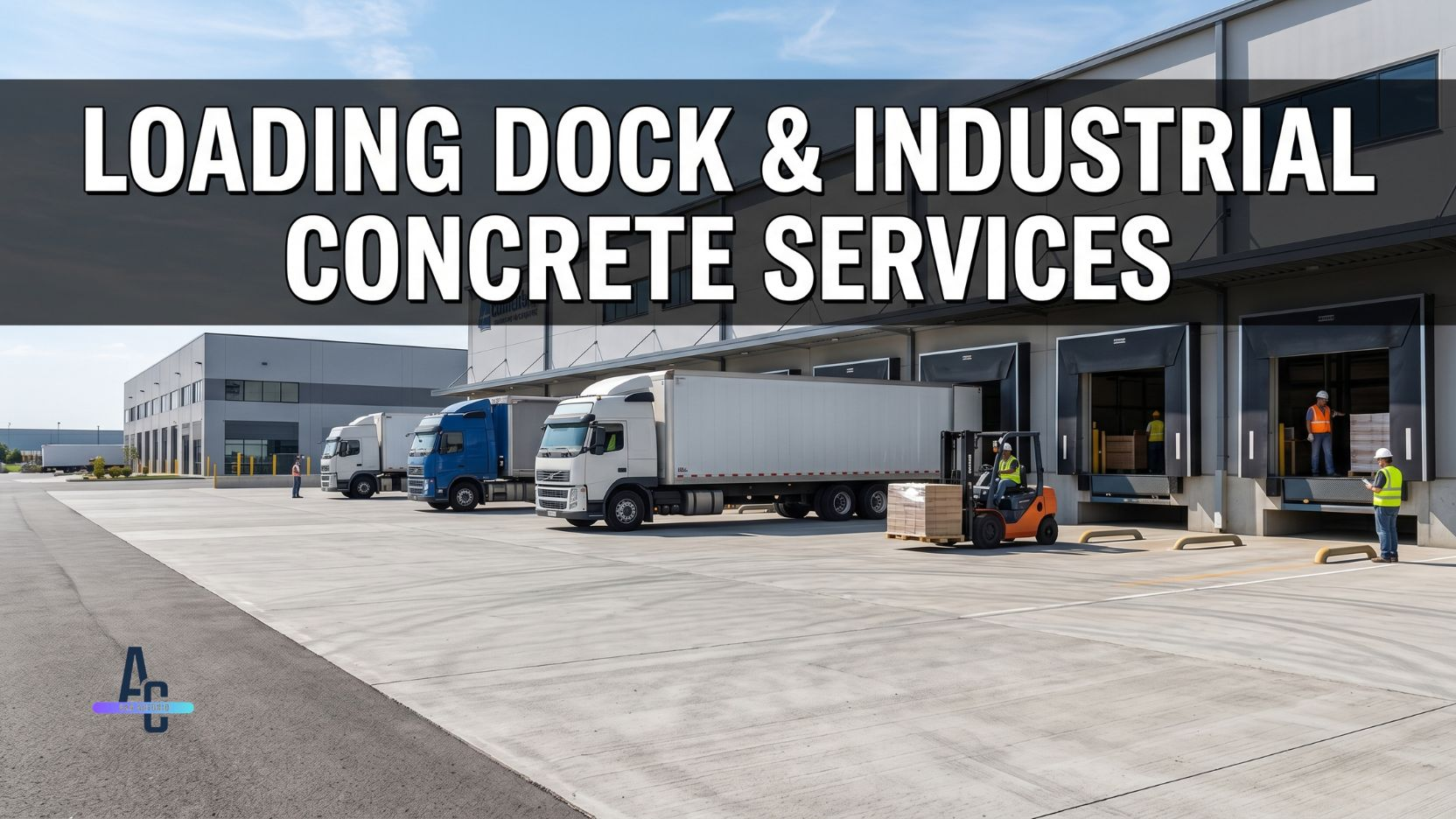
Loading docks, warehouse floors, and industrial aprons take punishment that residential concrete never faces. This guide covers every spec decision from slab thickness and joint design to surface hardeners and drainage so your next industrial pour holds up to decades of forklift traffic and heavy freight.
A loading dock that fails is not just a concrete problem. It is an operations problem. Cracked aprons create trip hazards, damage equipment, slow freight movement, and expose your facility to liability. In San Antonio’s industrial corridors, from the South Side distribution hubs to the Northeast Side logistics parks, we see the same patterns repeat: slabs poured to residential specs, joints spaced wrong for forklift axle loads, and surface treatments skipped in the name of cutting the bid. The result is a slab that looks fine at six months and needs full replacement by year five.
This guide covers everything a facility manager or property owner needs to know before contracting industrial concrete work in San Antonio: slab specifications, joint design, surface hardeners, drainage requirements, loading dock pit and leveler details, and how to evaluate a contractor’s bid for the details that separate a 10-year slab from a 30-year slab.
Residential and light commercial concrete is spec’d by use category and slab area. Industrial concrete has to be engineered around the heaviest axle load that will ever cross the slab. A fully loaded Class 8 freight truck puts 20,000 lbs on a single axle. A heavy forklift carrying a 10,000-lb pallet concentrates that load on four small contact patches. Thickness, reinforcement, subbase preparation, and joint design all derive from that number. If your contractor isn’t asking about your heaviest vehicle load before quoting, they’re guessing at the spec.
Slab Spec
Industrial concrete is not just thicker residential concrete. The mix design, reinforcement schedule, and curing protocol are all different from a standard commercial pour. Getting the slab thickness wrong is expensive to fix: it requires full demolition and repour. Getting the mix wrong shows up more slowly, as surface dusting, scaling, or premature cracking under load.
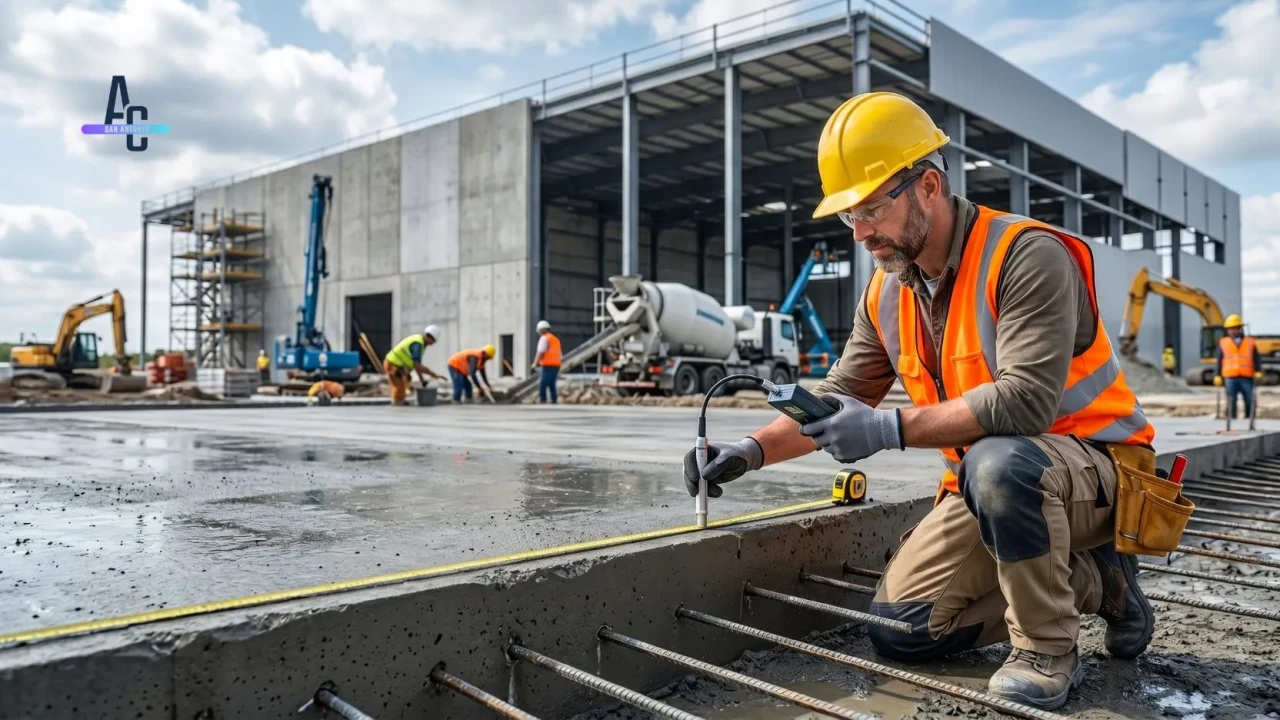
Dock aprons and truck approach areas: 7–8″ minimum. These areas take the full axle weight of Class 8 vehicles transitioning from grade to dock height. Rebar at #5 or #6 on 12″ centers in both directions is standard. The subbase needs a minimum of 6″ of compacted crushed stone, and more if site soils are soft or poorly draining.
Interior warehouse floors: 6″ minimum for typical counterbalance forklift traffic. Reach trucks and heavy-load operations with axle weights above 15,000 lbs should spec 7–8″. Fiber-reinforced concrete (synthetic or steel fibers added to the mix) is increasingly the standard for warehouse floors because it reduces shrinkage cracking and adds toughness at the surface.
- Slab thickness specified per application: 7–8″ for dock aprons, 6–7″ for warehouse floors
- Compressive strength minimum stated in the quote: 4,000 psi for general industrial, 4,500 psi for heavy dock
- Reinforcement type and spacing specified: rebar size, spacing, and direction for all load-bearing areas
- Fiber reinforcement noted for interior floors where crack control is the primary goal
- Subbase depth and type included: 6″ minimum compacted crushed stone; lime stabilization noted for clay sites
Joint Design
In residential and commercial concrete, joints are primarily about shrinkage control, giving the slab a place to crack that isn’t random. In industrial concrete, joints do that and more: they manage load transfer between panels, accommodate slab movement under dynamic forklift loads, and protect dock equipment from differential settlement. A poorly jointed industrial floor shows up quickly as spalled and broken joint edges, which is one of the most common and costly industrial concrete failures.
| Joint Type | Application | Key specification detail |
|---|---|---|
| Control joint (saw-cut) | Interior warehouse floors; general industrial slabs | Cut to 1/4 of slab depth within 4–12 hours of pour; spacing equal to 24–36x slab thickness (e.g., 12′ on center for a 6″ slab) |
| Isolation joint | Where slab meets columns, walls, dock pits, or equipment pads | Full-depth break with compressible filler to allow independent movement; prevents slab cracking from column loads |
| Construction joint (doweled) | End of day’s pour; truck court and dock apron panels | Smooth dowel bars (1″ diameter, 18″ long, 12″ on center) enable load transfer while allowing horizontal movement |
| Armored joint | High-traffic forklift aisles; dock approach zones | Steel angle or proprietary armored edge system embedded at joint to prevent spalling under repeated dynamic loads; critical at dock leveler pockets |
Map forklift travel paths before designing the joint layout: The single best thing you can do for joint durability in a warehouse floor is to make sure the joint layout does not place joints perpendicular to main forklift travel aisles. When a forklift wheel hits a transverse joint at speed with a loaded pallet, the impact load is many times the static load. Joints in high-traffic aisles should run parallel to travel direction wherever possible, and any transverse joints in those zones should be armored. Share your equipment and racking layout with the contractor before the joint plan is finalized.
At dock doors specifically, the transition zone between the exterior apron and interior floor needs an armored construction joint or a properly detailed expansion joint. This is the point of maximum load variability: trucks backing up and pulling out, dock levelers cycling, forklifts crossing continuously. An unarmored or poorly sealed joint at this location will spall within two to three years under active loading, regardless of how good the rest of the pour is.
- Joint spacing confirmed for slab thickness: spacing (in feet) no more than 2–3 times the slab thickness (in inches)
- Doweled construction joints specified for dock aprons and any panels exceeding 20 feet in length
- Armored joints specified at dock door transitions and primary forklift aisle crossings
- Isolation joints included around all columns, walls, dock pits, and embedded equipment pads
- Saw-cut timing confirmed: cuts scheduled within 4–12 hours of pour to prevent random cracking
- Joint filler and sealant type specified: polyurea or semi-rigid epoxy for industrial traffic areas
Surface Treatment
Plain concrete, even at 4,500 psi, has a relatively soft surface layer that wears under forklift traffic, tire rubber, and the abrasive grit that gets tracked into warehouses. Surface hardeners and sealers are not optional upgrades for industrial applications. They are part of the base specification. The choice of treatment depends on the type of traffic, chemical exposure, and whether the floor needs to meet any slip-resistance or food-safety standards.
| Treatment type | Best for | Typical cost add | Reapplication |
|---|---|---|---|
| Dry shake hardener (metallic or mineral aggregate) | Warehouse floors under heavy forklift traffic; dock approach slabs | $1.50–3.00/sqft added to pour cost | One-time; incorporated at pour; no reapplication needed |
| Liquid chemical densifier (silicate or siliconate) | Existing or new slabs where dusting is a concern; light to medium traffic | $0.50–1.00/sqft | Every 3–5 years depending on traffic volume |
| Two-part epoxy coating system | Food processing, auto service, pharmaceutical; chemical resistance required | $3.00–6.00/sqft for a full two-coat system | Recoat every 5–10 years; prep and prime required for adhesion |
| Polyurethane topcoat sealer | Exterior dock aprons; any surface with UV exposure | $1.00–2.00/sqft | Every 3–5 years; appropriate surface prep required before recoating |
For dock aprons, specify a polyurethane sealer over a bare concrete surface rather than epoxy: Exterior aprons experience thermal cycling, UV exposure, and moisture intrusion from rain and pressure washing that cause epoxy coatings to delaminate within two to three years. Penetrating polyurethane sealers flex with the concrete, resist UV degradation, and last considerably longer on exterior applications. Save the epoxy system for interior floors where the conditions are controlled and chemical resistance is actually needed.
- Surface treatment type confirmed for application: dry shake hardener for new warehouse pours, densifier for existing slabs
- Epoxy or polyurethane coating specified only after confirming slab moisture levels meet manufacturer minimums (typically under 3 lbs/1,000 sqft/24hr)
- Exterior dock aprons specified with UV-stable polyurethane sealer, not epoxy
- Slip resistance rating confirmed for dock areas and any areas subject to wet conditions
- Reapplication schedule included in the maintenance plan for any applied coating system
Dock Details
The dock pit and leveler pocket are the most structurally complex parts of any loading dock concrete pour. They are also the areas most likely to suffer early failure when a contractor underestimates the spec. The pit walls carry the full horizontal load of trucks backing into the dock and the cyclic vertical load of the leveler. The pocket edges take repeated impact from the leveler deck and lip. Both need specific detailing that goes well beyond a simple formed concrete pour.
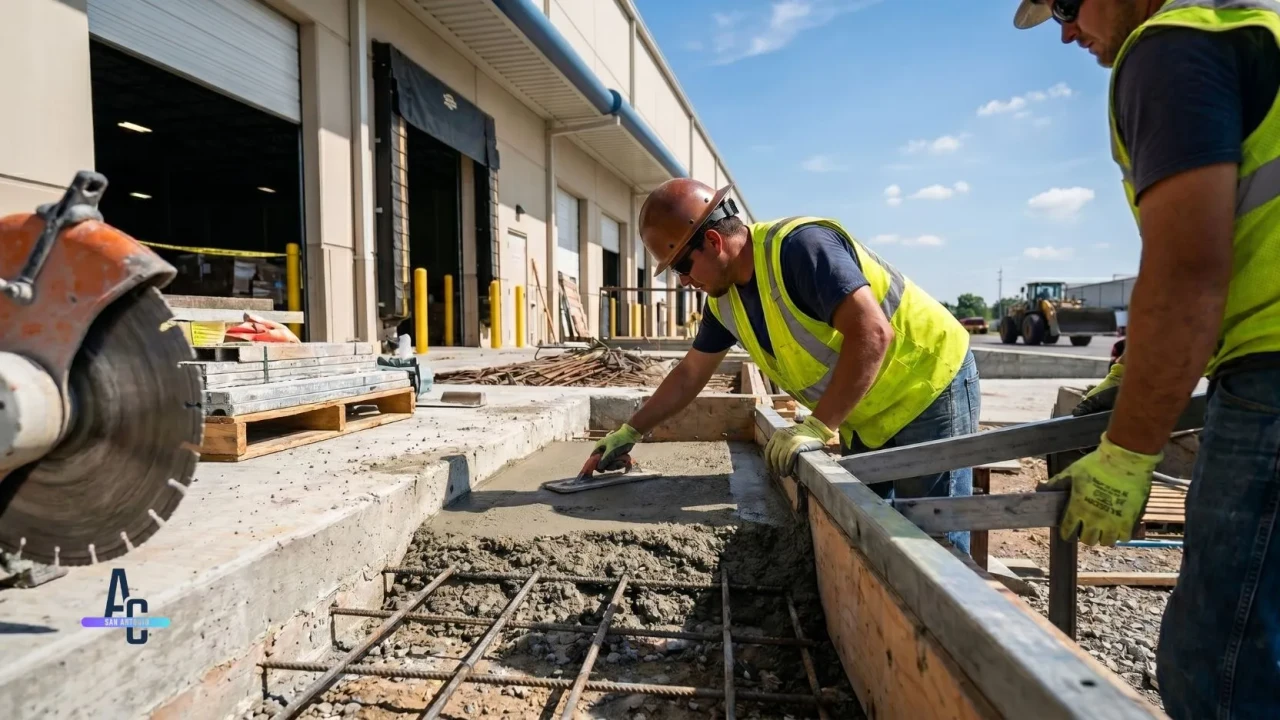
Dock pit walls: A minimum 8″ thick reinforced concrete pit wall is required. Rebar at #5 on 12″ centers in both vertical and horizontal runs. The pit floor should be a minimum 6″ slab with drain provision. Waterproofing the exterior pit wall face with a crystalline or sheet membrane is strongly recommended in San Antonio, where seasonal rain events can saturate the soil around the pit rapidly.
Leveler pockets: The concrete surrounding the leveler pocket must be formed with steel edge angles or a proprietary steel-framed pocket form. Plain concrete edges at a leveler pocket will fail within months under leveler cycling loads. The steel angle should be embedded in the concrete during the pour, not surface-applied after curing.
Drainage at dock aprons: Standing water at a dock apron accelerates freeze-thaw damage, creates slip hazards, and accelerates joint deterioration. Dock aprons should be sloped a minimum of 1% (1/8″ per foot) away from the dock face toward a trench drain or area drain at the outer edge of the apron. The drain should be sized for the impervious area it serves, factoring in San Antonio’s high-intensity rain events. A 6″-wide slot drain at the toe of the apron is the most common and effective configuration for active truck docks.
- Pit wall thickness confirmed at 8″ minimum with full rebar schedule, not just dowels from the floor slab
- Leveler pocket formed with steel edge angles or proprietary steel pocket form; plain concrete pocket edges not accepted
- Cast-in anchor bolts specified for all dock bumpers and seal plate hardware; no drilled-in anchors
- Pit exterior waterproofing included in the scope where soil contact is present
- Apron drainage slope confirmed: 1% minimum grade toward trench drain at apron toe
- Trench drain sized for impervious apron area, not undersized for cost reduction
Contractor Vetting
The gap between a well-spec’d industrial concrete bid and a price-driven one is significant, typically 20 to 40 percent. The lower bid is almost never apples-to-apples. It gets there by reducing slab thickness by an inch, swapping rebar for wire mesh, eliminating the surface hardener, and quoting a thinner subbase. Each of those cuts individually may seem minor. Together, they produce a slab that fails in five years instead of lasting thirty.
| What to ask | What a qualified contractor says | Red flag answer |
|---|---|---|
| What is the slab spec for this loading dock? | Provides thickness, psi, rebar size and spacing, and subbase depth without being prompted | “Standard commercial spec” with no specific numbers |
| How will you handle the leveler pockets? | Specifies steel-framed pocket forms and embedded edge angles; mentions this without prompting | “We form them with wood” or no mention of edge steel |
| What surface hardener or treatment do you include? | Names the hardener type (dry shake or densifier) and explains where each applies | “We can add that for extra”; no hardener in the base scope |
| How do you handle joints at the dock door transition? | Describes armored joint or doweled construction joint with specific detail | “Just a saw cut”; no armoring or load transfer mentioned |
| What is your experience with industrial pours in San Antonio? | Names specific projects, mentions local soil conditions and subbase approach | Only residential or light commercial references; no mention of expansive soil management |
| What mix design will you use? | States minimum psi, mentions water-cement ratio, and describes fiber content or admixtures if applicable | “Ready-mix from [supplier]” with no spec details on the mix itself |
Ask every bidder to provide a scope of work that lists the same line items: slab thickness, compressive strength, reinforcement type and spacing, subbase depth and material, joint type and spacing, surface treatment, and drainage provisions. When all bids address the same line items, price comparisons become straightforward. A contractor who refuses to specify these items in writing is a contractor who plans to make those decisions in the field, which is not in your interest.
Use this table to cross-check any contractor quote against the minimum specifications for each industrial concrete application in San Antonio.
| Application | Min. slab thickness | Min. compressive strength | Reinforcement | Cost range (San Antonio) |
|---|---|---|---|---|
| Loading dock apron (Class 8 trucks) | 7–8″ | 4,500 psi | #5 rebar, 12″ o.c. both ways | $14–18/sqft |
| Truck court / trailer staging | 7–8″ | 4,500 psi | #5 rebar, 12–18″ o.c.; doweled joints | $12–16/sqft |
| Warehouse floor (heavy forklift) | 6–7″ | 4,000–4,500 psi | #4–#5 rebar or fiber-reinforced | $10–14/sqft |
| Warehouse floor (light/medium traffic) | 5–6″ | 4,000 psi | Fiber-reinforced or wire mesh | $8–11/sqft |
| Dock pit walls | 8″ wall thickness | 4,000 psi | #5 rebar, vertical and horizontal | Bid per linear foot of pit |
| Industrial equipment pad | 6–8″ (load-dependent) | 4,000–4,500 psi | #4–#5 rebar or per equipment spec | $10–15/sqft |
| Light industrial service apron | 5–6″ | 3,500–4,000 psi | Wire mesh or light rebar | $8–11/sqft |
- Slab thickness confirmed per application type: 7–8″ for dock aprons and truck courts, 6–7″ for warehouse floors
- Compressive strength stated: 4,000 psi minimum for all industrial applications, 4,500 psi for active truck loading
- Reinforcement fully described: rebar size, spacing, and direction; not just “rebar included”
- Subbase depth and material confirmed: 6″ minimum compacted crushed stone; lime stabilization noted for clay sites
- Mix design specifics stated: water-cement ratio, fiber content, and any admixtures noted in writing
- Joint layout drawing or plan included with the quote; not just “joints as needed”
- Armored joints specified at all dock door transitions and primary forklift aisle crossings
- Doweled construction joints included for dock apron and truck court panels
- Leveler pocket detail confirmed: steel-framed form and embedded edge angles
- Cast-in anchor bolts specified for dock bumpers and all embedded hardware
- Surface hardener type confirmed: dry shake for new warehouse pours, densifier for existing slabs
- Sealer or coating type specified for exterior aprons: polyurethane (not epoxy) for UV-exposed surfaces
- Apron drainage slope confirmed: minimum 1% grade toward trench drain
- Trench drain capacity sized for the apron’s impervious surface area
- Pit exterior waterproofing included where soil contact is present
- Certificate of insurance received: $2M general liability minimum for commercial and industrial work
- Scope of work itemizes every spec line; no line items left as “standard” without detail
- Industrial concrete references from completed San Antonio projects available and verified
- Payment terms confirmed: progress billing tied to completed scope milestones, not front-loaded
- Curing plan confirmed: wet cure or liquid curing compound for minimum 7 days on all industrial pours
How thick should a loading dock apron be in San Antonio?
What does industrial concrete cost in San Antonio in 2026?
Why do joint edges on my warehouse floor keep spalling and breaking?
Can we pour a loading dock apron during San Antonio summers?
Do I need permits for loading dock or industrial concrete work in San Antonio?
Get a free industrial concrete quote in San Antonio
Tell us about your loading dock, warehouse floor, or industrial apron project. We will assess your site, review your load requirements, and give you a detailed written quote at no cost.