
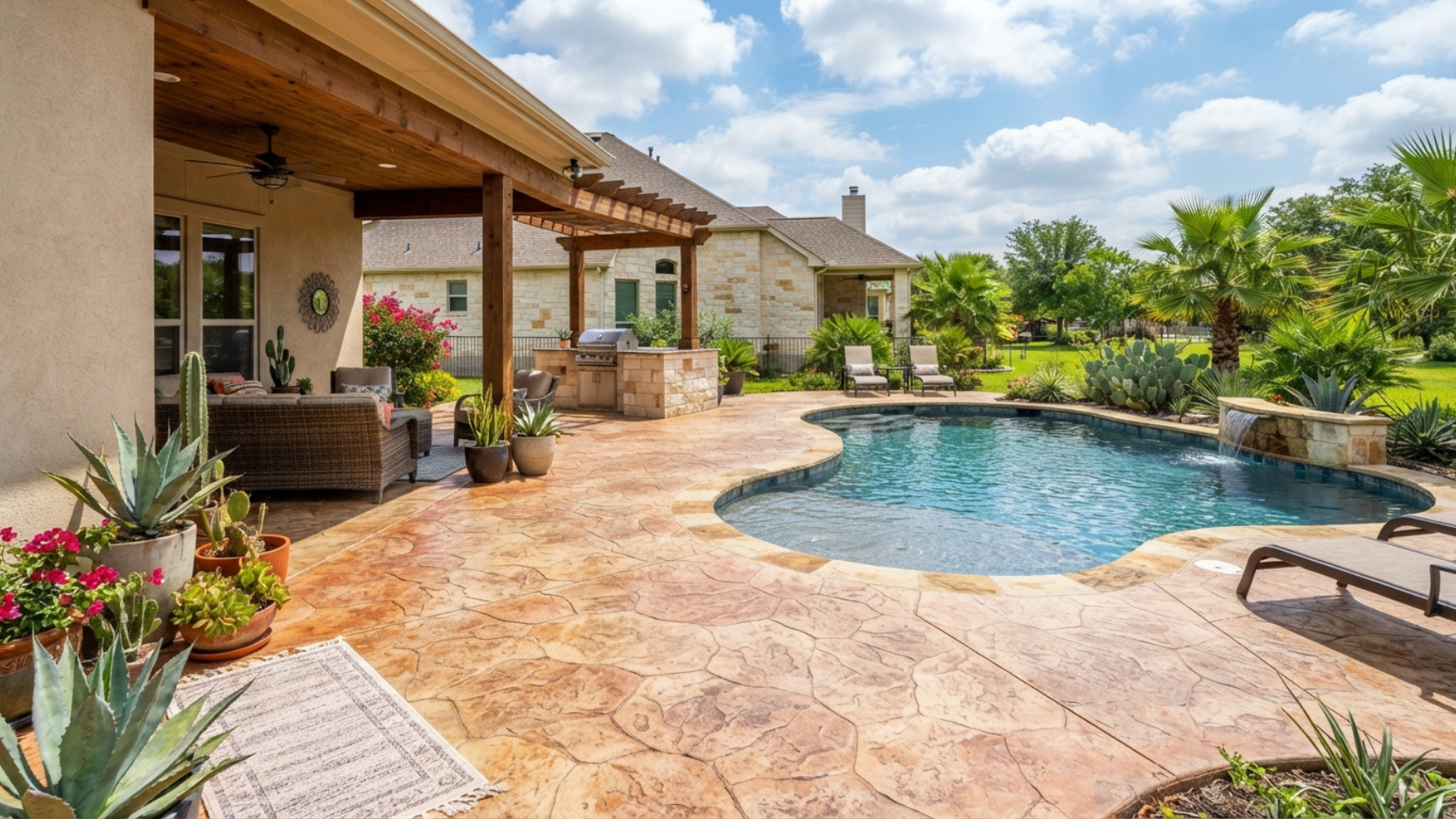
Plain gray concrete does not have to be the default for your San Antonio driveway, patio, pool deck, or interior floor. This guide covers the best decorative concrete options available in Bexar County with real cost ranges, durability notes for Texas conditions, and the ideas that work best in San Antonio’s climate and architectural style.
San Antonio homeowners have more decorative concrete options than ever in 2026, and the gap between a plain broom-finish slab and a high-end stamped or stained surface has never been wider in terms of curb appeal and resale value. Decorative concrete is not a niche product it is the most cost-effective way to achieve the look of natural stone, brick, or slate on a driveway, patio, pool deck, or interior floor, at a fraction of the cost of the real materials.
The challenge is that San Antonio’s environment adds specific demands. The Blackland Prairie clay soil that runs through most of Bexar County expands and contracts with moisture meaning every decorative surface needs proper base preparation and expansion joints to avoid premature cracking. Edwards Aquifer hard water leaves mineral deposits on exterior surfaces that affect how stains and sealers perform. And with over 220 days of sunshine per year, UV stability in every finish coat is not optional. This guide covers the ideas that work best in San Antonio, with those local conditions in mind from the start.
Every decorative concrete idea in this guide requires the same underlying structural commitment: proper base preparation on Bexar County’s expansive clay soil, correct slab thickness for the intended use, rebar or wire mesh reinforcement, and expansion joints at the right spacing. A stamped patio that cracks in year two because the base was skimped is not a decorative concrete problem it is a contractor selection problem. Get the structural spec correct, choose a qualified local crew, and then pick the decorative finish that fits your style and budget. That is the order of decisions that produces results lasting 20 to 30 years.
Patio
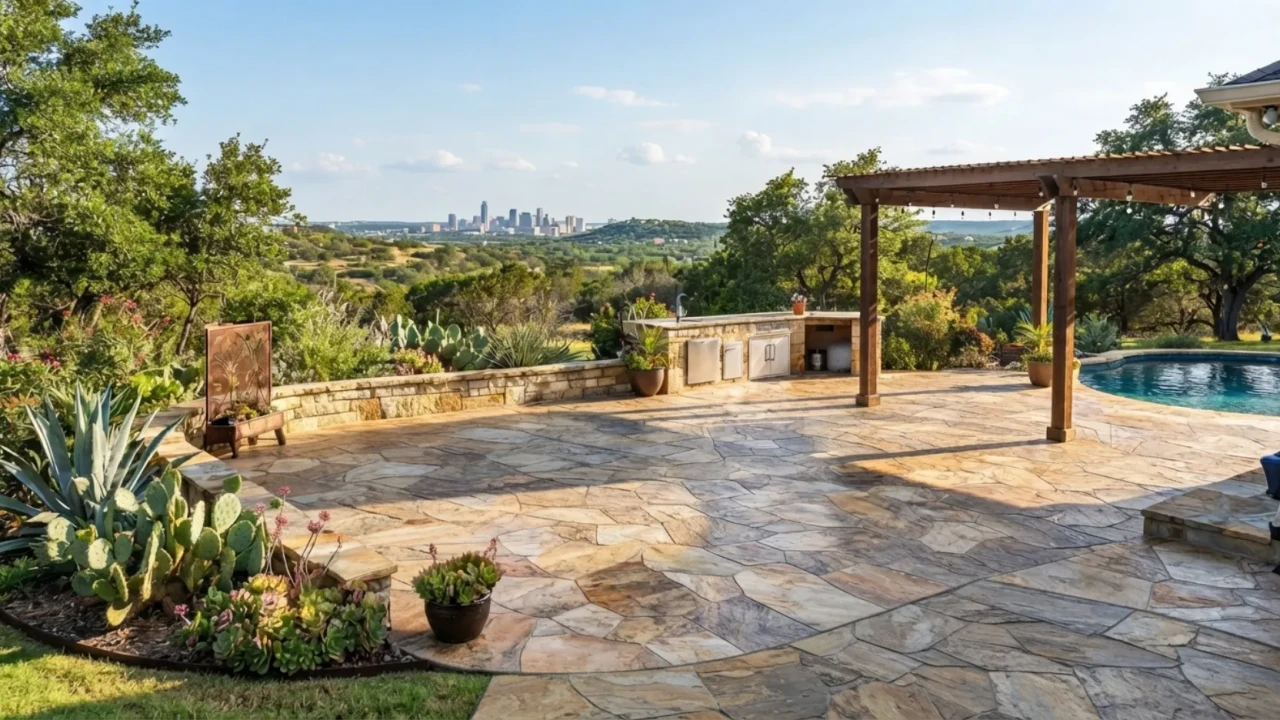
Stamped concrete is the single most requested decorative upgrade for San Antonio patios in 2026. A stamping mat pressed into freshly poured concrete creates the visual texture and depth of natural stone, flagstone, brick, or slate at roughly 30 to 50 percent of the cost of installing those real materials. For a backyard that gets regular outdoor entertaining use, the combination of durability and visual appeal is hard to match with any other surface.
The most popular patterns in San Antonio’s residential market include Ashlar slate (clean geometric lines that complement the region’s limestone architecture), flagstone (organic, irregular edges that feel natural in Hill Country-adjacent neighborhoods), and cobblestone border treatments paired with a smooth or broom-finish field for a high-end custom look. Integral color pigment added directly to the concrete mix rather than applied to the surface is the preferred approach for long-term color retention in Texas UV conditions.
- Pattern and color confirmed in writing before work begins stamps cannot be changed once concrete sets
- Integral color specified instead of surface-only color hardener for best UV performance in San Antonio
- Slab drainage slope confirmed at 1/8 inch per foot away from the house foundation
- First reseal scheduled at 28 to 30 days after pour, once the slab reaches full cure
Driveway
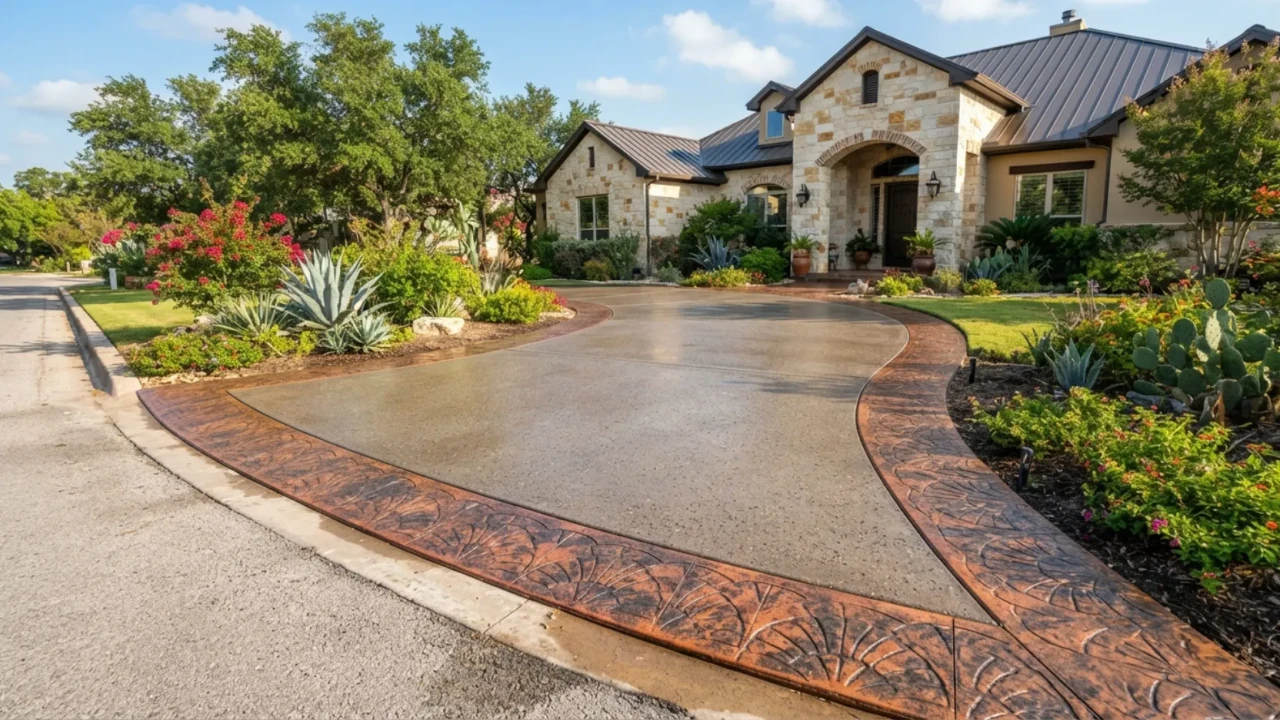
A full stamped driveway is one of the most impactful curb appeal investments a San Antonio homeowner can make. Unlike a plain broom-finish slab, a decorative driveway makes an immediate visual statement from the street and because it requires no additional materials beyond the concrete pour itself, the cost premium over a standard driveway is often less than homeowners expect.
The most popular approach for San Antonio driveways is a combination layout: a stamped border treatment (typically a cobblestone or brick pattern running 24 to 36 inches along both sides and across the apron) paired with a broom-finish or lightly textured field in the center. This design delivers the visual impact of a fully stamped surface at a lower total cost, while keeping the center of the driveway in a broom finish that is easier to maintain and more slip-resistant under wet conditions.
The border-plus-field approach is the most cost-effective decorative driveway option in San Antonio: A stamped cobblestone border running the perimeter of a standard two-car driveway (approximately 18 by 40 feet) covers 15 to 20 percent of the total surface area but delivers 80 percent of the visual impact of a fully stamped driveway. Pair it with an acid-stained or integrally colored broom-finish field for a custom look that stays within reach of most residential budgets typically $12 to $15 per square foot installed, versus $16 to $20 for a fully stamped surface.
- Rebar reinforcement confirmed in the contractor quote wire mesh alone is not adequate for vehicle-bearing slabs on San Antonio clay
- Border pattern and field finish specified in writing with a reference photo approved by the homeowner
- Apron treatment coordinated with the street approach the connection to the public sidewalk must meet City of San Antonio specifications
- Sealer type confirmed as vehicle-traffic-rated standard patio sealers are not formulated for driveway use
Pool Deck
Pool deck concrete in San Antonio serves three distinct requirements simultaneously: it must be non-slip when wet, it must not become dangerously hot underfoot in summer, and it must look attractive as the visual backdrop for one of the home’s most-used outdoor spaces. Decorative concrete handles all three requirements better than nearly any alternative surface material at a comparable price point.
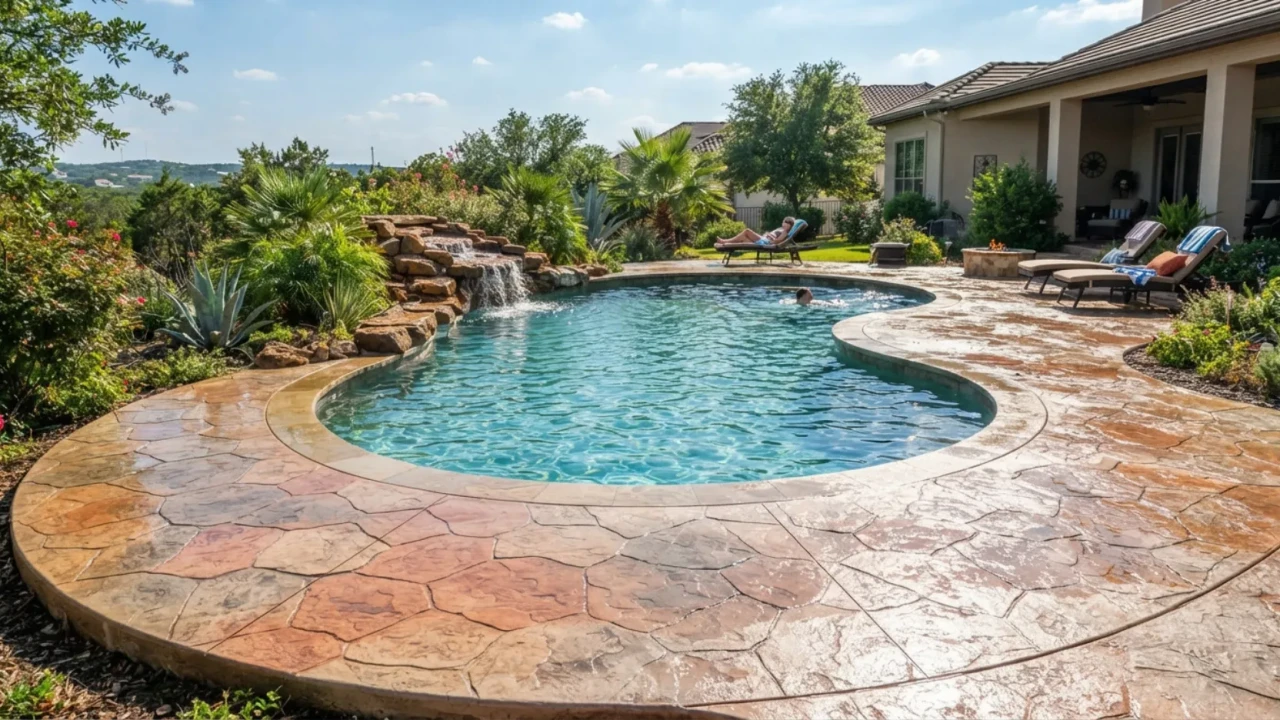
Exposed aggregate is the leading pool deck finish choice in Bexar County for good reason. The washed-away surface paste reveals natural stone aggregate embedded in the mix creating an inherently textured, slip-resistant surface that does not require a separate non-slip additive in the sealer. Light-colored aggregate (white quartz, tan river pebble, or cream limestone) also reflects solar radiation rather than absorbing it, keeping barefoot surface temperatures significantly lower than dark-colored or smooth finishes.
Stamped concrete pool decks in a Travertine or Ashlar slate pattern with a light integral color are the premium alternative producing a resort-style appearance that photographs well and adds measurable appeal in San Antonio’s real estate market. For stamped pool decks, a non-slip additive in the sealer coat is required, as stamped surfaces become slick when wet without it.
- Non-slip finish or non-slip sealer additive confirmed all pool deck surfaces require adequate wet traction
- Surface color specified as light-toned for heat management on unshaded sections
- Drainage slope confirmed away from the pool coping and toward perimeter drains 1/8 inch per foot minimum
- Sealer rated for pool chemical exposure and moisture standard landscape sealers are not formulated for pool deck conditions
Interior
Interior concrete staining has moved well beyond garage floors in San Antonio’s residential market. Homeowners in Alamo Heights, Tobin Hill, and the urban core are increasingly choosing stained concrete as the primary floor finish in living rooms, kitchens, and home offices attracted by its low allergen profile, easy maintenance, and the unique visual character that acid staining produces. No two stained concrete floors look identical, which is part of the appeal.
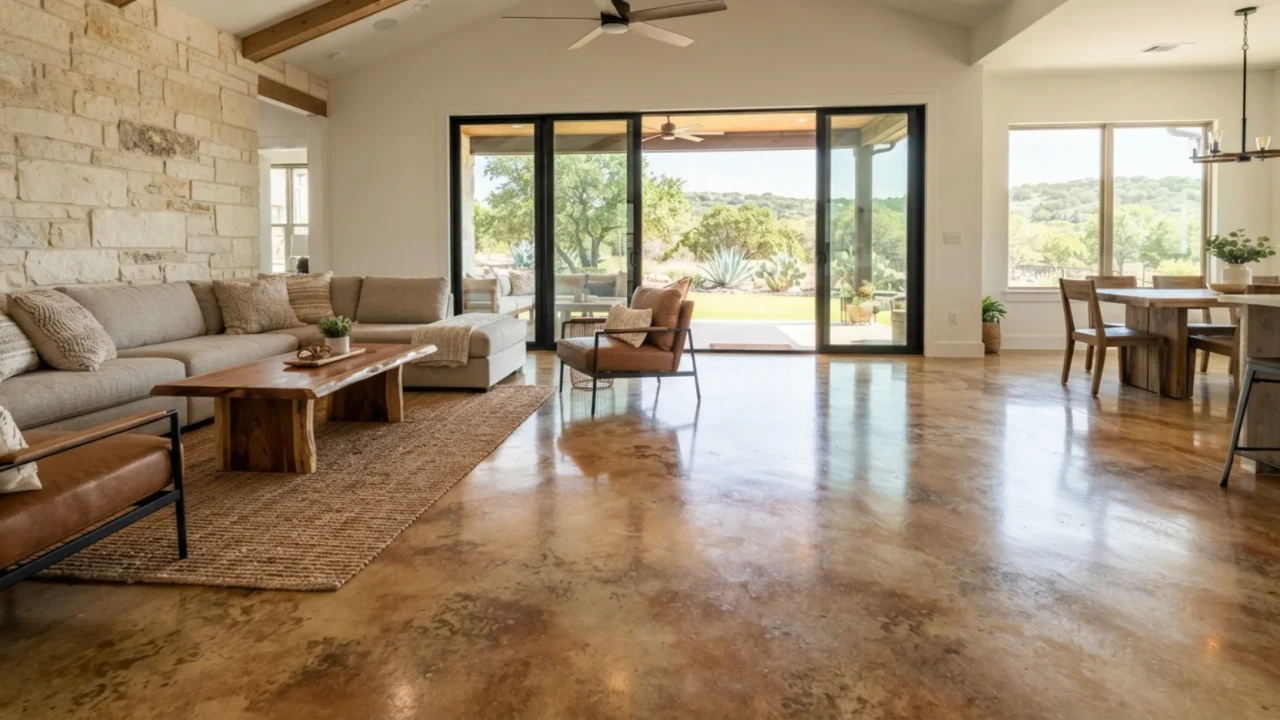
Acid staining on an interior slab creates permanent, mottled earth tones by chemically reacting with the calcium hydroxide in the concrete. Terracotta, amber, warm brown, and soft sage green are the most popular color choices in San Antonio interiors tones that complement the region’s Southwestern and transitional architectural styles. Because the color is chemically bonded into the surface, it does not peel, chip, or wear away with normal foot traffic.
Water-based concrete stains offer a broader range of colors with more consistent coverage better for homeowners who want a specific, predictable color output rather than acid staining’s natural variation. Both types require a quality clear sealer and, for living areas, a wax or polyurethane topcoat to protect against scuffs and maintain the finish between periodic resealings.
Score lines before staining for a custom tile or geometric look: Cutting shallow score lines into an existing slab before staining creates the visual appearance of large-format tile, slate squares, or geometric patterns without the grout lines that collect dirt and without the additional cost of setting tile over concrete. Score lines spaced 24 by 24 inches or 36 by 36 inches with a different stain tone applied in alternating sections can produce a high-end designer floor at a fraction of the cost of actual tile installation. This technique is particularly popular in San Antonio’s covered outdoor patios and open-plan main living areas.
- Existing slab assessed for curing compound residue and previous sealers before staining both block acid penetration
- Plastic sheet moisture test completed condensation under a taped sheet indicates the slab is releasing moisture that will affect sealer adhesion
- Test patch applied in a low-visibility corner before full-floor application acid stain results vary by slab mix and age
- Topcoat wax or polyurethane confirmed for living areas sealer alone is not adequate for high-foot-traffic interior floors
Entry Steps
Entry steps and front walkways are the first surface visitors see and the last thing a potential buyer notices when viewing a home from the street. Decorative concrete on entry steps gives a home a finished, cohesive look that plain broom-finish steps never achieve and because steps represent a relatively small surface area, the incremental cost of upgrading to a stamped or stained treatment is modest compared to the visual return.
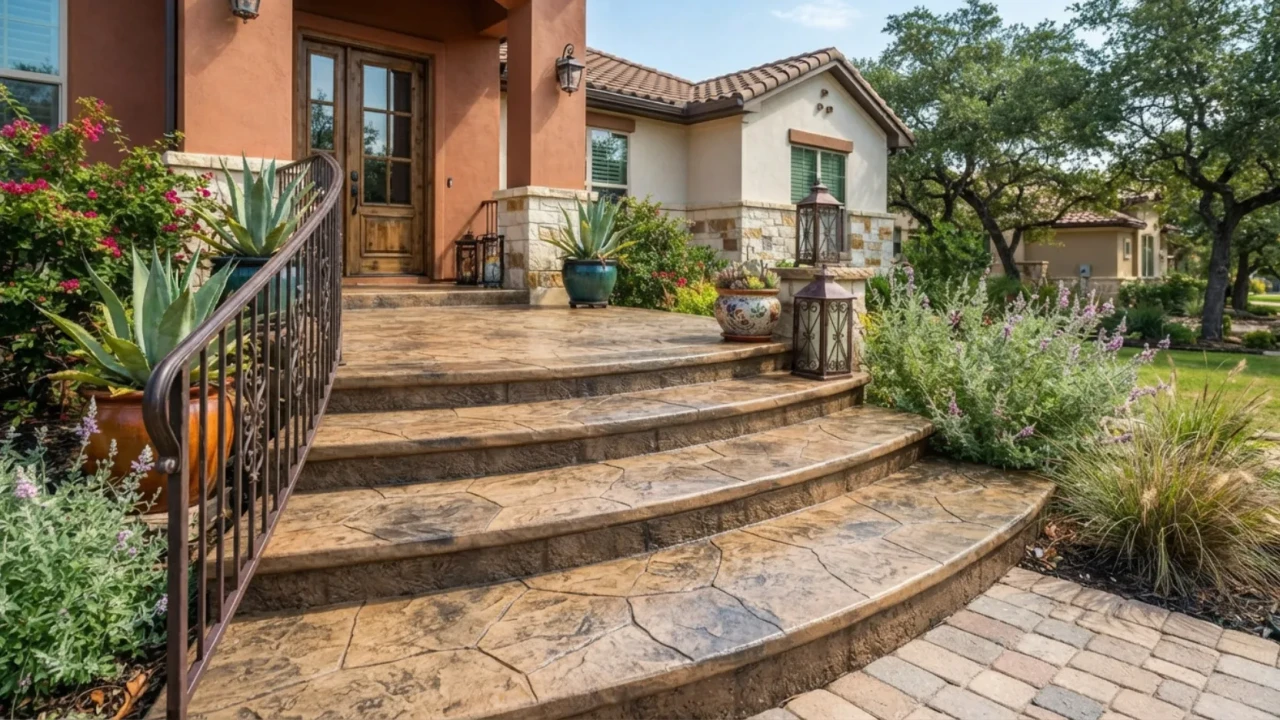
In San Antonio’s market, the most effective entry step designs coordinate the step treatment with the driveway or adjacent patio finish. A stamped Ashlar slate step with a matching flagstone patio behind it creates a unified outdoor environment that reads as intentionally designed rather than assembled from unrelated parts. When new steps are being poured alongside a decorative driveway or patio, specifying matching patterns and integral colors across all three surfaces is the most cost-effective approach single mobilization, single color batch, consistent result.
For existing steps where full replacement is not warranted, an overlay system can apply a thin bonded concrete layer over the original step surface and accept stamped texturing or staining. Overlays are cost-effective for cosmetic upgrades but require a structurally sound base a step that is crumbling or showing settlement cracks is not a candidate for overlay work.
- Step pattern coordinated with adjacent driveway or patio finish for a unified appearance
- Non-slip finish or non-slip sealer additive confirmed on all step treads step surfaces require better traction than flat slabs
- Riser height and tread depth confirmed as code-compliant before forming 7-inch riser and 11-inch tread is the standard residential spec in San Antonio
- Overlay suitability assessed if resurfacing existing steps only structurally sound steps without active cracking are candidates for overlay work
Patio / Walkway
Exposed aggregate is one of the most underrated decorative concrete options in the San Antonio market. By washing away the surface paste of fresh concrete to reveal the natural stone aggregate within the mix, contractors create a surface that is inherently textured, visually rich, and resistant to wear in ways that stamped or stained concrete are not. Because the decorative element is the aggregate itself embedded in the mix, there is no surface coating to peel, chip, or fade under UV exposure.
The appearance of an exposed aggregate surface is determined by the aggregate specified before the pour size, color, and mineral type. Local San Antonio suppliers stock a range of aggregates suited to Bexar County construction, including cream limestone pea gravel, brown river pebble, white quartz chips, and blended combinations that produce a multi-tonal surface similar to natural terrazzo. The aggregate choice is made before the pour and cannot be changed afterward, so discussing options and viewing samples in advance is essential.
- Aggregate type and color viewed as a physical sample before confirming the order photographs do not accurately represent final appearance
- Aggregate size discussed relative to the surface use finer aggregate (3/8 inch and under) for patios and walkways; coarser options for driveways
- Wash timing confirmed with the contractor the surface paste must be washed at the correct stage of set, not too early or too late
- Sealer application scheduled for 28 days post-pour exposed aggregate should be sealed to prevent staining and aggregate loosening over time
Overlay
Not every decorative concrete project starts with a new pour. For existing slabs that are structurally sound but visually tired a worn garage floor, a dated patio, a faded pool deck a concrete overlay or microtopping system can apply a fresh decorative surface over the existing concrete without the cost and disruption of full replacement. Overlays bond to the existing slab through mechanical and chemical adhesion, accepting staining, stamping, or decorative scoring on the new surface.
Microtoppings are ultra-thin overlay systems (typically 1/16 to 1/8 inch thick) applied to smooth the existing surface and create a fresh canvas for staining or polishing. They are particularly popular for interior floors in San Antonio’s residential renovation market, where homeowners want the look of a freshly poured stained floor without jackhammering out the existing slab. A microtopping system can transform a 20-year-old garage slab into a surface that looks and performs like a newly poured decorative floor at roughly half the cost of removal and replacement.
Overlay suitability test for San Antonio homeowners: Tap the existing slab surface with a hammer or hard object in a grid pattern across the full area. A solid, consistent sound indicates good adhesion between the base layers and confirms the slab is a candidate for overlay work. A hollow sound in any section means there is delamination or voids beneath the surface those areas will need to be addressed or cut out before an overlay can be applied successfully. Any slab with active cracks that show vertical displacement (one side higher than the other) is not suitable for overlay work and requires professional assessment before any decorative work proceeds.
- Slab assessed for structural soundness before overlay work begins hollow sections and active cracks must be addressed first
- Existing surface cleaned and profiled with shot-blasting or grinding to ensure mechanical adhesion of the overlay
- Overlay thickness appropriate for the intended use 1/16 to 1/8 inch for microtoppings; 3/8 to 1/2 inch for stamped overlay systems
- Product warranty reviewed not all overlay systems carry the same durability rating for exterior San Antonio conditions
Use this table as a starting point for any decorative concrete project in Bexar County. Cost ranges reflect installed pricing from San Antonio contractors in 2026, including labor, materials, base preparation, and a standard sealer coat.
| Application | Best finish options | Cost range (installed) | Maintenance interval |
|---|---|---|---|
| Backyard patio | Stamped (flagstone, Ashlar slate), exposed aggregate, stained | $10 to $22 per sqft | Reseal every 2 to 3 years |
| Front driveway | Stamped border with broom field, full cobblestone, stained broom | $9 to $18 per sqft | Reseal every 2 to 3 years |
| Pool deck | Exposed aggregate, stamped Travertine, salt finish, stained | $10 to $20 per sqft | Reseal every 1 to 2 years |
| Interior floor | Acid stain, water-based stain, microtopping with stain | $3 to $10 per sqft | Reseal every 3 to 5 years |
| Entry steps | Stamped to match adjacent patio, stained, overlay on existing | $200 to $600 per step | Reseal every 2 to 3 years |
| Walkways and paths | Exposed aggregate, brushed swirl, broom with stain | $6 to $12 per sqft | Reseal every 3 to 4 years |
| Existing slab upgrade | Microtopping with stain, overlay with stamp, re-stain and reseal | $4 to $12 per sqft | Reseal every 2 to 4 years |
- Surface type and primary use confirmed patio, driveway, pool deck, interior floor, or steps each have different structural requirements
- Budget range established with room for the full cost including base preparation, reinforcement, finish, and first sealer coat
- Reference photos collected and shared with at least two contractors for pricing comparison
- San Antonio-specific concerns reviewed: clay soil base requirements, UV-stable product selection, hard water mineral management
- Slab thickness confirmed in writing: 3.5 to 4 inches for patios, 4 to 5 inches for driveways, 4 inches for pool decks
- Base preparation depth specified: minimum 4-inch compacted crushed limestone in Bexar County’s clay soil conditions
- Reinforcement type included: wire mesh for patios, rebar grid for driveways and vehicle-bearing surfaces
- Expansion joint spacing confirmed: every 8 to 10 feet for driveways, every 10 feet for large patios
- Pattern, color, and finish type confirmed in writing with a reference photo attached to the contract
- Color approach specified: integral color (preferred) vs. surface color hardener integral color provides better long-term UV performance
- Non-slip specification confirmed for pool decks and entry steps
- First sealer coat included in the contract scope not a separate add-on after the pour
- Photos of completed decorative concrete projects in San Antonio reviewed not stock photos
- Certificate of insurance received and confirmed: $1 million or more general liability coverage
- Payment terms confirmed: deposit at start, balance on satisfactory completion no full payment before work begins
- Resealing schedule discussed and documented know what maintenance the surface will need before the project begins
What is the most popular decorative concrete option for San Antonio patios in 2026?
How does San Antonio’s climate affect decorative concrete performance?
Does decorative concrete add value to a San Antonio home?
Can I get decorative concrete on an existing slab without replacing it?
What is the best time of year to install decorative concrete in San Antonio?
Get a free decorative concrete quote in San Antonio
Tell us about your project patio, driveway, pool deck, interior floor, or steps. We will visit your property, assess the surface, and deliver a detailed written quote at no cost.