
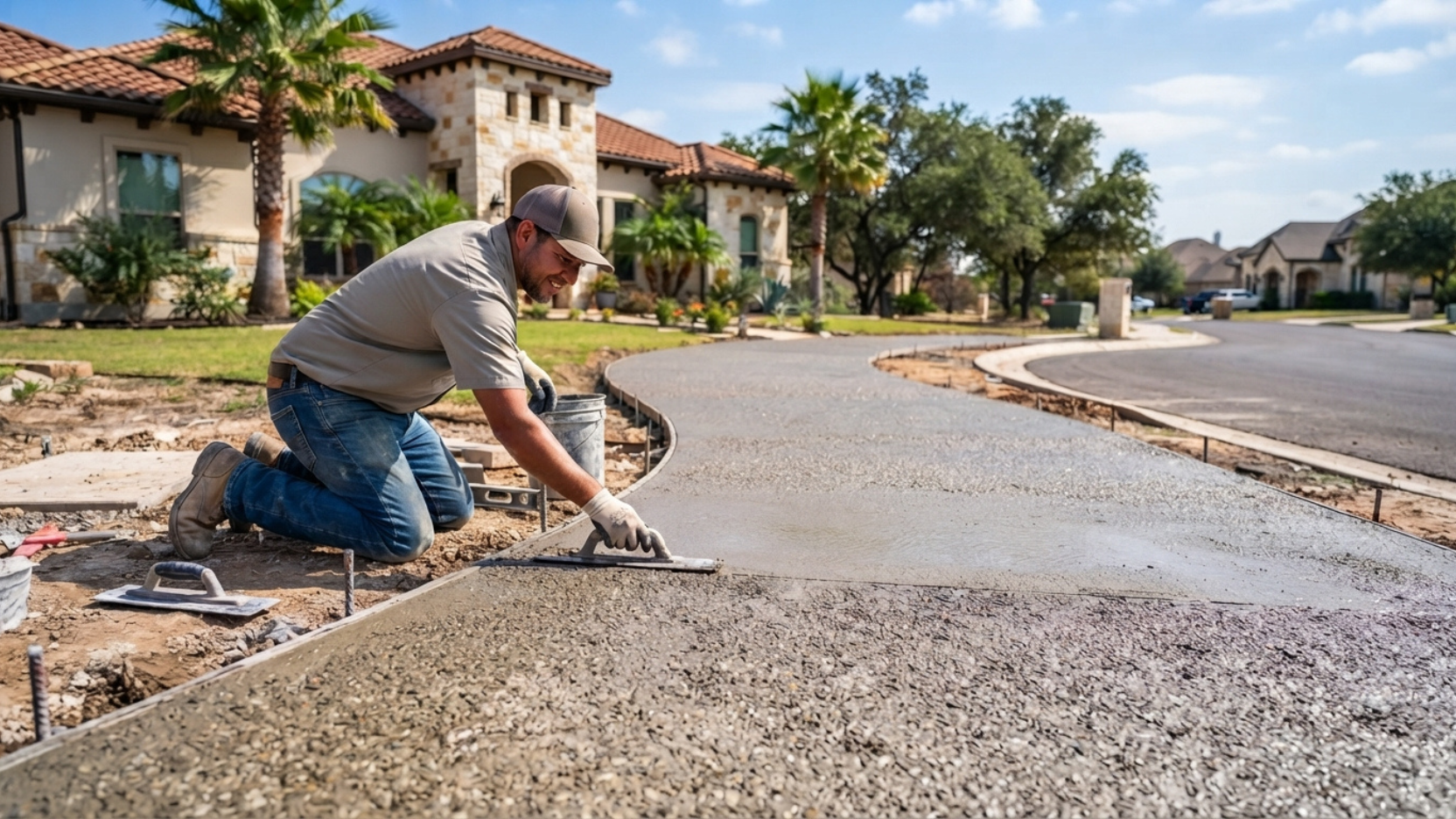
Choosing the wrong driveway contractor in San Antonio is one of the most expensive mistakes a homeowner can make. This guide covers everything you need to know: how to vet contractors, what a proper quote includes, what red flags to watch for, and what a driveway project should cost in the Bexar County market in 2026.
A concrete driveway is one of the highest-value improvements a San Antonio homeowner can make. It improves curb appeal, increases property value, and when done correctly, it lasts for decades with minimal maintenance. When done poorly, it cracks within a few years, settles unevenly, and leaves you paying again for a job that should have lasted a generation.
The difference between a driveway that fails early and one that performs for 30 years almost always comes down to the contractor. The concrete mix, the base preparation, the slab thickness, the reinforcement type, and the curing process are all determined by the crew doing the work not by the homeowner watching from a window. This guide gives you the knowledge to choose the right contractor, ask the right questions, and recognize the warning signs before any money changes hands.
Bexar County sits on some of the most challenging soil in Texas for concrete work: expansive Blackland Prairie clay that swells when wet and contracts when dry. This seasonal movement puts stress on any slab poured directly on an inadequate base. Combined with San Antonio’s intense summer heat, which accelerates curing and can weaken concrete if the slab dries too fast, and hard Edwards Aquifer water that can interfere with proper hydration, the local environment demands a higher level of care from contractors than most parts of the country. The solution is not complicated: proper base preparation, correct slab thickness, adequate reinforcement, and controlled curing. What varies is whether your contractor actually does all four.
Finding a contractor name is easy. Finding one who is licensed, insured, experienced with local soil conditions, and willing to do the work correctly is where most homeowners need guidance. The six steps below take you from an empty search to a signed contract with confidence.
Finding
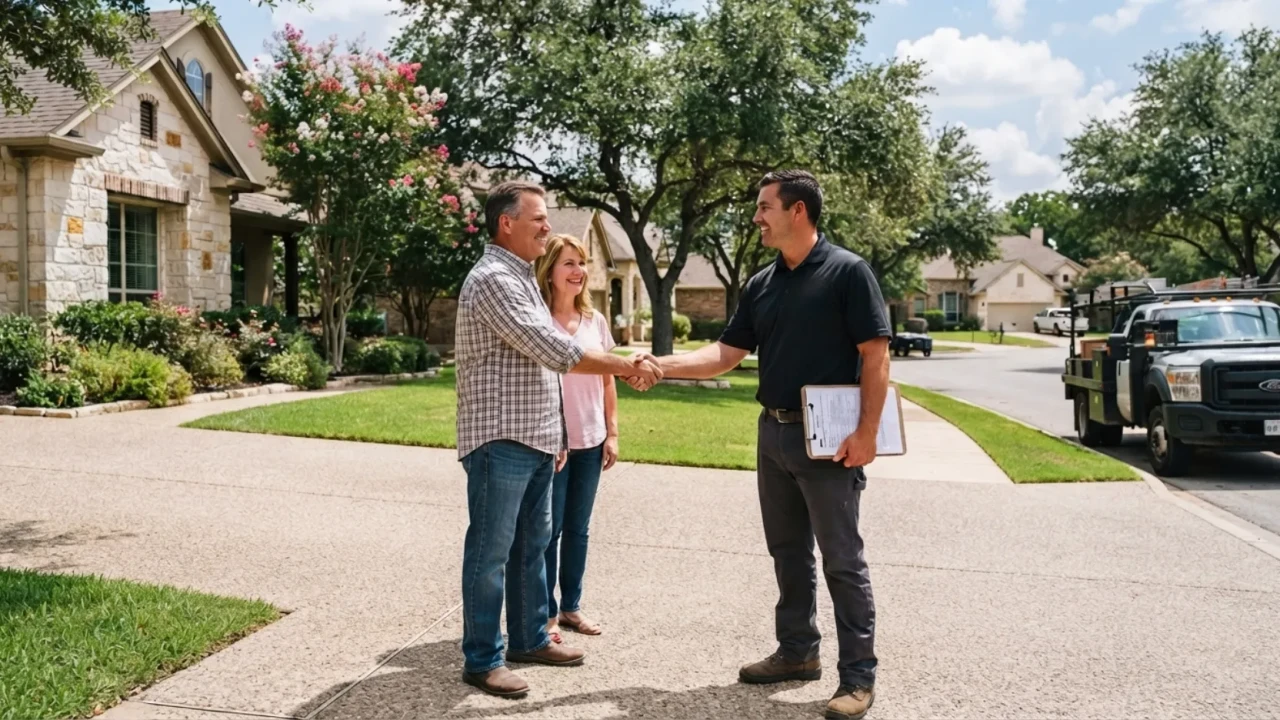
Online review platforms are a useful starting point, but they have meaningful limitations: reviews can be manufactured, recent negative experiences sometimes take months to surface, and a contractor with 50 reviews in Austin may have done very little work in Bexar County’s specific soil conditions. Start by asking neighbors on your street or in your HOA whose driveways look good after several years. A concrete surface that looks sharp after five or more San Antonio summers is a better endorsement than any star rating.
Nextdoor and local Facebook neighborhood groups are also strong sources for San Antonio-specific referrals. When someone recommends a contractor in these groups, you can follow up directly and ask specific questions: How long ago was the work done? Did they handle any warranty issues? Was the quote detailed or vague?
Look for driveways in your area that are 5 to 8 years old and still look solid. A new driveway always looks good. One that has survived five San Antonio summers, a few freeze events, and the natural clay soil movement of Bexar County without significant cracking or heaving tells you the contractor did the structural work correctly. Ask the homeowner who poured it.
Vetting
Before you invite a contractor to your property or discuss your project in any detail, confirm two things: they carry general liability insurance with at least a $1 million coverage limit, and they have a verifiable local business address and business registration. In Texas, concrete contractors are not required to hold a state license in the same way electricians or plumbers are but they should be registered as a business entity and carry insurance that protects you if something goes wrong on your property.
Ask for a certificate of insurance by email before the site visit. A legitimate contractor will send it without hesitation. A contractor who hedges, delays, or says they are “working on getting coverage” is not a contractor you should hire for a multi-thousand dollar project.
- Certificate of insurance received by email not just a verbal confirmation
- Coverage limit is $1M or higher for general liability
- Policy is current expiration date is in the future
- Workers compensation coverage confirmed for any employees on site
- Business registration verified on the Texas Secretary of State database at sos.texas.gov
Quoting
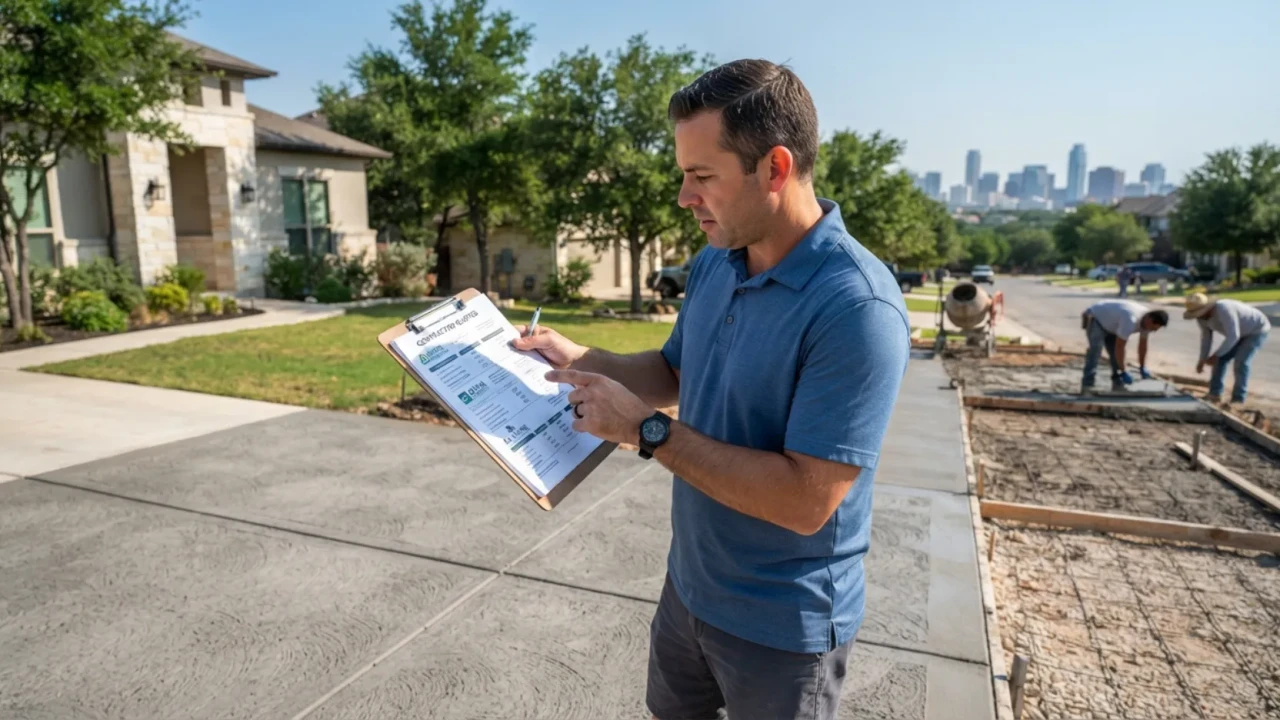
Getting three quotes is not just about finding the lowest price it is about having enough information to understand what a fair price looks like and what each contractor intends to actually build. Two contractors quoting on the same driveway can come in $2,000 to $5,000 apart not because one is ripping you off, but because one is planning a 4-inch slab with wire mesh on a 4-inch compacted limestone base, and the other is planning a 5-inch slab with rebar on a 6-inch base. The second quote is worth more money. The first quote looks cheaper until the driveway cracks in year four.
When the quotes arrive, do not compare the bottom-line number. Compare the specifications: slab thickness, base material and depth, reinforcement type, expansion joint plan, concrete PSI rating, and what is included in cleanup. Those details tell you what you are actually buying.
- Slab thickness specified in inches 4″ minimum for residential, 5″ for vehicle-heavy use
- Base material type and depth compacted crushed limestone is the San Antonio standard
- Reinforcement type wire mesh or rebar grid, with spacing noted
- Concrete mix PSI rating 3,000 PSI minimum for residential driveways, 4,000 PSI preferred
- Expansion and control joint plan spacing and method (saw cut or hand tooled)
- Finish type broom, brushed, stamped, or exposed aggregate
- Demolition and haul-off of existing concrete if applicable
- Payment terms deposit amount and balance due date
Vetting
The site visit is your best opportunity to evaluate whether a contractor actually knows what they are doing in San Antonio conditions. An experienced local contractor will have immediate, specific answers to questions about your soil, your slope, your drainage, and your existing base. A contractor who gives vague or generic answers or who seems annoyed by questions is showing you how they will handle issues on the job.
| Question to ask | Good answer | Concerning answer |
|---|---|---|
| What base preparation are you planning? | Excavation to 8-10″ depth, 4-6″ compacted crushed limestone base, compacted in lifts | “We’ll grade it out” with no mention of base depth or material type |
| What reinforcement will you use? | Rebar grid at #3 or #4 bars, 18″ centers for a residential driveway in San Antonio clay soil | “We use wire mesh” with no mention of gauge or placement height |
| How will you handle the drainage slope? | Minimum 1% slope (1/8″ per foot) away from the foundation, directed toward the street or a defined drainage path | “It’ll drain fine” with no specific slope or drainage plan |
| What PSI concrete mix will you use? | 3,500 to 4,000 PSI for a residential driveway higher for heavy vehicles | Cannot name the PSI or says “standard mix” |
| How will you cure the slab? | Wet curing for 3 to 5 days or liquid curing compound applied immediately after finishing especially important in summer | “We’ll come back and seal it later” with no mention of the initial curing process |
| Do I need a permit for this project? | Confirms awareness of San Antonio’s Right-of-Way permit requirements for driveways connecting to public streets | “You don’t need a permit for a driveway” without checking local requirements |
Quality
-optimized.webp)
Any contractor who is serious about their reputation will have references and photos of completed local work readily available. Ask specifically for San Antonio projects not Austin or Houston work because local soil conditions and local building standards matter. A contractor who excels on sandy soils in another region may not have adjusted their base prep approach for Bexar County’s clay-dominant Vertisol.
When you contact references, ask three specific questions: Did the driveway develop any cracks in the first two years? Did the contractor return promptly to address any issues? Would they use the same contractor again for a larger project? Those three questions cut through the pleasantries and get to the information you actually need.
Contract
A written contract for a driveway project should be a document you can read and understand not a one-page form with a price and a signature line. It should describe the exact scope of work, the materials to be used (with specifications), the project timeline, the payment schedule, and what happens if something goes wrong. Any contractor who resists putting specifics in writing is telling you something important about how they operate.
Payment terms for a legitimate driveway contractor in San Antonio are typically 30 to 50 percent deposit at contract signing with the balance due upon satisfactory completion and inspection by the homeowner. A contractor who demands full payment before work begins has removed their financial motivation to deliver quality results and your ability to withhold payment if something is done wrong.
Price is not the only factor in choosing a contractor, but understanding what a fair price looks like prevents you from being overcharged or from choosing a dangerously low bid that signals cut corners. The cost ranges below reflect actual San Antonio market pricing in 2026 based on project type and scope.
The lowest quote is almost never the best value for a driveway in San Antonio. A quote that is 25 to 30 percent below the other two you received is almost always missing something: base preparation depth, reinforcement spec, proper PSI mix, or expansion joints. Ask the contractor with the lowest bid to match the specifications from the higher quotes line by line. If they cannot or will not, the lower price is not saving you money it is telling you what they plan to skip.
San Antonio’s construction market includes a number of contractors who operate professionally and do excellent work and a smaller number who rely on homeowners not knowing what a proper driveway requires. The red flags below are patterns that repeat in virtually every bad driveway experience reported by Bexar County homeowners.
Red Flag
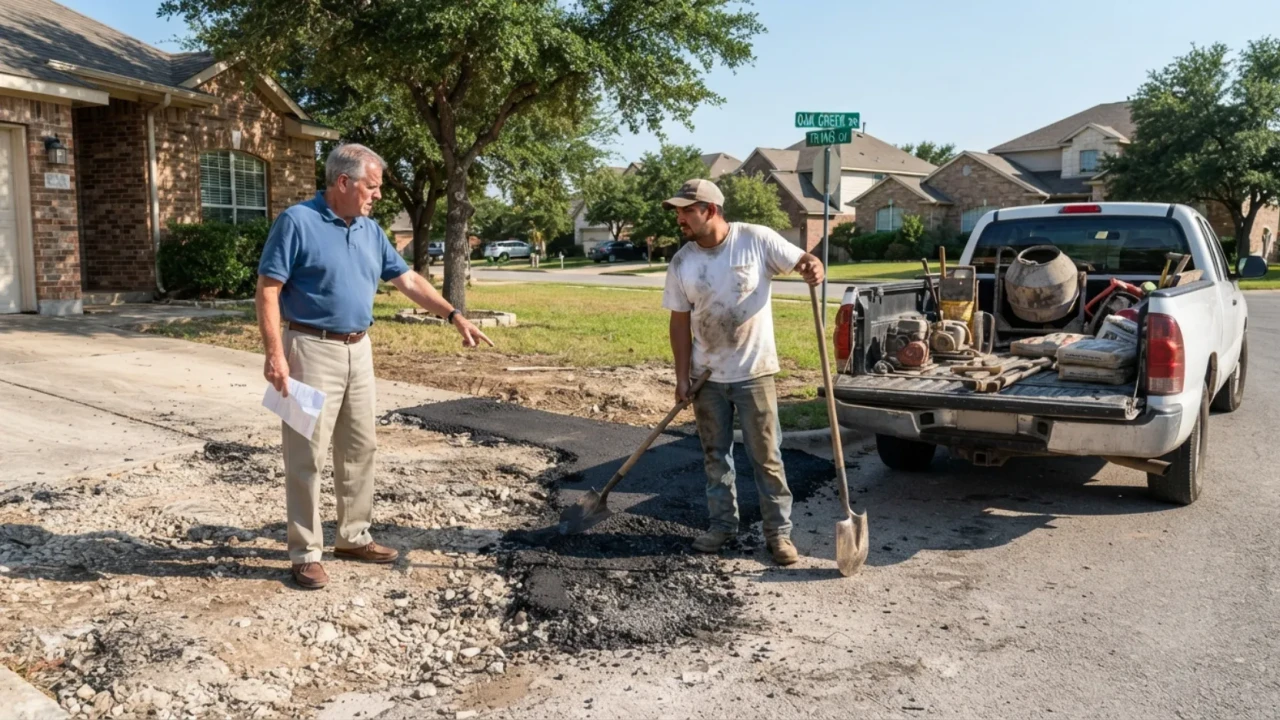
This scenario repeats multiple times per year in San Antonio neighborhoods: a crew approaches your door often after a storm or during a heat wave and offers to pave or repair your driveway at a dramatically low price because they say they have leftover material from a nearby job. The price sounds almost too good. It is.
At prices below $4 to $5 per square foot for a “complete” driveway, no legitimate base preparation is being done. The crew pours directly on bare or minimally graded dirt, uses an inferior concrete mix to maximize margin, skips reinforcement entirely, and is gone before the slab has finished curing. Within 18 to 24 months, the slab shows significant cracking, heaving, and surface deterioration and the contractor is nowhere to be found. There is no company address to contact, no insurance on file, and no recourse for the homeowner.
Red Flag
A legitimate concrete contractor operating in San Antonio has a verifiable physical business address not just a phone number and a website. Search the company name on Google Maps, on the Texas Secretary of State website, and on the Better Business Bureau directory. If none of these return a physical address for the business, the company has no local accountability infrastructure. If something goes wrong with your driveway, there is nowhere to go.
This does not mean the contractor needs a large office or a showroom. Many excellent small concrete companies in Bexar County operate from a home base with a small crew. What matters is that the business is registered, the address is verifiable, and the contractor has been operating in the San Antonio market long enough to have a local reputation. Ask how long they have been in business in San Antonio specifically not how long they have been contracting in general.
Red Flag
One of the most reliable indicators of a contractor who plans to cut corners is a written quote that says something like: “Concrete driveway, approximately 450 square feet $3,800 total.” No slab thickness. No base specification. No reinforcement type. No concrete PSI. No expansion joint plan. No finish description.
A vague quote is not protecting you from information overload. It is protecting the contractor from accountability. When the work is done and the slab is thinner than it should be, or the base was not properly compacted, the contractor can point to the quote and say they delivered exactly what was promised because nothing specific was promised. Every item that is not specified in writing is an item the contractor can skip without violating the contract.
Red Flag
A contractor who requires full payment before placing a single form or moving a single shovelful of base material has removed every financial incentive to do the work correctly. Once they have your money, you have no leverage. If the slab is poured thin, if the base is skimped, or if the contractor simply does not show up for a week, your only recourse is a demand letter or small claims court both of which are slow, stressful, and uncertain.
Standard payment terms in San Antonio’s concrete market are a deposit of 30 to 50 percent to secure the project and schedule materials, with the remaining balance due upon completion and homeowner inspection. Some contractors request a mid-project payment for very large projects. These are reasonable structures. 100 percent upfront is not regardless of what reason is given.
Knowing what should happen on installation day lets you identify problems before the concrete sets. Once a slab hardens, correcting a structural deficiency requires full demolition and replacement. These are the steps a qualified San Antonio driveway contractor should execute in this order.
Process
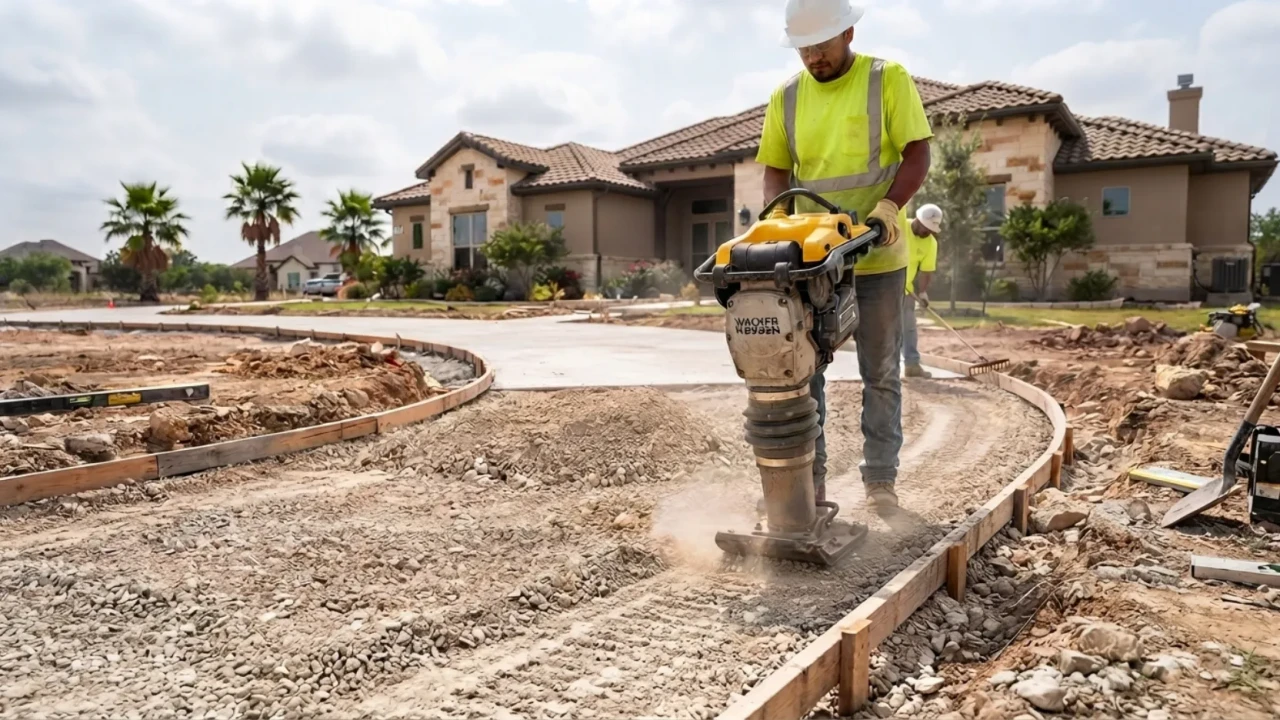
For a new concrete driveway in San Antonio, site preparation means excavating to a total depth of 8 to 10 inches below the finished surface level enough to accommodate 4 to 5 inches of concrete plus 4 to 6 inches of compacted base. In Bexar County’s clay soil, this base is typically crushed limestone (caliche), which provides stable support and resists the moisture-driven movement that pure clay soil creates beneath slabs.
The base must be compacted in layers typically two passes of 2 to 3 inches each using a plate compactor. A base that is dumped and rough-graded without compaction will settle unevenly under the weight of the concrete and the vehicles driving over it, leading to cracking within a few years. Watch for this specifically: if the crew dumps base material and immediately starts setting forms without running a compactor, ask about it directly.
Process
Once the base is compacted and graded to slope, the contractor sets the forms typically 2×4 or 2×6 lumber boards anchored with stakes that define the shape and thickness of the driveway. The top of the forms defines the finished concrete surface height. Check that the forms are level across the width of the driveway and that they are staked firmly enough to hold the weight of fresh concrete without shifting.
Reinforcement either rebar or wire mesh is placed inside the forms before the pour. Critically, the reinforcement must be elevated to the middle of the slab depth, not lying flat on the base. Rebar chairs (small plastic or wire supports) hold it at the correct height. Reinforcement that sits on the base provides almost no tensile benefit it needs to be in the center of the concrete mass to do its structural job.
Process
Concrete delivery in San Antonio should be scheduled for early morning during summer months before 8 AM if possible to avoid the peak heat of the afternoon. Fresh concrete poured in 95-plus degree heat without active curing measures loses moisture too quickly for the hydration reaction to complete properly, resulting in a weaker final product with a higher likelihood of surface cracking and dusting.
After screeding and floating, the contractor applies the finish (broom, stamped, exposed aggregate, or brushed) and then critically begins the curing process. For a San Antonio driveway in warm weather, this means either wet curing (keeping the surface continuously moist for 3 to 5 days with burlap and water or a curing blanket) or applying a liquid curing compound immediately after finishing. Either method is acceptable. No curing treatment at all is not.
San Antonio’s contractor market includes several categories of driveway providers. Understanding the differences helps you set expectations and ask the right questions for each type.
| Contractor type | Typical strengths | Typical limitations | Best for |
|---|---|---|---|
| Small local crew (owner-operator) | Lower overhead, often high craftsmanship, owner on site for the pour | Limited crew size may extend timeline, less marketing presence | Residential driveways where personal attention matters |
| Mid-size concrete company | Consistent processes, dedicated crews, faster scheduling | Owner may not be on site, quality depends on crew assigned | Standard residential and small commercial driveways |
| Large general contractor | Can handle large scope, multiple crews available | Concrete is often subcontracted you may not know who actually does the pour | Large commercial or multi-phase projects |
| Decorative concrete specialist | Stamped, stained, and overlay expertise, strong portfolio | Higher cost, may have longer lead times due to demand | Stamped driveways, overlays, decorative curb appeal upgrades |
| Handyman or general laborer | Low price point | Typically lacks concrete-specific equipment, insurance, and base prep knowledge | Not recommended for full driveway replacement or new pours |
- Collected at least 3 referrals from neighbors, Nextdoor, or local Facebook groups for San Antonio contractors
- Verified physical business address on Google Maps and Texas Secretary of State website
- Confirmed company has operated in San Antonio and Bexar County for at least 3 years
- Checked BBB listing for any unresolved complaints at bbb.org
- Certificate of insurance received by email minimum $1M general liability coverage
- Policy expiration date confirmed as current
- Workers compensation coverage status confirmed for on-site crew
- Business registration verified with Texas Secretary of State
- Three written quotes collected from separate contractors
- Each quote specifies slab thickness, base material and depth, reinforcement type, concrete PSI, finish, and joint plan
- Quotes compared by specification not just bottom-line price
- Any quote more than 25% below the others has been explained in full by the contractor
- Demo and haul-off costs itemized separately if existing concrete must be removed
- Three references from recent San Antonio driveway projects contacted and interviewed
- Before and after photos of at least 2 local driveway projects reviewed
- Site visit to a completed project in your area arranged if possible
- Written contract includes full scope of work with all specifications from the quote
- Payment terms confirmed: 30 to 50 percent deposit, balance on completion
- Workmanship warranty of at least 1 year included in writing
- Change order process defined: any scope changes require written approval with pricing before execution
- Permit responsibility assigned in the contract contractor handles Right-of-Way permit if connecting to public street
How much does a new concrete driveway cost in San Antonio?
Do I need a permit for a driveway replacement in San Antonio?
What is the best time of year to pour a concrete driveway in San Antonio?
How long does a concrete driveway last in San Antonio?
Should I repair my existing driveway or replace it entirely?
Get a free driveway quote in San Antonio
Tell us about your driveway project new installation, replacement, or resurfacing. We visit your property, assess the site, and deliver a detailed written quote with full specifications at no cost.