
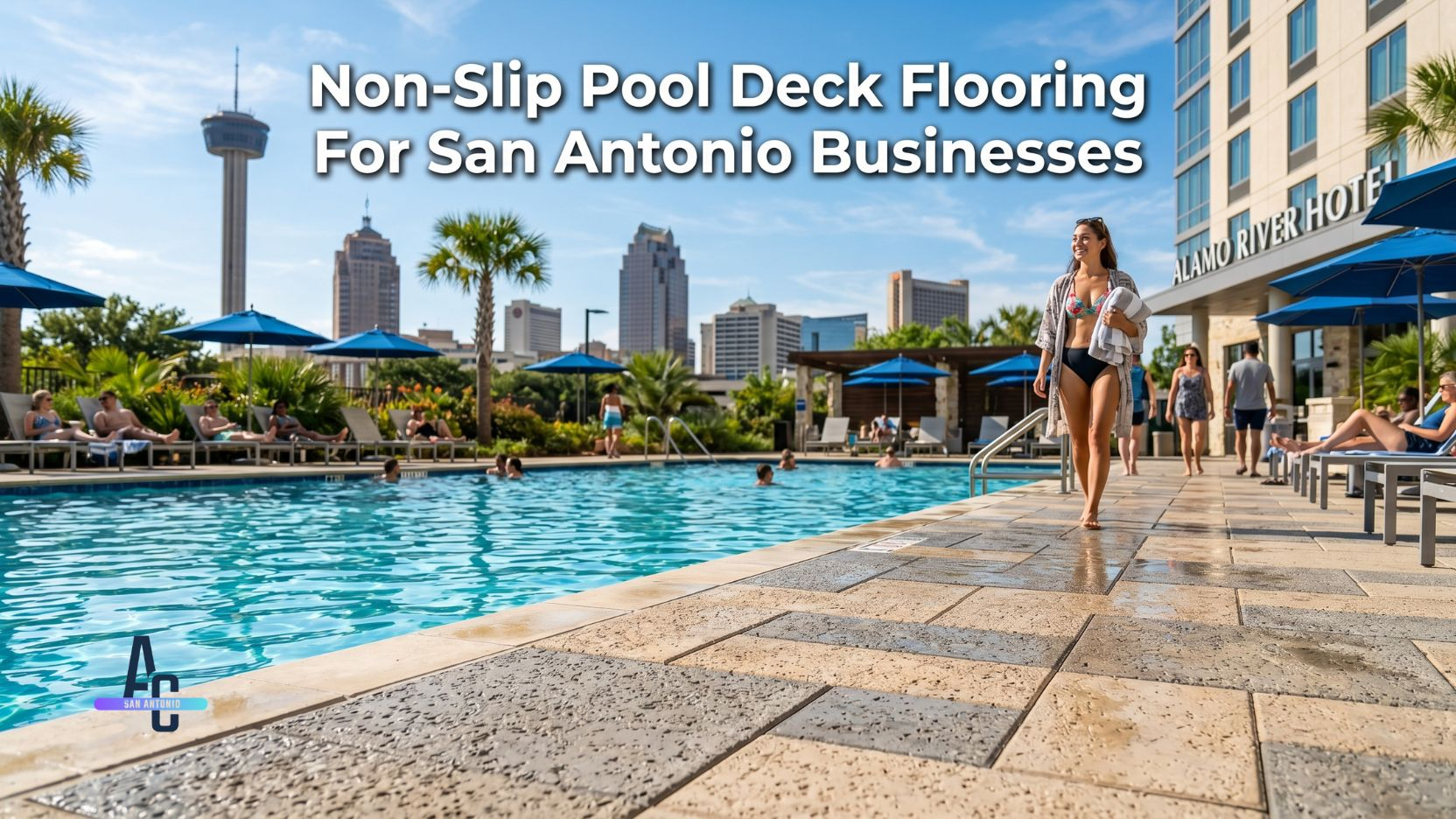
A wet pool deck at your San Antonio business is not just a maintenance issue. It is a liability issue. This guide covers every flooring option that delivers real slip resistance in Texas heat, what the code requires, and what you should be asking your concrete contractor before any work begins.
A slip-and-fall on a commercial pool deck is not a minor incident. In Texas, business owners and property managers face direct liability exposure when a surface fails to provide adequate traction, and San Antonio’s combination of intense sun, frequent splashing, and heavy foot traffic from hotels, apartment complexes, and recreation facilities creates exactly the conditions where ordinary concrete becomes dangerous. The good news is that non-slip pool deck flooring is a solved problem. There are proven surface options at every price point, and the right one for your business depends on three factors: the existing condition of your deck, the volume and type of foot traffic you receive, and your maintenance capacity.
This guide covers all four non-slip flooring categories available for San Antonio commercial pool decks, how they perform in Texas heat, what they cost, and what your contractor needs to specify before any resurfacing work begins.
Most business owners evaluate pool deck surfaces by how they look in product photos, which are always dry, always in good light, and always brand new. The metric that actually determines safety is the wet coefficient of friction (COF), measured when the surface is saturated. The ADA requires a minimum COF of 0.6 for accessible surfaces; reputable pool deck contractors in San Antonio specify surfaces that exceed 0.8 wet COF for commercial applications. Any contractor who cannot tell you the wet COF of the surface they are proposing is not specifying for safety. They are specifying for aesthetics. Start there, then choose the finish.
Top Pick
Exposed aggregate is the commercial pool deck surface that San Antonio concrete contractors have relied on for decades, and for good reason. The finish is created by washing away the surface paste of fresh concrete to reveal the stone aggregate embedded in the mix. The result is a textured, pebbled surface that provides natural grip even when completely saturated, does not depend on a topcoat or sealant for its slip resistance, and ages gracefully under Texas sun without fading or peeling.
For a commercial property in San Antonio, exposed aggregate is the lowest-maintenance non-slip solution available. There is no topcoat to reapply, no anti-slip additive that wears away, and no seam or joint pattern that traps dirt. The aggregate itself is the texture, and it does not wear smooth under normal foot traffic the way a broom finish can.
- Aggregate type and color specified in writing before the pour or overlay begins
- Wet COF target confirmed with contractor: 0.8 minimum for commercial pools
- Overlay thickness specified: minimum 3/8 inch for commercial resurfacing
- Existing slab condition assessed and documented before overlay is approved
- Sealant schedule confirmed: first seal at 28 days, reapplication every 3 to 5 years
High Value
A textured concrete overlay is the most common commercial pool deck resurfacing solution in San Antonio because it addresses three problems at once: it restores a worn, slick, or cosmetically damaged surface; it adds consistent slip resistance through a combination of texture and anti-slip aggregate additive; and it can be tinted or colored to update the appearance of an aging deck without a full demolition and repour. Applied correctly over a prepared slab, a quality overlay will last 7 to 10 years in San Antonio’s climate before requiring refinishing.
Anti-slip additive must be specified by type and broadcast rate, not just mentioned: Many overlay proposals simply say “anti-slip additive included.” That tells you nothing. The additive type (silica sand, aluminum oxide, or polymer grit), the particle size, and the broadcast rate per square foot all directly determine the final wet COF. Ask your contractor to specify the additive by product name, particle size in mesh (typically 36 to 60 grit for pool decks), and broadcast rate. If they cannot provide that, they are guessing at your deck’s slip resistance.
- Overlay type selected for the property type: spray, knockdown, broom, or cool-deck style
- Anti-slip additive specified by product name, grit size, and broadcast rate
- Existing slab surface shot-blasted or ground to promote bonding before overlay application
- Wet COF target confirmed: 0.8 or higher for commercial pool applications
- Color and tint specified in writing if applying a colored overlay
- Recoat interval confirmed in the contract: typically 5 to 8 years for spray overlay
Premium
Stamped concrete is the most visually striking pool deck surface available to San Antonio businesses, and it can be made safe for commercial use when the right sealer is specified. The critical distinction is this: standard stamped concrete with a gloss or semi-gloss sealer is genuinely dangerous when wet. That is the version most homeowners have, and it is not appropriate for a commercial pool environment. Stamped concrete becomes appropriate for commercial use when it is sealed with a matte or low-sheen sealer that incorporates an anti-slip additive, typically aluminum oxide or polymer grit, mixed directly into the sealer before application.
For a hotel, resort, or high-end apartment complex in San Antonio, stamped concrete can create the look of natural slate, travertine, or flagstone at a fraction of the material cost, while delivering a safer surface than real stone when properly sealed. The sealer must be reapplied every 2 to 3 years, and the anti-slip additive must be incorporated at every reapplication or the slip resistance degrades.
- Sealer type specified as matte or low-sheen with anti-slip additive (not gloss or semi-gloss)
- Anti-slip additive type confirmed: aluminum oxide grit is the industry standard for pool decks
- Wet COF of the specified sealer-plus-additive combination confirmed before approval
- Resealing schedule written into the property maintenance plan: every 2 to 3 years
- High-wear zones (pool entry, ladder areas, steps) identified for more frequent inspection
- Pattern and integral color specified in writing; changes cannot be made after the pour
Alternative Systems
Pavers and modular rubber surfaces are not the right choice for every commercial pool in San Antonio, but they solve specific problems that poured concrete cannot. If your pool deck has a section that is structurally compromised and cannot support an overlay, if you need to return a portion of the deck to service faster than a poured surface allows, or if your property requires a fully ADA-compliant surface replacement on a tight timeline, these systems are worth understanding.
| Surface system | Non-slip performance | Heat performance in SA | Install timeline | Typical cost |
|---|---|---|---|---|
| Concrete pavers (tumbled) | Good wet COF (0.7 to 0.9) from natural texture | Moderate; lighter colors help; joints stay cooler | 2 to 4 days for typical deck | $18 to $30/sqft installed |
| Travertine pavers | Good naturally; avoid honed or polished finish | Excellent; stays cooler than concrete in direct sun | 3 to 5 days for typical deck | $22 to $38/sqft installed |
| Rubber deck tiles (commercial grade) | Excellent wet COF (0.9 to 1.2) at all times | Poor; black rubber absorbs heat aggressively in Texas sun | 1 to 2 days for typical deck | $8 to $18/sqft depending on thickness |
| Composite wood deck tiles | Moderate (varies significantly by product) | Moderate; stays cooler than concrete but requires UV-stable product | 1 to 2 days for typical deck | $12 to $22/sqft |
For most San Antonio commercial pool properties, pavers and rubber tiles work best as supplements to a concrete deck rather than full replacements. A common approach for upscale hotel pools is a concrete overlay deck with travertine pavers at the pool coping and around seating areas. The concrete handles the high-foot-traffic open deck, and the travertine provides a premium aesthetic at the edges where guests actually notice the material.
Dark rubber tiles are not appropriate for exposed San Antonio pool decks: Rubber tile surfaces provide outstanding traction, and they are commonly used in shaded pool areas, indoor aquatic centers, and locker room transitions. In direct San Antonio summer sun, however, dark rubber tiles can reach surface temperatures that are genuinely unsafe for barefoot contact. If you are considering rubber tiles for an outdoor commercial pool deck, specify only light-colored, UV-stable tiles and verify the manufacturer’s surface temperature data for direct sun exposure in a Sun Belt climate.
- Surface material confirmed for bare-foot heat safety in direct San Antonio sun
- Wet COF of specified paver or tile product confirmed with manufacturer data sheet
- Joint width and material specified: joints that are too wide create trip hazards and ADA issues
- Base preparation confirmed: pavers require compacted base just as poured concrete does
- Paver finish confirmed as tumbled or textured (not honed, polished, or smooth)
Use this table to match your property type and priorities to the correct surface category. Every option listed here can be executed correctly by an experienced San Antonio commercial concrete contractor.
| Surface option | Best property type | Wet slip resistance | Maintenance demand | Cost range (SA) |
|---|---|---|---|---|
| Exposed aggregate (new pour) | High-traffic HOA, aquatic centers, municipal pools | Excellent (0.8 to 1.0+ COF) | Low; seal every 3 to 5 years | $14 to $22/sqft |
| Exposed aggregate overlay | Existing decks in good structural condition | Excellent | Low; same as new pour | $10 to $16/sqft |
| Cool deck / spray texture overlay | Hotels, apartment complexes, barefoot-heavy decks | Good (0.7 to 0.9 COF) | Low to moderate; recoat every 5 to 8 years | $8 to $14/sqft |
| Knockdown overlay | Upscale multi-family, hotel pool decks | Good (0.7 to 0.9 COF) | Moderate; recoat every 5 to 7 years | $10 to $16/sqft |
| Stamped concrete with anti-slip sealer | Resorts, luxury hotel pools, high-end HOA | Good when properly sealed (0.6 to 0.8 COF) | High; reseal every 2 to 3 years mandatory | $16 to $26/sqft |
| Travertine pavers | Upscale resort and boutique hotel coping areas | Good (0.7 to 0.9 COF with tumbled finish) | Moderate; seal grout joints annually | $22 to $38/sqft |
Slip resistance on a commercial pool deck is not just a best practice. It is a compliance requirement under multiple overlapping frameworks, and the liability exposure for a business that allows a pool deck to remain below standard is significant. Here is what applies to most San Antonio commercial pool operations.
Compliance
Commercial pool decks in San Antonio are subject to several regulatory frameworks simultaneously. While a full legal review is outside the scope of a concrete contractor’s role, every business owner and property manager should understand the baseline requirements before authorizing any resurfacing or new deck work.
| Requirement | What it means for your deck | Who it applies to |
|---|---|---|
| ADA Slip Resistance (0.6 wet COF minimum) | Any accessible route at a commercial pool must meet the 0.6 COF threshold when wet. This includes all walking surfaces between parking, the pool entry, and the pool perimeter. | All commercial properties with public or semi-public pool access |
| Texas Health and Safety Code: Pool Safety | Commercial pools in Texas must meet pool deck surface standards including slip-resistant finishes in the immediate pool surround area. The Texas Department of State Health Services enforces these standards through pool inspection programs. | Hotels, apartment complexes, HOAs, gyms, and any property with a pool for use by persons other than the owner |
| OSHA General Duty Clause (if employees access the deck) | Employers must maintain walking surfaces free from recognized hazards. A pool deck with documented slip history or worn slip-resistant coating may constitute a recognized hazard under OSHA’s General Duty Clause. | Hotels, resorts, aquatic facilities with staff on deck |
| Insurance policy requirements | Many commercial general liability policies include provisions requiring that walking surfaces at aquatic facilities meet ASTM F1637 or equivalent standards. Failure to maintain a compliant surface can affect claims coverage after a slip-and-fall incident. | All commercially insured pool operations |
- Surface type chosen based on property type, traffic volume, and maintenance capacity (not aesthetics alone)
- Wet COF of the specified surface confirmed: 0.8 minimum for high-traffic commercial pools
- Heat performance confirmed for direct San Antonio sun exposure; light colors specified where barefoot comfort matters
- ADA compliance of the proposed surface confirmed with the contractor in writing
- Anti-slip additive type, grit size, and broadcast rate specified by product name in the proposal
- Overlay thickness confirmed: minimum 3/8 inch for commercial exposed aggregate; 3/16 inch minimum for spray texture
- Existing slab condition assessed before overlay is approved; delaminated or structurally or structurally compromised areas identified
- Surface preparation method confirmed: shot-blasting or grinding required before overlay application
- Sealer type confirmed for stamped surfaces: matte or low-sheen with anti-slip additive only
- Contractor has commercial pool deck experience and can provide local San Antonio references
- Certificate of insurance received: $2M+ general liability minimum for commercial work
- Written specification sheet provided for the complete system: product names, COF data, application rates
- Project timeline and cure period confirmed; pool reopening date built around proper cure time, not convenience
- Recoat or resealing schedule written into property maintenance plan before work begins
- High-wear zones identified: pool entry steps, ladder areas, and main walkway from changing rooms
- Annual inspection protocol established: check COF in high-wear areas each season
- Surface specification documentation filed: product sheets, COF data, and contractor warranty on record
What is the safest non-slip pool deck surface for a San Antonio hotel or apartment complex?
How hot does a concrete pool deck get in San Antonio in the summer?
How often does a commercial pool deck need to be resealed or resurfaced?
Can we resurface our commercial pool deck without closing the pool for a long time?
Is stamped concrete too slippery for a commercial pool deck in San Antonio?
Get a free commercial pool deck quote in San Antonio
Tell us about your property: hotel, apartment complex, HOA, or recreation facility. We will assess your existing deck, recommend the right non-slip surface for your traffic and budget, and give you a detailed written quote at no cost.