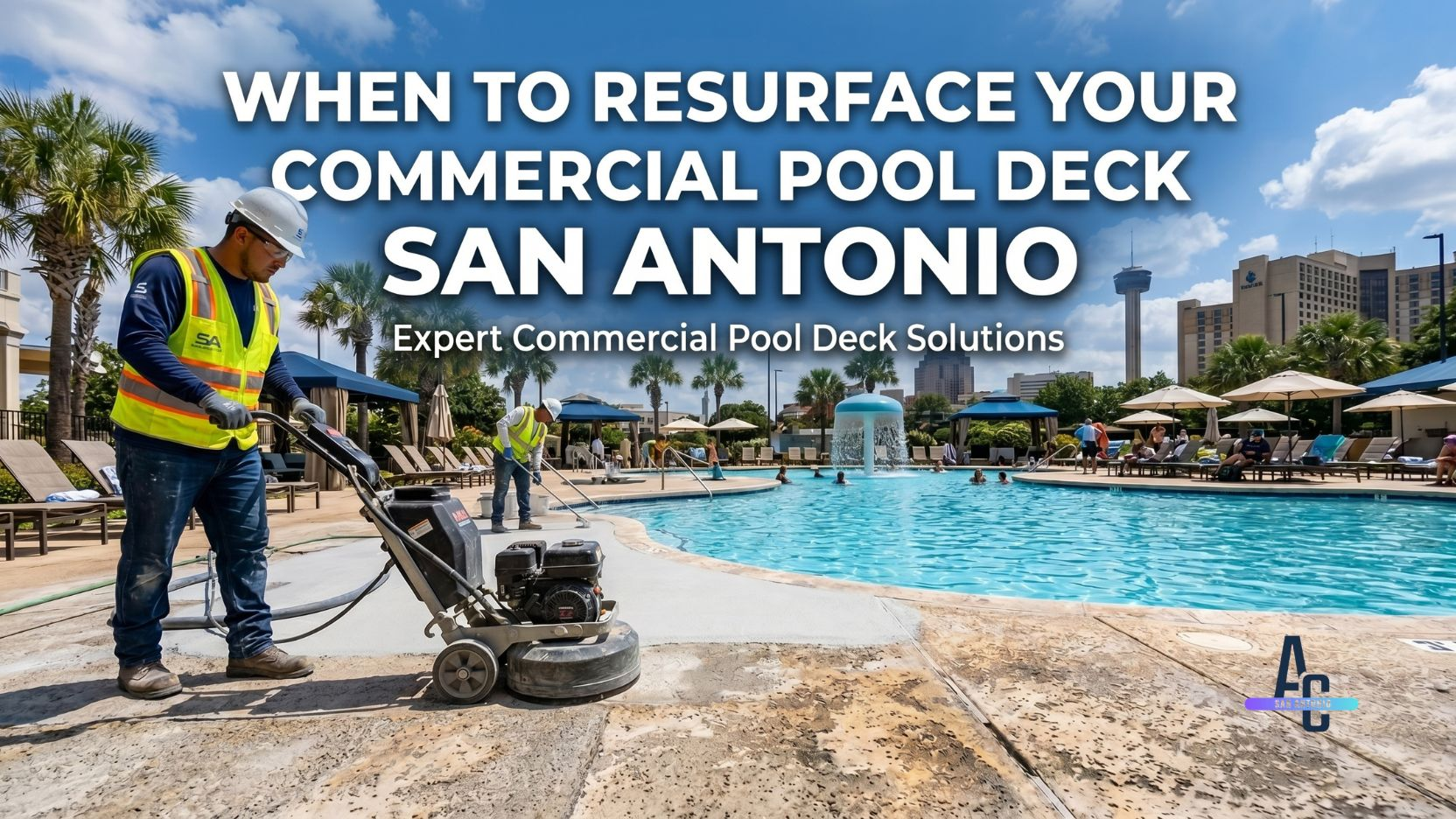
Commercial Concrete Guide: San Antonio, TX
Your commercial pool deck takes more abuse than almost any other concrete surface on your property. Between San Antonio’s brutal summer heat, constant pool chemical exposure, heavy foot traffic, and years of UV punishment, every deck has a tipping point. This guide tells you exactly when that tipping point is, what your options are, and what resurfacing actually costs in 2026.
Commercial pool deck resurfacing San Antonio Pool deck repair vs. replacement Cost guide · Timing signals · Surface options Hotels · Apartment Complexes · Rec Centers Updated 2026
A
Affordable Concrete San Antonio, Editorial Team
With over 10 years of residential and commercial concrete experience in San Antonio and the surrounding areas, our team has completed thousands of pool decks, driveways, patios, and commercial slabs across Bexar County. Every guide we publish reflects real on-the-ground expertise, not generic contractor advice pulled from out-of-state sources.
· affordableconcretesanantonio.com · Licensed and Insured · $2M Liability Coverage
Part of our complete commercial pool deck services guide
Commercial Pool Deck Concrete Services San Antonio: Everything You Need to Know (2026)
→
$3–7/sqft
Average cost to resurface a commercial pool deck in San Antonio with an overlay system
8–15yrs
Typical lifespan of an original commercial pool deck surface before resurfacing is needed
150°F+
Peak surface temperature reached on an unsealed or dark concrete pool deck during San Antonio summers
72hrs
Typical pool reopening window after resurfacing, depending on overlay system and cure conditions
Most commercial pool deck failures do not happen overnight. They develop over years, often starting with signs that property managers mistake for cosmetic issues: a few cracks here, some fading there, a rough patch near the steps. By the time the surface becomes a genuine liability concern, the window for a simple overlay has often closed, and full replacement becomes the only option.
The good news is that knowing what to look for changes that outcome completely. A commercial pool deck that is addressed at the right stage of deterioration can be resurfaced for a fraction of replacement cost, with results that look better and last longer than the original pour. This guide covers every signal, every option, and every cost involved in making that decision correctly for your San Antonio property.
The most expensive mistake commercial property owners make: waiting too long
Resurfacing works when the underlying concrete slab is structurally sound. Once the base has failed due to water intrusion, soil movement, or years of deferred maintenance, no overlay system can fix the problem. At that stage, demo and replacement is the only path forward, at three to five times the cost. The entire value of this guide is helping you identify the warning signs before that threshold is crossed.
● ● ●
Five things every commercial property owner must know
The complete guide to commercial pool deck resurfacing in San Antonio
01
The warning signs that tell you it is time to resurface
What to look for, how to assess severity, and when each sign means you still have time
Warning Signs
Commercial pool decks show wear in a predictable sequence. The challenge is that early-stage signs are subtle enough that property managers often normalize them until the surface has crossed from resurfaceable into replacement territory. Each of the warning signs below carries a different level of urgency. Knowing which is which is what separates a smart resurfacing project from an emergency replacement job.
Surface pitting and scaling: The top layer of concrete begins to flake and pit, exposing the aggregate underneath. This is often the first visible sign of deterioration and is typically caused by pool chemical runoff, UV exposure, and the expansion-contraction cycle of San Antonio’s heat. At this stage, an overlay system is still straightforward.
Hairline cracking: Fine cracks that do not go through the full slab depth are primarily cosmetic and often normal in any concrete surface over several years old. They become a problem when water begins using them as a pathway into the slab, which accelerates deterioration significantly in San Antonio’s heat-and-rain cycle.
Early stage: Surface scaling, fading, minor hairline cracks Mid stage: Spalling, wider cracks, pooling water, slip hazards Late stage: Heaving, vertical displacement, base failure signs Critical: Trip hazards, structural compromise, liability exposure
Spalling and delamination: Spalling is the visible breaking away of chunks or layers of concrete from the surface. Unlike surface pitting, spalling often indicates that water has penetrated the slab and caused internal pressure damage, a more advanced deterioration stage. Delamination, where a previous overlay or coating separates from the base concrete, is a sign that moisture was trapped during a prior resurfacing job.
Drainage problems and pooling water: Standing water near the pool edge is a safety issue and an accelerant of concrete deterioration. Properly installed pool decks should slope away from the pool at a minimum of 1/8 inch per foot. When that slope is compromised by surface wear or settling, standing water becomes a recurring problem that will rapidly worsen any existing surface damage.
Slip hazards and texture loss: A commercial pool deck’s non-slip texture is a safety requirement, not an aesthetic preference. As the surface wears, that texture diminishes. For hotels, apartment complexes, and recreation centers, a slippery pool deck creates direct liability exposure. If guests or residents can no longer walk safely across the wet deck, resurfacing is no longer optional from a legal standpoint.
⚠️ San Antonio liability note: Texas premises liability law places the responsibility for maintaining a reasonably safe environment on commercial property owners. A pool deck with documented slip hazards that has not been addressed is not just a maintenance problem. It is an active legal exposure. Documenting deterioration and acting on it promptly is part of responsible commercial property management.
Heaving and vertical displacement: When one section of the deck is visibly higher or lower than an adjacent section, the underlying soil or base has moved. This is the late-stage warning sign, and it is the line between resurfacing and replacement. Heaving caused by San Antonio’s expansive clay soils, tree root intrusion, or water erosion beneath the slab cannot be corrected by any overlay system. The base failure must be addressed before any surface work begins, often requiring slab removal.
Warning sign assessment checklist
- Surface scaling or pitting visible: early stage, overlay system is appropriate
- Hairline cracks present: have a contractor assess whether they are surface-only or full-depth
- Spalling or chunk delamination: mid-stage, resurface promptly before water intrusion worsens
- Standing water or drainage issues: address slope and drainage in the resurfacing scope
- Slip hazard confirmed: resurfacing is now a liability and safety requirement, not just cosmetic
- Heaving or vertical displacement: base assessment required before any surface work is quoted
02
How San Antonio’s climate accelerates commercial pool deck wear
Why local conditions shorten surface lifespan faster than national averages suggest
San Antonio Climate
Generic concrete lifecycle charts are written for average U.S. conditions. San Antonio is not average. The combination of intense UV radiation, extreme summer heat, episodic freeze events in winter, expansive clay soils, and the persistent chemical environment of pool water creates a deterioration rate that is significantly faster than most published benchmarks. Understanding these factors helps property managers set realistic maintenance schedules rather than being surprised by early deterioration.
UV intensity: San Antonio averages 220+ sunny days per year Surface temps: 140 to 160 degrees F on dark or unsealed concrete in summer Freeze events: 10 to 20 nights below 32 degrees F per year on average Clay soils: Expansive Vertisol soils across most of Bexar County Pool chemicals: Chlorine and pH adjusters react with unsealed concrete over time
UV and thermal cycling: Concrete expands in heat and contracts at night. In San Antonio’s summer, that daily temperature swing can span 30 to 40 degrees Fahrenheit. Over years, this thermal cycling stresses the surface layer and the sealant system. Unsealed concrete absorbs that stress directly, which is why unsealed commercial pool decks in San Antonio typically show visible surface degradation within five to seven years of installation.
Freeze-thaw events: San Antonio does not have a harsh winter climate, but it does experience periodic freeze nights, typically in January and February. When water that has penetrated an unprotected crack freezes, it expands by roughly nine percent. That expansion is enough to widen existing cracks and accelerate spalling. A single freeze event on a surface with existing water intrusion can cause more damage than a full summer season of UV and heat exposure.
Pool chemical exposure: Chlorine, muriatic acid, and the pH-adjusting chemicals used in commercial pool maintenance are mildly corrosive to concrete when runoff is allowed to pool on the deck surface without rinsing. Over years, this chemical exposure etches and weakens the top layer of unsealed concrete. This is one of the primary reasons that concrete sealing on commercial pool decks is not a maintenance preference but a basic protective requirement.
Pro tip
The San Antonio maintenance schedule that actually works for commercial pool decks: Reseal the deck every two years with a penetrating siloxane or acrylic sealer rated for pool deck use. Inspect the entire surface in March, before pool season opens, and again in November after it closes. Address hairline cracks with flexible polyurethane caulk at the first inspection of each year. This two-year sealing cycle, combined with annual crack maintenance, is the single most effective way to push a commercial pool deck’s service life toward the 15-year mark before resurfacing is needed.
Bexar County soil movement: The expansive clay soils across most of San Antonio are the underlying cause of many commercial pool deck problems that appear to be surface issues. As clay soils absorb water during rain events and shrink during dry periods, the ground underneath the slab shifts. Without adequate base preparation and properly spaced control joints, that movement translates directly into cracking and settling at the surface level. This is why a concrete inspector examining a deteriorated pool deck always checks for vertical displacement before recommending an overlay solution.
San Antonio climate protection checklist
- Deck is sealed with a pool-rated penetrating or acrylic sealer on a two-year cycle
- Control joints are inspected annually and resealed with flexible caulk if cracked or missing
- Pool chemical runoff does not pool on the deck surface; drainage channels or slope confirmed
- Pre-season inspection scheduled each March before heavy pool use begins
- Post-season inspection scheduled each November to catch any freeze-season damage
- Any crack allowing water penetration addressed before the first freeze night of winter
03
Your resurfacing options for commercial pool decks in San Antonio
Overlay systems, coatings, and finishes rated for commercial use and Texas climate
Surface Options
Not every resurfacing product is appropriate for commercial use, and not every contractor in San Antonio installs the full range of options. Understanding what is available helps property owners have a more informed conversation with contractors and avoid being sold an entry-level solution for a high-traffic commercial application.
Micro-Topping Overlay
A polymer-modified cement overlay applied at 1/8 to 1/4 inch thickness over the existing slab. Creates a fresh, uniform surface that can be colored, textured, or stamped. The most versatile resurfacing option for commercial pool decks with minor to moderate surface deterioration.
Best for surfaces with scaling, pitting, and minor cracking. Not appropriate for slabs with structural movement or base failure.
Stamped Overlay System
A thicker polymer overlay, typically 3/8 to 1/2 inch, that can be stamped with patterns mimicking slate, flagstone, tile, or brick. Provides a complete aesthetic upgrade over the existing surface and adds measurable property value for hotels and high-end apartment complexes.
Requires sealing every two to three years. The most impactful visual upgrade available in the resurfacing category.
Exposed Aggregate Overlay
Aggregate is seeded into the overlay surface and the paste is removed to expose the stone. Provides inherent, long-lasting slip resistance that does not depend on a surface coating. The most safety-focused resurfacing option for high-traffic commercial pools.
Appearance is determined by aggregate size and color. Specify both before work begins. Cannot be changed after installation.
Cool Deck Coating
A textured acrylic coating system specifically formulated to reflect heat and stay cooler underfoot than standard concrete. In San Antonio’s summers, where uncoated pool decks can reach 150 degrees F, a cool deck coating can reduce surface temperatures by 30 to 40 degrees F. Standard in the commercial pool market.
Surface temperature reduction makes this the most guest-comfort-focused option. Recoating typically needed every five to seven years.
Kool Deck / Texture Coat Spray
A spray-applied texture coating that provides slip resistance and mild heat reduction in a fast-applying system. Common on budget-conscious commercial resurfacing projects where downtime needs to be minimized. Typically available in a range of earth tones and lighter colors that reflect heat.
Entry-level resurfacing option. Lower cost and faster application than overlay systems. Shorter service life; expect recoating every four to six years with commercial traffic.
Concrete Grinding and Sealing
Where the existing surface is sound but has lost its texture, diamond grinding restores a uniform profile and opens the concrete pores for a deep penetrating sealer. Not a visual transformation option, but a cost-effective way to restore slip resistance and weather protection on decks that do not need a full overlay.
Best when the surface is structurally sound but slick, uneven, or heavily stained. Lower cost than overlay systems.
$6–10/sqft
stamped overlay
Stamped overlay system: Full aesthetic upgrade with pattern and color options. Best for hotels and high-end properties where curb appeal is a factor. Includes surface prep, overlay, stamping, color, and sealant.
Micro-topping or exposed aggregate overlay: Mid-range resurfacing with strong durability and slip resistance. The preferred commercial standard for apartment complexes and recreation centers in San Antonio.
Cool deck or texture coat spray: Entry-level commercial resurfacing with heat reduction and slip resistance. Lower upfront cost with shorter service life than overlay systems. Best for properties managing tight capital budgets.
Concrete grinding and penetrating seal: Not a visual resurfacing but a surface restoration. Appropriate where the deck is structurally sound and slip resistance needs to be restored without a full overlay investment.
🏗️ Commercial spec note: For commercial pool decks serving hotels, apartment communities, or public recreation facilities, the resurfacing system must meet ADA slip resistance requirements (a coefficient of friction of at least 0.6 on wet surfaces). Not every product on the market meets this threshold. Always confirm slip resistance certification with your contractor before product selection, and request documentation of the product’s tested wet-surface COF rating.
Resurfacing option selection checklist
- Surface condition assessed before product selection: minor deterioration vs. structural damage changes the right answer
- ADA wet-surface slip resistance (COF of 0.6 or higher) confirmed for the selected product
- Heat reduction confirmed if surface temperature comfort is a priority for guests or residents
- Overlay thickness appropriate for the existing surface condition: thicker systems for more damaged decks
- Color and texture specified in writing before work begins: cannot be changed after application
- Sealing schedule for the new surface established: every two to three years for overlays, every five to seven for cool deck systems
04
Resurfacing vs. full replacement: how to make the right call
The structural and financial framework for deciding between overlay and demo-and-repour
Cost Decision
The decision between resurfacing and full replacement is the most consequential one a property manager will make about a deteriorating pool deck. Made correctly, it saves significant capital while delivering a surface that performs well for another decade. Made incorrectly, it results in an overlay that fails within a year or two because the underlying slab was not actually sound enough to support it.
When resurfacing is the right call: The existing slab is structurally intact. There is no vertical displacement between adjacent sections. Water does not pool due to grade issues that cannot be corrected with an overlay. Core sampling or sounding (tapping the surface to listen for hollow spots) shows consistent bonding throughout. In these conditions, an overlay system is not only appropriate but will typically outlast a rushed replacement pour done under budget pressure.
When replacement is unavoidable: The slab has base failure beneath it. There is heaving or sections with vertical displacement greater than 1/2 inch. Prior resurfacing layers are delaminating due to trapped moisture. The control joints have failed and the slab is cracking along unintended lines. In any of these conditions, no overlay product applied on top will last, and a contractor recommending one without addressing the base is not acting in the property owner’s interest.
| Condition |
Resurfacing appropriate |
Replacement required |
| Surface scaling and pitting |
Yes, overlay system resolves this completely |
No, unless slab is also structurally compromised |
| Hairline cracking |
Yes, after crack repair and surface prep |
Only if cracks are active and widening |
| Spalling (chunks missing) |
Yes, with patching compound and overlay |
Only if delamination is widespread and deep |
| Drainage and slope issues |
Yes, overlay can correct minor slope deficiencies |
Major grade changes require demo and repour |
| Prior overlay delaminating |
Only after full removal of failed overlay |
If moisture damage penetrated to the base slab |
| Heaving or vertical displacement |
No, base failure must be corrected first |
Yes in most cases, unless isolated to one panel |
| Tree root intrusion under slab |
No, root removal and base repair required first |
Yes if root damage is widespread beneath the deck |
The cost difference is significant: Commercial pool deck resurfacing in San Antonio typically runs $3 to $10 per square foot depending on the overlay system chosen. Full demo and replacement for commercial concrete runs $15 to $25 per square foot when demolition, hauling, base prep, forming, pour, and finishing are all included. On a 3,000 square foot pool deck, that is the difference between roughly $9,000 to $30,000 for resurfacing versus $45,000 to $75,000 for replacement. The financial case for catching deterioration early is clear.
Decision tip
The sounding test: a quick field assessment you can do yourself before calling a contractor: Walk the entire deck and knock on the surface firmly with your knuckles or a small rubber mallet. A solid, dense sound indicates good bonding between the surface layer and the slab beneath. A hollow or drum-like sound indicates delamination or a void. Mark every hollow spot with chalk or tape before the contractor arrives. If hollow spots cover more than 25 to 30 percent of the deck area, that is a red flag for either a failed prior overlay or significant subsurface moisture damage, both of which change the resurfacing calculation.
Resurface vs. replace decision checklist
Sounding test performed across the entire deck: hollow spots documented and mapped
No vertical displacement greater than 1/2 inch between adjacent deck sections confirmed
No active soil heaving or base movement detected along the perimeter or at control joints
Drainage slope still functional: water moves away from the pool edge without correction
Prior overlay not delaminating: if a previous resurfacing has failed, full removal required before new overlay
Contractor recommendation for resurfacing supported by a written assessment of slab condition
05
Vetting a commercial concrete contractor in San Antonio
What separates a qualified commercial contractor from a residential crew taking on a job they are not equipped for
Contractor Vetting
Commercial pool deck resurfacing is not the same as residential concrete work. The products are more technical, the surface prep requirements are more demanding, the timelines are compressed because pool closures cost money, and the liability exposure if the work fails is considerably higher. A contractor who does excellent residential driveway work is not necessarily equipped to handle a hotel pool deck resurfacing project. Knowing what to look for protects the property and the budget.
| What to verify |
What a qualified commercial contractor provides |
Red flag response |
| Commercial experience |
Specific portfolio of commercial pool decks, hotels, or apartment complexes in San Antonio |
Residential portfolio only; vague claims of experience without photos or references |
| Product specification |
Named overlay product with written data sheet showing slip resistance, UV stability, and commercial ratings |
Generic references to “our overlay system” without product documentation |
| Surface prep plan |
Written scope covering pressure washing, grinding or shot blasting, crack repair, and primer application |
Quote that jumps directly to material and application without specifying prep steps |
| Liability insurance |
Certificate of insurance with at least $2M general liability coverage for commercial work |
$1M residential policy offered for a commercial project; no documentation on request |
| Pool closure timeline |
Clear schedule with specific cure milestones and a written reopening date based on product specs |
Vague estimates of “a few days” without product data sheet backing the timeline |
| Warranty terms |
Written warranty on both labor and materials with specific conditions and duration |
Verbal warranty only; no written documentation of coverage |
| ADA compliance |
Confirmation that the selected product meets the 0.6 wet COF standard with supporting documentation |
No knowledge of ADA slip resistance standards or dismissal of the question |
⚠️ The San Antonio commercial pool deck low-bid trap: Commercial property managers often receive bids that vary by 40 to 60 percent on the same scope. The lowest bid almost always reflects one of three shortcuts: inferior overlay product with lower ratings, skipped or minimal surface prep, or inadequate crack repair before overlay application. All three shortcuts produce the same result: a resurfacing job that begins to fail within two to three years rather than lasting the expected eight to twelve. The cost of a failed resurfacing job, including repeat mobilization, material cost, and extended pool closure, almost always exceeds the savings from the low bid. Get three detailed quotes, compare the product specifications and prep scope line by line, and make the decision on total value rather than initial price.
Surface preparation is where commercial resurfacing jobs succeed or fail: The overlay system is only as durable as the bond between it and the existing slab. That bond is created entirely during surface preparation. Shot blasting or diamond grinding to open the concrete pores, thorough cleaning to remove all contamination including pool chemical residue and sunscreen oils, proper crack repair with flexible polyurethane filler rather than rigid patching compound, and the correct primer system for the overlay product chosen. A contractor who provides a thorough written prep scope is a contractor who understands why the preparation matters.
Commercial contractor verification checklist
Commercial pool deck portfolio reviewed, specifically in San Antonio or similar climate conditions
Named overlay product verified with product data sheet covering slip resistance and UV stability ratings
Written surface prep scope includes shot blasting or grinding, crack repair method, and primer system
Certificate of insurance with $2M or more general liability coverage received and verified
Pool closure and reopening timeline documented in writing with product cure schedule backing it
Written warranty covering both labor and materials with clear terms and duration
ADA wet-surface slip resistance compliance confirmed with product documentation
● ● ●
Quick reference by property type and condition
Resurfacing guide for San Antonio commercial properties
Use this reference to identify the recommended action based on your property type and the current condition of your pool deck. Costs reflect 2026 San Antonio market rates installed.
| Property type |
Typical deck size |
Recommended resurfacing system |
Estimated cost range (San Antonio, 2026) |
| Hotel or resort pool |
3,000 to 8,000 sqft |
Stamped overlay or micro-topping with integral color; cool deck coating where heat is the primary concern |
$18,000 to $80,000 depending on system and size |
| Apartment complex pool |
1,500 to 4,000 sqft |
Exposed aggregate overlay or cool deck coating; texture coat spray for budget-focused projects |
$6,000 to $32,000 depending on system and size |
| HOA community pool |
1,000 to 3,000 sqft |
Cool deck coating or micro-topping; exposed aggregate for high-traffic areas near entry steps |
$4,000 to $24,000 depending on system and size |
| Municipal or rec center pool |
4,000 to 15,000 sqft |
Exposed aggregate overlay for maximum slip resistance; ADA compliance documentation required |
$20,000 to $105,000 depending on system and size |
| Commercial gym or fitness club pool |
800 to 2,500 sqft |
Micro-topping with non-slip broadcast aggregate or cool deck coating |
$3,500 to $20,000 depending on system and size |
| Waterpark or splash pad |
Varies widely |
Specialty waterpark overlay systems with maximum slip resistance and chemical resistance ratings |
Custom scope and pricing required |
● ● ●
Commercial pool deck resurfacing master checklist
Complete this before signing any resurfacing contract or releasing a deposit
Condition assessment
Full surface sounding test completed: hollow spots mapped and percentage of affected area documented
All cracks measured for width and depth: hairline vs. structural vs. full-depth differentiated
Drainage slope confirmed functional: no standing water at pool edge or low points
Vertical displacement check complete: no section elevated more than 1/2 inch relative to adjacent panels
Prior resurfacing layers assessed for delamination: removal required if failing
Product and system selection
Overlay product selected and data sheet reviewed: slip resistance, UV stability, and commercial rating confirmed
ADA wet-surface COF of 0.6 or higher confirmed with documentation
Heat reduction performance confirmed if surface temperature comfort is a priority
Color, texture, and pattern specified in writing before work begins
Sealing schedule for the new surface established in writing
Contractor qualification
Commercial pool deck portfolio reviewed for San Antonio or comparable climate experience
Certificate of insurance received: $2M or more general liability for commercial work
Written surface prep scope verified: shot blasting or grinding, crack repair method, primer system specified
Warranty terms confirmed in writing: labor and materials with clear duration and conditions
At least two additional quotes obtained with product specifications compared line by line
Project execution and reopening
Pool closure start and reopening date confirmed in writing with product cure schedule attached
Guest or resident notification plan in place before work begins
Post-application inspection scheduled before pool reopens: no bubbling, delamination, or missed areas
First resealing date scheduled based on product manufacturer recommendation
Annual inspection schedule established for ongoing maintenance after resurfacing
● ● ●
Common questions from commercial property owners
FAQs
Q
How long does a commercial pool deck resurfacing take in San Antonio, and how long will my pool be closed?
For a typical commercial pool deck of 2,000 to 5,000 square feet, the resurfacing process takes two to four days of active work, plus cure time. Most overlay systems require 48 to 72 hours of cure time in San Antonio’s conditions before foot traffic is allowed, and a full seven days before the area should be exposed to pool water splash. That means a realistic pool closure window runs five to ten days total from the first day of surface prep to the day the pool reopens. Projects that involve extensive crack repair, full overlay removal, or slope correction will add time. Get the closure and reopening schedule in writing from your contractor, backed by the product data sheet, not just a verbal estimate.
Q
How much does it cost to resurface a commercial pool deck in San Antonio?
Commercial pool deck resurfacing in San Antonio runs $3 to $10 per square foot for most overlay systems, depending on the product chosen and the condition of the existing surface. A texture coat or cool deck spray system is at the lower end of that range. A stamped or micro-topping overlay with integral color is at the upper end. For a 3,000 square foot apartment complex pool deck, expect to budget $9,000 to $30,000 for resurfacing versus $45,000 to $75,000 for full demo and replacement. Surface prep condition, crack repair extent, and the number of prior overlay layers to remove all affect final cost. Get three quotes with itemized scopes and compare the prep work, not just the bottom line.
Q
What is the best time of year to resurface a commercial pool deck in San Antonio?
October through April is the ideal window for commercial pool deck resurfacing in San Antonio. Overlay systems cure best in moderate temperatures, typically between 50 and 90 degrees F, and San Antonio’s fall and winter months consistently provide those conditions. The practical advantage is also significant: most commercial pools in San Antonio run reduced hours or are closed entirely from November through March, which allows resurfacing to happen with no revenue impact from the pool closure. Summer resurfacing is possible but requires early morning application, strict temperature monitoring of the overlay during cure, and more careful product selection for heat tolerance. If your pool schedule allows any flexibility, fall or winter is the right timing.
Q
Can you resurface a pool deck that has already been resurfaced before?
Yes, with an important qualification: the existing resurfacing layer must be properly bonded to the slab beneath it. A second or third overlay system can be applied over a prior one as long as the existing layer is sound, flat, and chemically compatible with the new product. If the prior overlay is delaminating or hollow-sounding in significant areas, it must be removed entirely before a new system is applied. Overlaying a failing resurfacing layer is one of the most common and costly mistakes in commercial pool deck maintenance, because the new system will fail in the same pattern as the old one. Always have the existing surface assessed before committing to an over-application approach. A contractor who recommends overlaying a delaminating surface is not working in your long-term interest.
Q
How do I know if my pool deck needs resurfacing now or if I can wait another season?
The question to ask is whether the surface deterioration is still confined to the top layer or whether it has reached the slab. Surface scaling, fading, minor hairline cracks, and texture loss are all conditions where waiting another season increases the work required but does not necessarily push you from resurfacing into replacement. Spalling, drainage problems, and slip hazards are conditions where waiting another season creates liability exposure and will likely worsen rapidly, especially if the surface goes through another San Antonio summer unprotected. Vertical displacement or heaving means the wait is already over. The safest approach for any commercial property owner unsure of where their deck falls in this spectrum is a professional assessment in the spring before pool season opens. A good contractor will tell you honestly whether you can wait, and that assessment costs far less than finding out the hard way mid-season.
Continue researching your commercial pool deck project
Continue exploring expert resources for your commercial pool deck project in San Antonio. These guides cover the best surface options for hot Texas weather, compare stamped concrete and pavers, explain non-slip flooring solutions for safer pool areas, and connect you with professional resurfacing and repair services.
☀️
Guide 1
Best Commercial Pool Deck Surfaces for San Antonio Heat
→
🧱
Guide 2
Stamped Concrete vs. Pavers for Commercial Pool Decks
→
🚶
Guide 3
Non-Slip Pool Deck Flooring for San Antonio Businesses
→
🏊
Service page
Commercial Pool Deck Resurfacing Coatings & Repair San Antonio
→
Get a free commercial pool deck assessment in San Antonio
Tell us about your property and your deck’s current condition. We will visit the site, assess the surface, and give you a detailed written quote covering resurfacing options, timeline, and cost at no charge.