
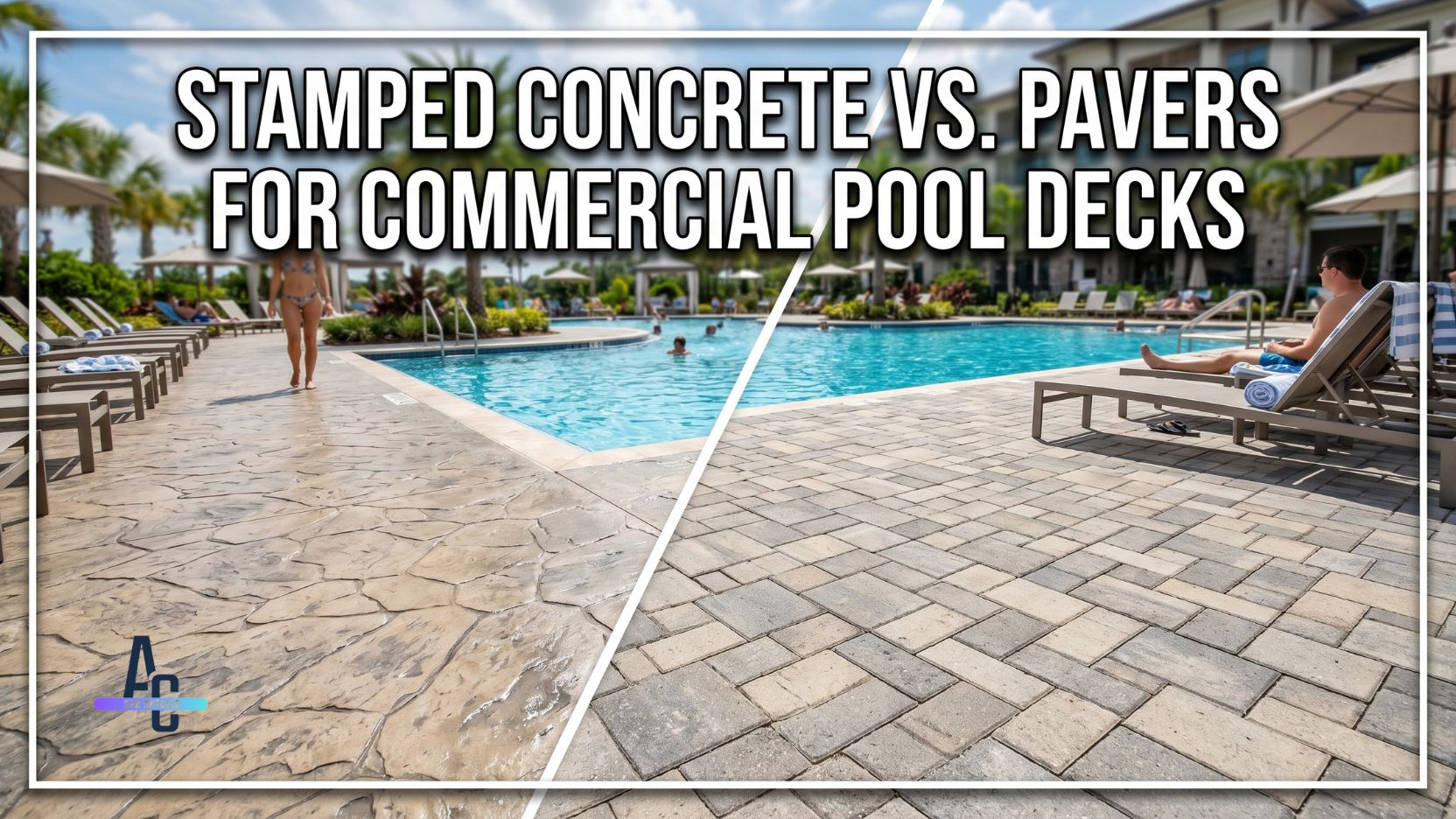
Two of the most popular commercial pool deck surfaces in San Antonio come with very different price tags, maintenance commitments, and long-term performance records. This guide breaks down every factor that matters for hotel, apartment, and municipal pool operators making this decision in 2026.
When a San Antonio hotel, apartment complex, or community center is planning a pool deck surface, the two finalists almost always come down to stamped concrete and pavers. Both look great in a brochure. Both can perform well with proper installation. But they behave very differently under the specific conditions of a commercial pool environment in South Texas, and the wrong choice creates ongoing costs that far outweigh the initial price difference.
This guide covers every factor that matters for commercial pool operators: upfront cost, long-term cost of ownership, heat performance, slip safety, ADA compliance, and which surface type makes the most sense for specific facility types. The goal is to give facility managers and property owners the information they need to make a decision they will not regret five years from now.
Most commercial buyers come into this decision focused on the upfront price per square foot. That is the wrong starting point. The right question is: what does this surface cost to maintain over 10 years, and what happens when something goes wrong? Stamped concrete costs less to install, seals as a single continuous slab, and requires no individual unit replacement. Pavers cost more upfront, but individual units can be pulled and replaced without disturbing the rest of the surface. The winning choice depends almost entirely on your facility’s priorities, not on which material looks better on day one.
Cost
Stamped concrete consistently costs less to install than pavers at commercial scale. The gap widens on larger projects because the stamped concrete process does not require individual unit placement, which is the most labor-intensive part of any paver installation. On a 5,000-square-foot hotel pool deck, that labor difference adds up quickly.
One cost factor that many buyers overlook is drainage infrastructure. Pavers installed on a permeable base allow water to infiltrate through the joints, which can reduce the need for surface drains. Stamped concrete requires a properly sloped surface (typically 1 to 2 percent pitch toward drains) and adequate drain placement from the beginning. Retrofitting drainage on a concrete deck is expensive. Spec it correctly at installation and this is a non-issue.
- Quote includes site excavation, sub-base preparation, and compaction, not just material and finish costs
- Stamped concrete quotes specify reinforcement type: rebar or fiber reinforcement at commercial spec
- Paver quotes specify base depth: 6 to 8 inches compacted aggregate is commercial minimum in San Antonio’s clay soils
- Resealing schedule and estimated 10-year cost included in the total cost of ownership analysis
- Drainage plan confirmed: slope and drain locations specified for concrete; permeable base spec confirmed for pavers
Durability
San Antonio’s climate is harder on outdoor surfaces than most U.S. cities. Summer surface temperatures on a dark pool deck can exceed 140 degrees Fahrenheit. The underlying Bexar County clay soils swell when wet and shrink when dry, creating constant movement in the base layer. Pool chemicals, particularly chlorine, degrade unsealed concrete finishes over time. Any surface you choose for a commercial pool deck in this market needs to be evaluated against all three of these stressors, not just against generic durability claims.
Clay soil movement is the biggest durability threat for both surfaces. Bexar County’s expansive Vertisol clay shrinks and swells with every rain cycle, and San Antonio sees dramatic seasonal swings. For stamped concrete, this means rebar reinforcement (not just wire mesh) and expansion joints every 10 feet are mandatory at commercial scale. For pavers, it means a deeper compacted base than typical residential installs, ideally 6 to 8 inches of well-graded crushed limestone, topped with a properly screeded bedding layer. A contractor who does not mention soil conditions when quoting a San Antonio pool deck project is not the right contractor for your facility.
- Stamped concrete: rebar reinforcement (#4 at 16-inch centers minimum) specified for commercial pool deck slab
- Stamped concrete: expansion joints placed every 10 feet in both directions to control thermal cracking
- Pavers: base depth confirmed at 6 to 8 inches compacted crushed limestone for San Antonio clay conditions
- Sealer type specified for pool environment: polyurethane or polyaspartic for concrete; penetrating sealer for stone pavers
- Paver joint material confirmed as pool-rated: standard polymeric sand is not adequate for pool deck applications
Safety
Slip resistance is not a preference on a commercial pool deck. It is a legal requirement. The ADA Standards for Accessible Design and OSHA guidelines both specify minimum coefficient of friction standards for wet pedestrian surfaces, and pool decks are among the highest-risk surfaces in any commercial facility. Choosing a surface that looks great but performs poorly when wet creates a liability exposure that dwarfs any savings from a lower installation price.
| Safety Factor | Stamped Concrete | Pavers | Advantage |
|---|---|---|---|
| Wet slip resistance (texture) | High when broom-finished or broadcast aggregate applied; moderate with smooth stamp texture; sealer adds a variable | High for concrete pavers with brushed surface; variable for natural stone; travertine can be slippery when wet if honed | Concrete (with correct finish and anti-slip sealer) |
| Trip hazard risk (surface level) | Monolithic slab has no joints to shift; expansion joints are controlled and flush when properly installed | Individual units can settle unevenly over time, especially in clay soils; any unit displaced more than 1/4 inch becomes an ADA and OSHA trip hazard | Concrete |
| ADA slope compliance | Slope precision controlled at pour; 1 to 2 percent grade to drain engineered from the start | Slope maintained in base preparation; minor settlement over time can compromise drainage and ADA cross-slope compliance | Concrete (easier to maintain long-term) |
| Surface temperature (barefoot) | Can be very hot in full Texas sun; light color and reflective sealer are critical specifications, not optional upgrades | Travertine and light concrete pavers stay noticeably cooler than stamped concrete; this is a meaningful safety comfort advantage for barefoot guests | Pavers (light-colored travertine or concrete) |
| Sealer traction impact | Gloss sealers significantly reduce wet friction; always specify a matte or anti-slip additive sealer for pool decks | Sealed pavers are less affected by sealer type because the joint texture breaks up the surface; risk is lower but still present | Pavers (less sealer-dependent) |
For paver surfaces, the trip hazard risk requires active management, not just correct installation. Build quarterly inspections into your facility maintenance schedule. Any paver unit that has settled more than a quarter inch relative to its neighbors needs to be reset immediately. On a heavy-use commercial pool deck, this inspection is just as important as maintaining proper water chemistry.
- Stamped concrete: anti-slip additive (aluminum oxide or silica broadcast) specified in the sealer application
- Stamped concrete: matte or satin finish sealer required, not gloss, for all pool deck areas
- Stamped concrete: coefficient of wet friction rating of 0.60 or higher confirmed with the sealer product selected
- Pavers: quarterly inspection schedule planned for joint height variance greater than 1/4 inch
- Both surfaces: ADA-compliant slope (maximum 2 percent in any direction) confirmed in the drainage plan
- Both surfaces: surface temperature assessment conducted for the specific material and color chosen, not generic spec sheets
Maintenance
Maintenance requirements on paper and maintenance realities in operation are two different things. A stamped concrete deck requires periodic resealing, which temporarily closes the surface during application and curing. A paver deck requires joint inspection and occasional releveling of settled units, which can be done on individual sections without closing the entire deck. Neither surface is maintenance-free, but the type of maintenance differs significantly and the operational disruption profile matters for facilities that cannot afford extended closures.
Staining is a genuine concern on both surfaces. Pool chemicals, sunscreen, food service spills, and organic material from landscaping all stain pool deck surfaces. On sealed stamped concrete, most stains are surface-level and wash off with a pressure wash before the next sealer application. On pavers, staining can penetrate the porous material if not cleaned promptly. Natural stone pavers are more vulnerable than concrete pavers in this regard. Algae growth in the joints of a paver deck is another recurring maintenance issue that requires treatment and does not affect concrete slabs.
For facilities that cannot tolerate multi-day closures: Stamped concrete resealing requires the surface to be clean, dry, and closed to traffic during application and the subsequent curing period, typically 24 to 48 hours. On a year-round commercial pool, this means scheduling resealing during low-demand periods (November through February in San Antonio) and planning the closure in advance. Paver joint resanding can typically be done in sections without closing the entire deck, which is an operational advantage worth factoring into the decision for high-volume facilities.
Efflorescence is a maintenance issue that affects both surfaces but appears differently. On stamped concrete, it shows up as a white mineral deposit on the surface, which clears with an acid wash treatment. On concrete pavers, it appears in the joints and on the face of individual units. It is purely cosmetic and does not affect structural performance, but it is a recurring issue in San Antonio’s humid summer conditions that facilities teams should anticipate and budget for.
- Stamped concrete: resealing closure period factored into facility operations calendar and guest communications plan
- Stamped concrete: first resealing scheduled no earlier than 28 to 30 days after pour (full cure required before sealing)
- Pavers: joint material type confirmed as pool-rated; standard polymeric sand re-sanding scheduled at 3-year intervals
- Both surfaces: annual pressure washing scheduled before the summer season peak
- Both surfaces: efflorescence treatment product and protocol identified before installation (not after first occurrence)
- Both surfaces: stain response protocol established for pool chemicals, sunscreen, and food service spills
Decision Guide
There is no single correct answer to the stamped concrete versus pavers question. The correct answer depends on your facility type, your capital versus operating expense budget structure, your tolerance for periodic closures, and how heavily the surface will be used. The table below distills the decision by facility type based on the conditions that matter most in a San Antonio commercial pool environment.
| Facility Type | Recommended Surface | Primary Reason |
|---|---|---|
| Hotel or resort pool (high-end, image-driven) | Travertine or premium concrete pavers | Visual distinction, cooler surface temperature, individual unit replaceability for long-term appearance control |
| Apartment complex community pool | Stamped concrete | Lower installed cost, single-surface maintenance, no joint shifting risk for high-traffic residential use |
| Municipal or recreation center pool | Stamped concrete with broom or broadcast finish | Maximum slip resistance, budget efficiency at large scale, long lifespan with proper sealing program |
| HOA community pool | Stamped concrete or concrete pavers (both viable) | Decision turns on HOA capital budget. Stamped concrete is lower upfront; concrete pavers offer spot repair flexibility that appeals to volunteer maintenance boards |
| Commercial gym or fitness center | Stamped concrete | High foot traffic, chemical cleaning frequency, and anti-slip sealer control make concrete the more manageable choice |
| Restaurant or hospitality outdoor pool | Pavers (concrete or natural stone) | Aesthetic flexibility, easier partial replacement for sections near food service, premium visual finish at lower risk of large-scale failure |
For facilities where the decision genuinely could go either way, a hybrid approach works well on some San Antonio commercial properties: stamped concrete for the main deck field, with a paver border or accent band around the pool coping. The concrete covers the highest-traffic zone efficiently, while the paver border adds visual distinction and allows the facility to benefit from both materials where each performs best.
- Facility type matched to surface recommendation in the table above
- Underground utility locations mapped before surface material selection is finalized
- 10-year total cost of ownership calculated for both options, not just installed price per square foot
- Operational closure tolerance assessed: can the facility sustain 24-to-48-hour closures for resealing, or is section-by-section maintenance required?
- Hybrid approach evaluated for facilities where budget and aesthetics pull in different directions
Use this table as your quick reference when comparing contractor quotes and evaluating proposals for a San Antonio commercial pool deck project.
| Factor | Stamped Concrete | Pavers |
|---|---|---|
| Installed cost (San Antonio) | $10 to $18 per square foot | $18 to $30 per square foot |
| Lifespan (properly maintained) | 25 or more years | 20 to 30 years (concrete pavers); 30 or more (natural stone) |
| Resealing frequency | Every 2 to 3 years (pool environment) | Every 3 to 5 years if sealed; joints re-sanded every 3 to 5 years |
| Spot repair | Patch repairs are visible; large cracks may require section demolition | Individual units pulled and replaced without disturbing adjacent surface |
| Trip hazard risk | Low (monolithic slab with controlled expansion joints) | Moderate (joint settlement risk in clay soils; requires quarterly inspection) |
| Surface temperature (barefoot) | Hot in full Texas sun; color and sealer choice have significant impact | Travertine runs noticeably cooler; concrete pavers vary by color |
| Slip resistance | Excellent with broom finish and anti-slip sealer; risk with gloss sealer | Good; less sealer-dependent; joint texture helps when wet |
| Utility access | Requires jackhammering and patch repair | Pull, access, and relay individual units with no permanent damage |
| Best facility fit | Apartments, municipal pools, gyms, HOAs on a budget | Hotels, resorts, upscale HOAs, restaurant pools, facilities with buried utilities |
- Installed cost per square foot confirmed for both options with San Antonio-specific quotes, not national averages
- 10-year maintenance cost estimated for each option and added to installed cost for true comparison
- Capital budget vs. operating budget implications assessed (pavers shift more cost to operations; concrete front-loads it)
- Facility closure cost during resealing factored into stamped concrete option evaluation
- Anti-slip sealer with silica additive specified in writing for stamped concrete; matte or satin finish required
- Wet coefficient of friction target of 0.60 or higher confirmed with selected sealer product
- ADA-compliant slope (1 to 2 percent maximum) confirmed in drainage design for both surface options
- Paver inspection protocol established: quarterly check for joints displaced more than 1/4 inch
- Stamped concrete: rebar reinforcement at commercial spec confirmed (not wire mesh alone)
- Stamped concrete: expansion joints every 10 feet in both directions specified in contract
- Pavers: base depth of 6 to 8 inches compacted crushed limestone confirmed for Bexar County clay conditions
- Paver joint material specified as pool-rated product, not standard polymeric sand
- Underground utility locations mapped and documented before surface selection is finalized
- Contractor has verifiable commercial pool deck experience in San Antonio, not just residential concrete work
- Certificate of insurance received: minimum $1M general liability and $2M recommended for commercial projects
- References from completed commercial pool deck projects in Bexar County available on request
- Written quote itemizes base prep, reinforcement, pour or placement, finish, sealing, and cleanup as separate line items
Is stamped concrete slippery around a commercial pool?
How hot do stamped concrete and pavers get in San Antonio summers?
What happens when a paver unit cracks or shifts on a commercial pool deck?
How often does stamped concrete need to be resealed on a commercial pool deck?
Can we install pavers over an existing concrete pool deck instead of demolishing it?
Get a free commercial pool deck quote in San Antonio
Tell us about your facility, your timeline, and your priorities. We will assess the site, walk you through both surface options with real numbers, and give you a detailed written quote at no cost.