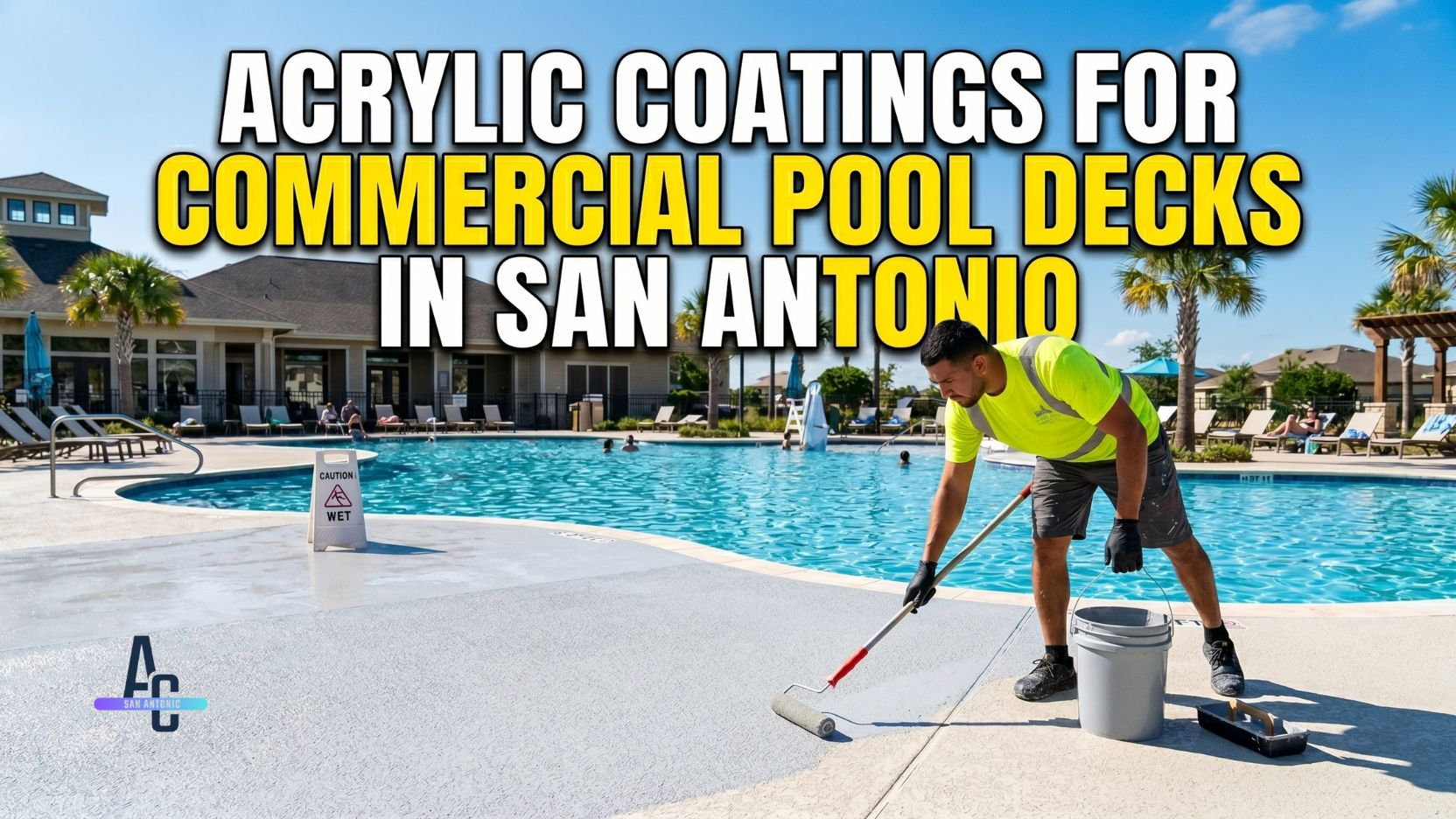
The right acrylic coating system extends a commercial pool deck's life by 10 to 15 years, eliminates liability from slip-and-fall incidents, and keeps you in compliance with Texas Health and Safety Code requirements. This guide covers every decision: system types, cost expectations, surface prep, and what questions to ask before signing a contract.
San Antonio's commercial pool operators hotels on the River Walk corridor, HOA communities throughout Stone Oak and Alamo Ranch, aquatic centers run by NEISD and SAISD, and private clubs across Bexar County share a common problem: concrete pool decks that were poured once and then left to absorb years of UV exposure, chlorine splash, heavy foot traffic, and Texas heat cycles. By the time the surface shows visible deterioration, the liability risk is already significant.
Acrylic coatings are the most widely specified resurfacing solution for commercial pool decks in San Antonio because they solve multiple problems at once: they restore a safe, non-slip surface without requiring full demolition, they bring faded or stained decks back to a uniform appearance, and they add a protective layer that extends the underlying concrete's lifespan by a decade or more. But the quality difference between a correctly specified and installed acrylic system and a cheap, rushed job is enormous and it shows up fast in the Texas climate.
This guide covers the full decision: which acrylic coating system is right for your commercial application, what surface preparation actually requires, how to read a bid, and what compliance obligations apply to commercial pool decks in Texas.
Property managers and facilities directors are frequently sold on coating brand names when the real variable is surface preparation quality. An acrylic coating applied over a dirty, contaminated, or structurally compromised surface will fail within 12 to 18 months regardless of the product used peeling, bubbling, and delaminating from the substrate. The same coating applied over a properly diamond-ground, cleaned, and primed surface routinely lasts 8 to 12 years in San Antonio's climate. When evaluating bids, the prep scope is the line item that separates contractors who know what they are doing from those who do not.
Not all acrylic coatings are the same product. The term covers a range of formulations with meaningfully different performance characteristics and the correct choice depends on your facility's traffic volume, existing concrete condition, budget cycle, and aesthetic requirements. Specifying the wrong system type is as costly as applying the right one incorrectly.
Matching the system to the facility: Hotels and resort properties with high guest volume and aesthetic expectations typically specify Kool Deck or acrylic texture systems. HOA community pools with moderate traffic and tighter budgets are well-served by a 2-coat standard acrylic. Older aquatic facilities with cracked surfaces but sound structural slabs are the primary candidates for rubberized acrylic or overlay systems. The facility type, traffic load, existing surface condition, and budget cycle all feed into the correct system specification.
- Existing surface condition assessed: sound, hairline-cracked, spalled, or structurally compromised
- Traffic volume confirmed: light HOA use, moderate hotel pool use, or heavy aquatic center volume
- System type specified in writing in the bid: standard 2-coat, rubberized, overlay, or texture system
- Finish color specified: lighter tones strongly preferred for surface temperature management in San Antonio
- Crack bridging requirement evaluated: any cracks over 1/8" need rubberized or overlay system, not standard acrylic
Surface preparation is the most critical phase of any acrylic coating project and the phase most frequently cut short by low-bid contractors. An acrylic coating is only as durable as its bond to the substrate. Anything that compromises that bond residual sealer, chlorine contamination, laitance (the weak cream layer on the surface of concrete), oil, or loose material will cause the coating to delaminate, sometimes within a single season.
Drain and expansion joint detailing is a liability point, not a finish point: At every floor drain and expansion joint, the acrylic coating must be correctly terminated and sealed. Coating over a live expansion joint without a proper backer rod and flexible joint sealant will crack within one seasonal cycle as the joint moves. Around drains, the coating must tuck under the drain ring flange not just coat up to it to prevent water infiltration under the coating edge. These are small details that separate a commercial-grade installation from a residential-grade one.
- Moisture testing confirmed before any prep begins coating cannot be applied over wet concrete
- Mechanical profiling method specified: diamond grinding or shotblasting, not pressure wash only
- Existing sealer identified and removal method specified chemical stripping or mechanical grinding
- All cracks individually evaluated and repair method specified by crack width and activity
- Spall and void repair included as a separate scope item not assumed to be covered by the coating
- Primer coat specified and included in the scope as a distinct application step
- Expansion joint and drain termination method described in the scope of work
Commercial pool decks in Texas are subject to regulatory oversight from the Texas Department of State Health Services (TDSHS) under Texas Administrative Code Title 25, Chapter 265. For most commercial pool operators in San Antonio hotels, HOAs, fitness facilities, and aquatic centers the deck surface is a regulated element, not just an aesthetic one. A resurfacing project that does not meet surface requirements can trigger a citation at the next routine inspection.
| Requirement | Standard | How acrylic coatings comply |
|---|---|---|
| Slip resistance | TDSHS requires a "slip-resistant" surface within the pool deck area; ANSI A326.3 Dynamic Coefficient of Friction (DCOF) of 0.42+ for wet surfaces is the industry benchmark | Sand-aggregate additive in the acrylic finish coat creates a textured surface that meets or exceeds the 0.42 DCOF threshold when properly applied specify aggregate inclusion in writing |
| Surface condition | Deck must be free of cracks, crevices, and rough or uneven surfaces that could cause injury or harbor contamination | A properly prepared and applied acrylic coating eliminates surface cracks and creates a uniform, cleanable surface this is one of the primary compliance benefits of resurfacing |
| Drainage | Deck must slope to drains at a minimum grade of 1/8" per foot (1%) away from the pool edge; no ponding permitted | Acrylic coatings follow the existing deck slope they do not correct inadequate slope. If existing drainage is non-compliant, slope correction must occur before coating |
| ADA accessibility | ADA Standards for Accessible Design require stable, firm, and slip-resistant surfaces on accessible routes including pool deck paths to entry points | Acrylic textured coatings meet ADA surface requirements; ensure accessible routes to pool entry and emergency egress maintain compliant cross-slopes (max 2%) |
| Chemical resistance | Deck surface must be capable of withstanding regular disinfectant and sanitizer splash without degradation | Acrylic coatings are formulated for chlorine and chemical resistance; confirm this rating with the specific product specification sheet before application |
If your facility holds a TDSHS public pool permit required for hotels, apartments, fitness centers, and HOAs with pools open to non-household guests your next scheduled inspection will include a deck surface evaluation. A completed resurfacing project should be documented: keep the contractor's specification sheet, the product data sheets for the coating and primer used, and photos of surface preparation stages. This documentation demonstrates due diligence if the surface is ever questioned during an inspection or in the event of a slip-and-fall claim.
- TDSHS public pool permit status confirmed verify inspection cycle and last inspection date before scheduling work
- Aggregate additive specified in finish coat to achieve DCOF 0.42+ slip-resistance rating
- Existing deck drainage slope confirmed compliant at 1/8" per foot before coating coating will not correct inadequate slope
- ADA accessible routes to pool entry and emergency egress identified and included in scope
- Product data sheet for specified coating confirmed to list chemical and chlorine resistance
- Project documentation retained: spec sheets, product data sheets, and prep photos
Commercial acrylic coating projects in San Antonio are priced per square foot of deck area, with the final number driven by surface condition, system type, deck geometry, and mobilization factors. A hotel with a simple rectangular 3,000 sqft deck in reasonable condition is a fundamentally different project than an aquatic center with 8,000 sqft of cracked, heavily contaminated deck surrounding a competition pool with multiple drains, gutters, and geometry breaks. Both require acrylic coatings; neither should be bid at the same unit price.
For commercial pool operators, pool closure for deck resurfacing is a revenue and resident-satisfaction issue. A properly sequenced commercial acrylic project should require no more than 24 to 48 hours of pool closure time in most San Antonio summer conditions. Here is the realistic timeline:
The two variables that extend this timeline are surface moisture (wet concrete requires additional drying time before coating) and ambient temperature. In San Antonio's summer heat which accelerates drying this timeline is realistic and routinely achieved by experienced commercial crews. Scheduling for early-week project start allows a Friday reopening if needed, minimizing weekend revenue loss for hotel and resort operators.
What a legitimate commercial acrylic coating bid should itemize: Surface preparation (specify method), crack repair (unit price or allowance per linear foot), primer coat, acrylic base coat, acrylic finish coat (specify aggregate inclusion), drain and joint detailing, and cleanup and reopening. Any bid that provides a single lump-sum number without line-item detail is a bid you cannot evaluate or compare. Ask for the scope broken out by task a contractor who knows what they are doing can provide this in 24 hours.
- Bids received from at least three commercial concrete contractors with verifiable commercial pool deck references in San Antonio
- Each bid itemized by task: prep, repairs, primer, base coat, finish coat, joint and drain detailing
- Project timeline specified with pool reopening date included in the contract
- Minimum mobilization charge disclosed upfront for smaller deck areas
- Weather contingency plan in the contract rain delays are a real risk during San Antonio's spring storm season
- Warranty terms specified: what is covered, for how long, and what maintenance is required to keep it valid
An acrylic coating is not a set-and-forget solution. In San Antonio's commercial pool environment heavy UV exposure from May through September, chlorine and chemical splash, foot traffic from bare feet carrying pool water and sunscreen, and the occasional high-pressure hose-down from facility cleaning crews a coating that receives no maintenance will show visible deterioration within three to four years. A coating that receives basic annual maintenance will look and perform well for seven to twelve years.
The single most impactful maintenance step for commercial acrylic coatings in San Antonio is an annual acrylic sealer application. This refreshes the UV-protective layer that prevents the coating from fading, chalking, and becoming brittle in Texas sun. For a 3,000 sqft deck, a professional annual reseal runs $800 to $1,500 a fraction of the cost of a full recoating project and the primary variable that separates a seven-year coating from a four-year one.
The other critical maintenance practice is early response to edge lifts and small delamination areas. When a corner of the coating begins to lift typically at an expansion joint, drain edge, or step nosing the affected area is acting as a water pathway under the coating. Left unaddressed, a two-inch lift becomes a two-foot delamination within a single wet season. A small repair kit applied immediately by a facilities technician costs almost nothing; the same delamination area after six months of water infiltration requires professional patch work and potentially full recoating in that zone.
- Annual professional reseal coat scheduled for spring (March or April in San Antonio before peak pool season)
- Monthly low-pressure wash with pH-neutral, acrylic-safe cleaner no acid-based cleaners on coated surfaces
- Quarterly visual inspection of all drain edges, expansion joints, and step nosings for edge lifts
- Immediate repair response protocol in place for any delamination do not wait for annual maintenance cycle
- High-pressure washing policy confirmed: pressure washing crews instructed not to exceed 1,500 PSI on coated deck surfaces
- Pool furniture and equipment protection plan in place: rubber pads under furniture feet, no dragging across coated surface
Use this table as a starting-point specification guide. Each row summarizes the recommended system, expected cost range, and maintenance interval for that facility type in San Antonio's climate.
| Facility type | Recommended system | Installed cost range | Recoat interval |
|---|---|---|---|
| Hotel or resort pool | Kool Deck or acrylic texture system, lighter color, 2-coat minimum | $6 to $10/sqft | 8 to 12 years with annual reseal |
| HOA community pool (residential) | Standard 2-coat acrylic with sand aggregate finish | $3 to $5/sqft | 5 to 8 years with annual reseal |
| HOA community pool (aging deck) | Rubberized acrylic over repaired cracks | $4 to $7/sqft | 6 to 10 years with annual reseal |
| Fitness center or YMCA pool | Heavy-duty 2-coat acrylic or overlay system | $4 to $8/sqft | 5 to 8 years with annual reseal |
| School or municipal aquatic center | Overlay system with rubberized base on deteriorated decks | $5 to $8/sqft | 7 to 12 years depending on traffic |
| Apartment complex pool | Standard 2-coat acrylic; rubberized if significant cracking | $3 to $6/sqft | 5 to 8 years with annual reseal |
- System type selected based on existing surface condition and traffic level not just unit price
- Coating product specified by brand and product name "acrylic coating" alone is not a specification
- Aggregate inclusion confirmed in finish coat for DCOF 0.42+ slip-resistance compliance
- Finish color selected: lighter tones for surface temperature reduction in San Antonio heat
- Crack bridging requirement evaluated: hairline cracks need rubberized or overlay system, not standard acrylic
- Mechanical prep method specified: diamond grinding or shotblasting not pressure washing only
- Existing sealer identified and removal method specified in the scope
- Crack repair method specified by crack width and activity classification
- Primer coat included as a distinct line item in the bid
- Expansion joint and drain termination method described in the scope of work
- TDSHS public pool permit status confirmed and inspection cycle reviewed
- Existing deck drainage slope confirmed compliant at 1/8" per foot minimum
- ADA accessible route requirements identified and included in project scope
- Product data sheet for specified coating confirms chlorine and chemical resistance rating
- Project documentation plan in place: spec sheets, prep photos, product data sheets retained on file
- Certificate of insurance received and verified: $1M+ general liability minimum for commercial work
- Bid itemized by task not a single lump-sum number
- Pool reopening date confirmed in writing in the contract
- Weather contingency and delay clause included in contract
- Warranty terms specified: coverage period, what is covered, and maintenance requirements to keep warranty valid
- Local commercial references from completed pool deck projects in San Antonio provided by contractor
Get a free commercial pool deck coating quote
Tell us about your facility hotel, HOA, aquatic center, or apartment complex. We will assess the existing surface condition, specify the right acrylic system, and give you a detailed written quote with no obligation.