
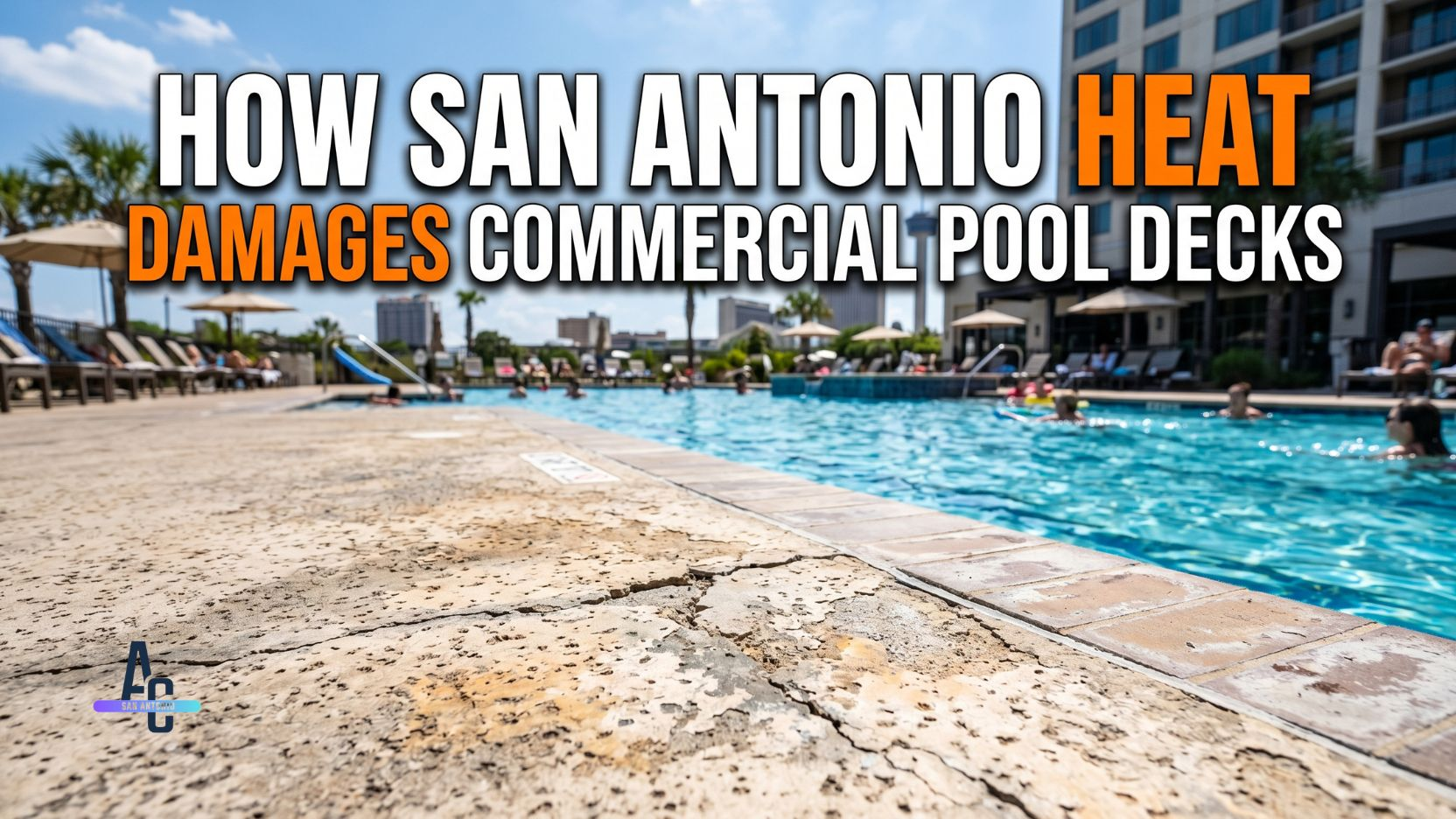
San Antonio averages over 220 sunny days per year and routinely hits surface temperatures above 150 degrees Fahrenheit on unshaded concrete. If your commercial pool deck is cracking, fading, or flaking, the heat is almost certainly to blame, and understanding exactly how it works is the first step toward stopping it.
Commercial pool decks in San Antonio are exposed to one of the most punishing combinations of climate stress in the entire United States. The combination of extreme heat, intense UV radiation, repeated thermal cycling, and frequent water contact creates a set of damage mechanisms that work together to degrade concrete faster than almost any other environment in the country.
Property managers at hotels, apartment complexes, and HOAs often assume that cracking and surface deterioration are simply signs of old age. In most cases, the damage is heat-driven and preventable. Understanding exactly what is happening to your deck at the surface and structural level makes the difference between a $3,000 repair today and a $30,000 full replacement in three years.
Commercial pool deck deterioration in San Antonio does not happen overnight. Every summer season adds thermal stress, UV degradation, and moisture intrusion that compounds on the previous year’s damage. A deck that looks acceptable at year three may be structurally compromised at year five and require full replacement by year seven. Catching heat damage early, and understanding which type of damage you are dealing with, determines whether you spend a few thousand dollars on targeted repair or tens of thousands on demolition and repour. This guide breaks down each damage mechanism in plain terms so you can identify what you are seeing and act at the right time.
Thermal Damage
Concrete expands when it heats up and contracts when it cools down. In San Antonio, the daily temperature swing between an early morning low and a peak afternoon high during summer can exceed 30 degrees Fahrenheit. On the surface of an unshaded pool deck, that swing translates to a surface temperature change of 60 to 80 degrees or more between sunrise and mid-afternoon.
Concrete moves a measurable amount with every one of those cycles. A 100-foot pool deck expands and contracts by roughly half an inch across its length with every major temperature change. If that movement has nowhere to go, the concrete builds up internal stress until it cracks. This is why expansion joints exist, and why decks poured without adequate joint spacing, or with joints that were never properly maintained, crack predictably within a few years of installation in this climate.
The fix for thermal cracking depends on severity. Hairline cracks under a quarter of an inch are typically addressed with polyurea or epoxy injection and a fresh sealer coat. Wider cracks with displacement indicate that the underlying joint system has failed and require saw-cutting new control joints, filling the damaged area, and resealing the entire deck surface.
Inspect expansion joints every spring before pool season opens: Joint sealant in San Antonio degrades faster than the manufacturer’s rated lifespan because of the UV intensity here. A joint that was filled with quality sealant three years ago may be cracked, hardened, or missing entirely by now. Refilling joints with fresh backer rod and polyurethane sealant before the summer season costs very little and prevents the cracking that leads to expensive structural repairs.
- Straight cracks running perpendicular to the length of the deck, spaced 8 to 15 feet apart
- Cracked, missing, or hardened expansion joint sealant along control joint lines
- Cracks that appear every spring after the first major heat surge of the season
- Vertical displacement along a crack line, with one side of the crack higher than the other
- Cracks that have widened since the last inspection season
UV Damage
Ultraviolet radiation does not just fade colors. At the intensity levels San Antonio receives year-round, UV breaks down the polymer chains in concrete sealers and decorative coatings, degrading their ability to repel water and protect the surface below. An acrylic sealer applied to a commercial pool deck in San Antonio has a real-world effective lifespan of 18 to 24 months, not the 3 to 5 years listed on the product label, because the label was written for average U.S. sun exposure, not south Texas.
Once the sealer is compromised, UV begins acting directly on the concrete paste itself. The cement matrix that binds the aggregate together slowly carbonates and weakens under prolonged UV exposure, causing the surface to become chalky and powdery. This process is called dusting, and it accelerates sharply once the sealer fails. A dusty, chalky surface is not just a cosmetic problem. It means the concrete’s protective skin is eroding, and every gallon of pool water, chemical splash, or rain event now penetrates deeper into the slab than it should.
The repair approach for UV degradation depends on how far the damage has progressed. If the sealer has failed but the concrete surface is still intact, cleaning the deck, applying a light diamond grind to remove the degraded paste layer, and resealing with a commercial-grade penetrating sealer will restore protection. If the surface has dusted significantly, resurfacing with a cementitious overlay or spray texture coat before resealing is the correct approach.
Not all sealers are equal for San Antonio conditions: Consumer-grade acrylic sealers from hardware stores are formulated for average climates. For a commercial pool deck in Bexar County, specify either a penetrating silane-siloxane sealer for raw concrete surfaces or a commercial-grade polyurethane topcoat for decorative or resurfaced decks. Both outperform standard acrylics by a wide margin under continuous UV and heat exposure. Ask your contractor for the specific product name and spec sheet, not just “a good sealer.”
- Deck color has faded significantly since original installation or last resurfacing
- Surface feels chalky or powdery when rubbed with a dry hand
- Water applied to the deck soaks in immediately rather than beading up
- Sealer is flaking, peeling, or showing whitish haze in direct sun
- Sealer was last applied more than two years ago on a south-facing or fully exposed deck
Spalling
Spalling is the condition where chunks, flakes, or layers of the concrete surface break away from the slab. On a commercial pool deck, it is one of the most common and most misdiagnosed forms of heat damage. Most property managers assume spalling is caused by freeze-thaw damage, which is the leading cause in northern climates. In San Antonio, the mechanism is different: it is driven by the combination of water penetration and rapid heat evaporation.
Here is what happens. Pool water, rain, and chemical overspray penetrate an unsealed or under-sealed deck surface and saturate the top inch or two of the concrete. When the summer sun heats the deck surface to 140 or 150 degrees Fahrenheit, that absorbed moisture converts to steam faster than it can escape through the concrete’s pores. The trapped steam pressure builds up below the surface and forces off pieces of the concrete skin above it. The result is the cratered, pitted, or flaking surface that property managers across San Antonio know well.
The timeline from early pitting to structural spalling in San Antonio is typically three to five years on an unmaintained deck. Regular sealing, prompt patching of early-stage craters, and keeping chemical splash areas clean extends that window significantly. Once rebar is exposed, the clock moves faster because moisture is now rusting the steel, which expands and accelerates the spalling from below.
- Small craters or pop-outs across the deck surface. Even a handful are a warning that more are coming
- Irregular patches where the top layer of concrete has flaked away and the aggregate is visible
- Rust-colored staining on the deck surface, which signals rebar corrosion below
- Any section where the deck surface sounds hollow when tapped with a hard object
- Ongoing use of deck without any sealer application in the last two years
Chemical Damage
Concrete is alkaline by nature. Pool chemicals, particularly chlorine products and pH-down chemicals like muriatic acid, are either mildly acidic or chemically aggressive to the calcium compounds in concrete. At normal temperatures, this reaction is slow enough that a well-sealed deck can resist it for many years. In San Antonio’s summer heat, the chemical reaction rate increases significantly, and the combination of high temperature and frequent chemical contact accelerates surface deterioration in ways that are rarely obvious until the damage is already extensive.
The most common pattern is along the pool coping edge and any areas where overflow water drains across the deck. These zones see concentrated chemical contact and are also the hottest parts of the deck in direct sun. Etching, roughening of the surface texture, and accelerated color fading all appear in these areas first before spreading across the rest of the deck.
| Chemical type | Effect on concrete surface | Heat multiplier effect |
|---|---|---|
| Chlorine (liquid or tablet) | Gradual bleaching of sealers and decorative coatings; surface etching with repeated contact | Reaction rate roughly doubles for every 18 degrees Fahrenheit of temperature increase |
| Muriatic acid (pH down) | Direct chemical etching of the cement paste; removes surface material with each contact event | Even dilute concentrations act more aggressively on hot surfaces than on cool ones |
| Algaecides and clarifiers | Generally low concrete impact; some formulations can stain unsealed surfaces | Faster evaporation on hot deck surfaces leaves concentrated residue behind |
| Calcium hypochlorite (shock) | Strong oxidizer; can bleach and degrade polymer-based coatings rapidly | Granules that land on a hot dry deck surface can cause localized etching within hours |
Rinse the deck immediately after any chemical addition to the pool: The most effective and cheapest protection against chemical deterioration is a simple operational practice. Any time shock, pH chemicals, or algaecide is added to the pool, a brief rinse of the surrounding deck surface with fresh water dilutes any splash or overspray before it can sit on hot concrete and etch the surface. This takes about two minutes and costs nothing. It extends the life of both the sealer and the underlying concrete significantly.
- Roughened or etched texture along the pool coping edge that differs from the rest of the deck surface
- Accelerated color fading concentrated near pool edges compared to the far perimeter of the deck
- White calcium deposits or staining that cannot be removed with standard deck cleaning
- Pitting concentrated in areas where overflow water regularly crosses the deck
- Sealer in the coping zone failing at a faster rate than the rest of the deck
Structural
Every other damage mechanism on this list attacks the concrete from the surface down. Subbase failure attacks it from the bottom up, and it is the most expensive category of heat-related damage because it cannot be fixed with resurfacing or resealing. When the soil beneath a commercial pool deck fails, sections of the slab lose support, flex under load, and eventually crack or collapse entirely.
In San Antonio, the primary driver of subbase failure is the clay-heavy Vertisol soil that dominates Bexar County. These soils are highly expansive: they swell significantly when wet and shrink substantially when dry. During extended heat and drought periods, which San Antonio experiences regularly, the soil beneath a pool deck can shrink enough to create voids several inches deep directly under the slab. The concrete spans those voids for a while, but concrete is not designed to bridge unsupported spans under foot traffic and furniture loads. The slab eventually cracks, settles unevenly, or collapses into the void.
Diagnosing subbase failure requires a professional inspection. An experienced contractor will sound the deck by tapping sections with a steel rod to identify hollow areas, and may use ground-penetrating radar on larger commercial decks to map void locations without breaking anything open. If the voids are limited in scope, slab lifting with polyurethane foam injection can fill them and stabilize the deck at a fraction of the cost of demolition. If the subbase has failed across a significant portion of the deck, full removal and repour with a properly engineered compacted limestone base is the only durable solution.
- Sections of the deck that produce a hollow sound when tapped with a hard object
- Cracks where one slab section sits higher or lower than the adjacent section
- Visible unevenness or rocking in the deck surface when weight shifts across it
- Cracks that were filled in a previous season but have reopened in the same location
- The deck was installed before 2022 with no professional subbase inspection since the regional drought
The earlier damage is caught, the lower the repair cost. The table below reflects typical commercial pool deck repair pricing in the San Antonio market as of 2026. Final costs vary based on deck size, access conditions, and the extent of damage found during inspection.
| Repair type | Typical cost range | Best candidate |
|---|---|---|
| Expansion joint refill (full deck) | $800 to $2,500 | Joints cracked or missing sealant; no active structural cracking present |
| Crack injection and reseal | $1,500 to $4,000 | Hairline to quarter-inch cracks with no displacement; sealer failed or degraded |
| Spot patch and reseal | $2,000 to $6,000 | Localized spalling, pitting, or surface pop-outs covering less than 20 percent of deck area |
| Full deck resurfacing with overlay | $5 to $10 per square foot | Widespread surface degradation, UV fading, or early-stage spalling across the deck |
| Polyurethane foam slab lifting | $3,000 to $8,000 | Settled or hollow sections caused by subbase voids; concrete structurally intact |
| Partial section demolition and repour | $12 to $20 per square foot | Localized structural failure or rebar exposure in a defined deck zone |
| Full deck demolition and repour | $18 to $30 per square foot | Widespread subbase failure, structural cracking throughout, or advanced spalling with rebar exposure |
- Walk the full deck perimeter and interior and note any new cracks, spalling, or surface changes since last inspection
- Tap suspicious sections with a steel object to check for hollow spots indicating subbase voids
- Inspect all expansion joints for cracked, missing, or hardened sealant and schedule refill if needed
- Test the sealer condition by pouring a small amount of water onto the deck: if it soaks in rather than beading, resealing is overdue
- Schedule any crack injection, patching, or resealing work before opening the pool to avoid losing revenue days mid-season
- Rinse the deck surface immediately after any chemical addition to the pool to prevent hot-surface chemical etching
- Keep the deck surface clean of algae, calcium deposits, and organic debris that hold moisture against the concrete
- Note any new cracks or spalling that appear during the season for fall inspection and repair
- Ensure deck drainage is functioning correctly and no water is pooling on the surface for extended periods
- Conduct a full inspection of the deck before the end of the year and compile a repair list for winter scheduling
- Apply a fresh coat of commercial-grade sealer if the water bead test indicates the current sealer has failed
- Fill any cracks identified during the season before winter temperature changes widen them further
- Document the deck condition with photos each fall to establish a baseline for tracking deterioration rate over time
- Schedule a professional concrete inspection that includes subbase sounding and a written condition report
- Evaluate whether resurfacing with a cementitious overlay is appropriate before surface degradation requires full replacement
- Review the original installation specs and confirm expansion joint spacing and slab thickness are adequate for the current usage level
How do I know if my pool deck cracks are from heat damage or something more serious?
How often does a commercial pool deck in San Antonio need to be resealed?
Can a spalled commercial pool deck be resurfaced, or does it need to be replaced?
My pool deck feels hot enough to burn feet in summer. Does that mean it is being damaged by heat, or just uncomfortable to walk on?
Is it worth resurfacing a commercial pool deck, or should we just replace it?
Get a free commercial pool deck inspection in San Antonio
Tell us about your property: hotel, apartment complex, HOA, or recreation facility. We will assess the deck condition, identify any heat damage, and give you a detailed written repair or resurfacing recommendation at no cost.