
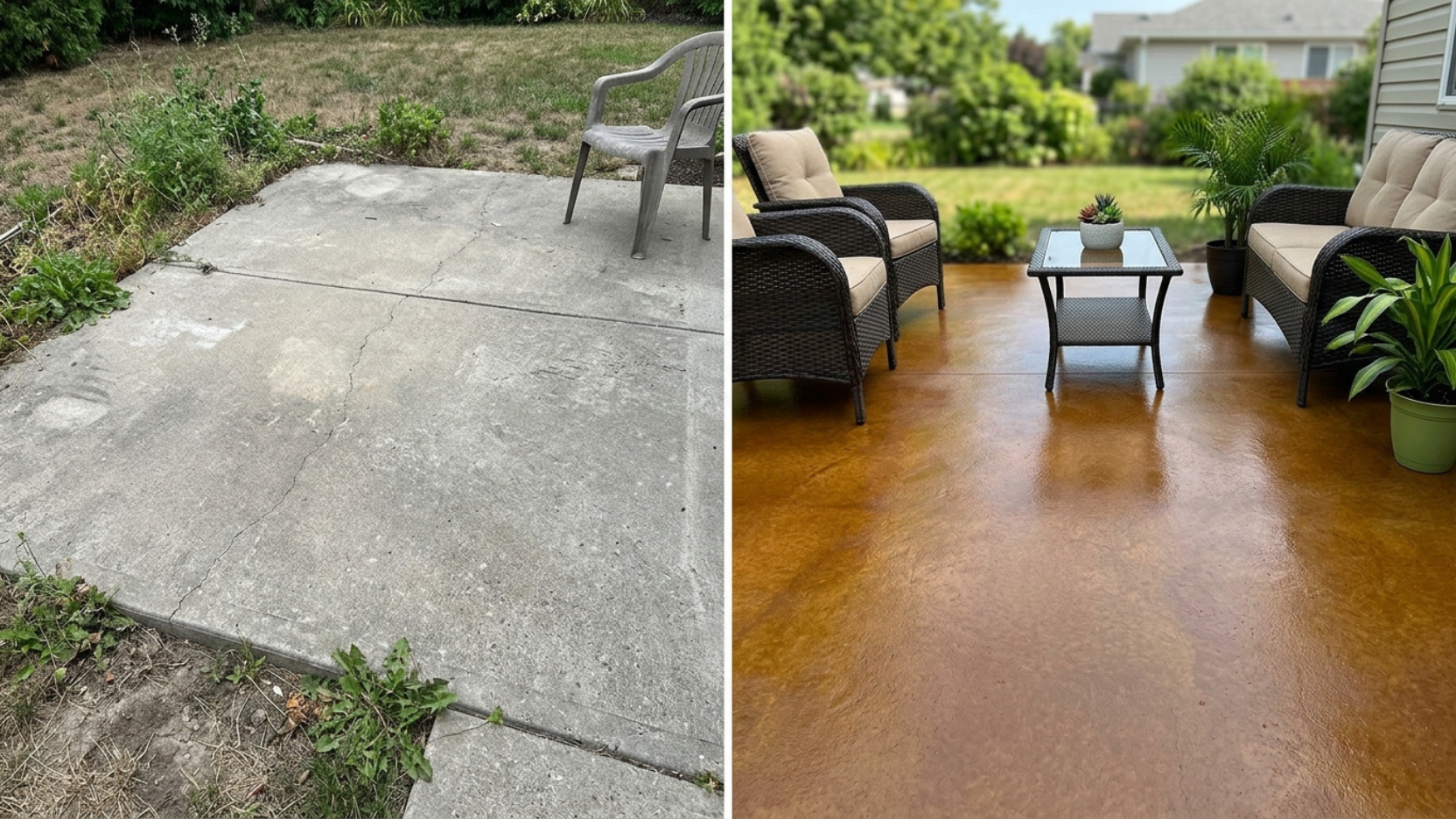
San Antonio homeowners ask this question every week. The honest answer depends on your surface condition, your goals, and who does the work. This guide covers real costs, realistic ROI, and the situations where staining is absolutely the right call and where it is not.
Concrete staining is one of the most cost-effective ways to transform a dull gray slab into something that looks intentional, designed, and high-end. But it is not a miracle fix. Staining works brilliantly in the right scenarios and delivers disappointing results when homeowners expect it to cover serious surface problems or when the prep work gets skipped.
This guide gives you a straight answer: where staining delivers strong ROI in San Antonio, where the numbers are harder to justify, what the realistic costs look like in 2026, and the five questions you need to ask any contractor before signing a contract.
Staining does not replace the concrete. It transforms its surface appearance while preserving the structural investment you already made. That distinction changes the ROI math entirely. You are not paying for a new slab you are paying for a finish that can add $8,000 to $15,000 of perceived value to a patio or interior floor for $1,500 to $4,000 in total project cost. That is the case for staining in most San Antonio residential applications.
ROI Analysis
The investment case for concrete staining is strongest when you already have a structurally sound slab that simply looks bad. This is the most common scenario in San Antonio, where homeowners inherit gray builder-grade patios, faded driveways, and plain garage floors that are perfectly functional but visually dull.

Replacing a structurally sound 400 sqft patio slab runs $4,000 to $8,000 in San Antonio after demolition, hauling, base prep, and a new pour. Staining that same slab costs $1,200 to $3,200 and produces a result that looks dramatically better than a plain new broom finish. The financial difference is $3,000 to $6,000 in favor of staining.
On resale value, the National Association of Realtors consistently places outdoor living spaces among the top return-on-investment upgrades for residential properties. A stained and sealed concrete patio photographed well adds perceived value that plain gray concrete does not.
- Your existing slab is structurally sound with only minor hairline cracks no heaving or base failure
- You want a decorative result and your budget does not support a full replacement or paver install
- You plan to sell or refinance within three to five years staining improves listing photos significantly
- The surface is a covered patio, garage floor, or interior area where UV exposure is reduced
- You are refreshing a rental property staining delivers high visual impact at low per-unit cost
Cost Guide
Cost transparency matters when evaluating any home improvement investment. Staining quotes in San Antonio range from $2 per square foot from unlicensed weekend crews to $12 per square foot for premium multi-step decorative systems. The difference is in prep work, stain quality, sealer type, and contractor experience not profit margin inflation.
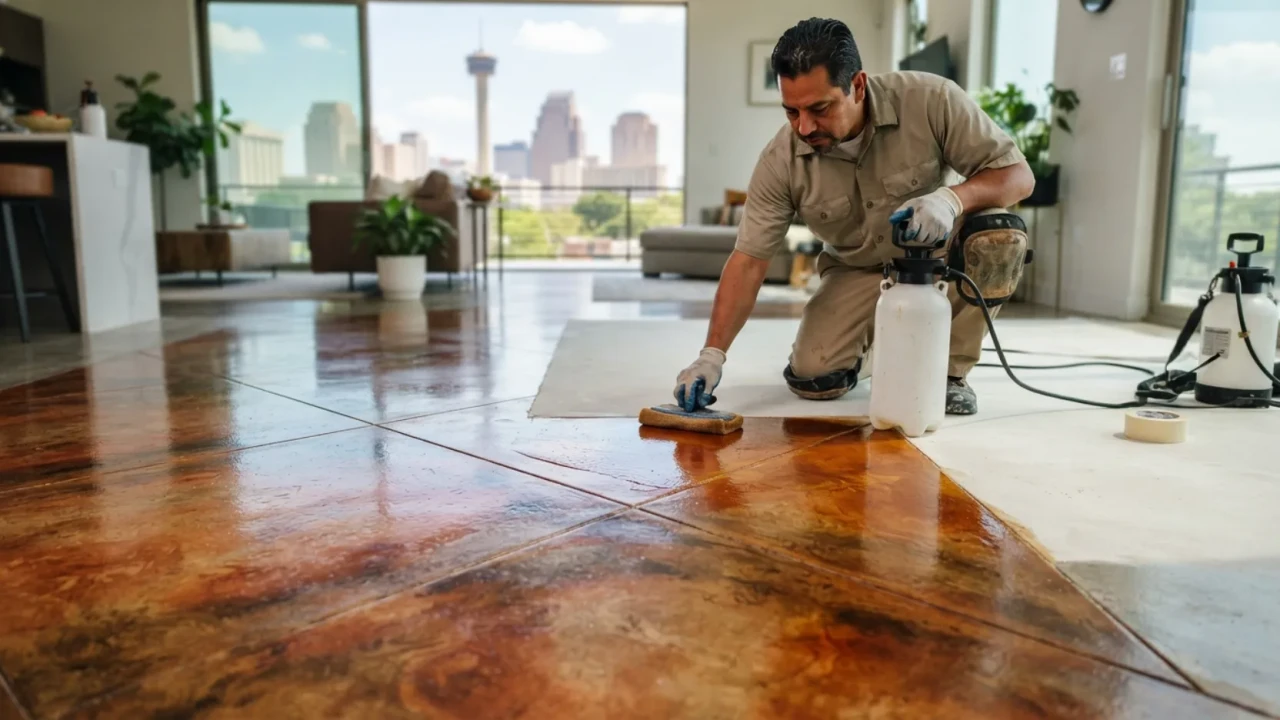
A properly scoped staining project has four line items: surface preparation (cleaning, crack filling, etching), stain material and application, optional decorative scoring or saw-cut patterns, and the sealer coat. Quotes that bundle all of this into a single number with no breakdown deserve follow-up questions.
| Stain type | Typical cost / sqft | Best for | San Antonio consideration |
|---|---|---|---|
| Acid stain | $3–7/sqft installed | Patios, pool decks, covered floors, aged slabs with character | Reacts unpredictably with Edwards Aquifer hard water minerals always test a patch first |
| Water-based stain | $2–5/sqft installed | Interior floors, areas needing predictable color matching | Less reactive chemistry more consistent color result on SA’s mineral-rich slabs |
| Acetone dye | $4–8/sqft installed | Interior concrete, polished floors, garages wanting vibrant color | UV-sensitive fades faster outdoors under Texas sun; use only for interior or covered applications |
| Epoxy stain/coating | $3–6/sqft installed | Garage floors, commercial interiors, areas needing chemical resistance | Can peel if moisture vapor transmission through slab is not addressed first test for moisture before applying |
| Overlay with stain | $6–12/sqft installed | Damaged or uneven slabs where staining alone is insufficient | Adds a thin concrete layer over existing slab before staining allows staining on surfaces that otherwise cannot accept it |
The prep budget is where most homeowners underspend and regret it. Surface preparation is 40 to 50 percent of the total labor cost on a staining project and it is the part that determines whether the stain bonds correctly and lasts. A slab with grease stains, paint overspray, old sealer residue, or efflorescence from Blackland Prairie clay migration needs chemical cleaning, mechanical grinding, or both before stain will penetrate correctly. Budget at least $1.00 to $1.50 per square foot for prep on any surface that is not freshly poured and clean.
- Quote separates prep, stain material, application, and sealer as distinct line items
- Stain type specified: acid stain, water-based, dye, or epoxy each has different performance characteristics
- Sealer type specified: penetrating (lower sheen, more natural) or topical (higher gloss, needs recoating more often)
- Square footage confirmed and consistent with your own measurement discrepancies in quotes often trace back here
- Prep scope listed: cleaning method, crack filling, etching, and any grinding or scarifying needed
Stain Types
Stain type selection is not just an aesthetic choice it is a chemistry match between the product and your specific slab. San Antonio’s water supply from the Edwards Aquifer is unusually high in calcium and magnesium. These minerals accumulate in concrete over time and affect how acid stains react. A slab that produces stunning amber tones in Austin may turn muddy green in San Antonio if the contractor does not account for local mineral content.
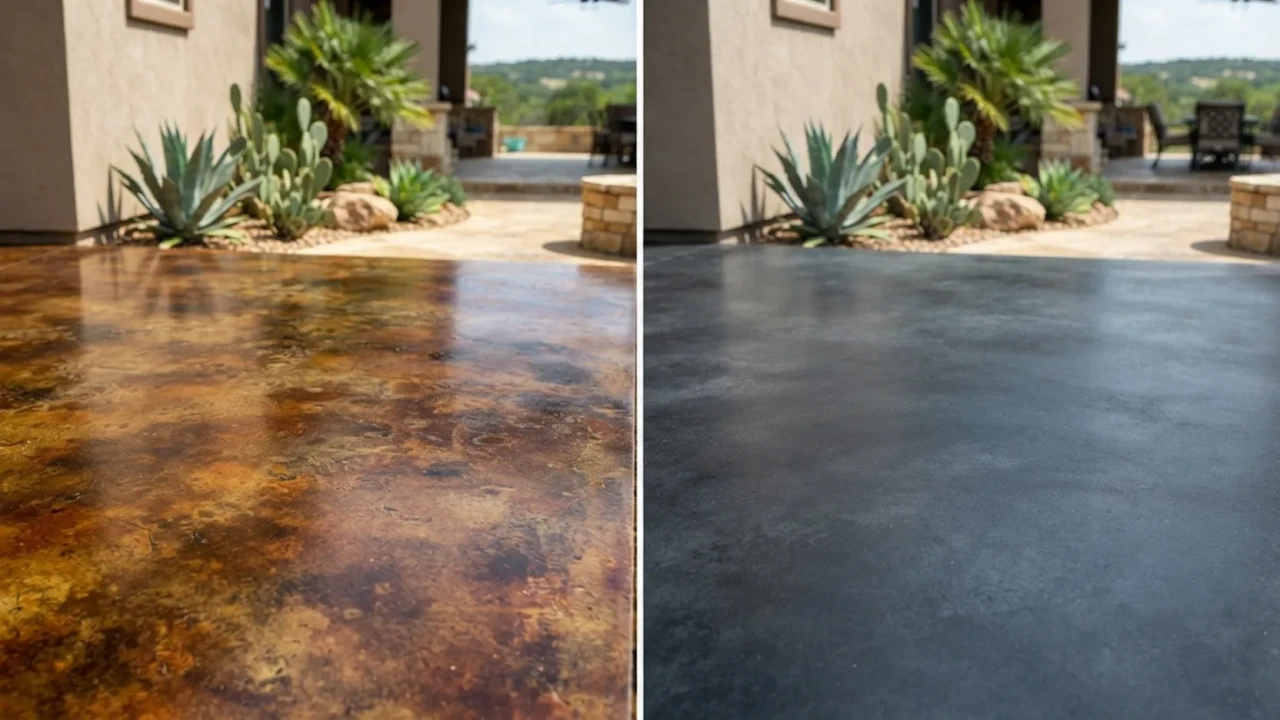
For most San Antonio outdoor applications patios, driveways, pool decks a water-based stain system with a penetrating sealer gives the most durable result under UV exposure and hard water conditions. Acid stain is the right choice when you want organic, one-of-a-kind color variation and have a contractor experienced enough to control the reaction chemistry on SA mineral content.
Interior applications garage floors, covered patio slabs, sunroom floors open up the full range of options including acetone dyes and epoxy systems where UV durability is not a constraint.
- Location confirmed: interior or covered (full options) vs. exposed outdoor (avoid UV-sensitive acetone dyes)
- If acid stain: patch test on inconspicuous area first to check color reaction with your specific slab chemistry
- If epoxy: moisture vapor emission test completed before application to rule out delamination risk
- Sealer UV protection rating confirmed for any outdoor San Antonio application
- Color expectation set correctly: acid stain results vary; water-based stain results are more predictable
Durability
Stained concrete itself the chemical reaction between stain and concrete is essentially permanent. The stain does not peel off because it is not a coating on top of the surface; it is part of the surface. What degrades over time is the sealer that protects it. Maintenance for stained concrete is fundamentally a sealer maintenance task, not a re-staining task.
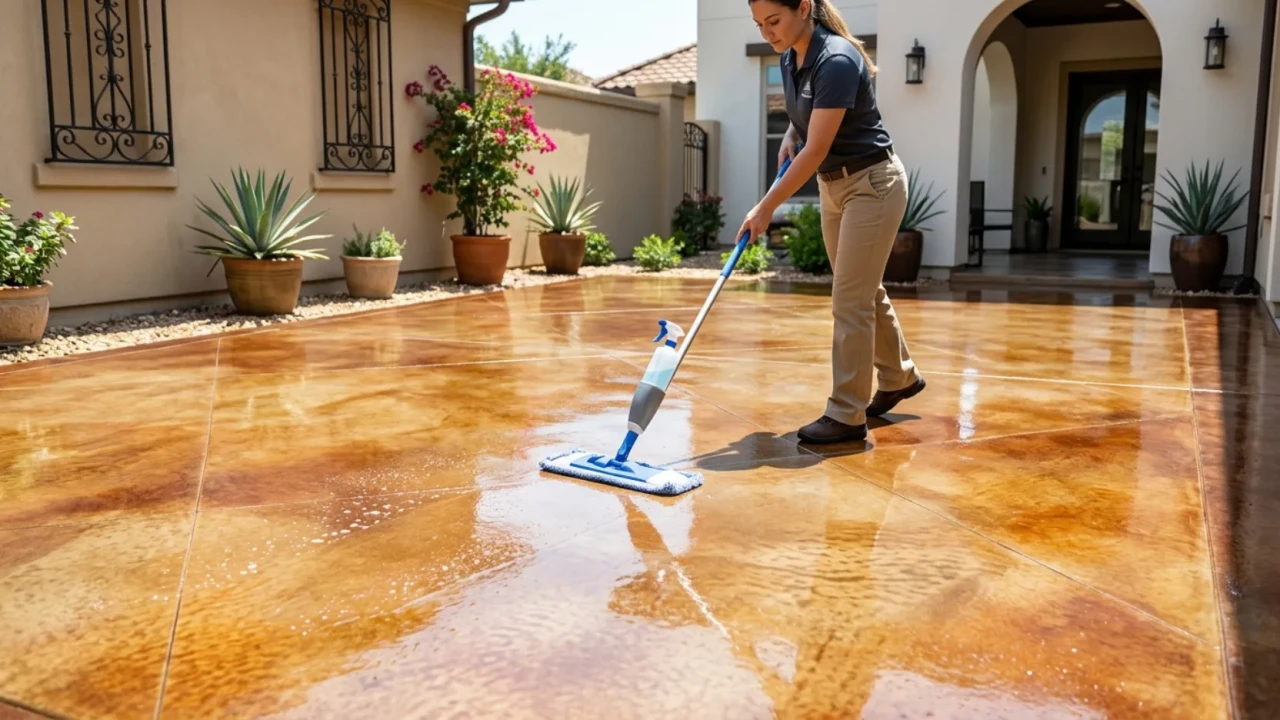
In San Antonio’s climate intense UV exposure from May through September, occasional below-freezing nights in December and January, and moderate but unpredictable rainfall an outdoor stained concrete slab needs resealing every two to three years to maintain its color depth and surface protection. An interior or covered stain application can go three to five years between resealing.
The biggest durability risk for stained concrete in Bexar County is not the stain itself it is the Blackland Prairie clay soil underneath the slab. SA’s expansive Vertisol soils swell with wet-season moisture and shrink during summer drought cycles. This movement transfers stress to the slab and can cause cracking over time. A stained slab is no more or less vulnerable to this than a plain slab. The prevention is proper base preparation and control joints not the staining process itself.
The water bead test tells you when to reseal. Sprinkle water on your stained concrete surface. If it beads up and rolls off, the sealer is intact. If it soaks in within 30 seconds, the sealer has worn through and it is time to recoat. Do this test once a year in San Antonio, the best time is October after the summer UV peak. Catching the resealing window before the surface fully opens up keeps maintenance costs minimal and extends the stain’s visual quality for decades.
- Sealer type specified at installation: penetrating vs. topical, and UV protection rating for outdoor use
- Resealing interval noted in writing: every 2 to 3 years for outdoor SA applications
- Water bead test scheduled annually October is the ideal timing after summer UV peak
- Existing slab assessed for base failure before staining: heaving or displaced cracks indicate soil movement issues
- Control joint locations noted stain will not hide structural cracking, only cosmetic hairlines
Honest Limits
Not every slab is a good candidate for staining. A contractor who tells you staining can fix any problem is prioritizing the sale over your outcome. These are the four scenarios where staining is genuinely not worth the investment and where a different approach makes more financial sense.

The most common mistake San Antonio homeowners make with concrete staining is treating it as a repair solution for structural problems. Staining adds color. It does not add structural integrity. A slab that is heaving, has wide cracks with vertical displacement, or has a failed base layer beneath it will continue to deteriorate after staining. You will have a beautiful-looking slab for 12 to 18 months until the underlying problem reasserts itself and then you have spent money on staining and still need a new slab.
| Scenario | Why staining does not work here | Better alternative |
|---|---|---|
| Heaving or displaced cracks | Indicates base failure from clay soil movement. Staining masks the symptom; the slab continues to shift and crack further | Full demolition, re-grading, compacted base, new slab |
| Spalling surface | Delaminating concrete surface will not accept stain penetration correctly. Result is blotchy and peels within months | Concrete overlay (micro-topping) over existing slab, then stain the overlay |
| Heavy oil or grease contamination | Stain cannot penetrate oil-contaminated concrete. Chemical cleaning helps, but deeply saturated slabs repel stain in irregular patches | Epoxy coating (encapsulates contamination) or grind and re-surface before staining |
| Prior coating or sealer still present | Existing sealer or paint blocks stain penetration entirely. Result is uneven adhesion and early peeling | Full mechanical surface prep (grinding or shot blasting) to remove existing coating, then stain |
- Walk the entire slab and mark any cracks wider than 1/4 inch or showing vertical displacement these indicate structural issues
- Check for surface spalling or delamination: press a screwdriver handle against the surface hollow sounds indicate subsurface failure
- Test for prior sealer or coating: water dropped on the surface should absorb within 60 seconds if it beads, existing sealer is blocking penetration
- Assess for oil or grease: driveway and garage slabs with years of vehicle staining may need grinding or encapsulation before staining
- If structural issues are found, get a structural assessment before investing in any surface treatment
Contractor Vetting
Concrete staining is a craft that requires chemistry knowledge, surface reading skill, and timing precision that general concrete contractors do not always possess. The five questions below will reveal within a 10-minute conversation whether you are talking to someone who knows what they are doing in San Antonio conditions.
| Question to ask | What a strong answer sounds like | Concern response |
|---|---|---|
| How do you handle SA hard water and mineral content in the slab? | Mentions doing a patch test, neutralizing with baking soda solution, and adjusting acid concentration based on local calcium content | Blank look or “it’s the same everywhere” indicates no local experience |
| What prep does my specific slab need before staining? | Walks the slab first, checks for existing sealer, identifies contamination spots, and names specific cleaning or grinding steps | “We just clean it and stain it” with no slab-specific assessment |
| What sealer do you use outdoors and why? | Names a specific product with UV protection rating, explains penetrating vs. topical, discusses expected recoat schedule in Texas climate | Generic “we use a good sealer” with no UV or product specification |
| Can I see photos of acid stain work you have done on SA slabs? | Provides local project photos showing the color variability that results from SA concrete chemistry not stock images | Online stock photos or only out-of-market project examples |
| What happens if the color result is not what I expected? | Explains that a patch test sets expectations before full application, and describes their correction process for color that deviates from the sample | “The stain always looks like the sample” this is not accurate for reactive acid stains |
On any project using reactive acid stain, insist on a test patch in a location that will be covered or is inconspicuous under a future furniture piece or in a corner. The Blackland Prairie clay minerals that leach into SA concrete slabs over time can push acid stain results in unexpected directions. The patch test takes 24 hours and costs nothing extra. A contractor who resists doing one is either inexperienced or in a hurry neither is the person you want doing irreversible color work on your patio or floor.
- Contractor has specific SA local experience and can discuss hard water and clay mineral effects on stain chemistry
- Patch test offered and scheduled before full application on any acid stain project
- Written quote itemizes prep, stain material, application labor, and sealer separately
- Portfolio of completed San Antonio projects available not stock photos
- Insurance certificate provided: minimum $1M general liability coverage
- Slab is structurally sound with no heaving, wide cracks, or vertical displacement
- Surface has no spalling, delamination, or hollow spots that would block stain penetration
- No prior sealer or paint coating blocking the surface or prep plan for mechanical removal is included
- Oil or grease contamination assessed garage and driveway slabs may need encapsulation or grinding first
- Stain type chosen for your specific application: acid stain for organic variation, water-based for predictable color
- Color expectation calibrated correctly: acid stain varies; what you see in a sample differs from full-slab result
- Sealer type confirmed with UV protection rating for outdoor SA use
- Any decorative scoring or saw-cut pattern work discussed and priced separately
- Contractor has verified SA-area staining experience and can discuss local chemistry conditions
- Patch test included in project scope for any acid stain application
- Itemized written quote received covering all four cost components: prep, stain, application, and sealer
- Insurance certificate on file: $1M+ general liability minimum
- Payment terms confirmed: deposit upfront, remainder on satisfactory completion
- Resealing interval noted: every 2 to 3 years for outdoor SA applications, 3 to 5 for covered or interior
- Water bead test scheduled annually to monitor sealer condition
- Annual pressure wash planned to remove dirt, organic matter, and algae before they penetrate sealer
- Crack monitoring plan in place: hairline cracks normal, widening or displaced cracks need professional assessment
How much does concrete staining cost in San Antonio in 2026?
Does concrete staining increase home value in San Antonio?
How long does concrete staining last in Texas heat?
Can you stain a concrete driveway in San Antonio?
What is the difference between concrete staining and painting?
How does San Antonio’s water affect acid stain results?
Get a free concrete staining quote in San Antonio
Tell us about your slab — patio, driveway, pool deck, or interior floor. We assess the surface, walk you through the right stain and sealer options for your specific conditions, and give you a detailed written quote at no cost.