
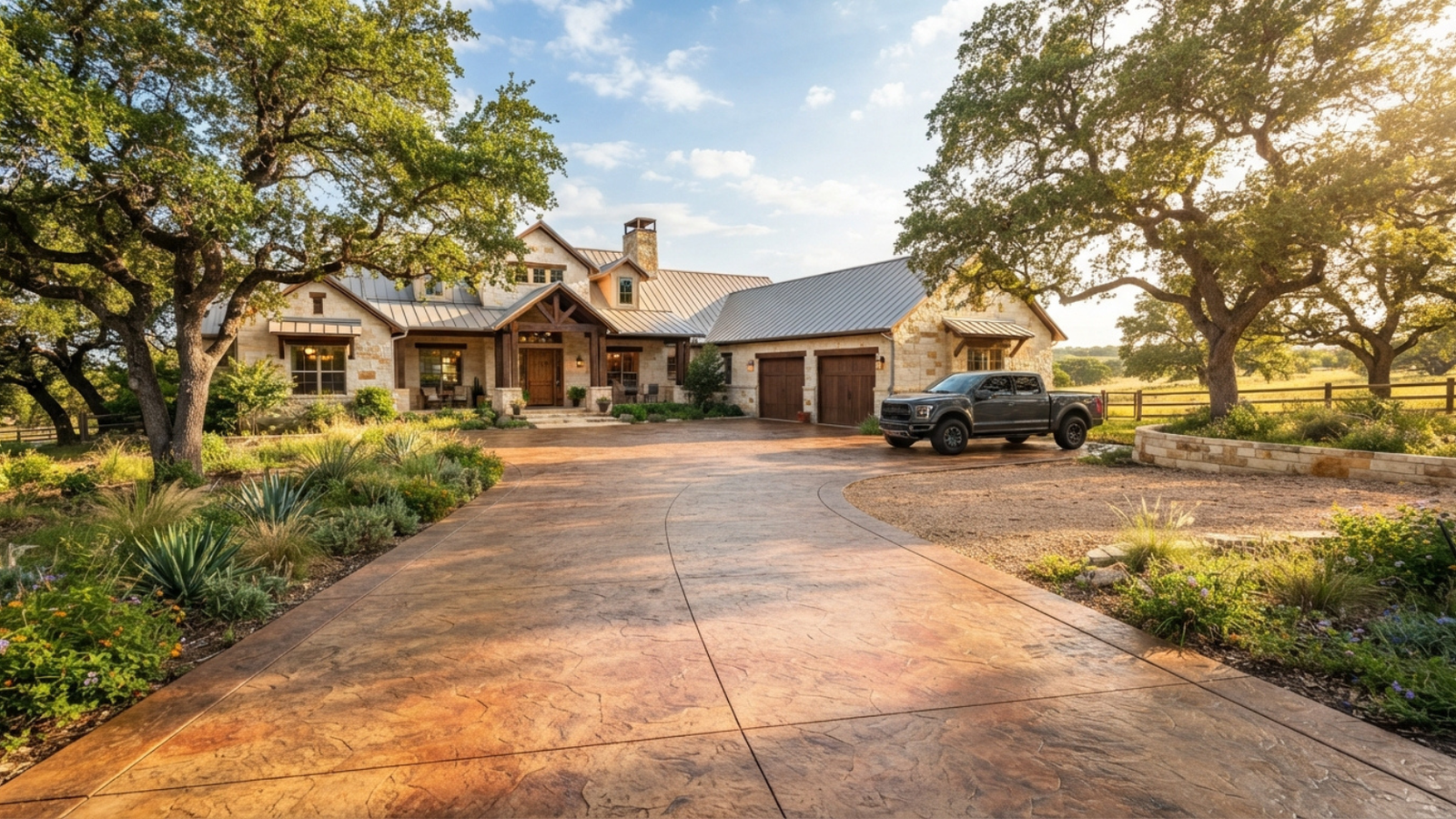
San Antonio homeowners ask us the same questions every week about cost, longevity, cracking, maintenance, timing, and what separates a driveway that lasts 30 years from one that fails in five. This guide answers every one of them honestly, with local pricing, local soil conditions, and no filler.
Everything San Antonio homeowners ask about concrete driveways
A concrete driveway is one of the larger home improvement investments a Bexar County homeowner makes, and the questions that come with that decision deserve straight answers. How much will it actually cost? How long will it last on San Antonio’s Blackland Prairie clay soils? Why do some driveways crack in three years while others look new at twenty? What does a fair contractor quote actually include?
We have answered these questions in person at thousands of San Antonio properties. This article organizes the most common ones into clear, honest responses with 2026 local pricing, soil-specific context, and practical advice that applies whether you are pouring a new driveway or repairing an existing one.
What does a concrete driveway cost in San Antonio?
Cost FAQ
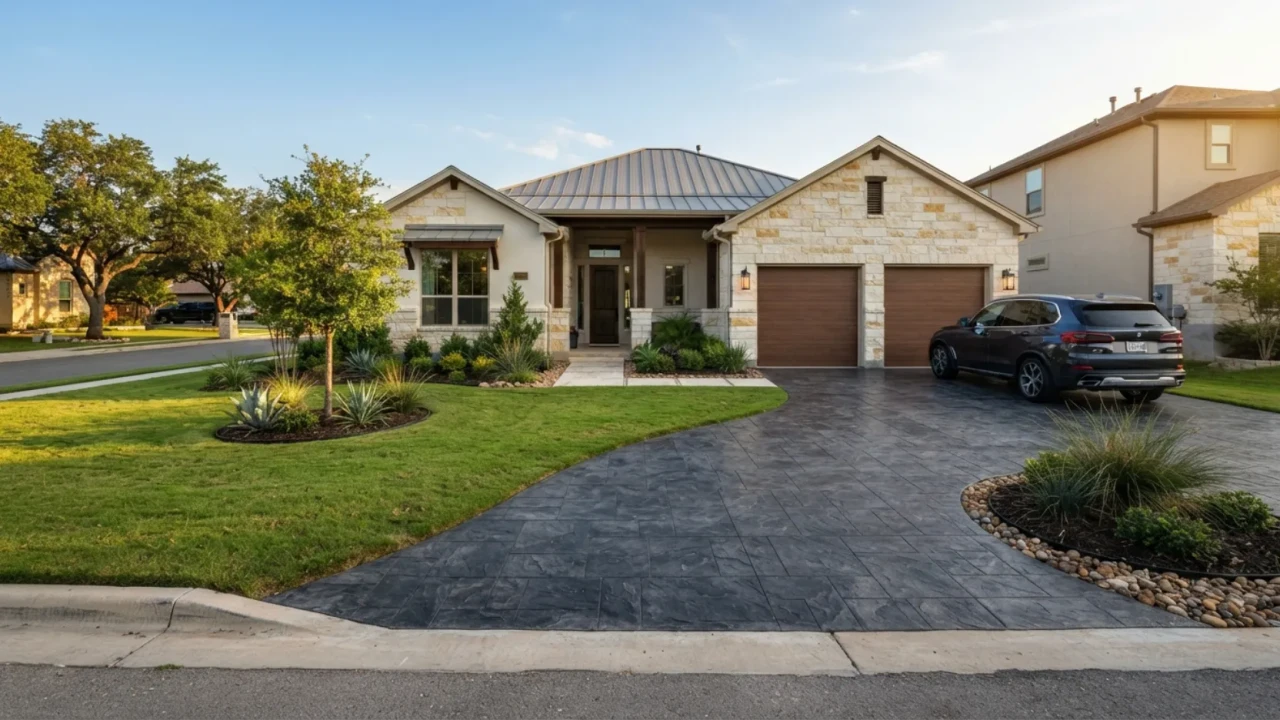
In 2026, a standard residential concrete driveway in San Antonio runs $7 to $12 per square foot installed, which includes site prep, compacted base, pour, broom finish, and control joint cutting. For a typical two-car driveway of approximately 400 to 600 square feet, that puts the total cost between $2,800 and $7,200 depending on scope and site conditions.
The range is wide because site variables drive cost significantly in this area. Removing an existing asphalt or concrete driveway adds $1 to $3 per square foot. Sloped lots require additional grading. Very long runs from street to garage add both material and labor. And Bexar County’s expansive Blackland Prairie clay soil requires a thicker compacted base than most U.S. markets typically 4 to 6 inches of crushed limestone rather than the 2 to 3 inches common in other regions.
Cost Comparison
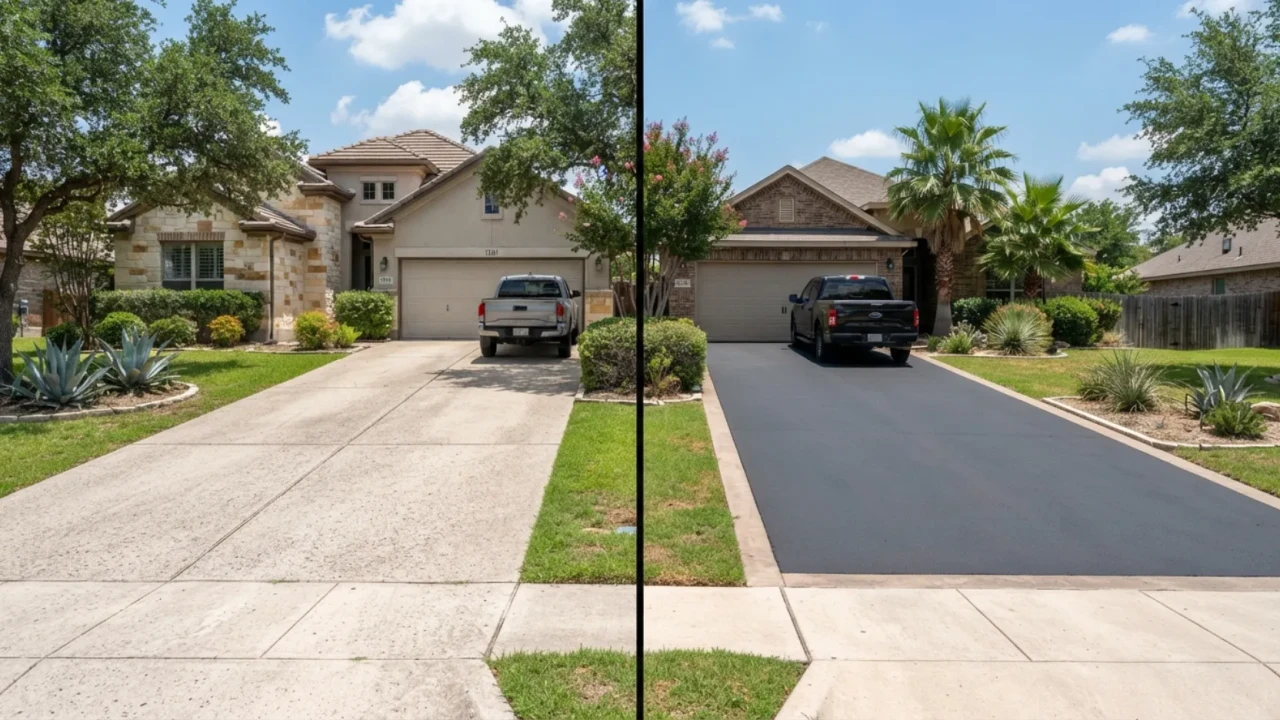
Asphalt typically costs $3 to $6 per square foot installed in San Antonio roughly 30 to 50 percent less than standard concrete upfront. That cost advantage disappears quickly when you account for maintenance. Asphalt requires sealing every 1 to 3 years and resurfacing every 8 to 15 years. Concrete, properly installed, requires sealing every 3 to 5 years and has a usable lifespan two to three times longer than asphalt before major work is needed.
| Factor | Concrete | Asphalt |
|---|---|---|
| Installed cost (per sq ft) | $7-12 | $3-6 |
| Lifespan in San Antonio | 30-40 years | 12-20 years |
| Summer heat performance | Stable; does not soften | Softens and ruts in Texas heat |
| Sealing frequency | Every 3-5 years | Every 1-3 years |
| Major resurfacing needed | Rarely; spot repair only | Every 8-15 years |
| 25-year total cost (600 sqft) | $4,800-7,200 installed + sealing | $2,400-4,200 installed + 1-2 resurfacings |
In San Antonio’s climate, the asphalt cost advantage narrows further because summer temperatures routinely exceed 100 degrees Fahrenheit, accelerating asphalt softening and degradation. Concrete is the better long-term value for most residential driveways in Bexar County.
Winter Storm Uri context: The February 2021 freeze exposed a clear difference between the two materials. Many asphalt driveways in San Antonio developed significant cracking and heaving from the rapid freeze-thaw cycle, while properly installed concrete driveways with adequate expansion joints performed far better. Concrete’s structural integrity in extreme temperature swings gives it a significant advantage in this market.
How is a concrete driveway installed?
Specs FAQ
A residential driveway in San Antonio should be poured at a minimum of 5 inches thick, not the 4-inch spec common in other parts of the country. Bexar County’s Blackland Prairie Vertisol clay soil expands when wet and contracts when dry, creating movement beneath the slab that a thinner concrete section cannot accommodate. The 5-inch minimum is our baseline recommendation for standard passenger vehicle use.
The compacted crushed limestone base is equally important. Clay soil beneath a driveway moves it swells during San Antonio’s Flash Flood Alley rainfall events and shrinks during drought. A proper base of compacted limestone creates a stable, well-draining platform that reduces the amount of movement the slab has to absorb. Contractors who pour directly over native soil are setting up a driveway for early failure.
The most common cause of premature driveway failure in San Antonio is insufficient base preparation not the concrete itself. A 4-inch slab on a proper 6-inch compacted base outperforms a 6-inch slab poured over compacted native clay. Always confirm base depth is included and specified in your contractor’s written quote before any work begins.
- Slab thickness specified as 5″ minimum for standard passenger vehicles in San Antonio
- Base depth confirmed: 4″ minimum, 6″ preferred for Bexar County clay soils
- Base material specified as compacted crushed limestone not native clay or fill dirt
- Wire mesh or rebar reinforcement confirmed and elevated to mid-slab height (not resting on the ground)
- Control joints spaced every 8-10 feet to manage shrinkage cracking
Timeline FAQ
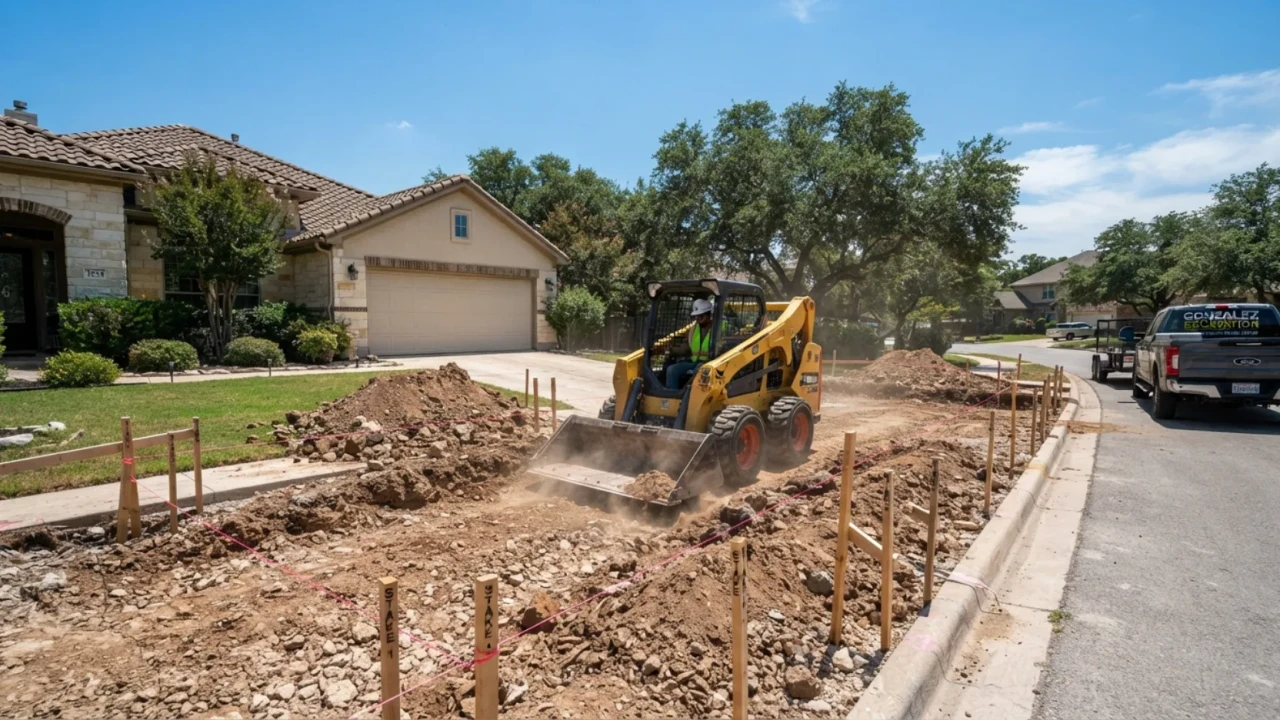
Most residential driveways in San Antonio can be poured in a single day once the base preparation is complete. The full timeline from first site visit to usable surface typically runs 7 to 14 days, accounting for scheduling, demo if needed, base work, and the mandatory curing period before vehicle use.
San Antonio’s summer heat accelerates surface drying but does not speed up the underlying curing reaction that takes 28 days regardless of temperature. What heat does is increase the risk of the surface drying out before the interior cures, which weakens the finished product. A quality contractor will apply a curing compound or maintain wet curing for at least three days after the pour, particularly on summer projects.
October through April is the ideal window for San Antonio driveway pours. Moderate temperatures mean slower surface evaporation, easier finishing conditions, and lower demand from other projects which can translate to a slightly better price and faster scheduling. Summer pours are done every day by experienced crews, but they require early morning starts and more careful curing management. If your project is flexible on timing, fall or early spring is worth planning for.
How long will my driveway last, and why do they crack?
Lifespan FAQ
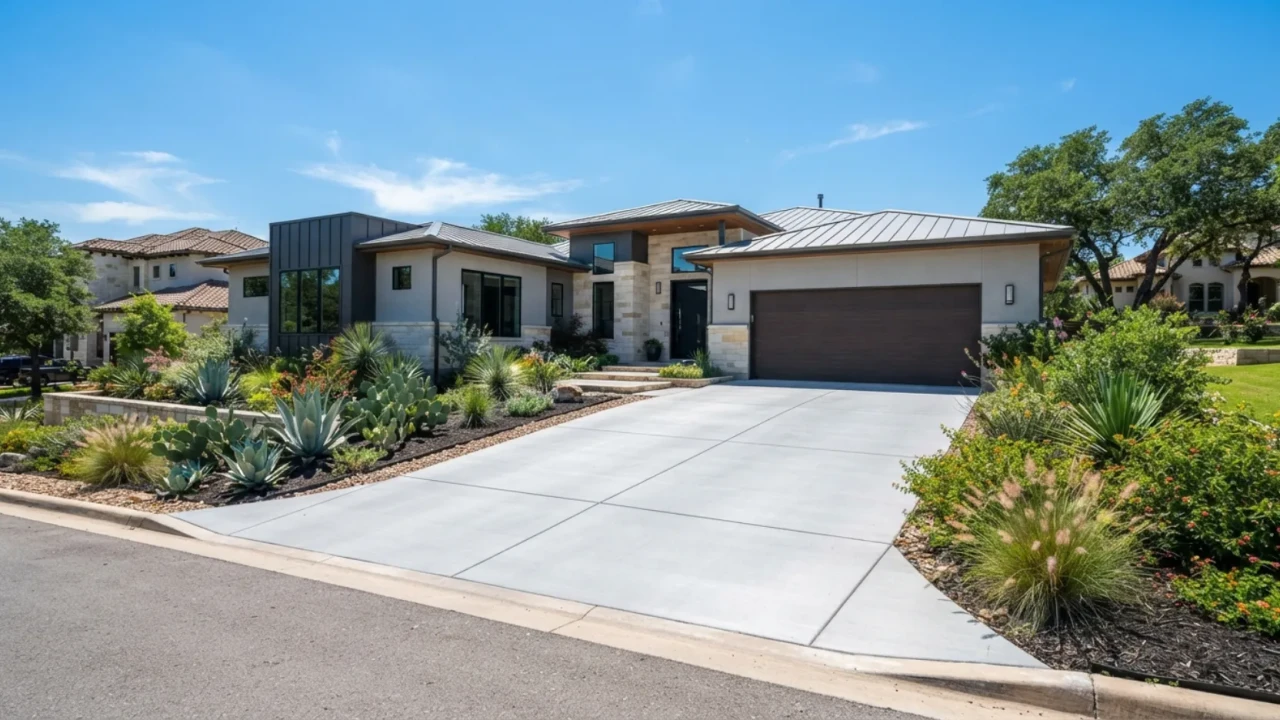
A properly installed and maintained concrete driveway in San Antonio will last 30 to 40 years before requiring major replacement work. We regularly see driveways in established neighborhoods across Bexar County that are 25 or 30 years old and still structurally sound they just need a clean and reseal.
The variables that determine how long your specific driveway lasts are base preparation quality, slab thickness, sealing history, drainage, and whether large trees are planted nearby. A thin slab poured over inadequate base on clay soil near a large live oak has a fundamentally different lifespan than a properly specced driveway with good drainage and no root intrusion.
Texas UV intensity is a factor that many homeowners underestimate. San Antonio receives intense ultraviolet radiation year-round, which degrades unsealed concrete surfaces over time bleaching the color and opening the surface to water penetration. Sealing is not optional for longevity in this climate; it is the primary maintenance action that extends the gap between replacement and the next major repair.
- Proper base depth and compaction completed before pour the single biggest lifespan factor
- Control joints cut at correct intervals to direct shrinkage cracking to planned locations
- Drainage slope of at least 2% away from the foundation confirmed with contractor
- No trees within 10 feet of the driveway perimeter root intrusion is a leading cause of structural cracking
- First seal scheduled at 28 to 30 days after pour, then every 3 to 5 years thereafter
Cracking FAQ
Not all cracks are equal, and knowing which type you have determines whether you need a $30 repair kit or a full replacement quote. There are two categories: cosmetic shrinkage cracks and structural cracks.
| Crack type | Appearance | Cause | Action needed |
|---|---|---|---|
| Hairline shrinkage | Less than 1/4″ wide, both sides at same level, no pattern | Normal moisture loss during curing happens in nearly every slab | Fill with concrete crack filler; cosmetic only |
| Control joint cracking | Crack follows a straight saw-cut line | Working as designed the joint directed the crack where it was planned | Fill the joint with a flexible sealant if open; normal function |
| Structural heaving | One side of crack is higher than the other (vertical displacement) | Base failure, clay soil movement, tree root intrusion | Professional assessment required may need section removal and repour |
| Map or spider cracking | Network of cracks across the surface in a web pattern | Poor curing, over-watering the surface, hard Edwards Aquifer water deposits | Surface grinding or overlay for cosmetic fix; structural assessment if deep |
| Corner cracking | Diagonal crack from a corner, often near a tree or drain | Undermining from water erosion or root pressure at the slab edge | Investigate cause before patching underlying issue must be resolved first |
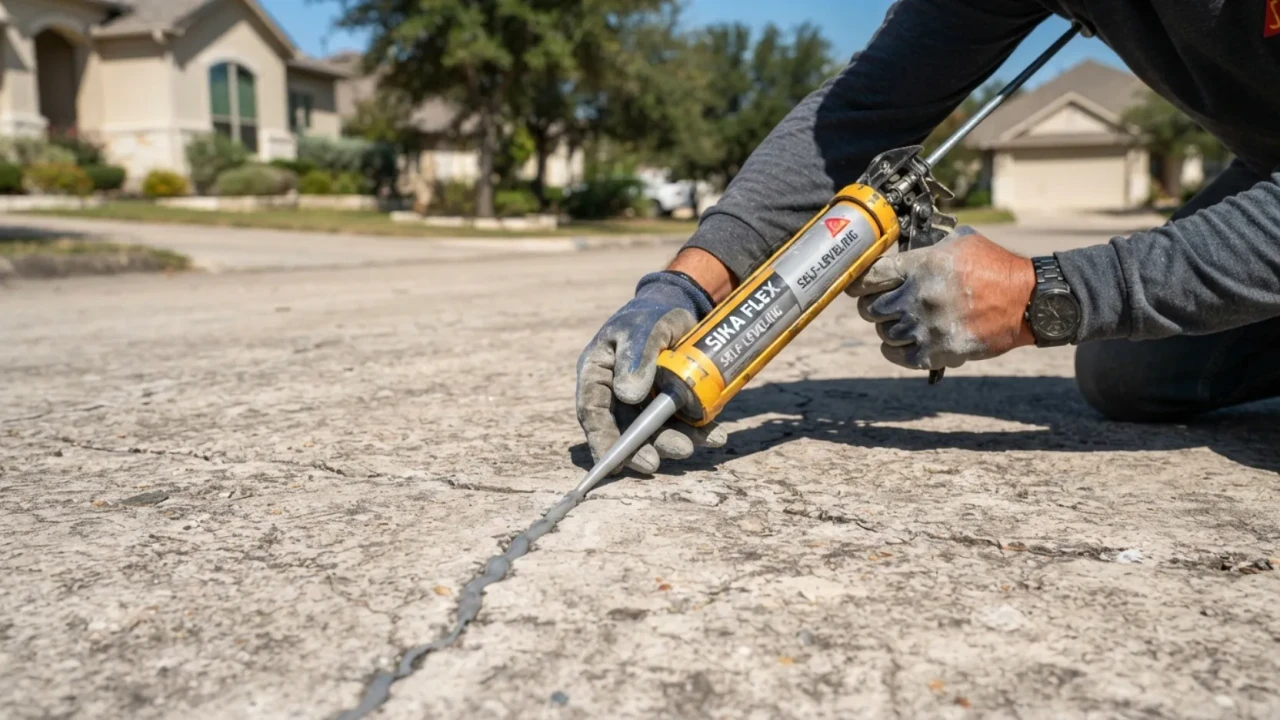
In San Antonio, the most common cause of structural cracking is Blackland Prairie clay soil movement. The clay expands significantly when wet during Flash Flood Alley rain events and contracts sharply during drought. This seasonal movement creates upward pressure (heaving) and downward voids beneath the slab over time. A properly compacted crushed limestone base reduces but does not eliminate this movement; the control joints are designed to accommodate what remains.
Edwards Aquifer hard water also contributes to surface scaling and map cracking over time. The mineral deposits left by sprinkler systems or standing water can degrade unsealed concrete surfaces faster than in softer-water markets. Sealing creates a barrier against this mineral penetration.
What does concrete driveway maintenance actually involve?
Maintenance FAQ
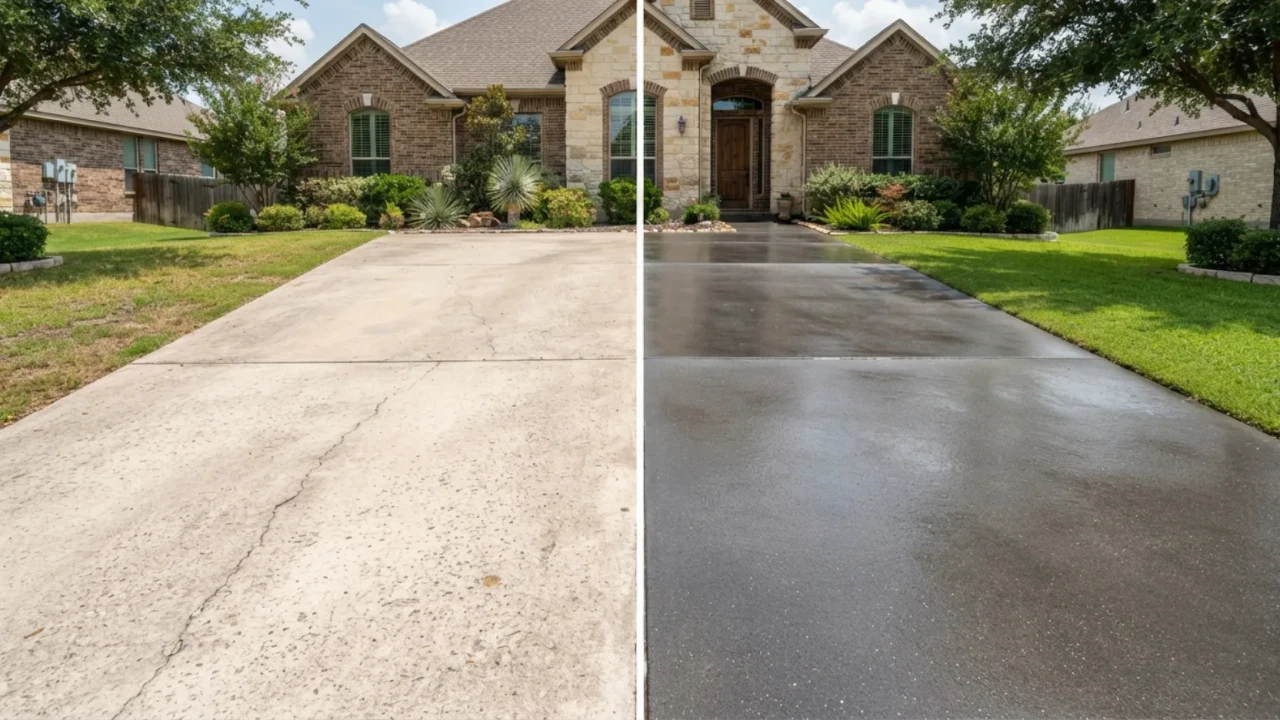
Yes sealing is the single most important maintenance action for a San Antonio concrete driveway. The combination of intense Texas UV radiation, occasional freeze events, Flash Flood Alley rainfall, and Edwards Aquifer hard water creates conditions that degrade unsealed concrete meaningfully faster than in most U.S. markets.
A penetrating concrete sealer (silane or siloxane-based) fills the surface pores, repels water, resists UV bleaching, and blocks oil and chemical penetration. A good application costs $150 to $400 as a DIY project or $300 to $600 professionally done on a standard two-car driveway far less than any repair work it prevents.
Film-forming acrylic sealers are common at big-box stores and less expensive upfront, but they wear unevenly and can peel or yellow in Texas UV conditions. A penetrating silane or siloxane sealer absorbs into the surface and does not change the appearance it protects without creating a surface coating that can fail.
Cleaning FAQ
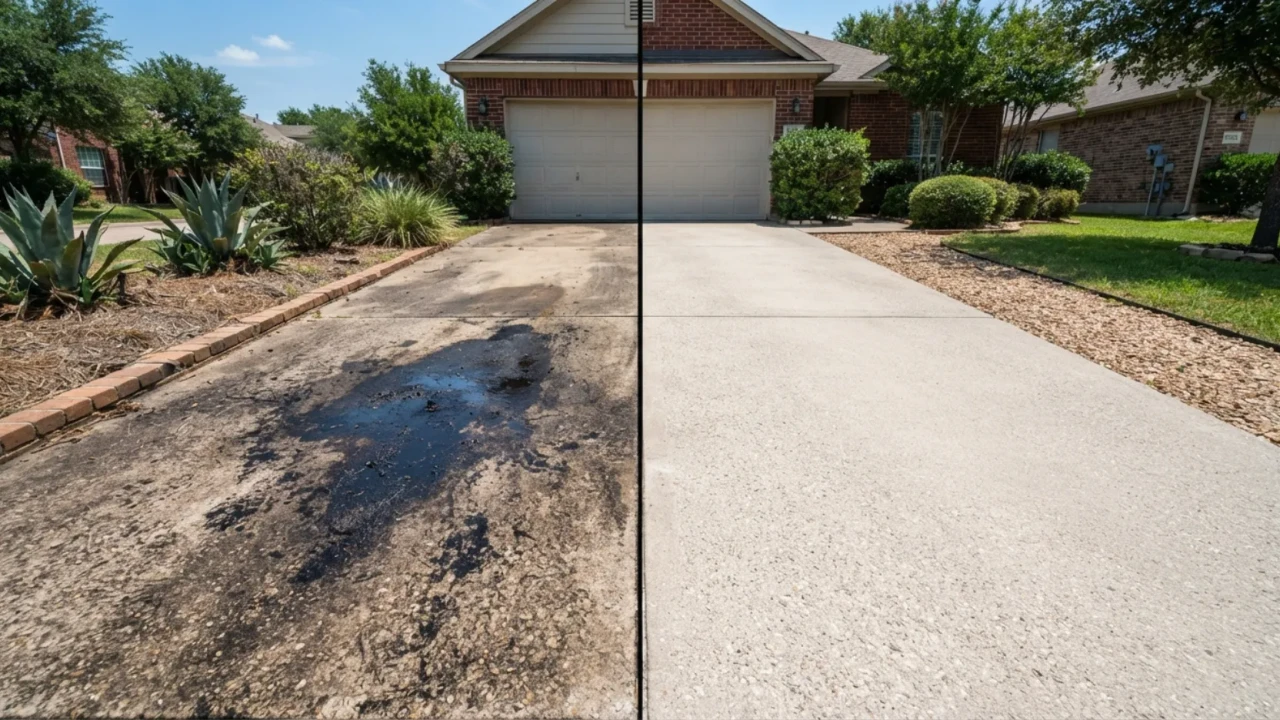
Oil stains on concrete penetrate fast within hours on an unsealed surface. The sooner you treat them, the better the result. Fresh stains can often be removed with a commercial concrete degreaser, a stiff brush, and a thorough rinse. Old, set stains require more aggressive treatment: a poultice of powdered concrete cleaner (trisodium phosphate or an enzyme-based product) applied over the stain, covered, and left for 24 to 48 hours.
For deeply set stains, an acid wash (muriatic acid diluted 1:10 with water) can resurface the stained layer but this requires full personal protective equipment, neutralization after application, and careful rinse management to avoid runoff into landscaping. It is a job most homeowners are better off hiring out for large or deep stains.
After any stain removal treatment, reseal the affected area once it is dry. Cleaning agents open the surface pores, and those pores need to be resealed to prevent future penetration. A spot application of sealer over the cleaned area is usually sufficient rather than a full driveway reseal.
- Annual pressure wash to remove dirt, algae, and organic staining from Flash Flood Alley rainfall
- Oil and grease stains treated immediately do not allow to set for more than 24 hours
- Expansion joints inspected annually and refilled with flexible backer rod and sealant if cracked
- Resealing every 3 to 5 years for standard broom finish; every 2 to 3 years for stamped or stained
- Hairline cracks filled with concrete crack filler before they widen through the next wet-dry cycle
Hiring right and navigating San Antonio permits
Permits FAQ
For most standard residential driveway replacements or additions within your property line, no structural building permit is required from the City of San Antonio. However, two situations do require a permit or approval:
A legitimate San Antonio concrete contractor will know the current permit requirements and pull any required Right-of-Way permit on your behalf. If a contractor tells you permits are not required and you later find out they were, you are responsible for any fines or required removal. Confirming with the city directly is always worth the phone call.
Contractor FAQ
A legitimate, detailed concrete driveway quote from a San Antonio contractor should specify every major variable not just the total price. Here is what a complete quote includes, and what a vague or suspicious one leaves out.
| Quote item | What it should say | Red flag if missing |
|---|---|---|
| Slab thickness | 5″ minimum for residential driveways in San Antonio | Quote says “concrete driveway” with no thickness spec |
| Base preparation | Excavation + compacted crushed limestone base, 4-6″ depth | Base not mentioned; or “prepared sub-base” with no material or depth specified |
| Reinforcement | Wire mesh or rebar grid, elevated to mid-slab height | Reinforcement not listed; or “rebar” with no placement detail |
| Finish type | Broom finish, exposed aggregate, stamped specified clearly | No finish mentioned; or “standard concrete finish” with no definition |
| Control joints | Saw-cut or tooled joints at specified intervals | Joints not mentioned at all |
| Demo and haul-off | Included or excluded and priced separately | Not addressed big cost surprise if it’s excluded and you assumed included |
| Payment terms | 30-50% deposit, remainder on completion | Full payment demanded before any work starts |
| Insurance | Certificate of liability insurance available on request | “We’re covered” verbally with no documentation offered |
After major weather events, San Antonio regularly sees crews approaching homeowners with low-ball driveway offers typically $3 to $4 per square foot claiming leftover material. At that price, there is no proper base, no reinforcement, and often a substandard mix. The driveway will crack within two to three years, and the contractor is long gone. Only hire from companies with a verifiable local address, a real insurance certificate, and a written spec-level quote.
- Slab thickness confirmed at 5″ minimum for standard residential use
- Base type and depth specified: compacted crushed limestone, 4-6″ for Bexar County clay soils
- Reinforcement type confirmed: wire mesh minimum, rebar for heavy vehicle use
- Control joint spacing confirmed: every 8-10 feet in each direction
- Drainage slope of 2% minimum away from the home foundation specified
- Certificate of general liability insurance received and verified $1M minimum
- Quote itemizes base prep, reinforcement, pour, finishing, and cleanup separately
- Demo and haul-off of old surface addressed (included or separately priced)
- Payment terms confirmed: deposit upfront, balance on completion and inspection
- Local San Antonio references from completed projects available
- Reinforcement elevated off the base to mid-slab height not resting on the ground
- Curing process agreed: wet curing or curing compound applied for minimum 3 days
- No vehicle traffic for minimum 7 days; foot traffic restricted for 48 hours
- First sealing scheduled at 28 to 30 days after pour
- Reseal every 3-5 years (broom finish) or every 2-3 years (stamped or stained)
- Annual pressure wash to remove dirt, algae, and hard-water mineral deposits
- Expansion joints inspected and refilled annually if cracked or missing sealant
- Oil stains treated immediately do not allow to set more than 24 hours
- Hairline cracks filled with concrete crack filler before next wet-dry seasonal cycle
FAQs
Can I park on a new concrete driveway right away?
How wide should a driveway be in San Antonio?
Can concrete be poured in San Antonio’s summer heat?
What is the minimum slope for a concrete driveway in San Antonio?
Can I repair a cracked driveway instead of replacing it?
How does San Antonio’s clay soil affect my concrete driveway?
Get a free concrete driveway quote in San Antonio
Tell us about your driveway project — new pour, repair, or upgrade. We will visit your property, assess the site conditions, and give you a detailed written quote at no cost.