
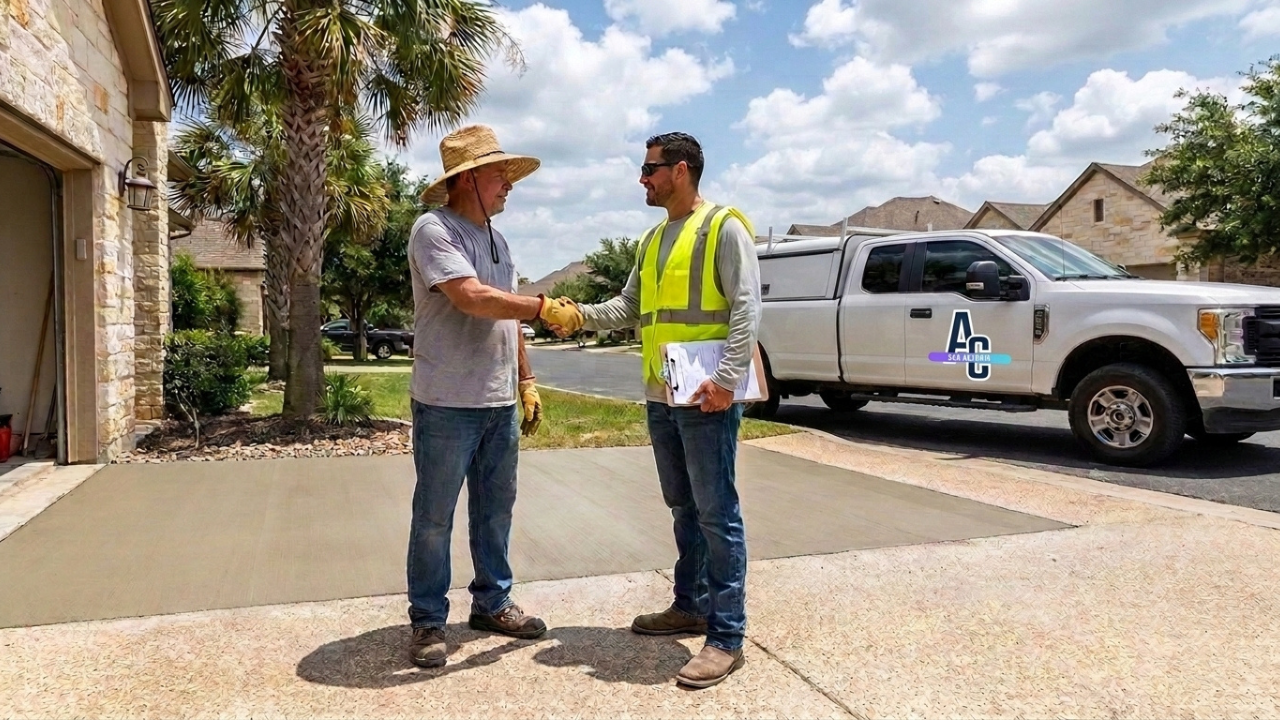
An extra car, a work truck, or an RV needs a place to park, and in San Antonio it cannot be the grass. This guide shows what to look for in concrete parking pad contractors, what a pad typically costs, which city rules apply, and the red flags to walk away from.
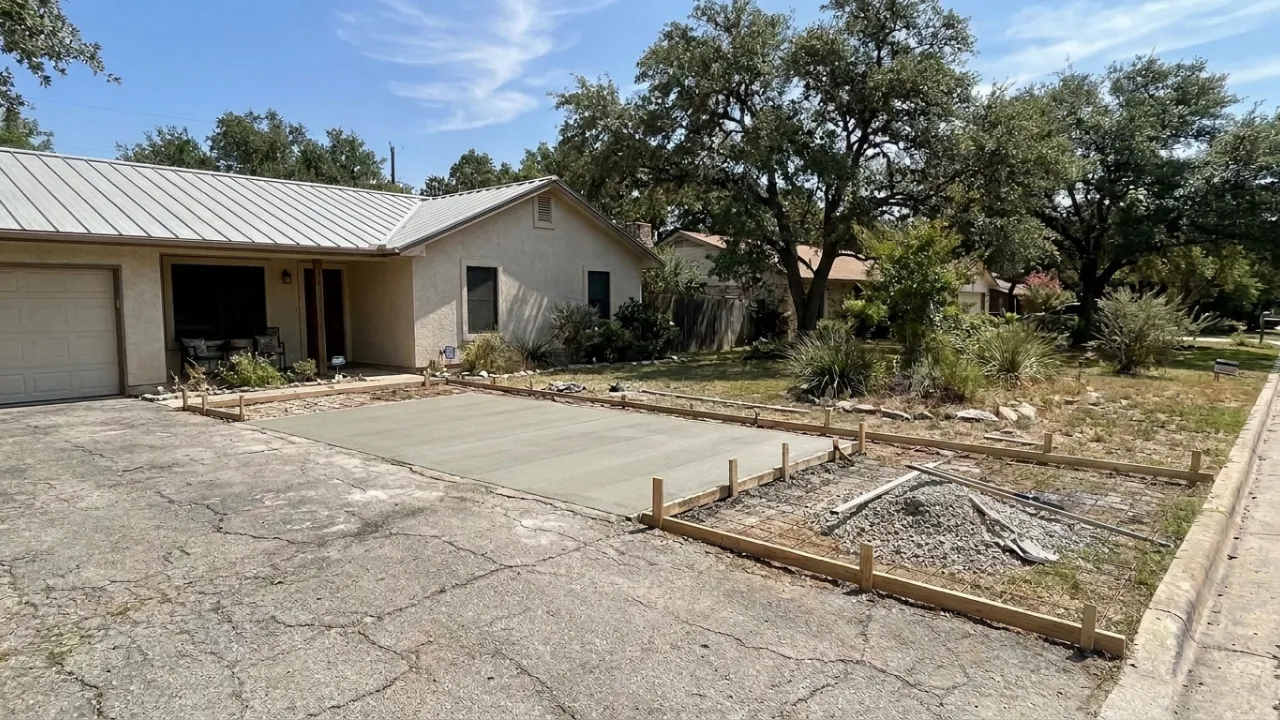
- What should I look for in concrete parking pad contractors?
- What is a concrete parking pad, and do I need one?
- What San Antonio rules apply to a parking pad?
- Do I need a permit for a concrete parking pad?
- How much do concrete parking pad contractors charge?
- How should a parking pad be built for San Antonio soil?
- What happens after I hire a parking pad contractor?
- How long does a concrete parking pad take?
- What are the red flags when hiring a pad contractor?
- What should I ask before I sign?
- Where do we work?
- What else are homeowners asking?
Hire a concrete parking pad contractor who checks your base, pours at least 4 inches thick (5 to 6 for trucks or RVs), and puts the price in writing. A 10-by-20-foot pad typically runs about $1,500 to $3,000. San Antonio caps front and side yard parking areas at 50% of lot width, so ask about city rules first.
What should I look for in concrete parking pad contractors?
Look for a licensed, insured concrete crew that measures your site, explains the base and slab thickness, and gives you a written, itemized price. The best concrete parking pad contractors also know the city’s front-yard parking rules and check them before they quote.
- Insurance you can verify: Ask for the certificate. Our service pages state $2,000,000 in liability coverage, which is the kind of number you should see in writing.
- A site visit, not a phone price: Soil, slope, access for the concrete truck, and how the pad meets your driveway all change the job.
- Spec on paper: Thickness, base depth, steel, joints, and finish should be listed on the estimate.
- Local rule knowledge: They should ask about lot width, the curb, and your HOA before they pick a size.
- Recent local reviews: Read reviews from San Antonio homeowners about driveway and slab work, not only patios.
Checked the concrete driveway installation and concrete driveway service pages and the City of San Antonio sources listed below on October 7, 2026.
What is a concrete parking pad, and do I need one?
A parking pad is a concrete slab built for parking, usually beside the driveway, in a side yard, or at the back of the lot. You need one if a vehicle, trailer, boat, or RV regularly parks off the driveway on dirt or grass.
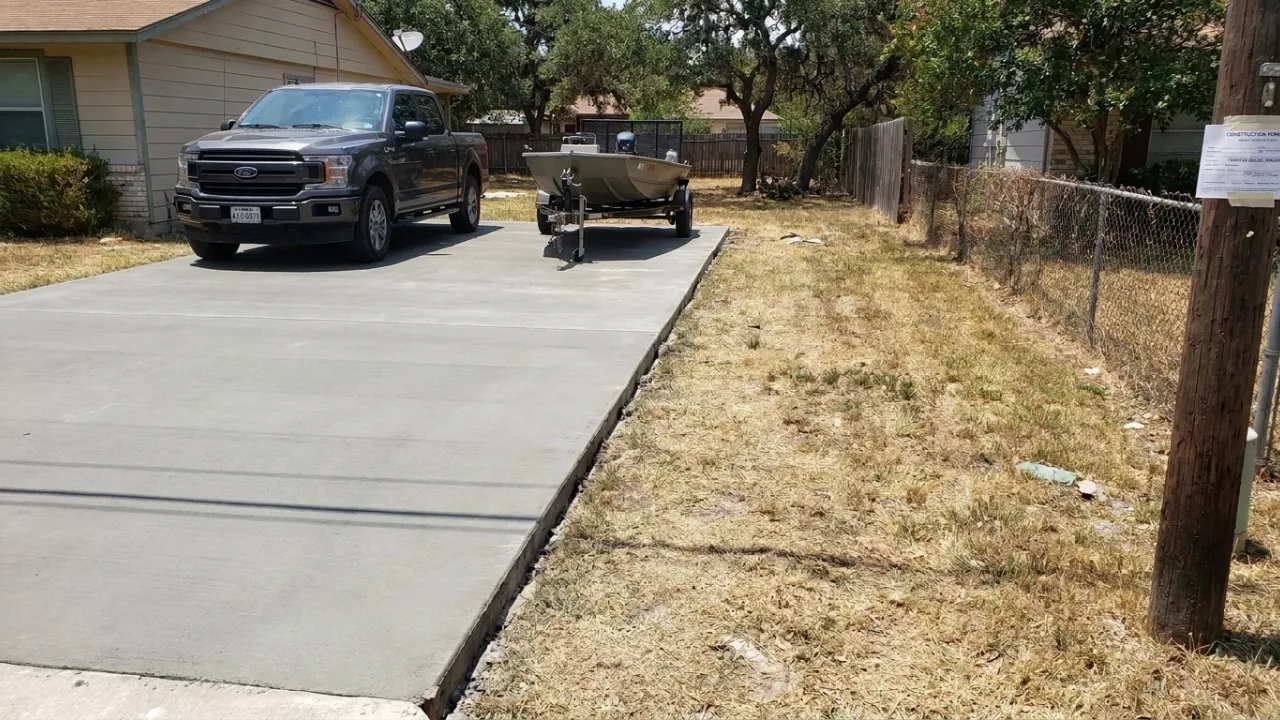
Common jobs include a single-car pad next to a narrow driveway, widening a driveway to fit two cars side by side, a side-yard pad for a trailer, and a longer, thicker RV pad. In San Antonio, parking in the front or side yard on bare ground is a code violation, so a pad is often the fix for a notice as well as for muddy tires.
What San Antonio rules apply to a parking pad?
City Code Sec. 19-194 says vehicles parked in a front or side yard must have all wheels on an improved surface, such as concrete, and that parking area cannot be wider than 50% of the lot’s average width, with a few exceptions.
- Improved surface: Concrete, brick, asphalt, or gravel with a permanent border. The city’s Code Enforcement newsletter says gravel must be at least 3 inches deep.
- 50% width cap: The front or side yard parking area cannot exceed half the average lot width. Exceptions cover lots 25 feet wide or less, curbless streets or streets under 30 feet wide, and buildings that do not meet setback rules.
- Connected to the street: The pad has to run in a continuous path from the curb, street, or alley, so it cannot be an island in the lawn.
- RVs and oversized vehicles: The city says to park an RV on an improved surface on your property and keep it out of the restricted area 15 feet from the curb or street line.
The city’s own guidance is plain: “Pave no more than 50% of your front yard if needed (consult your Neighborhood Association).” Measure your lot before you choose a pad size.
Do I need a permit for a concrete parking pad?
Usually not for the pad itself if it sits inside your property line, but often yes if the work touches the curb, drive approach, or public sidewalk. San Antonio’s No Permit Required List includes driveways inside the property line.
The city’s Sidewalk-Curb Permit covers drive approaches, curbs, and sidewalks in the public parkway between your property line and the street. The application asks whether you are adding a second driveway or building a residential driveway wider than 20 feet, which is exactly what many parking pads do. If you need a new curb cut, that work needs the permit and an inspection before the concrete is poured.
- Historic, Neighborhood Conservation, and Corridor Districts: These can add design rules.
- HOA deed restrictions: These are separate from city permits and can limit size and location.
- Outside city limits: Alamo Heights, Leon Valley, Helotes, and other separate cities, and unincorporated Bexar County, follow their own rules.
Confirm your address with Development Services at 210-207-1111 before work starts. A good contractor will tell you whether your pad touches the right-of-way and who pulls the permit.
How much do concrete parking pad contractors charge?
A typical broom-finish parking pad in San Antonio runs about $1,500 to $3,000 for a single-car 10×20 slab and about $3,800 to $7,700 for a thicker RV pad. Tear-out, extra base, and curb work add to that.
| Job | Typical cost in San Antonio | Time on site |
|---|---|---|
| Single-car side pad, about 10×20 ft, 4 to 5 in. | $1,500 – $3,000 | 1 to 2 days |
| Two-car pad or driveway widening, about 20×20 ft | $2,800 – $5,600 | 1 to 2 days |
| RV or trailer pad, about 12×40 ft, 5 to 6 in. with rebar | $3,800 – $7,700 | 2 to 3 days |
| Remove turf or old gravel and add base | About $1 – $3 per sq. ft. extra | Often the first day |
Typical estimate ranges as of October 2026, not a quote. A curb cut or new drive approach in the right-of-way is priced separately after the permit check. We give every price in writing after a free site visit.
What changes the price
- Size and thickness: an RV pad needs more concrete and more steel than a car pad
- Site prep: removing grass, roots, or old gravel, and building up a low spot
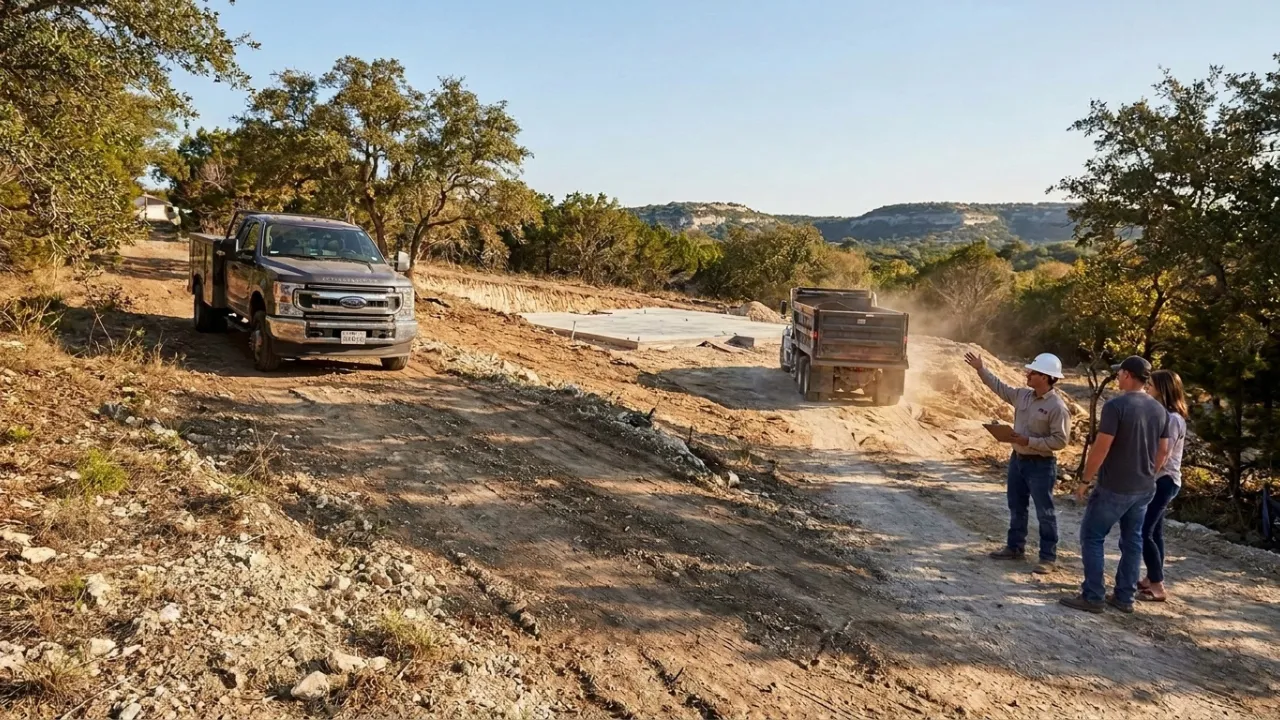
- Access: whether the concrete truck can reach the pad or the mix has to be pumped
- Finish and extras: broom finish is standard, while stamped or stained finishes cost more
- Permits and curb work if the pad needs a new drive approach
Size it to the vehicle and the city rules
How should a parking pad be built for San Antonio soil?
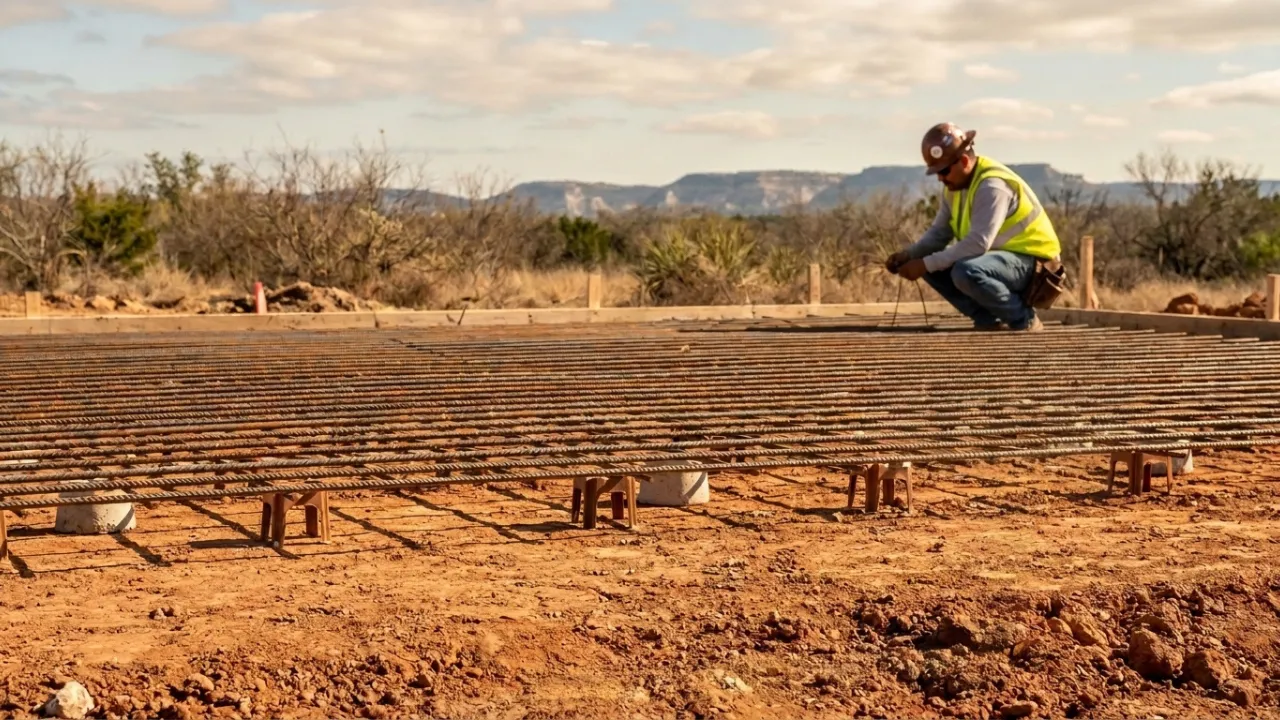
On a compacted crushed-stone base, with rebar set inside the slab, the right thickness for the heaviest vehicle, and joints and slope planned before the pour. Much of San Antonio sits on expansive clay that swells when wet and shrinks in drought, so the base matters as much as the concrete.
- Dig out soft soil: Turf, roots, and organic soil come out so the base sits on firm ground.
- Compacted base: A crushed-stone base gives even support over clay, and caliche lots may need the dig adjusted.
- Thickness: At least 4 inches for cars, and 5 to 6 inches for pickups, trailers, and RVs, with thickened edges where tires roll on.
- Steel on chairs: A rebar grid lifted into the slab, not lying on the dirt.
- Joints and slope: Control joints spaced for the slab width, and a pitch that sends rain away from the house and the garage.
- Meeting the driveway: Ask how the new pad ties into the old slab, so the two can move without cracking each other.
More on slab specs: how thick should a concrete driveway be?
What happens after I hire a parking pad contractor?
A site visit and written estimate come first, then the permit check, prep, pour, and cure. Here is how our driveway installation crew runs a pad job.
- Free site visit: Ted or a crew lead measures the area, checks slope, drainage, soil, and street access, and asks what you will park on it.
- Written estimate and permit check: The price lists thickness, base, reinforcement, and finish. If the pad touches the curb, approach, or sidewalk, the city permit comes first.
- Prep and base: The crew removes turf or gravel, grades the subgrade, and places and compacts the base.
- Forms, steel, and pour: Forms and rebar go in, then the pour, a broom finish, and control joints.
- Cure and walkthrough: The slab is protected while it cures, and you get a clear date for when it can take a car, a truck, or an RV.
“I hired them for a stamped concrete driveway, and the result was fantastic. The pattern was perfect, the color enhanced our curb appeal, and they were transparent about costs and on schedule.”
Driveway client, San Antonio · Google review shown on our driveway installation page
How long does a concrete parking pad take?
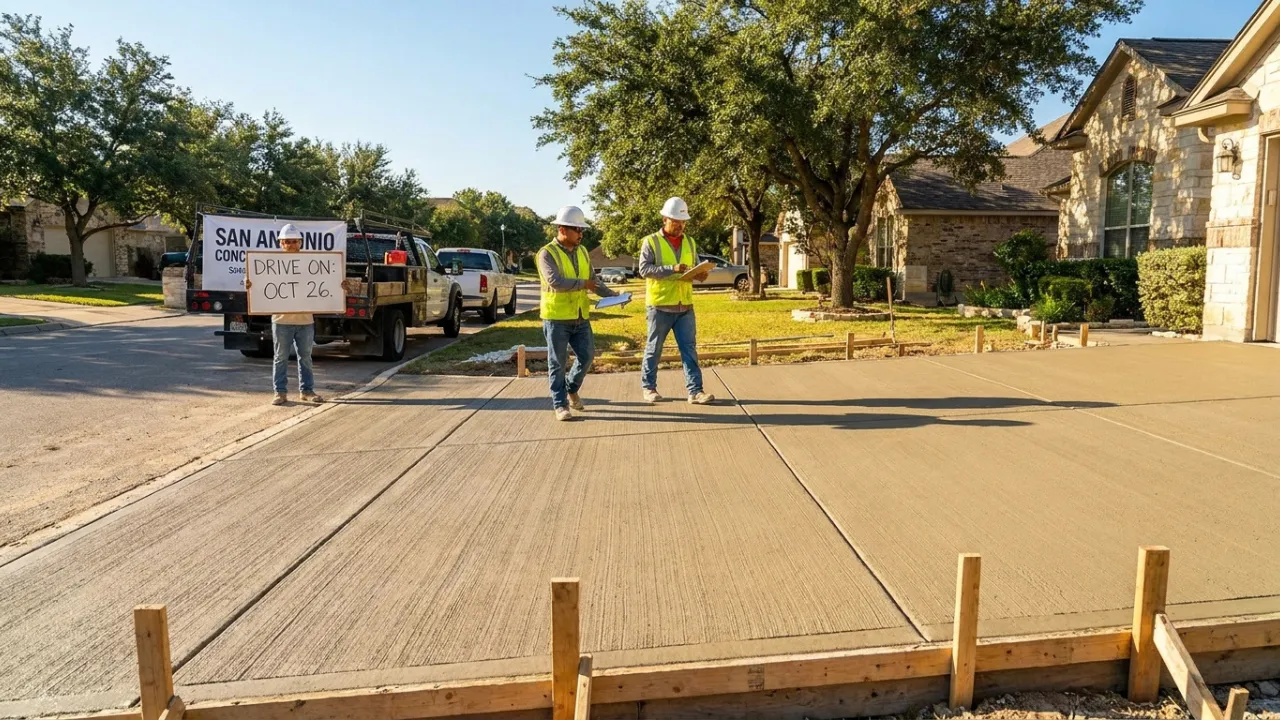
Most parking pads take about 1 to 3 working days to prep, form, and pour once the site is ready. A permit for curb work, tear-out, or rain can add days before the pour.
Curing takes longer than building. Our driveway installation page says you can typically walk on new concrete after 1 to 2 days, drive a car on it after about 7 days, and park heavy trucks or trailers on it after about 28 days. Plan where the RV will sit for that month before the old gravel comes out.
Planning around the weather? Read how weather affects concrete driveways in San Antonio.
What are the red flags when hiring a pad contractor?
Walk away from a contractor who will not put the price and spec in writing, asks for most of the money up front, or says city rules do not matter. Those are the jobs that end in cracked slabs and code notices.
- Price given over the phone without a site visit
- No thickness, base, or steel listed on the estimate
- Large cash deposit before materials are ordered
- No proof of insurance when you ask
- Plans to pour straight on grass or loose dirt
- “No permit needed” for a new curb cut
Not sure about a quote you already have? Call (713) 504-2341 and we will walk your site for free.
What should I ask before I sign?
Ask how thick the pad will be, what goes under it, who handles the permit, and when you can park on it. The answers should match what is written on the estimate.
Your parking pad hiring checklist
Use it with every contractor you compare.
- Measure your lot width and the pad size you want.
- Check HOA rules before you get quotes.
- Ask for proof of liability insurance.
- Get thickness, base, and steel in writing.
- Ask how the pad ties into the driveway.
- Ask who pulls any curb or approach permit.
- Confirm when a car and an RV can park on it.
- Ask what the workmanship warranty covers.
Related reading: how to choose a concrete driveway contractor
Our service page: concrete driveway and parking pad installation in San Antonio, TX. For repairs or replacement of an existing driveway, see our concrete driveway page.
Need a concrete parking pad in San Antonio?
Free site visit, thickness and price in writing before work starts, licensed and insured crew.
Where do we work?
Affordable Concrete San Antonio works across San Antonio and nearby areas from our shop at 1247 W Thompson Pl, San Antonio, TX 78226.
Our driveway installation page lists San Antonio plus Helotes, Leon Valley, Shavano Park, Terrell Hills, Alamo Heights, Converse, Universal City, Schertz, Boerne, Cibolo, Fair Oaks Ranch, Bulverde, Spring Branch, New Braunfels, Pleasanton, Floresville, Castroville, Lytle, and Von Ormy. Not sure about your address? Call (713) 504-2341.
What else are homeowners asking?
These are the short answers people want before they book a quote.
What should I look for in concrete parking pad contractors?
A licensed, insured crew that visits the site, lists thickness, base, and steel on a written estimate, and checks San Antonio parking and curb rules before quoting.
How much does a concrete parking pad cost in San Antonio?
A single-car pad of about 10 by 20 feet typically runs $1,500 to $3,000. Larger two-car or RV pads cost more, and curb work is priced separately.
How thick should a concrete parking pad be?
At least 4 inches for cars. Pickups, trailers, and RVs usually need 5 to 6 inches with rebar and thickened edges.
Do I need a permit for a parking pad in San Antonio?
Usually not for a pad inside your property line, but a new curb cut or drive approach needs a Sidewalk-Curb Permit. Confirm with Development Services at 210-207-1111.
How wide can a front yard parking pad be in San Antonio?
City Code Sec. 19-194 limits front and side yard parking areas to 50% of the lot’s average width, with exceptions for narrow lots and some streets.
When can I park on a new concrete pad?
You can usually drive a car on it after about 7 days. Wait about 28 days before parking heavy trucks, trailers, or an RV.
Sources used in this article:
- City of San Antonio, Vehicle Responsibilities (front and side yard parking, RV parking), checked October 7, 2026, sa.gov
- City of San Antonio Code Enforcement, Code Connection newsletter, January 2015 (City Code Sec. 19-194), sanantonio.gov
- City of San Antonio, Sidewalk-Curb Permit Application, checked October 7, 2026, docsonline.sanantonio.gov
- City of San Antonio, No Permit Required List, sa.gov
- Affordable Concrete San Antonio, concrete driveway installation service page, checked October 7, 2026, affordableconcretesanantonio.com/concrete-driveway-installation-san-antonio/
This article is general information for San Antonio homeowners. Prices are typical estimates and can change. City rules can change too, and the City of San Antonio is the final authority. It is not a quote and does not replace a site visit.
What should I read next?
Start with our driveway installation page, or keep reading if you are still sizing or budgeting the pad.