
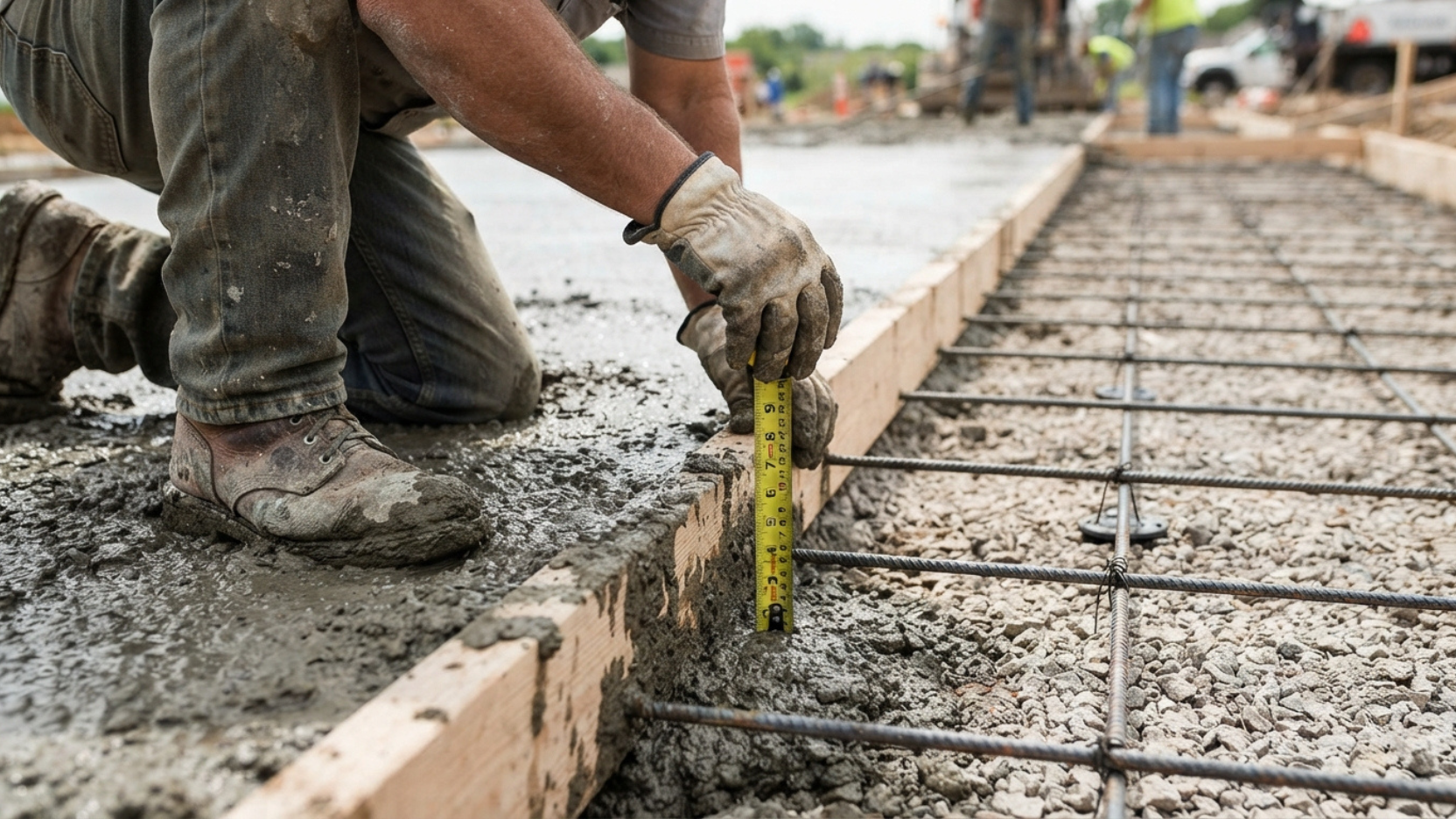
Driveway thickness is the single most important structural decision in any concrete pour. Go too thin and the slab cracks under vehicle loads. Go too thick and you pay for concrete you do not need. This guide covers every scenario from standard passenger cars to heavy pickup trucks with the exact specs San Antonio contractors use in 2026.
Concrete driveway thickness is not a preference you can upgrade later. Once the slab is poured and cured, the thickness is permanent. Too thin, and the slab will crack under repeated vehicle loads, thermal expansion from San Antonio’s heat, and the constant movement of Bexar County’s expansive clay soils. Too thick, and you have paid for concrete that contributed nothing to structural performance.
The good news is that getting thickness right is straightforward once you understand the variables: what vehicles will use the driveway, what the soil conditions are, and what the contractor is specifying for the base underneath the slab. This guide walks through every scenario with the actual numbers San Antonio concrete contractors use in 2026.
Driveway thickness is engineered for the heaviest vehicle that will park or drive over the slab on a regular basis not the average vehicle. If you drive a compact car to work but park an F-250 on the driveway every night, spec for the truck. The concrete does not know about your commuter car. It only feels the 8,000-pound pickup sitting on it overnight, five nights a week, in the summer heat that softens San Antonio’s clay substrate. Start with your heaviest regular vehicle, and the rest of the thickness decision is simple math.
Standard Spec
The American Concrete Institute (ACI) and the Portland Cement Association both recommend a minimum of 4 inches of concrete for residential driveways that carry standard passenger vehicles. This is the spec that covers the vast majority of San Antonio driveways two-car households with sedans, crossovers, and standard SUVs in the 3,500 to 5,500-pound range.

A properly poured 4-inch slab on a compacted base handles repeated vehicle loads without cracking, provided the base preparation is done correctly. The concrete alone does not carry the load the base underneath transfers the weight down into the soil evenly. In San Antonio, that base is typically 4 inches of compacted crushed limestone, not raw soil.
- 4-inch slab thickness confirmed in writing in the contractor quote
- 4-inch compacted crushed limestone base included in scope not just poured over native soil
- 3,000 psi minimum concrete mix specified
- Wire mesh or rebar reinforcement included rebar preferred for San Antonio clay soils
- Expansion joints planned at 8 to 10-foot intervals
Heavy Load
The 4-inch standard is built around a typical passenger vehicle weighing 4,000 to 5,500 pounds. Once you start parking heavier loads on the slab regularly a full-size pickup truck, a travel trailer, an RV, or a boat on a trailer the load per square inch increases significantly. San Antonio contractors recommend stepping up to 5 inches as soon as the heaviest regular vehicle exceeds 8,000 pounds gross vehicle weight, and 6 inches for anything heavier or for slabs that will see occasional commercial vehicle use.

The additional inch or two of concrete is not just about raw weight. It is about the way repeated stress cycles accumulate in the slab over time. A heavy truck driven across the driveway daily creates small stress cycles with every pass. A 4-inch slab absorbs a finite number of these before micro-cracking begins. A 5 or 6-inch slab has significantly greater fatigue resistance and a longer useful life under those conditions.
Do not just thicken the slab also upgrade the base and rebar: When stepping up to a 5 or 6-inch slab for heavy vehicles, also upgrade the base from 4 inches to 6 inches of compacted limestone, and switch from wire mesh to a #4 rebar grid at 12 to 18-inch centers. The combination of a thicker base and heavier reinforcement does far more for longevity than simply pouring more concrete on an undersized base.
- Heaviest regular vehicle’s gross weight confirmed before spec is set
- Minimum 5-inch slab for any vehicle over 8,000 lbs GVW
- Minimum 6-inch slab for RVs, boat trailers, or regular heavy-duty truck use
- Base upgraded to 6 inches of compacted crushed limestone when slab exceeds 4 inches
- #4 rebar grid specified in writing for all heavy-use applications
- 4,000 psi concrete mix requested for any heavy-use driveway project
Base Prep
Every concrete contractor in San Antonio will tell you the same thing: the base is more important than the slab thickness. This is not false modesty. A 6-inch concrete slab poured directly onto uncompacted Bexar County clay will crack faster than a 4-inch slab on a properly prepared, compacted crushed limestone base. The concrete itself is strong in compression but weak in tension. When the soil beneath it moves, the slab bends. And bending creates tensile stress. And tensile stress, in concrete, means cracks.

The standard base preparation sequence in San Antonio is: excavate to the correct depth, compact the native subgrade with a plate compactor, lay 4 to 6 inches of crushed limestone (Type B or better), compact in 2-inch lifts until proofrolling confirms no deflection, then set forms and pour. Skipping any of these steps is where cheap driveways fail.
| Application | Slab thickness | Base depth | Total excavation depth |
|---|---|---|---|
| Standard residential driveway | 4 inches | 4 inches compacted limestone | 8 to 8.5 inches |
| Heavy pickup or SUV | 5 inches | 5 to 6 inches compacted limestone | 10 to 11.5 inches |
| RV, boat trailer, heavy-duty | 6 inches | 6 inches compacted limestone | 12 to 12.5 inches |
| Commercial driveway apron | 6 to 8 inches | 6 to 8 inches compacted base | 12 to 16.5 inches |
- Excavation depth confirmed in quote: slab thickness plus base depth, minimum 8 inches total
- Base material specified as crushed limestone not clay fill, recycled asphalt, or raw soil
- Compaction method specified: plate compactor in 2-inch lifts, not a single pass
- Subgrade compacted before base material is placed
- Proofrolling or compaction testing included for heavy-use applications
This is probably the most misunderstood part of driveway construction. Reinforcement steel whether wire mesh or rebar does not prevent concrete from cracking. Concrete will crack over time due to thermal expansion, shrinkage, and soil movement. The reinforcement’s job is to hold the two sides of a crack together so the slab remains structurally sound and level rather than shifting and heaving. In San Antonio’s expansive clay environment, this distinction matters enormously.

Wire mesh (also called welded wire reinforcement or WWR) is a grid of thin steel wires, typically 6×6-W1.4xW1.4. It works adequately for patios and light-use flatwork where soil movement is minimal. For driveways in Bexar County’s clay soils, rebar is the better choice. Rebar has greater cross-sectional area, is stiffer, and does a far better job of holding cracked sections together when soil movement occurs beneath the slab.
Rebar placement height matters as much as rebar size: Rebar sitting on the bottom of the slab provides almost no tensile reinforcement. It needs to be at mid-slab height 2 inches from the bottom for a 4-inch slab. Proper contractors use chairs or dobies to elevate the rebar during the pour. If you walk onto a pour site and the rebar is resting flat on the ground, that is a red flag that needs to be corrected before the truck arrives.
| Reinforcement type | Best application | Cost premium over mesh | San Antonio recommendation |
|---|---|---|---|
| Wire mesh (WWR) | Patios, light flatwork, walkways | Baseline | Not preferred for driveways on clay soil |
| #3 rebar at 18″ grid | Standard residential driveways | +$0.50 to $1.00/sqft | Minimum recommended for all driveways in Bexar County |
| #4 rebar at 18″ grid | Heavy truck or SUV use | +$1.00 to $1.50/sqft | Recommended for any vehicle over 8,000 lbs GVW |
| #4 rebar at 12″ grid | RVs, heavy-duty, commercial aprons | +$1.50 to $2.50/sqft | Required for RV pads, heavy equipment driveways |
- Rebar specified (not wire mesh) for any driveway in San Antonio’s clay soil conditions
- Rebar size and spacing confirmed in the written quote: #3 minimum for residential, #4 for heavy use
- Chair height or dobies specified to elevate rebar to mid-slab height during pour
- Rebar tied at intersections to maintain position during concrete placement
- No rebar left resting on the ground or base prior to pour
Local Factors
The national minimum of 4 inches for residential driveways was developed as a baseline for average soil conditions across the United States. San Antonio’s soil conditions are not average. Bexar County sits on Blackland Prairie Vertisol clay one of the most expansive soil types in North America. This soil can expand 30 to 40 percent in volume when saturated, exerting enough upward pressure to lift and crack a concrete slab that was not engineered for it.

There are three San Antonio-specific factors that every homeowner should understand before setting a driveway spec: the Blackland Prairie clay soils that expand and contract seasonally, the intense UV radiation and summer heat that stress concrete at the surface, and the hard water from the Edwards Aquifer that affects curing and long-term concrete performance.
Because of Bexar County’s expansive clay soils and the thermal stress from South Texas summers, local concrete contractors generally recommend a 4.5 to 5-inch slab for standard residential driveways rather than the 4-inch national minimum. This is not an upsell. The additional half inch adds meaningful fatigue resistance against the seasonal soil movement that causes premature cracking in the San Antonio market specifically. For heavy vehicles, the local recommendation is 5.5 to 6 inches.
Texas 811 utility locate is also a critical consideration before any excavation begins. Call 811 at least 48 hours before digging to have underground utilities marked. In San Antonio’s older neighborhoods especially, utility lines are often shallower than expected and the required excavation depth for a proper driveway base can reach them. Skipping the locate call is both illegal and dangerous.
- Texas 811 utility locate called at least 48 hours before excavation begins
- Slab thickness set to 4.5 to 5 inches minimum for standard residential in Bexar County clay
- Contractor confirmed familiarity with local soil expansion behavior and base requirements
- Summer pour scheduled for early morning start (before 10 a.m.) if unavoidable in June through August
- Curing compound or wet curing planned for at least 3 to 5 days post-pour given San Antonio heat
- First sealing scheduled at 28 to 30 days after pour to protect against UV and Edwards Aquifer hard water effects
Joints
Concrete will crack. That is not a failure it is a material property. The question is whether the cracks happen where you planned them (at control joints) or where the concrete decided on its own (random cracking across the slab). Control joints are deliberate weakened planes cut into the slab that direct the inevitable shrinkage cracks to those locations. Expansion joints are full separations between slab sections, filled with a compressible material, that allow each section to move independently without transferring stress to adjacent sections.

The standard rule for control joint spacing is that the distance between joints should be no more than 2 to 3 times the slab thickness in feet. For a 4-inch slab, that means a joint every 8 to 12 feet. For a 5-inch slab, 10 to 15 feet. The more expansive the soil, the closer the joints should be within that range. In San Antonio, erring toward the shorter spacing is always the right call.
- Control joint spacing specified in the quote: every 8 to 10 feet for 4-inch slabs, 10 to 12 feet for 5-inch slabs
- Joint depth confirmed: at least one-quarter of slab thickness
- Expansion joints included at all abutments: garage slab, curb cuts, adjacent sidewalks
- Joint filler material specified: backer rod and urethane sealant, not silicone or foam only
- Annual joint inspection added to driveway maintenance schedule
Use this table to match your driveway situation to the correct slab thickness, base depth, and reinforcement spec before getting any contractor quotes. If a quote comes in with lower specs than this table recommends for your situation, ask the contractor to explain the difference in writing.
| Use case | Slab thickness | Base depth | Reinforcement | Mix strength |
|---|---|---|---|---|
| Sedans and crossovers (under 5,500 lbs) | 4 to 4.5 inches | 4 inches compacted limestone | #3 rebar at 18″ grid | 3,000 psi |
| Standard SUVs and minivans (under 7,000 lbs) | 4.5 to 5 inches | 4 to 5 inches compacted limestone | #3 rebar at 18″ grid | 3,000 psi |
| Half-ton pickup trucks (F-150, Ram 1500, Silverado) | 5 inches | 5 to 6 inches compacted limestone | #4 rebar at 18″ grid | 3,500 psi |
| Heavy-duty trucks (F-250, F-350, Ram 2500+) | 5.5 to 6 inches | 6 inches compacted limestone | #4 rebar at 12 to 18″ grid | 4,000 psi |
| RV, boat trailer, or travel trailer | 6 inches | 6 inches compacted limestone | #4 rebar at 12″ grid | 4,000 psi |
| Commercial delivery trucks (occasional) | 6 to 8 inches | 6 to 8 inches compacted base | #4 to #5 rebar at 12″ grid | 4,000 to 4,500 psi |
| RV pad or dedicated heavy equipment pad | 6 to 8 inches | 8 inches compacted base | #5 rebar at 12″ grid | 4,500 psi |
- Slab thickness confirmed in writing: 4 to 4.5 inches minimum for standard residential, 5 inches for pickups, 6 inches for heavy vehicles
- San Antonio clay soil adjustment applied: add at least 0.5 inches to national minimum baseline
- Heaviest regular vehicle identified and used as the basis for the thickness spec
- Concrete mix strength specified: 3,000 psi minimum residential, 4,000 psi for heavy use
- Excavation depth included in quote scope: slab + base = 8 inches minimum total
- Base material specified as crushed limestone, not raw soil or recycled fill
- Base depth confirmed: 4 inches for standard, 6 inches for heavy use
- Compaction method specified: plate compactor in 2-inch lifts minimum
- Rebar specified over wire mesh for all Bexar County driveway applications
- Rebar size and grid spacing confirmed in writing: #3 at 18″ residential, #4 at 12 to 18″ heavy use
- Chair height or dobies specified to elevate rebar to mid-slab height
- No rebar resting on the base or ground at time of pour
- Texas 811 utility locate called at least 48 hours before any excavation
- Summer pour scheduled for early morning if June through August start is necessary
- Curing process confirmed: wet curing or liquid compound for minimum 3 to 5 days
- Control joint spacing confirmed: one joint per 2 to 3 times slab depth in feet
- Expansion joints at all abutments included in scope
- First sealing scheduled at 28 to 30 days post-pour
Is 4 inches thick enough for a concrete driveway in San Antonio?
How thick does concrete need to be for a truck driveway?
Does a thicker concrete driveway cost significantly more?
Can I park an RV on a regular 4-inch concrete driveway?
Why is the base depth as important as the concrete thickness?
Does a concrete driveway need rebar or is wire mesh enough in San Antonio?
Get a free driveway quote in San Antonio
Tell us about your driveway size, heaviest vehicle, and timeline. We will visit the property, assess the soil and base conditions, and give you a fully itemized written quote at no cost.