
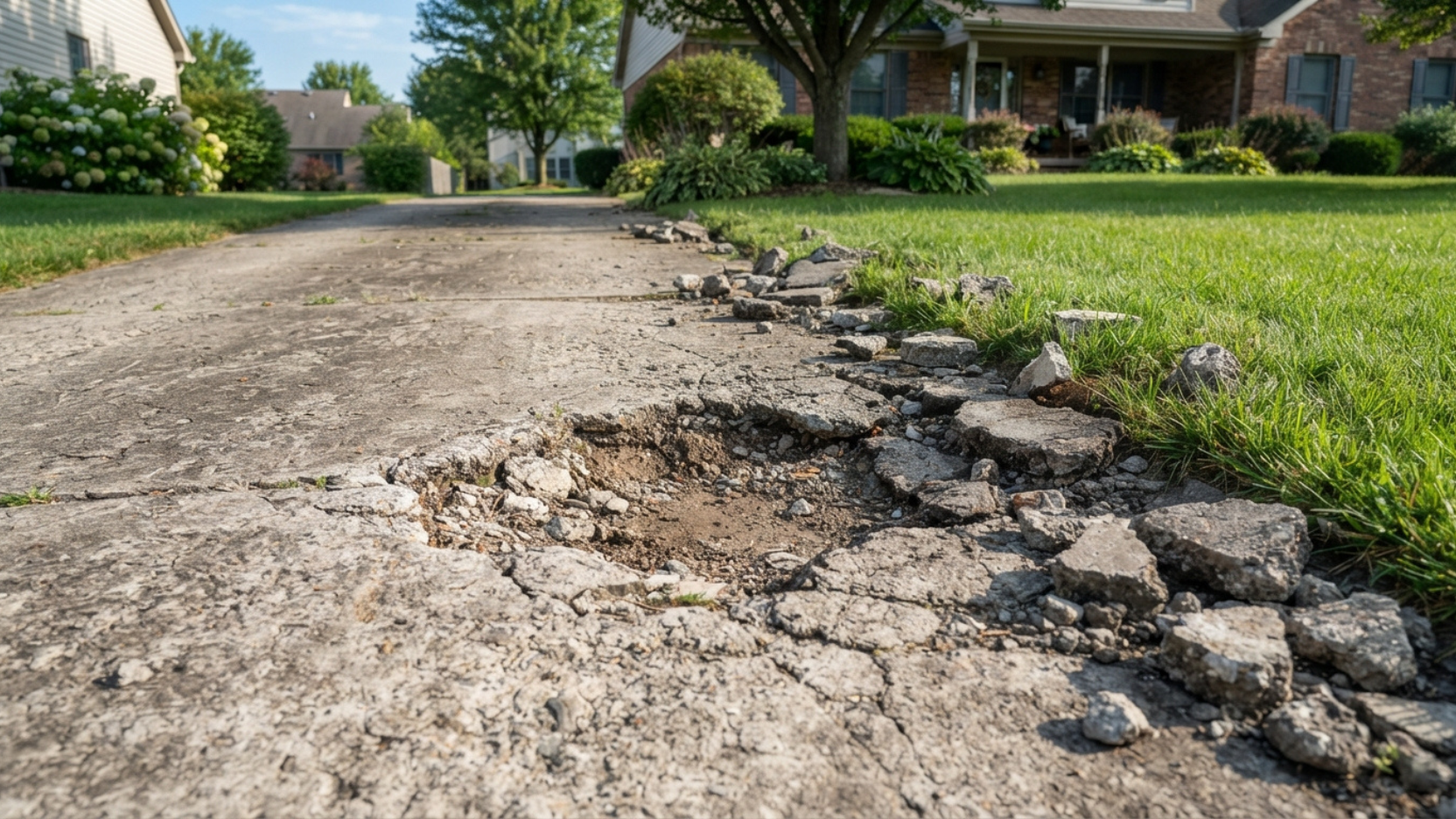
Most San Antonio driveways send clear warning signals before they fail completely. Catching these seven signs early can save you thousands in replacement costs and protect your home’s curb appeal and value.
San Antonio driveways face a punishment that most homeowners underestimate. Bexar County’s Blackland Prairie clay soils expand and contract with every rain cycle. Summer surface temperatures regularly exceed 150 degrees Fahrenheit on dark concrete, stressing the slab from above while the soil moves beneath it. Hard Edwards Aquifer water leaves mineral deposits in surface pores, and Texas UV intensity degrades unprotected sealers faster than in most U.S. markets.
The result is a concrete surface that gives plenty of warning before it fails if you know what to look for. The seven signs covered in this guide range from cosmetic issues that can wait a season to structural failures that require a contractor call this week. Identifying which category your driveway falls into is the most important repair decision you will make.
Every concrete driveway issue falls into one of two categories: surface damage (cracks, spalling, staining, and scaling that affect only the top layer of the slab) or base failure (heaving, sinking, and structural cracking caused by the soil moving beneath the concrete). Surface damage is almost always repairable at a fraction of replacement cost. Base failure particularly in San Antonio’s clay-heavy soils often requires full removal and repour with improved base preparation. The seven signs in this guide will help you identify which category your driveway is in before you call a contractor.
Act Now
Not all cracks are created equal. Hairline cracks under 1/8 inch wide are normal shrinkage cracks that develop as concrete cures and are primarily cosmetic. Cracks between 1/8 and 1/4 inch wide should be sealed to prevent water infiltration but do not indicate imminent structural failure. Cracks wider than 1/4 inch are a different conversation entirely.

A crack wider than 1/4 inch roughly the width of a pencil signals that the two pieces of concrete on either side of the crack are moving independently. In San Antonio’s Vertisol clay soils, this movement is almost always caused by the soil swelling when wet and shrinking during dry periods, a cycle that repeats dozens of times each year during normal weather patterns.
The critical secondary check with any wide crack is displacement: place a straight edge across the crack and see if one side is higher than the other. Vertical displacement, even 1/8 inch, means the base beneath one section has shifted. That is a base failure indicator, not just surface cracking.
- Measure the widest point of each crack with a ruler or coin (a dime is approximately 1/16 inch thick)
- Check for vertical displacement by placing a straight edge across the crack at multiple points
- Note whether cracks run parallel to expansion joints (normal) or at diagonal angles (more concerning)
- Document crack locations with photos so you can monitor growth over the next 30 to 60 days
- Call a contractor for any crack over 1/4 inch wide or any crack with vertical displacement
Act Now
A concrete driveway should lie flat. When individual slabs or sections rise above or sink below the surrounding surface, the base beneath that section has either compressed (sinking) or been lifted by expansive soil or tree roots (heaving). Both conditions are progressive they worsen with every rain cycle and both create trip hazards and vehicle clearance problems in addition to the structural damage.

Sinking typically results from voids forming beneath the slab. In San Antonio, the most common cause is tree roots decaying and leaving hollow spaces, or clay soil drying and compacting under the slab during extended dry periods. Mudjacking (pumping a slurry beneath the slab to re-level it) is a cost-effective repair for minor sinking when the concrete itself is in good condition.
Heaving is more common in San Antonio than sinking, because Bexar County’s clay soils expand aggressively when saturated. A slab section that rises an inch or more above its neighbor is being pushed up by swelling clay underneath often compounded by a tree root system that has grown beneath the concrete and acts as an additional lifting mechanism.
- Measure the height difference between adjacent slab sections at every visible joint
- Check for trees within 15 feet of the affected area document their proximity
- Note whether the problem area has a consistent drainage issue or sits in a low spot
- Displacement over 1 inch typically requires section removal rather than mudjacking
- Get a structural assessment from a concrete contractor before choosing between mudjacking and replacement
Repair Soon
Spalling describes the flaking or peeling of the top surface layer of concrete, leaving a rough, pitted, or cratered appearance. In San Antonio, spalling is accelerated by two local factors: the Edwards Aquifer’s hard water leaves calcium and magnesium mineral deposits in concrete pores, and the intense UV exposure combined with summer heat cycles causes surface sealers to fail faster, leaving bare concrete vulnerable to moisture penetration.

Early-stage spalling, where only the top 1/8 to 1/4 inch of the surface is affected, can be repaired with a concrete resurfacer applied over the cleaned and prepared slab. This product bonds to the existing concrete and creates a new wear surface that can last eight to twelve years with proper sealing. The critical condition: the base concrete must be sound and free of structural cracks before resurfacing.
Advanced spalling that has exposed the aggregate or penetrated deeper than 1/4 inch requires more aggressive repair. Deep patches with polymer-modified concrete repair mortars are effective for localized areas. When spalling covers more than 25 percent of the driveway surface, a full overlay or replacement is typically more cost-effective than spot patching.
The most common cause of premature spalling in San Antonio driveways is deicing salt damage from the 2021 Winter Storm Uri event. Many homeowners applied rock salt or calcium chloride to icy surfaces during the freeze, and the damage to unprotected concrete has continued to worsen each year since. If your driveway began showing surface deterioration in 2021 or 2022 and has been worsening steadily, deicing salt penetration is the likely cause. A concrete overlay is the most cost-effective repair for salt-damaged surfaces that are otherwise structurally sound.
- Estimate the percentage of the total surface area showing spalling or scaling
- Test the sound of the spalling area with a metal coin a hollow sound indicates delamination beneath the surface
- Under 10 percent affected: patch repair with polymer mortar is appropriate
- 10 to 25 percent affected: resurfacer overlay is the most cost-effective option
- Over 25 percent affected: get quotes for both full overlay and full replacement
Repair Soon
A properly designed concrete driveway should shed water completely within 20 to 30 minutes of a rain event ending. Water that pools or stands for hours is finding a low spot either from original installation error, settling over time, or heaving elsewhere on the slab that has altered the drainage slope. In San Antonio’s heavy spring and fall rain events, standing water on a driveway can persist for hours and penetrate any existing cracks, accelerating every other form of damage on this list.

The mechanics of drainage damage in San Antonio are particularly aggressive. When water enters cracks or unsealed expansion joints and saturates the clay base beneath, the clay swells lifting the slab in some areas while compressing in others. When that water evaporates during a dry period, the clay shrinks, creating voids. This cycle is responsible for a significant portion of the heaving and sinking issues described in Sign 02.
Minor drainage problems caused by small low spots (under 1/2 inch depth, under 10 square feet area) can sometimes be corrected with a concrete leveling compound applied to the low areas. More significant drainage failures require either mudjacking the low sections back to a proper slope or grinding down high sections. In severe cases, the affected area must be removed and repoured with a corrected grade.
- Observe the driveway during or immediately after a heavy rain event note where water collects
- Check whether standing water is draining toward or away from the house foundation
- Low spots under 1/2 inch deep may be correctable with leveling compound without full repair
- Water pooling near the garage door or house foundation requires immediate attention to prevent structural damage
- Document drainage patterns with photos or video during rain events to share with your contractor
Repair Soon
Unlike spalling, which is a surface-layer issue, pitting and pothole formation in concrete driveways indicates that aggregate has been dislodged from the concrete matrix itself. The concrete mix is no longer intact. This typically results from advanced freeze-thaw damage, deicing chemical penetration, heavy vehicle loading on an undersized slab, or a poor original concrete mix with inadequate water-to-cement ratio.

Individual potholes and deep pits in otherwise sound concrete can be repaired effectively with hydraulic cement or a polymer-modified repair mortar. The key to a long-lasting patch is preparation: the damaged area must be cut to a minimum depth of 1 inch with clean, vertical edges (not tapered or feathered), thoroughly cleaned, primed with a bonding agent, and filled in layers rather than all at once. A properly prepared and filled concrete patch can last five to ten years in a San Antonio driveway.
The failure mode to watch for: multiple potholes appearing within a 12 to 18 month period. Individual potholes are a localized repair issue. Widespread pothole formation across a driveway surface indicates that the entire concrete mix is deteriorating, often because the original slab was poured with a mix that had too high a water-to-cement ratio, reducing final strength across the entire pour.
Never use asphalt cold patch to fill concrete driveway potholes. It is a common DIY mistake asphalt patch material is inexpensive and easy to apply, but it does not bond to concrete, it will not hold up under vehicle traffic, and it creates a visual mismatch that is difficult to correct later. Use a hydraulic cement or polymer-modified concrete repair mortar rated for horizontal surfaces and vehicle traffic. These products are available at any San Antonio hardware store and bond permanently when the substrate is properly prepared.
- Count the total number of potholes or deep pits across the full driveway surface
- Under 5 localized areas: patch repair with polymer-modified mortar is appropriate
- Over 5 areas or pitting spreading across 15 percent or more of the surface: get an overlay or replacement assessment
- Ensure patch depth is minimum 1 inch with clean vertical edges feathered edges fail quickly
- Apply a bonding agent before patching and a penetrating sealer after the patch cures (28 days)
Monitor
Discoloration and staining on a concrete driveway are the most cosmetic issues on this list but they are also early indicators of sealer failure, which allows all the other damage types on this list to progress faster. In San Antonio, concrete sealers on driveways typically need reapplication every two to three years because of high UV exposure and temperature cycling. A driveway that has not been sealed in four or more years is essentially bare concrete facing the Texas climate with no protection.

Oil and grease stains from vehicle leaks are the most common driveway discoloration in residential San Antonio. If caught within 24 hours, a degreaser and scrub brush can remove most of the stain from unsealed concrete. After 48 hours, the oil begins to penetrate the concrete matrix permanently. Sealed concrete resists oil penetration, making stain removal far easier.
White efflorescence chalky white deposits on the concrete surface results from water moving through the slab and depositing calcium and magnesium salts on the surface as it evaporates. San Antonio’s Edwards Aquifer water is particularly high in these minerals. Efflorescence is primarily cosmetic but indicates that water is moving through the concrete regularly, which is the exact environment that accelerates crack propagation and spalling.
- Perform the water bead test: pour a cup of water on the surface if it absorbs rather than beads, sealer has failed
- Check for peeling, bubbling, or white haze in the sealer coating signs of surface-film sealer failure
- Note the date of last sealing most San Antonio driveways need resealing every two to three years
- Clean oil and grease stains with a commercial degreaser before resealing sealers will not bond over oil
- Schedule resealing for the fall season when surface temperatures are lower and curing conditions are better
Evaluate
Each of the six signs above, in isolation, points to a specific repair. But a driveway showing three or more of those signs simultaneously – especially one that is 20 years or older is telling you something different. It is telling you that the slab has reached a point of accumulated stress where repairs are patching individual symptoms while the underlying material continues to deteriorate.

Concrete driveways in San Antonio have an expected lifespan of 25 to 30 years with proper maintenance and 15 to 20 years without consistent sealing. A driveway that is 20-plus years old and showing cracks, spalling, and drainage issues simultaneously is almost certainly not a good repair candidate. The cost of addressing all three issues on an aging slab with the concrete itself weakening from decades of UV exposure, mineral penetration, and clay soil movement will often approach or exceed the cost of full replacement.
The repair vs. replace calculation in San Antonio: if the cost of all needed repairs on a slab over 18 years old exceeds 50 percent of full replacement cost, replacement is almost always the better investment. A new 4- to 5-inch slab with proper rebar reinforcement and a 4-inch compacted crushed limestone base will deliver 25 to 30 more years of service. Patching a slab that is already at end of life delivers three to five years of deferred replacement at best.
| Driveway age | Repair threshold | Recommended action |
|---|---|---|
| Under 10 years | Repair almost always the right call unless base failure is extensive | Address individual signs with targeted repairs and reseal |
| 10 to 18 years | Repair if cost is under 40% of full replacement; replace if multiple structural issues | Get both a repair quote and a replacement quote before deciding |
| 18 to 25 years | Replacement is often better value if more than 2 signs from this list are present | Full assessment from a licensed concrete contractor recommended |
| Over 25 years | Replacement almost always better economics material itself is at end of design life | Plan for full replacement; consider upgrading to 5″ slab with rebar |
- Count how many of the seven signs in this guide are present on your driveway simultaneously
- Confirm the approximate age of the slab original pour date is often available in home records or HOA documents
- If three or more signs are present and the slab is over 18 years old, get a replacement quote alongside any repair quote
- Ask your contractor specifically whether the base beneath the slab is still sound base condition is the key variable
- Factor in the finish upgrade opportunity: a replacement allows you to choose from the current finish options covered in the pillar guide
These ranges reflect 2026 pricing from licensed concrete contractors in the San Antonio market. Costs vary based on access, scope, and current material prices. Always get a minimum of three written quotes before committing to any repair or replacement project.
| Repair type | Typical scope | 2026 cost range (San Antonio) |
|---|---|---|
| Crack filling (hairline to 1/4″) | Routing and sealing individual cracks with polyurea or epoxy | $3 to $8 per linear foot |
| Concrete resurfacing overlay | New wear surface bonded over structurally sound existing slab | $3 to $6 per square foot |
| Pothole and spall patching | Polymer-modified mortar patch for localized voids | $100 to $400 per repair area |
| Mudjacking or foam lifting | Re-leveling sunken sections without concrete removal | $3 to $6 per square foot of lifted section |
| Section removal and repour | Removing one or more panels and pouring new concrete with proper base | $8 to $14 per square foot |
| Full driveway replacement | Complete removal, base preparation, and new 4″ to 5″ slab with rebar | $7 to $12 per square foot installed |
| Sealing (penetrating silane-siloxane) | Surface prep and professional sealer application | $0.50 to $1.50 per square foot |
- Measured width of the widest crack note whether it exceeds 1/4 inch
- Checked for vertical displacement at each crack with a straight edge
- Noted crack pattern: parallel to joints (normal) or diagonal (more concerning)
- Documented crack locations and width with dated photos
- Identified any sections that are higher or lower than adjacent slabs
- Noted trees within 15 feet that may have roots beneath the slab
- Checked for hollow sounds when walking or tapping the surface
- Confirmed whether the slab sits level or has areas of obvious settling
- Estimated percentage of surface showing spalling, scaling, or pitting
- Identified location and count of potholes or deep surface voids
- Performed water bead test to confirm sealer condition
- Noted presence of efflorescence, oil stains, or significant discoloration
- Observed drainage direction after rain water should flow away from the house
- Identified low spots where water pools after rain events
- Confirmed approximate age of the slab over 18 years triggers the replacement consideration
- Counted total number of signs from this guide present simultaneously on the driveway
Can I repair my concrete driveway cracks myself?
How long does a concrete driveway repair last in San Antonio’s climate?
Is it worth repairing a 20-year-old concrete driveway or should I just replace it?
Why is my concrete driveway cracking even though it was just poured two years ago?
How do I find a reputable concrete repair contractor in San Antonio?
Get a free driveway repair assessment in San Antonio
Not sure whether your driveway needs repair or full replacement? We will come out, assess the damage, and give you an honest written quote with no pressure and no cost.