
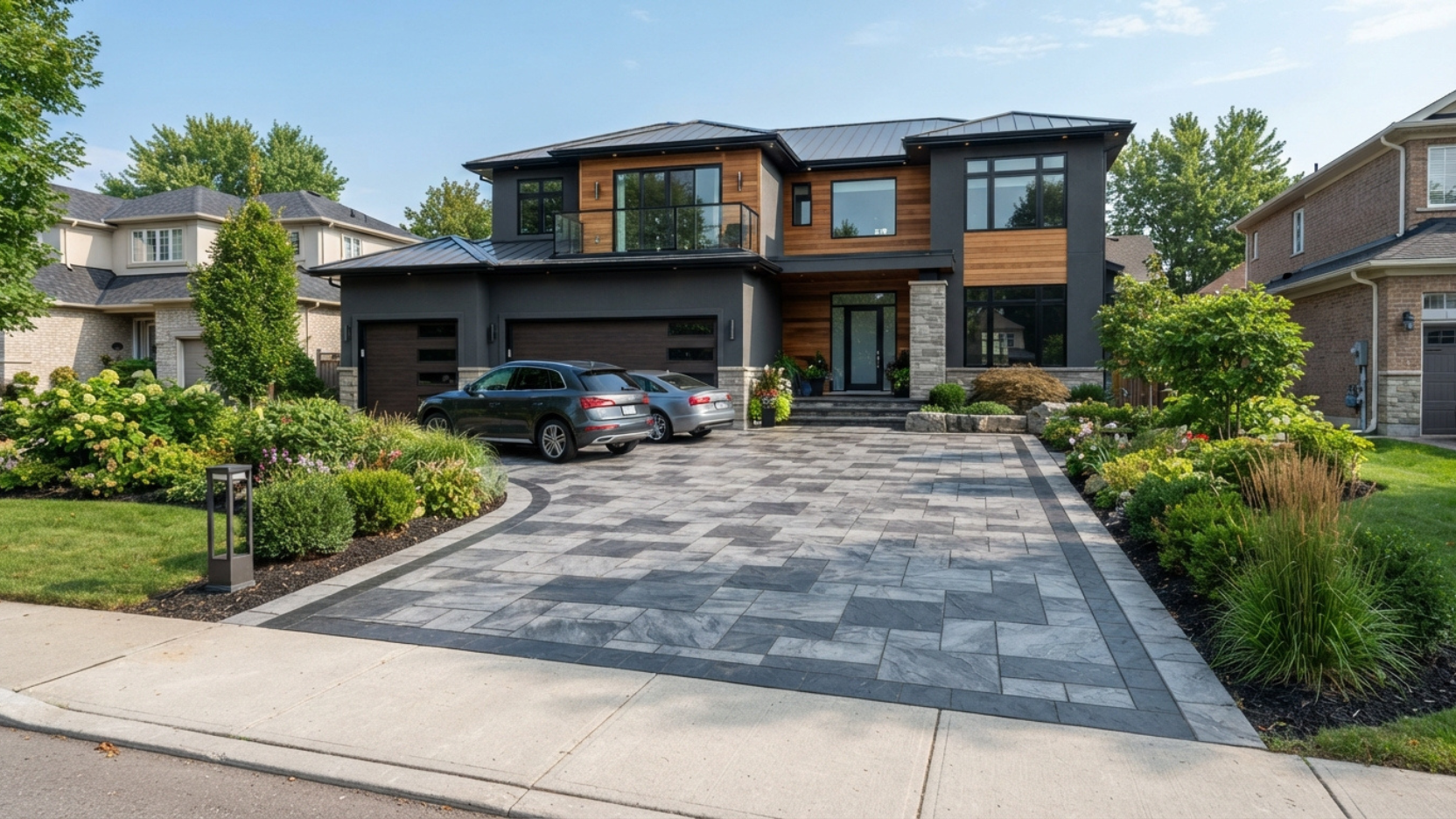
Stamped concrete can transform a plain driveway into a standout feature of your home. But it comes with real trade-offs in cost, maintenance, and durability under South Texas conditions. This guide gives you every fact you need before you commit.
Stamped concrete driveways are one of the most requested upgrades we install in San Antonio. The appeal is obvious: the look of natural flagstone, slate, or brick pavers at roughly half the material cost, poured as a single continuous slab with no shifting joints or weed-prone gaps. On a well-maintained property, a stamped driveway can add real curb appeal and perceived home value.
But stamped concrete is not the right choice for every San Antonio homeowner. Bexar County’s expansive Blackland Prairie clay soils, intense UV exposure from 220-plus sunny days a year, hard Edwards Aquifer water, and summer heat that can top 100 degrees all create a more demanding environment than most of the national contractor guides account for. Before you spend $15,000 to $25,000 on a stamped driveway, you need the full picture.
This guide gives you every pro and every con, grounded in real South Texas conditions, real 2026 pricing, and the specific questions to ask any contractor you’re considering hiring.
The most common mistake San Antonio homeowners make with stamped driveways is choosing the pattern and color before confirming the structural spec. In expansive Vertisol clay soil, the base preparation, slab thickness, and rebar placement determine whether your $20,000 driveway lasts 30 years or cracks in five. A beautiful stamped surface on an underprepared base is money lost. Confirm the spec in writing before you discuss aesthetics.
Pro
The visual impact of a well-executed stamped driveway is the reason most San Antonio homeowners choose it. A standard broom-finish driveway is functional and durable, but it looks exactly like what it is. A stamped driveway can convincingly replicate the appearance of natural stone, aged brick, or large-format slate tile at a cost that is $5 to $15 per square foot less than the real materials it imitates.

For a typical two-car driveway of 600 to 800 square feet in San Antonio, the most popular patterns in 2026 are large Ashlar slate, running bond brick, and European fan cobblestone. Integral color added directly to the mix (rather than surface-applied color hardener alone) gives you color that runs through the full slab depth, so minor surface wear or a chip does not expose gray concrete underneath.
- Pattern and color selected and confirmed in writing before pour day – no changes are possible after the concrete sets
- Integral color (pigment in the mix) specified rather than surface-applied color hardener only
- Release agent color chosen to create contrast with the base color, giving depth to the pattern
- Lighter color palette considered for heat reflection in San Antonio summers
Pro
When San Antonio homeowners compare stamped concrete to the alternatives that achieve a similar look, stamped concrete consistently comes out as the most cost-effective option. Natural flagstone driveways run $25 to $50 per square foot installed. Concrete pavers run $18 to $35 per square foot. Stamped concrete delivers a comparable aesthetic in the $15 to $25 per square foot range for most residential projects in Bexar County.
How to get the most value out of a stamped driveway budget: Focus the stamped work on the visible border and main field area, and use a contrasting exposed aggregate or broom finish for the side extensions and approach apron. This hybrid approach can reduce total project cost by 20 to 30 percent while preserving the premium appearance of the main driveway surface as seen from the street.
Pro
One of the most practical advantages of stamped concrete over actual pavers or natural stone is the absence of open joints. A paver driveway achieves its look at the cost of hundreds of linear feet of joints that require polymeric sand to stay filled, regular weed treatment to stay clear, and periodic re-leveling as individual units settle differently in San Antonio’s expansive clay soils. Stamped concrete gives you the visual impression of a paver or stone surface without any of those ongoing joint maintenance requirements.

In San Antonio’s climate, weed and grass growth in paver joints is accelerated by warm winters and abundant spring rainfall. Homeowners who choose pavers for their driveways frequently report spending two to three hours per month on joint maintenance during the growing season. Stamped concrete eliminates that obligation entirely.
The stamped surface does include control joints cut into the slab after pouring, but these are narrow, sealed with flexible joint filler, and do not allow plant growth or collect debris the way open paver joints do.
- Control joints cut to proper depth (one-quarter of slab thickness) within 12 to 24 hours of pour to direct any cracking
- Control joint spacing of 8 to 10 feet confirmed for a driveway application
- Flexible polyurethane joint filler used rather than rigid caulk for South Texas thermal movement
- Expansion joints installed at all abutments against the garage slab, sidewalks, and curb
Pro
A properly installed stamped concrete driveway in San Antonio has the same structural lifespan as a standard broom-finish driveway: 25 to 30 years with appropriate maintenance. The concrete itself does not become weaker because it has been stamped. The long-term durability difference between stamped and plain concrete is almost entirely a question of sealer maintenance, not structural integrity.

The key installation factors that determine whether a stamped driveway achieves its full lifespan in San Antonio are: a minimum 4 to 6 inch compacted crushed limestone base on top of native clay, a slab thickness of at least 5 inches for a vehicle-bearing driveway, and a rebar grid (#3 or #4 bar at 18-inch centers) rather than welded wire mesh. Wire mesh is adequate for patios but insufficient for the load and soil movement demands of a driveway in Bexar County clay soils.
Why San Antonio’s Edwards Aquifer hard water matters for concrete longevity: Hard water with high mineral content can leave calcium and mineral deposits on a sealed stamped surface, dulling the finish over time. Using a water softener for exterior cleaning and avoiding pressure washing with high-mineral well water will preserve your sealer’s appearance between recoating cycles. Most professional sealers in San Antonio recommend a penetrating silane-siloxane sealer as a base coat with an acrylic topcoat rather than acrylic-only, because the penetrating layer protects against mineral infiltration at the pore level.
Pro
Stamped concrete offers more design options than any other poured driveway material. Patterns range from simple running bond brick to complex European cobblestone fans and custom slate tile layouts. Colors can be layered using integral pigment in the mix, surface-applied color hardener, and release agent stains, creating depth and variation that mimics the natural color irregularity of real stone.

For San Antonio homes with Spanish Colonial, Mediterranean, or Texas Hill Country architecture, stamped concrete in an Ashlar or random slate pattern with warm earth tones creates a cohesive exterior that ties the driveway to the home’s style. For more contemporary homes, a large-format grid pattern in a cool gray or charcoal integral color achieves a clean, modern look.
- Pattern selected and stamping template confirmed in writing with the contractor before scheduling pour
- Base color (integral pigment) confirmed and a sample or color chip provided
- Release agent or color hardener accent color selected to create pattern depth
- Sealer sheen level agreed: matte, satin, or gloss (gloss is most popular for driveways, but gets slippery when wet without a non-slip additive)
- Non-slip broadcast aggregate or anti-skid additive specified in the sealer for vehicle entry and pedestrian areas
No driveway material is perfect. Here are the four most significant drawbacks of stamped concrete in South Texas conditions, explained honestly.
Con
The most immediate drawback of stamped concrete is the price premium over standard concrete. A plain broom-finish driveway in San Antonio runs $7 to $12 per square foot installed. A stamped concrete driveway runs $15 to $25 per square foot for the same footprint. On a 700 square foot two-car driveway, that is a difference of roughly $6,000 to $9,000 in total project cost before any decorative border, color enhancement, or reseal.

The additional cost comes from three sources: the labor-intensive stamping process (which must be completed within a narrow window while the concrete is workable), the coloring materials (integral pigments, color hardeners, and release agents), and the sealing application after curing. These are legitimate costs for skilled craftsmanship, not contractor padding. The trade-off is real visual return on investment for a surface you see and use every day.
Stamped concrete also has higher ongoing maintenance costs than plain concrete. Resealing every 2 to 3 years at $1 to $3 per square foot (DIY) or $2 to $5 per square foot (professional) adds approximately $700 to $3,500 to the total cost of ownership per sealing cycle over the life of the driveway.
- Total installed cost for a 700 sqft stamped driveway in San Antonio: $10,500 to $17,500 typical range (2026 pricing)
- Sealing budget of $700 to $2,100 every 2 to 3 years should be factored into total cost of ownership
- Get at least three itemized written quotes specifying base prep, reinforcement, pour, stamping, coloring, and sealing separately
- Avoid any contractor who gives a single lump sum price without breaking out the structural scope
Con
Plain concrete requires sealing, but neglecting to reseal a broom-finish driveway mostly results in minor surface weathering and dusting. Neglecting to reseal a stamped concrete driveway results in visible color fading, pattern definition loss, and reduced surface protection against moisture penetration. The acrylic sealers most commonly used on stamped concrete are UV-sensitive. San Antonio receives approximately 220 sunny days per year, with a UV index that regularly exceeds 10 from May through September. This degrades acrylic sealers meaningfully faster than the 3 to 5 year reseal intervals recommended in national contractor literature for temperate climates.
The sealing process itself is not complicated for a homeowner willing to do it themselves. Clean the surface with a concrete cleaner, allow to dry fully, and roll or spray a thin, even coat of the appropriate acrylic sealer. The equipment cost is approximately $80 to $150. The sealer itself costs $40 to $80 for a 5-gallon pail sufficient for 600 to 700 square feet. Professional resealing typically runs $2 to $5 per square foot.
- First seal applied by the installing contractor at or after 28 days post-pour (full cure)
- Subsequent resealing every 2 years for full-sun driveways in San Antonio, every 3 years for shaded driveways
- Sealer type confirmed: penetrating silane-siloxane base coat recommended under the acrylic topcoat for SA hard water conditions
- Non-slip additive mixed into the final sealer coat for vehicle entry and pedestrian areas
Con
All concrete driveways can develop cracks over time, particularly in Bexar County’s expansive clay soils. On a plain gray broom-finish driveway, a filled crack blends in reasonably well because the entire surface is uniform gray. On a stamped, colored driveway, a crack repair requires matching the base color, the accent color layering, and replicating the stamped pattern around the repair area. Even an experienced contractor cannot achieve a perfectly invisible repair on an aged stamped surface. The patched area will typically be visible on close inspection.

The way to minimize this risk is to ensure the structural installation is done correctly in the first place. The vast majority of premature cracking in San Antonio stamped driveways is caused by one of three factors: inadequate base preparation on native clay, insufficient slab thickness (4 inches rather than the 5 inches appropriate for a vehicle driveway), or control joints spaced too far apart. An installation that follows the correct structural spec for South Texas conditions dramatically reduces the probability of needing a crack repair during the life of the driveway.
Con
Stamped concrete has a smoother surface profile than broom-finish concrete. When coated with a high-gloss acrylic sealer without a non-slip additive, it can become slippery during San Antonio’s spring and fall rain events. This is particularly relevant at the base of a sloped driveway where water sheets off the surface toward the garage entrance, and for household members who may be unsteady on their feet.
The solution is straightforward: specify an aluminum oxide or polymer grit anti-skid additive in the sealer mix before it is applied. This additive creates subtle surface texture that dramatically increases wet traction without visibly altering the appearance of the stamped finish. Any competent concrete contractor in San Antonio should offer this as a standard option. If a contractor does not mention traction additives when discussing your stamped driveway sealer, ask specifically whether they plan to include one.
- Non-slip additive (aluminum oxide or polymer grit) specified in the sealer mix – this should be standard on any driveway application
- Sealer sheen level confirmed: satin or low-gloss recommended over high-gloss for vehicle driveways
- Driveway slope verified: no more than 1 inch of drop per foot of run at the entry approach
- Drainage direction confirmed: water should sheet away from the garage slab, not pool at the base of the slope
Use this table to compare stamped concrete to the other common driveway options available in Bexar County. Each material has the right application, and the best choice depends on your budget, maintenance tolerance, and aesthetic goals.
| Material | Installed cost (SA, 2026) | Lifespan | Maintenance level | Best for |
|---|---|---|---|---|
| Stamped concrete | $15 to $25/sqft | 25 to 30 years | Moderate (reseal every 2 to 3 yrs) | Homeowners who want premium curb appeal with lower material cost than pavers |
| Standard broom concrete | $7 to $12/sqft | 25 to 35 years | Low (reseal every 3 to 5 yrs, optional) | Durability and low maintenance as the primary priority; utility-focused applications |
| Concrete pavers | $18 to $35/sqft | 30 to 40 years | Moderate to high (joint maintenance, re-leveling in SA clay) | Homeowners who prefer individual unit flexibility and authentic paver appearance |
| Natural flagstone | $25 to $50/sqft | 30+ years | Moderate (joint repointing, periodic sealing) | Premium applications where authentic natural stone is the specific goal |
| Asphalt | $5 to $8/sqft | 15 to 20 years | Moderate (crack filling, resealing every 3 to 5 yrs) | Budget-priority applications; softens significantly in San Antonio summer heat |
| Exposed aggregate concrete | $10 to $16/sqft | 25 to 30 years | Low to moderate (periodic sealing) | Natural texture, excellent slip resistance; mid-tier decorative option |
- Slab thickness confirmed in writing: 5 inches minimum for driveways in Bexar County clay soils (not 4 inches)
- Base preparation specified: minimum 4 to 6 inches of compacted crushed limestone over native clay
- Reinforcement type confirmed: rebar grid (#3 or #4 at 18-inch centers) rather than welded wire mesh for a vehicle-bearing driveway
- Control joint spacing confirmed: every 8 to 10 feet, cut to one-quarter slab depth within 24 hours of pour
- Expansion joints specified at all slab abutments: garage slab, sidewalks, and street curb
- Stamping pattern selected and confirmed in writing with a reference photo or sample provided by the contractor
- Base color (integral pigment) confirmed with a physical color chip or cured sample, not just a digital image
- Release agent or color hardener accent color confirmed to create pattern depth and variation
- Sealer type confirmed: penetrating silane-siloxane base coat plus acrylic topcoat (not acrylic-only) for SA hard water conditions
- Sealer sheen level confirmed: satin or low-gloss for driveways
- Non-slip additive confirmed in the sealer mix: aluminum oxide or polymer grit anti-skid additive
- Certificate of insurance received and verified: $1 million or more in general liability coverage
- Written quote itemizes base prep, reinforcement, pour, stamping, coloring, sealing, and cleanup separately
- Payment terms confirmed: 30 to 50 percent deposit, balance due on completion and inspection
- Local references from completed stamped concrete driveways in San Antonio available on request
- Contractor has physical portfolio photos of completed stamped work (not stock photos)
- Texas 811 utility locate called and marked before any excavation begins (required by law)
- No vehicle traffic on the new slab for 7 days; foot traffic restricted for 48 hours in San Antonio summer heat
- Wet curing or liquid curing compound applied for 3 to 5 days after pour to prevent flash drying in TX heat
- First sealing by contractor at 28 days post-pour (full cure completed before any sealer is applied)
- Reseal reminder set for 2 years (full sun exposure) or 3 years (significant shade coverage)
- Joint filler inspected annually and touched up as needed before the next sealing cycle
How much does a stamped concrete driveway cost in San Antonio?
How long does stamped concrete last in San Antonio’s climate?
Is stamped concrete slippery when wet?
Can stamped concrete cracks be repaired to match the original finish?
What is the best stamped concrete pattern for a San Antonio home?
Do I need a permit for a stamped concrete driveway in San Antonio?
Get a free stamped concrete driveway quote in San Antonio
Tell us about your project and we’ll visit your property, assess the site conditions, and provide a detailed written quote at no cost. Serving all of Bexar County.