
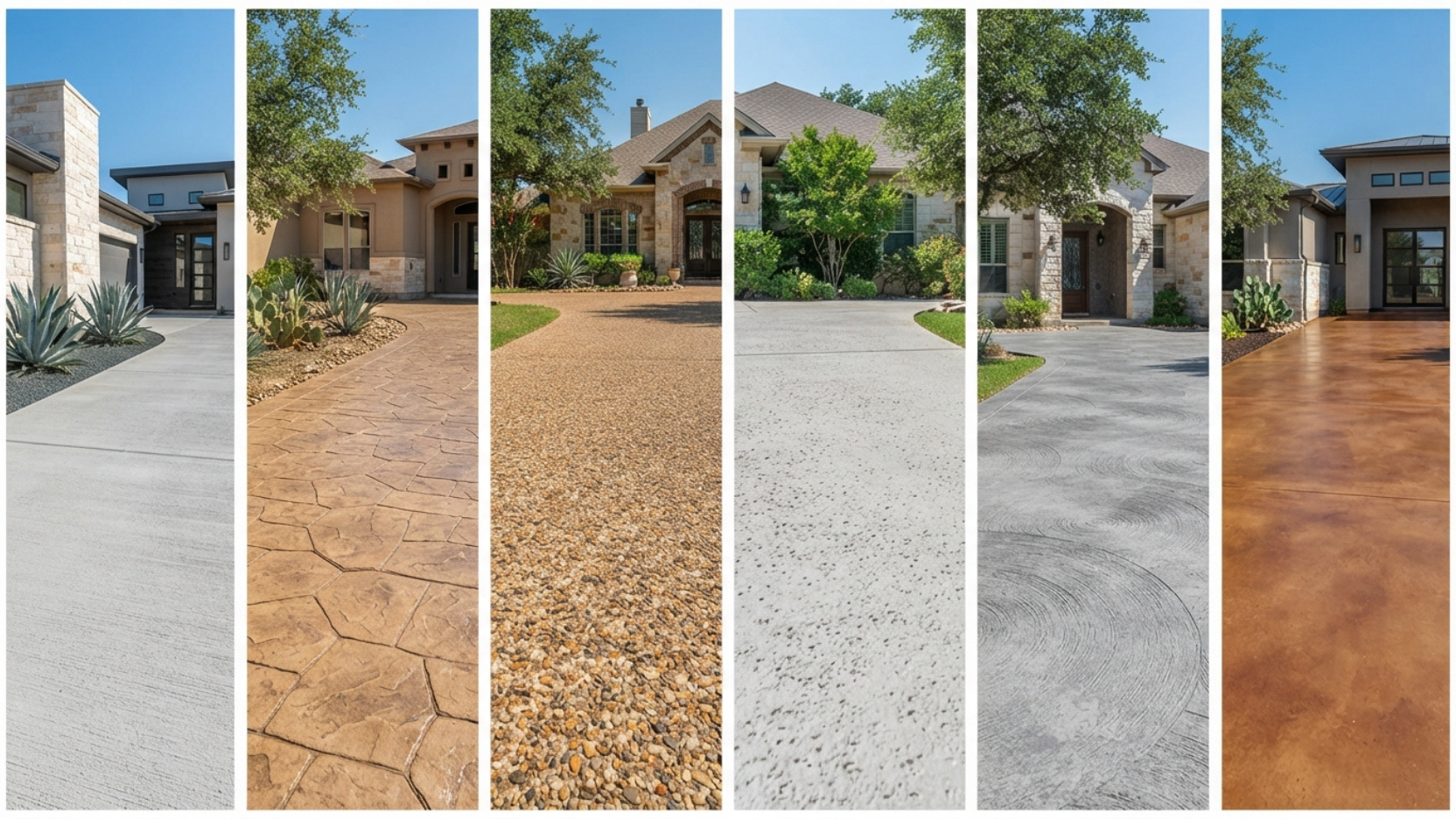
The finish you choose for your driveway affects slip resistance, curb appeal, long-term maintenance, and how well the slab holds up to San Antonio’s clay soils and triple-digit summer heat. This complete 2026 guide covers every finish option, what each costs locally, and exactly how to make the right call for your property.
Most homeowners treat driveway finish as a visual choice made at the end of the planning process. In reality, the finish you select affects surface grip, UV degradation rate, sealing requirements, repair costs, and how well the slab handles the seasonal soil movement that comes with San Antonio’s Blackland Prairie Vertisol clay. Choose the wrong finish for your conditions and you’re looking at premature wear, cracking, and resurfacing costs within five to ten years.
This guide is specific to San Antonio and Bexar County conditions in 2026. Generic concrete advice from national sources often misses the local factors that determine long-term performance here: the shrink-swell clay that moves seasonally beneath slabs, Edwards Aquifer water with high mineral content that affects curing and sealer adhesion, and summer UV intensity that degrades unsealed surfaces faster than nearly any other U.S. market. We’ll cover what each finish is, what it costs locally, how it holds up under those conditions, and which jobs it fits best.
Standard Finish

A broom finish is applied by dragging a stiff-bristled broom across the fresh concrete surface before it sets, creating a series of fine parallel ridges. The ridges provide reliable traction for vehicles and foot traffic in wet conditions, which is why this finish has been the default choice for driveways across Bexar County for decades.
In San Antonio’s climate, a broom finish performs well because the textured surface dissipates heat faster than smooth alternatives and handles the minor surface expansion caused by direct summer sun without cracking at the surface layer. The texture also holds sealer better than polished finishes, extending the protection cycle. For a standard two-car driveway of around 400-500 sqft, a broom finish typically runs $2,800 to $5,000 fully installed with a compacted crushed limestone base.
Medium bristle = best all-around result for San Antonio driveways. A coarse broom creates deep ridges that collect San Antonio’s caliche dust and are harder to pressure wash. A fine broom creates shallow ridges that wear smooth faster in high-UV conditions. A medium broom hits the right balance for grip, cleanability, and long-term wear resistance in our climate.
- Broom applied perpendicular to vehicle travel direction, not parallel
- Consistent stroke depth across the full slab no variation between edges and center
- Medium bristle broom specified in writing not coarse (dust collection) or extra-fine (wears smooth)
- First sealer application at 28-30 days after pour, not before full cure
- Resealing scheduled every 3-5 years under San Antonio UV conditions
Decorative Finish

Stamped concrete uses textured mats pressed into the fresh concrete surface to create patterns that mimic natural stone, cobblestone, brick, or slate. Color is added through integral pigments (mixed throughout the slab) or surface release agents that create contrast between high and low points of the pattern. For San Antonio driveways, the most popular patterns in 2026 are large-format ashlar slate, random flagstone, and cobblestone borders with a smooth field.
Stamped driveways deliver the strongest curb appeal of any concrete option. In San Antonio’s housing market, a well-executed stamped driveway adds measurable perceived value and distinguishes a property in competitive neighborhoods like Stone Oak, Alamo Heights, and Helotes. The trade-off is a shorter maintenance cycle: stamped concrete must be resealed every 2 to 3 years under San Antonio’s UV intensity, or the sealer breaks down, the color fades, and the surface becomes slippery when wet.
One critical San Antonio-specific consideration: stamped concrete requires the installer to work the stamps into the fresh surface within a tight window typically 2 to 4 hours after the pour. In summer heat (June through September), that window shrinks significantly. Experienced local crews start at 5 or 6 a.m. and work fast. If your contractor schedules a summer stamped driveway pour for midday, that is a warning sign.
Always specify integral color (pigment added to the concrete mix) rather than surface-only color hardeners on a driveway. Driveways take vehicle traffic, power washing, and abrasion. Surface-only color wears through to gray concrete within 5 to 8 years in San Antonio’s UV. With integral color, the pigment goes all the way through the slab if it chips or wears, the color is still there. It costs roughly $1 to $2 more per sqft and is worth every dollar.
- Pattern and color specified in writing before work begins verbal agreements are unenforceable once poured
- Integral color specified (pigment in the mix), not surface color hardener only
- Release agent color specified in writing for contrast effect
- Pour time confirmed: early morning start for any summer installation
- Sealing schedule confirmed in writing: first seal at 28 days, resealing every 2-3 years
- Sample board or reference project reviewed and approved before pour day
Natural Texture
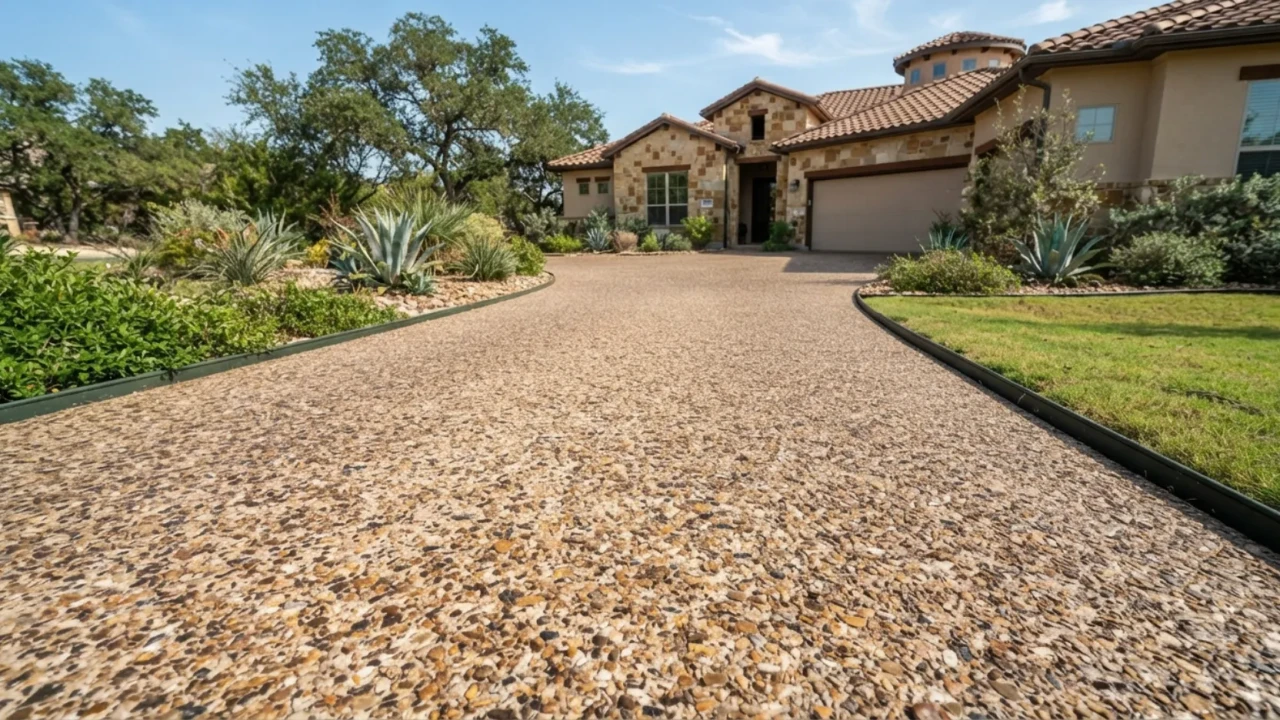
Exposed aggregate finish is created by seeding decorative stone or pebble into the fresh concrete surface, then washing away the top layer of cement paste before it fully sets to expose the aggregate underneath. The result is a naturally textured surface with the appearance and feel of embedded stone extremely durable, slip-resistant, and visually distinct from standard concrete without the maintenance demands of stamped work.
For San Antonio homeowners who want more visual interest than a standard broom finish without the maintenance cycle of stamped concrete, exposed aggregate hits the sweet spot. The inherent texture provides excellent traction without relying on a surface pattern that can become slippery when a sealer coat breaks down. The stone aggregate also reflects heat slightly better than a plain concrete surface, which matters in Bexar County summers where driveway surface temperatures regularly exceed 150 degrees Fahrenheit.
For San Antonio driveways, specify aggregate size and source before the pour. River pebble, granite chip, and limestone grit all behave differently underfoot and look distinct over time. Limestone aggregate can etch slightly from Edwards Aquifer hard water over years of wet-dry cycles. Granite chip holds its color and texture longer under San Antonio UV. Specify your aggregate in writing once it is poured into the mix, the selection cannot be changed.
- Aggregate type, size, and color specified in writing before work begins
- Aggregate seeded evenly across the full slab no thin or bare patches
- Paste wash-off timed correctly: not too early (pulls aggregate loose) or too late (paste sets hard)
- First sealer applied at 28 days; resealing scheduled every 3-5 years under San Antonio UV
- Granite or river pebble aggregate preferred over limestone for long-term color stability in hard water conditions
Texture Finish
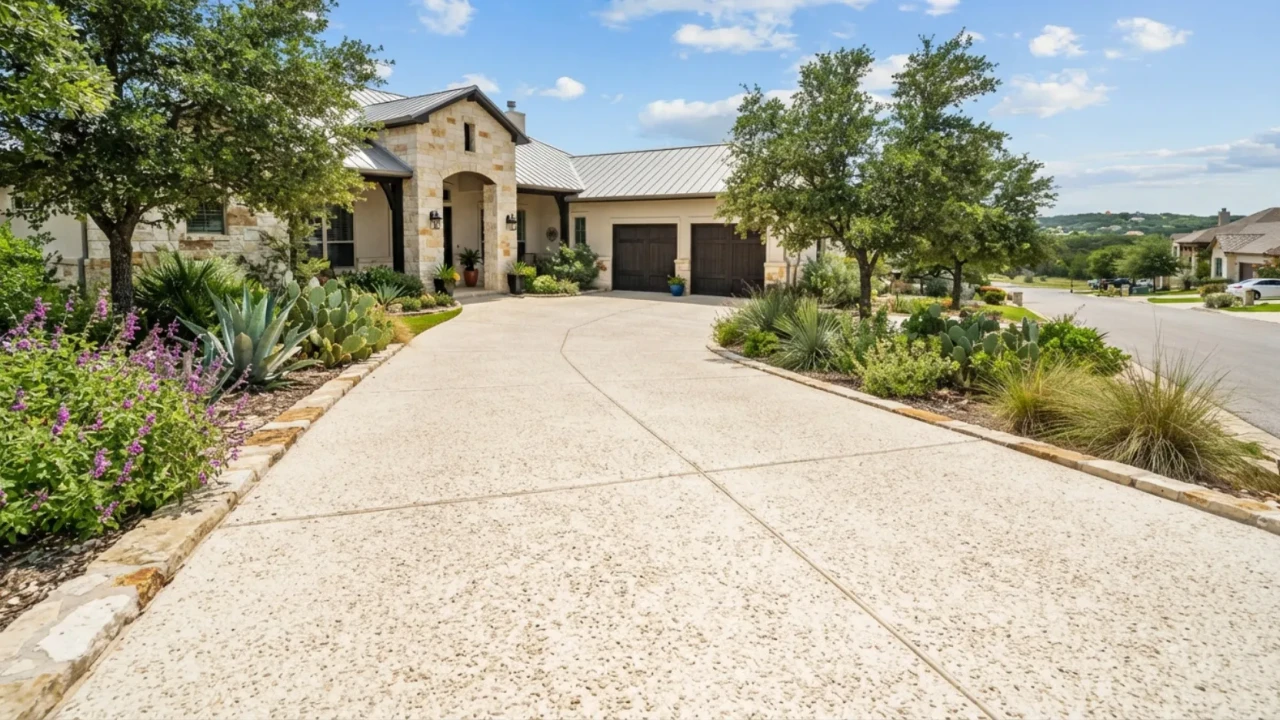
Salt finish is created by pressing rock salt granules into the fresh concrete surface, then dissolving them with water once the concrete has set, leaving a field of small pits and depressions across the slab. The result is a subtle, natural texture that provides solid traction without the visual boldness of exposed aggregate or the pattern work of stamped concrete. The look is softer and more organic than a standard broom finish while costing only slightly more.
Salt finish is often recommended for climates with frequent freeze-thaw cycles because the pit texture can trap water that then expands during freezing, causing spalling. In San Antonio, this is generally not a concern. The city averages fewer than 20 freezing days per year, and hard freeze events that cause moisture-expansion damage to concrete are rare. Salt finish performs well here and gives homeowners a mid-tier decorative option without the complexity of stamped work.
- Salt crystal size specified in writing: coarse (prominent texture) or fine (subtle dimple)
- Salt applied evenly across full slab avoid hand-scattered application that creates uneven pit density
- Dissolution timing confirmed: salt washed out after concrete has set, not before
- No large rock salt crystals near driveway edges where water pools closer pit spacing increases edge spalling risk
- Sealing scheduled at 28 days; pit walls benefit from sealer penetration to resist water intrusion
Decorative Broom
Brushed swirl finish is a variation on standard broom technique where the finisher uses curved, arc, or fan strokes rather than straight parallel lines. The result is a decorative broom pattern that reads as intentional and distinctive rather than functional and plain. The durability, maintenance schedule, and cost are nearly identical to a standard broom finish the difference is almost entirely visual, and the upcharge is typically $0.50 to $1.50 per sqft over a standard straight broom.
For San Antonio homeowners who want something that reads as more finished than a plain broom finish but do not want to commit to the maintenance demands of stamped or the upfront cost of exposed aggregate, decorative broom patterns are an easy upgrade to specify. Common patterns for driveways include fan swirl across the full width, border-and-field (swirl border with straight-broom field), and arc patterns that follow the curve of a circular driveway apron.
Fan swirl borders with a straight-broom field are the most popular decorative broom request for San Antonio driveways in 2026. The border creates a defined frame around the slab perimeter while the straight field remains easy to clean and maintains uniform traction. If you want visual interest without complexity, this is the lowest-risk upgrade available.
- Pattern direction and stroke style agreed in writing: fan, arc, full-width swirl, or border-and-field
- Pattern shown in a reference photo or sketch verbal descriptions are interpreted differently by different finishers
- Consistent stroke radius across full slab: no mixed patterns unless a border-field split is intended
- Edge detailing confirmed: borders should stop at a clean line, not trail off at the perimeter
Color Finish
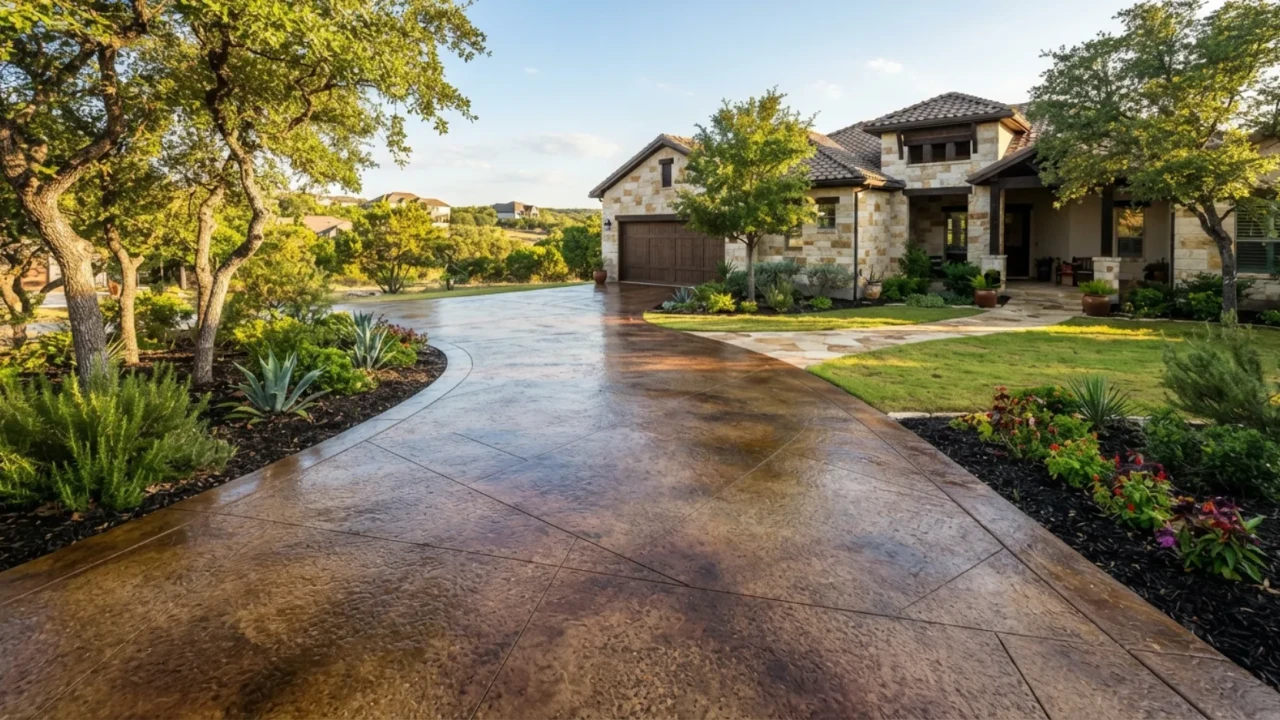
Concrete staining applies color to the slab surface through acid-based chemical reactions (acid stain) or penetrating water-based dyes. Acid stain reacts with the calcium hydroxide in concrete to create permanent, mottled earth tones terracotta, amber, brown, sage, and gray-blue depending on the acid used and the concrete mix composition. Because the color penetrates the surface rather than sitting on top of it, acid stain does not peel, flake, or chip the way surface paint or coating systems can.
One major advantage of concrete staining for San Antonio homeowners: it can be applied to an existing driveway that is structurally sound but cosmetically dated. If your current slab is 4 to 5 inches thick, has no significant structural cracking, and has a clean broom finish, acid staining is a cost-effective way to transform its appearance without demolition and replacement. Preparation is key the slab must be thoroughly cleaned, degreased, and free of existing sealer or coatings before stain is applied.
- Existing slab assessed for structural integrity before staining staining does not fix cracks or base failure
- Full surface degreasing and cleaning completed before stain application
- Existing sealer removed entirely stain cannot penetrate through sealer
- Test patch on an inconspicuous area completed and approved before full application
- Sealer topcoat type specified: penetrating (matte, non-slip) vs. acrylic (glossy, can be slippery when wet)
- Resealing scheduled every 2-3 years under San Antonio UV intensity
The table below reflects 2026 installed pricing for a standard two-car driveway in San Antonio (approximately 400 to 500 sqft), including base preparation, reinforcement, pour, finishing, and first sealer application at 28 days. Pricing reflects mid-market contractors, not lowest-bid operators.
| Finish type | Cost per sqft | Lifespan (sealed) | Sealing cycle | Best for |
|---|---|---|---|---|
| Broom finish | $7 – $10 | 30-50 years | Every 3-5 yrs | Budget-conscious, maximum durability |
| Salt finish | $8 – $11 | 25-35 years | Every 3-5 yrs | Subtle texture upgrade over broom |
| Decorative broom / swirl | $7.50 – $11 | 30-50 years | Every 3-5 yrs | Visual interest at broom-finish cost |
| Exposed aggregate | $10 – $14 | 30-50 years | Every 3-5 yrs | Natural look, maximum grip, low maintenance |
| Stained concrete | $10 – $15 | 20-30 years | Every 2-3 yrs | Color on existing slab or new pour |
| Stamped concrete | $14 – $18 | 25-35 years | Every 2-3 yrs | Maximum curb appeal, premium look |
The estimates below reflect a standard broom finish at $8.50/sqft average and a stamped finish at $16/sqft average, including full base preparation with 4 inches of compacted crushed limestone, 5-inch slab thickness, wire mesh or rebar reinforcement, and first seal at 28 days. Adjust upward 10 to 15 percent for complex shapes, significant grading, or premium aggregate selections.
Every finish recommendation in this guide factors in four San Antonio-specific conditions that generic concrete guides miss entirely. Understanding these helps you evaluate contractor proposals and ask the right questions before signing anything.
San Antonio’s predominant native soil is a Vertisol clay that swells when wet and shrinks when dry. Seasonal soil movement creates uplift and lateral stress on driveway slabs that is far more aggressive than sandy or loam soils. This is why control joint placement, base depth, and reinforcement are non-negotiable for any finish type. A stamped concrete driveway poured over an uncompacted clay base with inadequate joint spacing will crack within five years regardless of how well the finish is applied. Ask every contractor to specify base preparation in writing: at minimum four inches of compacted crushed limestone over the native clay, with control joints every eight to ten feet.
San Antonio’s water supply from the Edwards Aquifer has high calcium carbonate content. Hard water used in concrete mixing and in curing affects the chemical balance of the hydration process. It also deposits mineral buildup on sealed surfaces over time, which shows up as white haze (efflorescence) on darker finishes. For stained and stamped driveways with integral color, seal with a penetrating silane-siloxane sealer rather than a surface acrylic penetrating sealers resist efflorescence buildup better and do not trap mineral deposits between the sealer film and the slab surface.
San Antonio receives on average 220 sunny days per year with a UV index that regularly reaches 11 (extreme) from May through September. UV degrades organic sealers faster here than in most U.S. markets. For stamped and stained finishes that rely on a sealer coat for both color protection and surface grip, the 2-to-3-year resealing cycle is not conservative it is the minimum required to maintain performance. Standard broom and exposed aggregate finishes are less sealer-dependent for structural protection, but sealing still extends the surface life significantly under San Antonio’s sun loading.
Before any driveway excavation begins, Texas law requires contractors to call 811 to locate underground utilities. This is not optional and not the homeowner’s responsibility but confirm your contractor has placed the call before work starts. In established San Antonio neighborhoods, irrigation lines, gas service laterals, and cable conduits are often routed through driveway zones. An unmarked strike during excavation creates project delays, repair costs, and liability that fall on whoever failed to call.
- Finish type selected and confirmed in writing: broom, salt, decorative broom, exposed aggregate, stained, or stamped
- For stamped and stained finishes: pattern, color, and release agent (if applicable) confirmed in writing
- Integral color specified for any colored finish (not surface hardener only)
- For exposed aggregate: aggregate type, size, and color specified in writing before pour
- Reference photo or sample board approved and attached to the contract
- Slab thickness confirmed in writing: 5 inches minimum for driveways (not 4 inches)
- Base type and depth specified: minimum 4 inches of compacted crushed limestone over native clay
- Reinforcement type confirmed: wire mesh for standard driveways, rebar grid for heavy vehicle or RV loads
- Control joint spacing specified: every 8 to 10 feet in both directions
- Texas 811 utility locate call confirmed before excavation begins
- Certificate of insurance received and verified: $1M+ general liability minimum
- Quote itemizes base prep, reinforcement, pour, finishing, sealing, and cleanup separately
- Payment terms confirmed: 30-50 percent deposit, balance on completion not full payment before work
- Local San Antonio references from completed driveway projects (not just patios or slabs) available on request
- Summer pour: early morning start time confirmed in writing for any stamped or stained work
- Curing process confirmed: wet curing or liquid compound applied for minimum 3 days after pour
- No vehicle traffic for 7 days minimum; foot traffic restricted for 48 hours
- First sealing scheduled at 28 to 30 days after pour
- Sealing cycle set: every 2-3 years for stamped and stained finishes, every 3-5 years for broom and aggregate
- Sealer type specified: penetrating silane-siloxane for colored finishes in hard-water conditions
What is the most durable driveway finish for San Antonio’s clay soils and heat?
How much does a concrete driveway cost in San Antonio in 2026?
Can I stain my existing concrete driveway instead of replacing it?
Is stamped concrete slippery when wet?
Do I need a permit for a new concrete driveway in San Antonio?
How long before I can park on a new concrete driveway?
Get a free driveway finish quote in San Antonio
Tell us your driveway size, your preferred finish, and your timeline. We’ll visit your property, assess the existing base conditions, and give you a detailed written quote at no cost.