
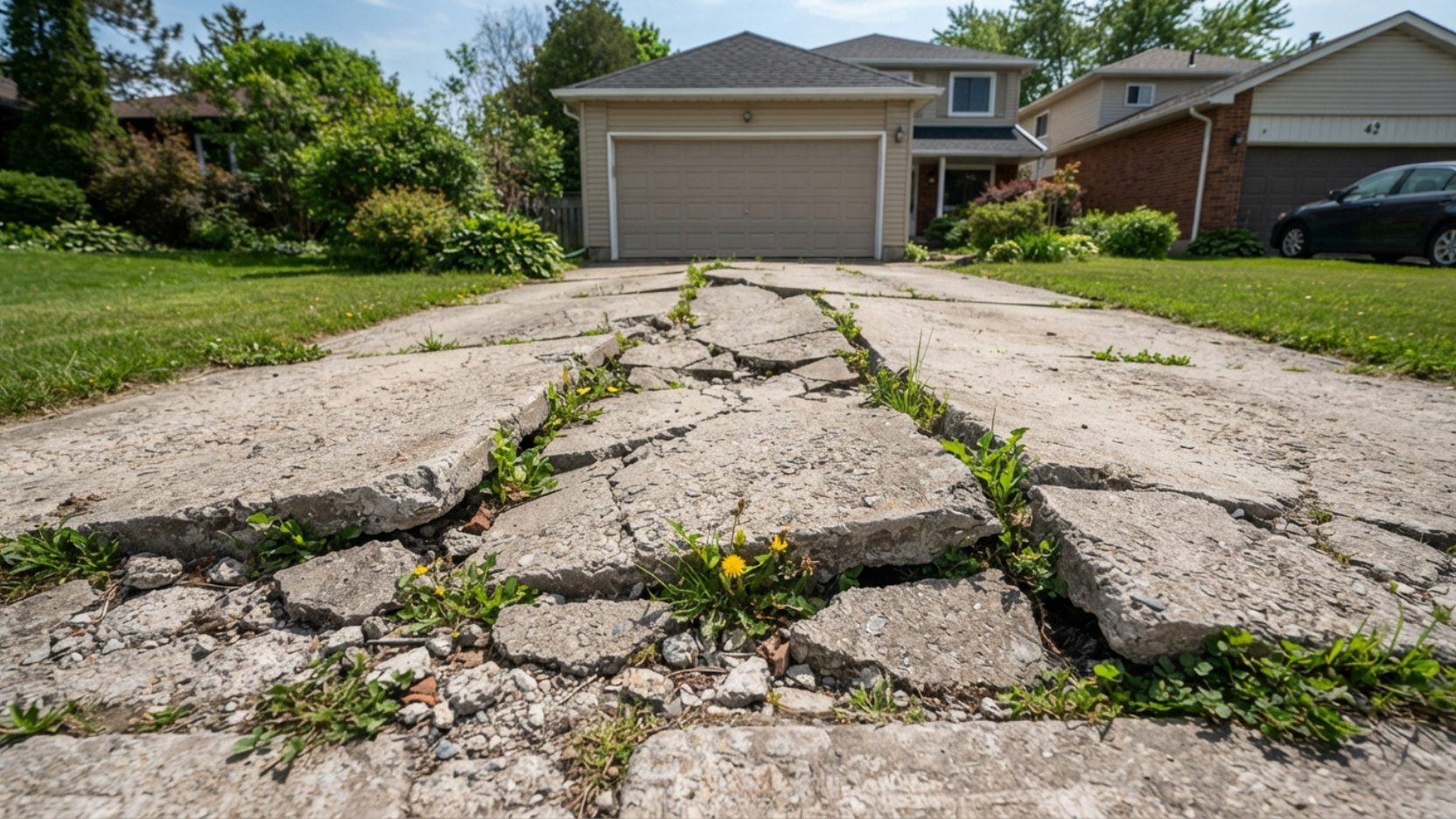
Repair versus replace is the most consequential decision a San Antonio homeowner makes about a concrete driveway. This guide walks through every warning sign, the cost math behind each option, and how San Antonio’s Blackland Prairie clay soils change the calculation compared to most U.S. cities.
The decision to repair or replace a concrete driveway is rarely obvious from the surface alone. A driveway can look rough from above while the base underneath is perfectly sound. Conversely, a surface with only moderate cracking can be sitting on a failed base that will destroy any patch job within a year. In San Antonio, where the Blackland Prairie Vertisol clay soil expands and contracts with every rain cycle, reading the right signals matters more than in most cities.
This guide covers every warning sign that points toward replacement rather than repair, the cost numbers for both approaches in 2026 San Antonio, and the specific factors age, damage type, base condition, and soil movement that change the calculation for homeowners in Bexar County.
Most homeowners focus on how much of the driveway is cracked. Experienced contractors look at what kind of damage is present. Widespread hairline cracking over a structurally sound base can be repaired at reasonable cost. A small area of heaving where one panel is visibly higher than an adjacent one signals a base failure that no surface patch will fix. In San Antonio’s expansive clay soil environment, vertical displacement anywhere on the slab is a more reliable replacement indicator than total crack count.
Replace
Vertical displacement where one panel of the driveway has lifted or dropped relative to an adjacent panel is the strongest single indicator that the problem is below the concrete, not in it. This heaving is caused by soil movement, usually from San Antonio’s expansive Blackland Prairie clay expanding when wet and contracting during dry periods. No surface repair addresses the underlying soil behavior.

When the base moves, it takes the slab with it. Grinding or mudjacking the raised panel provides temporary relief, but in most San Antonio cases the soil continues its seasonal movement and the differential returns within one to three years. The only permanent fix is removing the damaged section, stabilizing the base, and pouring new concrete.
- Run a straightedge or long level across panel joints any vertical gap indicates displacement
- Check whether the high side changes after a heavy rain (expanding clay) or prolonged dry spell (contracting clay)
- Look for exposed roots near raised panels root removal plus panel replacement is the correct scope
- If mudjacking was attempted previously and the heaving returned, replacement is the only remaining option
Replace
Isolated cracking a single control joint that widened, or a hairline crack in one panel is a repair job. But when cracking is distributed across multiple panels and covers more than 25 to 30 percent of the total driveway surface, the cost math shifts. Patching each crack individually at that scale approaches or exceeds the cost of full replacement, without the benefit of a fresh, uniform surface or new base preparation.

San Antonio’s climate accelerates crack propagation in older slabs. The combination of intense summer UV, triple-digit heat during cure seasons, and the clay soil’s repeated expansion-contraction cycles means a driveway that has started cracking widely will continue to deteriorate faster than one in a more stable soil environment. Spot repairs on a slab in this state typically last three to five years before new cracking returns around the patch edges.
The 50 percent rule for San Antonio driveways: If crack repair and patching would cost more than 50 percent of full replacement cost, choose replacement. A standard two-car driveway (approximately 500 sqft) costs $3,500 to $6,000 to replace in 2026 San Antonio. If crack repairs are quoted above $1,750 to $3,000, you are within the window where replacement delivers a structurally sound, visually uniform result at the same or only slightly higher cost and with a 25-year lifespan, rather than a patched surface of uncertain durability.
- Measure crack width at the widest point under 1/4″ indicates potential repair candidate; over 1/4″ warrants base investigation
- Count how many separate crack runs exist across the driveway and estimate total linear footage
- Check whether cracks follow control joint lines (normal) or cut diagonally across panels (base movement signal)
- Look for crack edges with different heights on each side vertical displacement means base failure, not surface repair
Age Factor
A well-installed concrete driveway in San Antonio has a realistic lifespan of 25 to 30 years when properly sealed and maintained. After that point, the concrete matrix itself begins to break down from accumulated UV exposure, freeze-thaw cycling, hard water mineral deposits from the Edwards Aquifer, and cumulative stress from load cycles. A 30-year-old driveway that looks acceptable today will typically begin accelerating its deterioration in ways that outpace any repair investment.

Edwards Aquifer water the primary water source for most of San Antonio has high calcium and mineral content that deposits inside concrete pores over decades. This buildup, combined with Texas UV intensity that degrades the surface binder progressively, means older concrete in San Antonio tends to become brittle and porous faster than the industry average. If you do not have a sealing history for a driveway over 20 years old, assume it has absorbed two decades of water penetration.
- Surface scaling or spalling concrete surface flaking away in thin layers indicates subsurface moisture damage
- Widespread pitting or porous texture a sign that the surface binder has degraded from UV and mineral penetration
- Efflorescence (white chalky deposits on the surface) mineral migration from water moving through the slab
- Loss of original surface texture smooth areas where the broom or aggregate finish has completely worn away
Structural
A properly graded driveway sheds water away from the home and toward the street or a designed drainage point. When base movement from San Antonio’s clay soil or from settlement shifts the slope, water begins pooling on the surface or, more seriously, running toward the garage floor or house foundation. This is not a surface problem. Regrading requires removing and replacing the concrete along with correcting the base.

In San Antonio’s heavy summer rain events where 2 to 4 inches can fall in an hour during thunderstorm season a driveway with reversed drainage pushes a substantial water volume toward the home. Repeated moisture intrusion near a foundation in clay-heavy soil accelerates the same expansion-contraction cycle that damages the driveway itself, creating a compounding problem that worsens each wet season.
Replace
A single failed repair does not necessarily point to replacement improper patch technique or the wrong filler product can cause early failure even on a sound slab. But when two or more repairs have been attempted and none have lasted more than a few years, the repair history itself becomes diagnostic evidence. The underlying cause usually base movement or concrete that is too far deteriorated to bond with patch material is not going to change.

The economics of repeated repairs deteriorate quickly. A concrete crack repair in San Antonio typically runs $200 to $800 depending on linear footage. Two rounds of repairs on the same cracks puts the homeowner at $400 to $1,600 invested with no lasting improvement and a driveway that still needs replacement. At that point, stopping the repair cycle and budgeting for replacement delivers better return on investment per dollar spent.
- What was the specific product and technique used in previous repairs was it appropriate for the crack type?
- Did the previous repair fail at the patch edges (bonding failure) or did new cracks appear elsewhere (base movement)?
- Has the soil condition under the driveway been assessed were tree roots near the failure areas?
- Is the total spent on prior repairs within $1,000 to $1,500 of full replacement cost? If so, replace.
Assess First
Surface scaling where the top layer of concrete flakes away in thin sheets is one of the more visible forms of deterioration. In San Antonio, it is most commonly caused by the Edwards Aquifer’s hard water depositing minerals inside the concrete pores over years, combined with the thermal cycling of summer heat and occasional winter freezes. When scaling is limited to the top 1/8 inch and covers under 30 percent of the surface, resurfacing is a viable option. When it penetrates deeper or covers the majority of the driveway, resurfacing products cannot bond adequately.

The test for whether resurfacing will hold is simple: clean the surface thoroughly and apply water. If water is absorbed quickly and the surface appears darkened in patches, the concrete is too porous for resurfacing products to achieve lasting adhesion. If water beads or runs off even on the scaled areas, the concrete matrix may still be dense enough to accept a resurfacer. A qualified contractor can perform this assessment in minutes.
- Tap the surface with a steel rod or coin a hollow sound indicates subsurface delamination (replace)
- Apply water to scaled areas and time absorption over 30 seconds means the concrete is still dense enough for resurfacing
- Measure depth of scaling with a straightedge and feeler gauge over 1/4″ depth makes resurfacing impractical
- Look for aggregate (gravel) fully exposed and no longer bonded to the surrounding paste indicates the mix has failed structurally
Use this table to evaluate your specific situation. When multiple “replace” indicators line up in the same driveway, the cost math almost always favors a full replacement over continued patching.
| Condition or factor | Repair is appropriate | Replacement is appropriate |
|---|---|---|
| Crack width | Under 1/4″ wide, no displacement | Over 1/4″ wide, or any vertical displacement between edges |
| Crack distribution | Isolated to 1-2 panels or control joints | Distributed across 25%+ of total surface area |
| Driveway age | Under 15 years with good sealing history | Over 25 years, or 15-25 years with no sealing history |
| Panel heaving | None present | Any vertical displacement between adjacent panels |
| Drainage | Minor ponding trench drain may resolve | Water flowing toward structure or widespread grading failure |
| Repair history | No prior repairs, or one repair that held 5+ years | Two or more prior repairs that failed within 3 years |
| Surface scaling | Shallow (under 1/8″), under 30% of surface, bonding test passes | Deep scaling, over 30% coverage, bonding test fails |
| Base assessment | Base is sound on probe compacted and solid | Base is soft, washed out, or has tree roots present |
| Repair cost vs. replacement | Repair cost is under 30% of replacement cost | Repair cost is 50% or more of replacement replace |
- Driveway is under 15 years old with a good sealing history
- Cracks are hairline width (under 1/4″) and limited to isolated areas
- No vertical displacement between any panels
- Base assessment shows a solid, compacted substrate
- No prior repairs attempted, or one repair held 5+ years
- Surface scaling is shallow and limited to small areas
- Repair quotes are under 30% of full replacement cost
- Driveway is 25 years old or older regardless of surface appearance
- Any panel heaving or vertical displacement is present
- Cracking covers more than 25% of total surface area
- Two or more prior repairs have not held beyond 3 years
- Drainage now flows toward the garage or house
- Deep scaling or pitting covers significant surface area
- Repair cost is 50% or more of full replacement cost
Replacement costs depend on driveway size, existing concrete removal, base preparation requirements, and finish choice. These are 2026 ranges from actual contractor quotes in San Antonio and surrounding Bexar County communities.
Generic concrete driveway guides are written for average U.S. soil and climate conditions. San Antonio presents a specific combination of factors that either accelerate deterioration or change how deterioration signals should be read.
SA-Specific
The black clay soils of the Blackland Prairie which covers much of Bexar County are classified as Vertisols: highly expansive soils that swell when wet and shrink when dry. The volumetric change in San Antonio’s Vertisol clay can be substantial, generating enough upward force to lift concrete slabs and enough lateral shrinkage to create voids beneath them. This seasonal movement is the single biggest reason San Antonio driveways crack and heave faster than driveways in most other U.S. cities.
What this means for repair-vs-replace decisions: any cracking or heaving on a driveway sitting on Vertisol clay has a higher probability of being base-related than the same damage on a driveway in a more stable soil region. Contractors who are unfamiliar with San Antonio soils may recommend repairs that experienced local crews would immediately recognize as base failures requiring replacement.
SA-Specific
Edwards Aquifer water the primary source for most San Antonio municipal water has significantly elevated mineral content, particularly calcium carbonate. Over years of irrigation, rain, and sprinkler overspray, these minerals deposit inside concrete pores and eventually disrupt the internal structure of the paste matrix. Combined with Texas UV intensity (San Antonio receives among the highest annual UV doses of any major U.S. city), unsealed concrete driveways in San Antonio age faster than the 25 to 30 year average suggests.
An unsealed driveway in San Antonio can show structural surface aging consistent with a 20-year-old slab in as little as 12 to 15 years from installation. This does not automatically mean replacement is required at 15 years but it does mean the deterioration curve is steeper here than in most cities, and waiting too long to assess an aging driveway can push the homeowner from a repair situation into a replacement situation faster than expected.
Understanding the replacement sequence helps homeowners verify that contractors are following proper procedure and not cutting steps that affect long-term performance.
Step 1
The old slab is broken up using a jackhammer or saw and removed from the site. Once the concrete is out, the contractor can inspect the base directly. This is the most important diagnostic moment of a driveway replacement: the base condition determines whether a standard replacement scope is sufficient, or whether additional base correction work is needed before forming and pouring new concrete.
Step 2
Base preparation is where driveway replacements succeed or fail. In San Antonio’s clay soil, a compacted crushed limestone base of at least 4 inches and preferably 6 inches for heavier use driveways provides the stable foundation that prevents future heaving. Forms are set to the correct grade and slope, and rebar (#3 or #4 at 18-inch centers) is placed on chairs to keep it at mid-slab height during the pour.
- Base material is crushed limestone or equivalent not recycled base material that may contain clay
- Base is compacted with a plate compactor, not just graded and left ask to see the compactor on site
- Rebar is on chairs or supports elevating it off the base surface mid-slab placement is correct
- Forms are set at the correct grade and slope verify with a level before the truck arrives
- Expansion joints are planned at 8 to 10 foot intervals confirm in writing on the contract
Step 3
In San Antonio’s summer heat, early morning pours are standard practice. Concrete that is placed in afternoon heat dries too fast before the hydration reaction completes, weakening the final slab. The pour is screeded, floated, and finished broom strokes applied while the concrete is still workable and then cured immediately. In summer, a liquid curing compound is applied right after finishing to prevent rapid moisture loss.
- Measured crack widths across all problem areas recorded widest point per crack run
- Checked for vertical displacement at all panel joints used a level to confirm
- Estimated total percentage of surface area showing cracking, scaling, or damage
- Noted driveway age and any known sealing history
- Observed drainage direction after the last rain event confirmed water flows away from structure
- Documented any prior repair attempts and how long each held
- Demo and haul-out included confirm disposal fee is not a surprise line item
- Base material type and depth specified minimum 4″ compacted crushed limestone
- Slab thickness confirmed 4″ minimum, 5″ if heavy vehicles regularly use the driveway
- Reinforcement type confirmed rebar grid (#3 or #4 at 18″) not wire mesh alone
- Expansion joint spacing and type specified in the written scope
- Finish type confirmed with sample or reference photo if decorative
- Curing method specified liquid compound or wet cure for minimum 3-5 days
- Texas 811 utility locate will be called before any demo begins confirmed with contractor
- Contractor has experience with Blackland Prairie clay soils and has discussed base depth accordingly
- City of San Antonio Right-of-Way permit obtained if driveway connects to a public street
- Pour scheduled for cooler months if flexible on timing October through April is preferred
- If summer pour, early morning start time confirmed and curing compound included in scope
- No vehicle traffic for 7 days after pour informed all household members and visitors
- First sealing scheduled at 28-30 days after pour
- Resealing reminder set for every 3-5 years for broom finish; 2-3 years for stamped or decorative
- Irrigation sprinklers adjusted to avoid overspray on the new slab reduces mineral deposit buildup
How long should a concrete driveway last in San Antonio before it needs replacing?
Can a cracked concrete driveway be repaired instead of replaced?
How much does it cost to replace a concrete driveway in San Antonio in 2026?
Do I need a permit to replace a concrete driveway in San Antonio?
What is the best time of year to replace a concrete driveway in San Antonio?
Get a free driveway replacement quote in San Antonio
Tell us about your driveway — size, current condition, and what you have noticed. We will assess the site, give you an honest repair-vs-replace recommendation, and provide a detailed written quote at no cost.