
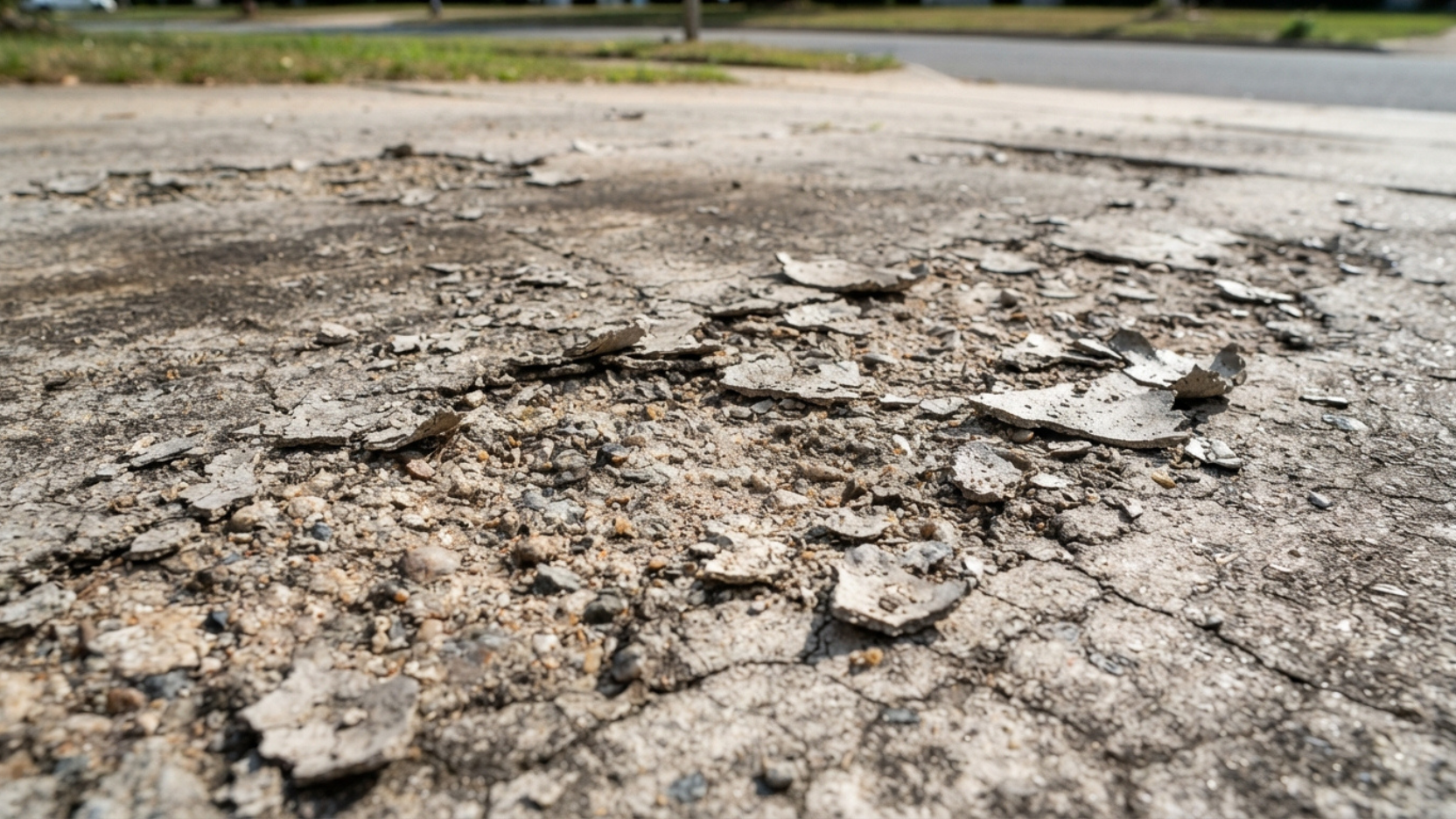
Most concrete driveway failures in San Antonio trace back to a handful of preventable errors made before, during, or shortly after the pour. This guide covers every major mistake what causes it, what it costs to fix, and how to make sure your contractor avoids it entirely.
San Antonio homeowners invest anywhere from $3,500 to $9,000 in a new concrete driveway. That is a significant outlay and yet a large share of those driveways develop serious problems within five years. Early cracking, surface flaking, uneven settlement, and drainage failures are common. In nearly every case, the root cause is not bad luck. It is a preventable mistake made at the planning stage, during the pour, or in the weeks immediately after installation.
Bexar County’s expansive Blackland Prairie Vertisol clay soils, the intense Texas UV load, Edwards Aquifer hard water, and summer heat conditions that accelerate concrete curing all create a specific set of challenges that generic contractor advice does not address. This guide covers the ten most common concrete driveway mistakes San Antonio homeowners encounter, with the repair cost context and prevention checklist you need before signing any contract.
A verbal agreement about “pouring a driveway” leaves every critical decision slab thickness, base depth, reinforcement type, expansion joint spacing, curing method unspecified. Most of the mistakes in this guide happen because those details were never nailed down in writing. A legitimate San Antonio concrete contractor will provide a quote that itemizes every one of these specifications. If the quote just says “concrete driveway” with a price, that is the first red flag on this list.
Structural
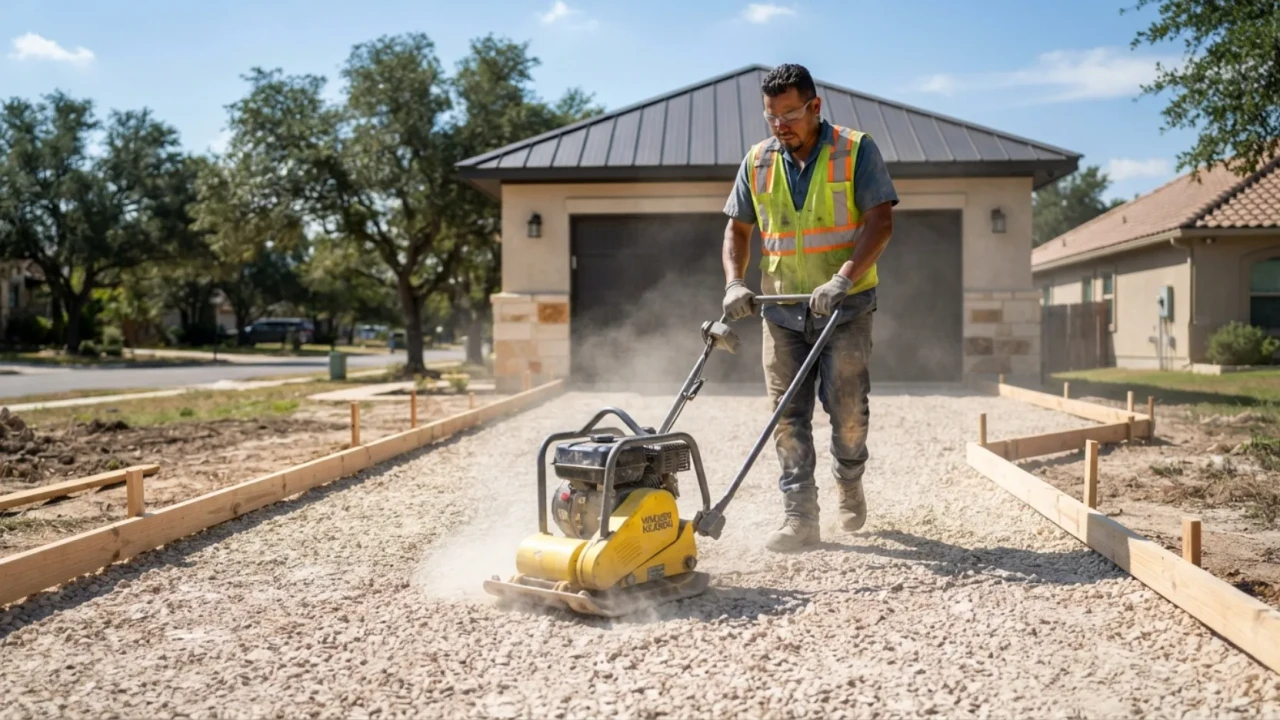
Concrete does not crack because of what is above it. It cracks because of what is beneath it. Bexar County’s expansive clay soils swell dramatically when wet and shrink when dry, creating a constantly shifting foundation. Without a properly compacted gravel or crushed limestone base, that movement transfers directly into the slab and concrete does not flex. It fractures.
A correctly prepared driveway base in San Antonio requires excavating 6 to 8 inches below finished grade, then compacting 4 to 6 inches of crushed limestone fill. This is not optional. Contractors who skip excavation and pour directly over existing soil or who compact only superficially are creating a slab that will settle unevenly and crack within a few years.
- Require the quote to specify excavation depth, base material, and compaction method in writing
- Visit the site on day one of work if no excavation is happening, stop the job
- Ask specifically about compaction equipment hand tamping is not sufficient for a vehicle driveway
- Confirm crushed limestone base (not just loose fill) is specified compactable material is not negotiable in clay soils
Structural
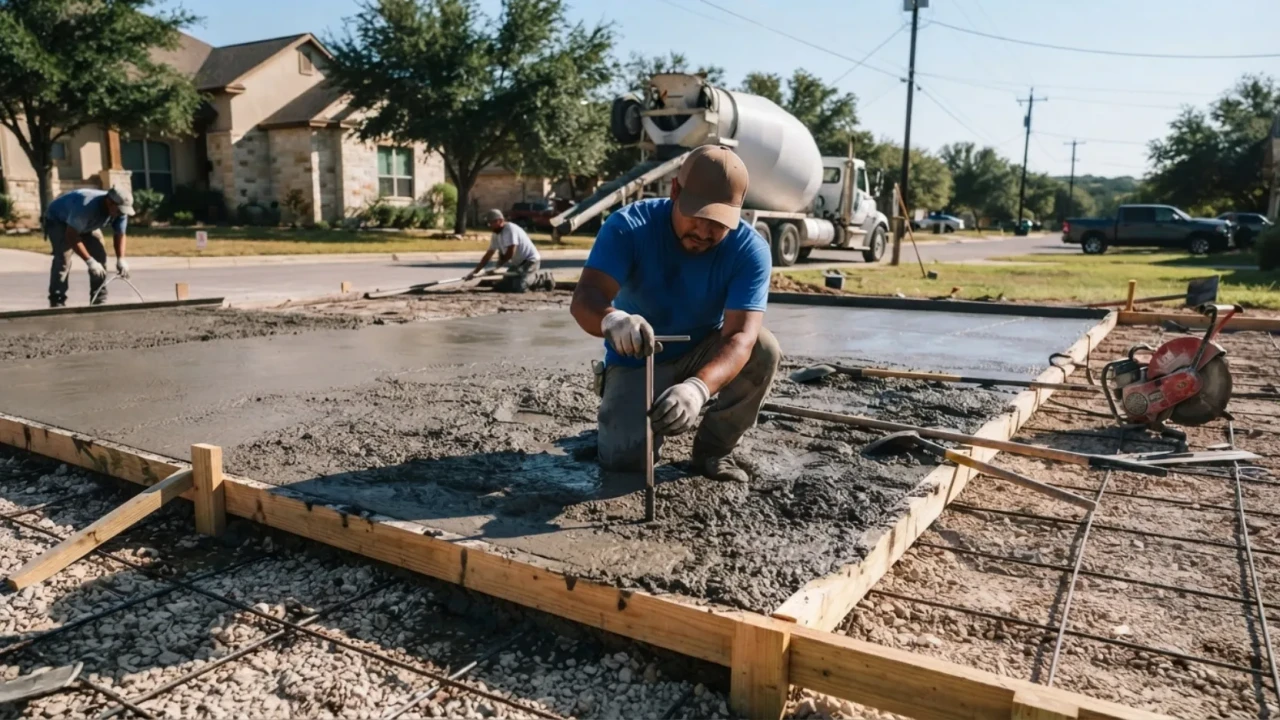
Slab thickness is one of the easiest places for a contractor to cut costs invisibly. Pouring 3.5 inches instead of 5 inches saves the contractor money on concrete and you will never see the difference until the slab begins cracking under vehicle loads. The industry minimum for a residential driveway that will carry passenger vehicles is 4 inches. Households with trucks, SUVs, or any commercial vehicles should specify 5 inches minimum.
In San Antonio, where Blackland clay soils amplify any base instability, slab thickness becomes even more critical. A thin slab over expanding soil is a recipe for early failure regardless of how well the base is prepared.
How to verify slab thickness after the pour: Once the driveway has cured, you can drill a small hole at the edge and measure depth with a tape measure. If you are getting quotes now, ask the contractor to specify the concrete volume ordered it is easy to back-calculate whether the thickness matches the stated square footage. A contractor who objects to this question is worth walking away from.
- Require slab thickness to be written into the contract not just stated verbally
- Calculate the expected concrete volume (sq ft x thickness in feet) and confirm the ordered yardage matches
- For any driveway that will carry vehicles over 5,000 lbs, specify 5 inches minimum in the contract
Reinforcement
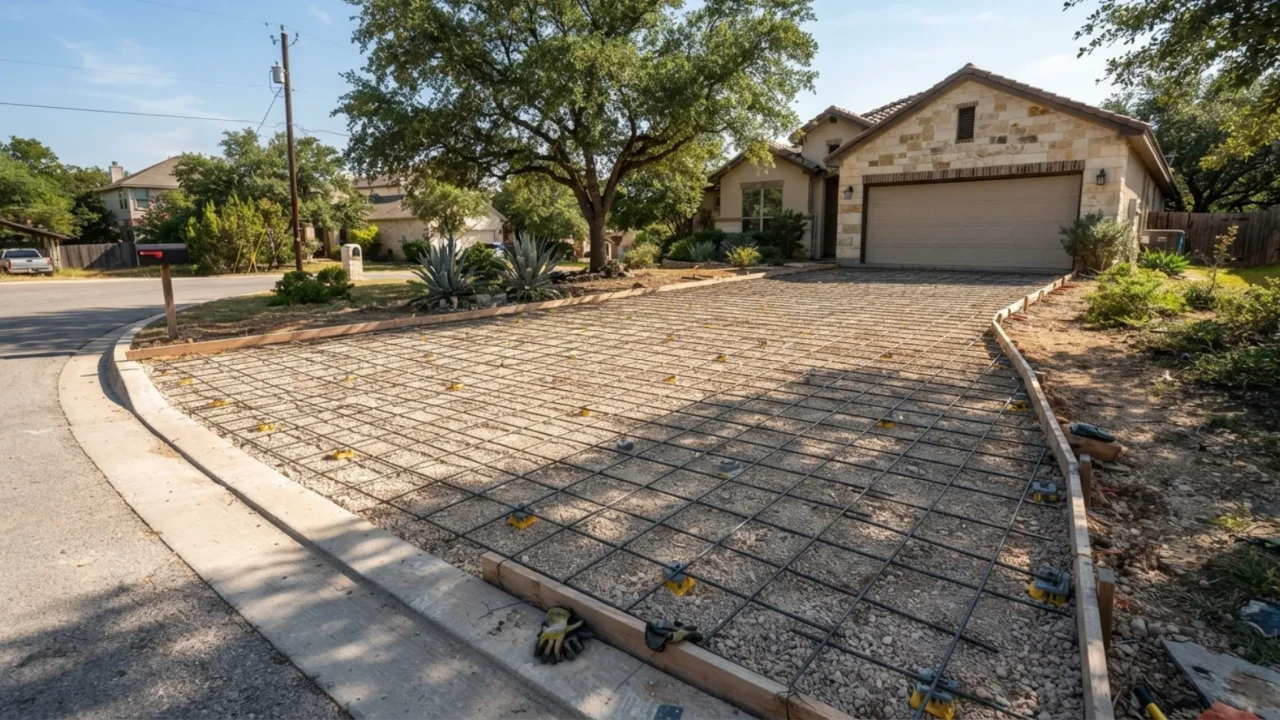
Welded wire mesh (WWM) is technically permitted for residential driveways, and many contractors use it because it is cheaper and faster to install than a rebar grid. In many regions, it performs acceptably. In Bexar County’s expansive clay soils, it is the wrong choice.
Wire mesh is a passive reinforcement it helps hold a crack together after it forms, but it provides limited resistance to the tensile forces that cause cracking in the first place. Rebar (#3 or #4 bars on 18-inch centers) creates an active grid that distributes load across the full slab and resists the bending forces that expansive soil movement generates. For a driveway in San Antonio, rebar is the correct call not an upgrade.
- Specify rebar reinforcement in the contract not “reinforcement” generically, which allows wire mesh substitution
- Confirm rebar bar size (#3 minimum, #4 preferred) and spacing (18 inches on center both ways)
- Inspect before the pour rebar should be elevated off the base on chairs, not lying flat on the ground
- Reject any contractor who says wire mesh is “just as good” for a vehicle driveway in San Antonio
Cracking Risk
All concrete cracks. That is not a defect it is a material property. The entire point of control joints (also called expansion joints or contraction joints) is to create predetermined weak points where cracks occur predictably, in straight lines, where they can be sealed and managed. A driveway with no control joints, or with joints spaced too far apart, will crack randomly and unpredictably across the slab surface.
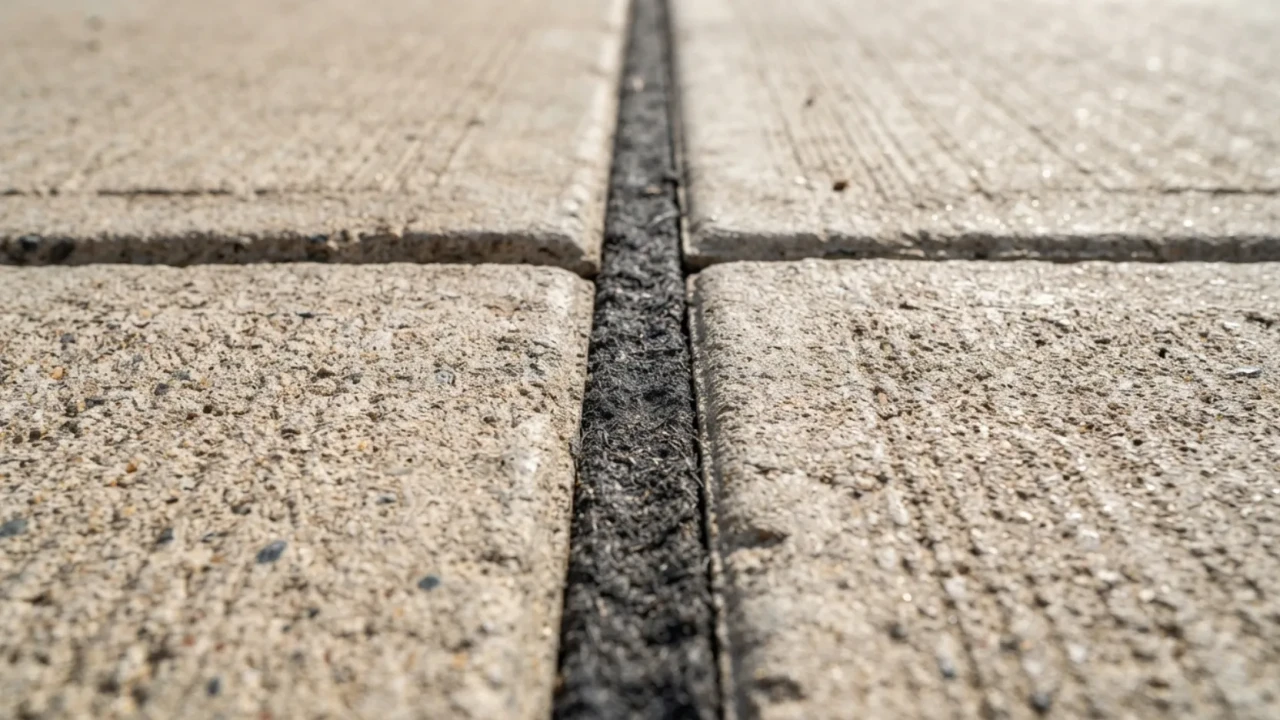
The standard rule of thumb for joint spacing is 2 to 2.5 times the slab thickness in feet. For a 4-inch slab, joints should appear every 8 to 10 feet. For a 5-inch slab, every 10 to 12 feet. Joints should also be placed where the driveway meets the garage slab, the sidewalk, and any other adjoining concrete structure these are natural stress concentration points.
Joint depth also matters. A control joint needs to reach at least one-quarter of the slab thickness to effectively guide cracking. A shallow saw cut that only scores the surface does not create the weak plane needed to control crack direction.
Expansion joints need periodic maintenance too: The backer rod and sealant in control joints breaks down over time, especially under San Antonio’s intense UV exposure. Inspect joint sealant every two to three years and refill any gaps with a compatible polyurethane or silicone sealant. An open joint allows water intrusion that softens the base and accelerates the very cracking the joint was designed to control.
- Require joint spacing and locations to be drawn on a simple diagram in the contract
- Confirm joints are cut or tooled on the same day as the pour saw cutting should happen within 6 to 18 hours of finishing
- Verify joint depth after cutting a proper cut reaches at least 1 inch deep on a 4-inch slab
- Inspect and reseal joints every 2 to 3 years as part of routine driveway maintenance
Curing
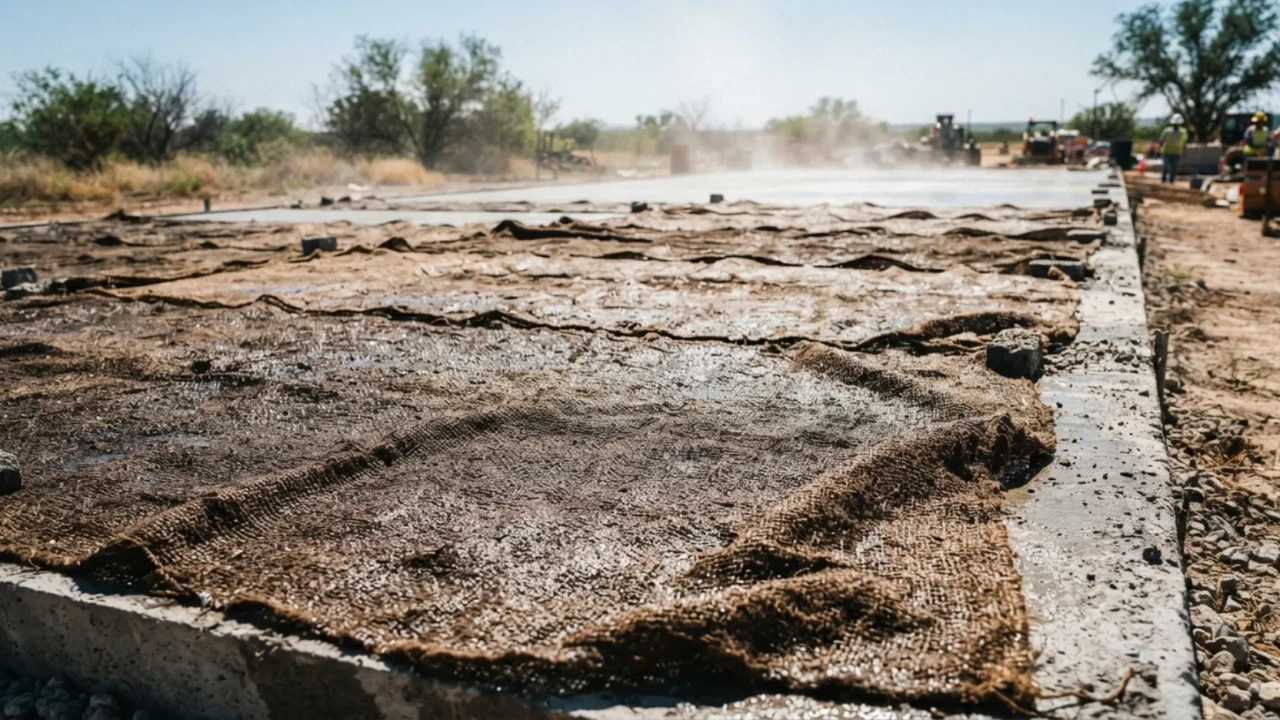
Concrete gains strength through a chemical process called hydration a reaction between cement and water that continues for 28 days. In San Antonio’s summer conditions, where temperatures routinely exceed 95 degrees Fahrenheit and direct sun can push slab surface temperatures to 140 degrees or more, the water needed for hydration evaporates from the slab surface before the reaction can complete. The result is a driveway that looks fine for a few years, then begins surface scaling, dusting, and deteriorating prematurely.
Proper summer curing in San Antonio means one of three approaches: wet curing (keeping the slab continuously moist for at least 3 to 5 days), applying a liquid curing compound immediately after finishing, or covering the slab with curing blankets. A contractor who pours, finishes, and leaves without addressing curing is leaving your driveway to fail in the first Texas summer.
- Ask explicitly what curing method the contractor uses there must be a specific answer, not a vague response
- Confirm curing compound or wet-cure protocol is part of the quoted scope, not an add-on
- Schedule summer pours in the morning whenever possible avoid afternoon pours in June through August
- Do not allow foot traffic for 48 hours or vehicle traffic for 7 days regardless of how hard the surface feels
Mix Quality
This is one of the most common on-the-ground mistakes that homeowners cannot see happening and would not recognize if they did. When a concrete truck arrives with a stiff, difficult-to-work mix, a crew under time pressure may add water directly to the drum to make the concrete more workable. This is called “watering down” or “retempering” the mix, and it has serious consequences for the finished slab.
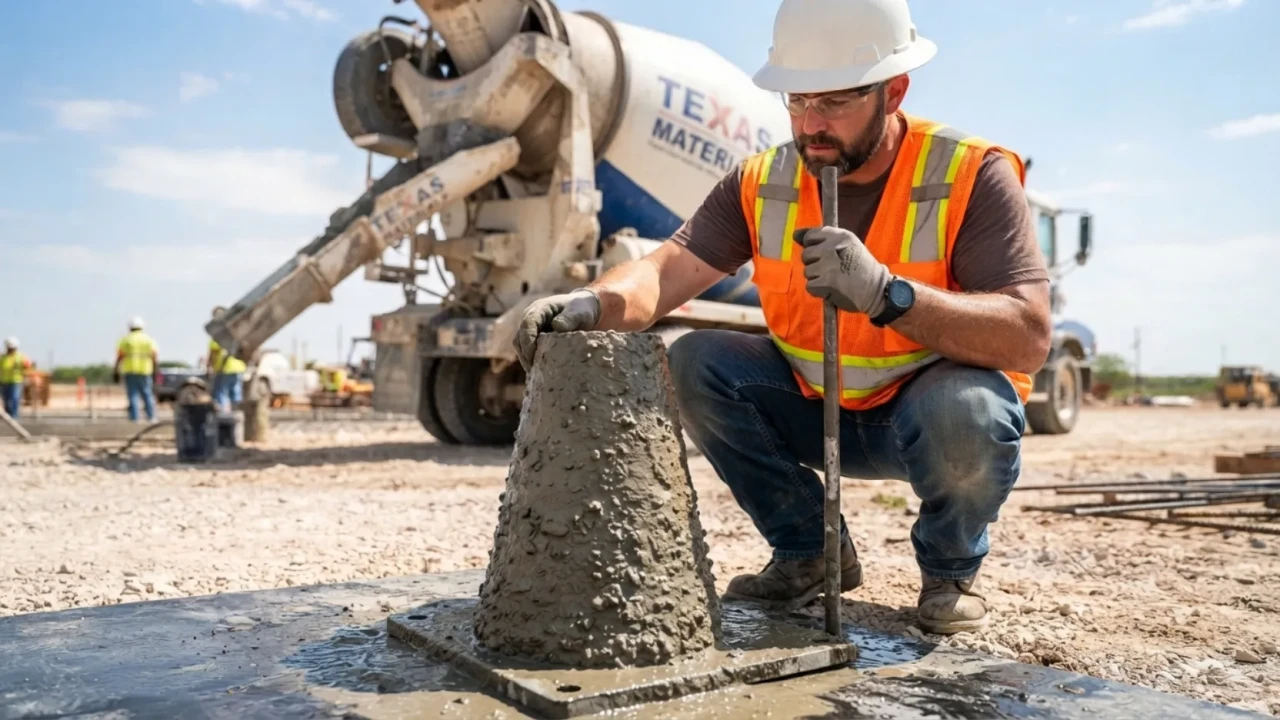
Every gallon of water added to a concrete mix beyond the designed water-cement ratio reduces compressive strength. A mix designed for 4,000 PSI compressive strength (the correct spec for a vehicle driveway) can drop to 3,000 PSI or below with excessive water addition. That is a 25 percent reduction in strength and the weakened concrete is also more porous, more susceptible to surface scaling, and more likely to crack under load.
The correct solution to a stiff mix is a plasticizer (water-reducing admixture) a chemical additive that improves workability without increasing the water content. A reputable San Antonio contractor will specify the correct mix design for the conditions and use admixtures to manage workability.
- Specify the concrete compressive strength in the contract: 4,000 PSI minimum for a vehicle driveway
- Be present for the pour if possible watch whether anyone adds water to the drum after the truck arrives
- Ask the contractor to obtain the concrete ticket (delivery receipt) from the batch plant and share it with you it shows the mix design and water content as batched
- If you observe water being added on-site, stop the pour and ask for an explanation before work continues
Drainage
San Antonio receives an average of 32 inches of rain per year, often in concentrated thunderstorm events. A driveway that does not drain properly either because the surface slope is inadequate or because the design channels water toward the garage, the foundation, or onto neighboring property will experience accelerated deterioration. Standing water softens the base, penetrates expansion joints, and in freeze events (which San Antonio does experience, as the February 2021 winter storm demonstrated) can cause surface scaling through ice expansion.
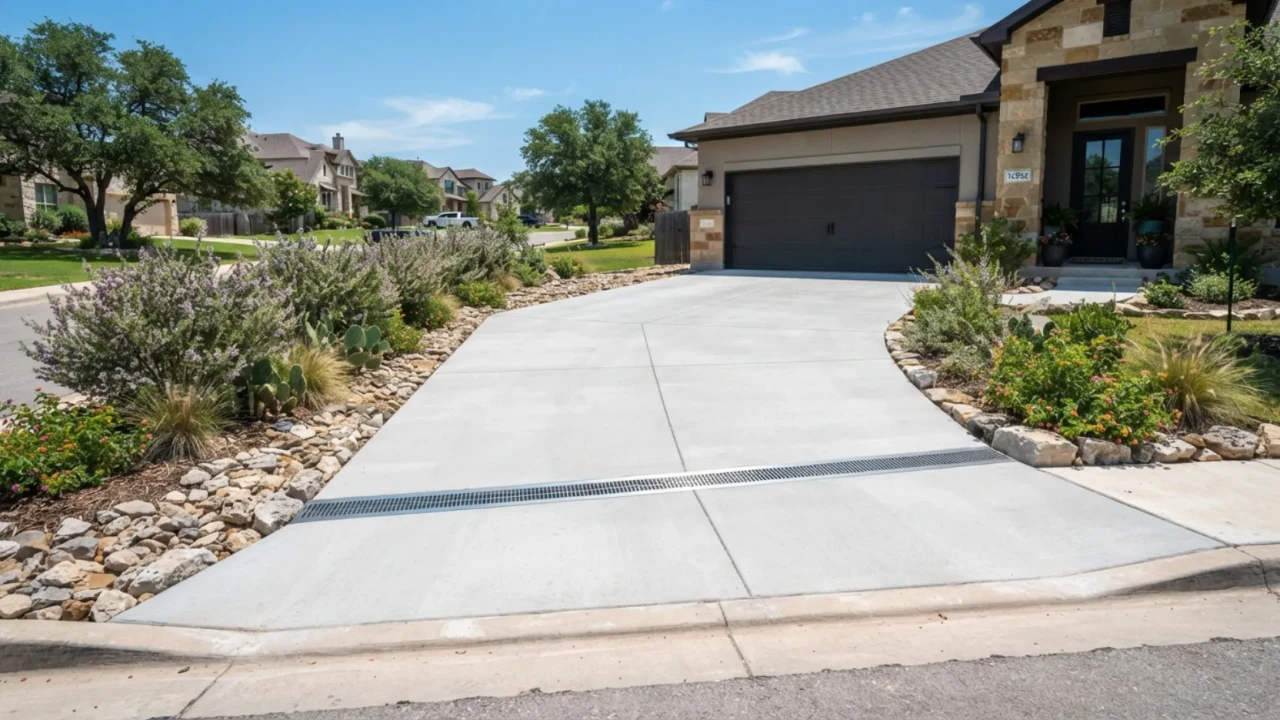
A properly designed driveway slopes away from the garage and home at a minimum of 1 percent (1/8 inch per foot) and ideally 2 percent. This seems like a small number and it is. But an experienced contractor establishes this slope during form-setting and grading, before a single yard of concrete is poured. Correcting slope issues after the pour requires costly grinding or overlay work that rarely fully solves the underlying problem.
Driveways that meet a public sidewalk also need to manage the transition carefully. Improper grading at the street edge can create a dam effect that traps water on the driveway surface during heavy rain events.
- Discuss drainage direction during the planning phase confirm which direction the driveway slopes and where water exits
- Walk the existing site after a rain before work begins identify any existing drainage issues that the new driveway design needs to address
- Confirm slope percentage is specified in the contract: 1 percent minimum, 2 percent recommended
- Inspect form placement before the pour to verify the slope is set correctly in the forms
Finishing
After concrete is poured and screeded, water naturally rises to the surface through a process called bleeding. This bleed water must evaporate completely before any troweling or finishing work begins. If the crew trowels or applies the broom finish while bleed water is still visible on the surface, they are trapping moisture beneath a sealed surface layer. This creates a weak, delaminating bond that eventually manifests as widespread surface scaling the top layer of the driveway flaking off in sheets.
- Work with a crew that has documented San Antonio experience local knowledge of summer concrete timing is not easily replicated
- Do not add water to the surface to make finishing easier this is another form of the water-addition mistake
- If you are observing the pour, watch for finishing work starting while the surface still has a visible sheen
Maintenance
Concrete is a porous material. Without a penetrating or film-forming sealer, a driveway surface absorbs everything it contacts oil and fuel drips from vehicles, water carrying dissolved minerals, UV radiation that bleaches and degrades the surface matrix, and the freeze-thaw cycling that occurs even in mild San Antonio winters. Sealing is the single highest-return maintenance action a homeowner can take to extend driveway life.
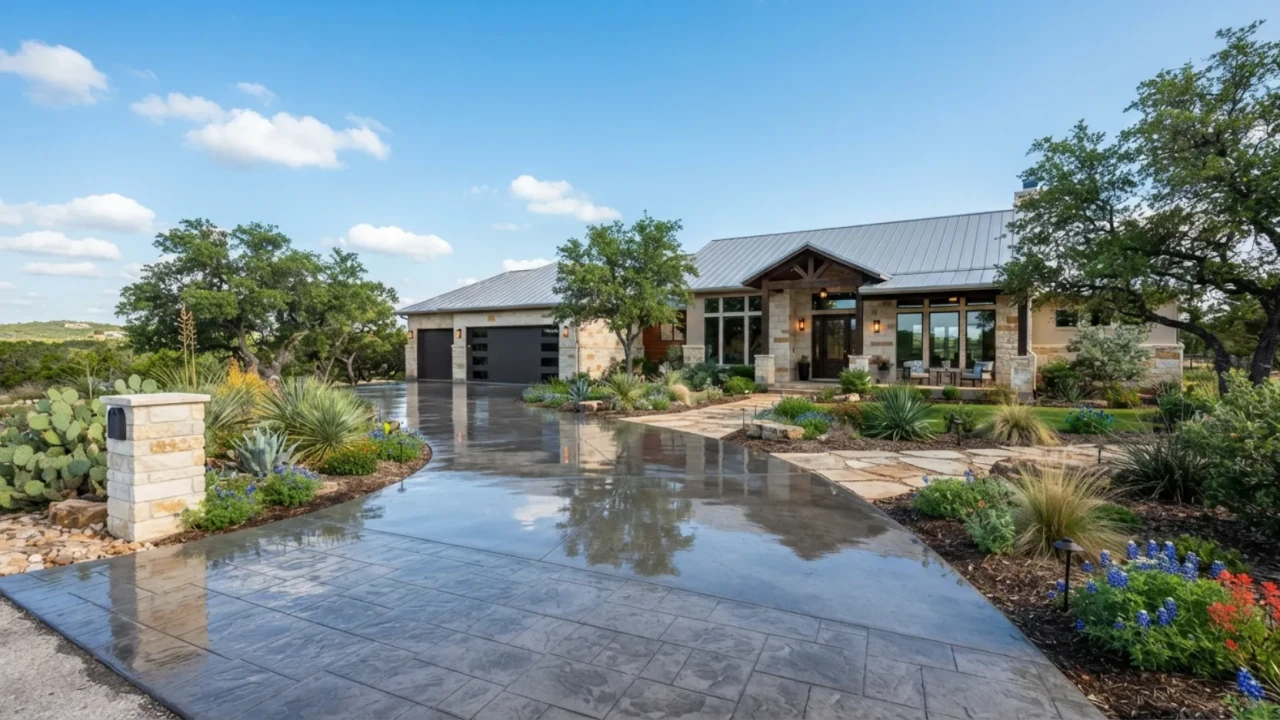
The first sealing should occur at 28 to 30 days after the pour not before, as the slab needs to complete its initial cure cycle first. After that, a standard broom-finish driveway in San Antonio should be resealed every 3 to 5 years. Driveways with decorative finishes (stained or stamped) should be resealed every 2 to 3 years to protect both the surface and the color layer.
For Edwards Aquifer hard water areas, mineral deposits (efflorescence) can build up on an unsealed surface and are much harder to remove once embedded. A penetrating silane or siloxane sealer is particularly effective in hard-water conditions because it repels water without forming a visible film that can yellow or peel under UV exposure.
- Schedule the first sealing appointment at 28 to 30 days from the pour date set a calendar reminder during the pour
- Use a penetrating sealer appropriate for San Antonio’s hard water conditions, not just a generic box-store product
- Set a maintenance reminder for every 3 to 5 years for standard finish, every 2 to 3 years for decorative
- Clean oil stains immediately before they penetrate a degreaser applied within 24 hours removes most vehicle fluid staining
Contractor Risk
Every mistake documented in this guide is made more likely by a single upstream failure: a contract that does not specify what is being done. A quote that says “install concrete driveway, 500 sqft, $4,500” leaves base preparation depth, slab thickness, reinforcement type, joint spacing, concrete mix design, curing method, and sealing all undefined. The contractor can make any decision on all of those items and be fully within the letter of what was agreed.
| Specification item | What to require in writing | Why it matters |
|---|---|---|
| Base preparation | Excavation depth + base material type + compaction method | Defines the foundation quality; most common shortcut location |
| Slab thickness | Minimum thickness in inches at any point | Determines load capacity and crack resistance |
| Reinforcement | Type (rebar vs. mesh), bar size, and spacing | Controls how cracks are managed under soil movement |
| Concrete mix design | Compressive strength (PSI) and special admixtures | Ensures delivered material meets structural requirements |
| Control joints | Spacing, depth, and locations at adjoining structures | Directs cracking to manageable, sealable locations |
| Curing method | Specific method: wet cure, curing compound, or blankets | Critical for strength development in San Antonio heat |
| Sealing | Whether included; sealer type; application timing | Protects surface investment from day one |
| Drainage slope | Direction and minimum grade percentage | Prevents water accumulation that softens base |
- Use the specification table above as a contract checklist every row should have a specific answer in your agreement
- Require a certificate of insurance before signing any contract not a verbal assurance
- Get at least three itemized quotes and compare them line by line, not just on total price
- Be skeptical of any quote more than 20% below the others the savings almost always come from cutting one of the items on this list
- Verify the contractor has a verifiable local address and completed project references in San Antonio or Bexar County
Use this table to evaluate any concrete driveway quote. A contractor who addresses every row in their written scope is a contractor worth trusting.
| Mistake | Warning sign in a quote | Estimated repair cost if ignored |
|---|---|---|
| Inadequate base prep | No mention of excavation depth or base material | $3,000 to $8,000 full replacement |
| Insufficient slab thickness | No thickness specified; unusually low concrete volume | $3,000 to $8,000 full replacement |
| Wire mesh instead of rebar | “Reinforced” without specifying type or size | $500 to $2,000 crack repair; potential replacement |
| Missing expansion joints | No joint spacing or locations mentioned | $200 to $800 crack sealing (recurring) |
| Poor summer curing | No curing method specified | $1,000 to $4,000 surface overlay or replacement |
| Excess water in mix | No mix design PSI specified | $1,500 to $5,000 overlay or full replacement |
| Poor drainage slope | No mention of grade or drainage direction | $800 to $3,000 grinding or overlay correction |
| Premature surface finishing | Crew experience no easy contract check | $1,000 to $4,000 surface overlay |
| No sealing | Sealing not included or mentioned in scope | $300 to $600 sealing plus $500 to $2,000 stain removal |
| No written specification | Quote shows only total price with no line items | Enables all of the above reject any such quote |
- Base material specified: compacted crushed limestone, minimum 4 inches depth
- Excavation depth confirmed: 6 to 8 inches below finished grade
- Slab thickness confirmed: 4 inches minimum, 5 inches for any truck or heavy vehicle use
- Reinforcement specified: rebar (#3 or #4 on 18-inch centers), not wire mesh alone
- Rebar elevation confirmed: chairs or dobies specified to hold rebar at mid-slab height
- Control joint spacing specified: every 8 to 10 feet for a 4-inch slab
- Joint locations identified: at garage slab, sidewalk, and any adjoining structure
- Concrete compressive strength specified: 4,000 PSI minimum for a vehicle driveway
- No water addition on-site confirmed request the batch ticket from the concrete supplier
- Drainage slope confirmed: 1 percent minimum, 2 percent preferred, sloping away from structure
- Curing method specified: wet cure, curing compound, or curing blankets not undefined
- Curing duration confirmed: minimum 3 to 5 days of active curing protocol
- Traffic restriction timeline confirmed: 48 hours foot traffic, 7 days vehicle traffic
- Certificate of insurance received $1M general liability minimum
- Local San Antonio references provided verified completed projects in Bexar County
- Payment terms confirmed: deposit upfront, balance on completion after inspection
- Full written scope received not just a price total
- First sealing scheduled at 28 to 30 days after pour
- Resealing reminder set for every 3 to 5 years (broom finish) or 2 to 3 years (decorative)
- Control joint inspection and resealing scheduled every 2 to 3 years
How soon will I notice if a contractor made one of these mistakes?
Can a cracked concrete driveway be repaired, or does it need to be replaced?
What is a fair price for a concrete driveway in San Antonio in 2026?
Is it true that all concrete eventually cracks? Does that mean the mistakes above do not really matter?
What time of year is best to pour a concrete driveway in San Antonio?
Get a free driveway quote in San Antonio
Tell us about your project. We will visit your property, assess the site, and give you a detailed written quote that specifies every item on this checklist — at no cost.