
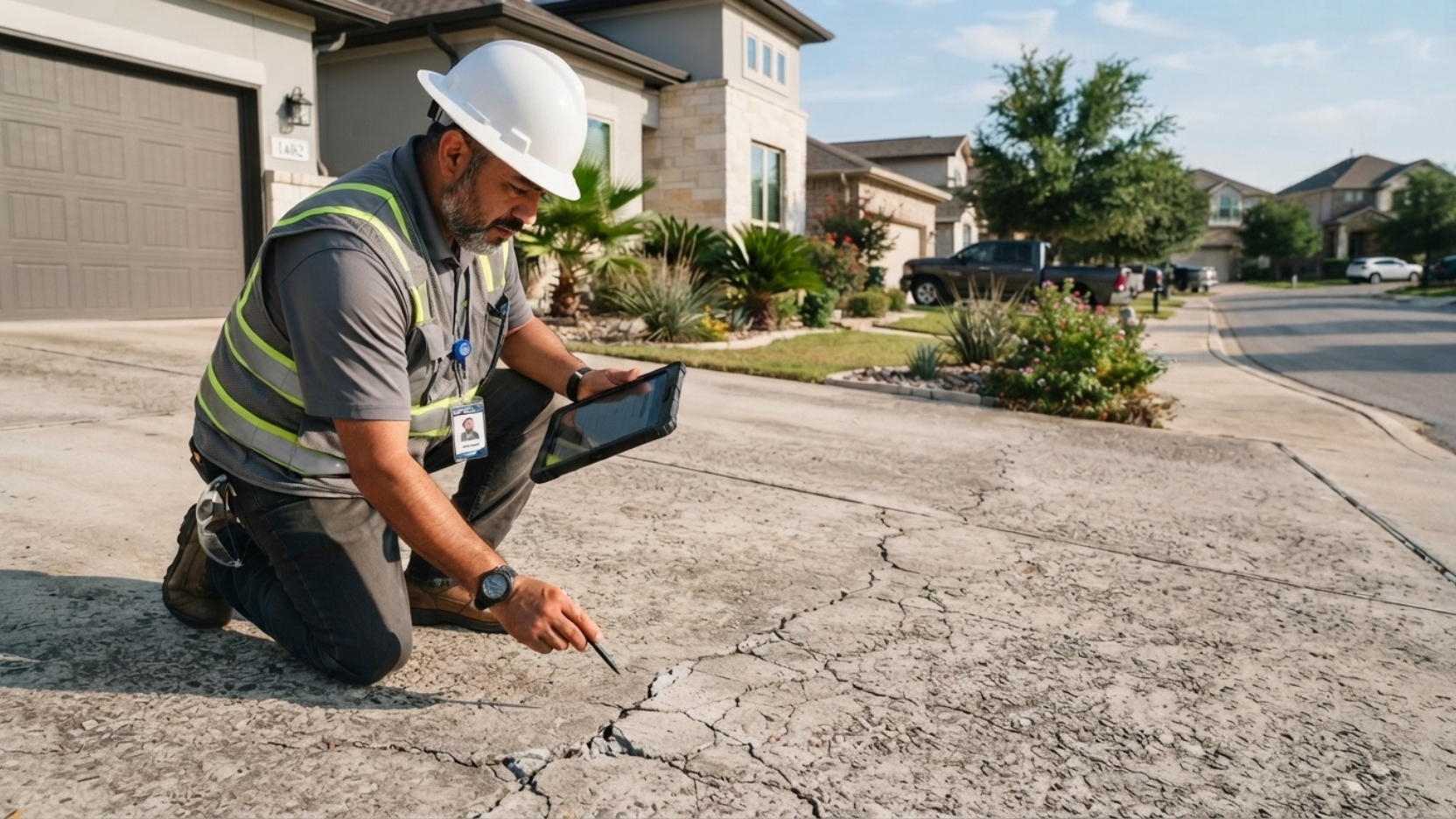
Hiring the wrong repair contractor costs more than the repair itself. This complete guide covers how to assess driveway damage, what repair methods actually work in Bexar County’s clay soil, how to vet contractors, what fair pricing looks like in 2026, and the contract terms that protect you before a single crack is patched.
A cracked, sunken, or spalling driveway in San Antonio is not just a curb appeal problem. It is a safety hazard, a drainage issue, and in many cases a sign of a deeper structural problem that a surface patch will not fix. The difficulty is that driveway repair is one of the most misrepresented services in the local contractor market. Homeowners routinely pay for resurfacing when they need replacement, or pay for full replacement when a targeted repair would have done the job for a fraction of the cost.
This guide gives you the framework to make that call correctly how to read what your driveway is telling you, what repair method matches each type of damage, how to find and vet a contractor in San Antonio who will do the work right the first time, and what the whole process should cost in 2026. Use it before you take a single quote.
Driveway damage in San Antonio almost always has one of two root causes: surface wear from UV exposure and traffic, or base failure caused by the shrink-swell movement of Bexar County’s Blackland Prairie Vertisol clay. Surface wear is fixed with resurfacing or targeted patching. Base failure is fixed only with demolition and replacement. A contractor who recommends resurfacing a driveway with vertical crack displacement, heaving, or large slab sections that have settled at different heights is selling you a repair that will fail within a few years. Knowing which category your driveway falls into before the first conversation puts you in control of the outcome.
Damage Assessment
Before you call anyone, spend ten minutes walking your driveway and categorizing what you see. Driveway damage in San Antonio falls into three distinct categories, each requiring a different response. Mixing them up is the most expensive mistake homeowners make when entering the repair process.
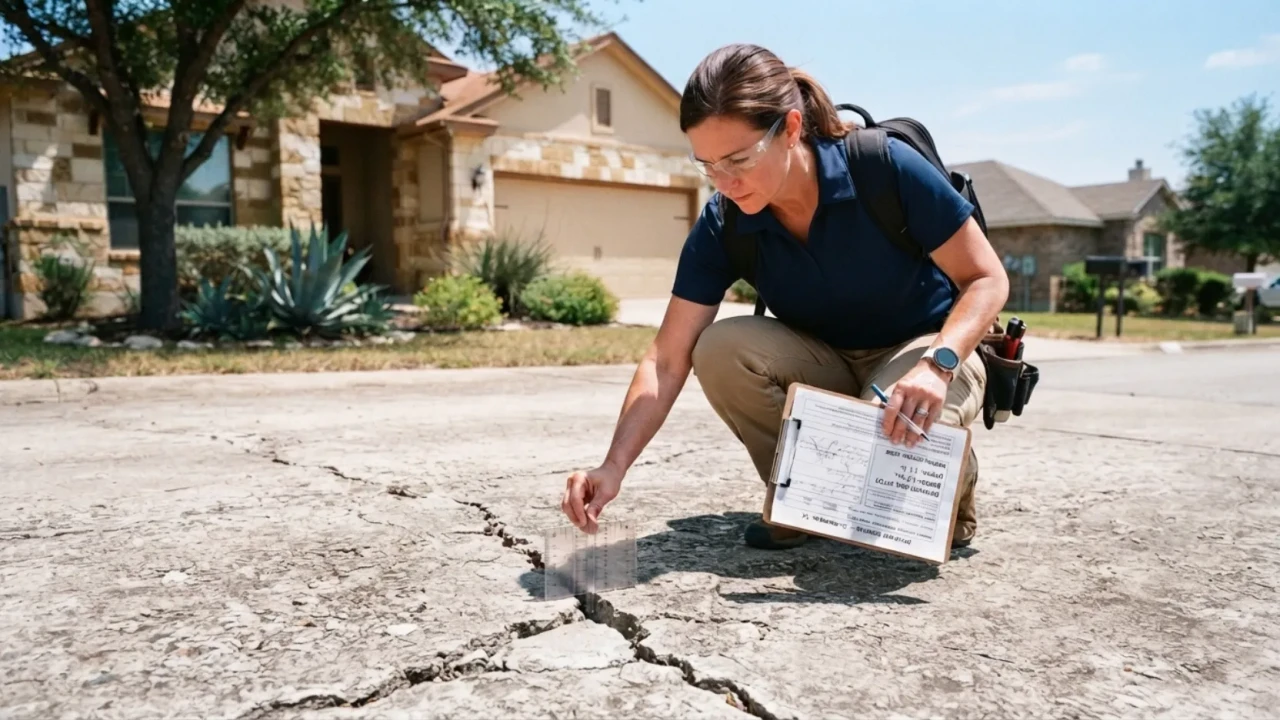
Category 1 Surface damage only: Hairline cracks under 1/4 inch wide, shallow spalling where the top layer is flaking, minor surface discoloration or scaling. These are cosmetic or early-stage issues. Resurfacing or crack injection can extend the life of the slab significantly.
Category 2 Structural cracking with no vertical displacement: Cracks wider than 1/4 inch but both sides of the crack are at the same level. Tree root intrusion or shrinkage from an undersized pour. Targeted repair is possible but requires addressing the cause, not just the crack.
Category 3 Base failure: One side of a crack is higher than the other (vertical displacement), sections of the driveway have sunk or heaved relative to each other, or a map-cracking pattern covers large portions of the surface. This is base failure. No surface repair addresses this. The only correct fix is demolition of the affected sections, proper base re-preparation with compacted crushed limestone, and re-pouring. Any contractor who recommends resurfacing over this type of damage is either inexperienced or not acting in your interest.
The 25-cent test for vertical displacement: Place a straightedge or level across a crack. If one side is higher than the other by more than 1/4 inch, you have a trip hazard and structural issue. The City of San Antonio considers this a safety defect on properties with public sidewalk access. Do not wait on a repair like this and do not let a contractor talk you into a grind-and-patch as a long-term solution if the underlying base has moved.
- Walk the entire driveway and note every crack location, width, and whether any vertical displacement is present
- Check for heaving or sunken sections by placing a long straightedge across multiple slab panels
- Look for map cracking patterns that cover large sections this indicates base movement, not surface wear
- Note any areas where the driveway surface is spalling, scaling, or flaking a sign of deicing chemical damage or low-quality pour
- Photograph all damage before calling contractors you will use these photos to compare what each contractor recommends
- Identify whether there are tree roots within 10 feet of the driveway a likely source of cracking that must be addressed in any repair
Repair Methods
There are four repair approaches available for concrete driveways in San Antonio. Each is appropriate for a specific damage profile. Understanding which method fits your situation before you collect quotes lets you evaluate contractor recommendations with confidence instead of guessing whether you are being oversold or undersold.
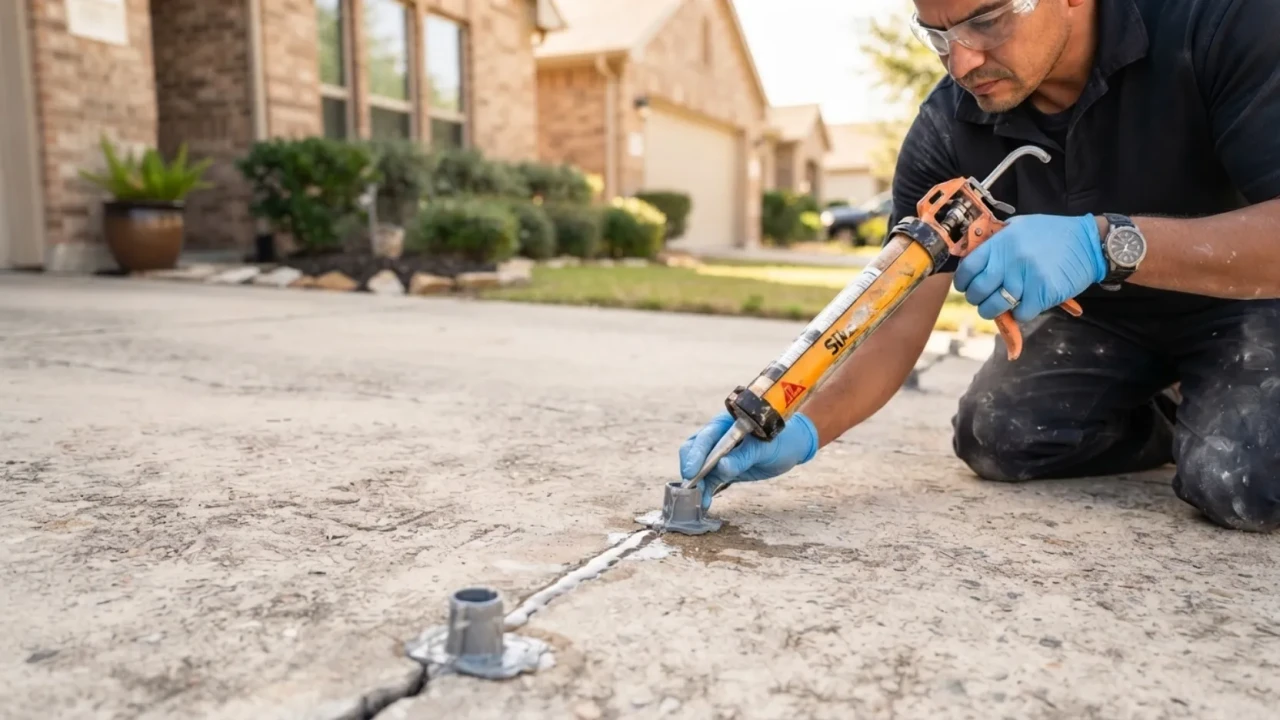
The biggest mistake in driveway repair is choosing a method by price without understanding what damage it actually addresses. A $500 resurfacing job applied to a base-failure driveway is not a bargain it is a temporary cover-up that will crack through within a year or two in San Antonio’s soil conditions.
Why resurfacing fails faster in San Antonio than in most U.S. cities: The shrink-swell cycle of Bexar County clay does not stop because a new surface layer has been applied. If the base beneath the existing slab has not been properly prepared, the new overlay will follow every crack and joint movement in the slab below it within 12 to 18 months. This is why local resurfacing jobs applied over structurally questionable slabs look good for one or two summers and then begin mirroring the original damage pattern. Always confirm the structural condition of the existing slab before approving a resurfacing quote.
- Confirmed no vertical crack displacement before approving any resurfacing or patching quote
- Confirmed no heaving or sunken slab sections before approving any overlay or resurfacing
- Tree roots identified and addressed in the repair scope before patching over root damage
- Repair method recommended by each contractor matches the damage category you identified in Step 1
- Any contractor recommending resurfacing over a structurally compromised slab has been asked to explain the structural assessment in writing
Verify First
Driveway repair attracts more unqualified and fraudulent operators than almost any other home improvement category in San Antonio. The work is visible, the quotes are often large, and most homeowners have no way to evaluate quality until months after the crew has been paid and left. Two documents eliminate the majority of the risk before any conversation about pricing begins.
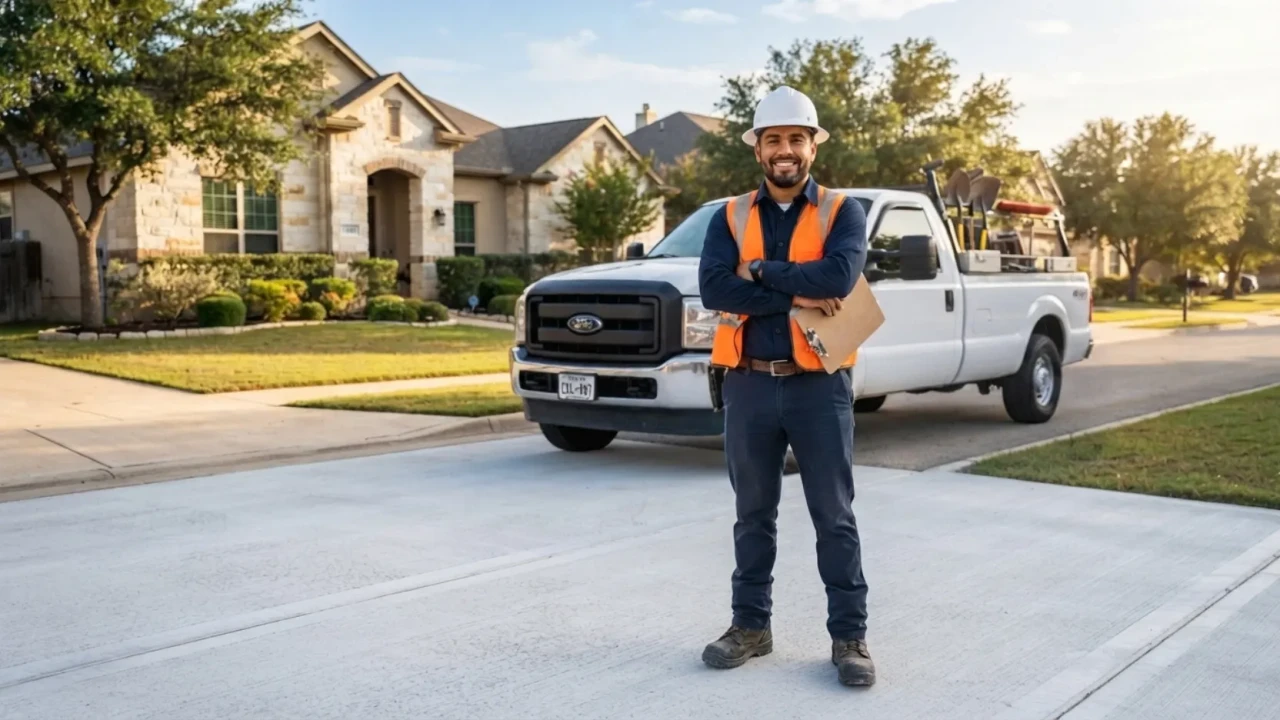
Request both documents before scheduling a site visit. Any contractor who hesitates on either is not the right contractor for a permanent concrete repair on your property.
| Credential | What a legitimate contractor provides | What raises a red flag |
|---|---|---|
| General liability insurance | Certificate of insurance on request, $1M+ per occurrence, verifiable by calling the insurer directly | Verbal assurance with no documentation, policy below $1M, or expired certificate |
| Workers’ compensation | Active workers’ comp coverage if the company has employees protects you from injury claims during the repair | No coverage and no explanation for why it is not required for their crew structure |
| Business legitimacy | A verifiable local address, a Google Business listing with history, and a phone number that answers | Cell-phone-only contact, P.O. box address, no online presence beyond a Facebook page |
| Local references | Recent San Antonio project references with addresses they encourage you to drive by and inspect the work | No local references available, offers only stock photos or projects from other markets |
| Review history | Google Business reviews with no systemic pattern of complaints about cracking, disappearing after payment, or warranty refusal | Multiple reviews mentioning the same failure pattern, or no reviews at all for a company claiming years of experience |
- Certificate of general liability insurance received minimum $1M per occurrence, active policy confirmed by calling the insurer
- Workers’ compensation coverage status confirmed and documented
- Local physical address verified not a P.O. box or out-of-state address
- Google Business profile reviewed for systemic complaint patterns, not just overall star rating
- BBB complaint history checked for the company’s registered name and any doing-business-as variations
- At least one recent San Antonio reference provided with an address you can visit or verify
Quote Detail
A quote that says “driveway repair, $2,800” tells you nothing about what you are actually purchasing. Two quotes at the same price can represent dramatically different scopes, and in driveway repair those scope differences determine whether the work holds up for one year or twenty. Three quotes minimum gives you a market rate baseline and lets you identify outliers in both directions.
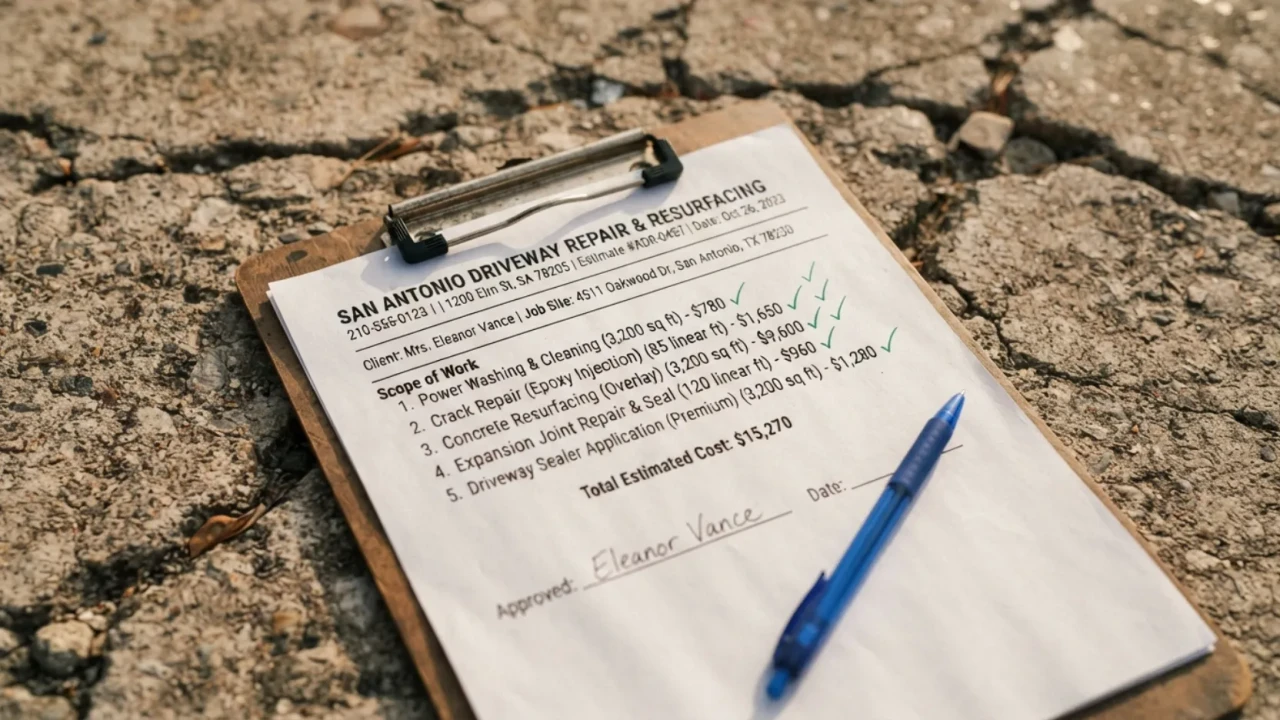
Every repair quote should itemize these elements separately. If a contractor cannot or will not provide this level of detail, you have no way to know what you are buying and no recourse if the work does not match expectations.
Share your damage photos with every contractor before the site visit. Send the photos you took during your self-assessment before scheduling the quote appointment. Contractors who look at the photos and recommend different repair methods than each other are giving you useful diagnostic information. If all three recommend the same approach, that is a strong signal it is the right one. If one recommends resurfacing and two recommend section replacement, ask the outlier to explain why their diagnosis is different in writing.
- Three minimum quotes collected before making any decision
- Each quote itemizes repair method, affected area, materials, base work, reinforcement, finish, and warranty
- All quotes address the same scope before comparing prices confirm any scope differences before treating price as the comparison variable
- Any quote significantly lower than the others has been reviewed for exclusions base work, reinforcement, and cleanup are the most common omissions
- Contractor who recommends a different repair method than the others has been asked to explain their structural assessment in writing
Local Knowledge
An experienced driveway repair contractor who has worked in San Antonio for years will answer these five questions with specific local references without needing to be prompted. A contractor who gives generic answers that could apply anywhere in Texas is either new to this market or not thinking carefully about the specific conditions that make Bexar County concrete repair different from the national average.
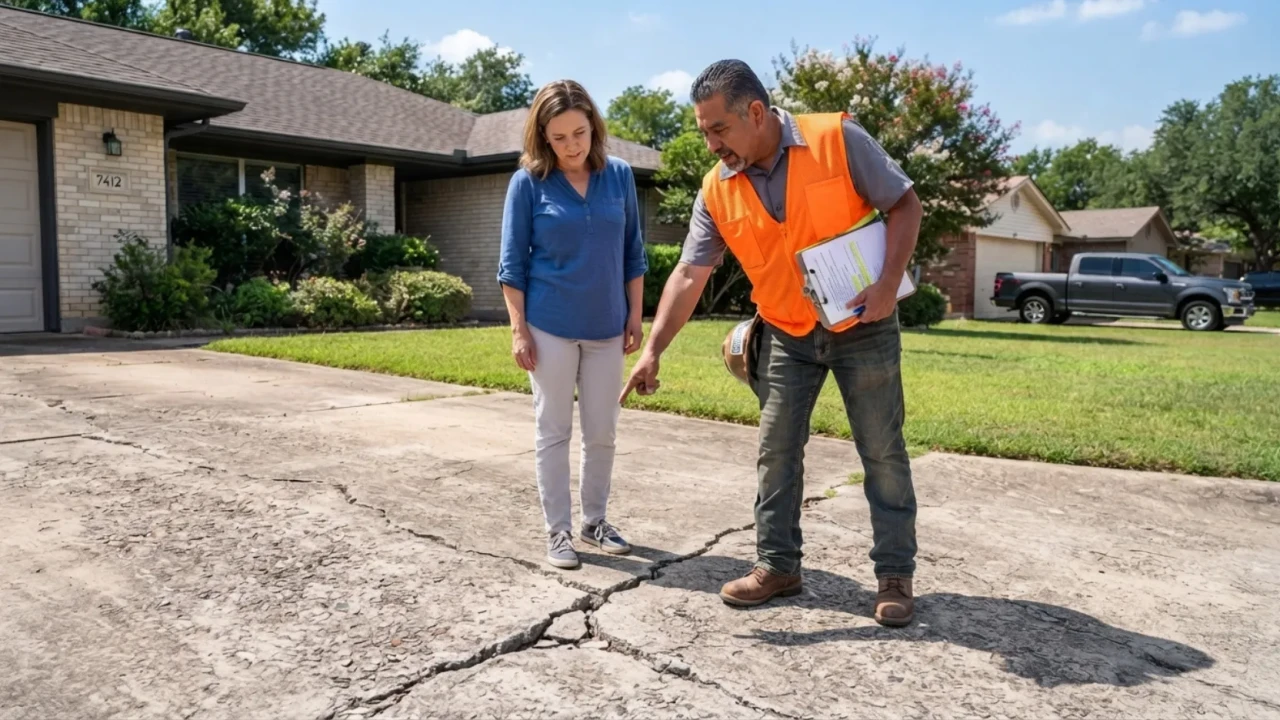
Use these questions as your screening interview. The goal is not to trip the contractor up it is to give experienced local contractors the chance to demonstrate their knowledge and to identify contractors who are unfamiliar with the conditions that make repair work in San Antonio uniquely challenging.
| Question to ask | Strong local answer | Generic answer (proceed with caution) |
|---|---|---|
| “What is causing the cracking in a driveway like mine and how does your repair address that cause?” | References Vertisol clay soil movement, explains that cracking follows base movement, and describes how the repair addresses the structural issue not just the surface symptom | “Concrete cracks over time” or “normal wear and tear” with no reference to soil conditions |
| “How do you prepare the base when you open up a section for replacement?” | Describes compacting a 4-to-6 inch crushed limestone base before the pour, mentions checking for moisture levels, references local soil behavior | “We compact the existing base” without discussing what that base is made of or its depth |
| “How do you handle curing after a summer repair pour in San Antonio?” | Describes wet curing for 3 to 5 days, liquid curing compound application, early morning scheduling to avoid peak heat, references the difference between drying and curing | “We let it cure naturally” or no specific protocol described |
| “Will the repaired section match the existing driveway in finish and color over time?” | Honest answer that fresh concrete will not perfectly match aged concrete in the short term, describes methods to minimize the contrast, sets realistic expectations about color uniformity | “It will look the same” or an overpromise on color matching without acknowledging the inherent limitation |
| “What warranty do you offer on this repair and what does it cover?” | Specific duration (at minimum 1 year), describes what is covered (workmanship defects in the repair area) and what is excluded (damage caused by continued base movement in other parts of the driveway) | Verbal promise of “standing behind the work” with no written warranty offered |
- Contractor references Bexar County clay soil or local soil conditions without being prompted
- Base preparation method described with specifics crushed limestone type, depth, and compaction approach
- Summer curing protocol described for any repair scheduled May through September
- Honest answer given on color matching no overpromises on blending fresh repair with aged concrete
- Written warranty scope confirmed duration, what is covered, and what is excluded
Red Flags
San Antonio homeowners lose significant money each year to driveway contractors who overpromise, underdeliver, collect payment, and disappear. Most of these situations could have been avoided by recognizing one of the following warning signs early in the process. These are not minor concerns that can be rationalized away each one has a direct link to either a financial loss or a failed repair.
A legitimate repair contractor never pressures you to decide on the same visit. A reputable San Antonio concrete company with a full project schedule is not desperate for your signature today. Same-day urgency whether tied to a “price that expires tonight” or “the crew is available this week only” is a sales tactic, not a real constraint. Take the time to collect at least three quotes, verify credentials on each, and compare scopes in writing. Any contractor who walks away because you will not sign immediately was not the contractor you wanted doing the work.
- Contractor was found through research, referral, or your own outreach not door-to-door solicitation
- No request for full payment before work begins deposit confirmed at 30 to 50 percent with balance due on completion
- Written contract received before any payment is made
- Contractor’s recommended repair method matches the damage category identified in your self-assessment
- No same-day pressure to sign at least 48 hours taken to compare quotes
- Local physical address confirmed and verifiable
Contract and Payment
A concrete driveway repair contract does not need to be a complex legal document. It does need to capture the full scope of work, the payment schedule, the project timeline, and the workmanship warranty in writing. Without these four elements, you have no practical recourse if the contractor delivers something different from what was discussed or disappears after the deposit is paid.
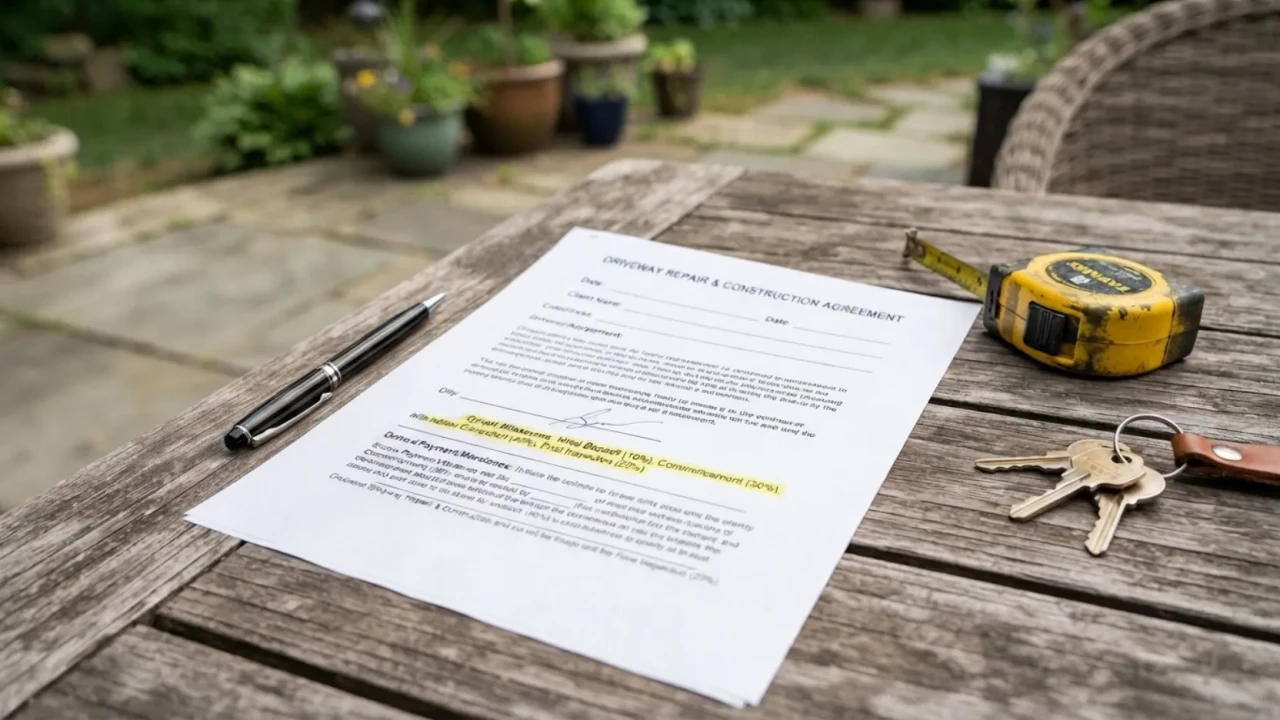
A legitimate contractor will sign a written agreement without hesitation. Resistance to putting anything in writing is the clearest possible signal that the contractor does not intend to be held to whatever was discussed verbally.
| Contract element | What to look for | Language to add if absent |
|---|---|---|
| Repair scope | All repair areas, methods, materials, and base work specified by line item | Transfer every item from the written quote into the contract; ask the contractor to initial each line |
| Payment schedule | 30 to 50 percent upfront, remainder due after walkthrough and your written approval of the completed work | Add language tying the final payment to your written sign-off, not to a calendar date or the pour date |
| Start and completion dates | Specific start date and estimated completion window not “as soon as possible” | Add a clause requiring written notification if the schedule changes by more than 5 business days |
| Workmanship warranty | At least 1 year on labor defects in the repaired area separate from manufacturer material warranty | If absent, ask the contractor to add it; most legitimate companies do this without objection |
| Lien waiver | Signed confirmation that all subcontractors and material suppliers have been paid upon project completion | Request a signed lien waiver as a condition of final payment release |
- Written contract in hand before any payment changes hands
- All specs from the quote transferred into the contract no verbal addendums accepted
- Payment schedule confirmed: 30 to 50 percent deposit, final payment triggered by written walkthrough approval
- Start date and completion window specified in writing
- Workmanship warranty of at least 1 year included in writing with scope defined
- Change order process defined any scope change requires written agreement before work changes
- Signed lien waiver requested as a condition of releasing final payment
Use this pricing table as a sanity check when reviewing quotes. These ranges reflect real project pricing in the San Antonio metro area in 2026 for properly scoped work that includes base assessment, appropriate materials, and correct reinforcement. Quotes significantly below these ranges should prompt a detailed scope review before any commitment is made.
| Repair type | Typical cost range (2026) | When this is the right call | Key inclusion to confirm |
|---|---|---|---|
| Crack injection (per crack) | $150 – $400 per crack | Isolated cracks under 1/2 inch with no base movement and no vertical displacement | Polyurethane or epoxy injection specified; not surface-only caulk |
| Concrete patching (localized) | $300 – $800 per damaged area | Isolated surface damage or spalling in a structurally sound slab section | Surface preparation and bonding agent included before patch application |
| Full driveway resurfacing | $3 – $8 per sq ft installed | Surface wear across the full slab with sound structure and no base movement confirmed | Structural assessment confirmed; existing cracks addressed before overlay |
| Partial section replacement | $4 – $7 per sq ft installed | Isolated base failure in one or two panels while remainder of driveway is structurally sound | Base re-preparation with compacted crushed limestone included; rebar added to match existing |
| Full demolition and replacement | $7 – $14 per sq ft installed | Widespread base failure, heaving, or original slab poured without adequate base preparation | Full base prep: 4-to-6 inch compacted crushed limestone, rebar grid, proper PSI concrete |
| Decorative resurfacing (stamped overlay) | $8 – $18 per sq ft installed | Structurally sound slab where the homeowner wants a decorative upgrade rather than plain gray | Structural assessment first; overlay brand, thickness, and pattern specified in writing |
- Walk the full driveway and photograph all damage cracks, spalling, displacement, heaving, and settled sections
- Categorize damage as surface only, structural cracking without base movement, or base failure with vertical displacement or heaving
- Note tree root proximity roots within 10 feet of cracked areas must be addressed in any repair scope
- Determine whether the driveway needs patch repair, resurfacing, section replacement, or full replacement based on damage category
- Certificate of general liability insurance received and verified active by calling the insurer directly
- Workers’ compensation coverage confirmed
- Local physical address verified searchable and verifiable on Google Maps
- BBB complaint history checked and Google Business review patterns reviewed
- Recent San Antonio driveway repair reference provided and followed up
- Three minimum quotes collected before any commitment
- Each quote itemizes repair area, method, materials, base work, reinforcement, finish, and warranty separately
- Quotes compared on equivalent scope price comparison only after confirming scope alignment
- Any low outlier quote reviewed for excluded structural elements before dismissing higher quotes
- Contractor’s recommended repair method matches damage category from self-assessment
- Written contract received before any payment is made
- All quote specs transferred to the contract with no verbal-only addendums
- Payment structure confirmed: 30 to 50 percent deposit, balance on walkthrough approval
- Workmanship warranty of at least 1 year included in writing
- Project start date and completion window specified in contract
- Signed lien waiver required as a condition of final payment release
- Traffic restrictions confirmed: no foot traffic for 48 hours, no vehicle traffic for 7 days on fresh pours
- First sealing scheduled at 28 to 30 days after any fresh concrete pour in the repair
- Resealing reminder set for every 2 to 3 years on stamped or stained repairs, every 3 to 5 years on standard broom finish
- Tree root management plan in place if roots contributed to the original damage
How do I know if my San Antonio driveway needs repair or full replacement?
How much does driveway repair cost in San Antonio in 2026?
Why do concrete driveways crack so much in San Antonio?
Can a cracked concrete driveway be resurfaced instead of replaced?
What warranty should I expect from a driveway repair contractor in San Antonio?
Does a driveway repair in San Antonio require a permit?
Get a free driveway repair assessment in San Antonio
We will visit your property, assess the damage honestly, tell you exactly what repair is appropriate for your situation, and provide a fully itemized written quote at no cost.