
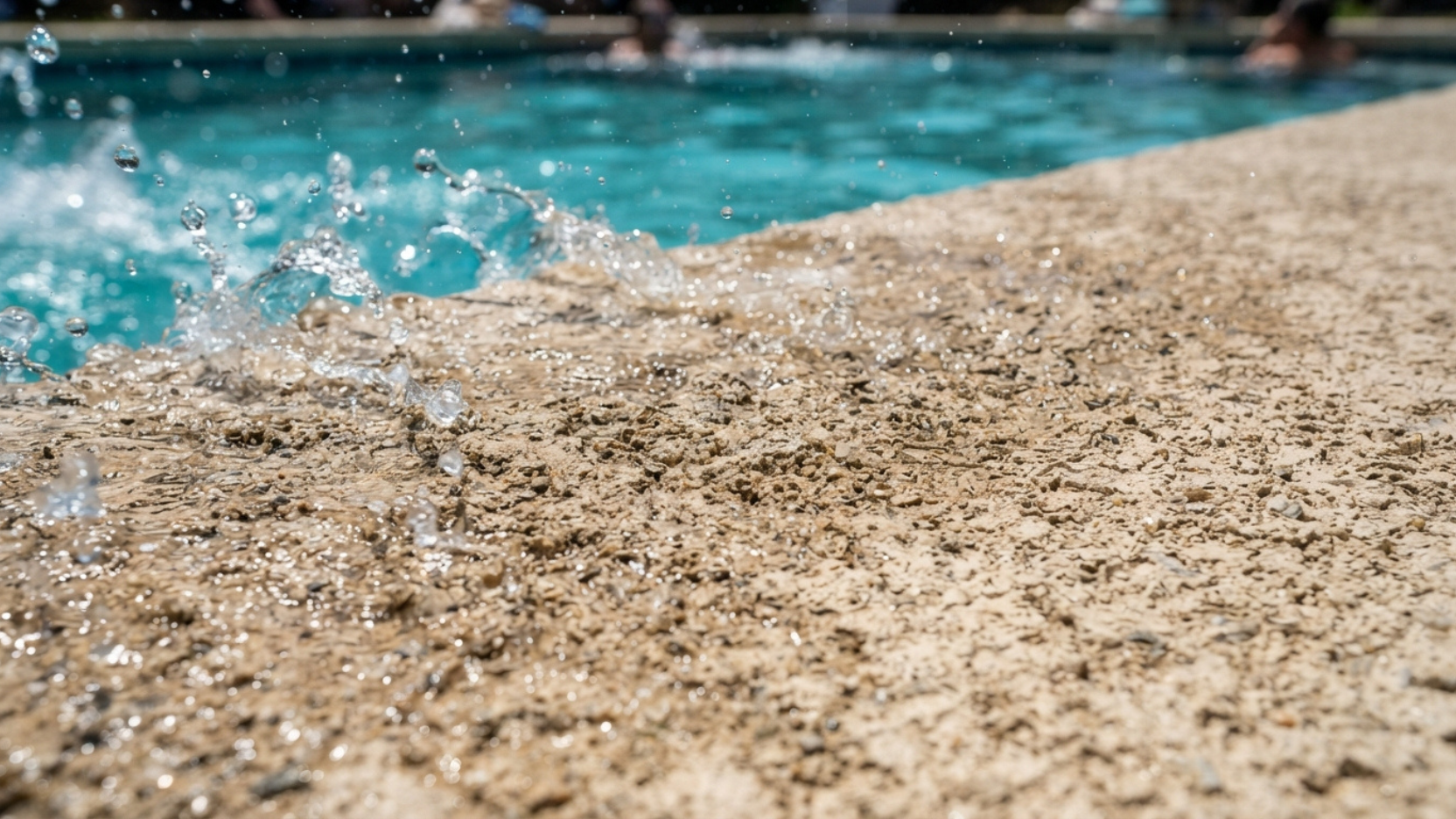
San Antonio’s intense heat, expansive Blackland Prairie clay soil, and hard Edwards Aquifer water put pool decks through more stress than almost any other surface around a home. This guide identifies the most common problems that show up on San Antonio pool decks and explains exactly what to do about each one.
A pool deck takes more punishment than almost any other concrete surface around a San Antonio home. It sits in direct Texas sun for eight or more months of the year, bears repeated wet-dry cycles from splashing and rainfall, and rests on Blackland Prairie Vertisol clay soil that swells when wet and contracts when dry. That combination produces a specific and predictable set of problems and most of them are repairable if you catch them at the right stage.
The critical distinction for every pool deck problem is whether the issue is cosmetic or structural. Cosmetic problems surface staining, minor spalling, hairline cracks can be addressed with patching compounds, resurfacing coatings, or cleaning treatments at relatively low cost. Structural problems slab settlement, wide displacement cracks, undermined sections require a concrete contractor’s assessment and, in some cases, partial or full slab replacement. Misidentifying a structural problem as cosmetic and applying a surface patch is the single most common and expensive mistake San Antonio homeowners make with pool deck repair.
Every pool deck problem on this list has a repair pathway as long as the underlying slab is structurally intact. A slab is structurally intact when it is not settled, heaved, or undermined, and when cracks do not show vertical displacement (one side higher than the other). If those conditions are met, surface repair and resurfacing options are viable and cost-effective. If the slab has settled, heaved, or has wide displacement cracks, surface repairs will fail within one to two seasons because the root cause soil movement has not been addressed. Get a structural assessment first before spending anything on surface treatments.
Most Common Issue
Cracking is the most frequently reported pool deck problem in San Antonio, and it comes in several forms that require very different responses. The most important diagnostic step is not the size of the crack but whether there is any vertical displacement between the two sides. Run your hand across the crack: if both sides are flush and level, the crack is almost certainly a shrinkage or control joint failure. If one side is higher than the other, the slab has moved, and the repair needed is structural, not cosmetic.
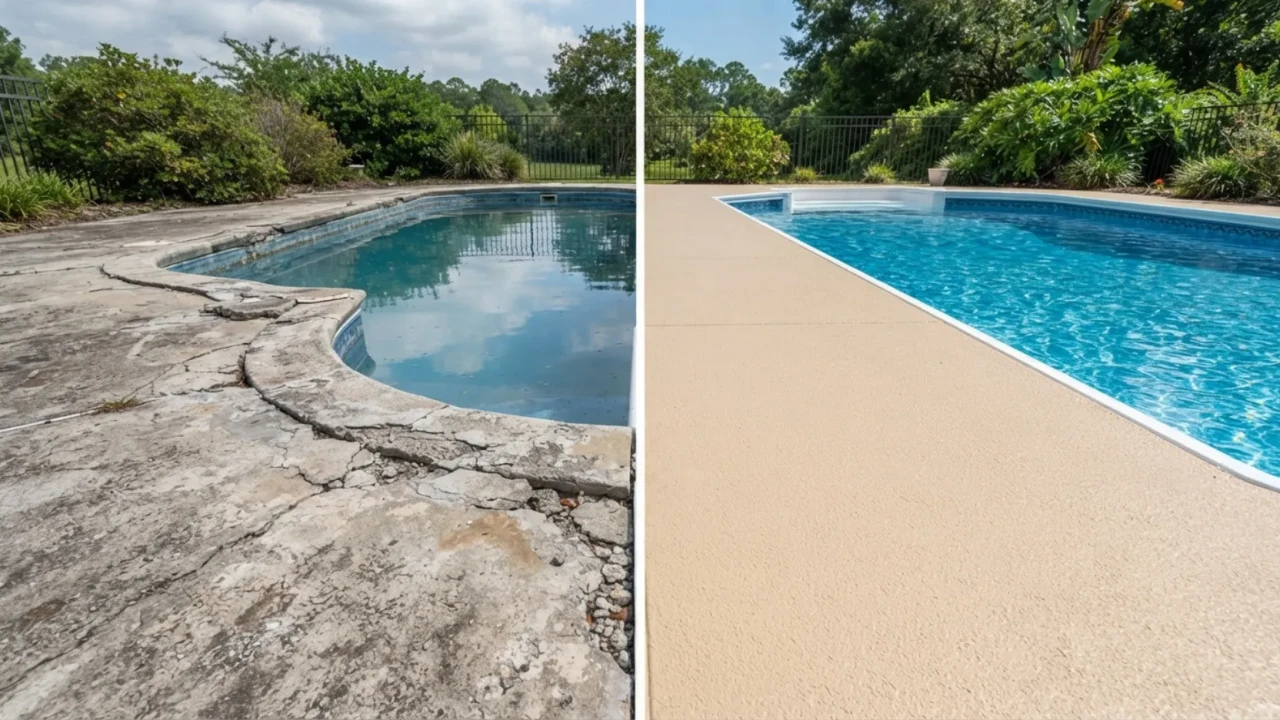
Hairline cracks (under 1/8 inch wide, no displacement): Normal concrete shrinkage. Common in the first one to three years after a pour, especially in slabs cured during San Antonio summers when surface moisture evaporates quickly. These are cosmetic. Clean with a wire brush, fill with a flexible concrete crack sealant rated for horizontal surfaces, and seal the entire deck surface within 30 days.
Medium cracks (1/8 to 1/4 inch wide, no displacement): Often the result of missing or inadequate control joints, or control joints placed too far apart. Still repairable without structural intervention if there is no displacement. Use a polyurethane or epoxy injection system for this width range. The filler must be flexible enough to accommodate the slight seasonal movement that Bexar County clay soils cause.
Wide cracks (over 1/4 inch) with displacement: This is the indicator of slab settlement or heaving driven by soil movement beneath the deck. In San Antonio’s clay-dominant Blackland Prairie soils, wet seasons cause the soil to swell and lift sections of slab while dry summers cause contraction and settlement. A surface patch over a displaced crack will fail within one season the soil movement that caused the crack is still happening. Options at this stage include mudjacking (pumping grout beneath the settled section to re-level it), polyurethane foam lifting (a faster and lighter-weight alternative), or partial slab replacement if the damage is too severe for lifting.
Track crack growth before calling a contractor. Use a pencil to mark the ends of any crack you notice, write the date next to your mark, and check again in two to four weeks. A crack that has not grown is far more likely to be a stable shrinkage crack that can be sealed. A crack that has extended or widened is active and indicates ongoing movement that is the situation that requires a professional structural assessment before any surface work is attempted.
- Run hand across crack surface flush sides indicate cosmetic crack, displacement indicates structural movement
- Measure crack width: under 1/8″ is hairline, 1/8″ to 1/4″ is medium, over 1/4″ requires contractor assessment
- Mark crack ends with pencil and date recheck in two to four weeks for growth
- Check whether crack follows a straight line (likely control joint failure) or runs diagonally (soil movement pattern)
- Look for multiple cracks radiating from a corner strong indicator of slab settlement
Surface Damage
Spalling is the progressive flaking or pitting of the concrete surface layer. It looks like the top surface of the slab is peeling away in irregular patches, exposing the coarser aggregate below. In San Antonio, three factors accelerate spalling relative to national norms: sustained high UV intensity that degrades surface hardness on unsealed concrete, the mineral-rich Edwards Aquifer water that leaves calcium deposits when pool splash evaporates on the deck, and the rare but significant freeze-thaw cycles that San Antonio experiences during winter storm events like the February 2021 freeze.
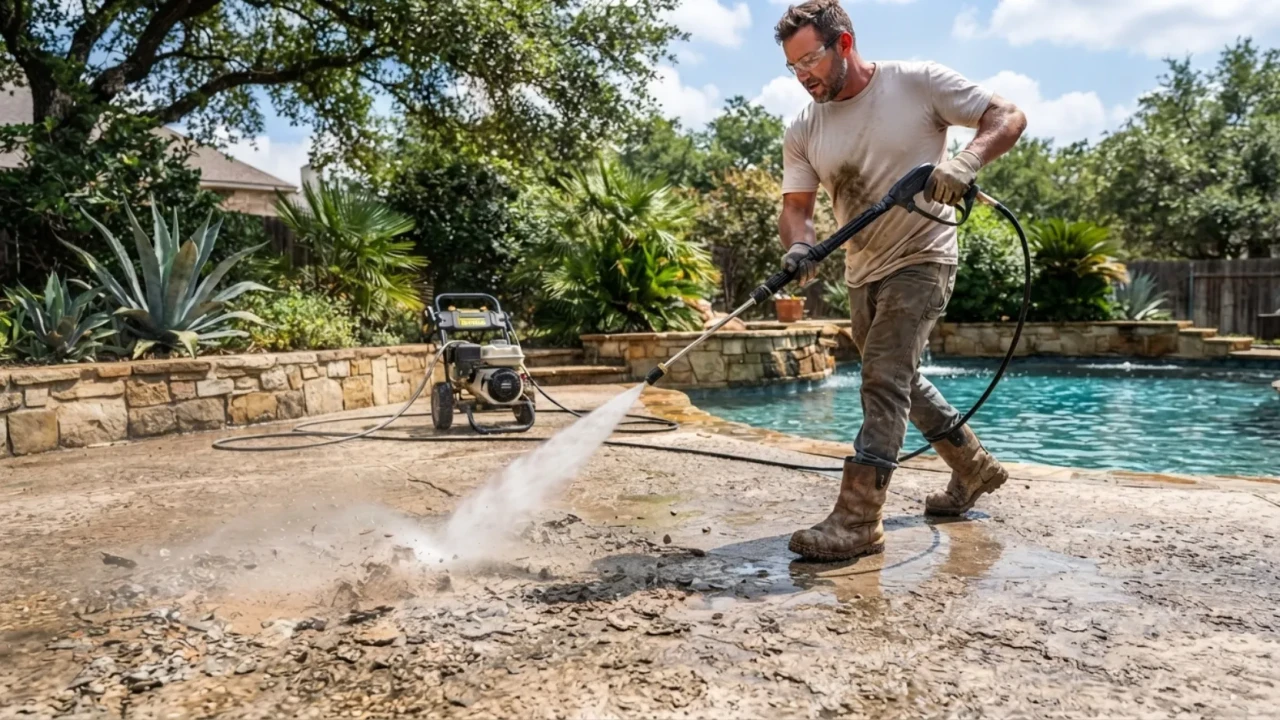
Early-stage spalling (surface pitting, patches under 1 inch diameter): If caught early, spalling can be treated with a concrete resurfacer or bonding overlay applied to the affected areas. The damaged surface must be ground or scarified first to remove all loose material and create a clean bonding profile. Applying resurfacer over loose or flaking concrete is the most common DIY mistake the new material will not bond and will peel off within months.
Advanced spalling (large patches, exposed aggregate throughout): When spalling covers more than 20 to 25 percent of the deck surface, spot patching is no longer the right approach. A full resurfacing overlay a thin concrete or polymer-modified topping coat applied across the entire deck is more cost-effective and produces a uniform appearance. Overlay systems available in San Antonio include standard concrete resurfacer, micro-topping, and spray deck coatings, each with different texture and slip-resistance profiles suited to pool environments.
- Estimate percentage of deck surface showing spalling: under 20% suits spot patching, over 20% warrants a full overlay
- Tap spalling areas with a hammer a hollow sound indicates the surface layer has delaminated and must be ground off before patching
- Check for white mineral deposits from Edwards Aquifer hard water these must be cleaned before any resurfacing product is applied
- Confirm the slab beneath the spalling is structurally sound: no settlement, no heaving, no displacement cracks
- Consider spray deck or stamped overlay if resurfacing these restore slip resistance that bare spalled concrete often loses
Structural Issue
Slab settlement happens when the soil beneath a pool deck section shifts downward, leaving the concrete unsupported and allowing it to drop. Slab lifting (or heaving) happens when expansive clay soil absorbs water and swells upward, pushing a section of deck higher than the surrounding slabs. Both problems are common in San Antonio’s Blackland Prairie clay zones and both create uneven surfaces that are a trip hazard, accelerate further cracking, and channel water in the wrong direction.
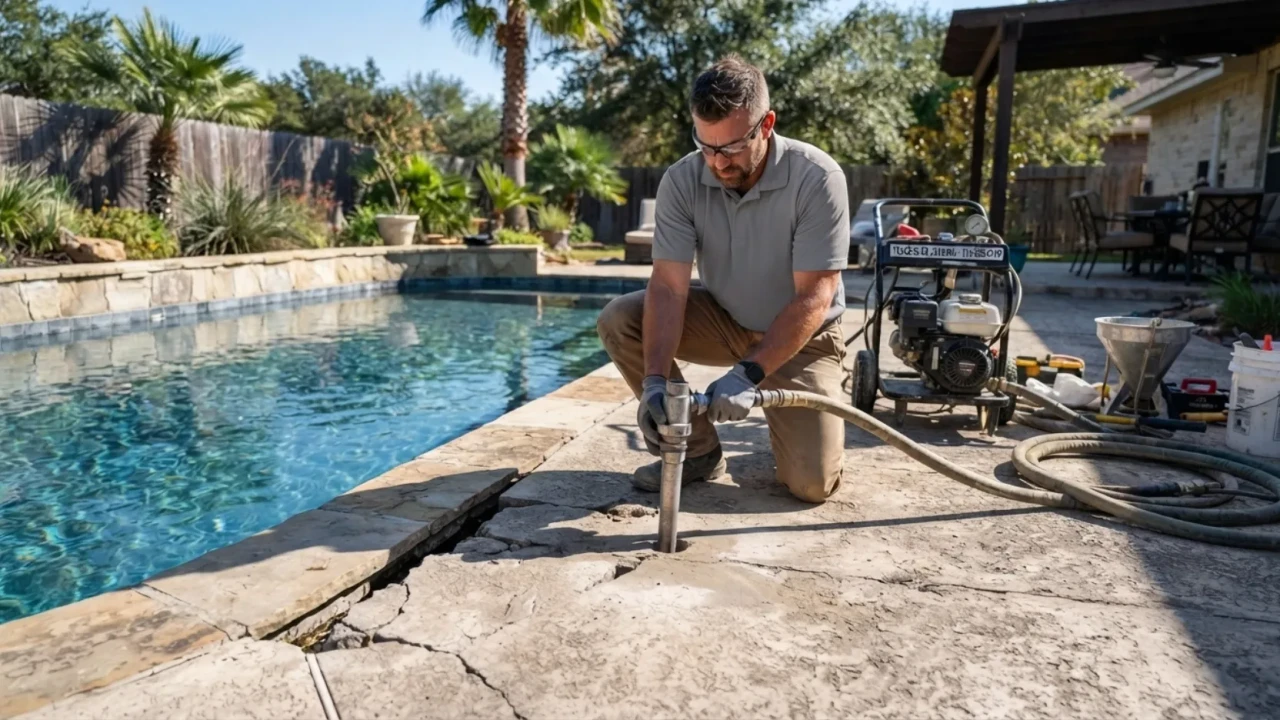
How to identify settlement: Walk the perimeter of the pool deck slowly and look for sections where one slab panel is visibly lower than an adjacent panel. A step of 1/4 inch or more between adjacent sections is a code-recognized trip hazard and must be addressed. Also look for sections that slope toward the pool edge or the house foundation both indicate movement that redirects water where it should not go.
How to identify heaving: Heaved sections are higher than adjacent slabs, often appearing as a raised ridge along a crack line. Heaving in San Antonio is almost always driven by expansive clay soil beneath the slab absorbing seasonal rain. It is more common in areas of the deck closest to the pool edge where water from rain and splash events saturates the soil repeatedly.
| Repair method | Best for | Cost range | San Antonio suitability |
|---|---|---|---|
| Mudjacking (grout pumping) | Settled slabs with voids beneath; sections that have dropped 1/2″ or more | $5–$10/sqft of affected area | Good effective in clay soil zones; heavier than foam but longer-proven track record |
| Polyurethane foam lifting | Settled slabs with voids; minimal disruption required; near pool equipment | $8–$16/sqft of affected area | Very good faster cure time (30 min vs 24 hrs for mudjacking), lighter load on existing soil |
| Grinding (trip hazard reduction) | Small displacement (1/4″ to 1/2″) that is stable and not growing | $100–$300 per joint | Suitable only when displacement is minor and stable does not fix the root cause |
| Partial slab replacement | Sections too damaged or too settled to lift; heavily cracked panels with displacement | $12–$20/sqft replaced | Necessary when existing slab integrity is compromised beyond repair by lifting |
Settlement almost always has a water source driving it. Before any lifting repair is done on a San Antonio pool deck, the drainage situation around the pool needs to be evaluated. If the settled section is in a low spot where rainwater ponds, or if an irrigation head is directing water toward the deck perimeter, the same settlement will recur within two to five years after repair. Ask the contractor whether drainage improvements should be part of the scope before approving any lifting work.
- Walk the deck slowly and check every joint for vertical displacement a difference of 1/4″ or more is a trip hazard
- Check deck slope direction: all sections should drain away from the pool and away from the home foundation
- Identify any water source near settled sections: ponding area, irrigation head, or downspout discharge
- Do not apply surface coatings or overlays over settled sections repair the structural issue first
- Get at least two contractor opinions on whether mudjacking, foam lifting, or partial replacement is the right approach
Cosmetic Repair
Pool decks collect a distinctive combination of stains that other concrete surfaces do not: chlorine and chemical splash, white calcium deposits from evaporated hard water, algae and mildew in shaded or constantly wet zones, tannin staining from nearby trees (a common issue in San Antonio neighborhoods with mature live oaks), and rust from metal furniture, pool equipment, or rebar corrosion beneath the surface.

White calcium and mineral deposits (efflorescence): Extremely common on San Antonio pool decks due to the Edwards Aquifer’s high mineral content. White powdery or crusty deposits form where water evaporates repeatedly on the same surface area. Treatment: diluted muriatic acid wash (1 part acid to 10 parts water), applied with a stiff brush, allowed to sit for five minutes, then thoroughly neutralized with a baking soda and water rinse before washing off. Wear eye protection and chemical-resistant gloves. After treatment, seal the surface to prevent recurrence.
Algae and mildew (green or black patches): Shaded pool deck areas in San Antonio collect algae growth quickly, particularly during the humid spring and fall months. Pressure washing removes most surface algae. Stubborn black mold patches require a sodium hypochlorite solution (pool shock works well) applied to the area, allowed to dwell for 15 to 20 minutes, then pressure washed. Sealing after cleaning dramatically reduces regrowth.
Rust stains: Orange or reddish-brown staining on a pool deck comes from two sources metal furniture, flower pots, or pool equipment resting on the surface, or (more seriously) rebar corrosion beneath the slab that is working its way to the surface. Surface rust from furniture or equipment responds well to oxalic acid-based rust removers formulated for concrete. Rust staining that appears in a pattern matching the rebar grid beneath the slab, or that is accompanied by spalling directly above the stain, indicates internal rebar corrosion and requires a structural assessment. This is a more serious condition than a surface stain.
- Identify stain type before selecting a cleaner the wrong product can worsen certain stains or damage the surface
- Test any cleaning product on a small inconspicuous area first before applying to the full surface
- Rust staining that matches the rebar grid pattern below the slab is a structural warning get a contractor inspection before treating
- Always seal the deck after any chemical cleaning treatment cleaning opens the surface pores that sealers need to close
- Widespread discoloration across 30% or more of the deck surface is better addressed by a full overlay than by repeated cleaning
Drainage Problem
A pool deck that ponds water is a pool deck that will fail faster on every other dimension. Standing water on a concrete surface saturates the base soil beneath it (accelerating clay soil movement), promotes algae growth, softens and stains the surface, and works its way into existing cracks to widen them. In San Antonio, where Flash Flood Alley rainfall can deliver two to four inches of rain in under an hour, inadequate pool deck drainage is not a minor convenience issue it is a material contributor to slab and surface deterioration.

The correct slope specification: Pool deck surfaces should be graded at a minimum of 1/8 inch per foot and ideally 1/4 inch per foot away from the pool edge and away from any structures adjacent to the deck. This slope should have been established when the deck was originally poured, but soil settlement and slab movement can alter it over time. If water is now flowing toward the house or sitting in low spots that were not there previously, the deck has moved since installation.
When slope cannot be restored by lifting: In some pool deck configurations, particularly those with fixed coping or spa features, re-leveling by mudjacking may not restore adequate drainage slope without other complications. In these situations, a channel drain installed at the low point of the deck is the most effective solution. A linear channel drain set flush with the deck surface collects water across the full width of the problem area and routes it to an appropriate discharge point.
After any major rainfall event in San Antonio, walk your pool deck perimeter and photograph any areas where water is still standing 30 minutes after the rain stops. This documents your drainage problem accurately and gives a contractor a clear picture of where the water is collecting and in what quantities. Drainage fixes are far less expensive when addressed before the standing water has had time to undermine the soil beneath settled sections or widen existing cracks. A channel drain addition to a San Antonio pool deck typically costs $800 to $2,500 installed depending on the length of drain needed and the outlet routing.
- Walk deck immediately after a rainstorm and note any sections where water ponds rather than runs off
- Check that all deck slope directs water away from the pool and away from the home foundation
- Look for areas where settled slab sections have created low spots or reversed drainage direction
- Consider a channel drain installation at persistent low points if re-leveling cannot restore adequate slope
- Ensure existing deck drains or scuppers are not blocked with debris from storm events or leaf drop
Safety Hazard
A pool deck’s surface texture is what makes it safe when wet. Over time, the original broom finish or exposed aggregate texture on a concrete pool deck wears smooth from foot traffic, power washing, and the abrasive effect of gritty Texas soil tracked in from the yard. A smooth concrete surface that is wet from pool splash is one of the most hazardous surfaces in a residential setting and it is a common condition on pool decks in San Antonio that have not been resurfaced in 10 or more years.

Assessing slip resistance: The simplest test is to pour a small amount of water on the driest, most trafficked section of the pool deck and walk across it in bare feet. If the surface feels slippery under wet conditions, the texture has degraded to a level that needs attention. Another indicator is a shiny or reflective appearance on sections of the concrete surface original broom finish concrete should look matte and slightly rough, not polished.
Restoration options without full resurfacing: For decks that are otherwise in good condition but have lost texture, an anti-slip additive (aluminum oxide or polymer grit) mixed into a penetrating sealer and applied to the entire surface is the lowest-cost intervention. This approach adds measurable slip resistance and is appropriate when the deck surface is structurally sound and not significantly spalled. The anti-slip sealer should be reapplied every two to three years in San Antonio’s UV conditions.
Resurfacing as a safety upgrade: When texture loss is widespread across the deck or when the surface has deteriorated to the point where no sealer-based solution will restore adequate grip, a full resurfacing overlay is the correct approach. Spray deck coatings like Kool Deck are particularly well suited to San Antonio because they address two problems simultaneously: they restore non-slip texture and they reduce surface temperature by 30 to 40 percent compared to bare concrete in direct Texas sun a significant comfort and safety improvement for a city where summer barefoot-on-concrete temperatures regularly exceed 140 degrees Fahrenheit.
- Wet test: pour water on the highest-traffic section and walk barefoot slippery feel confirms texture loss
- Visual test: original broom finish should look matte; a shiny or polished appearance means texture has worn smooth
- For mild texture loss on a sound surface: anti-slip additive in a penetrating sealer is the lowest-cost fix
- For widespread texture loss: full resurfacing overlay restores uniform safety across the entire deck
- Consider spray deck or Kool Deck coating if summer surface temperature is a comfort concern significant temperature reduction over bare concrete
- Reapply anti-slip sealer every two to three years under San Antonio UV conditions to maintain effectiveness
The table below summarizes the repair approach and 2026 cost ranges for each of the six pool deck problems covered in this guide. All figures reflect San Antonio and Bexar County market pricing and include contractor labor.
| Problem | Repair approach | 2026 cost range (San Antonio) | DIY possible? |
|---|---|---|---|
| Hairline cracking | Crack sealant plus deck sealing | $200–$600 DIY; $400–$900 contractor | Yes with the right flexible sealant product |
| Medium to wide cracking (no displacement) | Epoxy or polyurethane injection, then reseal | $600–$1,800 depending on crack volume | Partially injection equipment rental available but contractor preferred |
| Displacement cracking and settlement | Mudjacking or foam lifting, then surface repair | $1,500–$4,500 depending on affected area | No contractor required for lifting equipment |
| Surface spalling (spot repair) | Grind, bond coat, and resurfacer on affected areas | $1–$2/sqft; $400–$1,200 typical job | Yes with proper surface prep and bonding agent |
| Surface spalling (full deck resurfacing) | Full overlay: standard, spray deck, or stamped | $3–$20/sqft depending on overlay type | Standard resurfacer possible DIY; spray deck and stamped require contractor |
| Staining and discoloration | Targeted chemical cleaning by stain type | $150–$500 DIY supplies; $400–$900 contractor cleaning | Yes most stain types respond to DIY cleaning |
| Drainage and slope problems | Lifting repair and/or channel drain installation | $800–$2,500 for channel drain; lifting per above | No slope assessment and lifting require contractor |
| Slip resistance restoration | Anti-slip sealer or full resurfacing overlay | $300–$800 for anti-slip sealer; overlay per above | Anti-slip sealer is DIY-friendly; overlay requires contractor |
- Walk every section of the deck and run your hand across all cracks note any displacement (one side higher than the other)
- Check for sections that are visibly lower or higher than adjacent panels look at pool coping edge and expansion joints
- Tap the full deck surface with a hammer or screwdriver handle hollow sounds indicate delamination or voids below
- Check slope direction: water should drain away from the pool and away from the home foundation in all areas
- Mark and date all cracks and recheck in two to four weeks growing cracks require contractor assessment before any repair
- Estimate the percentage of the surface area showing spalling or surface damage over 20% warrants a full overlay evaluation
- Identify all stain types present: calcium deposits, algae, rust, tannin, or oil each requires a different cleaning approach
- Check for rust staining that lines up with the rebar grid below the surface this is a structural warning, not a cosmetic stain
- Wet test for slip resistance: pour water on the deck and walk barefoot on the most-used sections
- Check surface temperature in the afternoon if it is uncomfortable to walk on barefoot, consider a spray deck or light overlay coating
- Photograph all cracks, spalling areas, stains, and low spots with a tape measure in frame for scale
- Note the approximate age of the pool deck and whether it has ever been resurfaced or sealed previously
- Identify any nearby water sources that may be contributing to drainage or soil saturation issues
- Write down when the problems first appeared and whether they have been getting worse
- Request a written scope of work that separates surface repair costs from any structural work (lifting, crack injection, drainage)
- First sealing after any resurfacing work: follow the product manufacturer’s minimum cure time before sealing (typically 28 days for concrete overlays)
- Resealing schedule: every two to three years for spray deck and decorative overlays; every three to five years for standard resurfacer
- Annual pressure washing: use a fan-tip nozzle at 2,500 PSI or less never a zero-degree tip directly on the concrete surface
- After every major San Antonio rainfall event: walk the deck and check for new ponding areas or crack development
- Reapply anti-slip sealer every two to three years if slip resistance additive was used rather than a full resurfacing overlay
How much does pool deck repair cost in San Antonio in 2026?
Can you resurface a pool deck without replacing the entire slab?
Why does my San Antonio pool deck crack so much compared to other cities?
What is the best pool deck coating for San Antonio’s heat?
How do I get rid of the white staining on my pool deck?
Should I repair my pool deck or replace the entire slab?
Get a free pool deck repair assessment in San Antonio
Tell us about your pool deck we will visit your property, assess the structural condition and surface damage, and give you a detailed written repair or resurfacing quote at no cost. Serving all of San Antonio and Bexar County.