
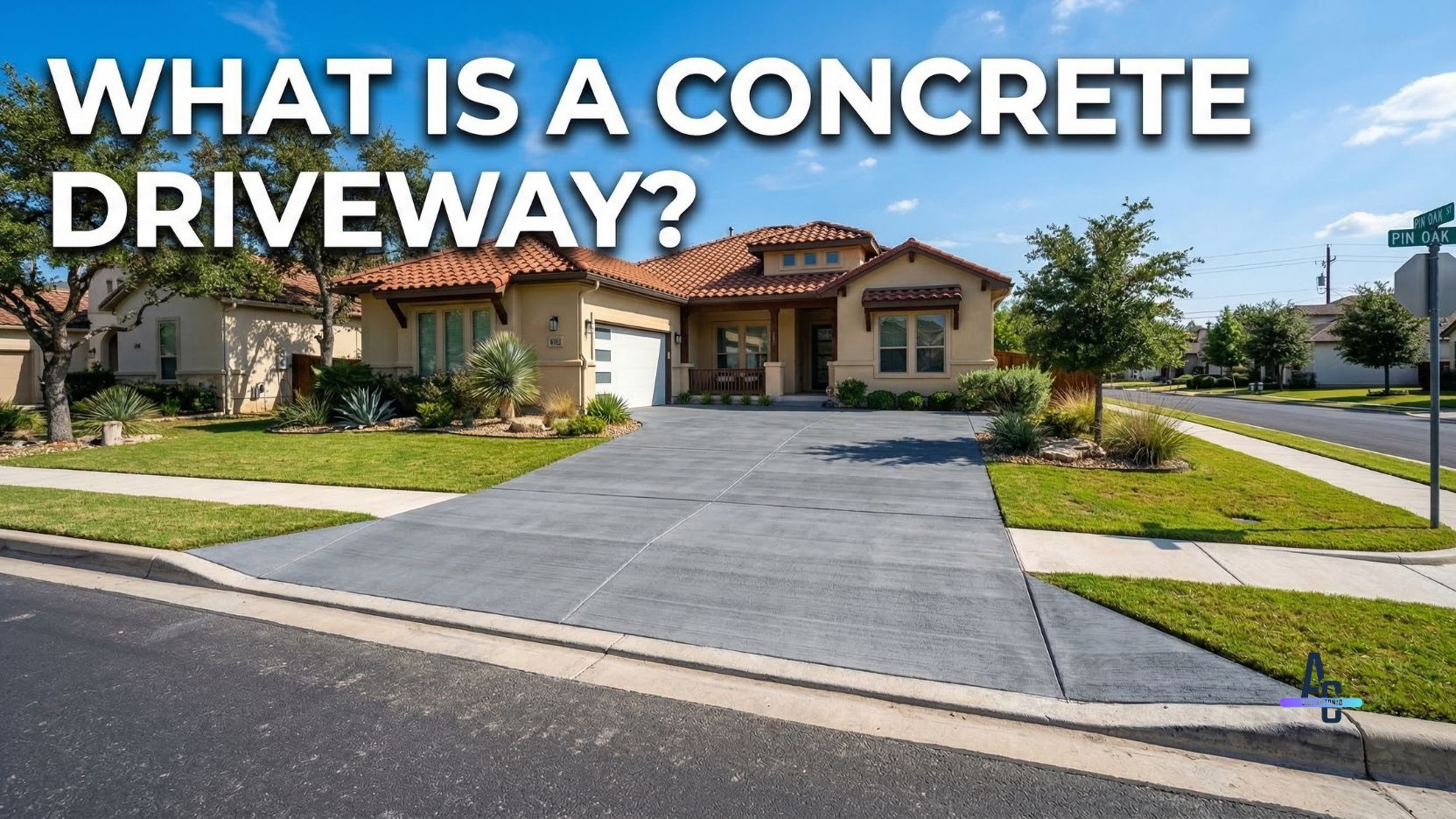
What is a concrete driveway? It is a reinforced slab of poured concrete on a compacted stone base that carries your cars from the street to the garage. This guide covers the materials in a concrete driveway, what goes under it, the finishes you can choose, what it costs in San Antonio, and how it compares with asphalt, gravel, and pavers.
- What is a concrete driveway?
- What is a driveway, and where does concrete fit in?
- What materials are in a concrete driveway?
- Is a cement pavement driveway the same as a concrete driveway?
- What goes under a concrete driveway?
- How does San Antonio clay soil affect a concrete driveway?
- What finishes can a concrete driveway have?
- How does concrete compare with asphalt, gravel, and pavers?
- How long does a concrete driveway last?
- How much does a concrete driveway cost in San Antonio?
- What should I ask before a concrete driveway is installed?
- Where do we work?
- What else are homeowners asking?
A concrete driveway is a slab of cement, sand, stone, and water, poured at least 4 inches thick over a compacted crushed limestone base with a rebar grid. Built that way, it lasts about 30 to 40 years on San Antonio clay soil. Call a pro for a new driveway, or when cracks pass 1/4 inch.
What is a concrete driveway?
A concrete driveway is a paved strip of poured concrete, usually at least 4 inches thick, that sits on a compacted stone base and carries vehicles from the street to your garage or parking area. Steel reinforcement and cut control joints help it carry weight and crack in straight lines instead of at random.
It is not just cement poured on dirt. A concrete driveway is a built system: excavation, a compacted base, forms, rebar on chairs, the concrete itself, a finish, control joints, and curing. When any one of those steps is skipped, the slab usually shows it within a few years.
The basic specs most San Antonio driveways are built to
What is a driveway, and where does concrete fit in?
A driveway is the private paved or graveled path that connects the street to your garage, carport, or parking pad. Concrete is one of several driveway surfaces, alongside asphalt, gravel, and pavers, and it is the most common choice for homes that want a long-lasting, low-upkeep surface.
- The driveway itself: The slab on your property that you park and drive on.
- The approach: The section that crosses the curb and sidewalk to meet the street. Work there involves the city, so the permit is confirmed before any pour.
- Add-ons: Side parking pads, RV pads, and walkways are often poured at the same time as the driveway.
Need extra parking beside the driveway? See our guide to concrete parking pads.
What materials are in a concrete driveway?
The main concrete driveway materials are Portland cement, sand, coarse aggregate such as gravel or crushed stone, and water, mixed into ready-mix concrete. Under and inside the slab you also have crushed limestone base, steel rebar, and sometimes fiber.
| Concrete driveway material | What it does | Typical spec in San Antonio |
|---|---|---|
| Cement | Binds the sand and stone together as it cures | Part of a 3,000 psi minimum mix, 4,000 psi for heavy use |
| Sand and stone aggregate | Gives the slab its bulk and strength | Delivered in ready-mix trucks |
| Water | Starts the chemical reaction that hardens the concrete | Kept in check so the mix is not watered down |
| Crushed limestone base | Spreads vehicle weight and separates the slab from clay | 4 to 6 inches, compacted |
| Rebar | Holds cracked sections together and level | Grid set on chairs inside the slab |
| Fiber (optional) | Helps control surface shrinkage cracks | Added to the mix, never a substitute for rebar |
| Curing compound and sealer | Hold moisture in while curing, then keep water and oil out | Seal about 28 to 30 days after the pour |
Specs from our driveway installation page and driveway thickness guide.
Is a cement pavement driveway the same as a concrete driveway?
Yes. People often say cement driveway or cement pavement driveway, but the finished surface is concrete, and cement is only one ingredient in it. Cement is the gray powder that acts as the glue; concrete is the hardened mix of cement, sand, stone, and water.
The difference matters when you compare quotes. Ask for the concrete mix strength in psi, the slab thickness, and the reinforcement, not just “a cement driveway.” Our post on cement driveway construction walks through how it is built.
What goes under a concrete driveway?
Under a concrete driveway is a compacted native subgrade, then about 4 to 6 inches of compacted crushed limestone base. A driveway poured on the ground with no base, sometimes sold as a ground concrete driveway, moves with the soil and cracks early.
- Excavation: The old surface and soft or organic soil come out. On caliche lots, the dig is adjusted so the base still sits level and firm.
- Subgrade: The native soil is compacted before any stone goes in.
- Base: Crushed limestone, compacted in layers, about 4 inches for cars and 6 inches for heavy use.
- Slab: At least 4 inches of concrete, 5 to 6 inches where pickups, SUVs, or trailers park, with thickened edges.
- Slope: About 1/8 to 1/4 inch of fall per foot toward the street so rain runs off.
How does San Antonio clay soil affect a concrete driveway?
Much of San Antonio sits on expansive clay that swells when wet and shrinks in drought, and that movement is the biggest threat to a driveway here. A compacted crushed limestone base, a rebar grid, and control joints let the slab ride over the movement instead of breaking with it.
- A crack is wider than 1/4 inch, or one side sits higher than the other
- Water pools on the slab or runs toward the garage or house
- A panel has sunk, tilted, or lifted near a tree
Call (713) 504-2341 or request a free quote.
What finishes can a concrete driveway have?
A broom finish is standard, and exposed aggregate, stamped, and stained or colored finishes cost more but change the look. The finish is the biggest swing in price per square foot.
- Broom finish: Light brushed texture for grip. The most common and lowest-cost choice.
- Exposed aggregate: The top cement paste is washed off to show the stone in the mix. Naturally slip-resistant.
- Stamped: Pressed with patterns that look like stone, brick, or slate. Needs resealing more often.
- Stained or colored: Integral color or stain warms up plain gray concrete.
Compare them side by side in our guide to the best concrete driveway finishes for San Antonio homes, or see our stamped concrete driveways.
How does concrete compare with asphalt, gravel, and pavers?
Concrete costs more than asphalt or gravel up front but lasts longer and needs less upkeep, while pavers cost more and can be fixed one section at a time. In San Antonio heat, concrete stays rigid where asphalt can soften.
| Driveway material | Main benefit | Main drawback |
|---|---|---|
| Concrete | About 30 to 40 years, stays firm in heat, low upkeep | Higher up-front cost, can crack if the base is poor |
| Asphalt | Lower up-front cost, about $4 to $7 per sq. ft. | About 15 to 30 years, binder softens in Texas summers, sealcoating every 1 to 3 years |
| Gravel | Lowest starting cost | Stones scatter, ruts, and need regrading |
| Pavers | High-end look, repairable by section | Usually the most expensive option |
Concrete and asphalt figures from our driveway installation page and concrete vs asphalt driveways guide.
How long does a concrete driveway last?
A properly built and maintained concrete driveway typically lasts about 30 to 40 years. Thin slabs without steel or a real base can start failing in 8 to 15 years.
Seal it about 28 to 30 days after the pour, then reseal every 3 to 5 years for broom or aggregate finishes, or every 2 to 3 years for stamped or stained. Keep cars off for about 7 days and heavy loads off for about 28 days. More in our guide on how long a concrete driveway lasts.
How much does a concrete driveway cost in San Antonio?
A standard broom-finish concrete driveway in San Antonio typically runs about $7 to $12 per square foot installed. Decorative finishes and tear-out of an old driveway add to that.
| Driveway type | Typical installed cost | Notes |
|---|---|---|
| Broom finish | About $7 to $12 per sq. ft. | Standard finish |
| Exposed aggregate | About $10 to $16 per sq. ft. | Stone texture, good grip |
| Stained or colored | About $12 to $18 per sq. ft. | New concrete |
| Stamped | About $14 to $20 per sq. ft. | Reseal every 2 to 3 years |
| Single-car driveway, 240 to 400 sq. ft. | About $2,800 to $4,800 | Broom finish, rebar, compacted base |
| Removing an old driveway | About $1,500 to $3,500 extra | Demo, haul-away, and grading |
Typical estimates as of November 2026 from our concrete driveway cost guide. They are not a quote. Your written price depends on size, thickness, access, and finish.
What should I ask before a concrete driveway is installed?
Ask for the slab thickness, base depth, reinforcement, mix strength, and finish in writing before work starts. Those details decide how long the driveway lasts, and they are easy to cut when they are not on paper.
- How thick is the slab, and is it thicker where heavy vehicles park?
- How deep is the crushed limestone base, and how is it compacted?
- Is there a rebar grid on chairs, and what psi is the mix?
- Where do the control joints go, and which way does water drain?
- Does the work touch the curb, approach, or sidewalk, and who handles the city permit?
- When can I drive on it, and when should it be sealed?
Ready to plan yours? Start with our concrete driveway installation service or our concrete driveway repair and replacement page, request a free quote, or call (713) 504-2341.
Thinking about a new concrete driveway?
Free site visit and a written, itemized price that lists base, thickness, steel, and finish before any work starts. Father-son owned in San Antonio.
Where do we work?
Affordable Concrete San Antonio works across San Antonio and nearby areas from our shop at 1247 W Thompson Pl, San Antonio, TX 78226.
We install and repair concrete driveways in San Antonio and these nearby areas: Helotes, Leon Valley, Shavano Park, Terrell Hills, Alamo Heights, Converse, Universal City, Schertz, Boerne, Cibolo, Fair Oaks Ranch, Bulverde, Spring Branch, New Braunfels, Pleasanton, Floresville, Castroville, Lytle, and Von Ormy. Not sure about your address? Call (713) 504-2341.
What else are homeowners asking?
These are the short answers people want before they book a quote.
What is a concrete driveway?
A concrete driveway is a slab of poured concrete, usually at least 4 inches thick, on a compacted crushed limestone base with a rebar grid. It carries vehicles from the street to the garage.
What materials are used for a concrete driveway?
The concrete is a mix of cement, sand, gravel or crushed stone, and water. Under and inside it are a compacted crushed limestone base, a rebar grid, and sometimes fiber.
What is the difference between cement and concrete?
Cement is one ingredient in concrete. Concrete is the finished material made from cement, sand, stone, and water, so a cement driveway is really a concrete driveway.
How long does a concrete driveway last?
A properly built and maintained concrete driveway typically lasts about 30 to 40 years. Thin slabs without steel or a proper base can fail in 8 to 15 years.
Is concrete better than asphalt for a driveway in San Antonio?
Concrete usually lasts about 30 to 40 years and stays firm in summer heat, while asphalt lasts about 15 to 30 years and costs less up front, about $4 to $7 per square foot.
How much does a concrete driveway cost in San Antonio?
A standard broom-finish concrete driveway typically runs about $7 to $12 per square foot installed. Stamped finishes run about $14 to $20 per square foot.
Sources used in this article:
- Affordable Concrete San Antonio, concrete driveway installation service page, checked November 12, 2026, affordableconcretesanantonio.com
- Affordable Concrete San Antonio, concrete driveway cost in San Antonio, checked November 12, 2026, affordableconcretesanantonio.com
- Affordable Concrete San Antonio, how thick should a concrete driveway be, checked November 12, 2026, affordableconcretesanantonio.com
- Affordable Concrete San Antonio, concrete vs asphalt driveways, checked November 12, 2026, affordableconcretesanantonio.com
This article is general information for San Antonio homeowners. Specs and lifespans depend on soil, loads, and build quality. Prices are typical estimates as of November 2026 and are not a quote.
What should I read next?
Start with our driveway installation page, or keep reading before you get quotes.