
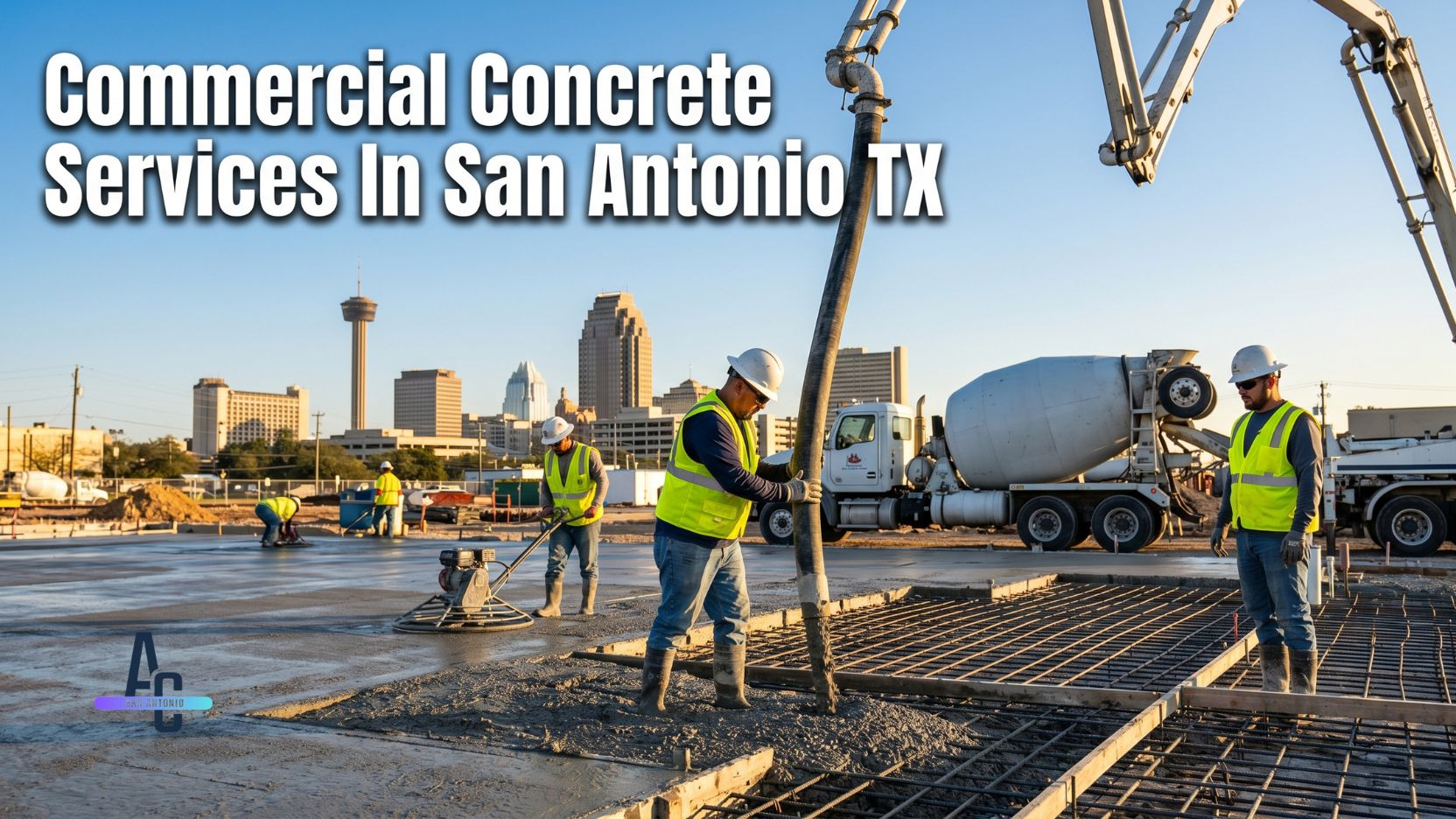
General contractors, builders, and property owners running their own projects often hire a concrete subcontractor for the slabs, flatwork, and paving. A good concrete sub shows up on schedule, builds to the drawings, and hands over clean paperwork. This guide covers what to look for, how concrete subcontractors price work in San Antonio, the scope to put in writing, permits and inspections, Texas lien waivers and retainage, and how long the work takes.
- What does a concrete subcontractor do?
- What should I look for in a concrete subcontractor?
- How much does a concrete subcontractor cost in San Antonio?
- What should a concrete subcontract include?
- How do lien waivers and retainage work with a concrete subcontractor in Texas?
- Who handles permits and inspections when you use a concrete subcontractor?
- How does San Antonio soil affect what a concrete sub should bid?
- How long does concrete subcontractor work take?
- What should I ask a concrete subcontractor before signing?
- Where do we work?
- What else are homeowners asking?
Hire a concrete subcontractor who carries at least $1 million in liability, bids your exact drawings line by line, and can name the crew and pour dates. Commercial flatwork in San Antonio typically runs about $5 to $9 per square foot installed. Expansive clay makes base prep critical, so call a pro early on heavy or structural slabs.
What does a concrete subcontractor do?
A concrete subcontractor is hired by the general contractor or owner to build the concrete part of a project: base prep, forms, reinforcement, placing, finishing, curing, and joints. The sub works to the project drawings and schedule, and the general contractor runs the overall job.
- Commercial flatwork: Building slabs, shop and warehouse floors, retail pads, and equipment pads.
- Site concrete: Sidewalks, curbs, dumpster pads, parking areas, and drive lanes.
- Residential builds and remodels: Driveways, patios, walkways, and garage slabs for builders and remodelers.
- Repairs and replacement: Panel replacement, joint repair, and edge rebuilds on existing property.
Our commercial concrete services page covers the work we take on for businesses, general contractors, and property owners in San Antonio.
What should I look for in a concrete subcontractor?
Look for a concrete subcontractor with insurance certificates in hand, recent jobs like yours, a crew it controls, and a bid that follows your drawings line by line. Price matters, but a sub who misses a pour date or fails an inspection costs the whole schedule.
- Insurance: General liability of at least $1 million per occurrence on commercial work, plus workers’ compensation, with you named as additional insured. We carry $2,000,000 in liability coverage.
- No state license to check: Texas does not issue a statewide license for concrete contractors, so insurance, references, and past work are your proof.
- Matching experience: A crew that pours driveways is not automatically ready for a warehouse floor with a flatness spec. Ask for local jobs of the same type and size.
- Its own crew: Ask who will actually form, place, and finish, and whether any of the work is passed to another sub.
- Hot-weather plan: From May through October, pours should start early with evaporation retarder and sunshade on hand.
Checked against our commercial concrete services page and our commercial contractor, flatwork, and permits guides on October 22, 2026.
How much does a concrete subcontractor cost in San Antonio?
Most concrete subcontractors in San Antonio price by the square foot or as a lump sum built from unit prices. Commercial flatwork typically runs about $5 to $9 per square foot installed, depending on thickness, base, reinforcement, and finish.
| Work | Typical installed cost | Notes |
|---|---|---|
| Light commercial slab | About $5 – $7 / sq. ft. | 4 – 5 in., wire mesh or light rebar, 4 in. base |
| Standard commercial slab | About $6 – $8 / sq. ft. | 6 in., rebar grid, 6 in. base |
| Heavy industrial slab | About $7 – $9 / sq. ft. | 7 – 8 in., #5 rebar, engineered base |
| Heavy-duty engineered slab | About $8 – $12+ / sq. ft. | Lime stabilization, thick reinforcement |
| Residential driveway, broom finish | About $7 – $12 / sq. ft. | For builders and remodelers |
| 5,000 sq. ft. standard 6 in. slab | About $30,000 – $40,000 | Simple arithmetic from the $6 – $8 range |
Typical estimate ranges as of October 2026, in line with our commercial slabs and flatwork guide, our cast-in-place concrete contractors guide, and our driveway cost guides. They are not quotes; your price is set in writing after a free site visit or plan review.
What most San Antonio projects can expect
What should a concrete subcontract include?
A concrete subcontract should spell out exactly which drawings and specs the sub is bidding, what is included and excluded, the pour schedule, and how changes and payments are handled. Most disputes come from scope that was assumed, not written.
- Drawings and spec sections: List the sheet numbers and revision dates the price is based on.
- Inclusions: Subgrade and base, forms, vapor barrier, reinforcement, concrete, finish, curing, saw cutting, and joint sealant, each on its own line.
- Exclusions: Common ones are testing lab fees, pump trucks, winter or hot-weather protection, layout, and dirt work. Know who pays for each.
- Mix and testing: At least 4,000 psi at 28 days for commercial flatwork, and no water added on site without retesting slump.
- Schedule: Mobilization dates, pour sequence, and how weather delays are handled.
- Change orders: Written and priced before extra work starts.
- Warranty: What the workmanship warranty covers and for how long.
How do lien waivers and retainage work with a concrete subcontractor in Texas?
In Texas, a concrete subcontractor’s lien waiver is only enforceable if it substantially follows the statutory forms in Chapter 53 of the Texas Property Code. Owners also must hold back 10 percent of the contract price during the work and for 30 days after it is complete.
- Conditional waivers: Swap a conditional progress waiver for each payment; it takes effect once the check clears.
- Unconditional waivers: Only after the sub has actually been paid.
- Retainage: The statute requires the owner to reserve 10 percent until 30 days after completion, so plan the final payment around it.
- Get legal advice: Lien deadlines and notices are technical. Have an attorney review your subcontract forms.
Based on Texas Property Code Sections 53.101 and 53.281 to 53.284, checked October 22, 2026. This is general information, not legal advice.
Who handles permits and inspections when you use a concrete subcontractor?
On most commercial jobs the general contractor holds the building permit, and the concrete subcontractor builds to it and must be ready for the pre-pour inspection. Work in the public right-of-way needs its own City permit.
- Commercial slabs and sitework: Expect a City of San Antonio permit, stamped engineering for structural slabs, and a pre-pour inspection of forms, base, and steel.
- Public right-of-way: Sidewalks, curb cuts, and drive approaches in the right-of-way need a Sidewalk-Curb Permit; agree in writing who pulls it.
- Residential flatwork: Sidewalks and driveways inside the property line are on the City’s No Permit Required List (checked October 22, 2026), but Historic, Neighborhood Conservation, and Corridor Districts can limit design and materials.
- Questions: Call Development Services at 210-207-1111 before work is scheduled.
Our commercial permits, codes, and ADA guide covers inspections and accessibility rules in more detail.
How does San Antonio soil affect what a concrete sub should bid?
San Antonio’s expansive clay swells when wet and shrinks when dry, so a concrete sub’s bid should show real base work and reinforcement, not a thin slab on bare dirt. Heavier and structural slabs usually need a geotechnical report and an engineered design.
- Base: At least 4 inches for light commercial and 6 inches for warehouses, with compaction testing in the scope.
- Reinforcement: Bar size and spacing in writing; rebar grid is preferred on clay soils.
- Drainage: Slabs and paving should shed water away from buildings.
- The slab will carry forklifts, racking, trucks, or heavy equipment
- The concrete holds up a building, such as a foundation or grade beam
- The site has a history of cracking, heaving, or standing water
- Bids for the same drawings are far apart, which usually means scope is missing
Call (713) 504-2341 for a free site visit or plan review, or see our commercial concrete slabs page.
How long does concrete subcontractor work take?
Most commercial slabs and flatwork take a few days to a few weeks on site, depending on size, inspections, and weather, and the concrete needs its full 28-day cure before forklifts or heavy equipment. Residential driveways can usually take cars after about 7 days.
- Plan review or site visit: The sub reviews drawings, access, and soil.
- Written bid: Itemized scope, exclusions, and price.
- Permits and submittals: Mix design and reinforcement submitted, permits confirmed.
- Base, forms, and steel: Then the pre-pour inspection where required.
- Pour and finish: Early-morning pours in hot months, then curing.
- Joints and closeout: Saw cuts, joint sealant after the 28-day cure, final walkthrough, and lien waivers.
What should I ask a concrete subcontractor before signing?
Ask every concrete subcontractor the same questions in writing so the answers line up side by side. Get at least three itemized bids for the same scope.
- Which drawings, revisions, and spec sections is this price based on?
- What is excluded, and who pays for testing, pumping, and layout?
- Who is the foreman, and is any of the work passed to another sub?
- What thickness, base, reinforcement, and psi are you pricing?
- Can I have your insurance certificate with my company named as additional insured?
- Will you provide Texas statutory lien waivers with every pay application?
Ready for a bid? See our commercial concrete services page, our driveway installation page for residential builds, our commercial contractor guide, or request a free quote.
Need a concrete subcontractor in San Antonio?
Free plan review or site visit, an itemized written bid, and a straight answer on specs, permits, and schedule. Licensed and insured, $2,000,000 liability coverage.
Where do we work?
Affordable Concrete San Antonio works across San Antonio and nearby areas from our shop at 1247 W Thompson Pl, San Antonio, TX 78226.
We work as a concrete subcontractor and direct contractor in San Antonio and these nearby areas: Helotes, Leon Valley, Shavano Park, Terrell Hills, Alamo Heights, Converse, Universal City, Schertz, Boerne, Cibolo, Fair Oaks Ranch, Bulverde, Spring Branch, New Braunfels, Pleasanton, Floresville, Castroville, Lytle, and Von Ormy. Not sure about your address? Call (713) 504-2341.
What else are homeowners asking?
These are the short answers people want before they book a quote.
What does a concrete subcontractor do?
A concrete subcontractor builds the concrete portion of a project for the general contractor or owner, including base prep, forms, reinforcement, placing, finishing, curing, and joints, following the project drawings and schedule.
How much does a concrete subcontractor charge per square foot in San Antonio?
Commercial flatwork typically runs about $5 to $9 per square foot installed in San Antonio, and heavy engineered slabs can reach $8 to $12 or more. A broom-finish residential driveway runs about $7 to $12.
Do concrete contractors need a license in Texas?
Texas does not issue a statewide license for concrete contractors. Check insurance certificates, recent local references, and past work of the same type instead, and confirm any permits the job needs.
What insurance should a concrete subcontractor carry?
Ask for at least $1 million per occurrence in general liability on commercial work, plus workers compensation, with your company named as additional insured. Affordable Concrete San Antonio carries $2,000,000 in liability coverage.
What is retainage on a Texas construction project?
Texas Property Code Section 53.101 requires the owner to reserve 10 percent of the contract price during the work and for 30 days after the work is completed.
Who pulls the permit, the general contractor or the concrete sub?
On most commercial projects the general contractor holds the building permit. Right-of-way work such as sidewalks and drive approaches needs a City Sidewalk-Curb Permit, so agree in writing who pulls it.
Sources used in this article:
- Texas Property Code Section 53.101, funds required to be reserved, checked October 22, 2026, statutes.capitol.texas.gov
- Texas Property Code Chapter 53, Subchapter L, waiver and release forms, statutes.capitol.texas.gov
- City of San Antonio, No Permit Required List, checked October 22, 2026, sa.gov
- City of San Antonio, Development Services Department, sa.gov
- City of San Antonio, Sidewalk-Curb Permit Application, docsonline.sanantonio.gov
- Affordable Concrete San Antonio, commercial concrete services page, affordableconcretesanantonio.com/commercial-concrete-services/
- Affordable Concrete San Antonio, commercial concrete slabs and flatwork guide, affordableconcretesanantonio.com/concrete-blogs/commercial-concrete-slabs-flatwork/
- Affordable Concrete San Antonio, how to choose a commercial concrete contractor, affordableconcretesanantonio.com/concrete-blogs/how-to-choose-a-commercial-concrete-contractor-in-san-antonio/
This article is general information for San Antonio property owners and builders. Prices are typical estimates as of October 2026 and can change. Laws and City rules can change too; the City of San Antonio is the final authority on permits, and this is not legal advice. It is not a quote and does not replace a site visit or an engineer.
What should I read next?
Start with our commercial services page, or keep reading if you are comparing bids.