
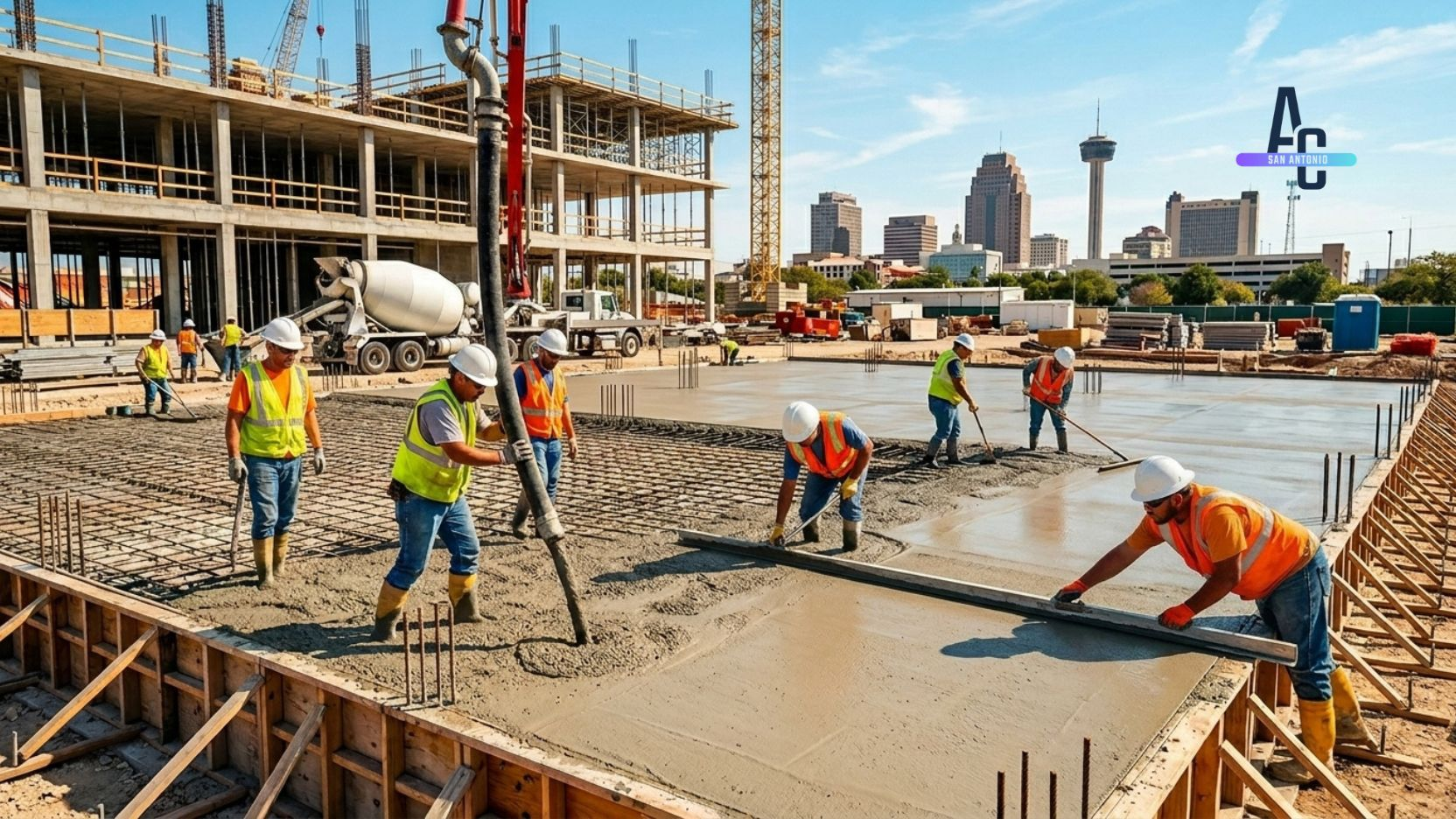
Hiring the wrong commercial concrete contractor can cost you tens of thousands in delays, failed inspections, and premature slab failure. This guide covers every factor that separates a qualified commercial contractor from a risky one: licensing, bonding, experience, bid review, scheduling, and local code knowledge.
On a commercial project, the contractor you hire matters more than the concrete itself. The same ready-mix can produce a parking lot that lasts 30 years or one that spalls and cracks within three, and the difference is almost always the crew, the prep, and the project management behind the pour. A retail slab that fails inspection, a restaurant patio that misses an ADA tolerance, or a warehouse floor that is out of flatness spec can each stall a business opening and trigger expensive rework.
This guide walks through how to evaluate a commercial concrete contractor in San Antonio the way an experienced project owner does: verifying credentials, matching experience to your building type, reading bids line by line, and confirming the contractor understands local permitting, expansive clay soils, and Texas accessibility requirements before any concrete is ordered.
The most expensive mistake commercial owners make is awarding the job to the cheapest bid without checking what that bid actually includes. A low number almost always means something is missing: thinner base prep, no vapor barrier, lighter reinforcement, or no allowance for the geotechnical conditions that San Antonio’s clay soils demand. The contractor who itemizes every line, asks about your operating schedule, and brings local commercial references is the one who saves you money over the life of the slab. Get the scope right first, then compare price.
Credentials
Texas does not issue a statewide license specifically for concrete contractors, which means anyone can call themselves one. On commercial work, that makes documentation your first line of defense. A qualified commercial contractor carries general liability insurance, workers compensation, and the bonding capacity your project requires, and they provide proof on request without hesitation.

General liability: $1M per occurrence is the floor for commercial work, with $2M aggregate common on larger projects. Ask to be named as an additional insured on the certificate.
Workers compensation: Required protection so that an on-site injury is the contractor’s responsibility, not a claim against your property or business.
Bonding: For larger contracts, payment and performance bonds guarantee the job finishes and subcontractors get paid, protecting you from liens.
- General liability certificate received and confirmed active with the insurer
- Coverage limits meet or exceed $1M per occurrence for commercial scope
- Workers compensation coverage verified for the contractor and any subcontractors
- Your company named as additional insured on the policy
- Payment and performance bonding confirmed for larger contract values
Experience
Commercial concrete is a different discipline from residential flatwork. Heavy-duty parking lots, loading docks, warehouse slabs with flatness tolerances, and ADA-compliant entrances each demand specific experience. The most reliable predictor of a successful project is a contractor who has completed work that closely matches yours in both type and size.

Ask for a matching portfolio: If you are building a retail center, ask for retail and restaurant projects. If it is a distribution warehouse, ask for slabs poured to a defined flatness number, not just driveways scaled up.
Confirm scope familiarity: Loading docks, dock levelers, control and construction joints, vapor barriers under conditioned space, and heavy-load thickening are commercial-specific details a residential crew may overlook.
- Portfolio includes completed projects of your building type and comparable size
- Contractor can name the specific commercial scope items your project involves
- Recent local commercial references available on request
- Familiarity with San Antonio expansive clay soils and base preparation demonstrated
- Crew has poured slabs to a flatness specification if your project requires one
Bidding
The single most useful habit in commercial contracting is refusing to compare lump-sum totals. A $90,000 bid and a $78,000 bid mean nothing until you see what each one includes. Ask every contractor for an itemized proposal that breaks out the same line items, so you are comparing the same scope across all three bids.

What a complete commercial bid itemizes: site work and excavation, subgrade preparation and compaction, base material and depth, vapor barrier, reinforcement type and grade, concrete strength in psi, finishing method, joint layout, sealing, and final cleanup.
Watch the exclusions: The fine print is where bids diverge. Items listed as “by others” or “not included” are how a low number is built, and they often become change orders later.
| Bid line item | What a complete bid specifies | Red flag |
|---|---|---|
| Subgrade and base | Compaction method and base depth stated, sized for clay soils | “Prep site” with no depth or compaction detail |
| Reinforcement | Rebar size and spacing or mesh grade specified | Reinforcement not mentioned, or “as needed” |
| Concrete strength | Defined psi appropriate to load, often 3,000 to 4,000 psi | No mix design or psi listed |
| Joints and sealing | Control and construction joint layout, sealing included | Joints and sealing left off the scope |
| Allowances and exclusions | Clear unit pricing for added quantities, exclusions listed plainly | Vague allowances that invite later change orders |
Ask for unit pricing. Commercial sites frequently uncover surprises once excavation begins, such as soft soils, buried debris, or utility conflicts. A contractor who provides unit prices per cubic yard and per square foot up front gives you a predictable way to handle added quantities, instead of an open-ended change order negotiated mid-project when you have little leverage.
- All three bids itemize the same line items for a true comparison
- Concrete strength in psi, reinforcement, and base depth are specified in writing
- Exclusions and “by others” items are read and understood before signing
- Unit pricing provided for likely added quantities and conditions
- Payment schedule tied to completed milestones, not full payment upfront
Scheduling
A commercial slab usually sits on the critical path of a larger build, or has to be poured around a business that is still operating. That makes scheduling and project management as important as the pour itself. You are evaluating whether the contractor has the crew size, equipment, and coordination to deliver on the date they promise.
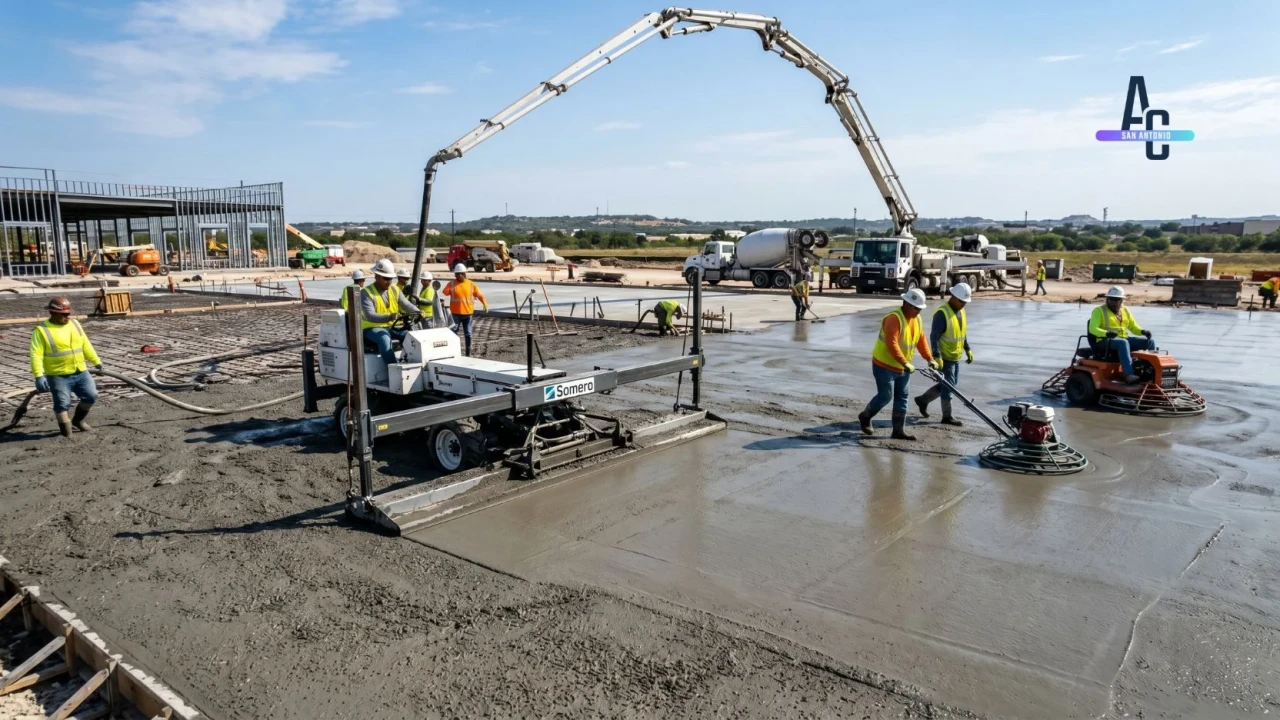
Capacity to deliver: Ask about crew size, equipment owned versus rented, and whether work is self-performed or subcontracted. Larger pours benefit from a laser screed, ride-on power trowels, and a pump truck.
Coordination: A dedicated project manager, a written schedule, and a plan for phasing around your operations separate a commercial contractor from a residential crew taking on a bigger job.
In San Antonio’s climate, scheduling also affects quality. Summer pours require early morning starts, curing compounds, and careful monitoring so the surface does not dry before it cures. A contractor who builds these realities into the schedule, rather than promising an impossible turnaround, is the one who delivers a durable slab on time.
- Crew size and equipment match the scale of your project
- A dedicated point of contact or project manager is assigned
- Written schedule provided with realistic milestones and cure times
- Plan in place to phase work around an operating business if needed
- Weather and contingency planning addressed up front
Codes & ADA
Residential flatwork often proceeds with little oversight. Commercial concrete does not. Your project will be permitted through the City of San Antonio Development Services Department, inspected, and held to accessibility standards. A contractor who has not worked through this process locally can stall your opening with failed inspections.
Permits and inspections: A capable commercial contractor knows what triggers a permit, coordinates inspections, and builds them into the schedule so the pour is not held up.
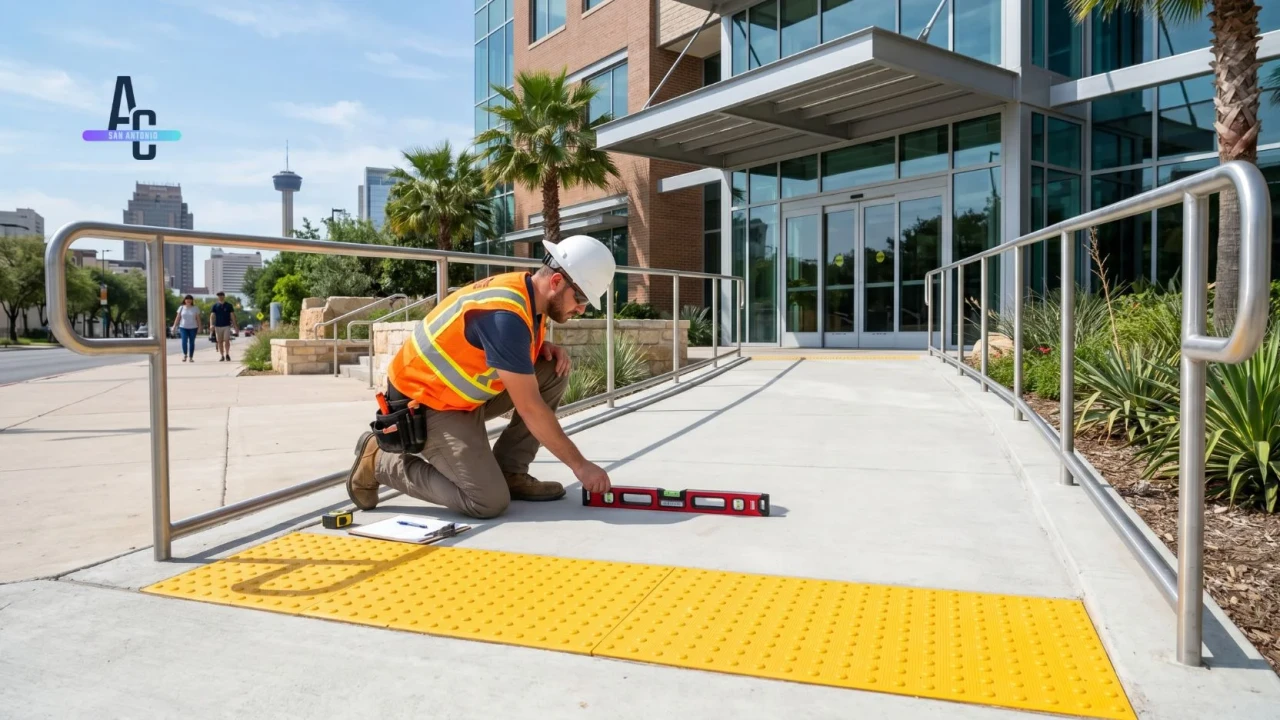
Accessibility: Commercial sites must meet the Texas Accessibility Standards and the ADA. Accessible routes, curb ramps, and parking have strict slope tolerances, and getting them wrong means tearing out and repouring concrete.
- Contractor knows what triggers a City of San Antonio permit for your scope
- Inspections are coordinated and built into the project schedule
- Accessible routes, ramps, and parking planned to ADA and TAS slope tolerances
- Registered Accessibility Specialist review accounted for if your project requires it
- Geotechnical recommendations followed for slabs over expansive clay
Reputation
The last layer of vetting is the one owners skip most often and regret most. References, safety record, and financial stability tell you whether a contractor who looks good on paper actually performs on site and stays solvent long enough to honor a warranty.

Call the references: Ask past commercial clients whether the job finished on schedule and on budget, how change orders were handled, and whether they would hire the contractor again.
Safety and stability: A documented safety program protects everyone on your site. A financially stable contractor can buy materials and carry payroll without demanding heavy upfront payments, and can stand behind a warranty.
- At least two recent commercial references contacted and verified
- Documented job-site safety program in place
- No pattern of unresolved complaints, liens, or disputes
- Financially able to purchase materials without excessive upfront payment
- Written warranty on workmanship provided in the contract
Use this table as your at-a-glance reference when comparing commercial concrete contractors in San Antonio. Each row is a quick green-light or red-flag test you can run during a site visit or bid review.
| Evaluation area | Green light | Red flag |
|---|---|---|
| Insurance | Current COI, $1M+ liability, names you as additional insured | “We’re covered” with no documentation |
| Experience | Portfolio matches your building type and size | Only residential or unrelated work to show |
| Bid quality | Itemized scope, psi, reinforcement, base, and joints specified | Lump sum with no detail or specifications |
| Scheduling | Written schedule, dedicated PM, realistic cure times | Verbal promises and impossible turnaround dates |
| Code and ADA | Knows local permitting, inspections, and slope tolerances | Unfamiliar with TAS, ADA, or San Antonio permitting |
| References | Verifiable recent commercial references provided | No references or stock photos only |
| Payment terms | Deposit upfront, balance tied to milestones | Full payment demanded before work begins |
- General liability certificate confirmed active directly with the insurer
- Coverage of $1M+ per occurrence, with you named as additional insured
- Workers compensation verified for the contractor and subcontractors
- Payment and performance bonding confirmed for larger contracts
- Portfolio includes completed projects of your type and comparable size
- At least two recent local commercial references contacted
- Familiarity with San Antonio expansive clay soils demonstrated
- Documented job-site safety program in place
- Three itemized bids compared on the same line items
- Concrete psi, reinforcement, base depth, and joints specified in writing
- Exclusions, allowances, and unit pricing reviewed and understood
- Payment schedule tied to milestones, with a written workmanship warranty
- Permitting and inspections coordinated through City of San Antonio
- Accessible routes and ramps planned to ADA and TAS tolerances
- Written schedule with realistic cure times and weather contingency
- Plan to phase work around your operations if the business stays open
What licenses should a commercial concrete contractor have in San Antonio?
How many bids should I get for a commercial concrete project?
How do I compare commercial concrete bids fairly?
Do commercial concrete projects in San Antonio require ADA compliance?
How long should a commercial concrete contractor’s warranty be?
Get a free commercial concrete quote in San Antonio
Tell us about your project: retail slab, restaurant patio, office walkway, warehouse floor, or industrial pad. We will visit the site, review the scope, and provide a detailed itemized quote at no cost.