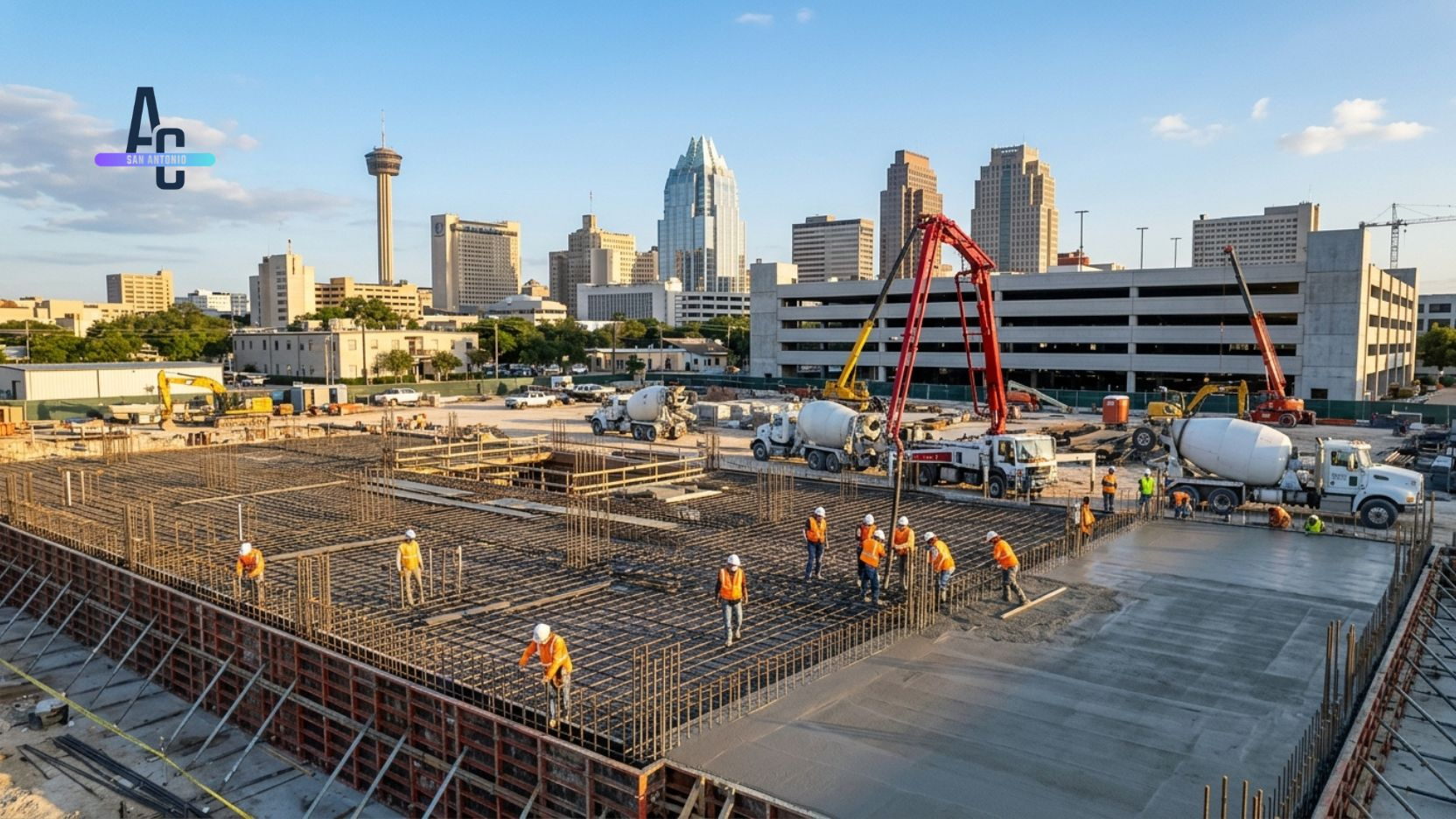
Commercial Concrete Cost in San Antonio

Commercial Concrete Cost In San Antonio

Commercial Concrete Cost in San Antonio | Affordable Concrete San Antonio
Commercial Concrete Guide: San Antonio, TX

What a commercial concrete project actually costs in San Antonio, broken down by project type, square footage, spec requirements, and the variables that move the price up or down. Real numbers from real jobs in Bexar County, not national averages that don't reflect the local market.

Commercial concrete cost San Antonio Parking lot concrete price per sqft Cost guide · 2026 pricing · Bexar County Warehouses · Retail · Offices · Industrial Updated 2026
A
Affordable Concrete San Antonio: Editorial Team
With over 10 years of residential and commercial concrete experience in San Antonio and the surrounding areas, our team has completed thousands of driveways, patios, pool decks, and commercial slabs across Bexar County. Every guide we publish reflects real on-the-ground expertise, not generic contractor advice.
· affordableconcretesanantonio.com · Licensed & Insured · $2M Liability Coverage
$5–9/sqft
Standard commercial parking lot concrete in San Antonio (6" slab, rebar, plain broom finish)
6"
Minimum slab thickness for commercial vehicle areas; 8" for heavy truck traffic and loading docks
$8–14/sqft
Commercial warehouse floor and interior slab, including vapor barrier and surface hardener
28 days
Full cure time before heavy vehicle or forklift traffic on a commercial slab

Commercial concrete pricing in San Antonio operates differently from residential work. The numbers are driven by scale, load requirements, permitting complexity, and the spec standards set by the City of San Antonio, TxDOT, and ADA compliance rules. A business owner or property developer budgeting for a commercial slab without understanding those variables will either overpay or underbuy, and both outcomes cost money.

This guide breaks down commercial concrete costs in San Antonio by project type: parking lots, warehouse floors, retail slabs, loading docks, and commercial driveways. It explains what drives the price, what the spec minimums are, and what questions to ask before any contractor begins work on your property.

The most important thing to understand about commercial concrete pricing in San Antonio

Commercial concrete is not priced the same way as residential work. The spec is more demanding, the permitting is more involved, and the liability exposure on a commercial property is higher. A contractor quoting a commercial parking lot at residential pricing is almost certainly cutting corners on thickness, reinforcement, or base preparation. The cost tables in this guide reflect properly spec'd commercial work that will pass a City of San Antonio inspection, not the lowest number you can find.

● ● ●
Six cost categories that cover most commercial projects
Commercial concrete costs in San Antonio by project type
01
Commercial parking lot concrete: cost per square foot in San Antonio
The most common commercial concrete project, with the most variation in pricing
Parking Lots
Commercial Concrete Cost in San Antonio

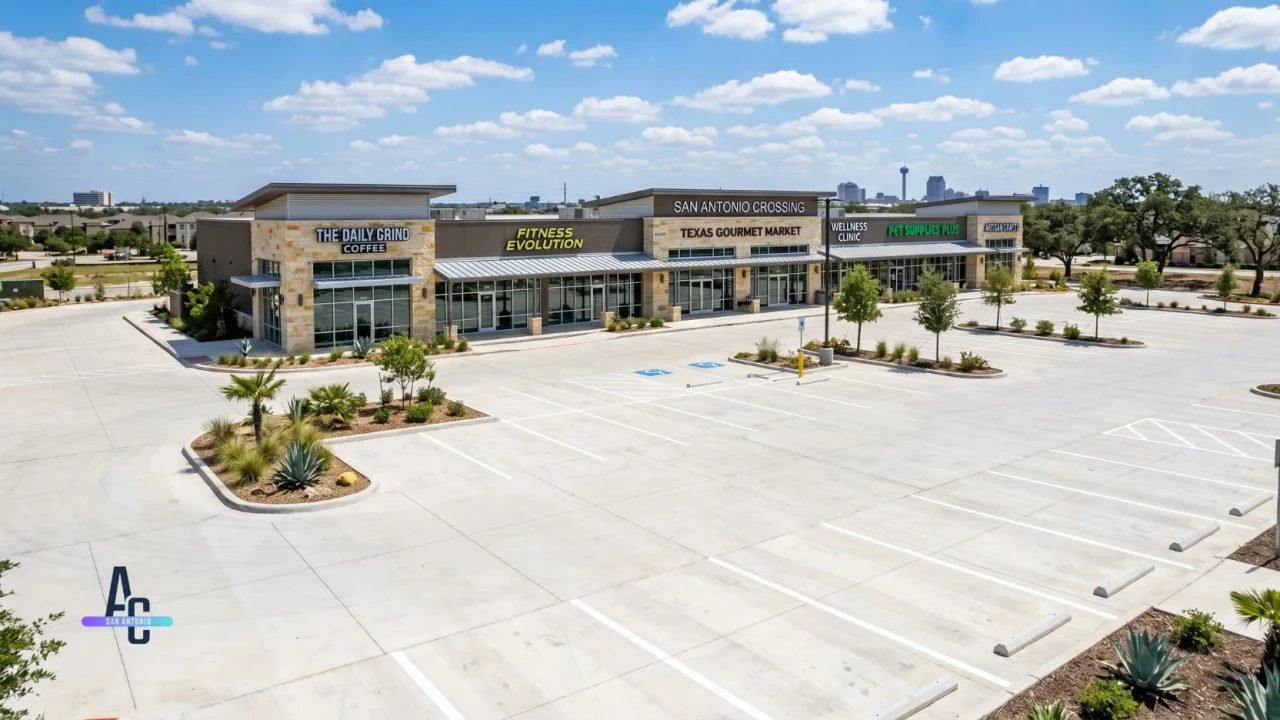
A commercial concrete parking lot in San Antonio is one of the highest-volume projects we handle. The pricing range is wide because the variables are wide: lot size, expected traffic type, subgrade condition, drainage requirements, and whether the city requires a permit (it almost always does for new commercial paving).

$5–7/sqft
standard
Standard passenger vehicle parking lot: 6" slab, #4 rebar at 18" centers, compacted crushed limestone base, broom finish, control joints at 15-foot spacing. The baseline spec for most retail and office parking in San Antonio.
$7–10/sqft
heavy-duty
Heavy vehicle parking (delivery trucks, fleet vehicles): 7–8" slab, #5 rebar at 12" centers, deeper base, dowel bars at joints. Required for any surface that will see regular Class 6 or higher truck traffic.
$9–13/sqft
ADA + drainage
ADA-compliant parking with drainage engineering: Adds accessible space layout, compliant slopes (max 2% cross slope), truncated dome detectable warning surfaces, and engineered drainage inlets. Required for any new or substantially renovated commercial parking facility in San Antonio.
$3–5/sqft
resurfacing
Concrete resurfacing (existing slab in fair condition): Grinding high spots, repairing spalls and cracks, applying a bonded overlay or micro-topping. Only viable if the existing slab has no structural failure; a proper assessment is required before quoting.
🏗️ San Antonio code note: Any new commercial paving over a certain size threshold requires a Commercial Site Development permit from the City of San Antonio Development Services Department. Stormwater management plans are typically required for projects over one acre of impervious cover. Your concrete contractor should include permit coordination in their scope. If they don't mention it, ask directly.

The single biggest variable in commercial parking lot pricing is the existing subgrade. Bexar County's expansive clay soils require thorough excavation and a compacted crushed limestone base of at least 6–8 inches. When a low bidder skips this step, the slab will crack and heave within 3 to 5 years, long before the structural life of the concrete itself is exhausted.

Cost tip

How to get parking lot pricing that is actually comparable across bids: Require every bidder to specify in writing: slab thickness in inches, rebar size and spacing, base material and depth, joint spacing, and whether ADA compliance is included. Without that, you are comparing different products at different prices. The $5/sqft bid may be a 4" slab with wire mesh. The $7/sqft bid may be a 6" slab with proper rebar. They are not the same project.

Parking lot scope checklist
  • Slab thickness specified: 6" minimum for passenger vehicles, 8" for trucks and heavy equipment
  • Reinforcement type and spacing in writing: #4 or #5 rebar at specified centers, not wire mesh alone
  • Base preparation depth confirmed: minimum 6" compacted crushed limestone in Bexar County clay soils
  • Control joint spacing noted: every 12–15 feet in both directions for a 6" commercial slab
  • ADA compliance scope included if any accessible parking spaces are part of the project
  • Permit coordination confirmed; commercial paving in San Antonio typically requires city permit
02
Warehouse and industrial concrete floor cost in San Antonio
Interior commercial slabs have different spec requirements: flatness, hardness, and load capacity drive the cost
Warehouse Floors
Commercial Concrete Cost in San Antonio

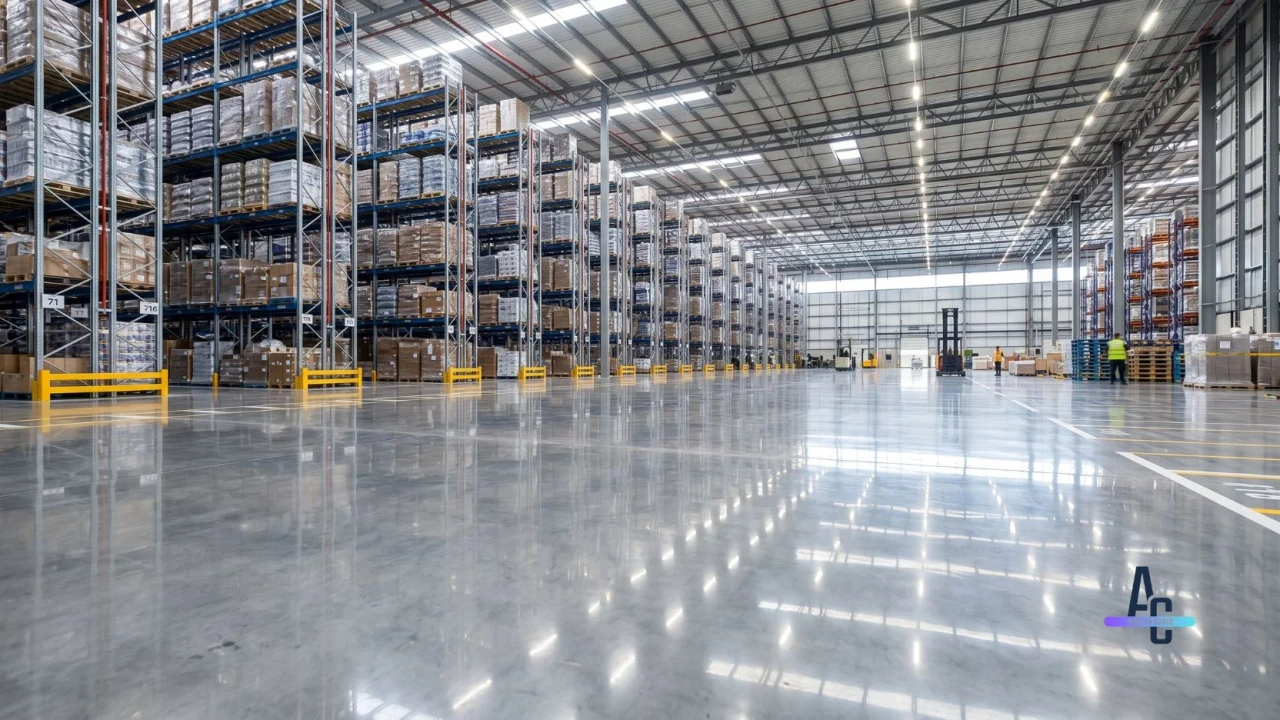
A warehouse or industrial concrete floor is a different product from a parking lot slab. The surface flatness tolerance, the concrete mix design, and the finish requirements are driven by the operations happening on the floor, not just the load it carries. A floor that racks and forklifts will roll across has to meet flatness standards (FF/FL numbers) that a parking lot never needs to worry about.

$8–12/sqft
standard
Standard warehouse floor (light forklift traffic): 6" slab on grade, #4 rebar, vapor barrier, broom or hard-trowel finish. Handles standard pallet jack and light electric forklift operations without additional surface treatment.
$10–15/sqft
heavy forklift
Heavy forklift and rack storage operations: 7–8" slab, fiber reinforcement plus rebar, power-trowel finish, dry-shake surface hardener applied to top 1/4" of slab. Required when propane forklifts over 10,000 lb capacity or high-bay racking will be used.
$14–20/sqft
super-flat
Super-flat floor (VNA very-narrow-aisle operations): Requires laser screed equipment, specialized mix design, and post-pour grinding to achieve FF50+ flatness tolerance. Used in distribution centers where narrow-aisle reach trucks operate from heights of 30+ feet. Very few contractors in San Antonio can execute this properly.
$3–6/sqft
epoxy coat
Epoxy or polyurethane floor coating (existing slab): Surface prep, crack repair, primer coat, and topcoat. Adds chemical resistance, dust control, and slip resistance to an existing concrete floor. Does not address structural deficiencies.

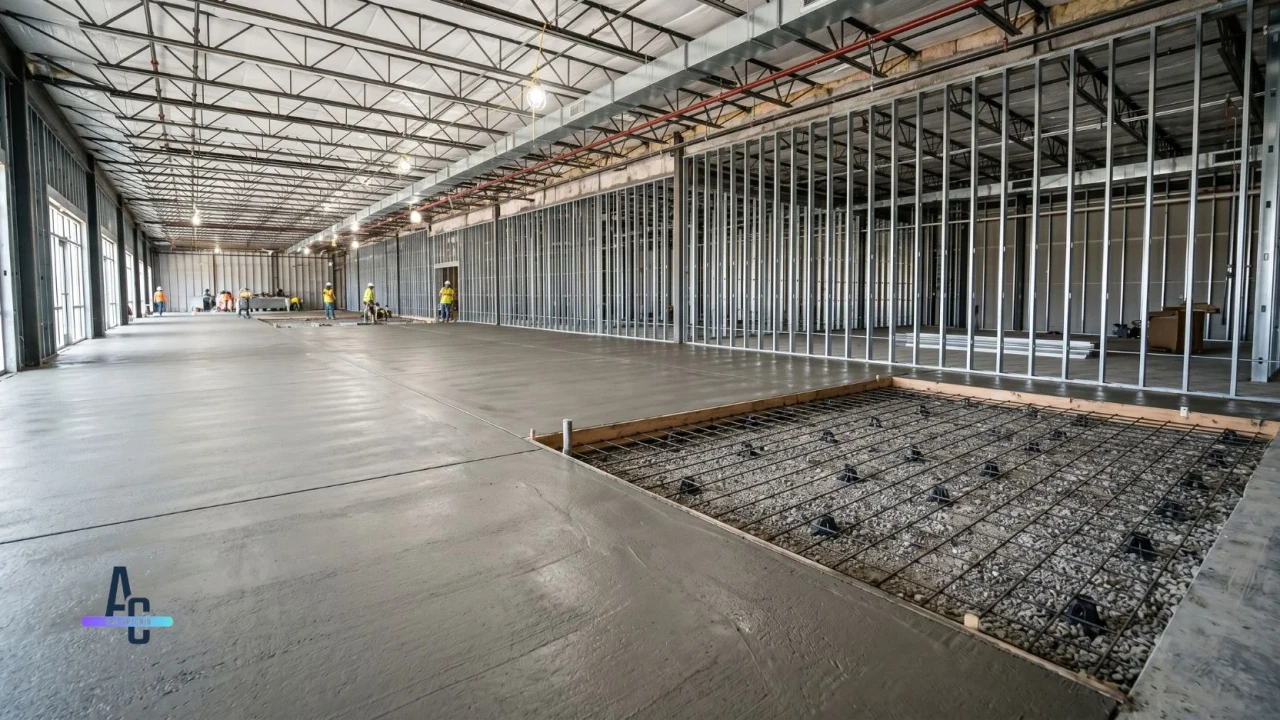
The vapor barrier is not optional for commercial warehouse floors in San Antonio. Even with our relatively dry climate, moisture migrating through the slab will damage floor coatings, rack anchors, and anything stored directly on the concrete. A 10-mil polyethylene vapor retarder under the slab is the minimum; 15-mil reinforced vapor barriers are standard for temperature-controlled storage facilities.

Spec tip

Ask for the design mix before approving a warehouse floor quote: A properly designed warehouse floor slab uses a minimum 4,000 PSI concrete mix, not the standard 3,000 PSI mix used for residential work. The w/c (water-to-cement) ratio should be 0.45 or lower to reduce shrinkage and improve surface hardness. Any contractor who cannot specify the mix design by PSI is not quoting a commercial-grade floor.

Warehouse floor checklist
  • Concrete mix design specified: minimum 4,000 PSI, w/c ratio 0.45 or lower
  • Vapor barrier included: 10-mil minimum polyethylene under slab, 15-mil for temperature-controlled spaces
  • Surface hardener specified if heavy forklift or rack anchor loading is expected
  • Flatness tolerance (FF/FL number) defined in the contract if forklift operations will occur
  • Saw-cut control joints scheduled within 4–8 hours of pour, before slab cracks on its own
  • Cure time before forklift traffic confirmed: minimum 7 days for light traffic, 28 days for full loads
03
Commercial driveway approaches, loading docks, and truck aprons
Where the most abuse happens and where cutting corners on spec costs the most money
Driveways + Docks
Commercial Concrete Cost in San Antonio

Commercial driveways and loading dock aprons are the hardest-working concrete on any commercial property. They carry fully loaded semi-trucks, suffer point loads from trailer landing gear, and absorb hydraulic fluid and diesel spills. No other surface on the property takes more abuse. The spec requirements reflect that, and the cost reflects the spec.

Standard commercial driveway approach: $9–13/sqft (8" slab, #5 rebar at 12" centers) Semi-truck loading dock apron: $12–18/sqft (8–10" slab, post-tensioned or heavy rebar, joint armor) Truck scale approach pad: $15–22/sqft (10" min., engineered design, high-PSI mix required) Concrete curb and gutter (commercial): $20–35/linear foot installed

Loading dock aprons require special attention to joint design. The transition between the apron and the adjacent pavement is where reflective cracking and joint deterioration start. Doweled construction joints with load transfer bars, armored joint edges, and a proper sealant system extend the life of the dock apron by 10–15 years compared to a standard butt joint.

⚠️ The most expensive mistake on loading docks: pouring the apron without designing the slope properly. A dock apron that slopes toward the building channels rainwater and fuel spills directly against the foundation wall. The correct slope is 1–2% away from the building, with a trench drain or grade break at the building face. This is a design decision that has to be made before the forms are set, not corrected after the pour.

Any commercial driveway approach connecting to a public street in San Antonio requires a City of San Antonio Right-of-Way Construction Permit. If the approach connects to a TxDOT-maintained roadway (a state highway or US route), a TxDOT Driveway Permit is required separately. These are not optional, and unpermitted work in the right-of-way can result in mandatory removal at the property owner's expense.

Driveway and dock checklist
  • Slab thickness specified for the actual expected load: 8" minimum for semi-truck traffic
  • Rebar size and spacing confirmed: #5 at 12" centers as a minimum for heavy commercial approaches
  • Slope direction designed and confirmed in writing: 1–2% away from the building
  • Doweled joints with load transfer bars specified at all construction joint locations
  • Right-of-way permit obtained before any work begins at the street connection
  • TxDOT permit confirmed if the approach connects to a state or US highway
04
Retail center, restaurant, and office concrete slabs: interior and exterior
Appearance requirements and ADA compliance add cost that purely industrial projects don't carry
Retail + Office
Commercial Concrete Cost in San Antonio

Concrete work for retail centers, restaurants, and office properties in San Antonio involves a different set of priorities than industrial work. Aesthetic finish matters in customer-facing areas. ADA compliance requirements are stricter because members of the public are using the space. And the timeline pressure is higher: a retail tenant cannot open until the concrete passes inspection.

Application Spec Cost range (San Antonio) Key considerations
Retail storefront sidewalk and apron 4–5" slab, broom finish, ADA-compliant slope $7–11/sqft Must meet City of San Antonio sidewalk standards and ADA cross-slope requirements (max 2%)
Restaurant patio (covered or uncovered) 4" slab, decorative finish, slope for drainage $10–20/sqft Stamped or stained finish common; grease trap access and floor drain locations must be set before pour
Office building exterior walkways 4" slab, broom finish, accessible route $7–12/sqft Accessible route from parking to building entrance must be continuous. ADA requires no change in level greater than 1/4" without a bevel
Retail strip center parking lot 6" slab, rebar, ADA spaces + accessible aisles $6–10/sqft Accessible parking space count is determined by total lot size per ADA standards; Van-accessible spaces require 8-foot access aisle minimum
Drive-through lane (restaurant / bank) 6–7" slab, #4 rebar, sealed joints $9–14/sqft Constant turning radius creates stress concentrations at edges; expansion joints and edge restraint are critical
Concrete retaining wall (commercial) Engineered design required by city $40–80/sqft of wall face Any retaining wall over 4 feet in San Antonio requires a stamped engineering drawing and Building Permit
Timeline tip

Build concrete cure time into your tenant opening schedule: The most common construction delay for retail and restaurant openings in San Antonio is concrete that is not fully cured before floor coverings, equipment, or heavy fixtures are installed. A concrete slab needs 28 days to reach full structural strength. You can walk on it in 48 hours and do light work in 7 days, but setting commercial kitchen equipment or rolling shelving into place at day 10 on a new slab risks surface damage and long-term strength issues. Build 28 days of cure time into your project timeline before the trades go back in.

05
The variables that move commercial concrete pricing in San Antonio
Understanding these nine factors lets you evaluate any bid with confidence
Pricing Variables
Commercial Concrete Cost in San Antonio

Commercial concrete quotes in San Antonio can vary by 30–50% for what appears to be the same project. That range is not arbitrary. It reflects real differences in what the contractor is including and what they are leaving out.

Variable Impact on price What to know
Project size (square footage) Larger = lower per sqft cost Concrete is a volume business. A 50,000 sqft parking lot costs significantly less per square foot than a 5,000 sqft lot; mobilization costs and concrete delivery efficiency scale with size
Existing site conditions Demolition, excavation, and haul-off add $1–3/sqft Removing existing asphalt or deteriorated concrete adds cost. Rocky subgrade or poor compaction may require deeper excavation than originally estimated
Subgrade quality Can add $1–4/sqft if lime stabilization is needed San Antonio's high-plasticity clay soils sometimes require lime treatment before a commercial base can be placed. This is identified in the geotechnical report. Do not skip the geotech on large commercial pours
Concrete mix design (PSI) 3,000 PSI vs. 4,500 PSI adds $0.50–1.50/sqft Commercial projects should specify minimum 4,000 PSI. Higher-strength mixes cost more at the batch plant but reduce long-term maintenance costs significantly
Reinforcement type Fiber-reinforced adds $0.30–0.60/sqft; heavy rebar grids add $1–2/sqft Wire mesh is the cheapest reinforcement option and the least effective in high-load commercial applications. Specify rebar size and spacing explicitly in your contract
Season and weather Summer pours may add scheduling premium Concrete work in San Antonio's peak summer heat requires early morning starts, curing compounds, and more labor oversight. Experienced contractors price this in; inexperienced ones skip the precautions and charge the same rate
Permitting complexity Permit fees range from $500 to $5,000+ depending on project scope Commercial projects in San Antonio almost always require permits. Permit fees, plan review time, and inspection scheduling should be factored into project timelines and cost
Access and site constraints Tight access for concrete trucks adds $0.50–2/sqft Concrete trucks need reasonable access to pour efficiently. Sites that require concrete pumping (because trucks cannot get close enough) will add pump rental and operator costs
Specialty finishes Decorative work adds $3–12/sqft over standard broom Exposed aggregate, staining, or stamped patterns in exterior commercial areas add both material and labor cost but can significantly improve the appearance and property value of retail and hospitality projects
Why you should not skip the geotechnical report on commercial pours over 10,000 sqft

Bexar County soils are not uniform. High-plasticity clay (PI above 30) is common in many parts of San Antonio and can require lime or cement stabilization before a commercial base can be placed. A geotechnical report costs $800–2,500 for a typical commercial site and tells you exactly what the subgrade conditions are. Without it, your contractor is guessing, and if the subgrade fails after the pour, no contractor warranty covers it. The geotech report is the cheapest insurance you can buy on a commercial concrete project.

06
How to evaluate and hire a commercial concrete contractor in San Antonio
Commercial work requires commercial-grade vetting; residential concrete contractors are not the same thing
Contractor Vetting
Commercial Concrete Cost in San Antonio

Not every concrete contractor in San Antonio is equipped for commercial work. Commercial projects require different insurance levels, permit experience, equipment capacity, and familiarity with city and county code requirements. Hiring a residential driveway crew for a commercial parking lot or warehouse floor is one of the most common and expensive mistakes property owners and developers make.

What to verify What a qualified commercial contractor provides Red flag
General liability insurance $2M+ general liability; commercial projects require higher coverage than residential Certificate of insurance below $1M, or no documentation provided
Workers' compensation Active workers' comp policy covering all crew members "We use subcontractors" as a reason not to carry workers' comp. This puts you at risk
Permit experience Has pulled commercial concrete permits in Bexar County recently and can name the permit types required for your project Does not mention permits or asks you to handle permitting yourself
Written quote detail Itemizes slab thickness, mix design PSI, rebar spec, base depth, joint spacing, finish type, and cleanup separately Quote is one line: "concrete parking lot, 10,000 sqft, $X"
Mix design specification States the concrete PSI, aggregate size, and w/c ratio, or refers to a specific ACI mix design Cannot specify PSI or says "we use standard concrete"
Commercial portfolio Photos and addresses of comparable completed projects in San Antonio Only residential projects in their portfolio, or stock photos with no verifiable local work
Payment terms Deposit (25–40%) to mobilize, progress billing on large projects, final payment after punch list approval Full payment required before work begins, or no written payment schedule
⚠️ Bonding matters on commercial work: For any commercial project over $50,000, ask whether the contractor carries a performance bond or payment bond. A performance bond guarantees completion of the work to spec. A payment bond protects you from mechanic's liens if the contractor fails to pay subcontractors or material suppliers. Not all concrete contractors carry bonds, but qualified commercial contractors can obtain them, and the fact that a contractor cannot get bonded tells you something important about their financial standing.
Contractor vetting checklist
  • Certificate of insurance received: $2M+ general liability and active workers' compensation
  • Permit experience confirmed: contractor can identify the permits required for your specific project type
  • Quote is itemized by spec, not just by total price; thickness, mix design, rebar, base, joints, finish all listed
  • Commercial portfolio verified: actual San Antonio projects at verifiable addresses
  • References from comparable commercial projects available on request
  • Payment terms in writing with a schedule tied to milestones, not just one upfront lump sum
● ● ●
Complete pricing reference for San Antonio commercial concrete
Commercial concrete cost summary by project type

Use this table as your starting-point budget reference. All prices reflect properly spec'd commercial work in San Antonio including base preparation, reinforcement, permitting allowance, and standard finish. Prices are per square foot unless noted.

Project type Slab thickness Reinforcement Cost range (San Antonio 2026)
Standard commercial parking lot (passenger vehicles) 6" #4 rebar at 18" centers $5–7/sqft
Heavy vehicle parking lot (trucks, fleet) 7–8" #5 rebar at 12" centers $7–10/sqft
ADA-compliant parking (new construction) 6" #4 rebar + accessible spec $9–13/sqft
Standard warehouse / distribution floor 6" #4 rebar + vapor barrier $8–12/sqft
Heavy-forklift warehouse floor 7–8" Rebar + fiber + surface hardener $10–15/sqft
Super-flat floor (VNA operations) 8" Engineered design, laser screed $14–20/sqft
Commercial driveway approach 8" #5 rebar at 12" centers $9–13/sqft
Loading dock apron (semi-truck) 8–10" Heavy rebar + joint armor $12–18/sqft
Retail storefront sidewalk 4–5" #3 rebar or wire mesh $7–11/sqft
Restaurant or office patio (decorative) 4" #3 rebar, stamped or stained $10–20/sqft
Drive-through lane 6–7" #4 rebar, edge restraint $9–14/sqft
Concrete curb and gutter N/A Per city standard detail $20–35/linear foot
Concrete retaining wall (commercial) Engineered Engineered (permit required) $40–80/sqft of wall face
Existing slab resurfacing N/A (overlay) Varies by condition $3–6/sqft
Epoxy floor coating (existing slab) N/A (coating) N/A $3–6/sqft
● ● ●
Commercial concrete project checklist for San Antonio
Complete this before signing a contract or approving any scope of work
Spec and engineering
  • Slab thickness confirmed for the specific use: 6" minimum for passenger vehicles, 8" for trucks, 10" for heavy dock loads
  • Concrete mix design specified by PSI: minimum 4,000 PSI for all commercial work
  • Reinforcement fully specified: rebar size, spacing, and placement depth, not just "rebar included"
  • Base preparation type and depth included: minimum 6" compacted crushed limestone in Bexar County
  • Control joint spacing and type (saw-cut vs. tooled) confirmed for slab dimensions
  • Vapor barrier specified for interior slabs: 10-mil minimum, 15-mil for temperature-controlled spaces
Permitting and compliance
  • City of San Antonio Commercial Site Development permit confirmed for new paving projects
  • Right-of-Way Construction Permit obtained for any approach connecting to a public street
  • TxDOT Driveway Permit confirmed if the approach connects to a state or US highway
  • ADA compliance scope included for all public-facing surfaces: slopes, accessible spaces, detectable warnings
  • Retaining wall engineering stamp confirmed if any wall exceeds 4 feet in height
  • Stormwater management plan confirmed if project exceeds one acre of impervious cover
Contractor verification
  • Certificate of insurance received: $2M+ general liability, active workers' compensation
  • Performance bond or payment bond requested for projects over $50,000
  • Commercial concrete portfolio verified with local San Antonio project references
  • Payment schedule in writing: milestone-based, not 100% upfront
  • Permit coordination responsibility assigned in the contract: contractor or owner?
Post-pour and project closeout
  • Curing method confirmed: wet cure or liquid curing compound for minimum 7 days
  • Traffic restriction schedule agreed: 48 hours foot traffic, 7 days light vehicle, 28 days heavy vehicle or forklift
  • City inspection scheduled before any paving is covered or construction continues
  • First sealing of exterior commercial surfaces scheduled at 28–30 days after pour
  • Joint sealant installation scheduled after initial saw-cutting and before the lot opens to traffic
● ● ●
Common questions from San Antonio commercial property owners
FAQs
Q
How much does a commercial parking lot cost in San Antonio?
A properly spec'd commercial concrete parking lot in San Antonio runs $5 to $7 per square foot for standard passenger vehicle use, which covers a 6" slab with rebar reinforcement, 6" compacted crushed limestone base, broom finish, and control joints at code-required spacing. For a 20,000 sqft lot, you are looking at $100,000 to $140,000 fully installed. Heavy vehicle or fleet use pushes the price to $7 to $10 per sqft due to the thicker slab and heavier rebar requirements. ADA compliance with engineered drainage can push a full project to $9 to $13 per sqft depending on the accessible space count and site grading. Always get three itemized quotes; total price alone does not tell you what spec you are buying.
Q
Is concrete or asphalt better for a commercial parking lot in San Antonio?
For San Antonio specifically, concrete outperforms asphalt in most commercial applications over a 20-year horizon. Here is why: asphalt softens in extreme heat, which is a real issue during San Antonio summers when surface temperatures can exceed 160 degrees Fahrenheit. That softening causes rutting under heavy vehicle loads. Concrete does not rut and does not require the sealcoating and overlay cycles that keep asphalt functional. The upfront cost of concrete is higher, typically $5 to $9 per sqft for concrete versus $3 to $5 per sqft for asphalt, but the 20-year maintenance cost of asphalt (sealcoat every 2–3 years, patching, eventual overlay) often exceeds the concrete price difference. For any commercial property expected to be held long-term, concrete is usually the better financial decision in this market.
Q
Do I need a permit for commercial concrete work in San Antonio?
Almost certainly yes. New commercial paving, parking lot construction, loading dock work, and any approach connecting to a public street all require permits from the City of San Antonio Development Services Department. The specific permits depend on the project scope: a Commercial Site Development permit for new paving, a Right-of-Way Construction Permit for street connections, and a separate TxDOT Driveway Permit if the work connects to a state or US highway. Retaining walls over 4 feet require a Building Permit with a stamped engineering drawing. Permitting timelines in San Antonio range from 2 weeks for simple projects to 8 weeks or more for complex commercial sites. Build that time into your project schedule, and confirm with your contractor who is responsible for pulling the permits; it should be in the contract.
Q
How long does commercial concrete take to cure before we can open the parking lot to customers?
Foot traffic is safe at 48 hours. Passenger vehicle traffic is safe at 7 days. Heavy vehicle, semi-truck, or forklift traffic should wait 28 days for full cure. In San Antonio's summer heat, the curing process actually completes faster on the calendar, but the precautions matter more, because inadequate curing in extreme heat weakens the final concrete strength. Your contractor should apply a liquid curing compound or wet-cure the slab for at least 7 days after the pour. If you need to open sooner than 28 days for trucks, ask about accelerated mix designs (Type III cement) that can reach design strength in 7 to 14 days, at a modest premium over standard Type I/II mixes.
Q
Why is my commercial concrete quote so much higher than what I see advertised online?
National average pricing guides and online cost estimators almost always reflect residential-grade concrete at residential-grade spec: 4" slabs with wire mesh and no permitting. Commercial concrete in San Antonio starts at 6" with rebar, requires permits, needs engineered base preparation, and often involves ADA compliance work and drainage engineering. None of that shows up in a "$4/sqft concrete" headline. If a local contractor gives you a quote that is dramatically lower than others, the first question to ask is what spec they are quoting. Request the slab thickness, mix PSI, rebar size and spacing, and base depth in writing. That comparison will tell you quickly whether the low bid is a bargain or a shortcut.
Q
How many ADA accessible parking spaces does my commercial parking lot need in San Antonio?
The number of ADA accessible spaces required is determined by the total lot size under the 2010 ADA Standards for Accessible Design, which is the federal standard enforced in San Antonio. The schedule is: 1 accessible space for lots of 1–25 total spaces; 2 for 26–50; 3 for 51–75; 4 for 76–100; 5 for 101–150; 6 for 151–200; and a sliding scale for larger lots. At least one accessible space per lot must be van-accessible, with an 8-foot-wide access aisle. All accessible spaces must be on the shortest accessible route to the accessible building entrance, with compliant signage and slopes not exceeding 2% in any direction. Your concrete contractor handling the lot should be familiar with these requirements and include compliant layout in the scope. If they are not, find a contractor who is.
More from Affordable Concrete San Antonio
Explore expert commercial concrete resources from Affordable Concrete San Antonio, covering contractor selection, project types, and local requirements. Learn about commercial concrete solutions for retail, office, industrial, and warehouse projects, along with permitting and ADA compliance guidance.

Get a free commercial concrete quote in San Antonio

Tell us about your project: parking lot, warehouse floor, loading dock, or retail slab. We will visit the site, assess the conditions, and give you a fully itemized written quote at no cost.

Brandon Wyatt

Author: Home Improvement & Roofing Specialist

Brandon Wyatt is a home improvement specialist with extensive experience in residential roofing, storm damage restoration, and exterior home maintenance in San Antonio, Texas.